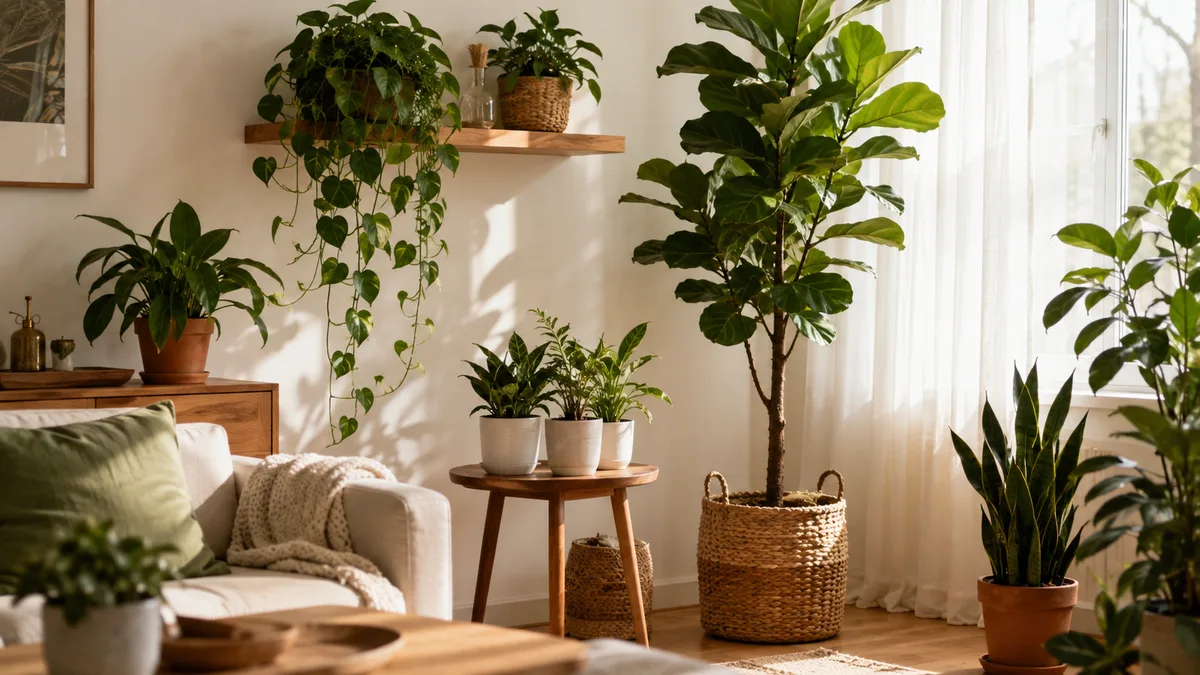
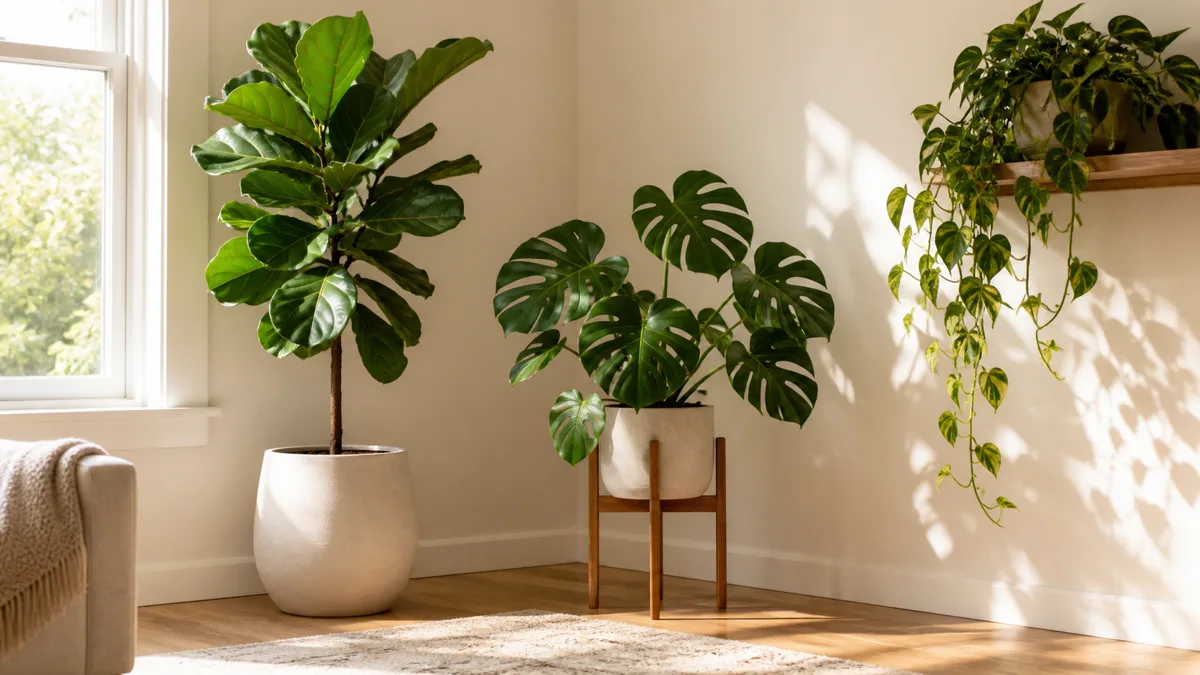
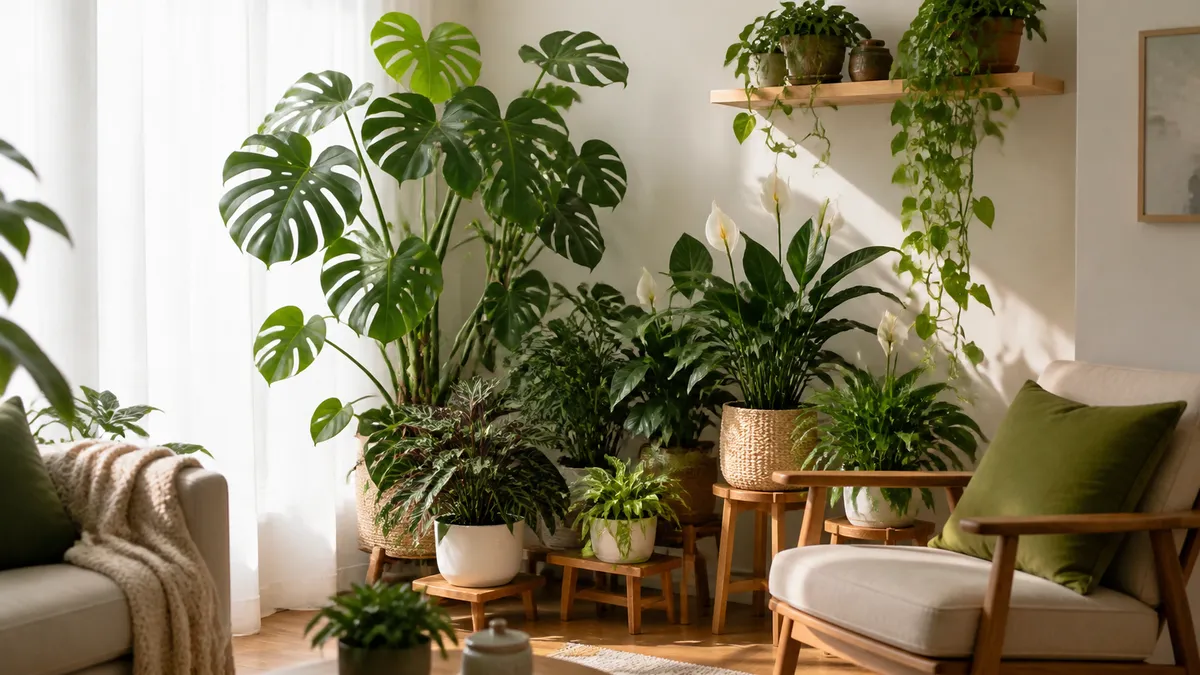
A plant sitting on the floor disappears into the room. Raise it eighteen inches on a stand and it catches light, fills a vertical gap, and becomes the piece people walk toward.
These fifteen stands each match a space and a plant type. Where shelves mount to walls, every stand here is freestanding — movable at will.
Some are mid-century tripods, some are rolling carts you push to the window and back, and one costs fifteen dollars in concrete blocks.
Mid-century tripod stand
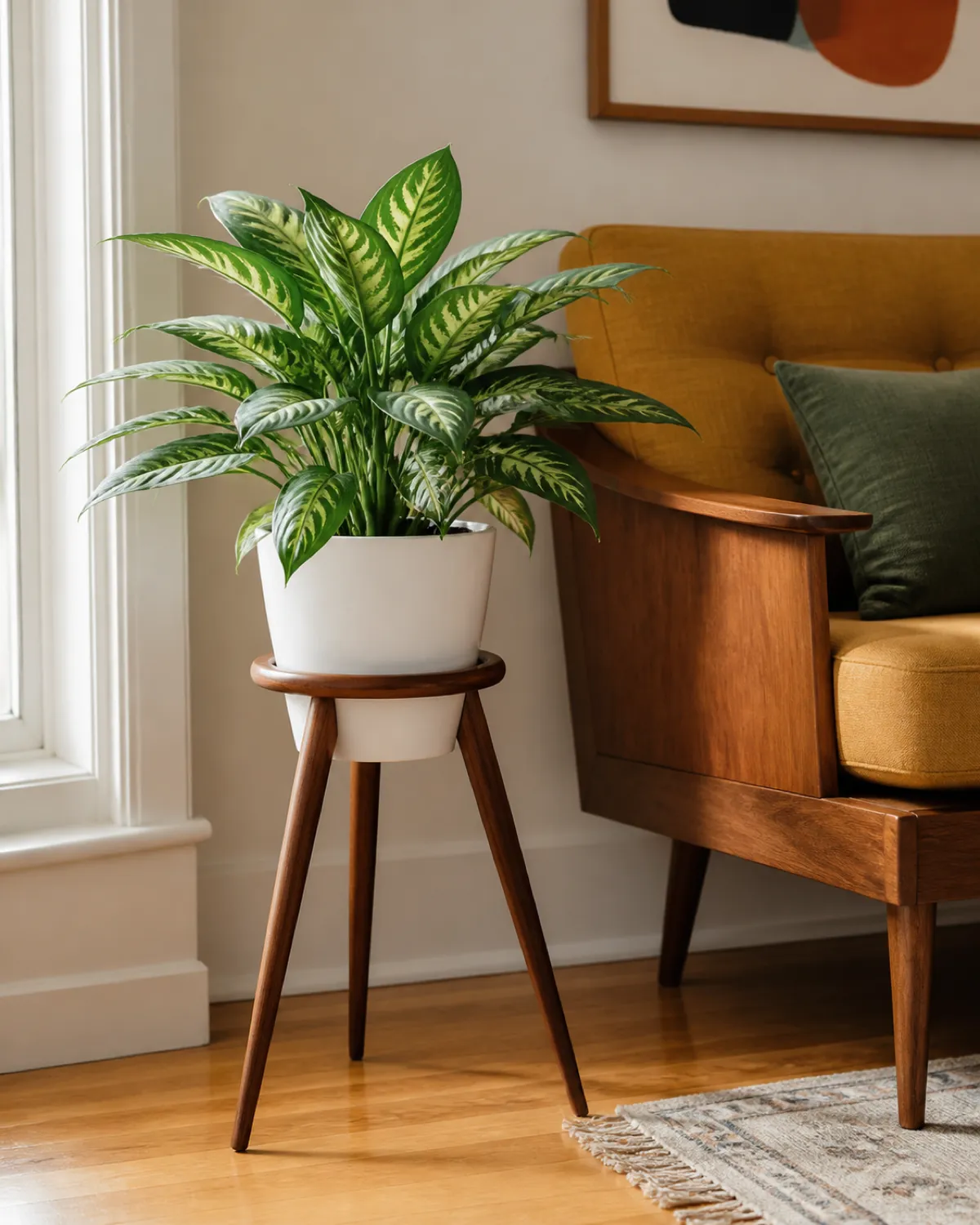
Three tapered legs, a round ring at the top, and one pot. The mid-century tripod stand is the most recognized plant stand silhouette in interior design, and it works because the geometry is inherently stable — three contact points never wobble, even on uneven floors.
The ring limits your pot size, which is actually a design advantage. You cannot overstuff a tripod with a pot three sizes too large. The constraint keeps the proportions clean.
- Best plants: Medium round-canopy species — Chinese evergreen, peperomia, prayer plant — where the round leaf mass echoes the round ring
- Height sweet spot: 18 to 24 inches, which lifts the plant to seated eye level next to a sofa or armchair
- Materials: Walnut and teak for classic warmth, black iron wire for industrial edge, brass or copper for a lighter tone
- Placement: Beside a sofa arm, at the end of a hallway, flanking an entryway — these stands look best standing alone, not pushed against a wall
Tripod stands pair poorly with trailing plants. The vines hang below the ring and hit the floor, tangling in the legs. Save those for elevated shelves or hanging setups.
Tiered corner tower
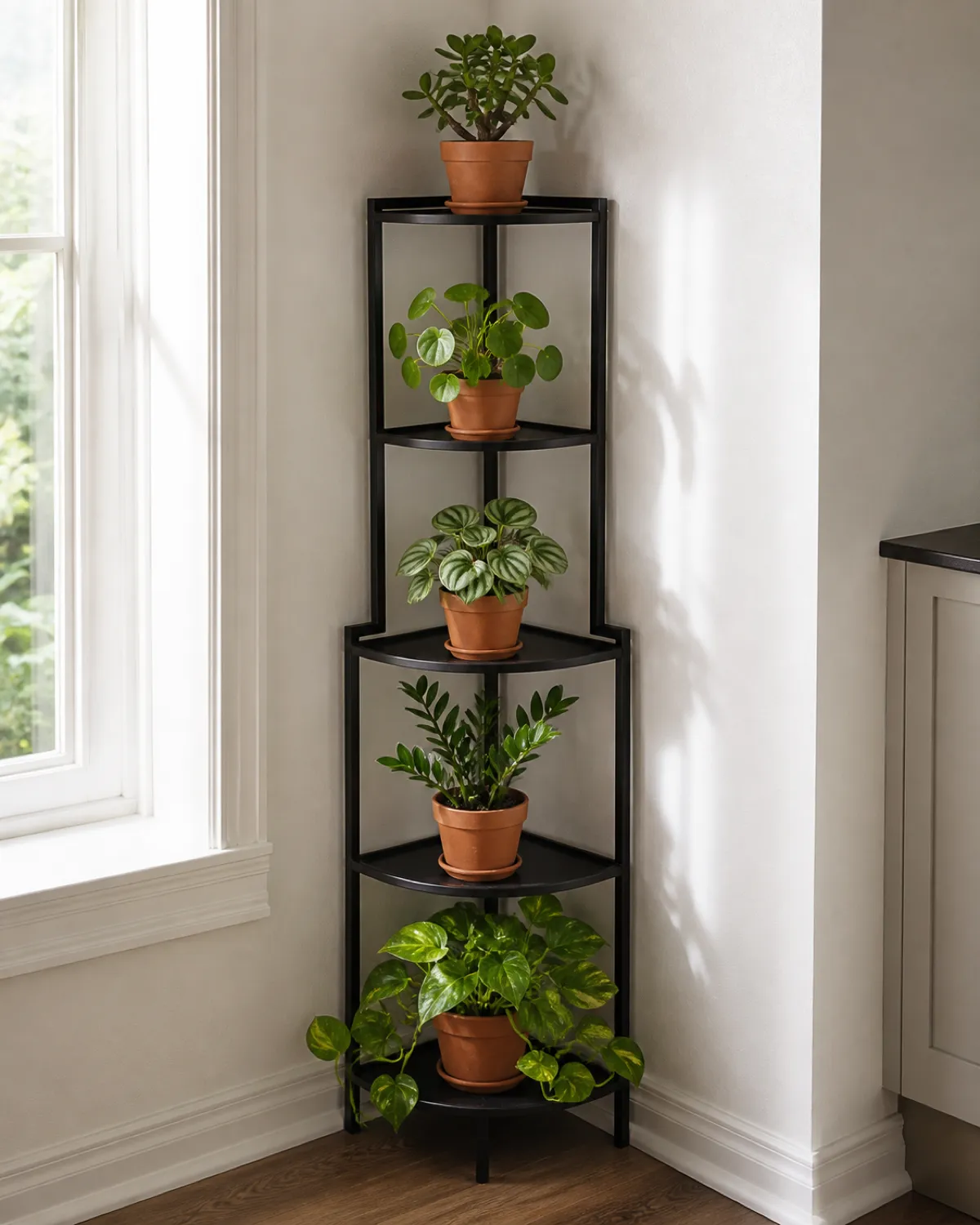
A corner tower stacks three to five shelves vertically in a footprint no wider than 12 inches square. In a small apartment where floor area is currency, this stand type delivers the highest plant-per-square-foot ratio of any option on this list.
The vertical design also creates a natural light gradient. The top tier sits closest to overhead and window light, while the bottom tier lives in the shadow of everything above it. Match your plants to this gradient instead of fighting it.
- Top tier: Sun-tolerant compact species — jade plant, succulents, small cacti
- Middle tiers: Medium-light plants — pilea, peperomia, compact begonia
- Bottom tiers: Low-light tolerant — ZZ plant, pothos, snake plant
Water drips downward. Every tier needs its own saucer or drip tray, because overflow from the top shelf will waterfall through every level below it. Plant corner ideas that use tiered towers without individual drip protection end up with water-stained floors and rotting lower shelves.
Ladder-style leaning stand
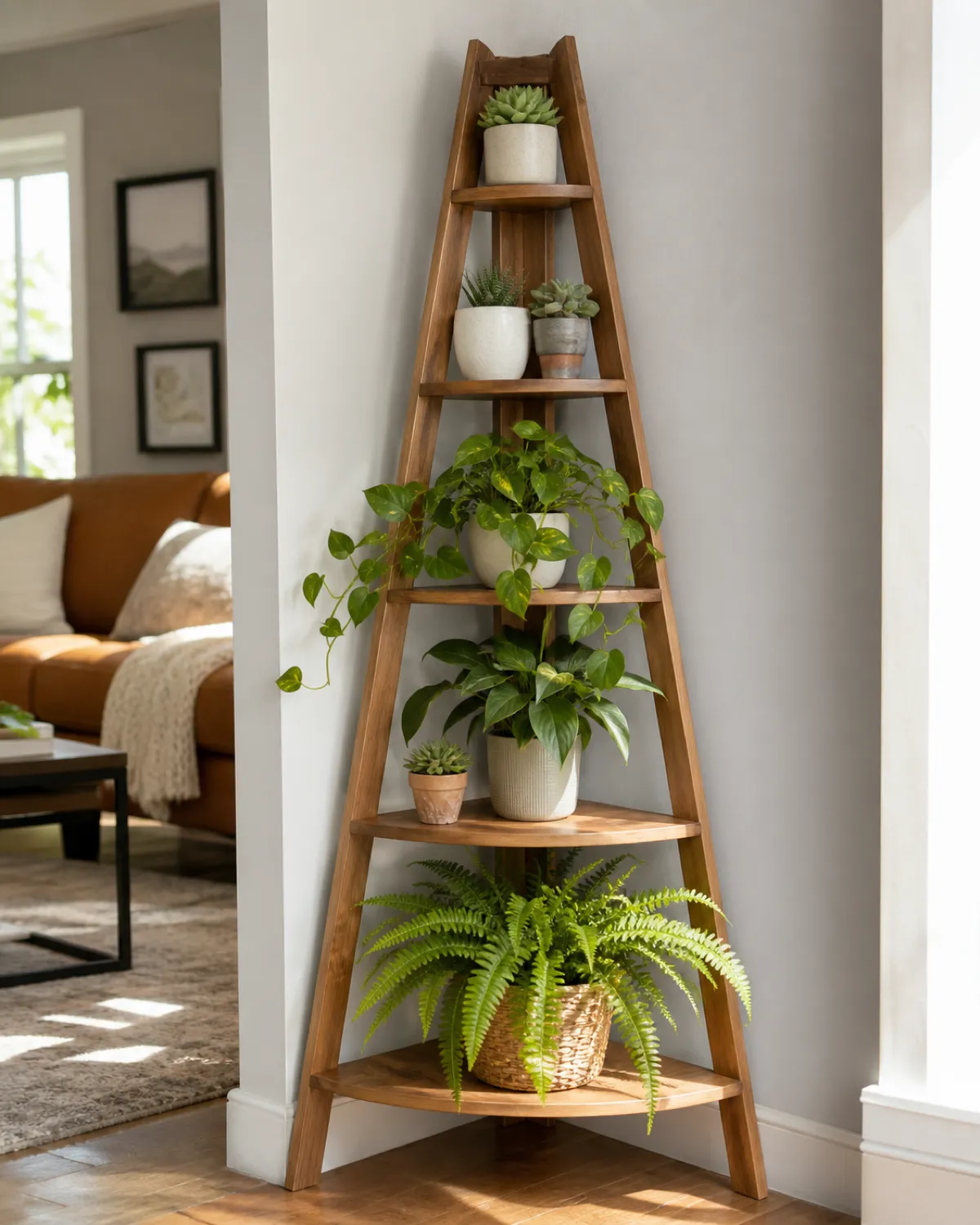
A ladder stand leans against the wall and graduates from narrow at the top to wide at the bottom. This tapering silhouette creates a forced-perspective effect — the narrowing upper shelves make the wall look taller and the room deeper than it actually is.
The proportional logic of the shelves also guides your plant sizing. Small pots belong at the top where the shelf is shallow, and the widest shelf at the bottom can hold a substantial fern or trailing arrangement.
- Top shelf: Compact succulents or a single air plant — anything wider than six inches will overhang
- Middle shelf: A trailing pothos or string of pearls, its vines cascading to the shelf below
- Bottom shelf: A medium Boston fern or calathea in a wider pot
No drilling, no brackets, no wall damage. The ladder stand leans under its own weight, which makes it the best option for renters who cannot put holes in walls. Move it from room to room as your light conditions change across seasons.
Rolling plant cart
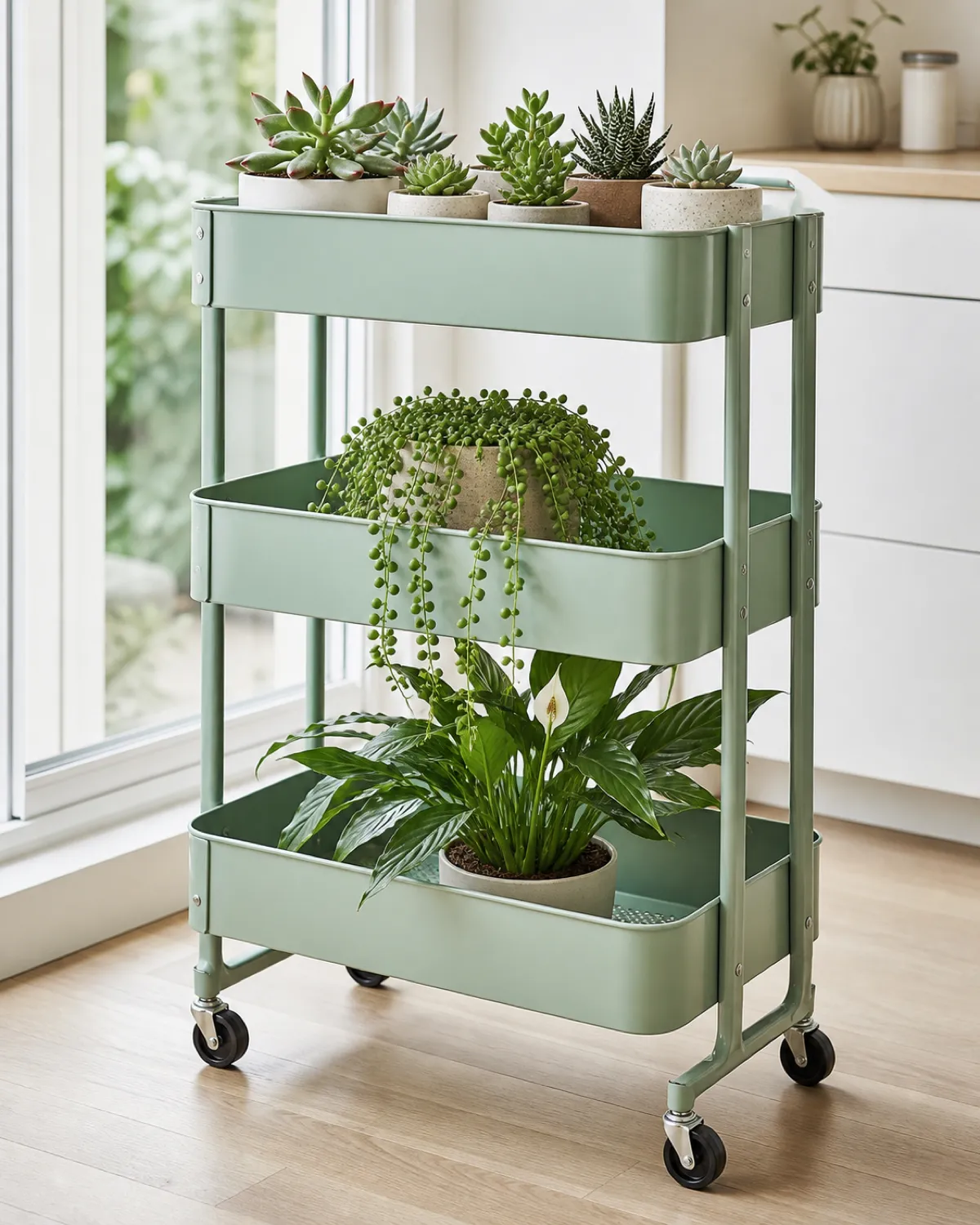
A rolling cart is the only plant stand on this list that moves. Push it to the window for four hours of morning sun, then roll it back to its display position. That mobility is worth more than any fixed stand can offer, because it effectively doubles the light your plants receive without permanently occupying window space.
Group plants with similar light needs on the same cart so they all benefit from the same sun session. A cart holding a mix of succulents and ferns creates an impossible compromise — the succulents want direct sun and the fern wants none.
- Three-tier metal carts in the thirty-dollar range handle the weight of four to six potted plants without flexing
- Best use case: Apartments where the only bright window is also the main traffic path or working surface
- Winter advantage: When the sun angle drops and your usual bright spot dims, roll the cart to wherever the light migrates
Line each tier with a waterproof tray or silicone mat. Carts have mesh or perforated shelves designed for air circulation, not water containment. Without a tray, every watering drips straight through to the floor.
The best plant stand is the one that fits where you actually have room. Start with your square footage, then match the stand to the constraint.
Pedestal column stand
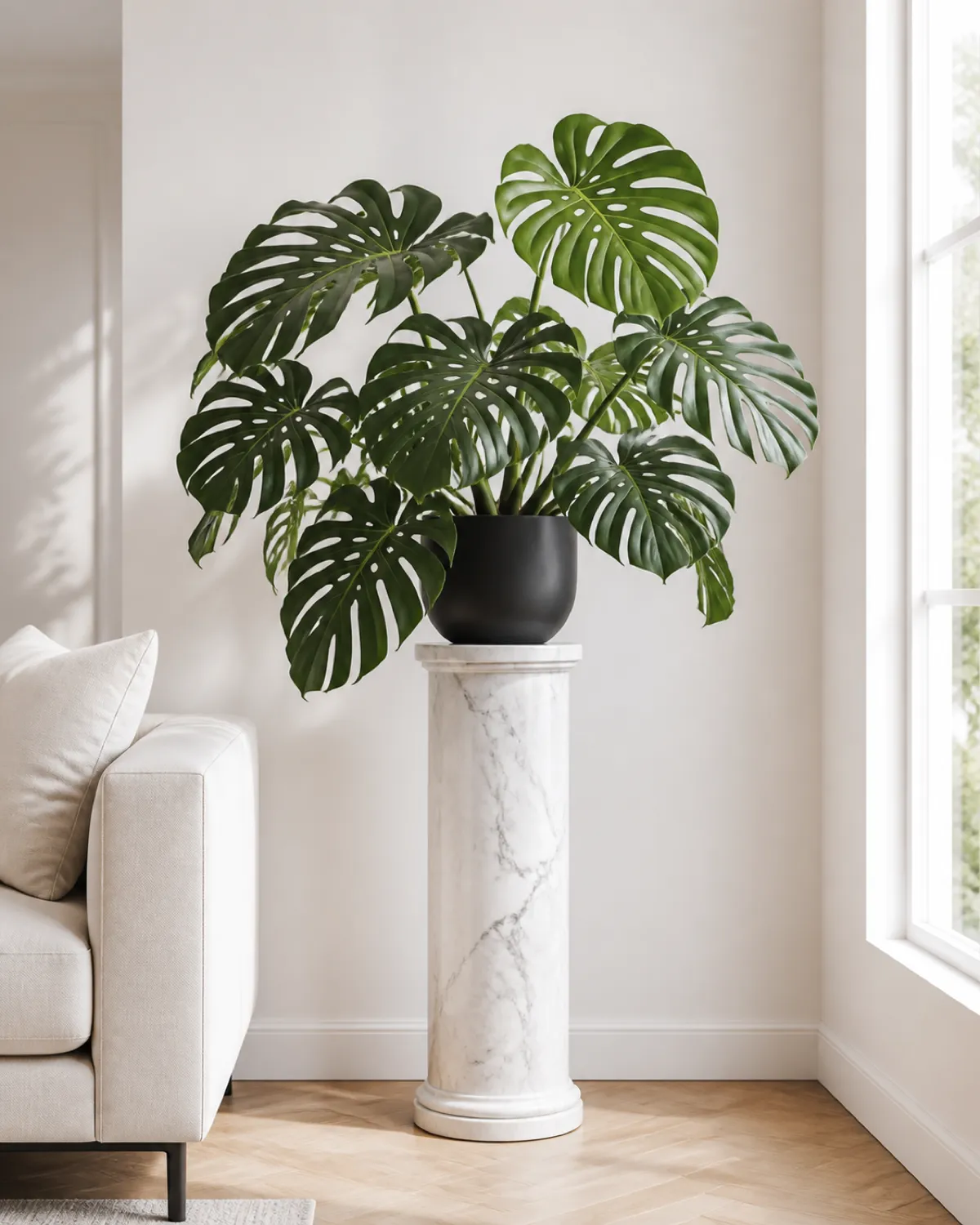
A pedestal turns a houseplant into a sculpture. The single column elevates one plant to two or three feet high, isolating it from everything else in the room and forcing the eye to see it as a deliberate statement rather than just another pot.
The transformation works because of the vertical isolation. A monstera on the floor sits among furniture legs and baseboards. The same monstera on a 30-inch pedestal rises above the visual clutter and commands the room.
- Best plants: Large single-specimen foliage — monstera, fiddle-leaf fig, bird of paradise — where the leaves cascade outward and downward from elevation
- Pot proportion rule: The pot base should not exceed 80 percent of the pedestal top diameter. Overhang beyond that looks precarious and breaks the floating effect
- Materials: Marble, terrazzo, and concrete provide the low center of gravity that prevents tipping. Hollow resin or fiberglass columns save weight but need a wide base
A pedestal is the wrong choice for plant collections. It is a single-specimen stage. Put one plant on it, let the negative space around it breathe, and resist the urge to cluster small pots at the base.
A-frame display stand
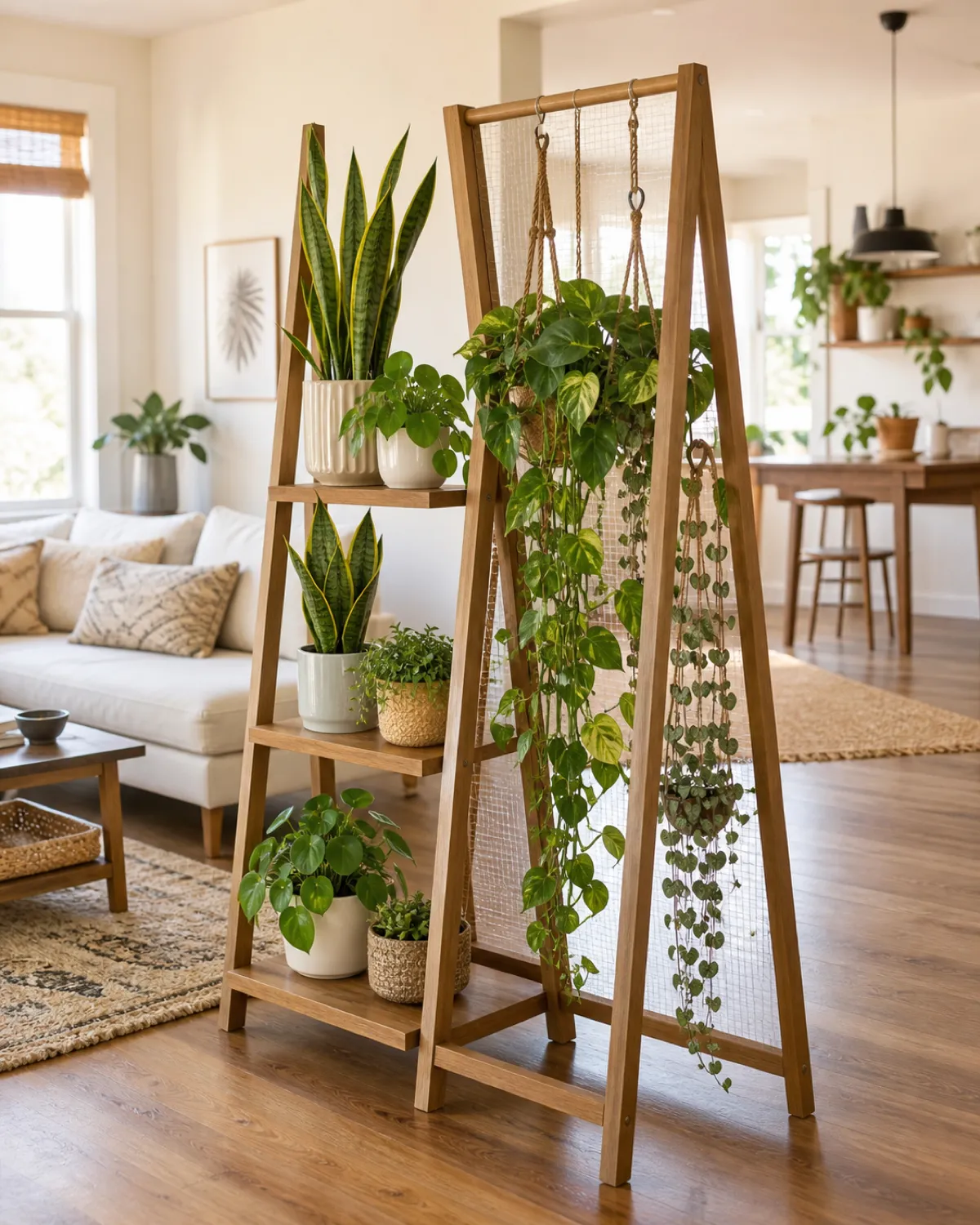
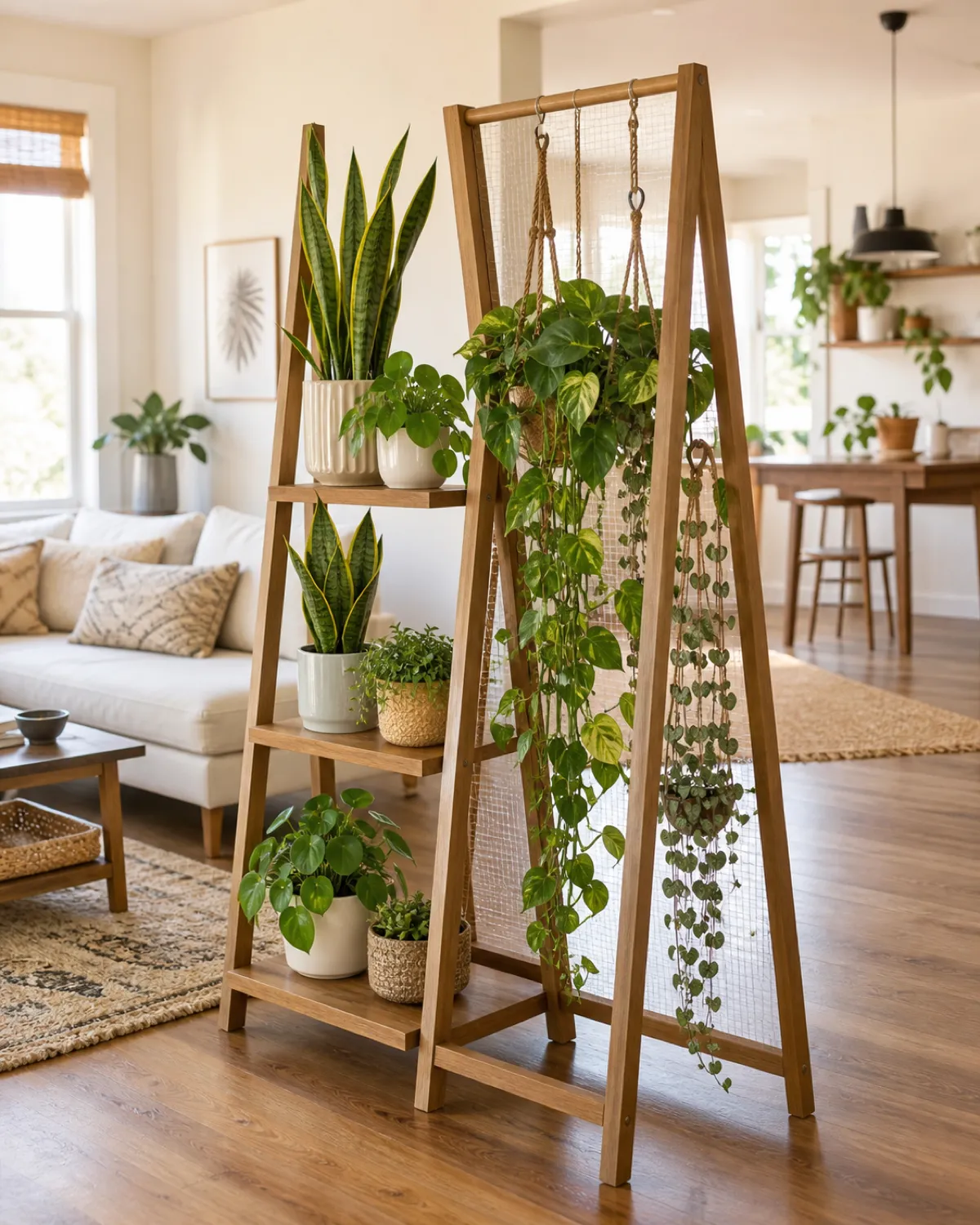
An A-frame stand is a triangle. It is open on both sides, which means plants face outward in two directions — and that makes it a natural room divider in open-plan layouts where you need visual separation without building a wall.
Place it between the living area and dining space, or between a sleeping zone and a working zone in a studio apartment. From either side, the arrangement looks complete. No blank back, no hidden face.
- Hooks side: Trailing pothos, string of hearts, or tradescantia — hang them from the crossbars and let the vines cascade downward
- Shelf side: Upright structural plants — snake plant, pilea, compact rubber plant — on the integrated shelves
- Stability advantage: The A-frame gets wider at the base, which means every plant you add lowers the center of gravity and makes the structure more stable, not less
Use consistent pot materials on both sides. A cohesive set of terracotta or matte white ceramics makes the arrangement read as one designed piece rather than a random collection of plants on a rack.
Window plant stand
Most windowsills are four to six inches deep — too narrow for a standard six-inch pot. A window stand extends that depth to 10 or 14 inches, and it positions plants at the center of the glass pane where light intensity peaks.
The light difference matters more than you might expect. A plant on a shallow windowsill sits below the midpoint of the glass, receiving light only from the upper portion of the window. A plant raised and centered on a window stand catches the full pane, which can mean 30 to 50 percent more photosynthetically active radiation.
- South-facing window: Succulents, small cacti, jade plant — species that tolerate or need direct sun
- East-facing window: Flowering species, herbs, African violets — morning sun without afternoon scorch
- North-facing window: Compact ferns, moss, small peperomia — species adapted to filtered ambient light
Some window stands clamp to the sill or frame without hardware. Others use tension rods between the window casings. Either way, check the weight rating before loading them — a collection of ceramic pots filled with wet soil weighs significantly more than empty pots on a store display.
Industrial pipe stand
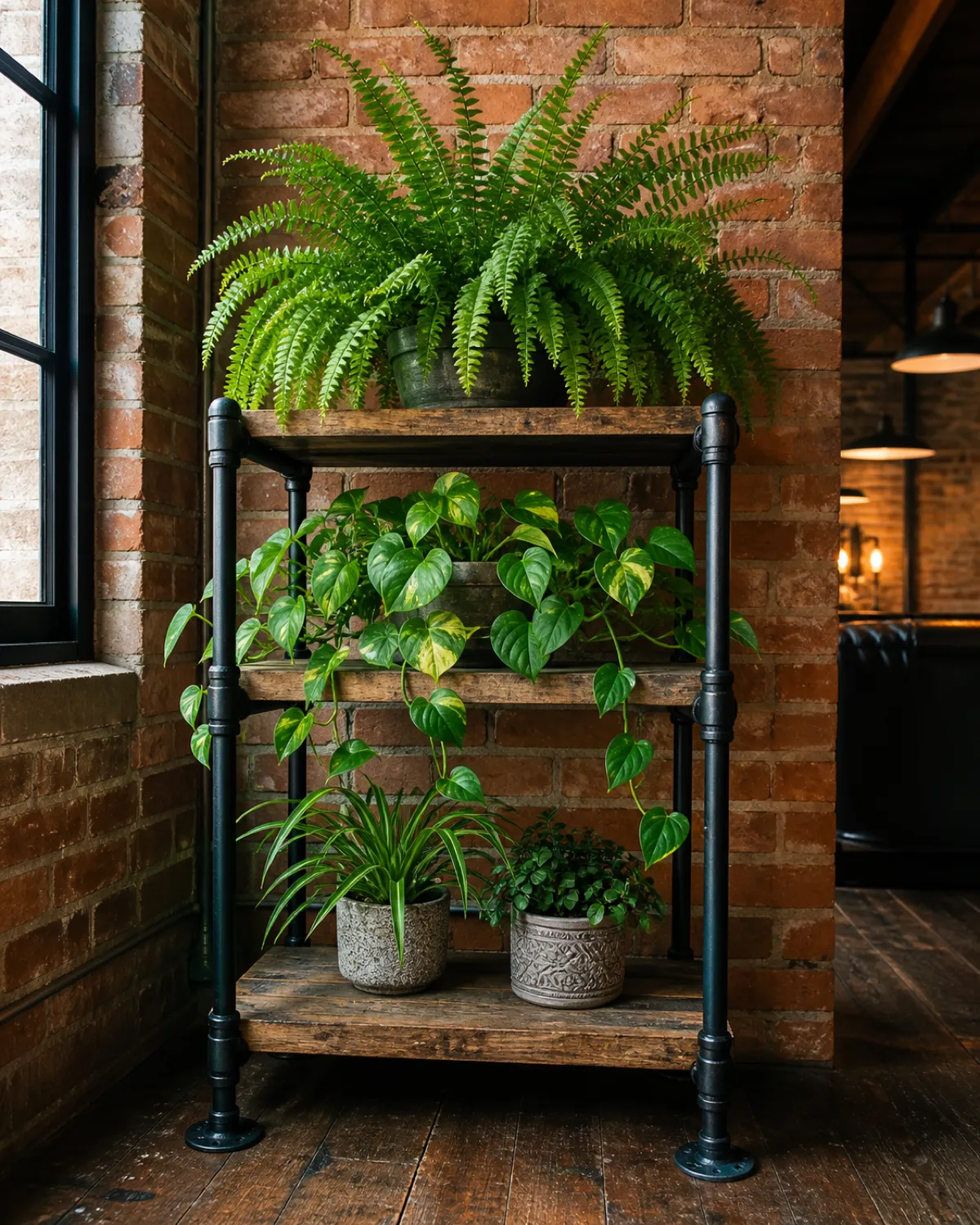
Black iron plumbing pipes are standardized. That means every fitting, flange, and pipe length snaps together in predictable dimensions — and you can build a plant stand that fits any space exactly, down to the inch.
No custom carpentry, no welding, no special tools. A single pipe wrench assembles the entire structure, and every component is available at any hardware store for a few dollars per piece.
- Total customization: Width, height, shelf count, and depth are all configurable by choosing different pipe lengths. A 36-inch-wide, three-shelf stand costs roughly fifty dollars in pipe and flanges plus two reclaimed wood planks
- Best plants: Soft green foliage — Boston fern, pothos, spider plant — creates the strongest visual contrast against the dark iron geometry
- Style fit: Loft apartments, exposed-brick rooms, modern industrial interiors. The black iron reads as intentional design, not plumbing
Floor flanges bolt to the base for freestanding stability, or screw directly into the wall for a bracket-mounted version. The freestanding option requires wider leg spacing for stability but keeps your walls intact.
Every plant stand decision comes back to three variables. Get these right and the stand works. Get any one wrong and it fails — visually, structurally, or horticulturally.
Floor-to-ceiling plant pole
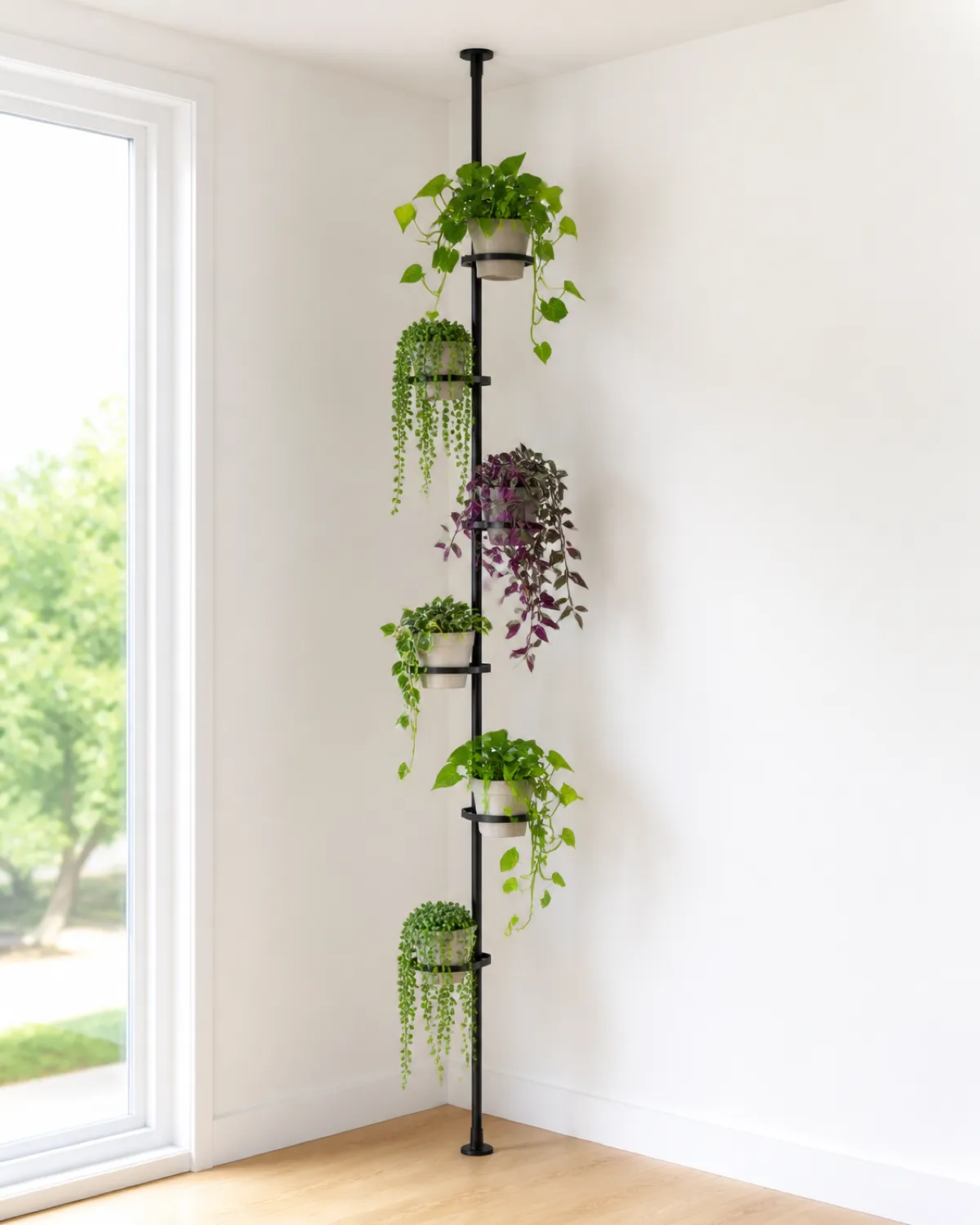
A tension pole takes zero floor space. It presses between the floor and ceiling with a spring mechanism, and every ring or hook along its length becomes a display point for a small trailing plant.
Five to eight plants hang from a single vertical line, creating a green column that reads like a living sculpture from across the room. The effect intensifies as the trailing vines from each level grow toward the plants below, eventually merging into a continuous cascade.
- Best plants: Pothos, string of pearls, tradescantia, string of hearts — anything that trails and tolerates the air circulation of an open room
- Ceiling requirement: The spring must press against a solid ceiling — drywall over joists works; unsupported drywall panels do not. Test by pressing firmly with your palm before installing
- Height limit: Ceilings above nine feet reduce the spring tension too much for reliable hold. Standard eight-foot ceilings are ideal
Watering is the one logistical challenge. The top rings are above head height, so you either take each pot down to water and rehang it, or you use a long-spout watering can from a step stool. A removable-hook system makes the first option practical.
Narrow slim stand for tight spaces
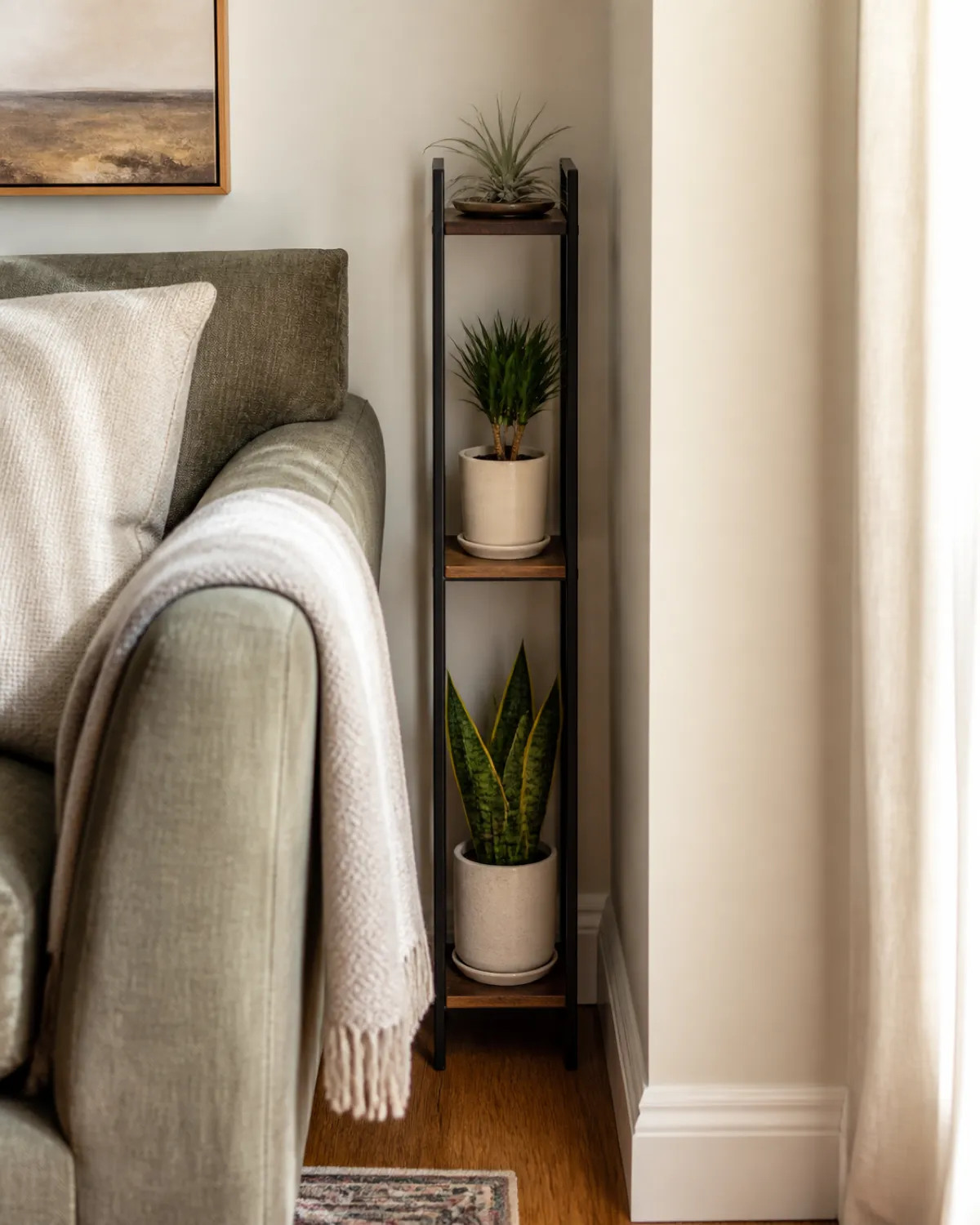
The gap between your sofa and the wall is six inches wide. The space beside the refrigerator is eight inches. The slot next to the front door where a shoe rack does not quite fit is ten inches. Standard furniture ignores all of these dead zones because nothing mass-produced is narrow enough to fill them.
A slim plant stand — six to ten inches wide, 30 to 40 inches tall — slides into these gaps and turns wasted vertical space into a display that draws attention precisely because nobody expects to see a plant there.
- Best plants: Narrow, upright growers — snake plant (Sansevieria cylindrica for the narrowest profile), dracaena, air plants — anything that grows vertically rather than spreading outward
- Avoid: Wide-canopy plants that would overhang the stand and collide with adjacent furniture
- Visual impact: Disproportionate. A plant in a space where nothing should fit registers as a surprise, which makes it more memorable than a larger arrangement in an expected location
Measure the gap before buying the stand, and measure it at the narrowest point — furniture gaps often taper. Leave at least one inch of clearance on each side so the stand does not scrape the sofa fabric or wall paint when you slide it in.
Natural wood stump stand
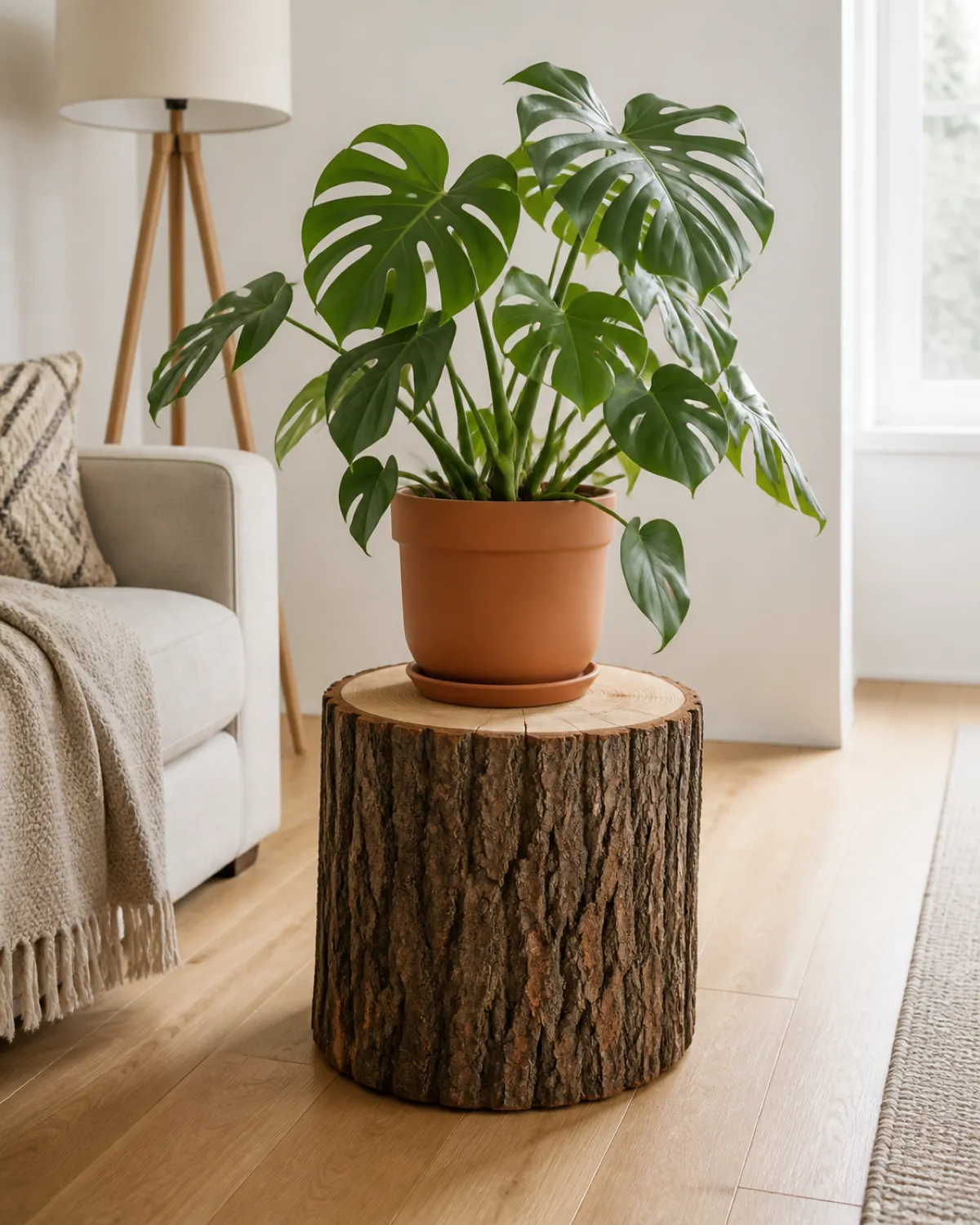
A wood stump is the only plant stand made from the same biological material as the plant sitting on it. That shared origin creates an instant visual coherence that no metal, ceramic, or plastic stand can replicate.
The tree rings on the flat top surface, the bark texture around the sides, and the imperfect organic shape all belong to the same aesthetic language as leaves and stems. The pairing feels inevitable rather than designed.
- Height range: 8 to 16 inches — stumps are not tall stands, and they do not try to be. The point is grounding, not elevation
- Best plants: Organic-silhouette species — monstera, rubber plant, fiddle-leaf fig — in earthy-toned pots (terracotta, raw ceramic, matte stone)
- Sources: Garden centers, firewood suppliers, online reclaimed-wood sellers, or a fallen tree in your own yard cut to length with a handsaw
Seal the flat top with a clear polyurethane coat to prevent moisture damage from pot condensation. Place a felt pad or cork disk underneath to protect hardwood floors from bark debris and sap residue.
Rotating stand
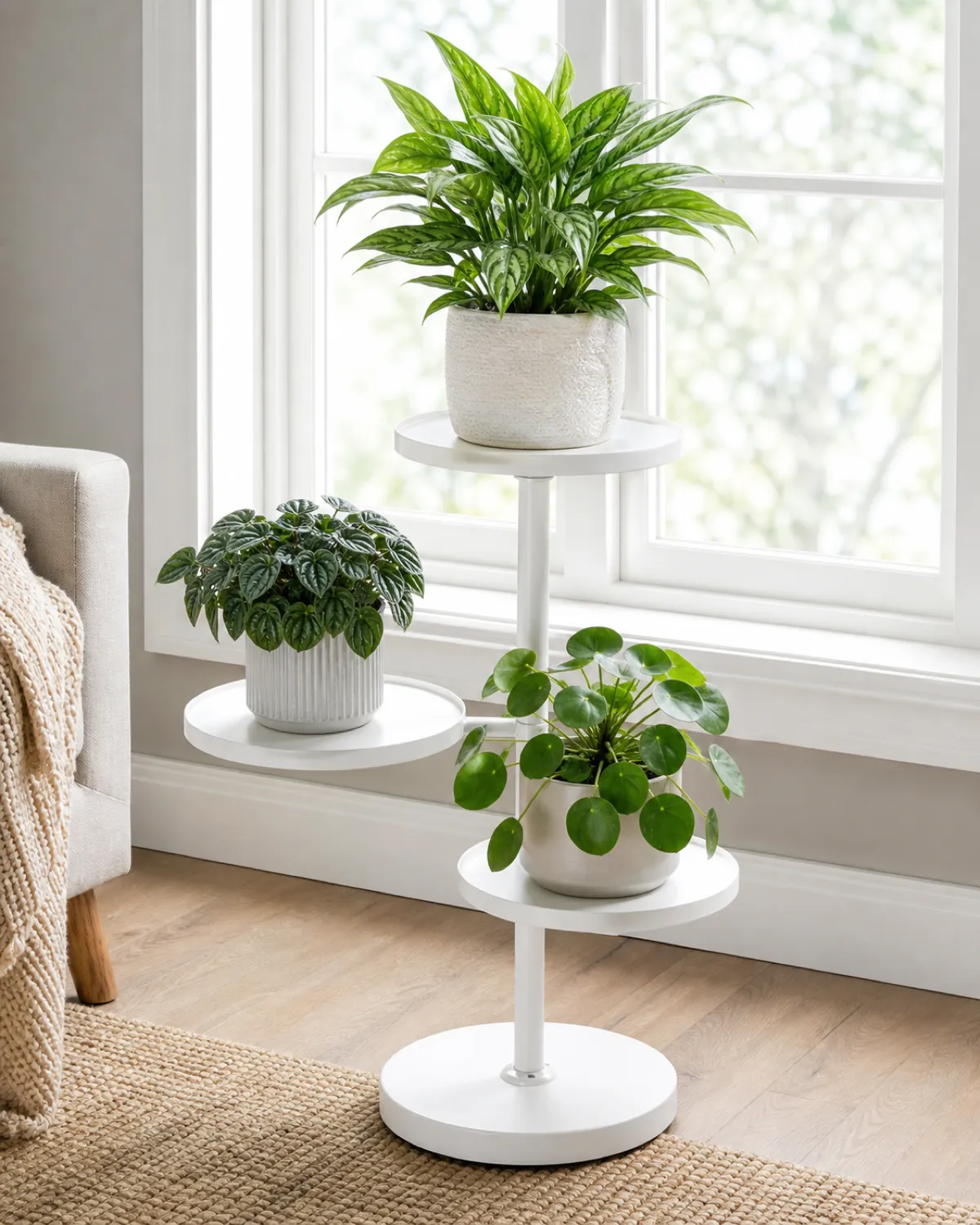
Every care guide for every houseplant says the same thing: rotate your pot a quarter turn every week to prevent lopsided growth toward the light. A rotating stand does this for multiple plants at once with a single push.
The bearing mechanism under each shelf allows independent rotation. Turn the top shelf 90 degrees on Monday, the middle shelf on Wednesday, and the bottom on Friday. Each plant gets even light exposure from all sides without lifting a single pot.
- Best plants: Symmetrical rosette or round-canopy species — Chinese evergreen, peperomia, pilea — where symmetry is the aesthetic goal
- Optimal position: Directly in front of a window, where the light direction is strongest and the benefit of rotation is greatest
- Watering bonus: Rotating the shelf 90 degrees after watering exposes a different face to air flow, which promotes even evaporation and reduces the chance of moisture pooling on one side of the soil surface
Avoid placing heavy, tall indoor plants on rotating tiers. The torque from a top-heavy pot can spin the shelf unexpectedly, and a four-foot bird of paradise that swings around can knock other plants off adjacent tiers.
Save this plant stand guide
- 1Mid-century tripodRound ring, three tapered legs. Best for medium pots at sofa-arm height. Walnut or iron. Avoid trailing plants.
- 2Tiered corner tower3-5 shelves, 12-inch footprint. Grade plants by light need from top to bottom. Individual drip trays per tier.
- 3Ladder leaning standNo drilling, no wall damage. Shelf width increases downward. Small pots top, trailing plants middle, large fern bottom.
- 4Rolling plant cartThe only movable option. Push to window for sun, roll back to display. Line tiers with waterproof trays.
- 5Pedestal columnSingle specimen, sculptural effect. Pot base under 80 percent of pedestal top. Marble or concrete for stability.
- 6A-frame displayDouble-sided, works as room divider. Hooks on one side for trailers, shelves on the other for uprights.
- 7Window standExtends narrow windowsill to 10-14 inches. Centers plants at peak light zone. Match plants to window orientation.
- 8Industrial pipe standFully customizable from hardware-store parts. One pipe wrench, zero carpentry. Soft foliage contrasts black iron.
- 9Floor-to-ceiling poleZero floor space. Tension spring between floor and ceiling. Best for trailing plants. Solid ceiling required.
- 10Narrow slim stand6-10 inches wide, fills dead gaps beside furniture. Upright narrow-profile plants only. Measure gap at narrowest point.
- 11Natural wood stumpOrganic material matches living plants visually. 8-16 inches tall. Seal top surface, felt pad underneath.
- 12Rotating standIndependent-spin tiers replace manual quarter-turn rotation. Best in front of windows. Avoid top-heavy plants.
- 13Macrame and basketSoft-structure alternative to hard stands. Boho aesthetic. Waterproof liner inside every woven basket.
- 14Multi-plant benchOne horizontal line, one surface, 3-5 matched pots. Alternating heights create rhythm. Under-window placement.
- 15DIY concrete blockFifteen-dollar three-tier build. Zero tools, zero skills. Hollow cores hold bonus small pots. Limit to three tiers unfixed.
kultivy.com
Macrame and woven basket stand
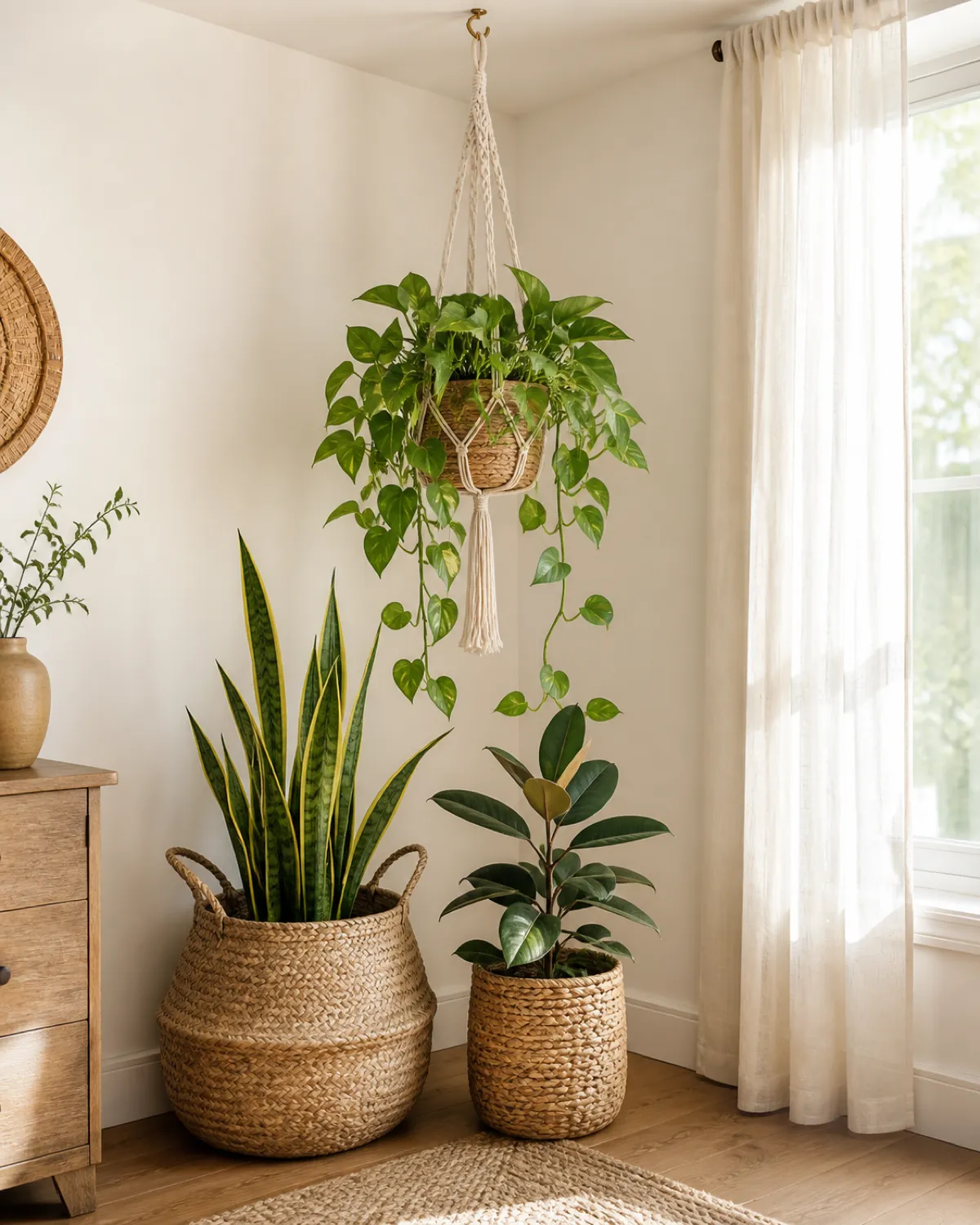
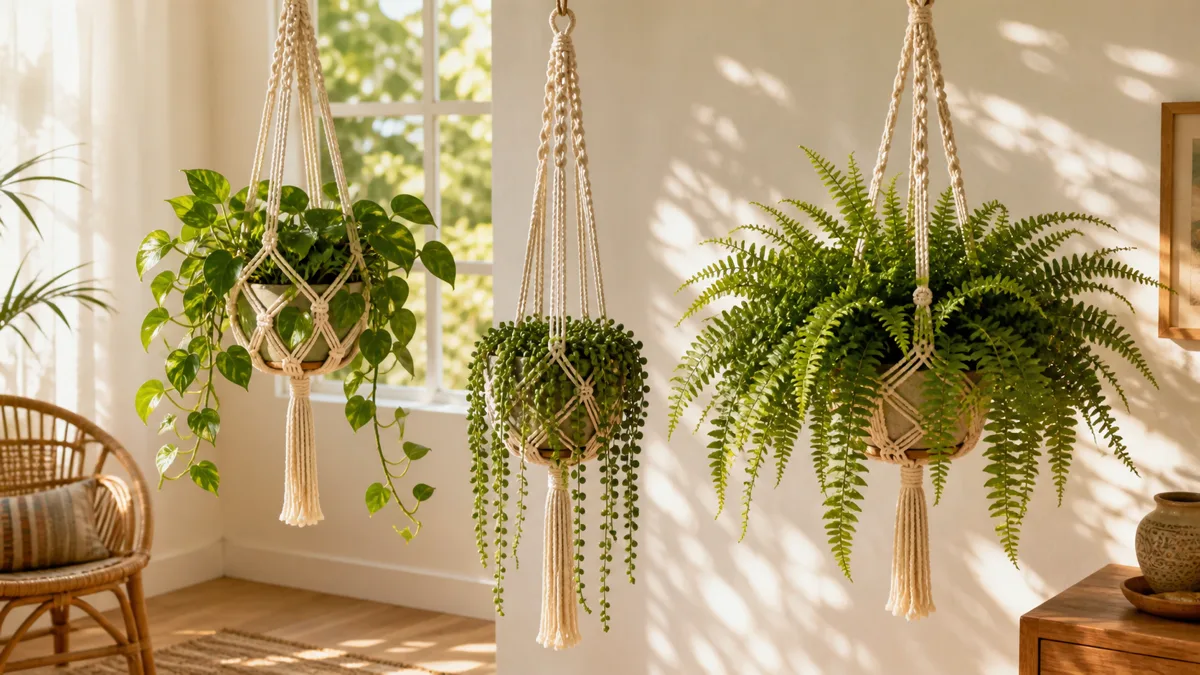
Every other stand on this list is a hard structure — metal, wood, concrete, pipe. Macrame and woven baskets are the soft alternative. They add textile warmth and boho texture to a room without introducing another piece of angular furniture.
The combination works vertically: a macrame hanger suspended from a ceiling hook provides the upper layer, while a woven basket on the floor anchors the bottom. The two together create a complete corner arrangement using materials that feel handmade and warm rather than manufactured.
- Ceiling macrame: Trailing pothos, string of pearls, or tradescantia — plants whose hanging growth fills the empty space between the ceiling and the basket below
- Floor baskets: Snake plant, rubber plant, or monstera — upright structural plants that add height from the ground up
- Related ideas: For more hanging plant setups and knot styles, the dedicated guide covers suspension methods in detail
Line every woven basket with a waterproof tray or plastic liner before placing a potted plant inside. Woven seagrass, jute, and rattan absorb water on contact, and once mold establishes in natural fiber it does not come out. The liner is not optional.
Multi-plant bench stand
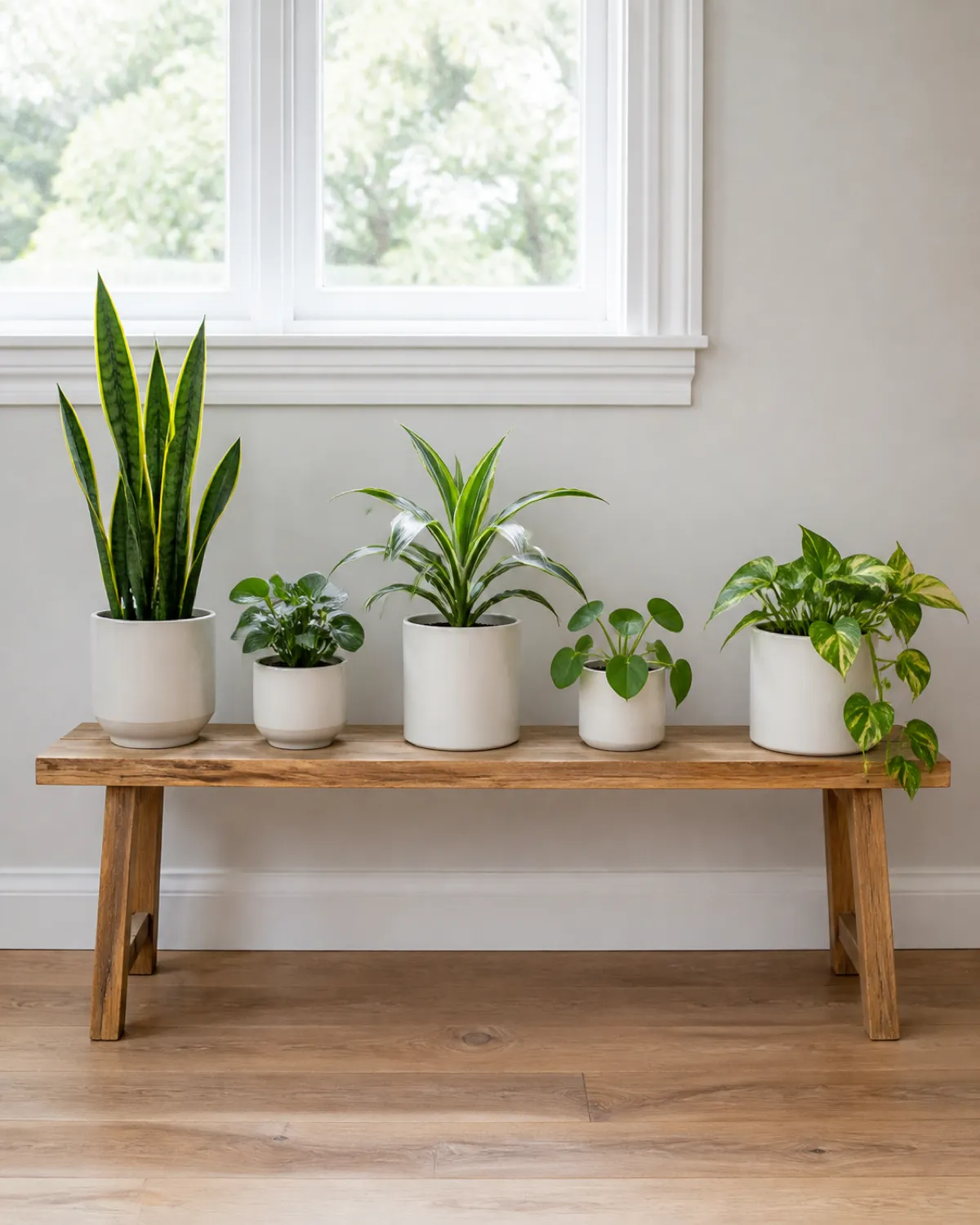
A bench is one line, one surface, and as many pots as the length allows. The simplicity is the point. Where tiered stands and towers add vertical complexity, a bench arranges everything along a single horizontal plane and lets the plants themselves provide the height variation.
The visual trick is rhythm. Alternate tall and short plants along the bench — snake plant, then peperomia, then dracaena, then pilea, then trailing pothos — so the eye bounces along instead of sliding past.
- Ideal length: 36 to 48 inches, holding three to five pots comfortably. Longer benches start to look like retail displays rather than home decor
- Pot coordination: Matching pots in slightly different sizes. Same material, same color, same finish — the consistency makes the arrangement read as one designed piece
- Best placement: Under a window, along a hallway wall, or facing a sofa across the room
A bench at 10 to 16 inches high sits below most furniture surfaces, which creates a visual layer that does not compete with side tables, desks, or shelving above. It fills the gap between the floor and the bottom of your existing furniture where nothing else goes.
DIY concrete block stand
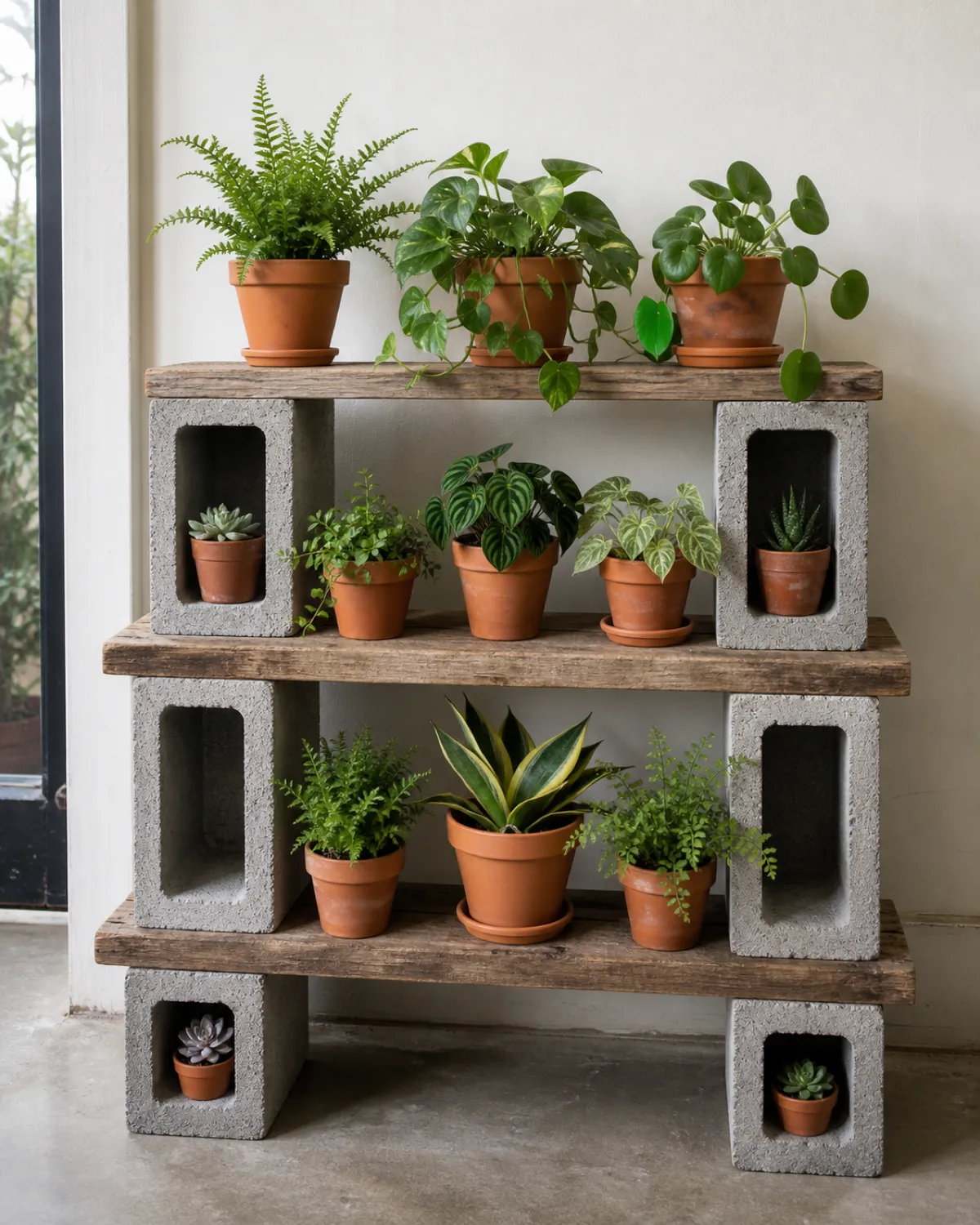
Two concrete blocks and a plank of wood make a shelf. Stack another set and you have two shelves. The total cost for a three-tier plant stand is roughly fifteen dollars, the assembly time is under ten minutes, and the only tool required is your hands.
Standard cinder blocks (CMU) measure 8 by 8 by 16 inches and weigh about 35 pounds each. That mass is an asset for plant stands — a concrete base will not tip, slide, or flex under any weight a houseplant can produce.
- Bonus planting slots: The hollow cores of each block are the perfect size for small four-inch pots. Tuck succulents or air plants into the openings for additional display space at zero extra cost
- Style range: Raw concrete reads as brutalist or minimalist. A coat of spray paint transforms it to match any palette. Whitewashed blocks fit Scandinavian rooms; matte black fits industrial spaces
- Safety: Unstacked blocks are stable up to three tiers without adhesive. Beyond three tiers, use construction adhesive between layers. Always stack on a flat, level surface
This is the best option for temporary spaces — dorm rooms, sublets, first apartments — where spending eighty dollars on a plant stand does not make sense. When you move, the blocks and planks disassemble flat and pack in a car trunk.

Mara Quinn edits Kultivy, where she shares houseplant care, propagation, beginner-friendly plant picks, and plant-styling ideas for anyone who wants their indoor plants to actually thrive. Every guide is image-led and reviewed for clarity, usefulness, image accuracy, and Pinterest-to-page alignment before it goes live. Visit the About page.