A Chinese evergreen is the rare houseplant that gives away its own care instructions on its leaves — literally. The darker the green, the less light it needs. The more pink or red, the brighter the spot it wants.
Aglaonema grows as a tight, low rosette-like clump of large, thick oval leaves from a central crown near soil level. No climbing, no trailing, no aerial roots. Just a compact mound of patterned foliage that stays put.
This guide covers the leaf-color light rule, watering, yellowing leaves, humidity, potting, feeding, propagation by division, repotting, pests, pet toxicity, popular varieties, and placement.
A Chinese evergreen's leaf color is the single best clue to where it belongs in your home. The thirteen sections below cover identification, the leaf-color light rule, watering, and everything else that keeps one thriving.
What a Chinese evergreen actually looks like
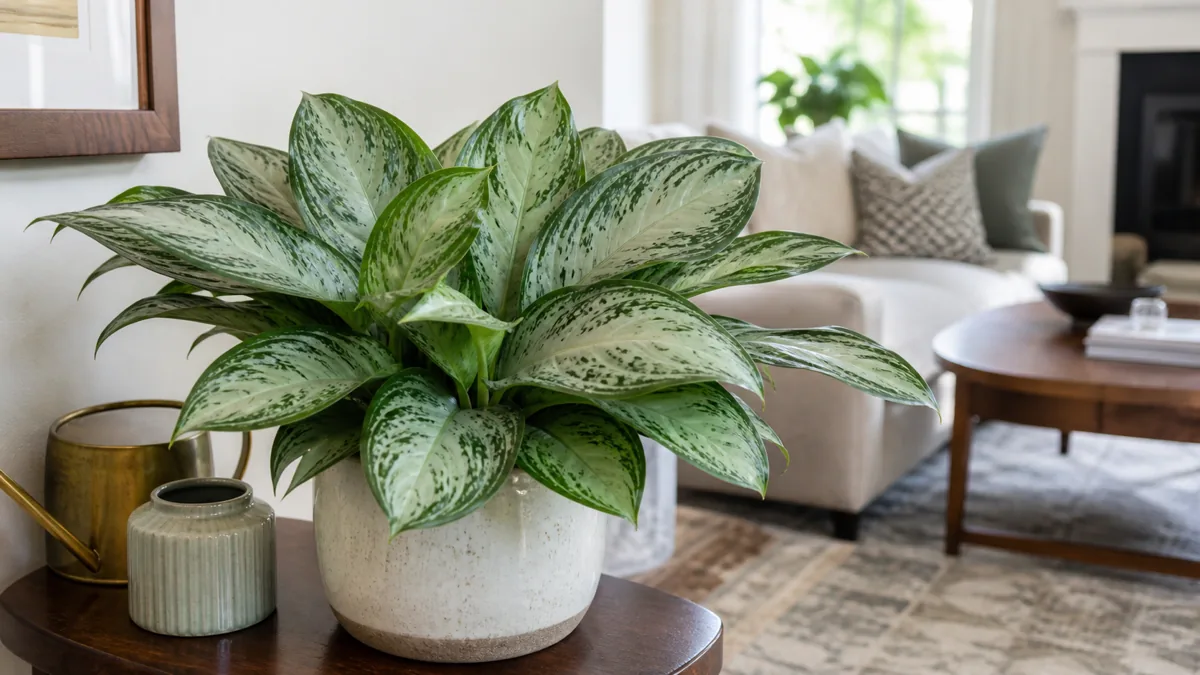
A Chinese evergreen grows as a tight, low clump of large, thick, oval-to-lance-shaped leaves radiating from a central crown at or just above soil level. No climbing, no trailing, no aerial roots — just a compact rosette that stays put wherever you place it.
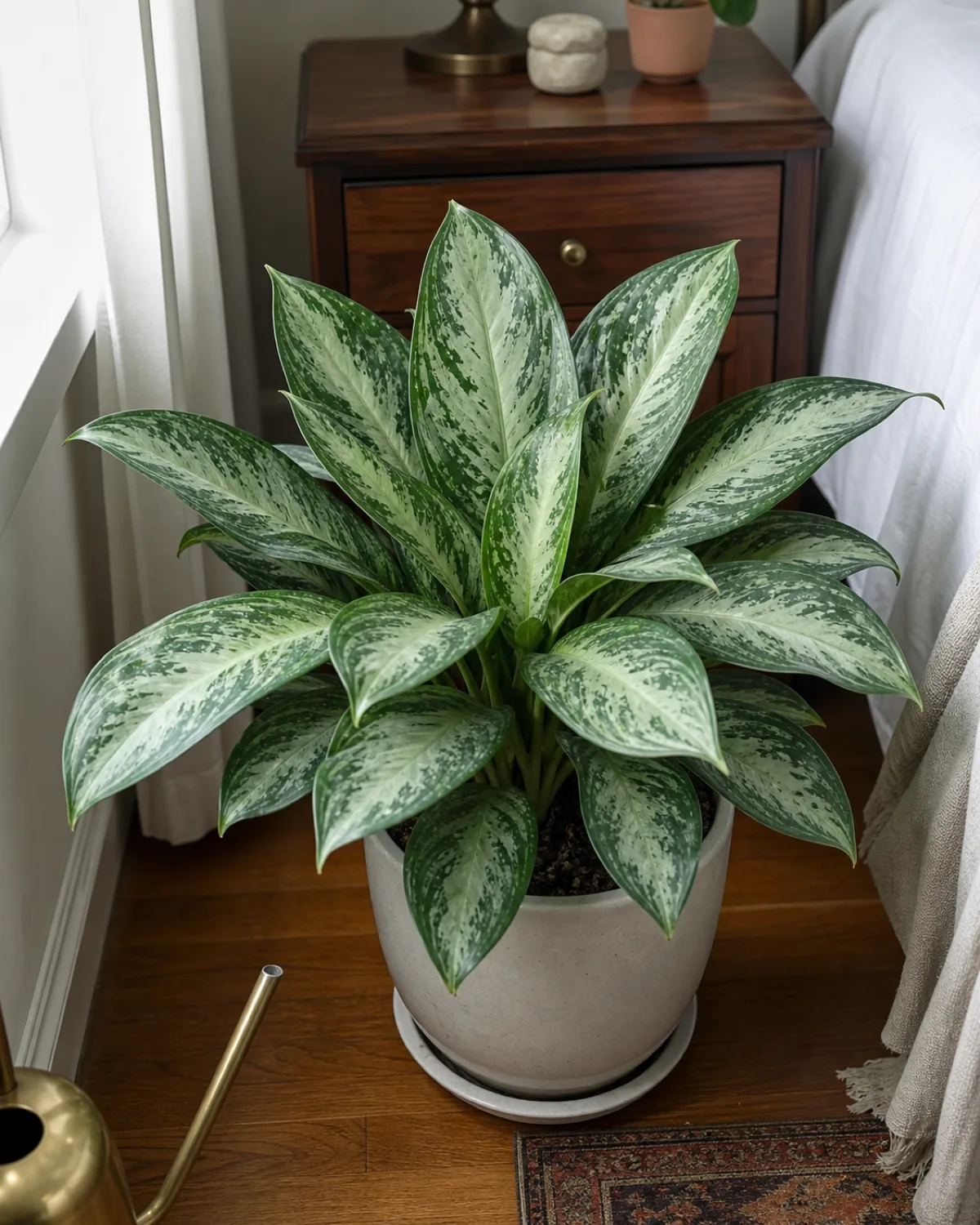
What sets Aglaonema apart from every other genus on this site is leaf-color range. A single species can come in solid deep green, silver-splashed, pink-veined, or red-margined varieties — more natural color diversity in one houseplant genus than all the other species covered here combined.
- Large, thick, oval-to-lance-shaped leaves growing in a tight low clump from a central crown.
- No climbing, no trailing, no aerial roots — a compact rosette that stays where you put it.
- More leaf-color diversity in one genus than any other houseplant species on this site.
The leaf-color light rule most people get backwards
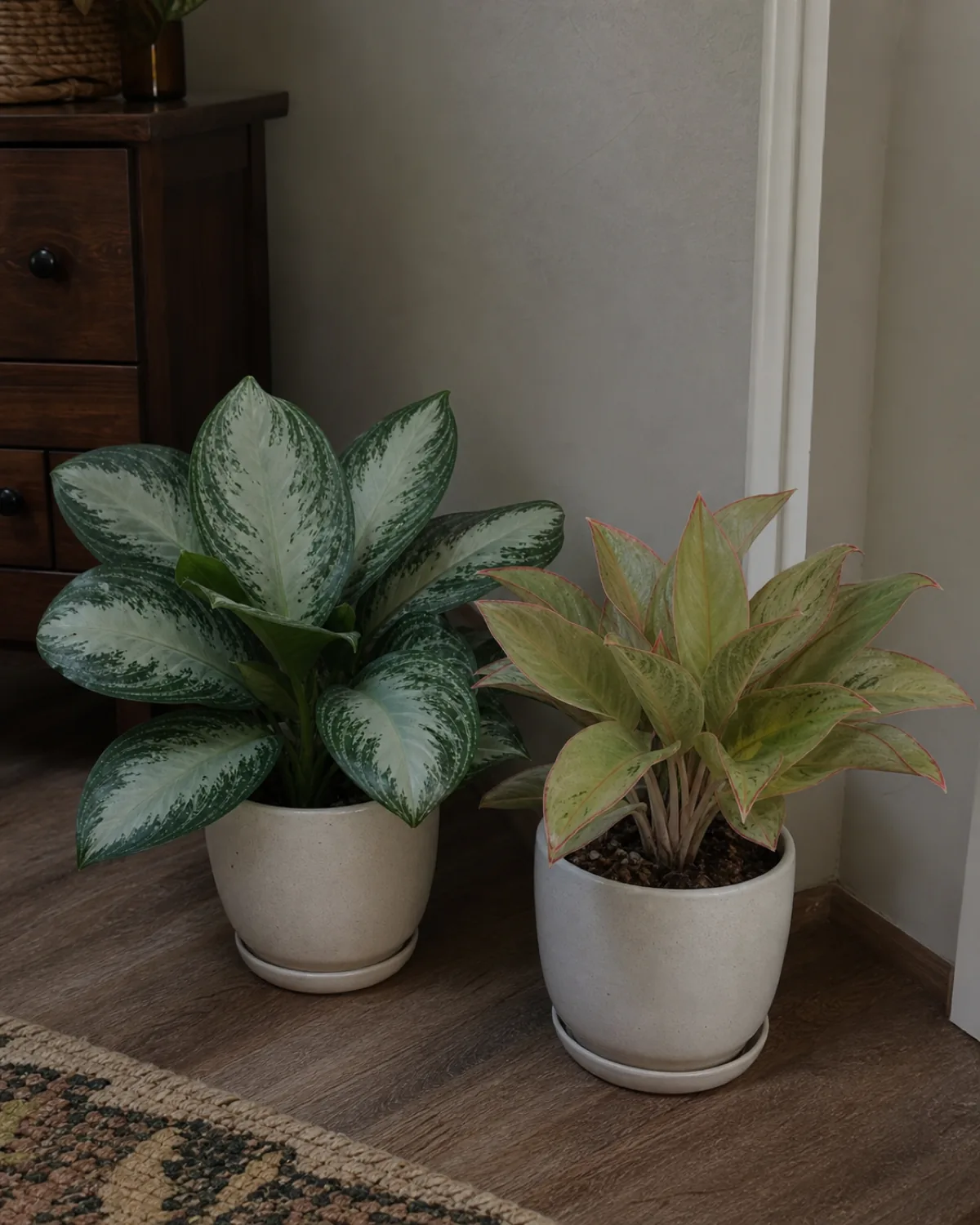
Darker, solid-green Aglaonema varieties genuinely tolerate low-light corners that would thin out even a pothos. A deep-green cultivar like Silver Bay or Maria handles a north-facing hallway or a windowless office just fine for years.
But pink, red, and heavily variegated cultivars — Siam Aurora, Valentine, Pink Dalmatian — need medium to bright indirect light to hold their color. Put one in a dark corner and the new leaves come in progressively greener until the pattern is nearly gone.
The rule runs opposite to the instinct most people bring from buying the showiest variety in the store: the more colorful the plant, the more light it needs to stay that way.
- Deep green varieties handle genuinely low light better than most houseplants on this site.
- Pink, red, and variegated varieties need medium to bright indirect light to hold their pattern.
- The showier the leaf color, the brighter the spot it needs — not the other way around.
How often to water a Chinese evergreen
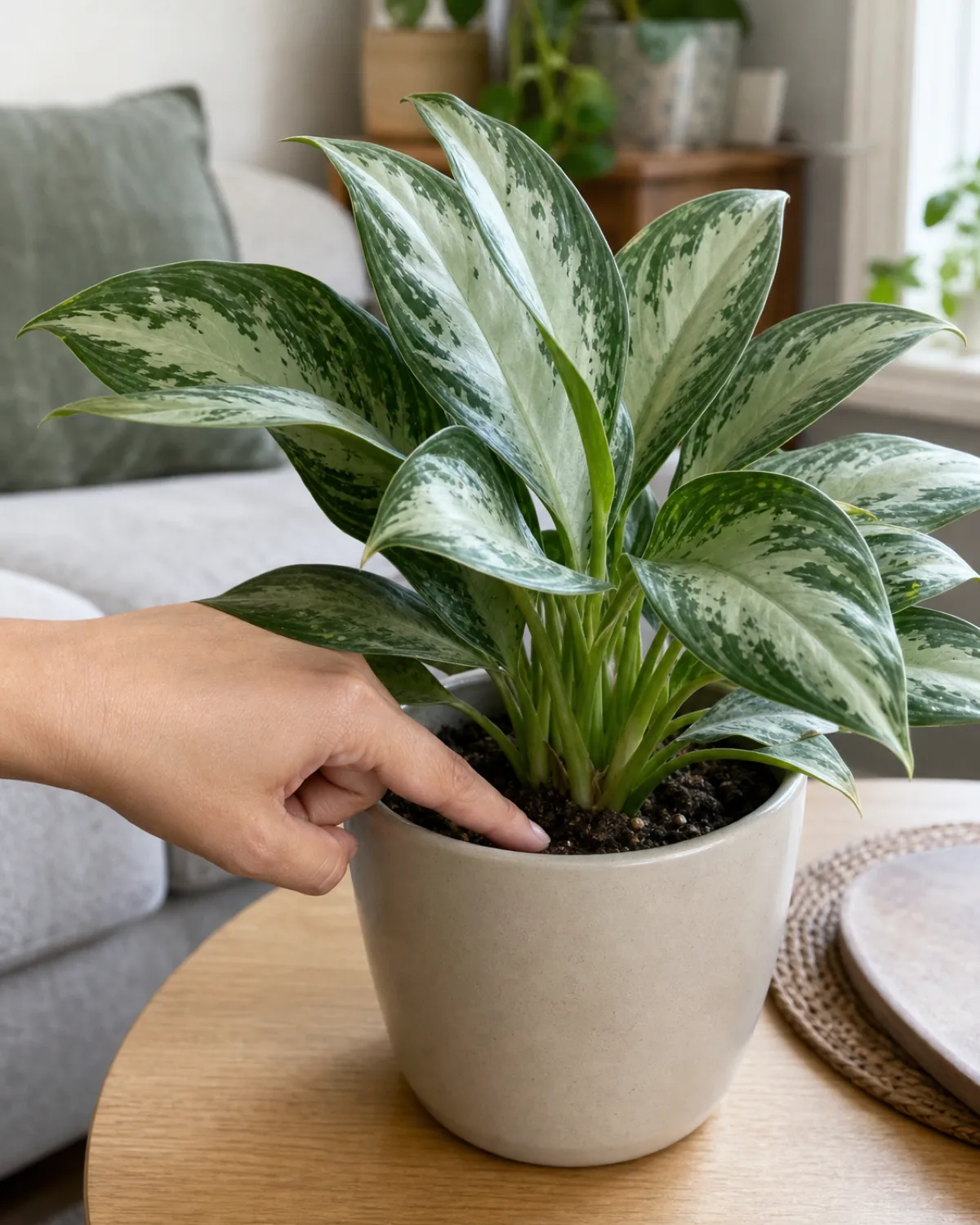
Let the top inch or two of soil dry between waterings. Aglaonema stores some moisture in its thick stems and tolerates brief dry spells without complaint, but sitting in waterlogged soil triggers root rot fast — the single most common way people kill this plant.
The safest habit is a finger test before every watering. If the top inch still feels damp, wait. Overwatering shows up as mushy lower stems before any leaf symptom appears, by which point the roots are already rotting.
- Let the top inch or two of soil dry between waterings.
- Tolerates brief dry spells, but waterlogged soil triggers root rot fast.
- Check with a finger test before every watering — if it's still damp, wait.
Why leaves turn yellow (and what each pattern means)
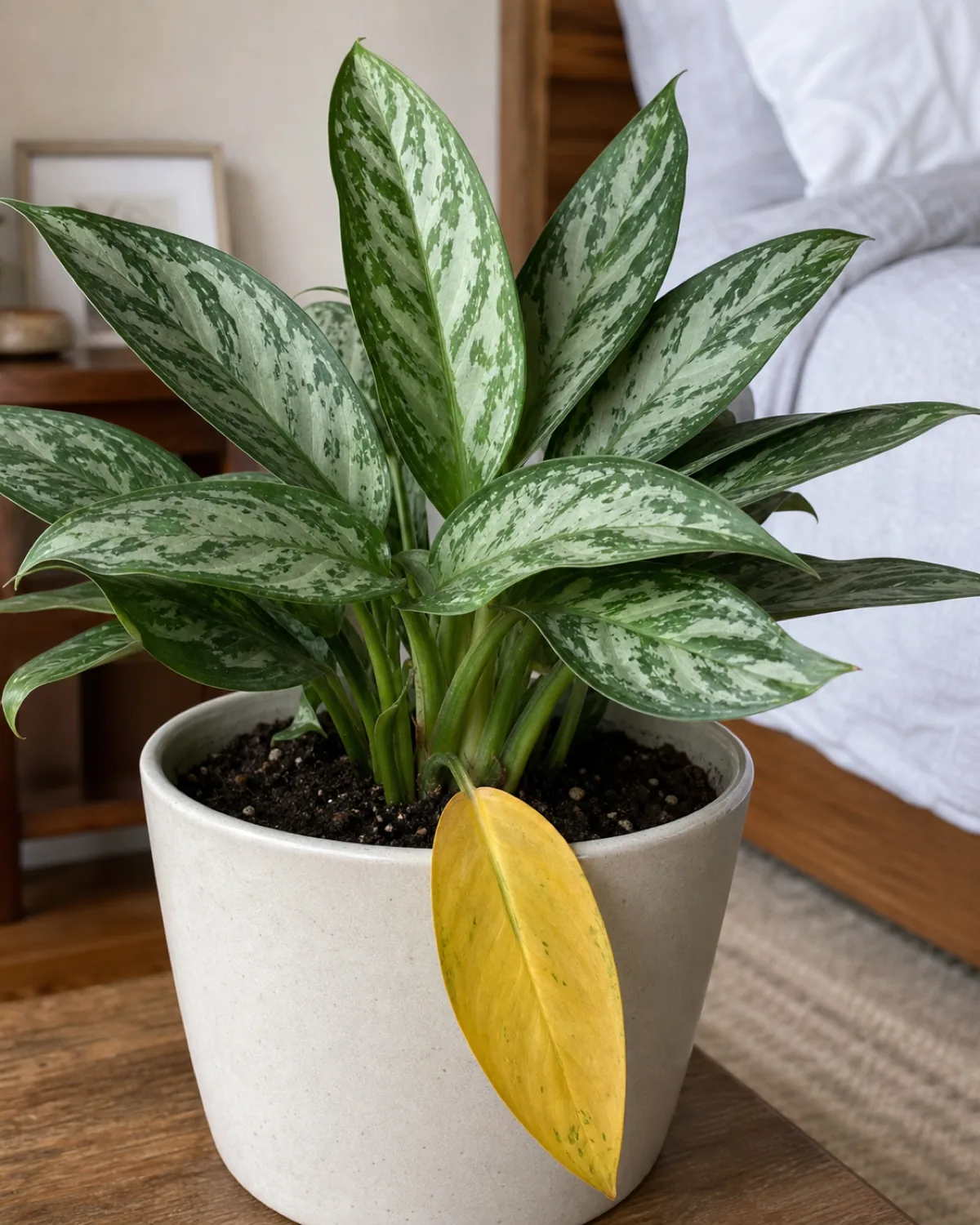
Yellowing leaves on a Chinese evergreen are telling you something specific depending on which leaf and what pattern:
Lower leaves yellowing one at a time and marching upward is the classic overwatering signal. The roots are drowning and the plant is shedding from the bottom.
Random yellow splotches on otherwise green leaves usually mean a cold draft or a sudden temperature drop. Pale, washed-out yellowing across the whole leaf points to too much direct sun bleaching the pigment. And yellowing at the leaf edges, working inward, is more often underwatering or chronically low humidity.
A single older leaf yellowing and dropping is normal aging, not a care problem.
- Bottom-up yellowing = overwatering and potential root rot.
- Random splotches = cold draft or temperature shock.
- Washed-out pale yellowing = too much direct sun.
- Edge yellowing = underwatering or low humidity.
A Chinese evergreen suits almost any indoor spot — but a couple of scenarios genuinely call for a different plant.
Humidity, temperature, and why cold drafts are the real enemy
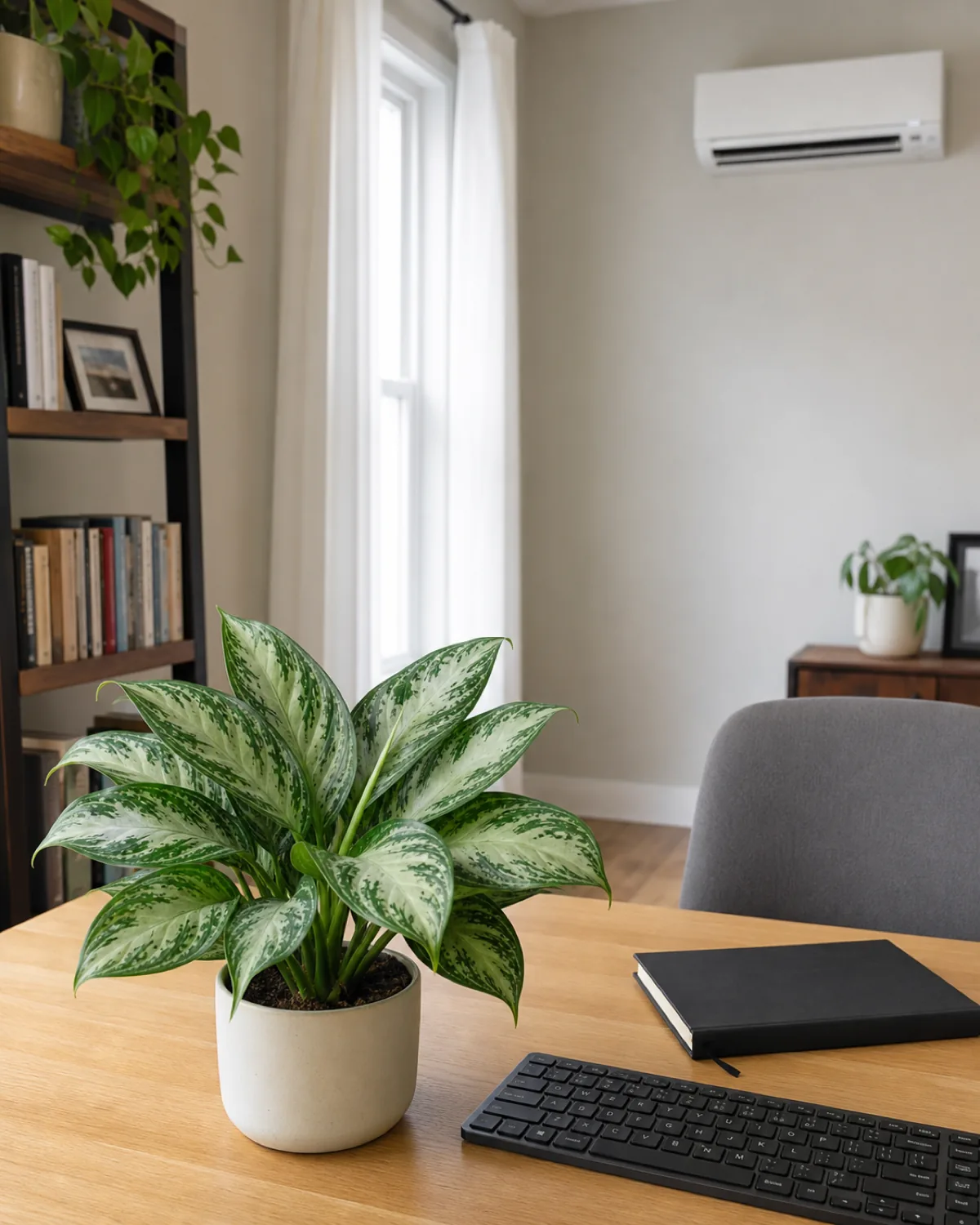
Aglaonema handles average household humidity without needing a humidifier or pebble tray. It's a tropical genus that adapted to shaded forest floors — not the damp, misty canopy layer — so standard indoor air is fine for it.
Temperature is the real vulnerability. A Chinese evergreen drops leaves dramatically if exposed to temperatures below 60°F (15°C) or cold drafts from exterior doors, single-pane windows, or air conditioning vents blowing directly on it. It's more cold-sensitive than most other houseplants on this site, including the palms.
Position it away from any source of cold air — not just an open window, but also a vent or a door that gets opened frequently in winter.
- Average household humidity is fine — no humidifier needed for most homes.
- Below 60°F (15°C) triggers dramatic leaf drop — more cold-sensitive than most houseplants here.
- Keep it away from cold drafts: exterior doors, single-pane windows, and direct AC airflow.
Why pot shape matters more here than soil recipe
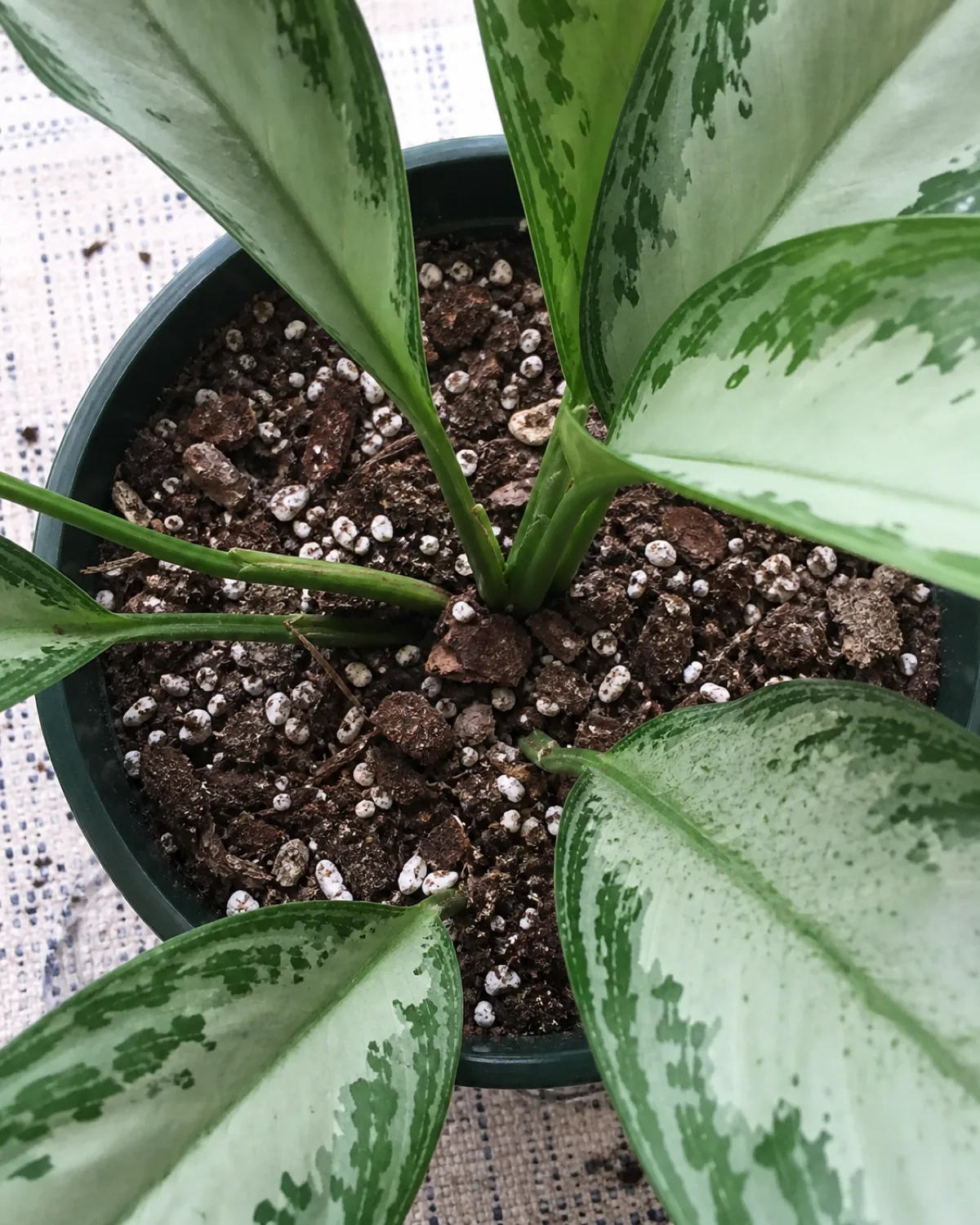
Most potting advice leads with the soil mix, but for a Chinese evergreen the pot itself is the bigger variable. Aglaonema roots stay unusually shallow and compact — they spread sideways near the surface rather than diving deep — so a tall, deep pot leaves inches of unreachable wet soil below the root zone, and that stagnant lower layer is exactly where anaerobic rot starts.
A squat, wide pot no more than an inch wider than the root ball, paired with any well-draining all-purpose mix amended with perlite, keeps moisture where the roots can actually use it. The mix matters less than matching the pot geometry to this plant's shallow root architecture.
- Shallow, compact roots that spread sideways — a squat pot fits the root architecture better than a tall one.
- No more than an inch wider than the root ball — excess soil below the root zone invites rot.
- Standard mix with perlite is fine — pot shape does more work than soil recipe for this genus.
Fertilizing: less is more
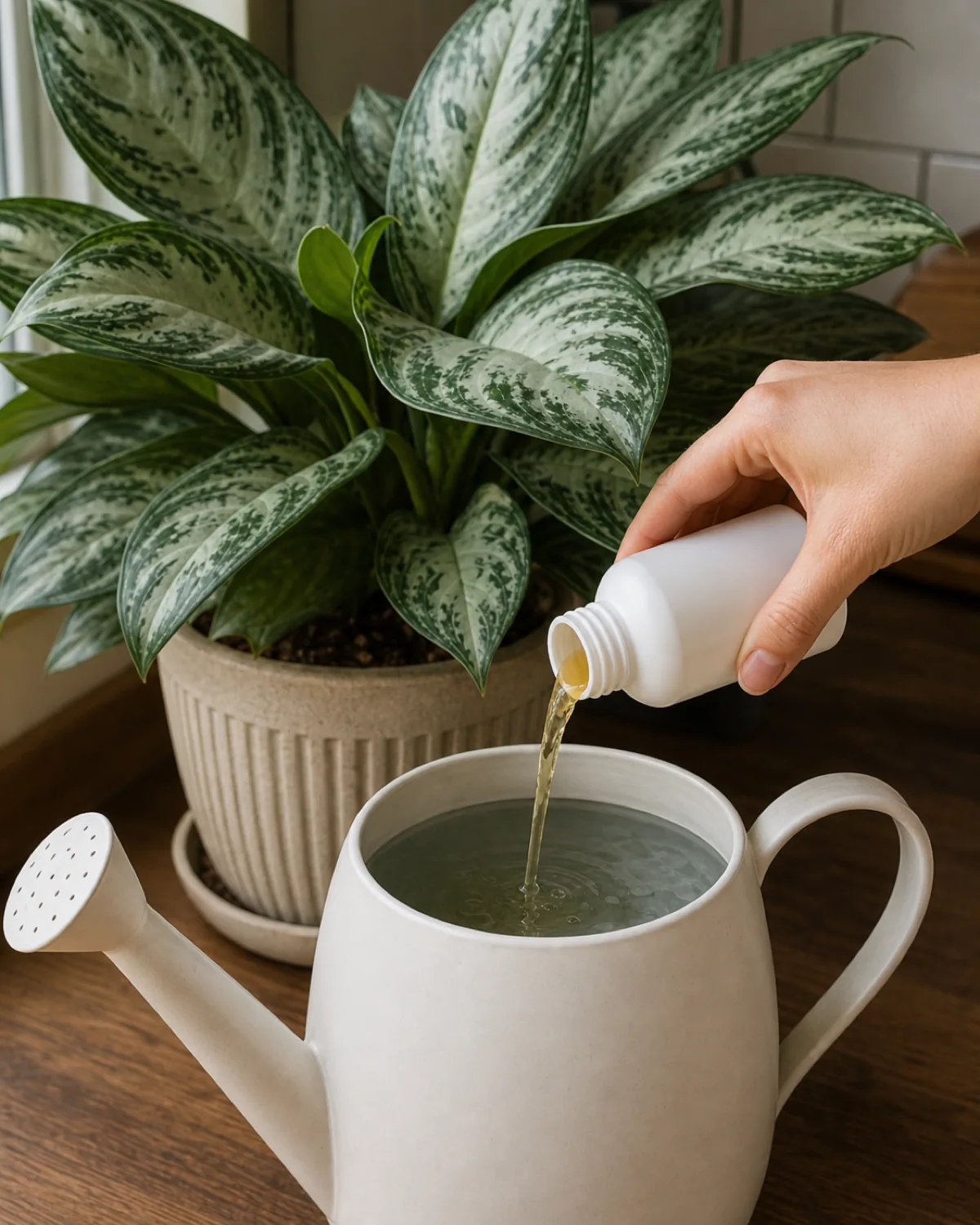
Feed monthly during spring and summer with a balanced liquid fertilizer diluted to half the label rate. Aglaonema is a slow grower that shows fertilizer burn — brown, crispy leaf edges — before it ever shows signs of hunger.
Stop feeding entirely in fall and winter. The plant isn't actively growing, and unused fertilizer salts build up in the soil, burning roots the plant can't flush.
- Monthly feeding, spring and summer only, at half strength.
- A slow grower that shows burn before hunger — less is genuinely safer.
- Stop feeding in fall and winter to avoid salt buildup.
Propagation: division is the only reliable method
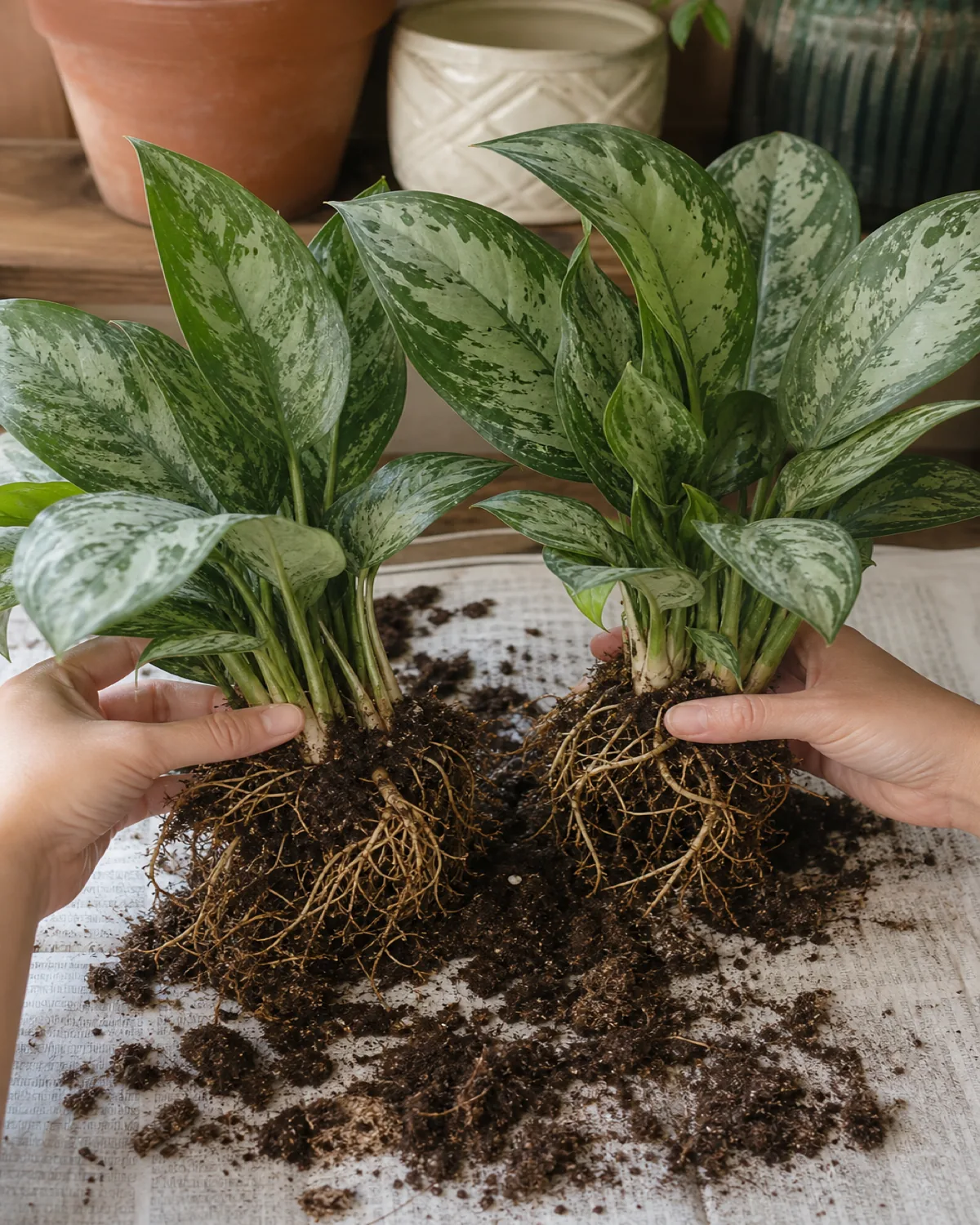
When repotting, separate any offset clumps that have grown their own root systems. Each section with a few leaves and its own roots can go straight into its own pot.
Stem cuttings root poorly compared to the easy water-rooting of a pothos or philodendron. Aglaonema's thick stems don't produce adventitious roots reliably.
Peace lily propagation works the same way, by division rather than cuttings, despite both being in the Araceae family. It's the clumping growth habit that dictates the method, not the family tree.
- Division during repotting is the practical method — separate clumps with their own roots.
- Stem cuttings root poorly compared to vine-type aroids like pothos or philodendron.
- Same method as peace lily — another clumping aroid that propagates by division, not cuttings.
Repotting: every 2–3 years, and no bigger
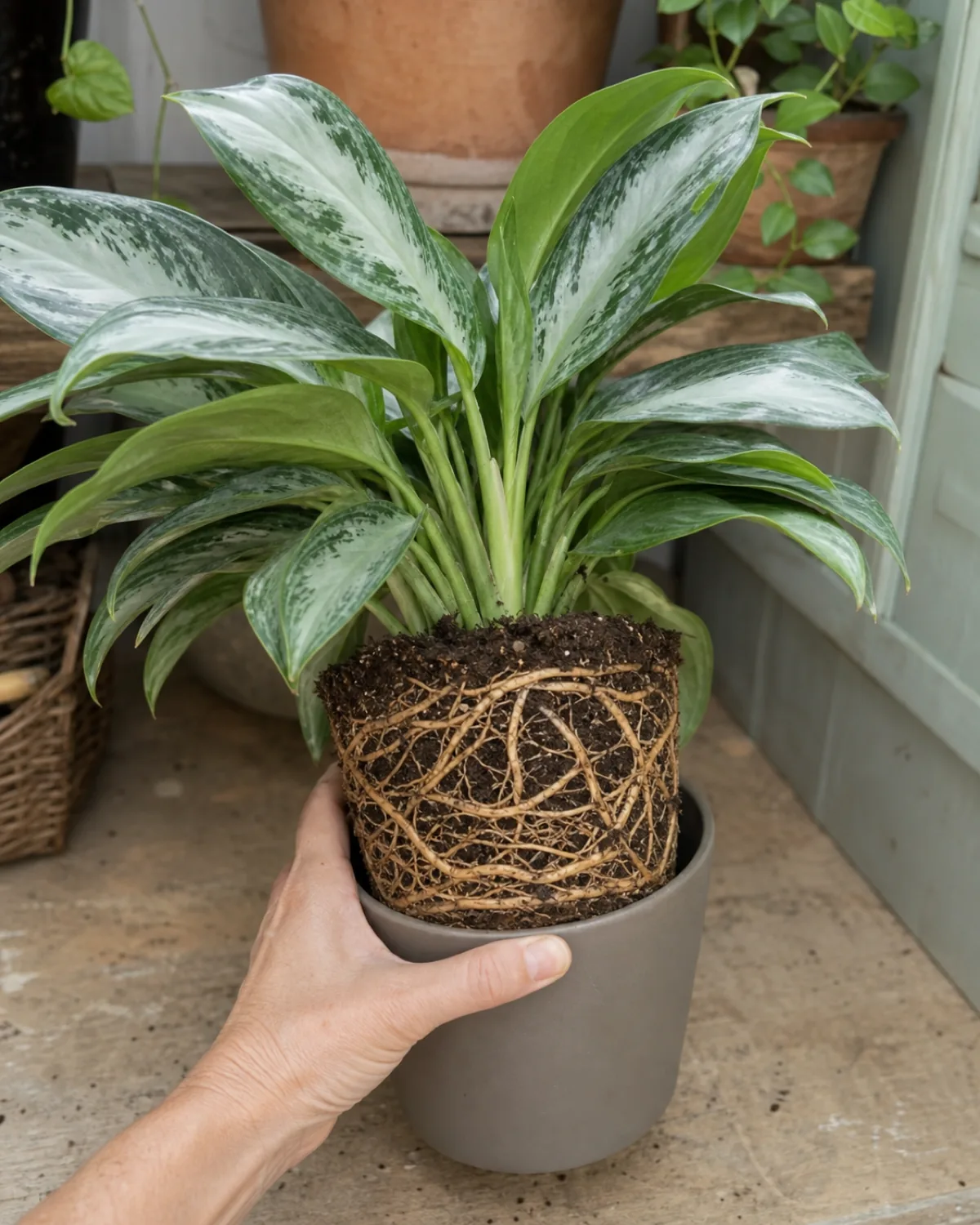
Aglaonema prefers to be slightly rootbound. Repot only when roots visibly circle the root ball or growth stalls noticeably — roughly every 2 to 3 years in most cases.
When you do repot, move up just one pot size. Jumping two or three sizes at once creates the same excess-soil moisture trap described in the potting section above, and a Chinese evergreen that's just been repotted into too much soil is the most common candidate for root rot in its first few months in the new pot.
- Slightly rootbound is fine — don't repot on a schedule, repot when it signals the need.
- Move up one pot size, never two or three at once.
- An oversized new pot is the most common root rot trigger after repotting.
Most Chinese evergreen problems trace back to one of four missed reads. Hold these four and it stays healthy for years on autopilot.
Chinese Evergreen Care: The Quick Reference
- 1Tight, low rosette of large patterned leavesNo climbing, no trailing — a compact clump that stays put.
- 2Darker leaves = lower light toleranceGreen varieties handle deep shade; pink and red need brighter spots.
- 3Water when the top inch driesOverwatering is the most common killer — when unsure, wait.
- 4Yellow leaves tell you what went wrongBottom-up = overwatering. Splotches = cold. Washed-out = sun. Edges = dry.
- 5Cold drafts are the real enemyBelow 60°F triggers dramatic leaf drop — worse than low humidity.
- 6Well-draining mix, snug potOne inch of extra room — oversizing risks root rot.
- 7Feed monthly at half strengthSpring and summer only — it burns before it starves.
- 8Propagate by division, not cuttingsSeparate rooted clumps during repotting.
- 9Repot every 2-3 years, one size upSlightly rootbound is fine — only move when roots circle visibly.
- 10Check leaf axils for mealybugs and scaleThe tight rosette creates hidden crevices where pests cluster.
- 11Toxic to cats and dogsCalcium oxalate crystals cause oral irritation — keep it elevated.
- 12Choose variety by light level, not just colorSilver Bay for dim rooms, Siam Aurora for brighter spots.
- 13North-facing windows and interior rooms for green varietiesPink and red types want east- or north-window proximity.
kultivy.com
Common pests: mealybugs and scale in leaf axils
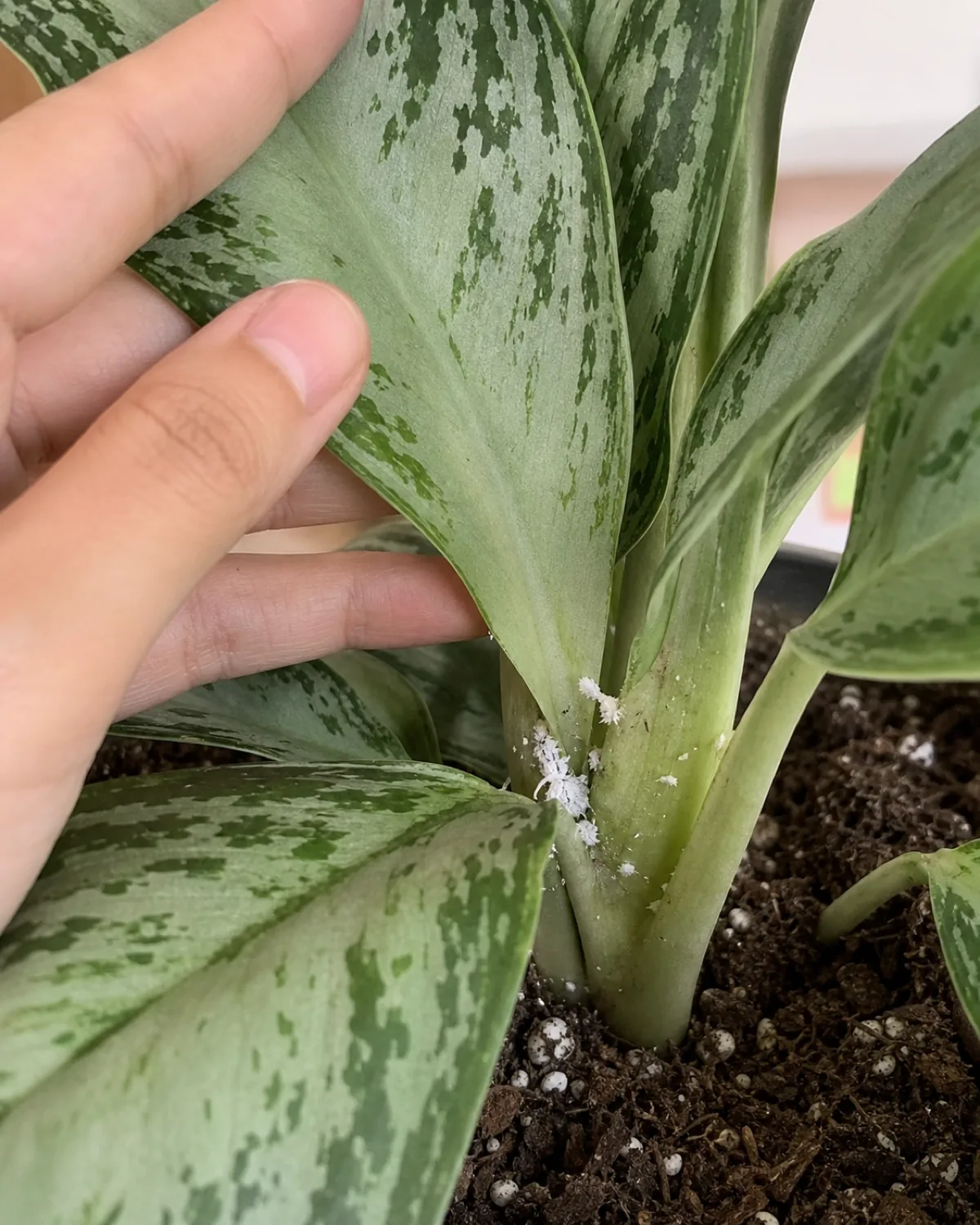
The tight rosette of large, overlapping leaves creates hidden crevices where mealybugs and scale love to cluster — right where the leaf base meets the central stem, hidden from a casual glance.
Regular inspection with a quick leaf-lift check catches an infestation before it spreads. A cotton swab dipped in rubbing alcohol removes individual mealybugs on contact; for a larger outbreak, a neem oil spray applied to the undersides and axils once a week for three weeks breaks the lifecycle.
- Mealybugs and scale cluster in the leaf axils, hidden by the overlapping rosette.
- Regular leaf-lift inspections catch infestations early.
- Rubbing alcohol for individuals, neem oil spray for outbreaks — three weekly applications.
Is a Chinese evergreen toxic to pets?
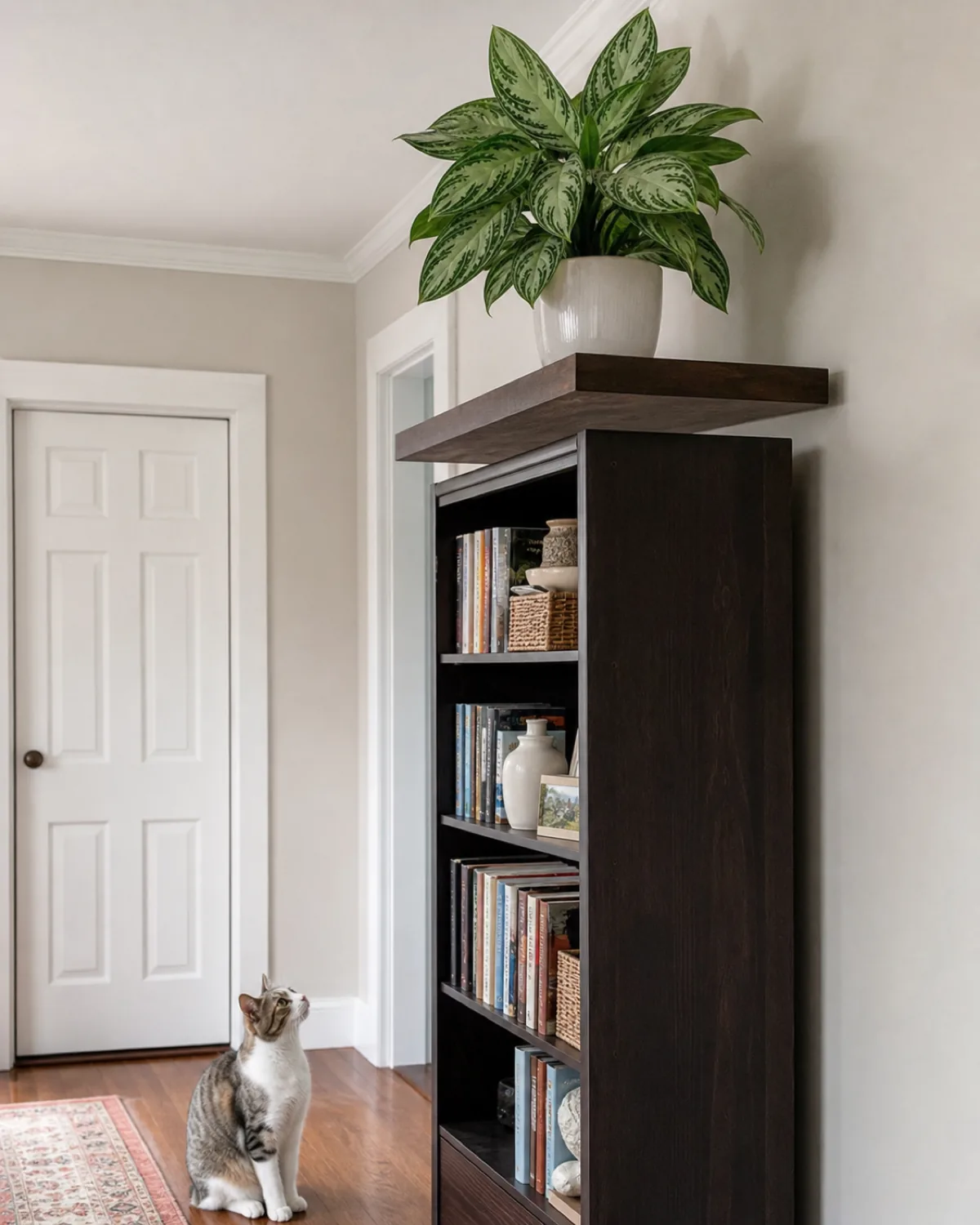
Yes. All Aglaonema species contain calcium oxalate crystals — microscopic needle-shaped structures in the stems and leaves that cause immediate oral pain, drooling, and swelling if a cat or dog chews on them. The reaction is usually self-limiting and rarely life-threatening, but it's intensely uncomfortable.
Keep a Chinese evergreen on a high shelf, a wall-mounted planter, or in a room pets don't access. If you want a similarly low-maintenance, low-light foliage plant that's genuinely non-toxic, a spider plant or parlor palm fills a similar niche without the toxicity concern.
- All Aglaonema species are toxic — calcium oxalate crystals cause oral irritation in cats and dogs.
- Keep it elevated or in a pet-free room.
- Spider plant or parlor palm fills a similar low-light, low-maintenance role without the toxicity.
Popular aglaonema varieties and which ones suit your light
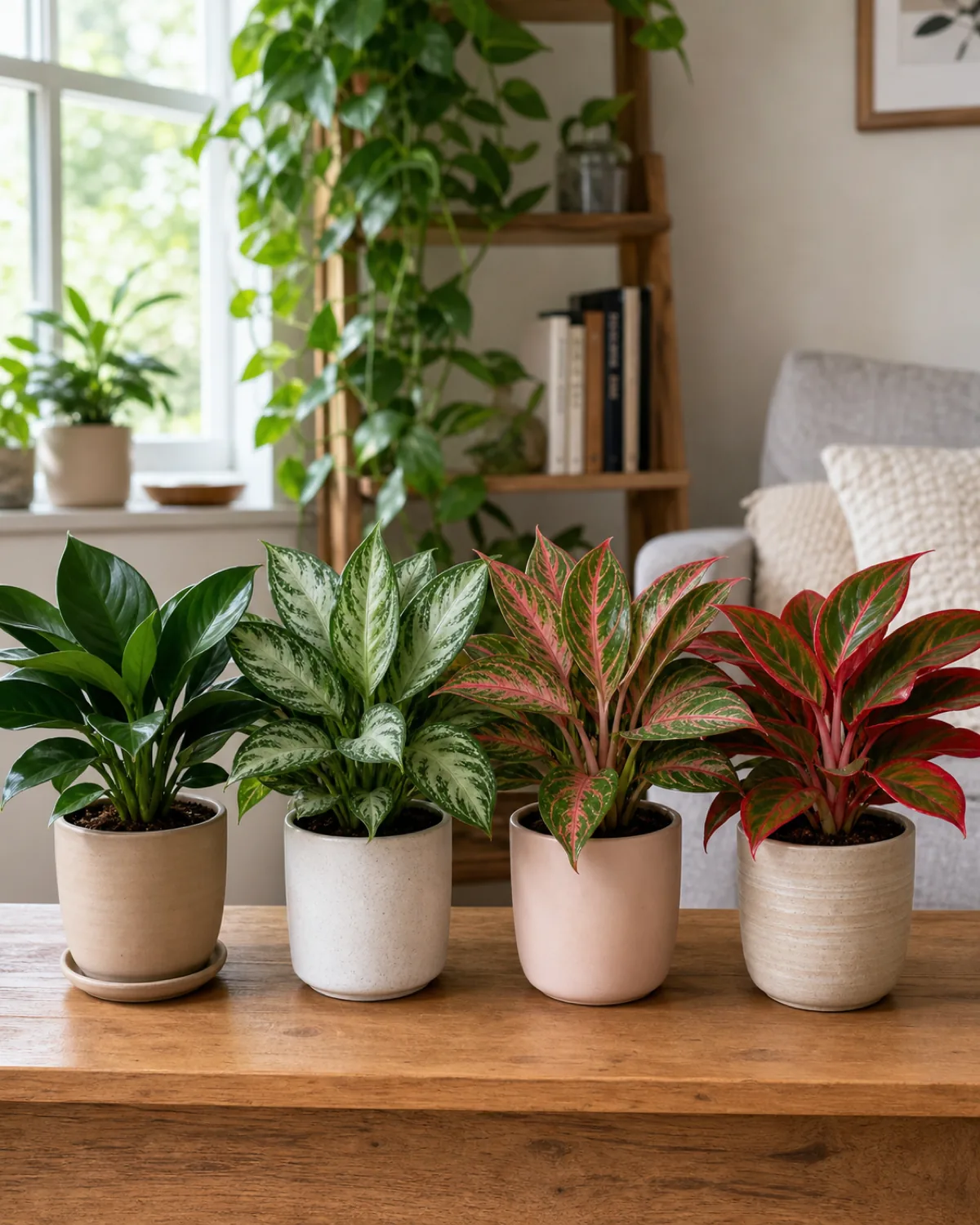
The easiest way to choose an Aglaonema is to match it to the light your room actually gets, not to pick the showiest one at the store and hope it adapts:
True low light (north-facing windowsills, interior hallways): Silver Bay, Maria, Emerald Beauty — deep green varieties with subtle silver patterning that hold their look in minimal light.
Medium light (a few feet from an east- or north-facing window): Silver Queen, Cutlass — silver-heavy varieties that need a bit more light to keep the contrast crisp but don't need direct sun.
Medium to bright indirect light (within arm's reach of an east-facing window, or a few feet from a south-facing one with a sheer curtain): Siam Aurora, Red Valentine, Pink Dalmatian — pink and red varieties that lose their color in anything dimmer.
- Match the variety to the room's light, not the other way around.
- Green varieties for dim rooms, silver for medium, pink and red for brighter spots.
- Color fading is the first sign a variety is in too little light for its needs.
Where to place a Chinese evergreen in your home
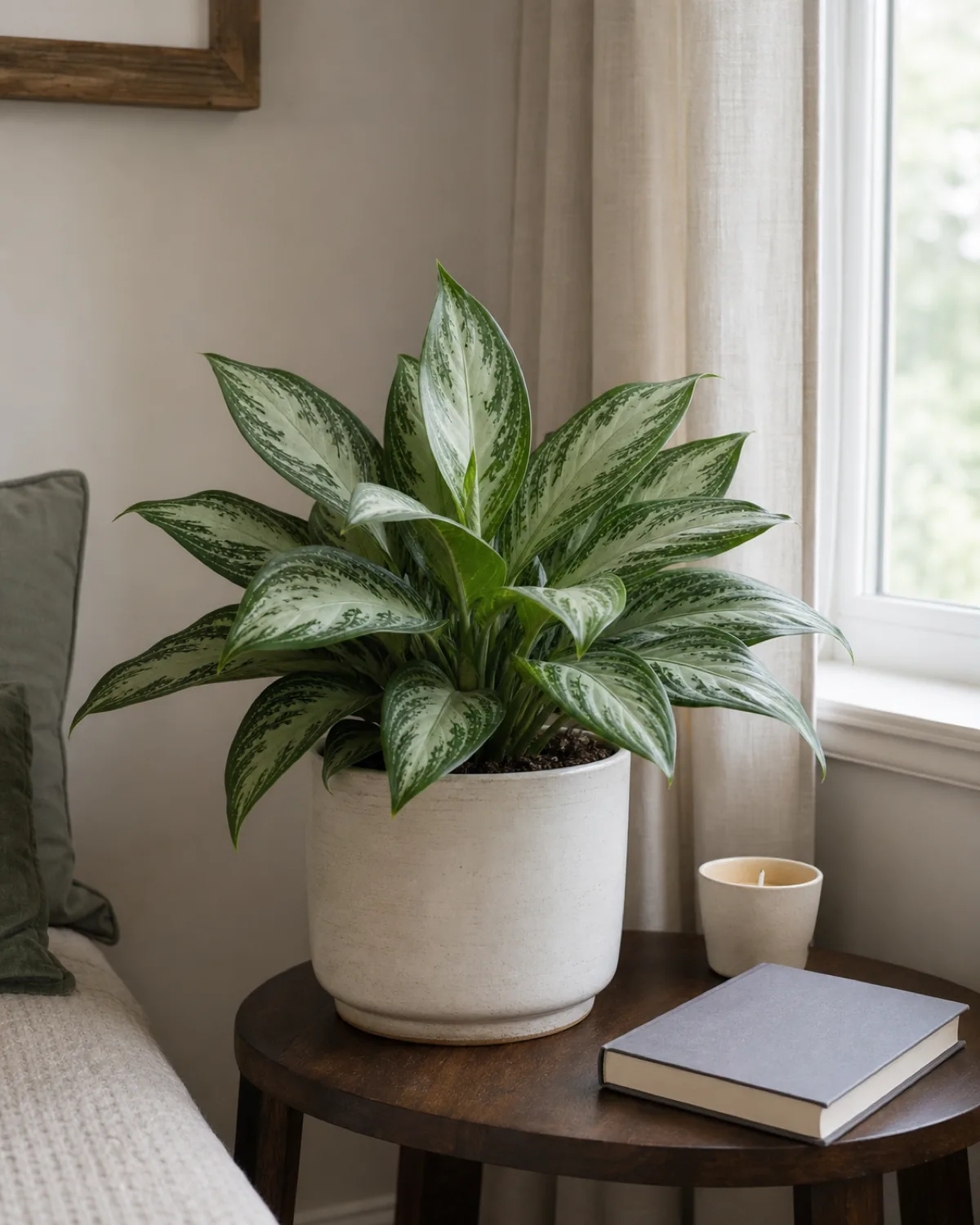
North-facing windowsills, interior hallways, bedrooms, and offices are all fair game for green varieties — these are some of the most genuinely low-light-tolerant foliage plants available.
Pink and red types belong within a few feet of an east- or north-facing window where they catch gentle indirect light without direct sun bleaching the pigment. A south- or west-facing window works only with a sheer curtain softening the light.
The one universal rule across all varieties: keep it away from cold drafts. An otherwise perfect north-facing hallway spot that happens to be next to the front door will cost leaves every time someone opens it in winter.
- Green varieties thrive in hallways, bedrooms, offices, and north-facing windowsills.
- Pink and red varieties need proximity to an east- or north-facing window.
- The universal placement rule: away from cold drafts, regardless of variety.

Mara Quinn edits Kultivy, where she shares houseplant care, propagation, beginner-friendly plant picks, and plant-styling ideas for anyone who wants their indoor plants to actually thrive. Every guide is image-led and reviewed for clarity, usefulness, image accuracy, and Pinterest-to-page alignment before it goes live. Visit the About page.