English Ivy Care: The Classic Vine That Prefers Your Coolest Room
English ivy thrives where most tropicals struggle — in cooler rooms with moderate light. Get the temperature right and everything else follows…
Care guides for popular houseplants — monstera, pothos, snake plant, philodendron, and more. Light, water, and growing tips tailored to each species.
English ivy thrives where most tropicals struggle — in cooler rooms with moderate light. Get the temperature right and everything else follows…
The braided trunk is the signature, but it starts in a nursery — not in nature. Wild Pachira aquatica grows as a single-trunk wetland tree up to sixty feet tall…
Crotons trade subtlety for spectacle — every leaf a different mix of red, orange, yellow, and green. Keep the light high and the drama stays in the foliage…
A syngonium starts as a compact rosette of arrow-shaped leaves. Let it climb and it becomes a different plant entirely — lobed, split, and twice the size…
A bonsai is not a species — it is a technique. Any woody plant can become one, and the skills that keep it alive are closer to sculpture than gardening…
Aloe vera is the rare houseplant that earns its shelf space twice — as a sculptural succulent and a medicine cabinet staple. Here is everything it actually needs…
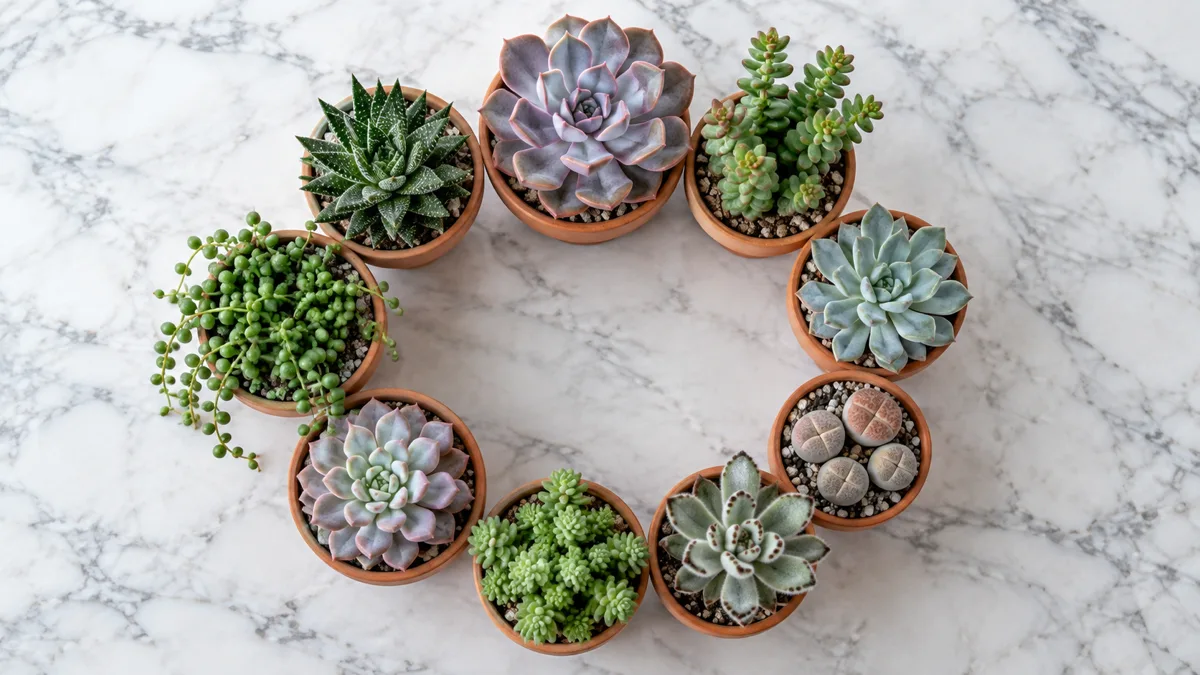
Cacti are succulents, but they play by their own rules. Areoles, spines, and a winter dormancy cycle that triggers flowers set them apart from every other plant on your shelf…
Dieffenbachia is the houseplant equivalent of a bold statement piece — large cream-and-green leaves that give any room instant tropical drama. The catch: every part of this plant is intensely toxic, and the bottom leaves will yellow no matter what you do…
Peperomia is one of the few houseplants that actually stays small. Most varieties top out under twelve inches, the leaves are thick enough to handle missed waterings, and it is one of the rare attractive houseplants that is completely safe for cats and dogs…
No other trailing houseplant fills a basket as fast as tradescantia. The problem is keeping it that way — the stems stretch, the base goes bare, and the purple fades to green…