Every snake plant shares the same reputation: indestructible, tolerates neglect, survives dark corners. That reputation is earned — but it flattens a diverse genus into one plant.
The reality spans gold-edged swords, ghostly silvers, tubular spears, and single paddle-leaf giants. The genus was reclassified from Sansevieria to Dracaena in 2017. Nursery tags still say Sansevieria.
The snake plant care guide covers the shared baseline. This guide is about what makes each variety different: 13 varieties from the most common to the rarest.
Dracaena trifasciata 'Laurentii' — the gold-edged classic that started the houseplant boom
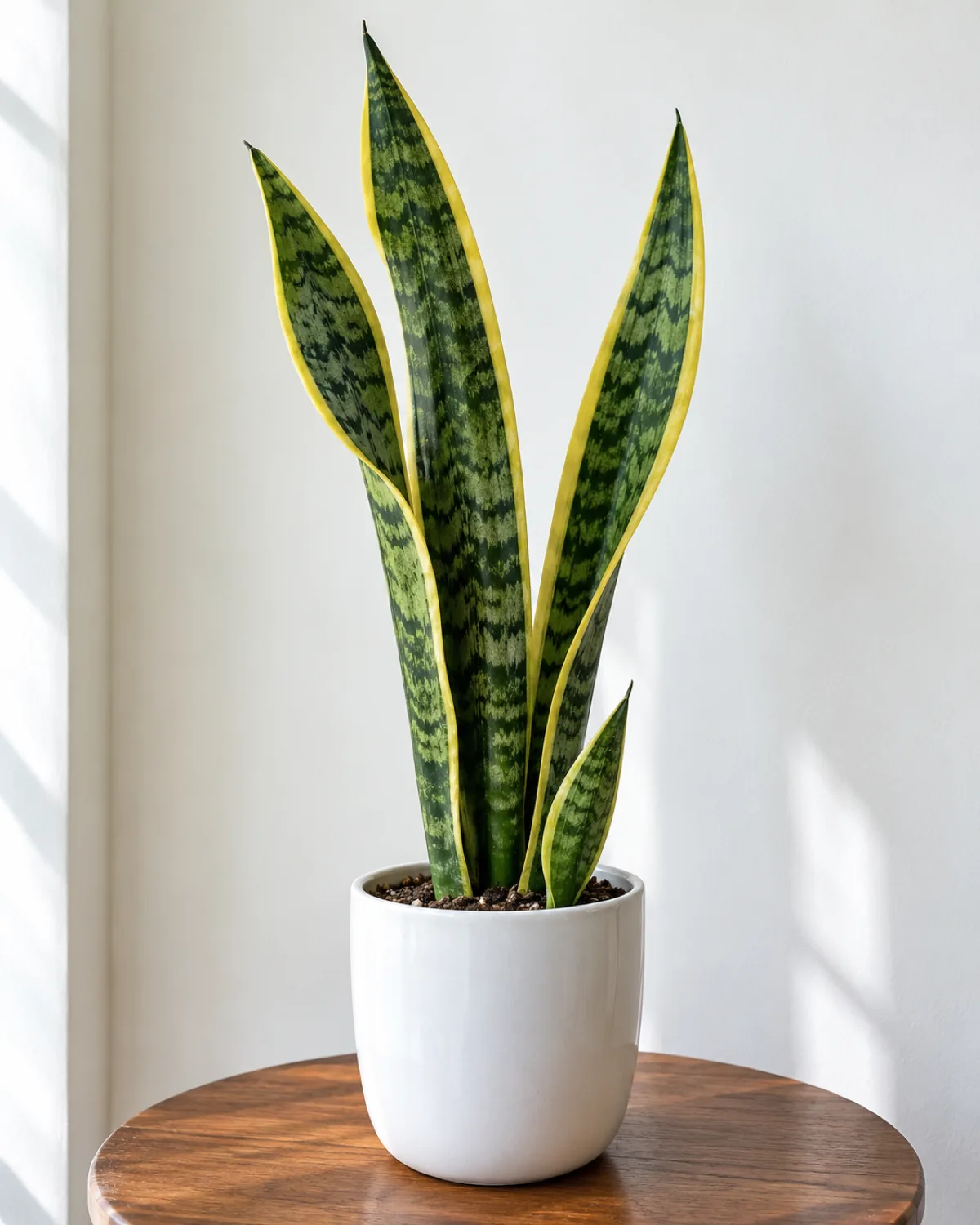
Laurentii is the snake plant most people picture when they hear the name. The tall, sword-shaped leaves carry dark green horizontal bands bordered by bold golden-yellow margins — a variegation pattern that is technically chimeral, meaning the yellow edge is a genetically distinct cell layer rather than a response to light.
That chimeral origin has a practical consequence for propagation. Leaf cuttings from Laurentii root readily but revert to plain green. The gold margin exists only in the outer cell layer, and a cutting regenerates from the inner tissue. To keep the yellow edge, you must propagate by division — separating pups from the mother plant with their roots intact.
- Identification tell: Golden-yellow margins running the full length of each leaf — the single most common variety in nurseries
- Confused with: The straight species (D. trifasciata), which has the same crossbanding but no yellow edge
- Height: Three to four feet indoors, sometimes taller in bright light with years of growth
- Care quirk: Overwatering causes mushy base rot faster than in most houseplants — the thick leaves store enough water to survive weeks without a drink
Laurentii is the gateway snake plant. It sits in offices, dentist waiting rooms, and hotel lobbies because it survives there — but it also looks striking enough to anchor a plant corner at home.
Dracaena trifasciata 'Zeylanica' — the silver-banded variety with wavy crosshatching
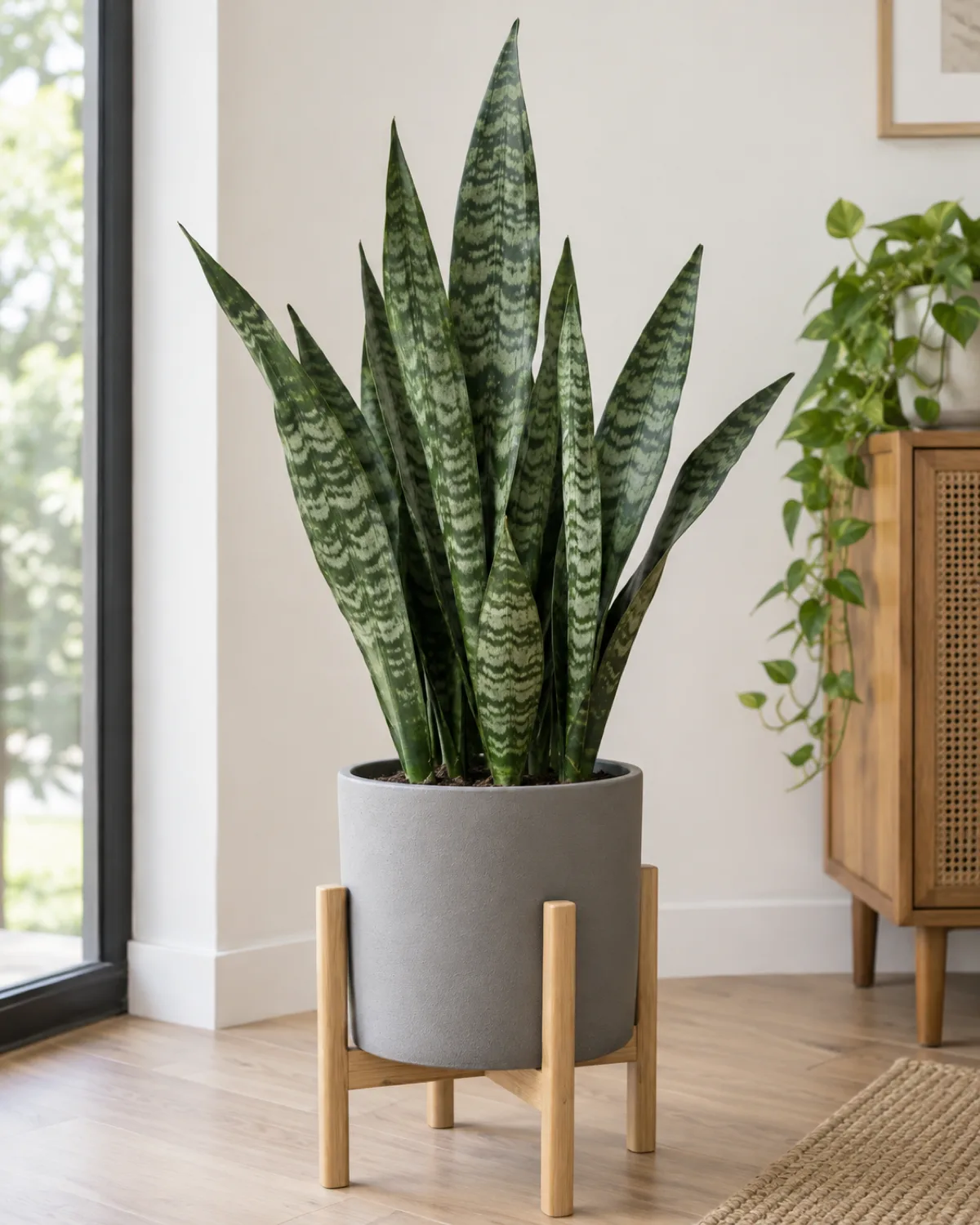
Zeylanica is the variety that gets mislabeled as the straight species more than any other. The leaves carry the same horizontal crossbanding as Laurentii but without the yellow edge. What sets Zeylanica apart from the true species is the pattern intensity — the silver-green bands are more defined, more wavy, and more visually prominent than the muted banding on a standard D. trifasciata.
The absence of yellow variegation actually makes Zeylanica more versatile in interior design. The neutral silver-on-green palette works in spaces where the bold gold edge of Laurentii competes with the existing color scheme.
- Identification tell: Silver-green crossbanding with no yellow or cream margin — the most commonly mislabeled variety
- Confused with: The straight species and young Laurentii that have not yet developed strong gold edges
- Growth speed: Slightly faster than Laurentii because the all-green leaf surface has more chlorophyll
- Light tolerance: The broadest in the genus — thrives in low light where variegated types lose their pattern
Zeylanica is the workhorse. It does everything Laurentii does without the golden edge, and it does it a little faster because every cell on the leaf is pulling its weight photosynthetically.
Dracaena trifasciata 'Moonshine' — the pale silver-green variety that glows
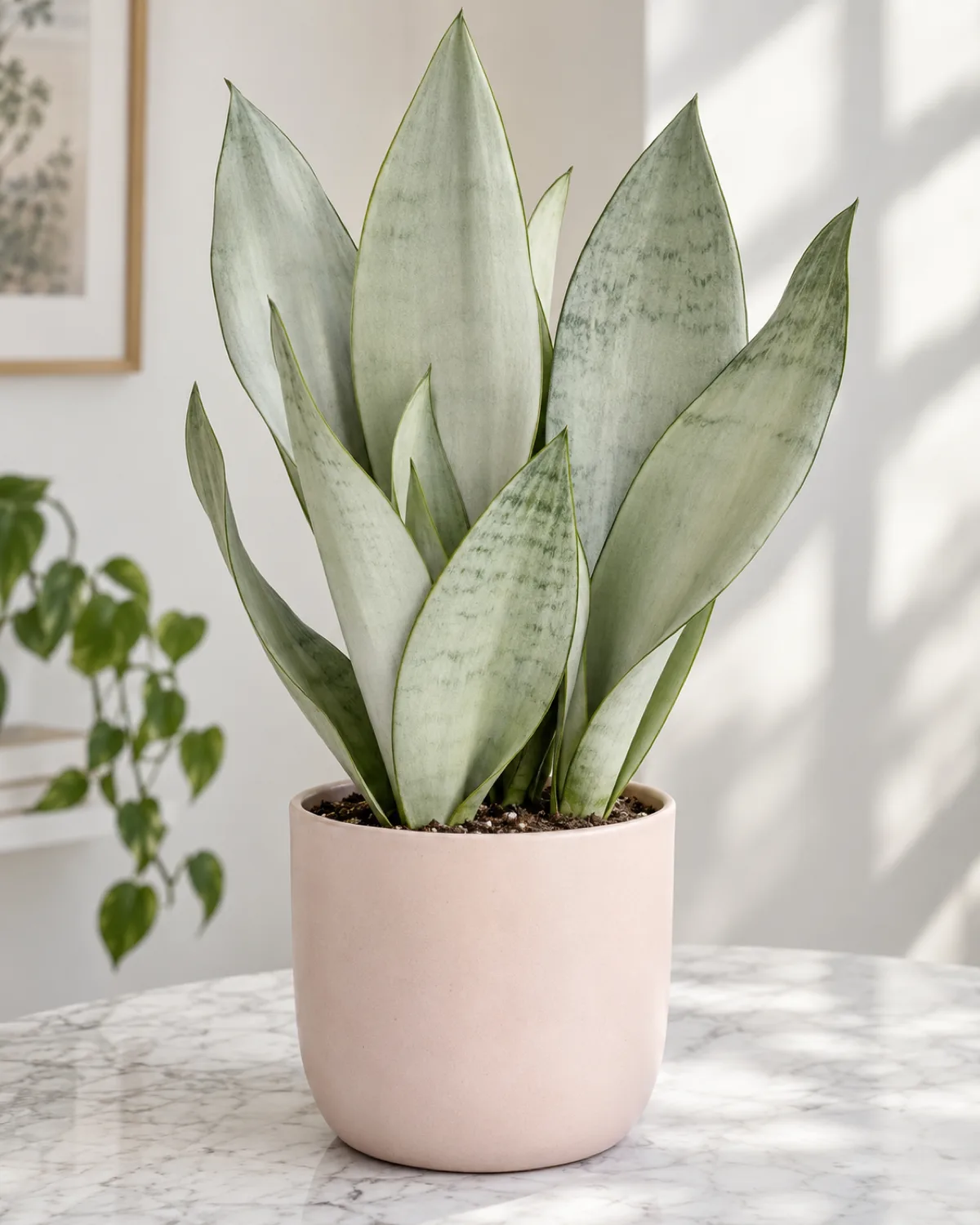
Moonshine is the snake plant that makes people stop and ask what it is. The broad, flat leaves are a pale silvery sage-green — almost ghostly in bright light — with faint darker crossbanding that is visible only at certain angles. The color has been compared to moonlight on water, which is where the cultivar name comes from.
The silver tone is a function of light. In bright indirect light, Moonshine stays pale and luminous. In low light, the leaves gradually darken to a standard green as the plant increases chlorophyll production to compensate. The color shift is reversible — move the plant back into bright light and the silver returns over a few months.
- Identification tell: Broad flat leaves in uniform silvery sage-green with almost no visible crossbanding
- Confused with: Sayuri, which is bluer and has faint longitudinal striping rather than the uniform wash of Moonshine
- Light sensitivity: Needs brighter light than most snake plants to maintain the signature color — not a dark-corner variety
- Propagation: Division only if you want to keep the silver color — leaf cuttings produce green offspring
Moonshine is the collector's entry point. It is available enough to find without a specialist nursery, unusual enough to stand out in any plant collection, and the light-responsive color gives it a quality that photographs differently in every setting.
Dracaena trifasciata 'Cylindrica' — the African spear with round tubular foliage
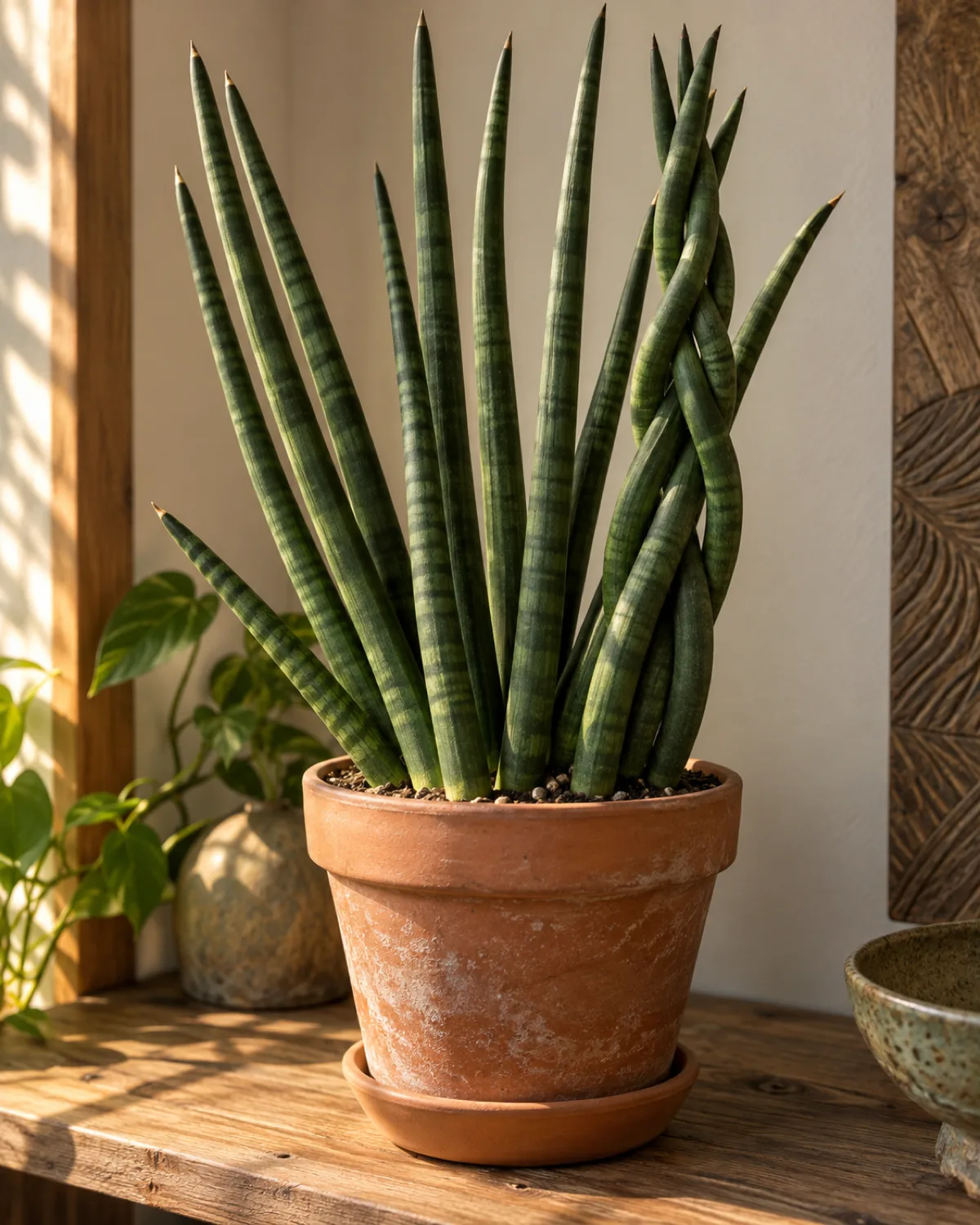
Cylindrica breaks every visual expectation of the genus. The leaves are completely round in cross-section — tubes, not blades — growing in a fan formation from the soil surface. The effect is architectural: a cluster of smooth green cylinders reaching upward like an abstract sculpture.
Nurseries often sell Cylindrica with the leaves braided or tied together, which looks striking but restricts new growth. If you buy a braided specimen, know that the braided leaves will stay braided permanently. New growth will emerge unbraided from the base, and the plant will eventually outgrow its forced shape.
- Identification tell: Round tubular leaves with no flat surface — the only common snake plant with a circular cross-section
- Confused with: Fernwood, which has narrower tubes with a slight arch — Cylindrica tubes are thicker and rigidly upright
- Growth speed: Slow, adding one to three leaves per year in good conditions
- Special note: Braided specimens cannot be unbraided without snapping the leaves — buy unbraided if you want the natural fan shape
Cylindrica is the snake plant for someone who wants a living sculpture. It reads as a design object first and a plant second, which makes it one of the few snake plants that appeals to people who do not consider themselves plant people.
Dracaena trifasciata 'Black Coral' — the moodiest Dracaena with near-charcoal pigmentation
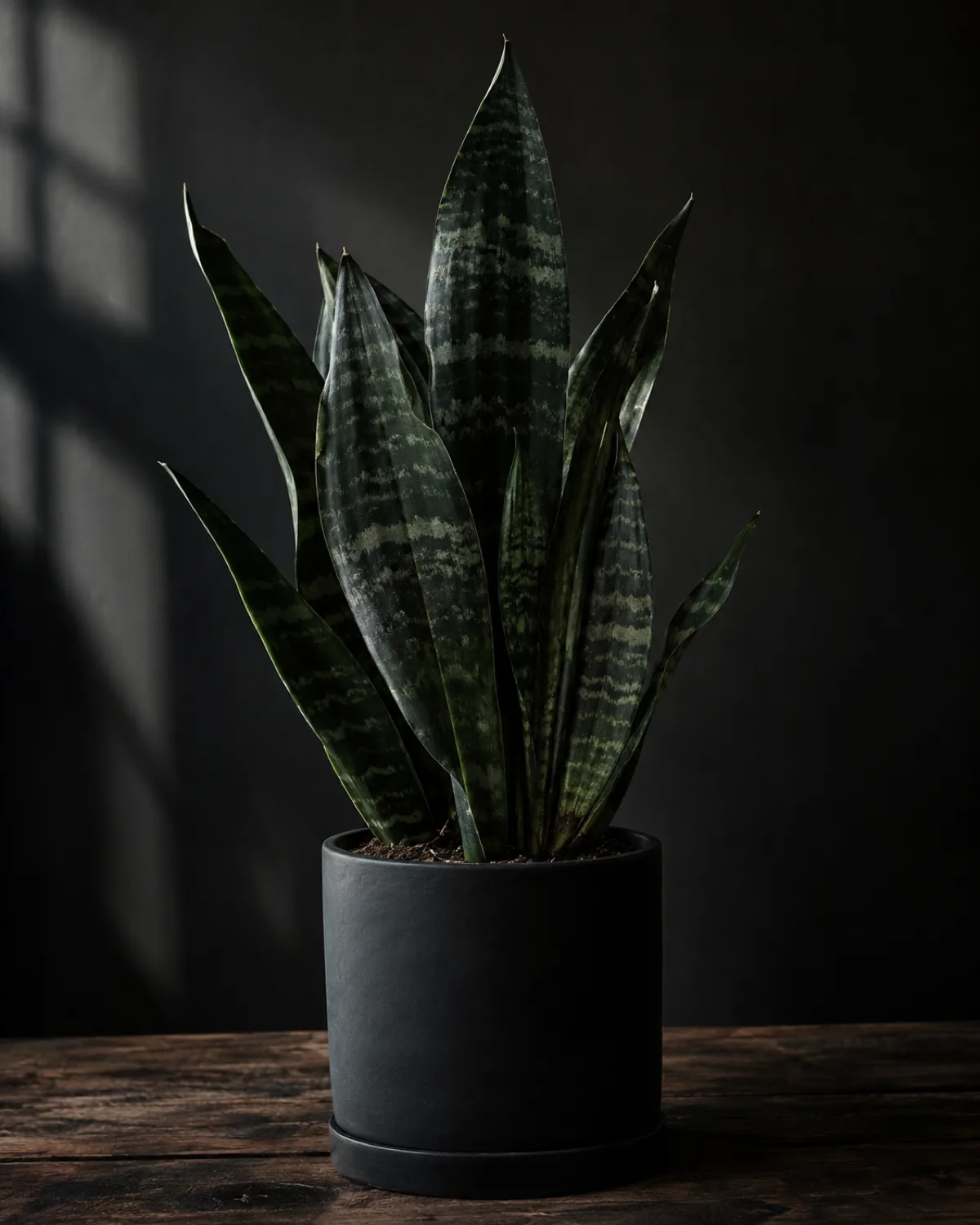
Black Coral is the dark horse in a genus dominated by greens and golds. The leaves are so deeply pigmented they read as near-black under indoor lighting, with pale gray-green crossbands emerging only when bright light hits the surface at the right angle. The effect is moody and dramatic — a plant that absorbs light rather than reflecting it.
The dark pigmentation is not a sign of stress. Black Coral is genetically selected for heavy anthocyanin production, and the near-black tone is its healthy color. If the leaves start lightening, the plant is actually asking for less light, not more — the reverse of most variegated snake plants.
- Identification tell: Leaves so dark they appear charcoal-black with faint pale crossbands — no yellow, no cream, no silver
- Confused with: A sun-stressed standard snake plant can darken, but Black Coral's dark tone is uniform and permanent
- Best display: Against a light wall or in a white or pale ceramic pot where the contrast is strongest
- Care quirk: Tolerates lower light than most varieties because the dense pigmentation absorbs photons efficiently
Black Coral is the snake plant for minimalist interiors and moody aesthetics. It pairs with matte black pots, concrete surfaces, and the kind of plant aesthetic that favors drama over cheerfulness.
Dracaena trifasciata 'Sayuri' — the silvery blue-green variety collectors chase
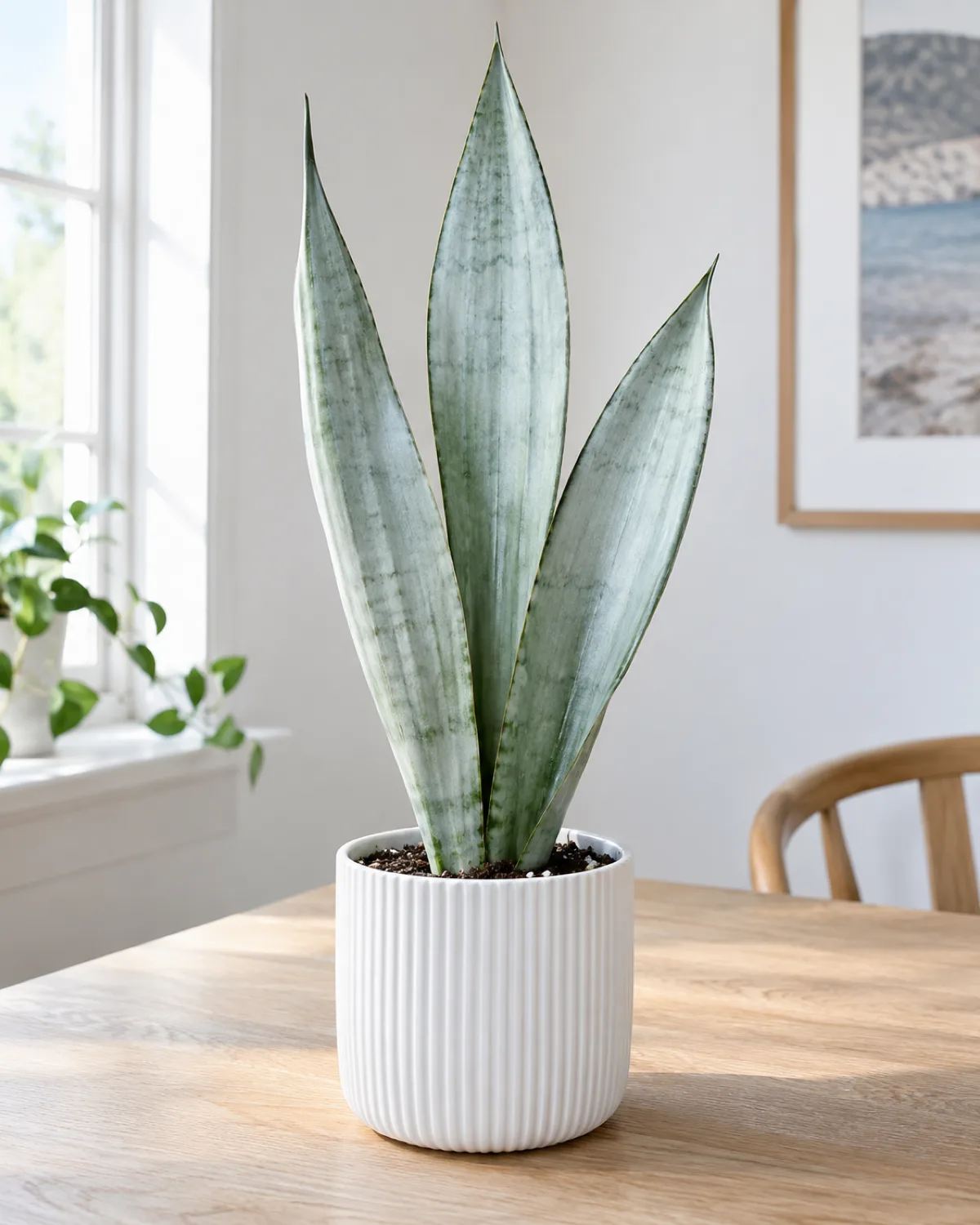
Sayuri occupies the space between Moonshine and Zeylanica — silvery like Moonshine but with a distinctly blue undertone and faint longitudinal striping that Moonshine lacks. The metallic sheen catches light differently from any other variety in the genus.
The blue tone is what most collectors are after. Where Moonshine reads as sage-silver, Sayuri reads as steel-blue with a frosted quality. Side by side, the difference is obvious. Alone on a shelf, Sayuri can be mistaken for Moonshine by anyone who has not seen both varieties.
- Identification tell: Blue-silver tone with faint vertical striping — wider leaves than Moonshine and bluer in hue
- Confused with: Moonshine (same silver palette but greener, without the blue tone or vertical striping)
- Availability: Less common than Moonshine — specialty nurseries and online sellers are the usual sources
- Light needs: Bright indirect light to maintain the blue-silver color — darkens in low light like Moonshine but with a gray-green shift instead of pure green
Sayuri is the collector's Moonshine. It does everything Moonshine does but with a cooler palette that photographs as more contemporary and pairs differently with interior finishes.
Dracaena trifasciata 'Bantel's Sensation' — the thin-leaved variety with white vertical stripes
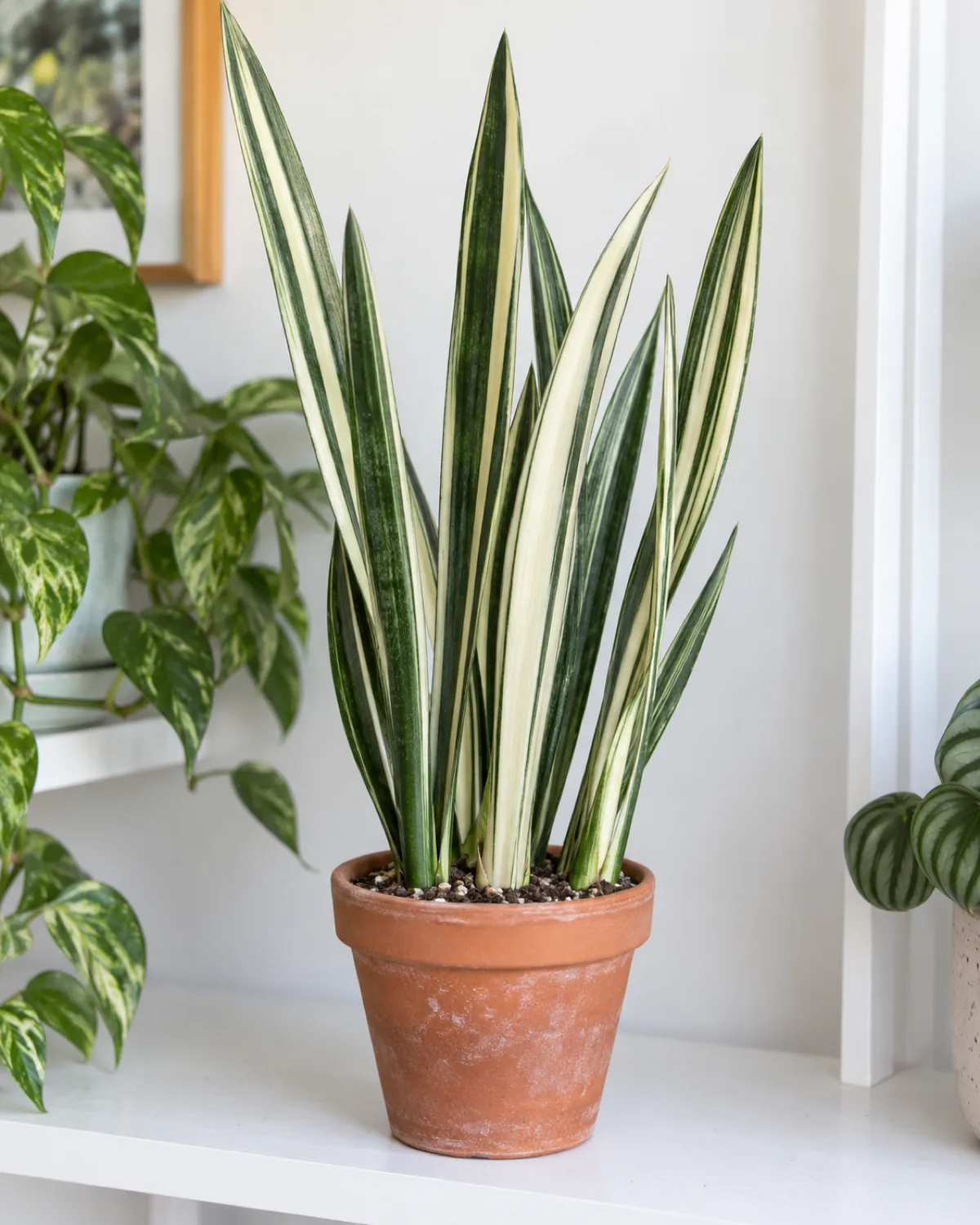
Bantel's Sensation breaks the genus pattern in one important way: the variegation runs vertically. Every other variety on this list carries horizontal crossbanding. Bantel's has cream-white longitudinal stripes running the full length of each narrow leaf, alternating with dark green in a pinstripe pattern.
The narrow leaves and heavy white variegation make Bantel's the most delicate-looking snake plant. It is also one of the slowest growers in the genus because the white stripes contain no chlorophyll — the plant runs on the green stripes alone, which limits photosynthetic capacity.
- Identification tell: Narrow leaves with cream-white vertical stripes — the only common variety with longitudinal variegation
- Confused with: Nothing common — the vertical stripe pattern is unique among snake plants sold in nurseries
- Growth speed: The slowest on this list — expect one to two new leaves per year even in bright light
- Sensitivity: More prone to overwatering damage than other varieties because the thin leaves hold less water reserve
Bantel's Sensation is the snake plant for the patient collector. It rewards waiting with a texture that no other houseplant in the genus — or in most collections — replicates.
Dracaena trifasciata 'Hahnii' (Bird's Nest) — the rosette-forming dwarf that stays tabletop-sized
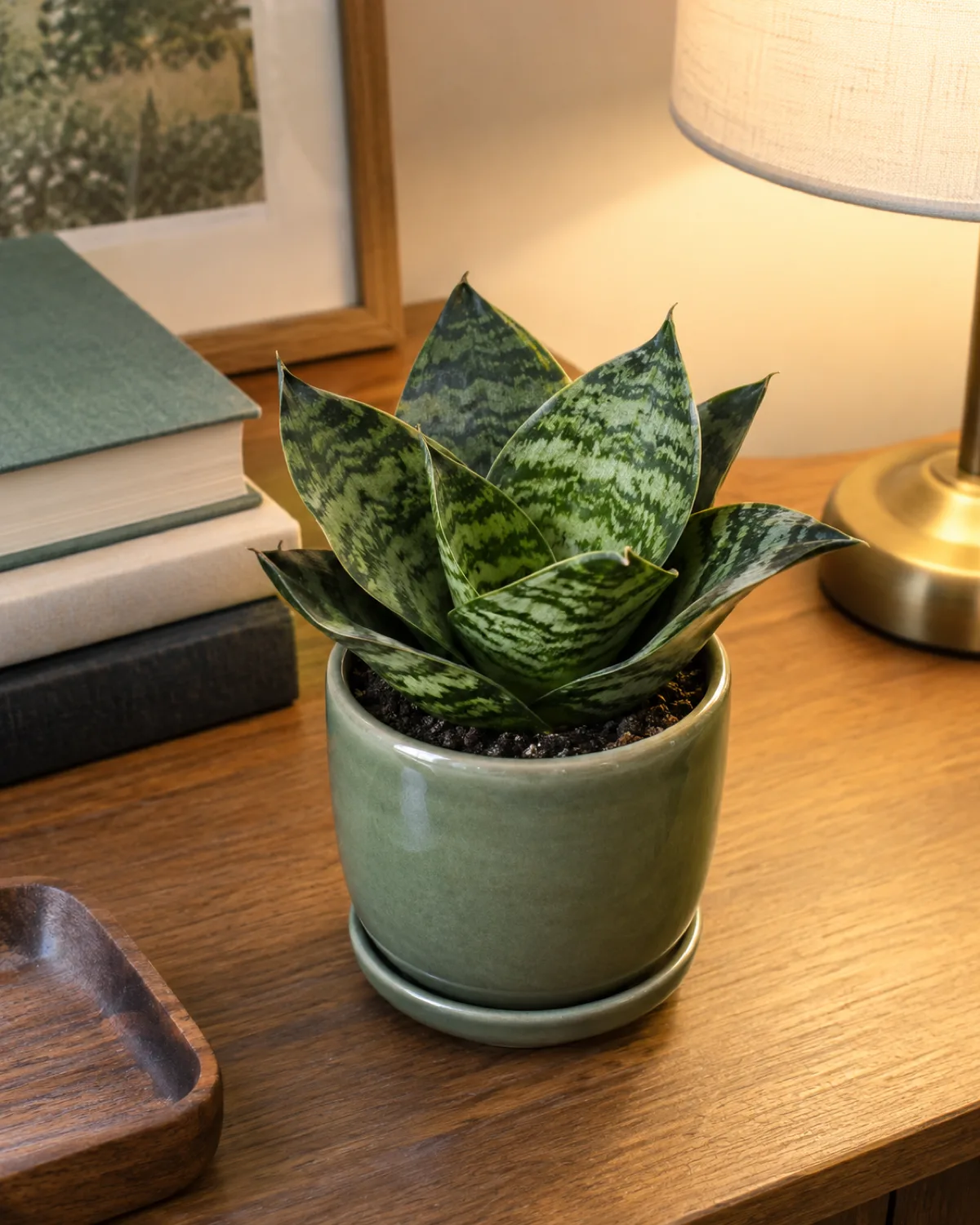
Hahnii is a sport — a spontaneous mutation — of the standard snake plant that was discovered in a New Orleans nursery in 1939. Instead of growing tall sword-shaped leaves, it produces a compact rosette that stays six to eight inches tall indefinitely. The leaves curve outward to form a cup or bird's nest shape that gives the cultivar its common name.
The banding pattern mirrors the standard species: dark green horizontal crossbands on a lighter green background. The difference is entirely in the growth habit. Hahnii makes pups freely, and within a year a single rosette can become a cluster of four or five nestled together in the pot.
- Identification tell: Compact rosette under eight inches with leaves curving outward to form a cup shape
- Confused with: Golden Hahnii (same shape but with gold margins) and Star Canary (same shape but with gold centers)
- Best use: Desks, bookshelves, bathroom ledges, and windowsills — anywhere a tall snake plant would overwhelm the space
- Propagation: Pups separate easily with a clean knife cut through the connecting rhizome
Hahnii proves that the snake plant body plan is more flexible than the sword-leaf stereotype suggests. The rosette form opens up placement options that tall varieties cannot serve.
Dracaena trifasciata 'Golden Hahnii' — the gold-margined bird's nest miniature
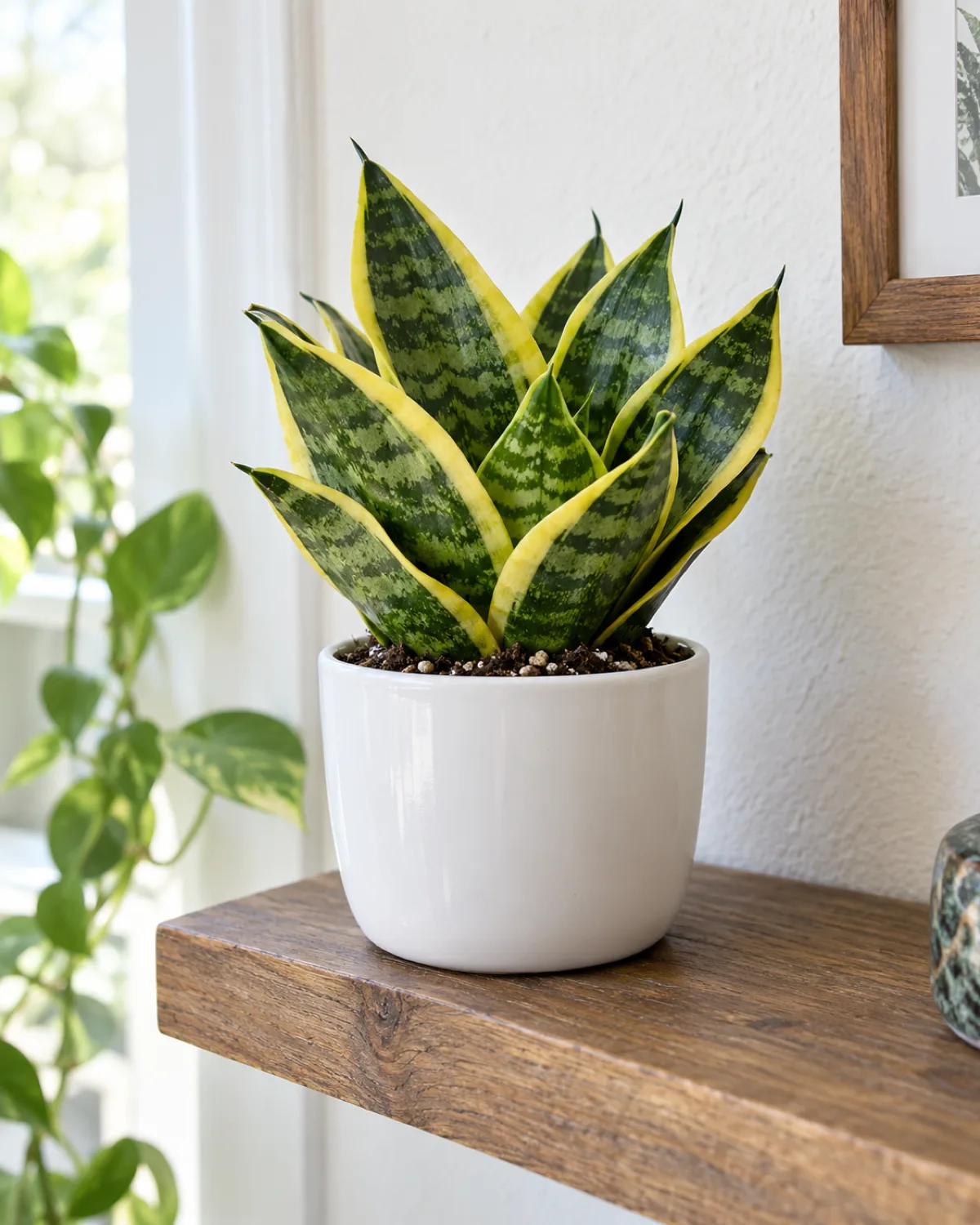
Golden Hahnii is Hahnii with Laurentii's color scheme compressed into a rosette. The compact cup shape stays identical — six to eight inches, outward-curving leaves — but each leaf carries bright golden-yellow margins that frame the dark green center.
The gold is the same chimeral variegation found in Laurentii, which means the same propagation rule applies: leaf cuttings lose the gold and revert to green. Division is the only way to maintain the variegated pattern in new plants.
- Identification tell: Compact rosette with Laurentii-style gold margins — a miniature version of the most popular snake plant
- Confused with: Star Canary, which has gold in the center of the leaf rather than on the margins — the color is reversed
- Size: Under eight inches at maturity — slightly smaller than plain Hahnii in most growing conditions
- Display: A matched trio of Golden Hahnii in identical pots creates a more impactful display than a single specimen
Golden Hahnii is the shelf-sized version of Laurentii. It delivers the same gold-and-green contrast in a footprint that fits a bedroom nightstand or a kitchen windowsill.
Dracaena trifasciata 'Whale Fin' — the single-leaf giant with paddle-shaped foliage
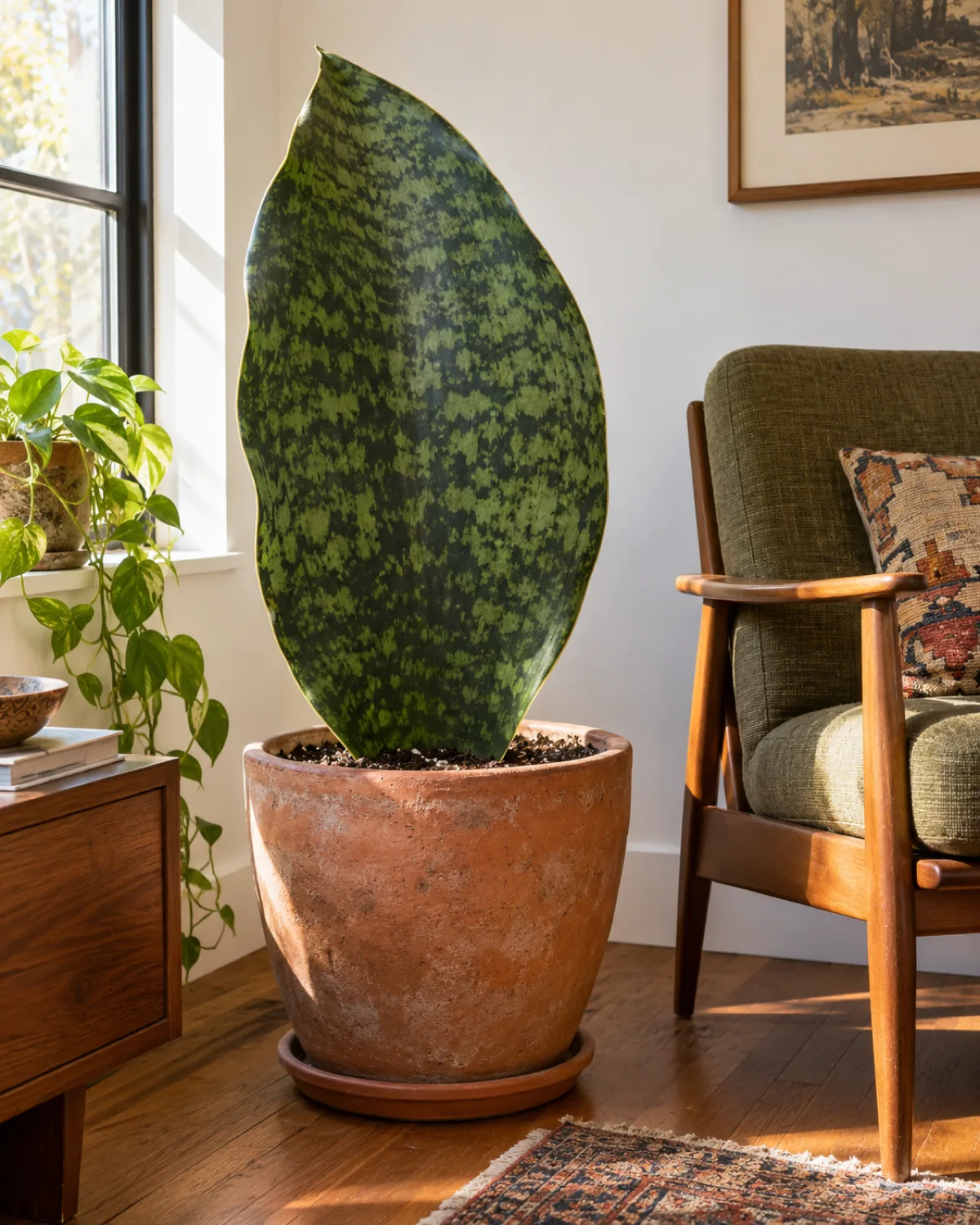
Whale Fin produces one enormous leaf per growth point — a broad paddle that can reach eighteen inches wide and over two feet tall. The mottled dark-green-and-light-green pattern spreads unevenly across the surface, and no two Whale Fin leaves carry the same pattern.
The single-leaf habit is what makes Whale Fin unmistakable. Where every other snake plant on this list forms a cluster of multiple leaves, Whale Fin sends up one leaf at a time from a thick underground rhizome. A mature specimen may have two or three leaves, but they emerge singly with long intervals between them.
- Identification tell: A single broad paddle-shaped leaf per growth point — no other snake plant looks like this
- Confused with: Nothing — the growth habit is unique in the genus
- Growth speed: Extremely slow — a single new leaf can take a year or more to fully emerge and harden
- Pot size: Needs a heavy pot to counterbalance the wide leaf — top-heaviness is the main display challenge
Whale Fin is the collector's trophy. It occupies the sculptural end of the snake plant spectrum alongside Cylindrica, but where Cylindrica multiplies into a cluster, Whale Fin stays solitary and monumental. One leaf, one statement.
Dracaena trifasciata 'Twisted Sister' — the curly variety with spiraling gold-edged leaves
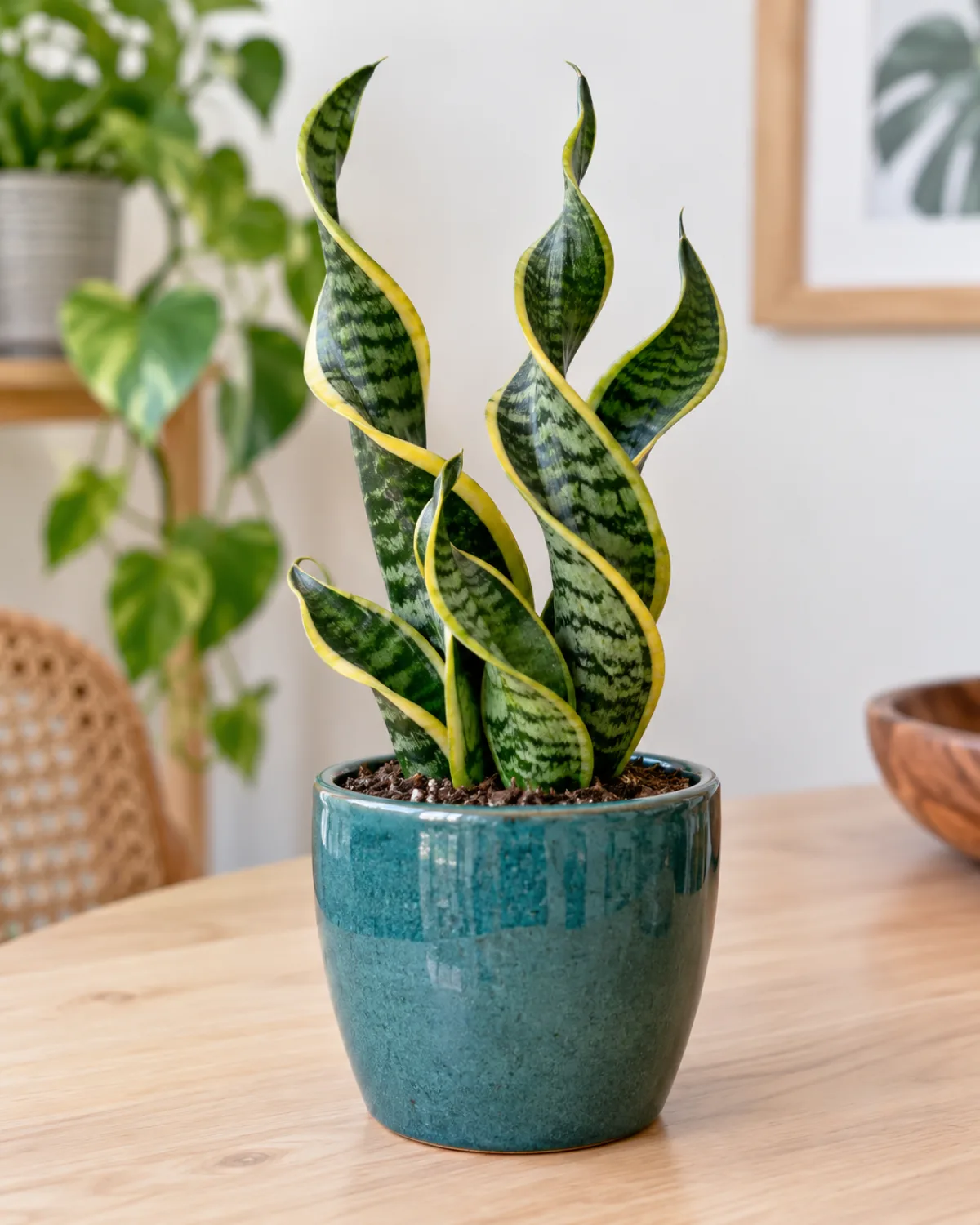
Twisted Sister adds movement to a genus defined by rigidity. The compact leaves carry the same gold-edged variegation as Laurentii but twist as they grow, spiraling outward in a dynamic form that no other snake plant achieves. The effect is playful — a plant that looks like it was caught mid-dance.
The twist is genetic, not environmental. Every leaf curls the same way regardless of light direction, pot orientation, or watering schedule. The plant stays compact — closer to Hahnii in height than to Laurentii — which makes the twist visible from any angle without the leaf reaching too far in one direction.
- Identification tell: Spiraling, curling leaves with gold margins — the only snake plant variety with a twist in its growth habit
- Confused with: Nothing — the twist is diagnostic
- Size: Compact, reaching ten to twelve inches in most conditions — a shelf or tabletop variety
- Display: Place it where the twist can be seen in profile — a side view shows the spiral better than a top-down view
Twisted Sister is the snake plant that earns a double-take. It has the color palette of Laurentii and the size of Hahnii, but the twist gives it a personality that neither parent variety possesses.
Dracaena trifasciata 'Fernwood' — the narrow cylindrical hybrid with arching habit
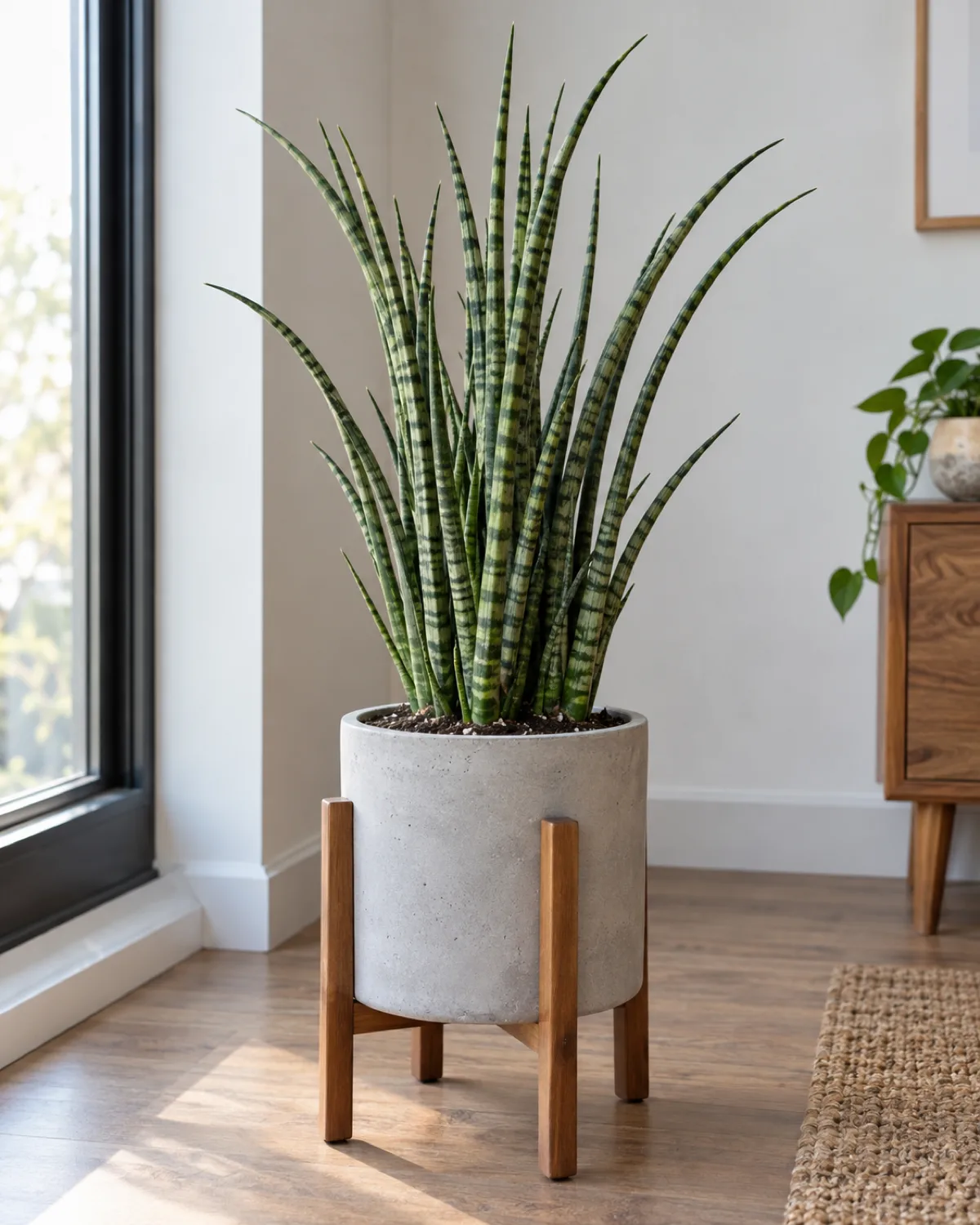
Fernwood is a hybrid that crosses the tubular leaf shape of Cylindrica with a more graceful growth habit. The leaves are narrower than Cylindrica tubes, with a slight arch that gives the clump a softer silhouette. The banding pattern reads as tiger-stripe — defined dark green bars on a lighter green background.
Where Cylindrica grows rigidly upright, Fernwood's leaves curve outward at the tips. The plant also clumps more readily, producing pups faster than Cylindrica and filling a pot with a dense thicket of arching tubes within a couple of years.
- Identification tell: Narrow cylindrical leaves thinner than Cylindrica, with a graceful arch and tiger-stripe banding
- Confused with: Cylindrica (thicker, rigidly upright, no arch) and the less common 'Fernwood Mikado' (even thinner tubes)
- Growth speed: Faster than Cylindrica — clumps fill out within one to two years
- Best display: A tall, narrow pot that lets the arching tips extend past the rim — plant stands at eye level show the architecture best
Fernwood is the approachable version of Cylindrica. It has the same architectural quality — tubular leaves that read as modern sculpture — but the arch and the faster growth make it less static and more forgiving of imperfect placement.
Dracaena trifasciata 'Star Canary' — the compact gold rosette that reverses the color map
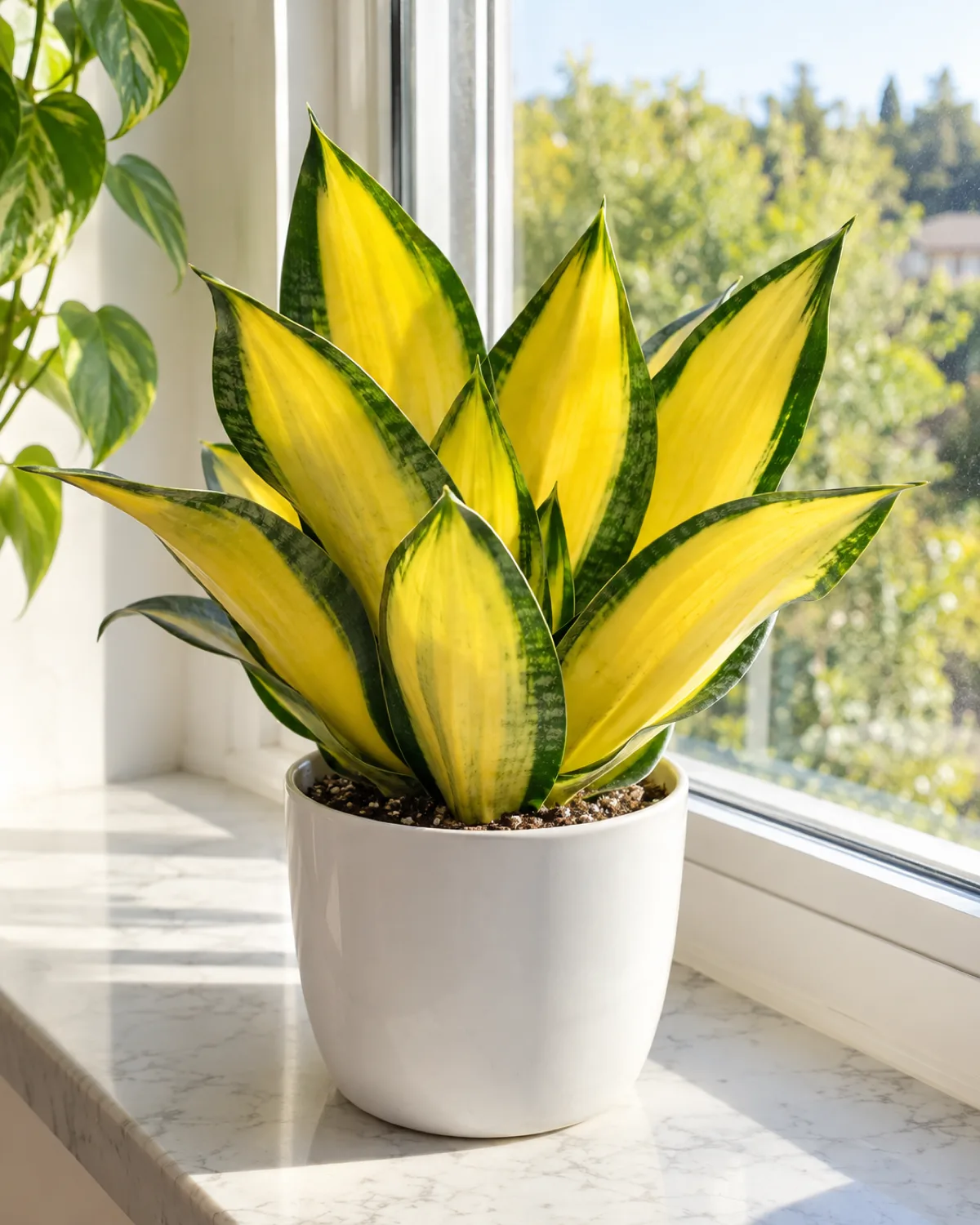
Star Canary closes this list with a color reversal. Where Golden Hahnii puts gold on the margins and green in the center, Star Canary flips the pattern: vivid golden-yellow dominates the center of each leaf while dark green frames the edges. The effect is a rosette that reads as gold first and green second.
The wider leaves distinguish Star Canary from Golden Hahnii even when the color pattern is ambiguous. Star Canary leaves are broader and slightly rounder, with the gold zone covering a larger proportion of the leaf surface. In bright light the gold intensifies to almost yellow, making this the most chromatically vivid snake plant in the dwarf category.
- Identification tell: Gold center with dark green margins — the reverse of Golden Hahnii's gold-margin-green-center pattern
- Confused with: Golden Hahnii — the color zones are inverted, and Star Canary's leaves are wider
- Light needs: Bright indirect light to maintain the vivid gold center — in low light the gold fades to chartreuse
- Availability: Less common than Golden Hahnii — specialty sellers and collector markets
Star Canary is the bookend to this collection. From Laurentii's gold-edged swords to Star Canary's gold-centered rosettes, the genus spans the full range of what a leaf can do with two pigments and a hundred years of cultivar selection.
13 Snake Plant Varieties Worth Collecting
- 1Laurentii — the gold-edged classicBold yellow margins on dark green swords. The most common and still one of the most striking.
- 2Zeylanica — the silver-banded workhorseWavy silver crossbanding without yellow edges. Fastest grower in the genus.
- 3Moonshine — the pale silver glowBroad silvery sage-green leaves that darken in low light. Collector entry point.
- 4Cylindrica — the African spearRound tubular leaves in a fan formation. Reads as sculpture, not foliage.
- 5Black Coral — the near-charcoal dramaLeaves so dark they absorb light. Best against white walls and pale pots.
- 6Sayuri — the blue-silver collector targetMetallic blue-silver tone with faint vertical striping. The cooler Moonshine.
- 7Bantel's Sensation — the vertical pinstripeCream-white longitudinal stripes on narrow leaves. Slowest grower, most unique pattern.
- 8Hahnii — the bird's nest dwarfCompact rosette under eight inches. The shelf-sized alternative to tall swords.
- 9Golden Hahnii — the gold-margined miniatureHahnii form with Laurentii gold edges. Division only to keep the variegation.
- 10Whale Fin — the single-leaf giantOne enormous paddle-shaped leaf per growth point. The collector trophy.
- 11Twisted Sister — the spiraling curlerGold-edged leaves that twist as they grow. Adds movement to a rigid genus.
- 12Fernwood — the arching cylindrical hybridTiger-striped narrow tubes with a graceful arch. The softer Cylindrica.
- 13Star Canary — the gold-centered rosetteVivid gold center with dark green margins. Golden Hahnii in reverse.
Save this list · Kultivy
FAQ
Are all snake plant varieties equally toxic to pets?
Yes. Every variety contains saponins in the leaf tissue. The toxicity is identical across all cultivars because the compound is structural, not linked to leaf color or pattern. Symptoms if a dog or cat chews a leaf:
- Nausea and drooling within minutes
- Vomiting and diarrhea if a larger piece is swallowed
- Mouth irritation that usually stops the animal from eating more
If you have pets, place snake plants on high shelves or in rooms the animals cannot access.
Can different snake plant varieties grow together in one pot?
They can share a pot because all varieties want the same soil, water, and light. The practical issue is growth rate — a fast Zeylanica will crowd out a slow Whale Fin within a year. Group varieties with similar speeds:
- Tall growers together: Laurentii, Zeylanica, Black Coral
- Compacts together: Hahnii, Golden Hahnii, Star Canary, Twisted Sister
Which snake plant variety grows the tallest?
Tallest to shortest, roughly:
- Zeylanica: Four feet or more in bright light — fastest grower, all-green leaves maximize photosynthesis
- Laurentii: Three to four feet — slightly slower than Zeylanica because the gold margins carry no chlorophyll
- Whale Fin: Leaves reach two feet, but one leaf at a time — wide rather than tall
For a floor-standing snake plant with maximum height, Zeylanica in a heavy pot is the best choice.

Mara Quinn edits Kultivy, where she shares houseplant care, propagation, beginner-friendly plant picks, and plant-styling ideas for anyone who wants their indoor plants to actually thrive. Every guide is image-led and reviewed for clarity, usefulness, image accuracy, and Pinterest-to-page alignment before it goes live. Visit the About page.