Lucky bamboo is not bamboo. It is Dracaena sanderiana from Central Africa, and the common name stuck because the segmented green stalks look like bamboo canes.
The plant became a feng shui gift-market staple, where specific stalk counts represent health, wealth, and prosperity. It also happens to be one of the easiest houseplants alive, thriving in a glass of water and indirect light.
This guide covers water culture, soil growing, shaping spirals, feng shui meanings, and the yellowing that sends most owners into a panic.
From the identity reveal to water culture, soil growing, feng shui meanings, shaping spirals, and diagnosing yellowing stalks. Jump to what you need.
What Lucky Bamboo Actually Is
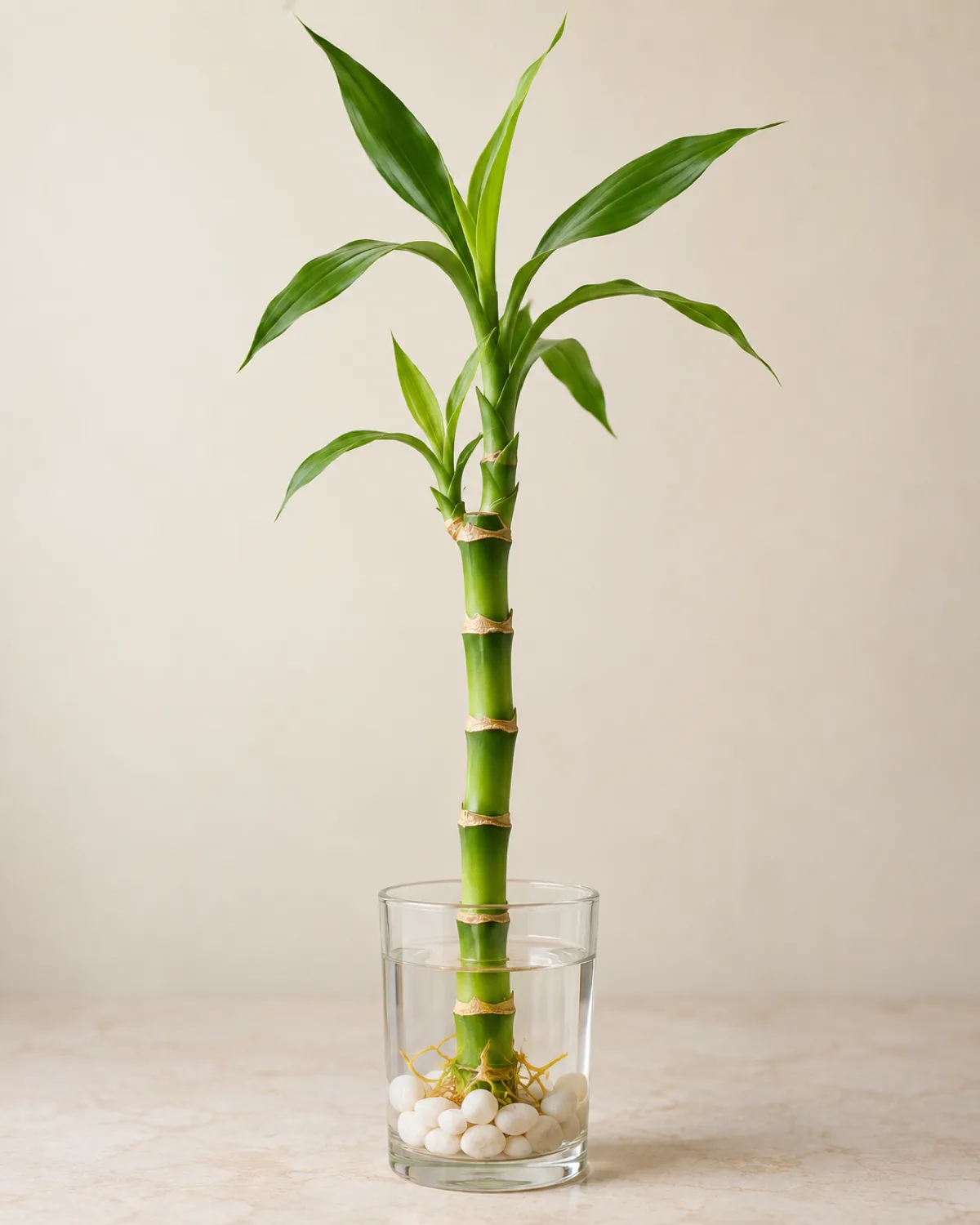
Lucky bamboo is Dracaena sanderiana, a monocot in the family Asparagaceae. It is native to the tropical rainforests of Cameroon in Central Africa, not to Asia where most people assume it originates. The plant was named after the German-English botanist Henry Frederick Conrad Sander, who ran one of the largest orchid nurseries in Victorian England.
The common name comes from the segmented green stalks that look like bamboo canes. True bamboo belongs to the grass family Poaceae and is a completely different plant — it grows outdoors, produces woody culms, and can reach sixty feet tall. Lucky bamboo rarely exceeds three feet indoors.
- Botanical name: Dracaena sanderiana (sometimes listed as Dracaena braunii)
- Family: Asparagaceae (same family as spider plant, ZZ plant, and dracaena)
- Native habitat: tropical West African rainforest understory
- Growth form: upright segmented cane with terminal leaf clusters
The plant's popularity exploded in the 1990s when it entered the feng shui gift market. Specific stalk counts carry specific meanings, turning lucky bamboo into a living greeting card that also happens to survive in a glass of water on a desk.
Light Requirements
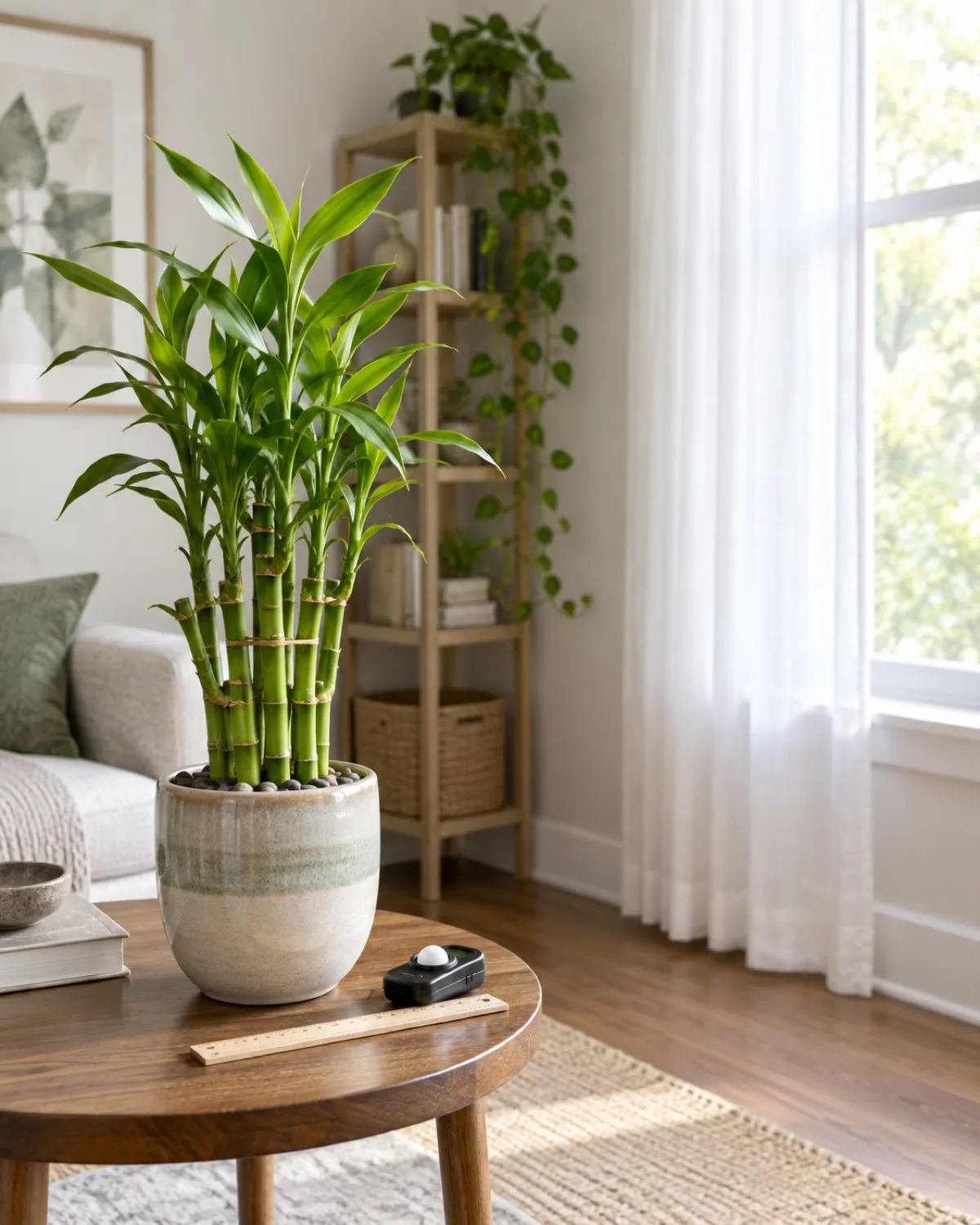
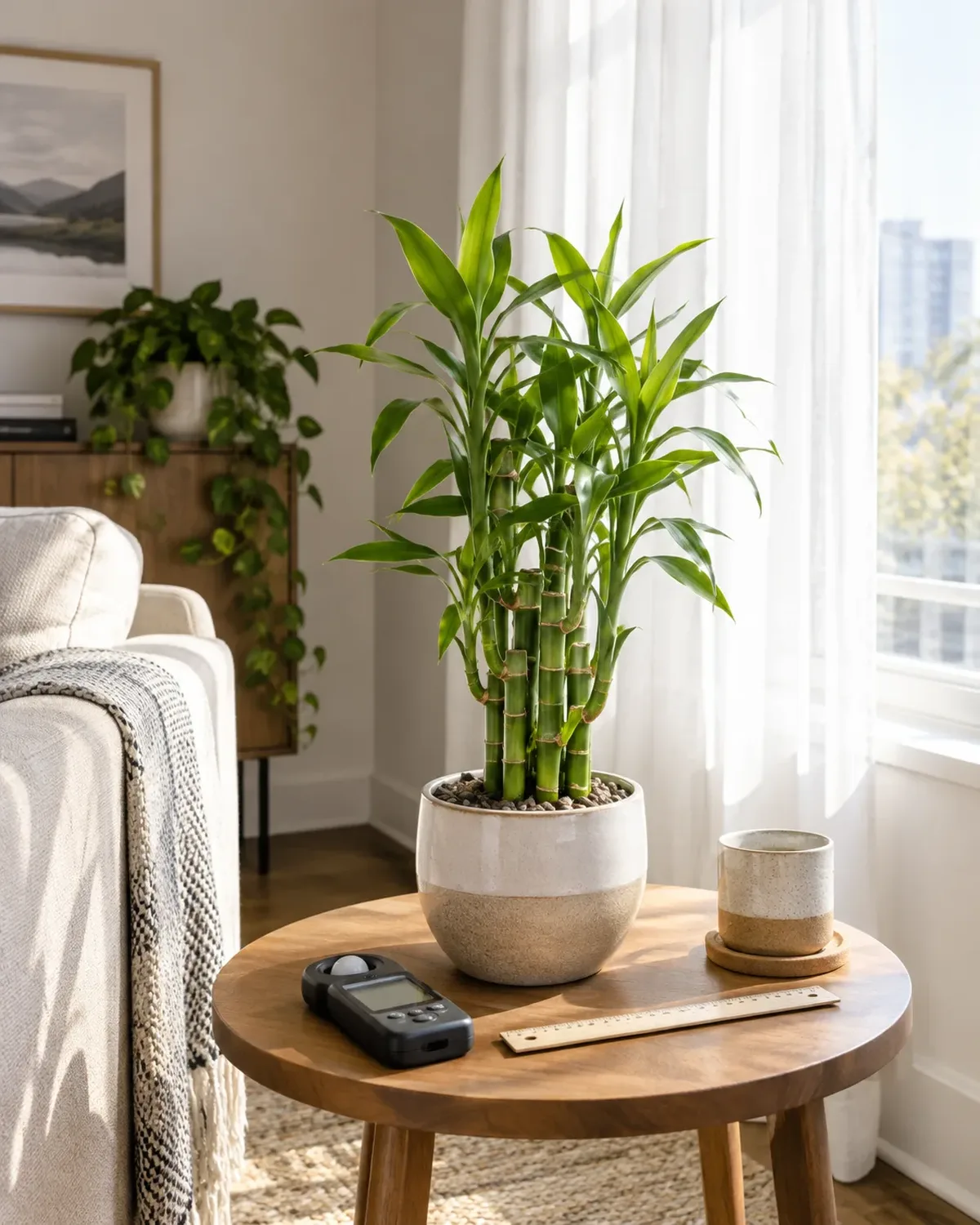
Bright indirect light is ideal. An east-facing window gives gentle morning sun without the intensity that scorches leaves. South and west windows work with a sheer curtain to filter the harshest afternoon rays.
Lucky bamboo tolerates low light better than most houseplants, which is why it survives on office desks and bathroom shelves. Growth slows in dim conditions, but the plant does not die. Direct sunlight, however, burns the leaves within days — the edges turn brown and crispy, and the stalks can bleach to a pale yellow.
- Ideal: bright indirect light, six or more hours daily
- Acceptable: moderate to low indirect light (growth slows but plant survives)
- Avoid: direct sunlight, especially afternoon sun through south or west windows
- Rotation: quarter turn weekly to prevent the stalks from leaning toward the light source
If your lucky bamboo is in a windowless room, it will survive for months but will gradually weaken. A grow light running ten to twelve hours daily can compensate for the lack of natural light.
Growing Lucky Bamboo in Water
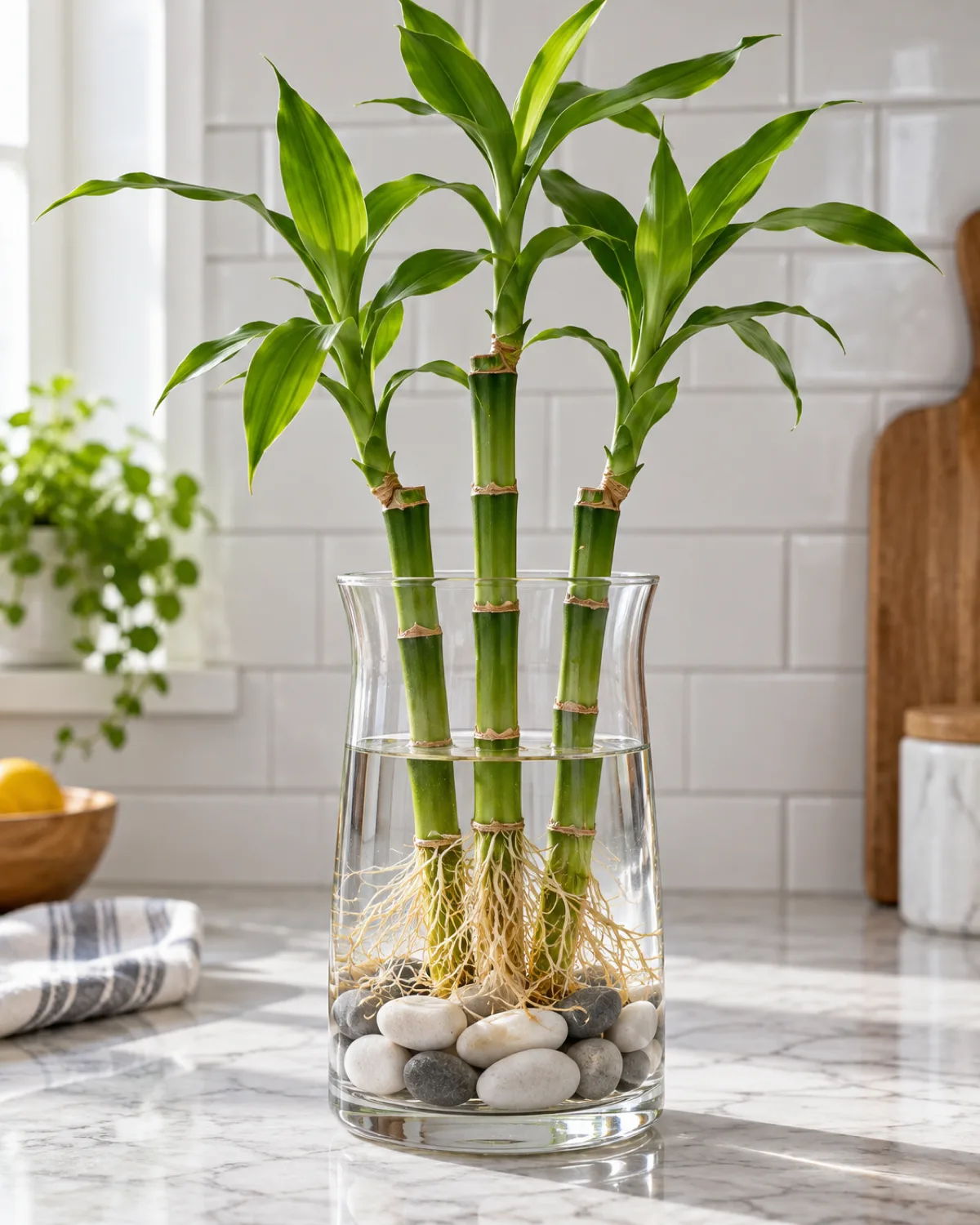
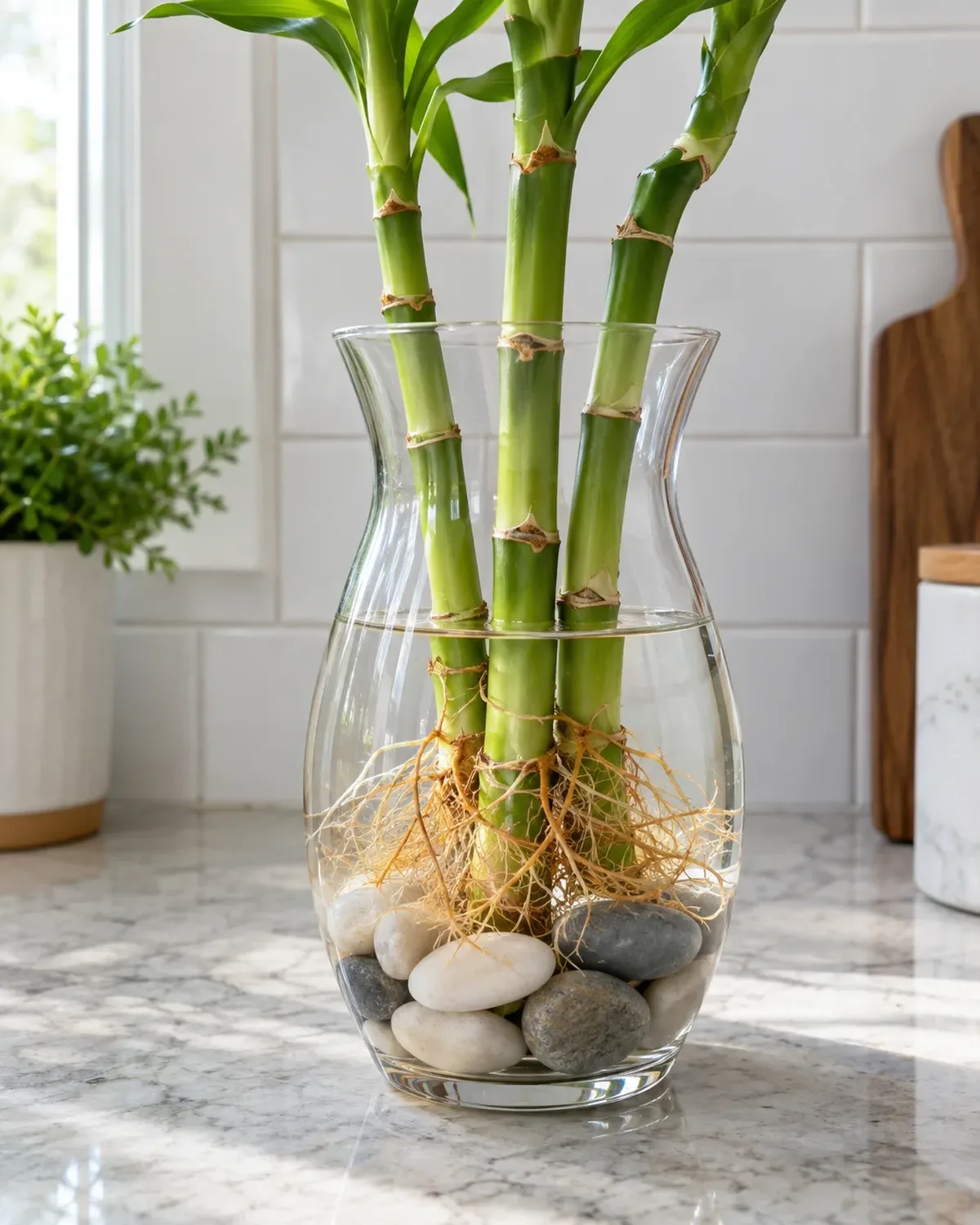
Water culture is the method most people use. The stalks stand in a glass vase with pebbles or decorative stones at the bottom for stability, and the roots grow directly into the water.
The water level should cover the roots completely — about one to two inches above the root zone. Too much water (submerging half the stalk) can cause rot above the root line. Too little leaves the roots exposed to air and they dry out.
Water quality is the make-or-break factor. Lucky bamboo is extremely sensitive to fluoride and chlorine, both common in municipal tap water. Use one of these alternatives:
- Distilled water: the safest option, available at any grocery store
- Filtered water: a basic carbon filter (Brita, PUR) removes chlorine but may not remove fluoride
- Rainwater: naturally free of both chemicals
- Tap water left out 24 hours: chlorine evaporates but fluoride does not — this only works if your water supply is not fluoridated
The vase does not need drainage holes because the plant is growing hydroponically. Choose a container that lets light reach the roots — clear glass is the classic choice, though opaque ceramic works if you check the water level regularly.
Growing Lucky Bamboo in Soil
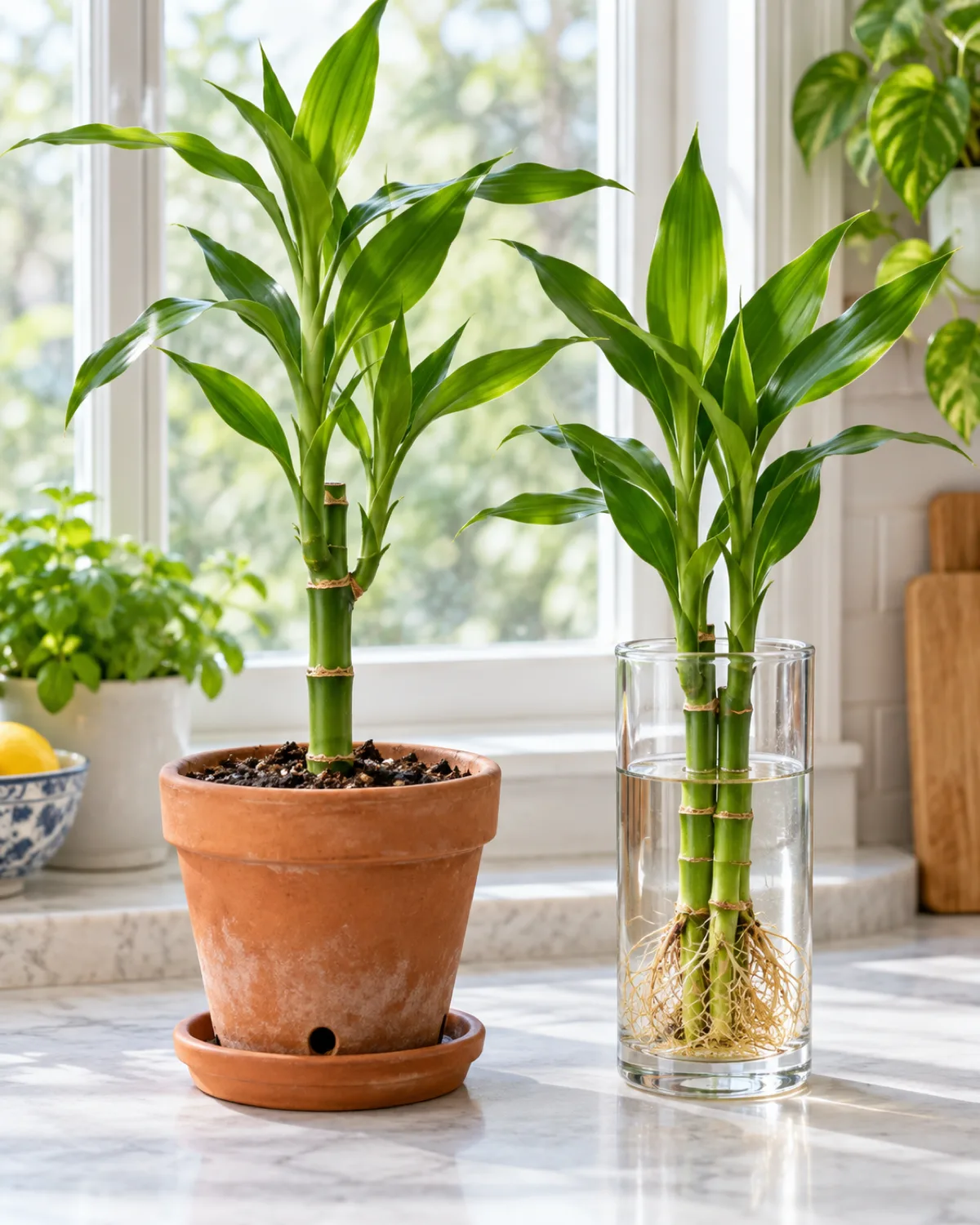
Soil culture produces faster growth and a larger root system. The plant accesses more nutrients from potting mix than from water alone, and the root structure becomes stronger over time.
Use a well-draining mix. One part standard potting soil, one part perlite, and a handful of peat moss creates the right balance — moist enough to keep the roots happy, loose enough to prevent waterlogging.
- Water when the top inch of soil feels dry, roughly once a week
- Ensure the pot has drainage holes — standing water at the bottom causes root rot
- Soil-grown lucky bamboo can eventually outgrow its desk-plant proportions, reaching two to three feet with wider leaf clusters
Transitioning a water-grown plant to soil is straightforward. Remove it from the vase, rinse the roots gently, plant in moistened potting mix, and water thoroughly. The plant may drop a leaf or two during the adjustment, but it recovers within a few weeks.
Soil culture is the better choice for anyone who wants the plant to grow larger over the long term. Water culture is better for decorative tabletop arrangements and gift presentations.
Fertilizing Lucky Bamboo
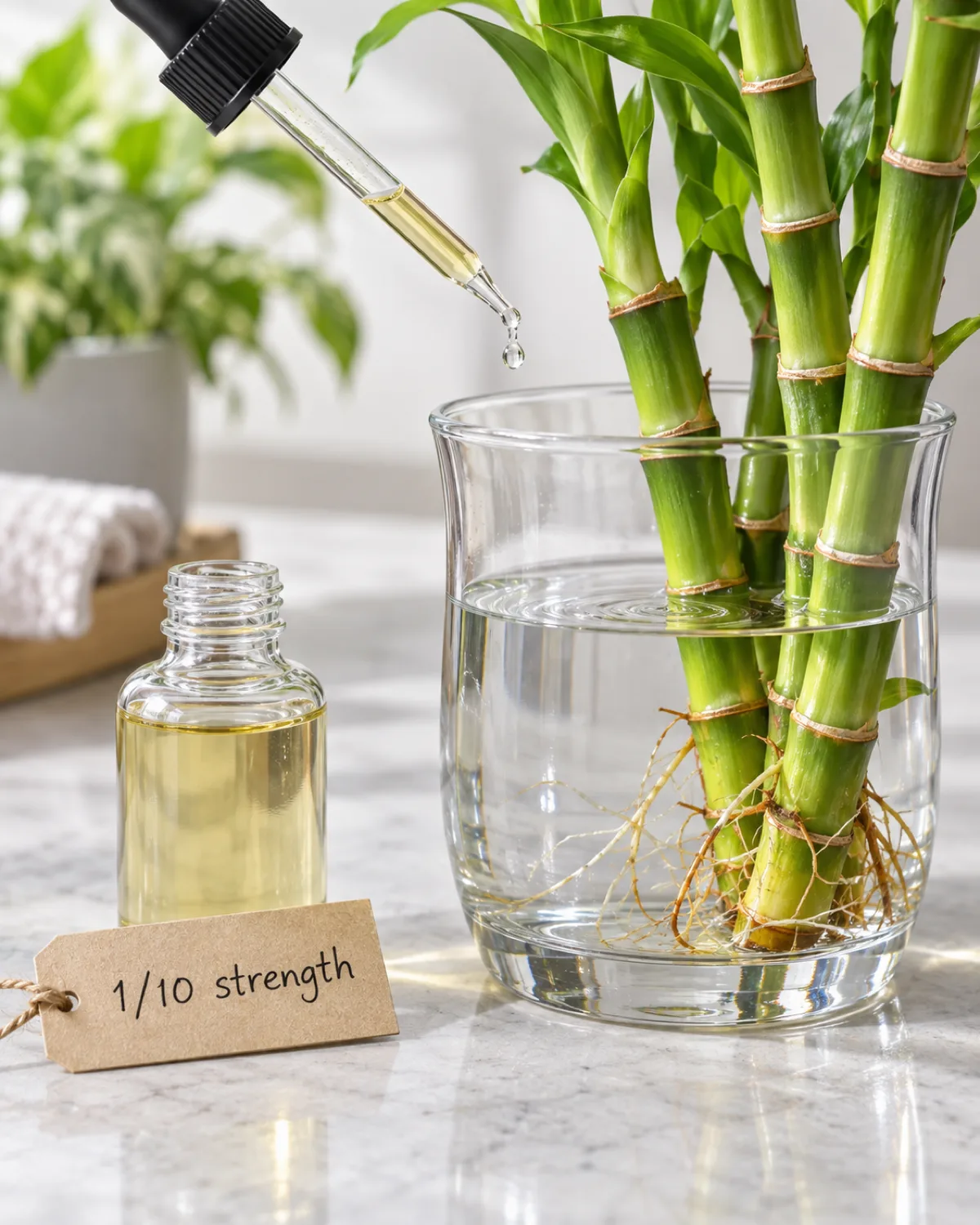
Lucky bamboo in water needs almost no fertilizer. One drop of liquid houseplant fertilizer diluted to one-tenth the label strength, added every two months, is enough. Overfertilizing is far more dangerous than underfertilizing — excess nutrients in a small vase of water burn the roots and turn the leaves yellow within days.
For soil-grown plants, the feeding schedule is slightly more generous:
- Water culture: one drop of diluted (1/10 strength) liquid fertilizer every two months
- Soil culture: standard liquid houseplant fertilizer at half strength, once a month during spring and summer, none in winter
- Signs of overfertilizing: brown or yellow leaf tips, salt crust on the soil surface or pebbles, algae bloom in the water
- Signs of underfertilizing: pale green leaves, slow growth (though slow growth in lucky bamboo is normal)
Dedicated lucky bamboo plant food exists and is pre-diluted to the correct strength. It is convenient but not necessary — any balanced liquid houseplant fertilizer works at the right dilution.
If you see brown tips after fertilizing, flush the system. For water culture, dump the water, rinse the roots and pebbles, and refill with clean filtered water. For soil, water thoroughly until liquid runs from the drainage holes, flushing the excess salts.
Temperature and Humidity
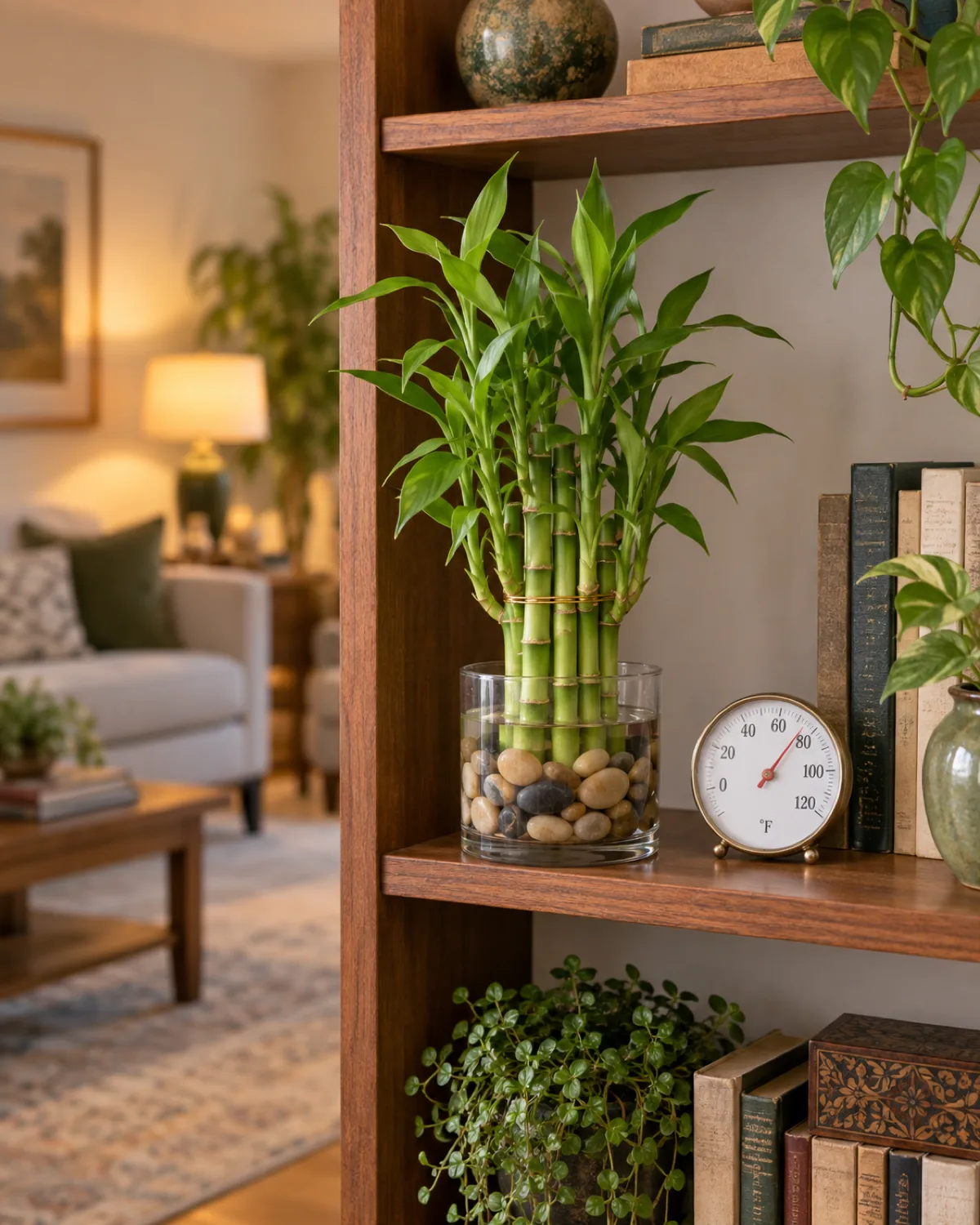
Lucky bamboo prefers the same temperature range as most people — sixty-five to ninety degrees Fahrenheit. It does best in the mid-seventies, which is conveniently close to standard indoor thermostat settings.
Cold is the real threat. Temperatures below fifty degrees Fahrenheit cause cold shock: the leaves droop, the stalks soften, and the plant may not recover. Keep it away from drafty windows in winter, exterior doors, and air conditioning vents that blow cold air directly onto the foliage.
Average household humidity is fine for lucky bamboo. Unlike ferns or calathea, which demand fifty to sixty percent humidity, lucky bamboo does not need a humidifier, pebble tray, or misting routine.
- Ideal temperature: 65–90°F (18–32°C)
- Danger zone: below 50°F (10°C) — cold shock, leaf drop
- Humidity: standard household humidity (30–50%) is sufficient
- Avoid: heating vents, radiators, drafty windows, AC direct blast
Feng Shui Stalk Meanings
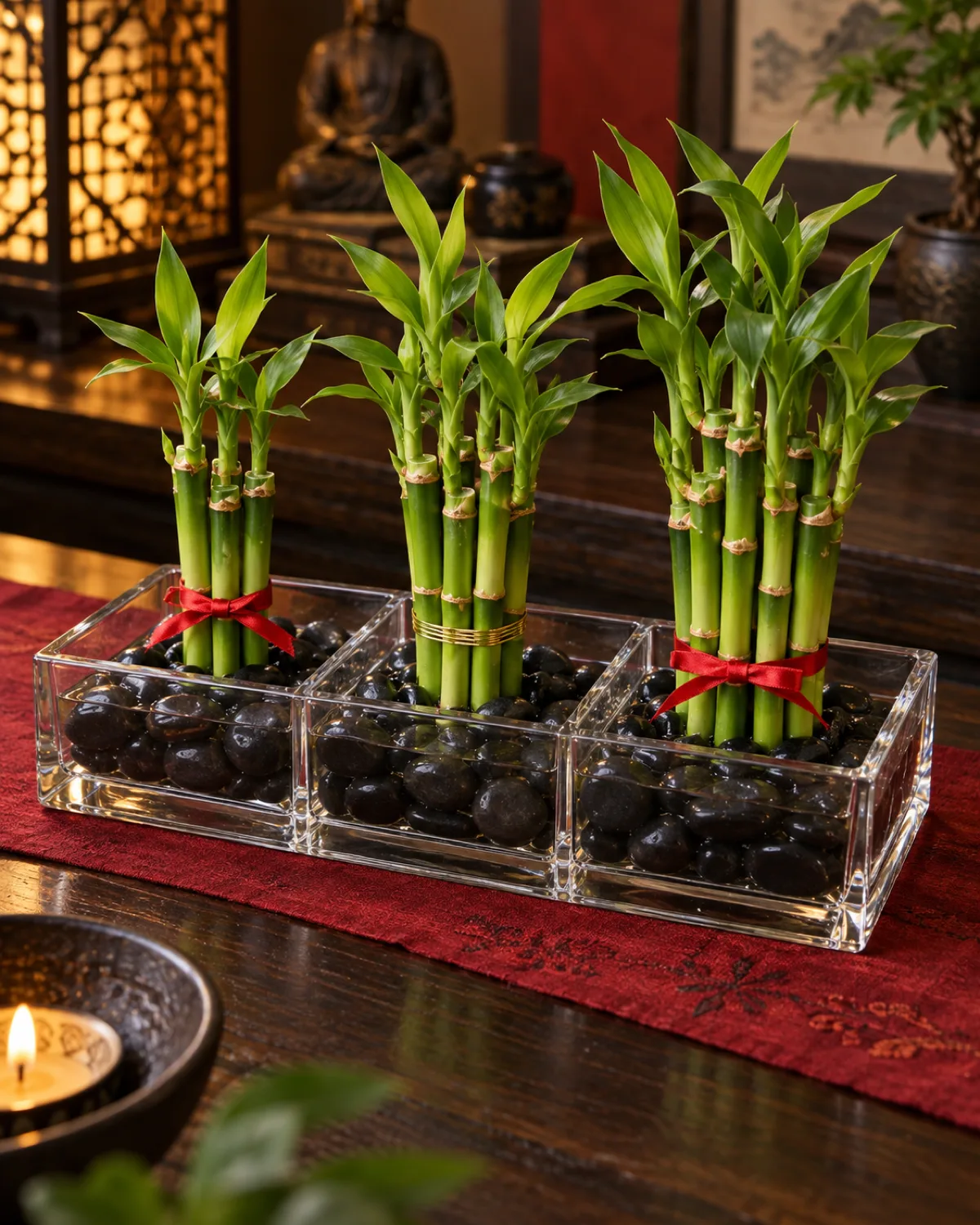
The number of stalks in a lucky bamboo arrangement carries specific meaning in feng shui practice. This is the primary reason the plant became a global gift item — you can send a coded message through the number of stalks you choose.
- 2 stalks: love and marriage — a common wedding or anniversary gift
- 3 stalks: happiness, wealth, and longevity — the most popular everyday arrangement
- 5 stalks: health in all five areas of life (emotional, intuitive, mental, physical, spiritual)
- 7 stalks: good health
- 8 stalks: growth, wealth, and prosperity — eight is the luckiest number in Chinese culture
- 9 stalks: great luck
- 21 stalks: a powerful all-purpose blessing
Never give four stalks. The number four is associated with death in Chinese culture because the word for "four" sounds nearly identical to the word for "death" in Mandarin, Cantonese, and several other Chinese dialects.
Placement also matters in traditional practice. The east sector of a room is associated with family health. The southeast sector is associated with wealth. A lucky bamboo arrangement in either location is considered auspicious.
Whether or not you follow feng shui principles, the stalk-count tradition is a useful gift-giving framework — it turns a simple plant into something personal.
Yellowing Stalks and Brown Tips
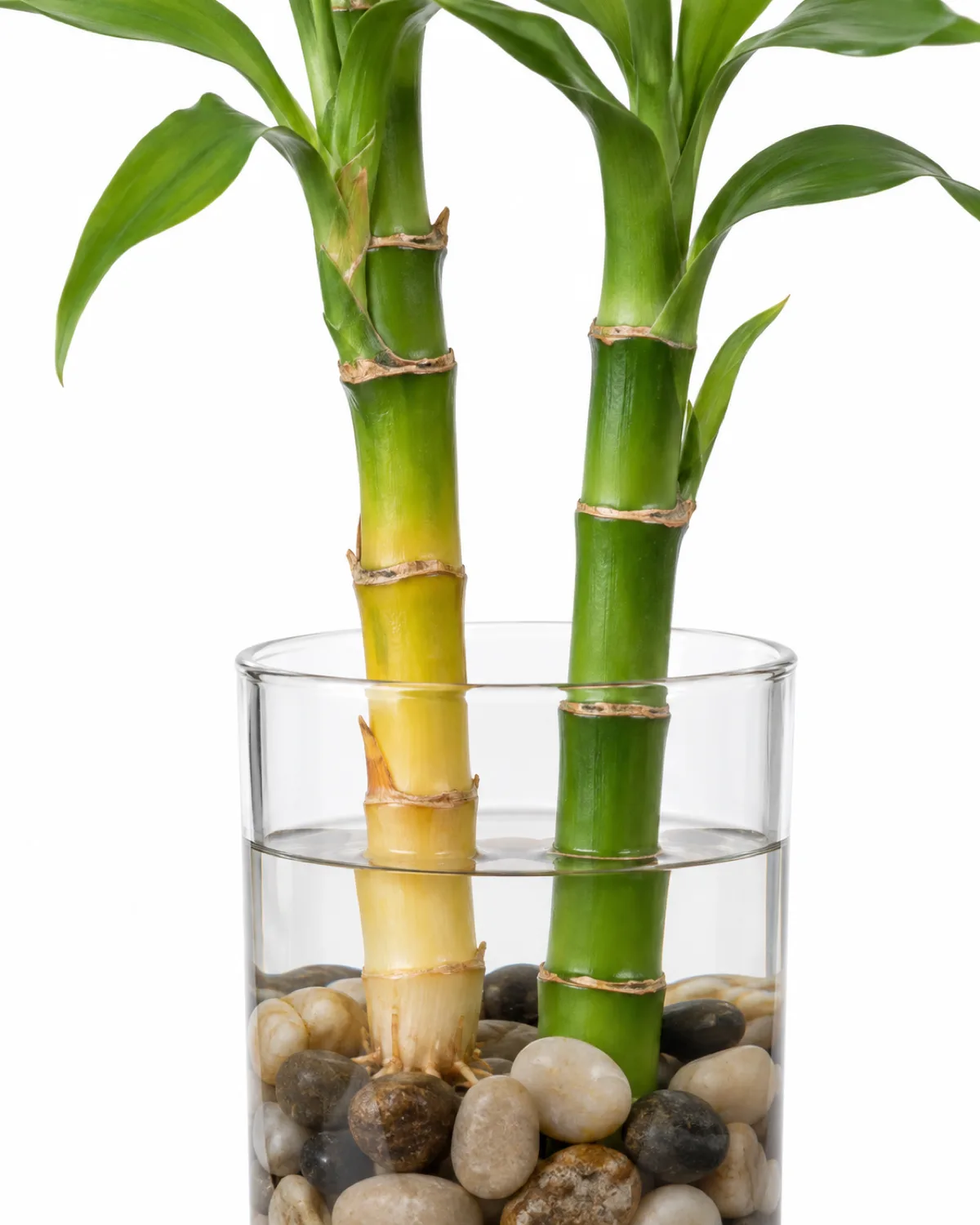
A yellowing stalk is the most common panic trigger for lucky bamboo owners. The cause is almost always one of five things, and identifying the right one determines whether the plant can be saved.
Chlorinated or fluoridated water is the most frequent cause. Yellowing starts at the leaf tips and spreads inward. Brown, crispy tips are the early signal — fluoride accumulates at the leaf margins first, then the entire leaf yellows. Switch to distilled or filtered water and new growth will come in green, though damaged parts will not revert.
Direct sunlight burns the leaves and can bleach the stalk itself. Move the plant to bright indirect light immediately.
Overfertilizing causes rapid yellowing from nutrient burn. Flush the water, rinse the roots, and skip fertilizer for at least two months.
- Overwatering in soil culture: soggy soil suffocates the roots, triggering yellowing from the base up
- Mineral buildup: salts from fertilizer or hard water cause brown tips. Flush the system — change water or water soil plants until liquid runs freely from drainage holes
- Natural aging: the oldest, lowest leaves occasionally yellow and drop off as the plant grows — this is normal and not a sign of disease
- Root rot: soft, mushy, brown roots with a foul smell — this is the terminal stage. Cut above the rot with a sterile blade and try to re-root the healthy top portion
If only one stalk in a multi-stalk arrangement is yellowing, remove it immediately. Rot can spread to neighboring stalks through shared water. Trim brown tips with clean scissors at a forty-five-degree angle to mimic the natural leaf shape — trimming is purely cosmetic and does not harm the plant.
Shaping and Curling Lucky Bamboo
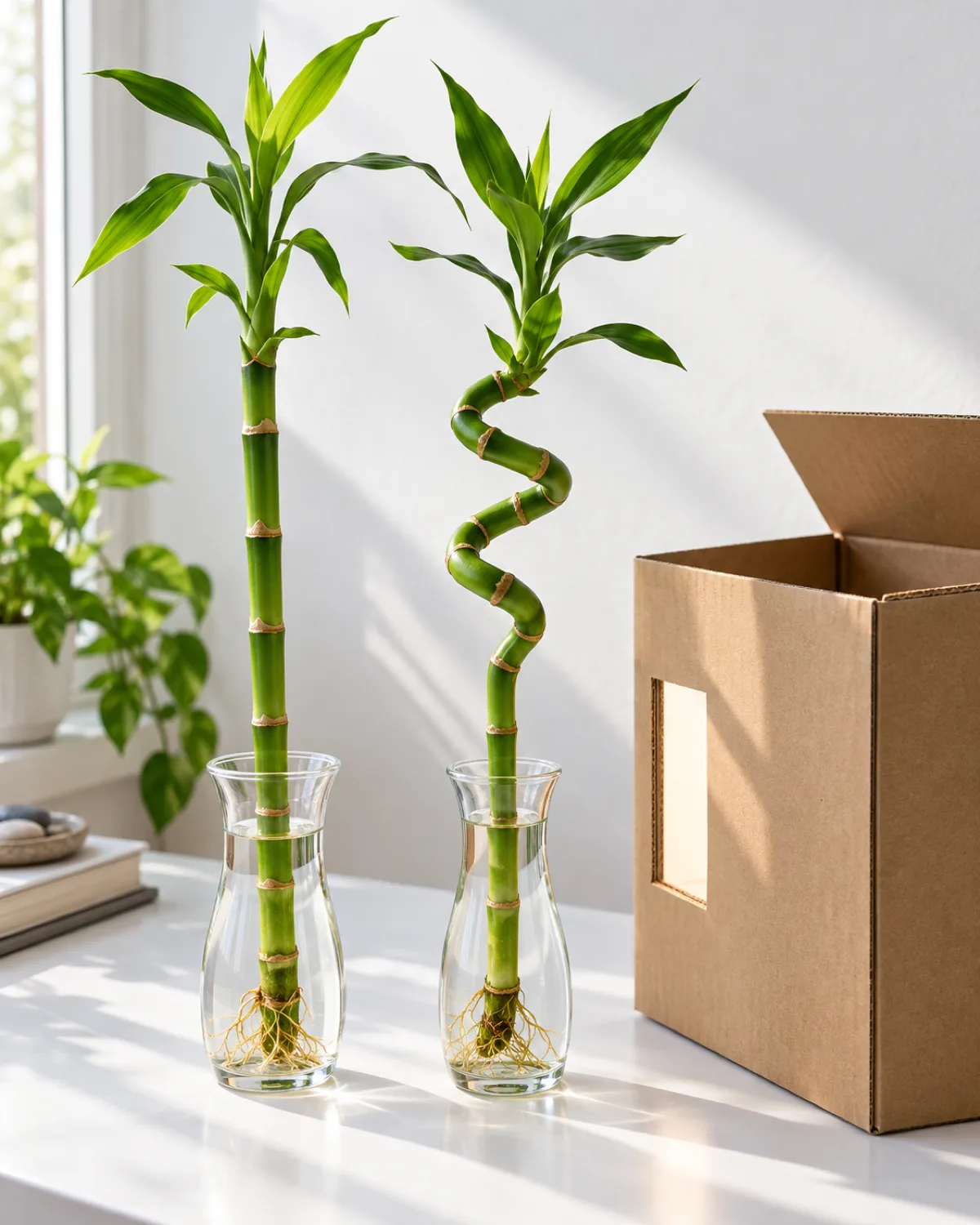
The spiral and curved forms sold in stores are not natural. Commercial growers create them by manipulating the direction of light.
The technique is simple but slow. A lucky bamboo stalk is placed inside a three-sided box with one open side. The plant grows toward the light coming through the opening. After a few weeks, the box is rotated so the opening faces a different direction, and the stalk bends toward the new light source. Repeating this over six to twelve months creates the signature spiral.
You can do this at home with a cardboard box:
- Cut a window on one side of the box
- Place the lucky bamboo inside with the window facing a light source
- Wait two to three weeks until the stalk bends noticeably toward the window
- Rotate the box ninety degrees and wait again
- Repeat until the spiral reaches the desired shape
Braided arrangements are created by growing three or more straight stalks close together and manually weaving them while they are still flexible. The stalks are tied with wire or ribbon to hold the braid while the plant grows into the shape permanently.
Wire training works for simpler curves. Wrap soft plant wire gently around the stalk in the desired shape, leave it for several months, and remove it once the stalk has hardened into the curve.
Propagation
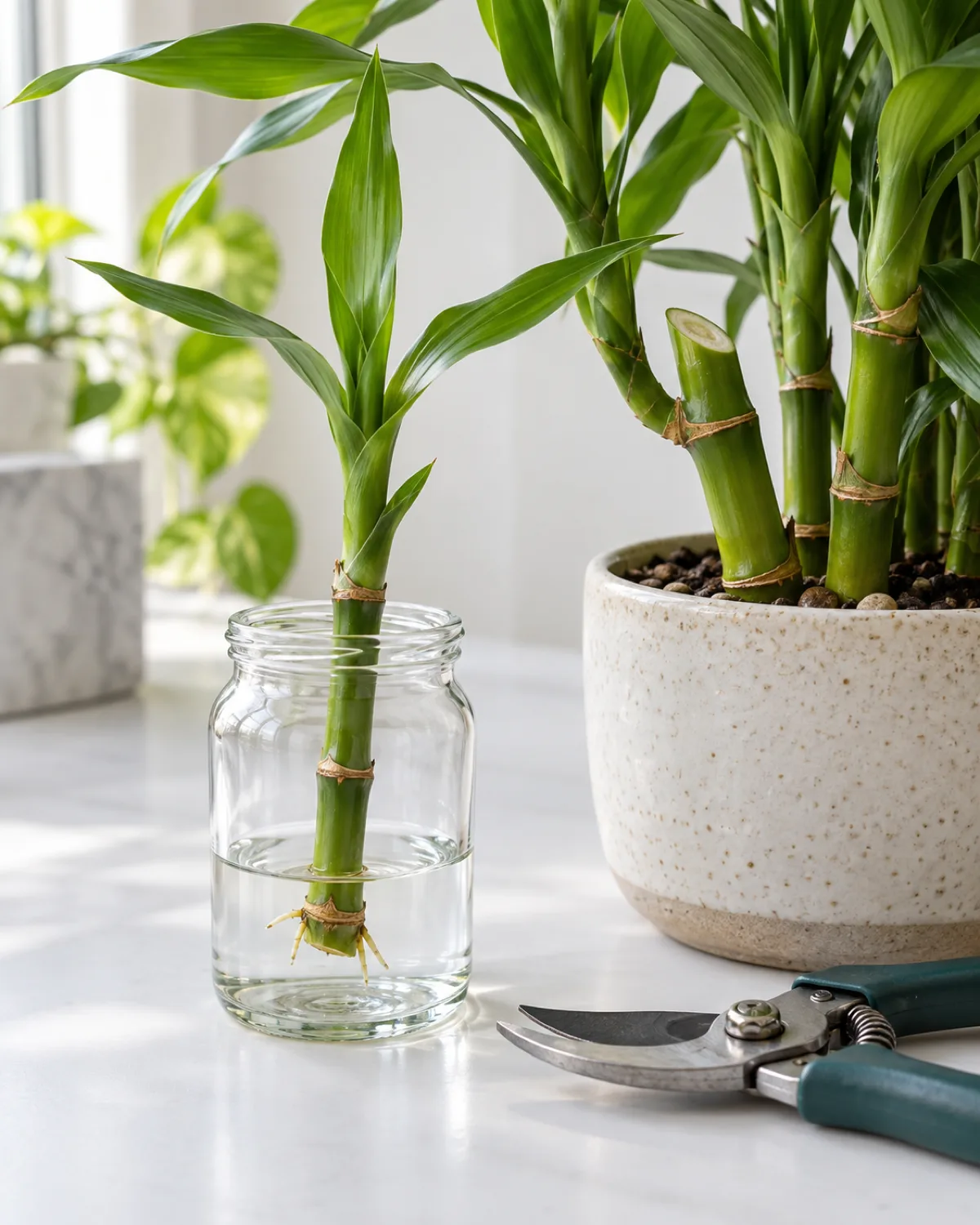
Lucky bamboo propagates easily from stem cuttings. The key is cutting at the right spot — just above a node, which is the slightly raised ring that wraps around the stalk.
Take a cutting four to six inches long. Make a clean diagonal cut with a sterile blade. Remove any leaves from the lower half. Place the cutting in a small glass of filtered water, deep enough to cover one or two nodes.
Roots appear in two to four weeks. Once the roots reach one to two inches long, you can either keep the cutting in water permanently or transplant it to soil.
- Rooting hormone: optional. Lucky bamboo roots readily without it, but a light dusting on the cut end can speed the process
- Offshoot separation: mature plants sometimes produce side shoots from existing nodes. These can be cut and rooted the same way
- Water temperature: room temperature filtered water. Cold water slows root development
- Light during rooting: bright indirect light, same as the parent plant
The parent plant will produce new growth from the node just below where you made the cut. This is how commercial growers produce bushy, multi-branched specimens — repeated cutting forces branching.
Repotting and Water Changes
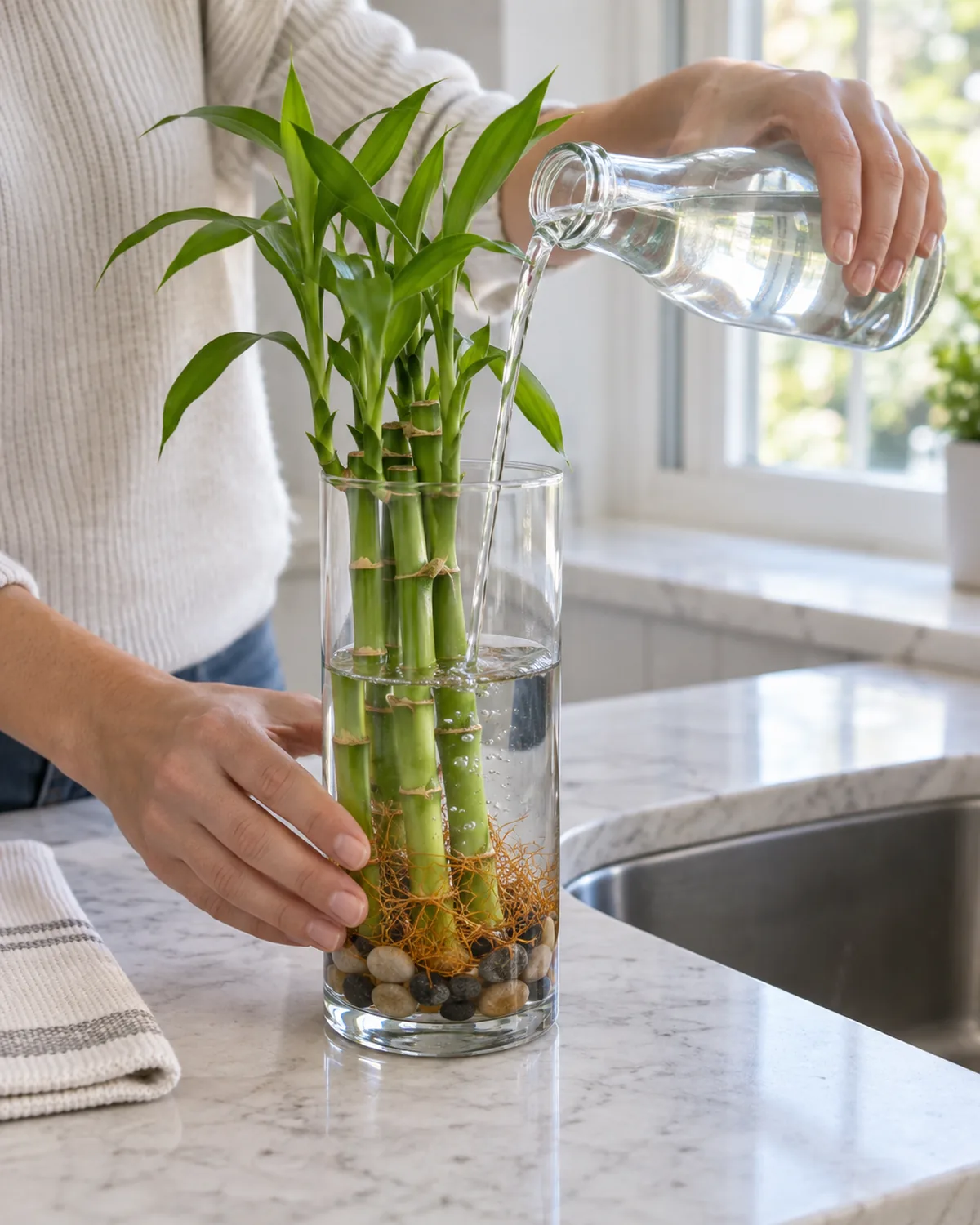
Water culture maintenance centers on one task: changing the water. Fresh water every one to two weeks keeps the roots oxygenated, prevents bacterial growth, and stops algae from taking over.
The water change routine takes two minutes:
- Lift the stalks out (pebbles usually stay in the vase)
- Pour out the old water
- Rinse the pebbles and vase under running water to remove any slime or algae buildup
- Inspect the roots — healthy roots are orange or reddish-brown, not black or mushy
- Refill with clean filtered or distilled water to one to two inches above the root zone
For soil-grown plants, repotting is needed every two to three years or when roots circle the bottom of the pot. Move up one pot size (one to two inches larger in diameter). Use the same well-draining mix described in the soil section.
- Signs it needs a bigger vessel: roots growing out of drainage holes, water running straight through without being absorbed, stunted new growth
- Algae prevention in water culture: avoid placing the vase in direct sunlight, and use an opaque container if algae is a recurring problem
- Cleaning roots: gently rinse under room-temperature water. Remove any black, mushy, or foul-smelling roots with clean scissors
Common Pests
Lucky bamboo is relatively pest-resistant, but three insects can find their way to it — especially when other houseplants nearby are already infested.
Spider mites are the most common pest on lucky bamboo. They appear as tiny dots on the undersides of leaves and spin fine webbing between the leaf bases. Yellowing, stippled leaves are the first sign. Wipe leaves with a damp cloth and treat with neem oil spray. See the full spider mites guide for the three-week treatment cycle.
Mealybugs look like small white cottony clusters in the leaf axils — the joints where leaves meet the stalk. Dab each cluster with a cotton swab dipped in rubbing alcohol. Check every few days for new ones.
Scale insects appear as small brown bumps attached to the stalk or leaf undersides. They do not move and are easy to miss. Scrape them off with a fingernail or soft brush, then treat the area with neem oil.
- Prevention: inspect new plants before bringing them near your lucky bamboo. Quarantine new purchases for two weeks
- Water culture advantage: soil-dwelling pests like fungus gnats are not a concern because there is no soil
- Treatment: neem oil spray (diluted per label instructions) every seven days for three consecutive weeks kills adults and newly hatched eggs
Toxicity
Lucky bamboo is toxic to cats and dogs. The plant contains saponins, which cause vomiting, drooling, loss of appetite, and dilated pupils in cats if ingested. Dogs experience similar gastrointestinal symptoms.
The ASPCA lists Dracaena sanderiana as toxic to both cats and dogs. This puts lucky bamboo in the same category as other Dracaena species, all of which contain saponins.
Placement strategy for pet households:
- High shelves: place the vase on a floating shelf or tall bookcase out of reach
- Enclosed spaces: a home office with a door that stays closed
- Alternative plants: if your cat is a determined chewer, consider pet-safe plants or cat-safe plants instead
The toxicity is rarely life-threatening — most cats and dogs vomit after chewing a leaf and do not return for more. However, if you suspect your pet has eaten a significant amount, contact your veterinarian or the ASPCA Animal Poison Control Center (888-426-4435).
Lucky bamboo is not toxic to humans. The stalks are sometimes used decoratively in food presentation at restaurants, though the plant itself is not edible.
Buying and Selecting Healthy Stalks
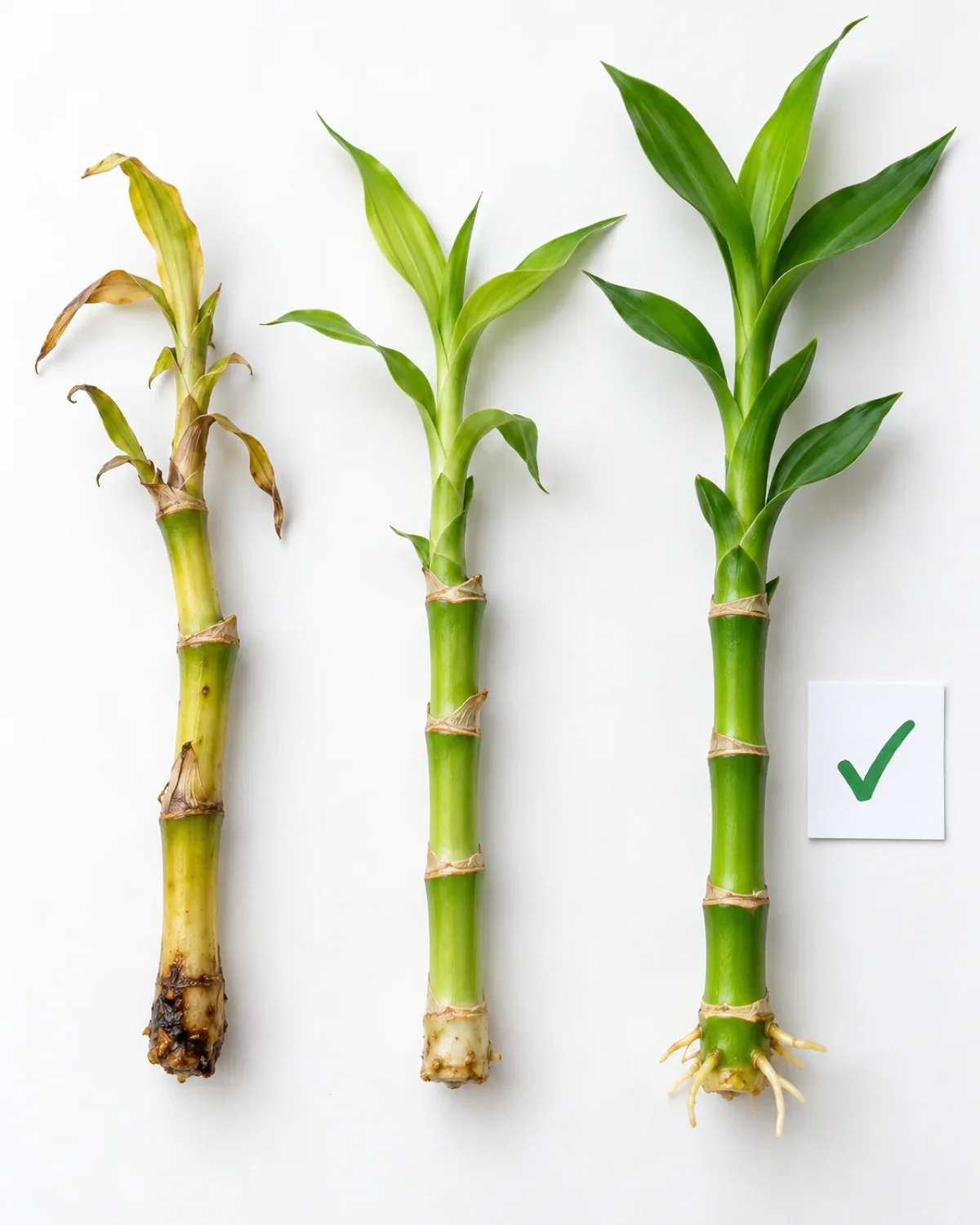
Not all lucky bamboo on the shelf is worth buying. A healthy stalk feels firm when you gently squeeze it — like a fresh celery stalk. A stalk that feels soft, mushy, or spongy is already rotting and will not recover.
What to look for:
- Bright green color: the stalk and leaves should be a vivid, consistent green. Pale, washed-out green suggests poor health or insufficient light during growing
- Firm stalk: squeeze gently near the base. Firm is good. Soft or squishy means rot has started
- Healthy roots: if visible through the packaging, roots should be orange or light brown, not black or slimy
- No yellowing: avoid stalks with yellow patches, especially at the base. Yellow at the top (leaf tips only) might be fluoride damage from store water, which is fixable. Yellow on the stalk itself is usually not
Where to buy:
- Garden centers: widest selection, best condition, staff can advise
- Grocery stores and home goods shops: convenient but plants may have been sitting in poor conditions for weeks
- Online: reputable sellers ship healthy stalks, but you cannot inspect before buying. Check reviews
Straight stalks are the cheapest. Spiral and braided forms cost more because they take months of careful light manipulation to produce. A single straight stalk starts around three to five dollars. A braided arrangement of eight or more stalks can run twenty to forty dollars.
Save for Later
Lucky Bamboo Care in 14 Takeaways
- 1Not actually bambooDracaena sanderiana from Central Africa. Same family as spider plant and ZZ plant, not related to true bamboo at all.
- 2Bright indirect light onlyDirect sun scorches leaves within days. Low light is tolerated but slows growth. East windows are ideal.
- 3Water culture is the classic methodStalks in a glass vase with pebbles. Use filtered or distilled water, change every one to two weeks.
- 4Soil grows it fasterWell-draining mix, water when top inch dries. Better for long-term growth and larger plants.
- 5Fertilize at one-tenth strengthOne drop every two months in water culture. Overfertilizing burns roots faster than underfertilizing starves them.
- 665 to 90°F comfort zoneAverage household temperature and humidity are fine. Cold below 50°F causes shock and leaf drop.
- 7Stalk count carries meaningThree stalks for happiness, five for health, eight for wealth. Never four — it represents death in Chinese culture.
- 8Yellowing and brown tipsUsually fluoridated water, direct sun, or overfertilizing. Brown tips are the early signal. Remove yellowing stalks from group arrangements immediately.
- 9Spirals come from directional lightA cardboard box with one window, rotated every few weeks. Takes six to twelve months for a full spiral.
- 10Propagation from stem cuttingsCut above a node, root in filtered water. New roots in two to four weeks. Rooting hormone optional.
- 11Water changes prevent rotFresh filtered water every one to two weeks. Rinse pebbles and inspect roots during each change.
- 12Spider mites are the main pestFine webbing and stippled leaves. Neem oil every seven days for three weeks. Mealybugs respond to rubbing alcohol.
- 13Toxic to cats and dogsSaponins cause vomiting and drooling. Place on high shelves in pet households or choose pet-safe alternatives.
- 14Buy firm, bright green stalksSqueeze test: firm is healthy, soft is rotting. Check roots if visible. Avoid yellow patches on the stalk.
kultivy.com
FAQ
Quick-reference answers:
- Is lucky bamboo a real bamboo? No. It is Dracaena sanderiana, a tropical plant from Central Africa. True bamboo is a grass in the family Poaceae. The only thing they share is the look of segmented green stalks
- Can lucky bamboo grow without sunlight? It survives in low light for extended periods but does best with bright indirect light. A windowless room will eventually weaken the plant. Use a grow light if natural light is unavailable
- How long does lucky bamboo live? With proper care, lucky bamboo can live for several years. Some well-maintained plants have survived over a decade. Lifespan depends primarily on water quality and light conditions
More common questions:
- Why is my lucky bamboo turning brown at the bottom? Brown, mushy stalks at the base indicate root rot, usually from stagnant water or waterlogged soil. Cut above the affected area with a sterile blade and re-root the healthy top portion in fresh water
- Can I put lucky bamboo in an aquarium? The stalk can sit with its roots submerged, but the leaves must remain above the waterline. Some aquarium hobbyists use lucky bamboo as a nitrate absorber, though it is not a true aquatic plant
- Does lucky bamboo purify air? Dracaena species appeared on the NASA Clean Air Study list, but the sealed-chamber conditions bear little resemblance to a living room. Lucky bamboo is a fine houseplant — buy it for how easy it is to grow, not for air purification claims. See the full air purifying plants breakdown
- Can I use ice cubes instead of watering? No. Cold water shocks the roots and slows growth. Always use room-temperature water
- My lucky bamboo is too tall — can I cut it? Yes. Cut the stalk above a node with a sterile blade. The lower portion will sprout new growth from the node below the cut, and you can root the top portion as a new plant

Mara Quinn edits Kultivy, where she shares houseplant care, propagation, beginner-friendly plant picks, and plant-styling ideas for anyone who wants their indoor plants to actually thrive. Every guide is image-led and reviewed for clarity, usefulness, image accuracy, and Pinterest-to-page alignment before it goes live. Visit the About page.