Ferns existed for 360 million years before the first flower ever appeared. They never bloom, never fruit, and those brown dots on the backs of their fronds are not disease — they are spore clusters, and they are the reason ferns are still here.
No other common houseplant group can make that claim. And no other group is quite so misunderstood indoors.
Ferns are ancient spore-bearing plants that thrive in humidity and shade. The thirteen sections below cover their unique biology, why those brown dots are normal, what kills them indoors (hint: dry air), and which ferns survive even the darkest apartments.
What makes a fern a fern
Ferns are the oldest surviving group of land plants that you can grow indoors. They appeared roughly 360 million years ago — predating flowering plants by over 200 million years — and they never evolved flowers, seeds, or fruit. The reproductive strategy that sustained them across four mass extinction events is spores.
The brown dots or lines on the undersides of mature fronds are sori, clusters of tiny sporangia where spores develop. They are not disease. They are not pests. They are the reason ferns still exist, and mistaking them for a problem is the single most common fern misconception.
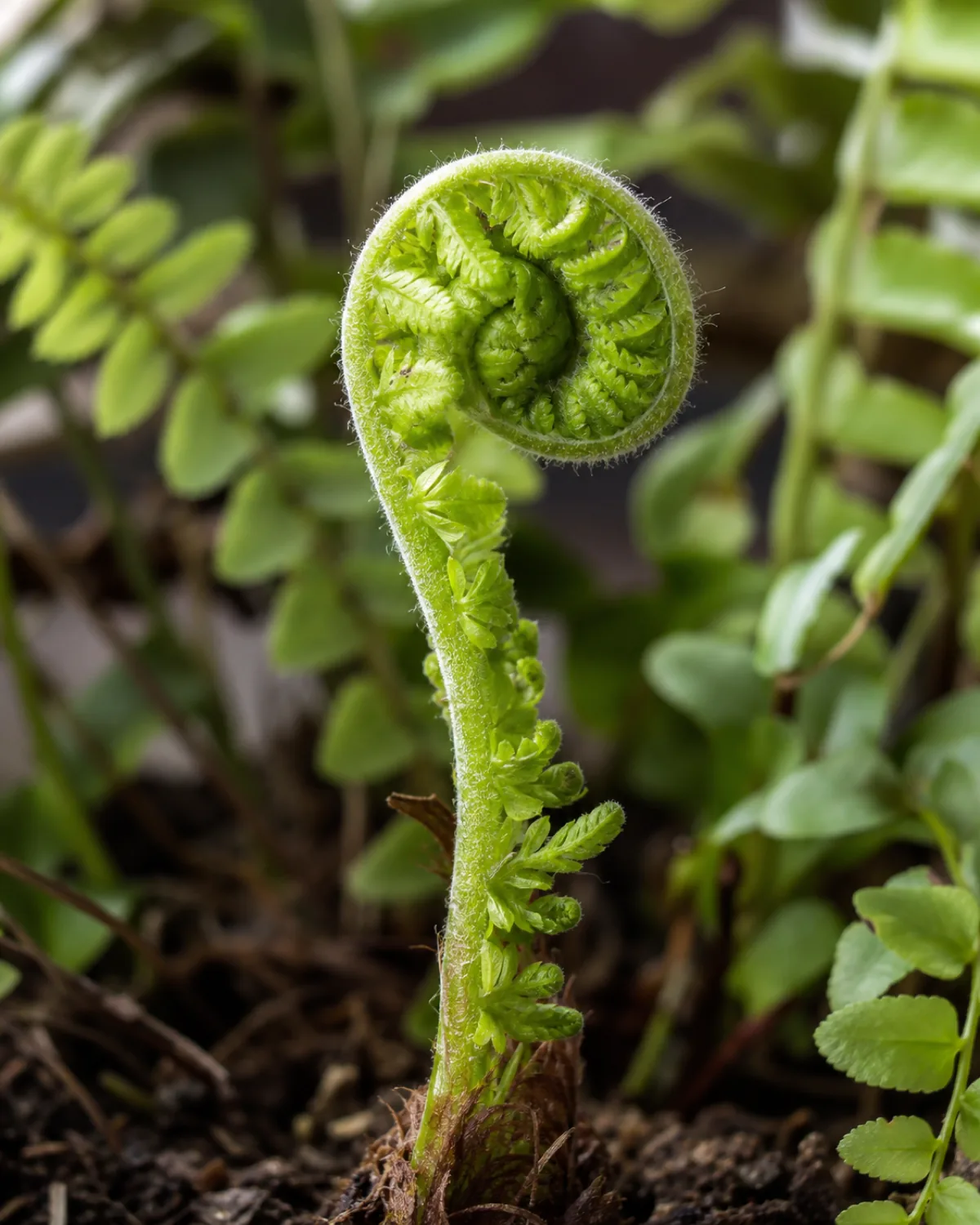
New fern growth emerges as a fiddlehead — a tightly coiled spiral called a crosier that slowly unfurls into a full frond. This unfurling mechanism is unique to ferns. No other plant group does it.
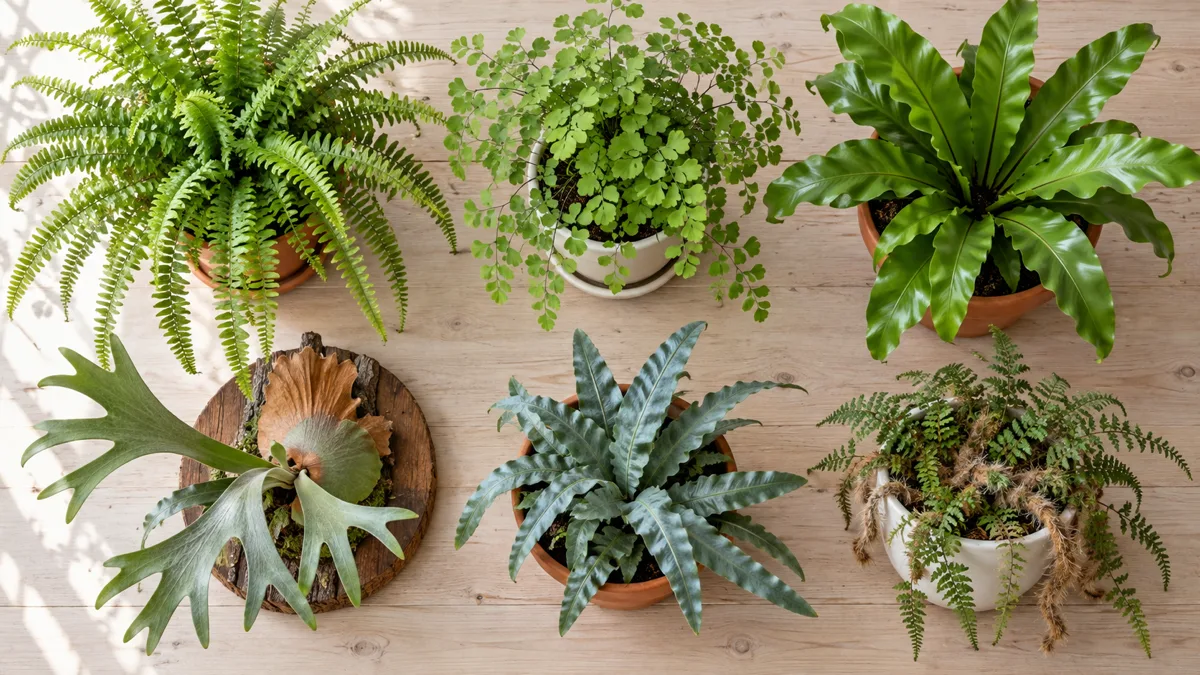
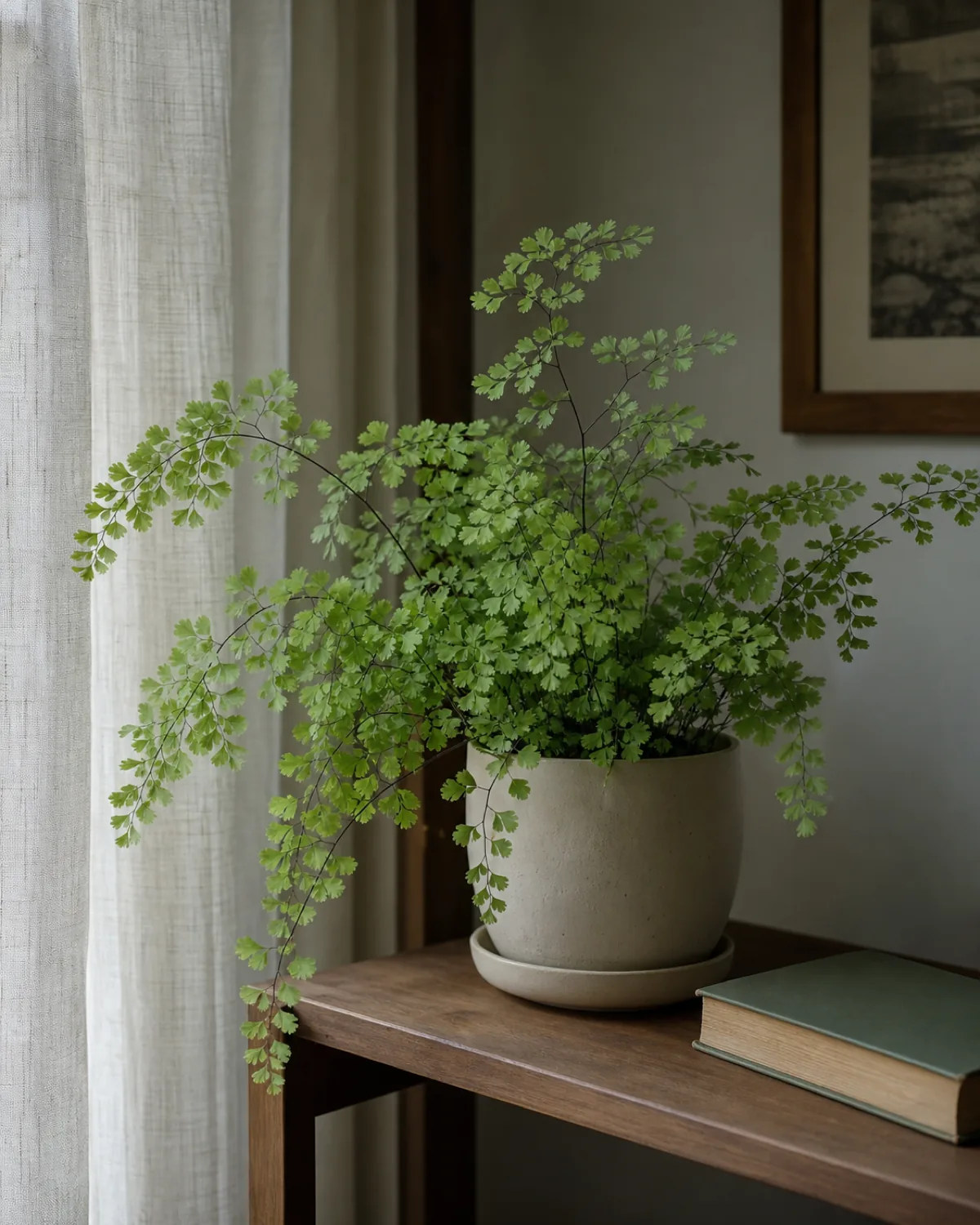
Five genera dominate indoor growing. Boston ferns (Nephrolepis) produce arching sword-shaped compound fronds that cascade beautifully from hanging baskets. Maidenhair ferns (Adiantum) have tiny fan-shaped leaflets on wiry jet-black stems and are the most beautiful — and most demanding — of the group.
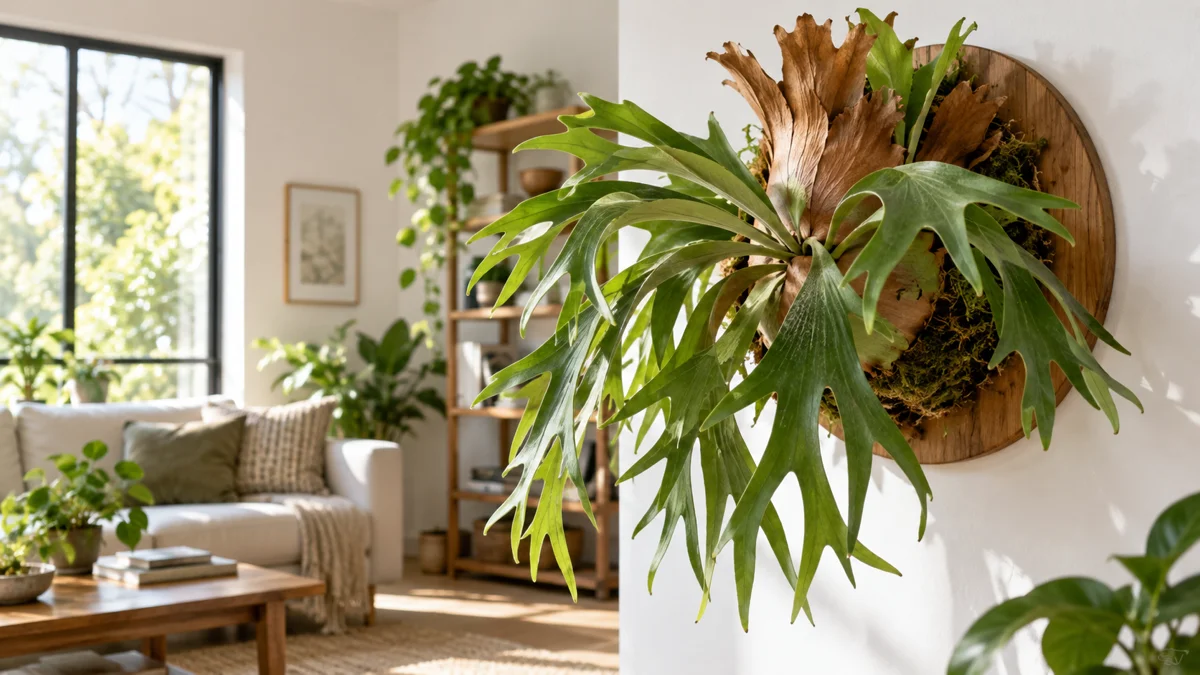
Bird's nest ferns (Asplenium) grow broad, undivided rosette fronds upward from a dark fibrous central cup. Staghorn ferns (Platycerium) mount on boards like living wall sculptures with forked antler-shaped fronds. Rabbit's foot ferns (Davallia) send fuzzy rhizomes creeping over the pot edge.
All share the same fundamental requirements despite coming from different families.
Light: less is genuinely more
Most ferns evolved on the forest floor under dense canopy shade. Bright indirect to medium light is ideal, and a north-facing or east-facing window is the sweet spot.
Direct sun burns fern fronds fast. The tissue is thinner than most houseplant leaves and lacks the waxy cuticle that protects succulents and rubber plants. Maidenhair ferns are the most burn-prone — direct afternoon sun turns their delicate leaflets papery within hours. Boston ferns tolerate brighter conditions but still scorch in sustained midday sun.
Bird's nest ferns handle lower light than nearly any other houseplant. They evolved under triple canopy in Southeast Asian rainforests, where less than two percent of sunlight reaches the forest floor. A dim north window that would starve a fiddle leaf fig is perfect for a bird's nest fern.
Diagnostic signs work in both directions. Fronds turning pale or yellow-green means too much light. Fronds stretching, growing sparse, and losing their fullness means too little. Ferns are genuine low-light survivors — they actually prefer less light than most houseplants, which makes them invaluable for dim rooms that nothing else will tolerate.
Our houseplant light guide covers the shadow test for measuring brightness without equipment. For ferns, the answer is usually simpler than you expect: if the spot feels too dark for other plants, a fern will probably like it.
Humidity: the single factor that makes or breaks fern care
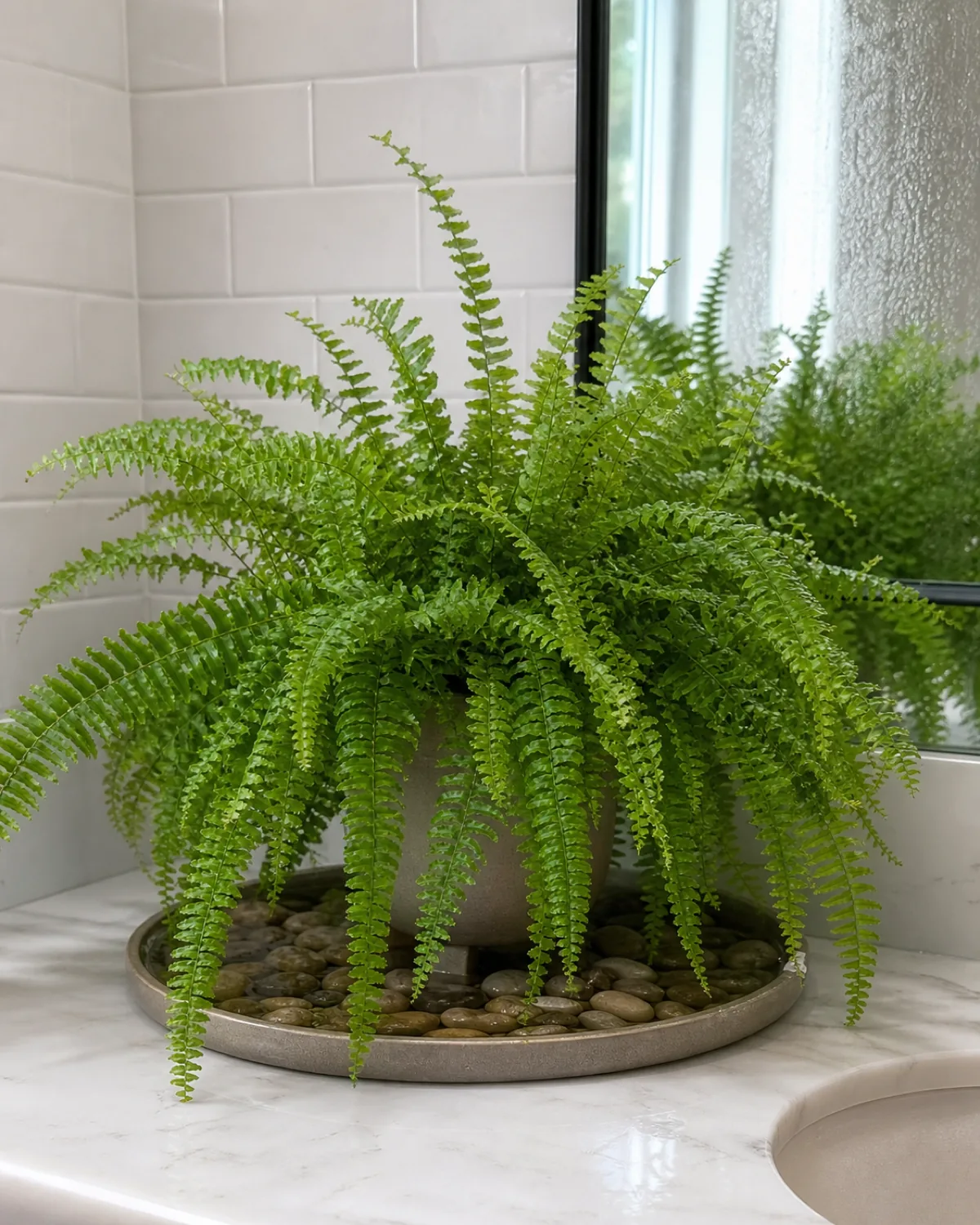
Humidity separates fern success from fern frustration more sharply than any other variable. Most indoor ferns need fifty to eighty percent humidity to maintain healthy fronds, and below forty percent the tips brown and crisp regardless of how well you water.
This is not the mild humidity preference that most tropical houseplants have. A pothos or snake plant will look fine at thirty percent humidity. A Boston fern will shed leaflets. A maidenhair fern will die.
Misting helps for about fifteen minutes before it evaporates — functionally useless for sustained humidity.
Effective strategies that actually work: place ferns in bathrooms where daily shower steam provides free humidity, group them on pebble trays filled with water so the pot sits above the waterline on the stones, run a room humidifier within a few feet, or grow smaller ferns inside glass terrariums where trapped transpiration holds seventy percent or higher.
Winter heating systems are the number one fern killer indoors. Forced-air heating drops relative humidity to twenty or thirty percent near vents and radiators — the equivalent of desert air for a plant evolved in rainforest understory. Boston ferns are the most forgiving, tolerating forty percent if well-watered. Maidenhair ferns crisp within days at that level.
Ferns are among the safest and most shade-tolerant houseplants — but their humidity demands are real, not optional.
Watering: consistent moisture, not soak-and-dry
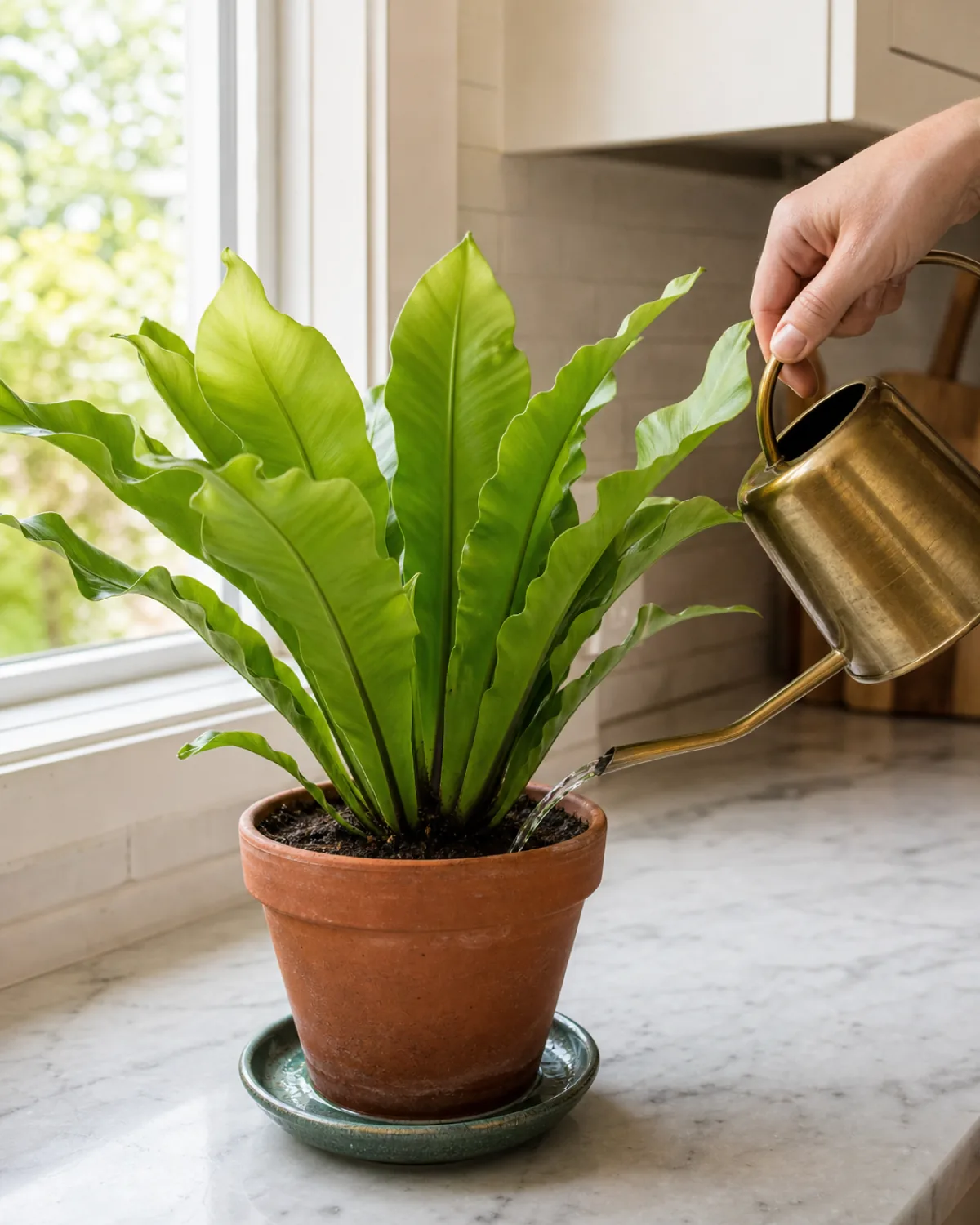
Ferns want consistently moist soil — never soggy, never bone-dry. The dramatic soak-and-dry cycles that jade plants and ZZ plants thrive on will kill a fern. The key word is consistent.
Check daily. The top half-inch of soil should stay slightly damp. Water thoroughly when the surface feels barely dry, and always use room-temperature water. Cold water shocks fern roots and can cause temporary wilting even when the soil is wet.
Boston ferns in hanging baskets dry out faster than potted ferns because air circulates around the entire root ball. Check them daily in summer — they are the highest-maintenance fern for watering frequency specifically because of how they are displayed.
Maidenhair ferns collapse within a single day of completely drying out. The delicate stems go limp and the tiny fan-shaped leaflets fold inward. If caught quickly, a thorough soak sometimes revives them, but repeated dry-outs cause cumulative damage that does not reverse.
Use filtered or rainwater if your tap water causes persistent brown tips even at adequate humidity. Ferns are sensitive to chlorine and fluoride — the brown tips that develop from water chemistry look identical to humidity damage but happen even at sixty percent humidity.
Our watering guide covers how to diagnose whether brown tips are a moisture problem or a water quality problem.
For bird's nest ferns, direct the water around the outside of the rosette, not into the central cup. Water sitting in that cup promotes rot in the crown where new fronds emerge.
Soil mix: hold moisture without drowning
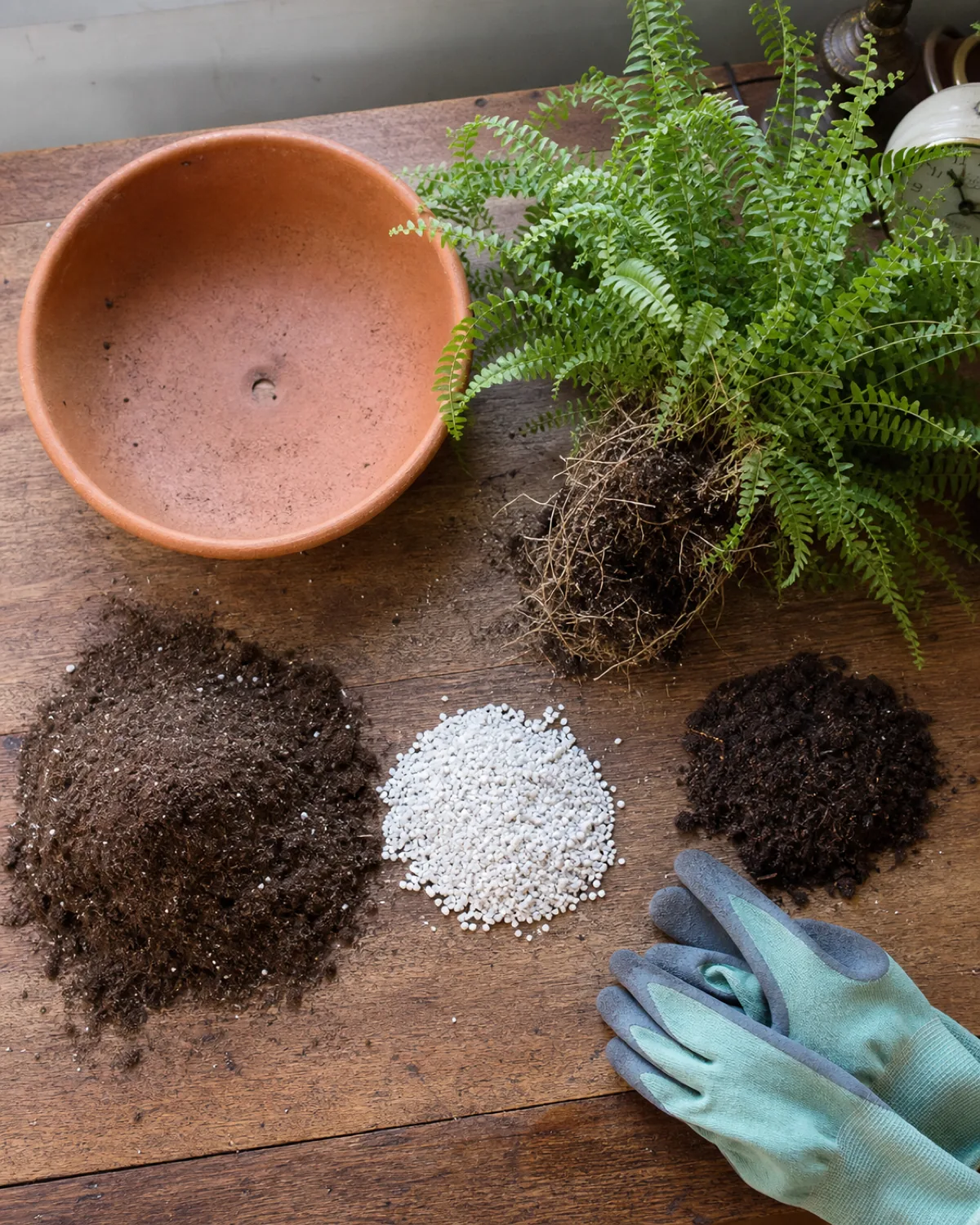
Two parts peat-based potting mix plus one part perlite plus one part compost or worm castings is the fern standard. The organic matter retains the consistent moisture ferns need while the perlite prevents compaction and ensures drainage.
Fern roots are fine and fibrous — nothing like the chunky aerial roots of monsteras or the thick rhizomatous roots of ZZ plants. Fine roots need steady contact with moist soil particles. Chunky bark mixes designed for aroids leave too many air pockets for fern roots to bridge, and heavy garden soil compacts around them and suffocates.
Staghorn ferns break the pattern entirely. They are epiphytes in nature, growing on tree trunks rather than in soil. Indoor staghorns mount on wooden boards with sphagnum moss packed around the root ball — no pot, no potting mix. Water them by soaking the entire mount in a bucket for fifteen to twenty minutes, then hang it back up to drain.
Most other ferns have shallow root systems. Wide, shallow pots work better than deep ones. Boston ferns are notorious for becoming rootbound quickly — when fronds start thinning from the center rather than the edges, the root mass has likely consumed most of the soil and it is time to divide and repot.
Temperature: steady warmth, draft-free
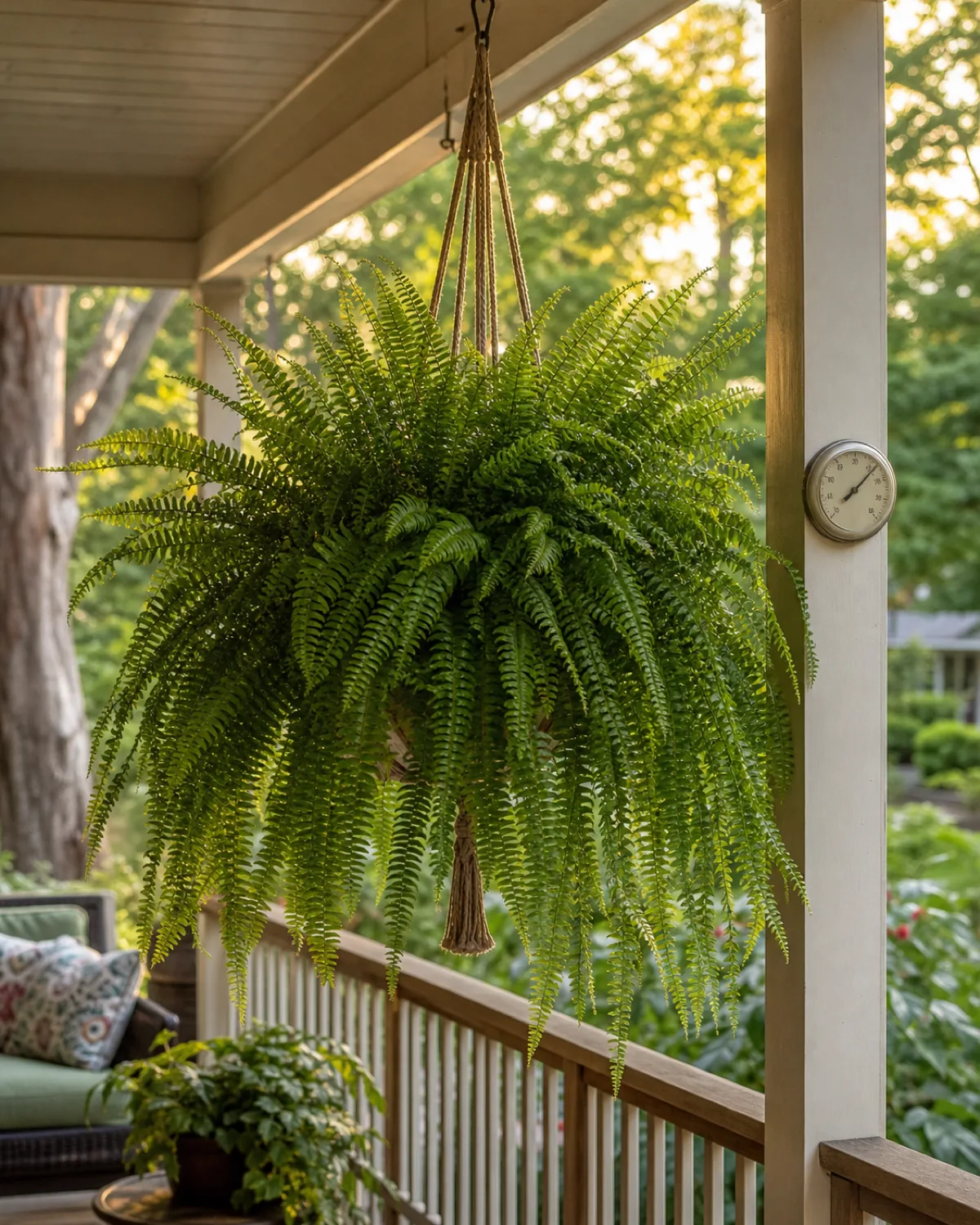
Sixty to seventy-five degrees Fahrenheit (fifteen to twenty-four Celsius) covers most indoor ferns. They dislike extremes in either direction — above eighty degrees fronds may wilt even with adequate watering, and below fifty degrees growth stops and cold damage darkens the frond tips.
The biggest temperature threat indoors is not cold rooms but drafts. Cold air from poorly insulated winter windows, hot blasts from heating vents, and the constant breeze from ceiling fans or air conditioning all desiccate fronds as effectively as low humidity. Fern tissue is thin and loses moisture to moving air faster than thicker-leaved plants.
Boston ferns on covered porches in summer are a tradition in the American South, and they love the warm, humid outdoor conditions. But they must come indoors before nighttime temperatures drop below fifty-five degrees Fahrenheit in autumn.
Maidenhair ferns are the most temperature-sensitive species. They want stable, unchanging conditions and respond to sudden temperature fluctuations — in either direction — with immediate leaf drop. Find them a spot where conditions stay consistent and resist the temptation to move them around.
Fertilizing: light feeding, light touch
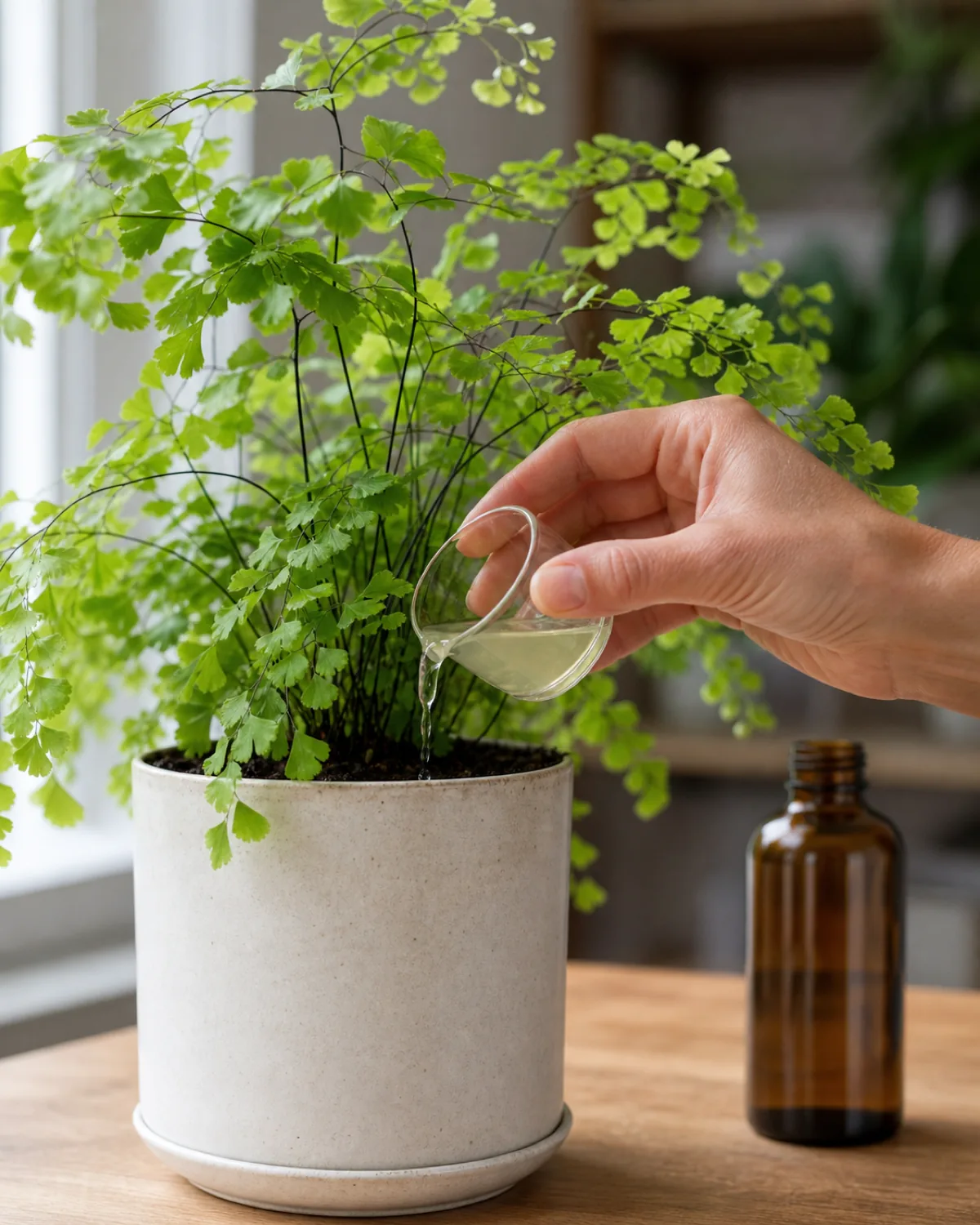
Ferns are light feeders. Balanced liquid fertilizer (10-10-10) diluted to half the label strength, applied once a month during the growing season from spring through fall, is sufficient. Skip feeding entirely from November through February.
Over-fertilizing burns the fine fibrous root system and produces brown, crispy frond tips that look exactly like humidity damage. If you see salt crust forming on the soil surface — white mineral deposits that were not there before — flush the pot thoroughly with plain water to dissolve the accumulated salts.
Maidenhair ferns are especially sensitive. Dilute to quarter strength rather than half. Their root hairs absorb minerals faster than the coarser roots of Boston ferns, so the same concentration that a Boston handles fine will burn a maidenhair.
Boston ferns respond well to fish emulsion or liquid seaweed extract applied monthly during active growth. These organic options release nutrients gently and steadily rather than the sharp spike that synthetic fertilizers deliver.
Never fertilize a fern within four to six weeks of repotting. The fresh potting mix contains enough nutrients for the initial establishment period, and newly disturbed roots are more vulnerable to salt burn. Our fertilizing guide covers how the three NPK numbers work and why half-strength feeding is almost always safer than full.
Those brown spots on the back: sori, not disease
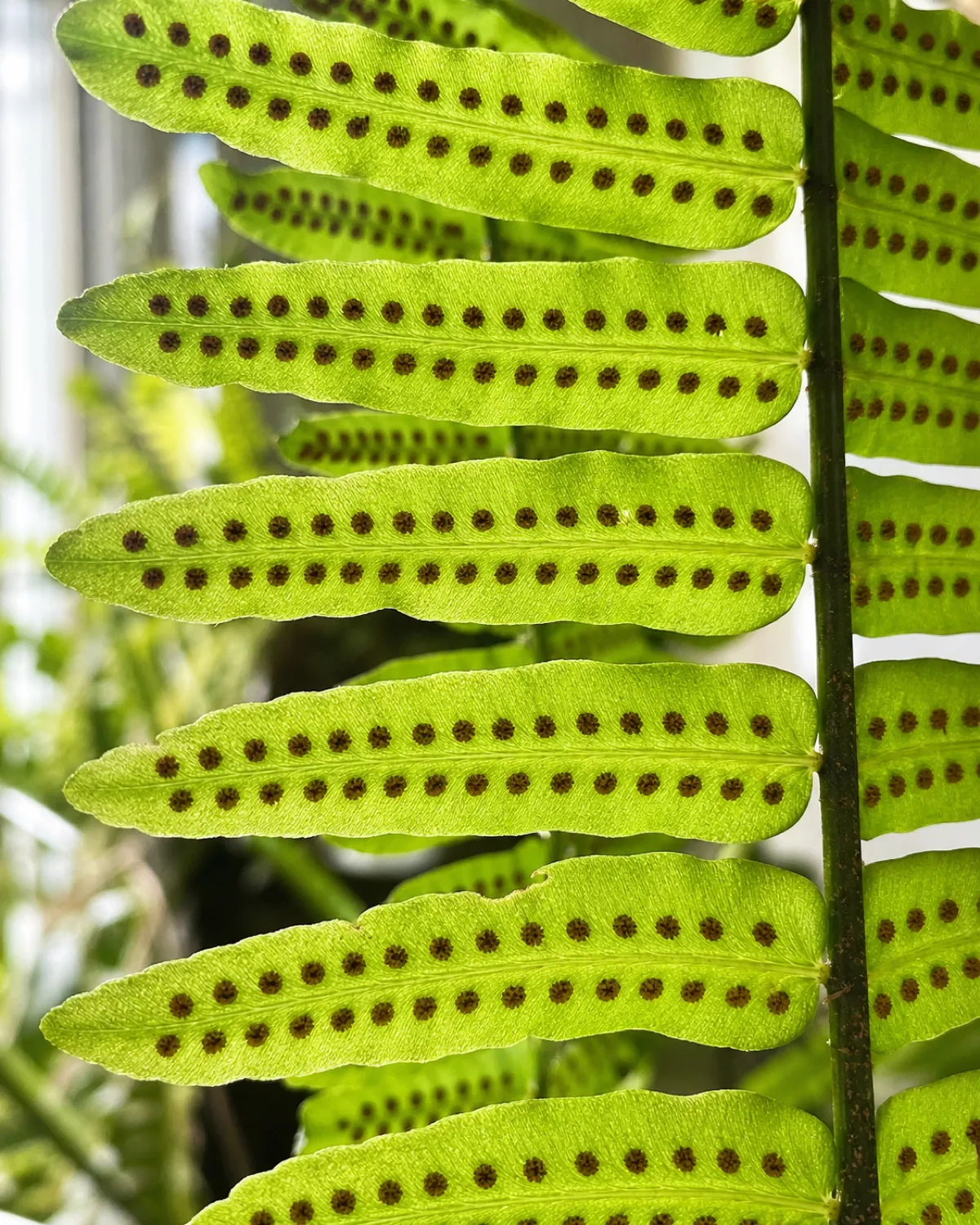
This section exists because thousands of healthy ferns get thrown away every year by owners who mistake their reproductive structures for disease.
The brown dots, lines, or patches arranged in symmetrical rows on the undersides of mature fronds are sori — clusters of sporangia where the fern produces its microscopic spores. They are completely normal. They are a sign of a healthy, mature fern. Their appearance means the plant is thriving enough to invest energy in reproduction.
Sori patterns vary by species and are one of the ways botanists identify fern genera. Boston ferns produce small round dots arranged in two neat rows along each leaflet. Maidenhair ferns have kidney-shaped patches along the margins of their fan-shaped leaflets. Bird's nest ferns display long parallel lines radiating outward from the central midrib like the teeth of a comb.
The diagnostic distinction between sori and actual problems is straightforward. Sori are symmetrically arranged and appear only on the underside of fronds. They are uniform in color and follow a repeating pattern.
Disease spots appear randomly on both upper and lower surfaces, are often discolored with yellow halos or mushy texture, and spread unevenly. Scale insects are irregularly placed bumps that can be scraped off with a fingernail — sori cannot, because they are part of the leaf tissue itself.
If in doubt, check a second frond. If the same pattern appears in the same position on another mature frond, it is sori.
Why your fern keeps dropping leaves
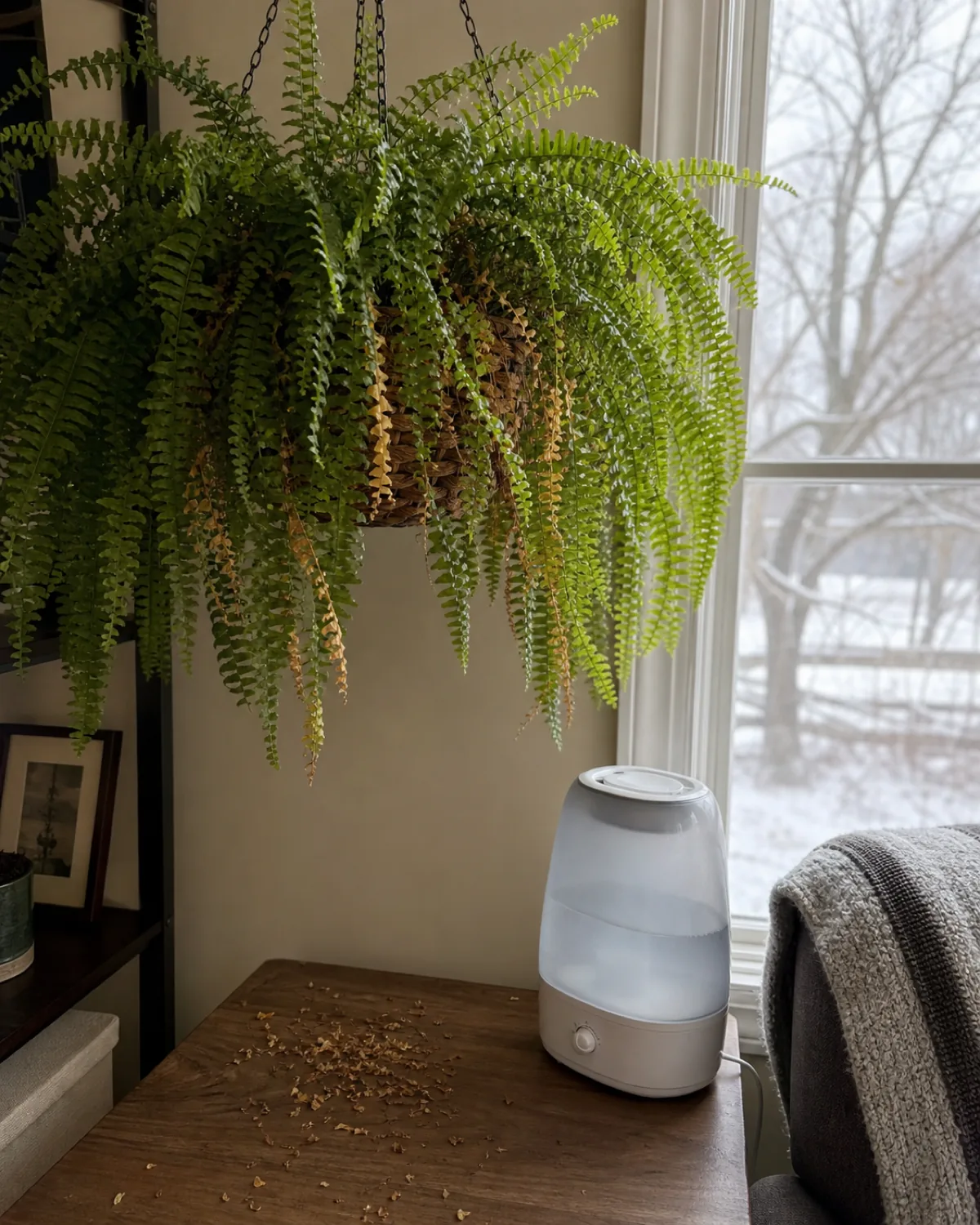
Leaf drop is the number one complaint from fern owners, and Boston ferns are the most notorious offenders. The tiny individual leaflets — called pinnae — detach and scatter across floors, shelves, and furniture with an efficiency that seems almost deliberate.
The causes, ranked by how often they are responsible:
Low humidity is the leading cause. When ambient humidity drops below forty percent, the thin fern tissue loses moisture faster than the roots can replace it. The plant sacrifices individual leaflets to reduce its total surface area. This is especially devastating in winter when heating systems run continuously.
Inconsistent watering is second. Letting the soil dry out completely even once triggers a defensive leaf drop. The damage from a single severe dry-out can take weeks to shed fully, so the dropping may continue long after you resume proper watering.
Too much direct light burns and dries frond tips, which then brown and fall. The damage is usually concentrated on the side of the plant facing the light source.
Normal inner-frond shedding is natural and not a problem. Older fronds in the center of the plant die back as the fern produces new growth from the crown. If only the innermost, oldest fronds are yellowing while new fiddleheads keep emerging, the plant is healthy.
Relocation shock causes temporary leaf drop when a fern moves to a new spot. The change in light, temperature, and humidity all at once overwhelms the plant. Minimize moves, and expect some shedding for two to three weeks after any relocation.
Pruning: maintenance only, no shaping needed
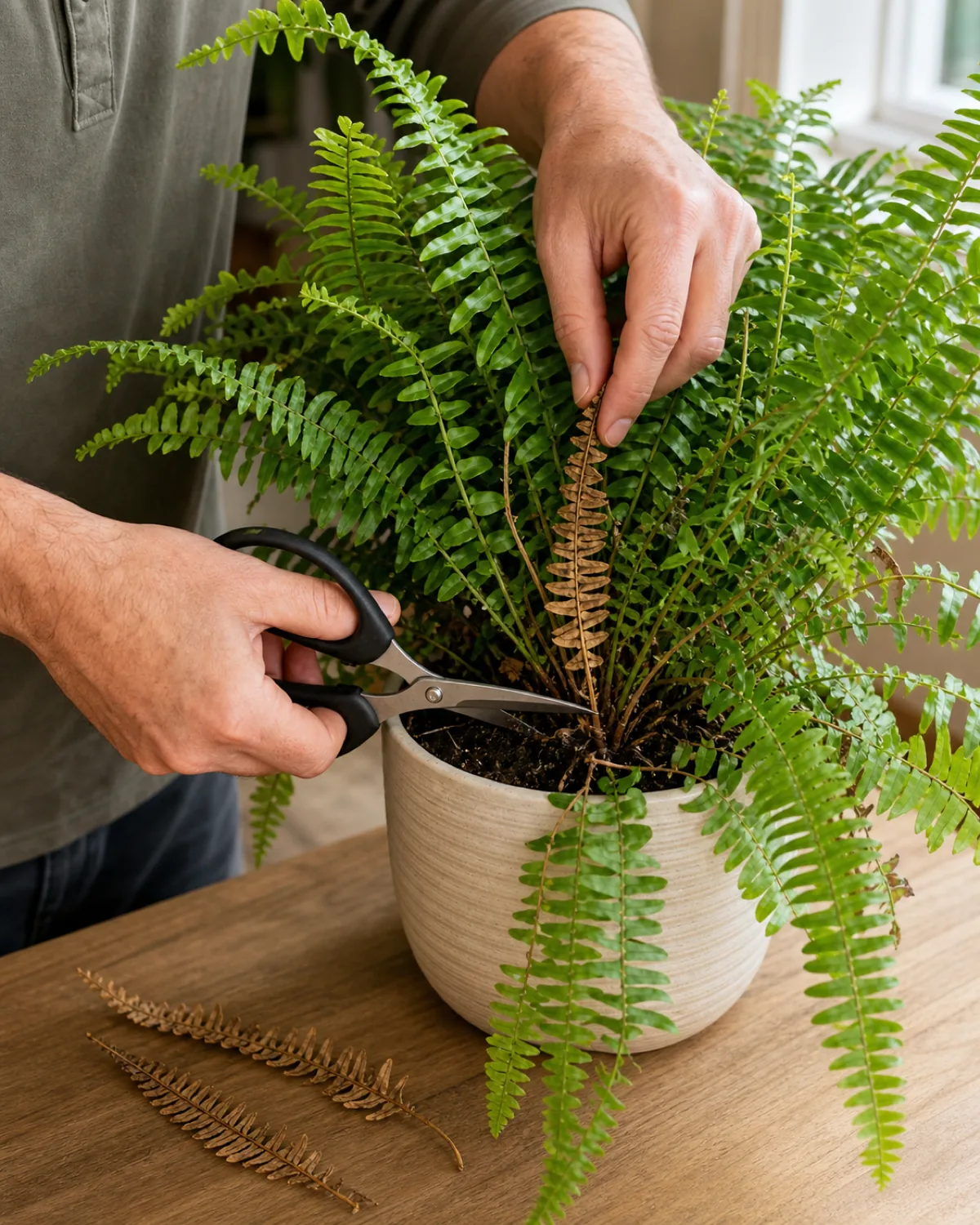
Ferns do not need the shaping and tip-pinching that begonias and philodendrons benefit from. Their growth pattern is self-organizing — new fronds emerge from the crown or rhizome in the arrangement the plant needs.
Pruning is purely maintenance: remove dead, brown, or yellowing fronds by cutting them at the base where they emerge from the crown. Use clean, sharp scissors. Remove the entire frond — never trim individual leaflets off a living frond, as the cut ends will brown and the partial frond will look worse than the original problem.
For Boston ferns, clearing dead fronds from the center opens up airflow through the plant and gives new fiddleheads room to unfurl. This is the closest thing to productive pruning that ferns require.
Staghorn ferns have two distinct frond types that demand different treatment. The fertile fronds — forked and antler-shaped — can be trimmed if they die. But the basal shield fronds — flat, round, and pressed against the mounting board — must never be removed even when they turn brown and papery.
Dead basal fronds still serve as a protective layer over the root system and as a moisture reservoir. Removing them exposes and damages the mount attachment.
Propagation: division is the practical path
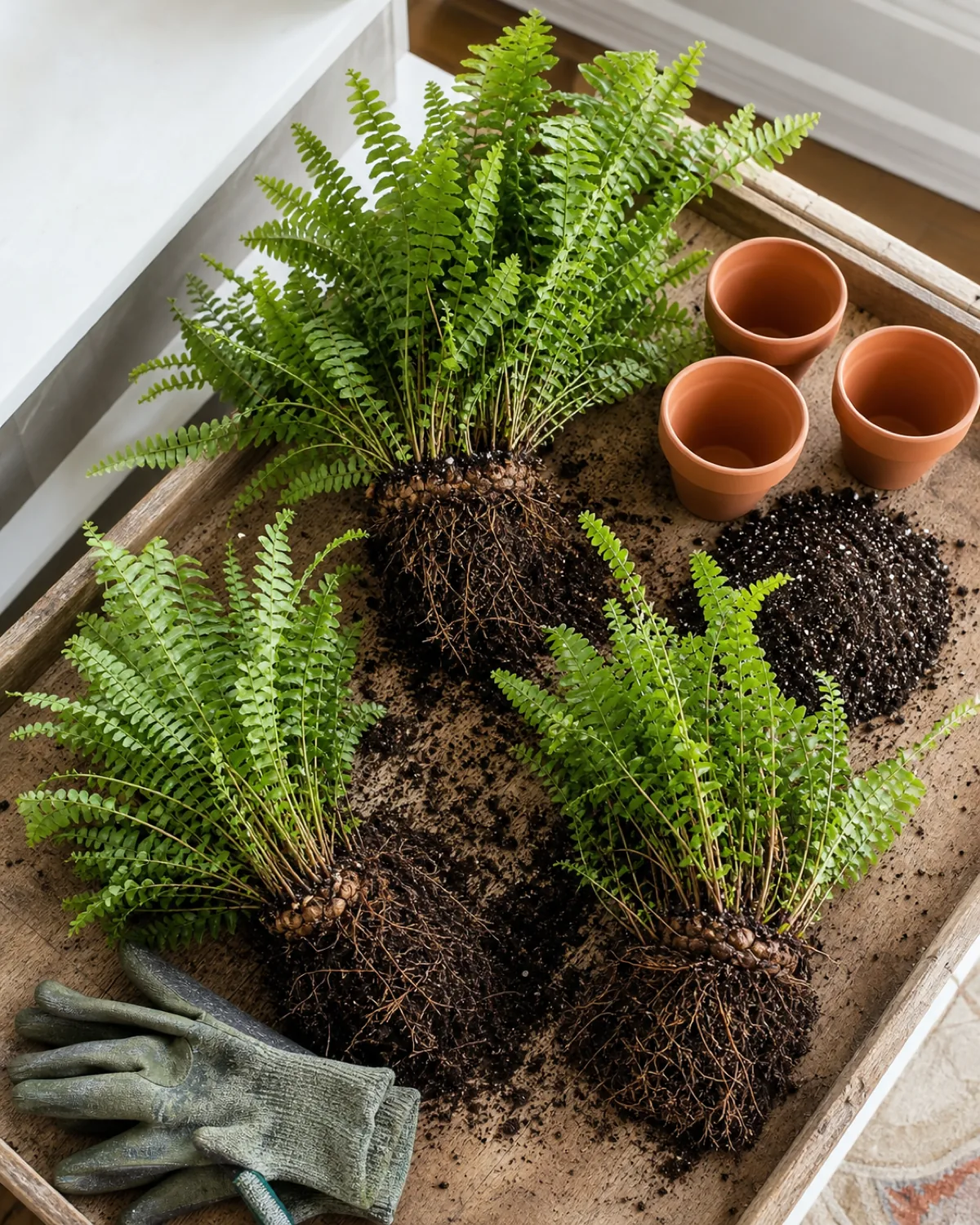
Three methods exist, but only one is practical for most growers.
Division is the easiest, fastest, and most reliable. In spring, remove a mature fern from its pot and look for natural divisions in the rhizome — separate clumps where clusters of fronds have their own root sections. Gently tease or cut these apart. Each division should have at least three to four fronds and a healthy section of roots attached.
Pot each division individually in fresh mix, water thoroughly, and keep them in high humidity for two to three weeks while the disturbed roots re-establish. A clear plastic bag loosely draped over the pot creates a temporary humidity tent.
Runners and stolons work specifically for Boston ferns. These vigorous growers send out long, wiry runners from the base that grow small plantlets at their tips. Pin a runner onto a pot of moist soil placed next to the mother plant, and once the plantlet develops its own root system, sever the connection.
This is the same principle as spider plant propagation, but Boston fern runners are less visible and easier to overlook.
Spore propagation is the third method and the one that almost nobody should attempt at home. Collect ripe spores by placing a mature frond face-down on white paper in a warm spot — fine brown dust falls off within a day or two.
Sprinkle the spores onto sterile moist peat in a sealed container and wait two to six months for tiny heart-shaped prothalli to appear. These eventually produce actual fern frondlets. It is a fascinating biological process detailed in our propagation guide and wildly impractical for casual growers.
Toxicity: one of the safest plant groups for pet owners
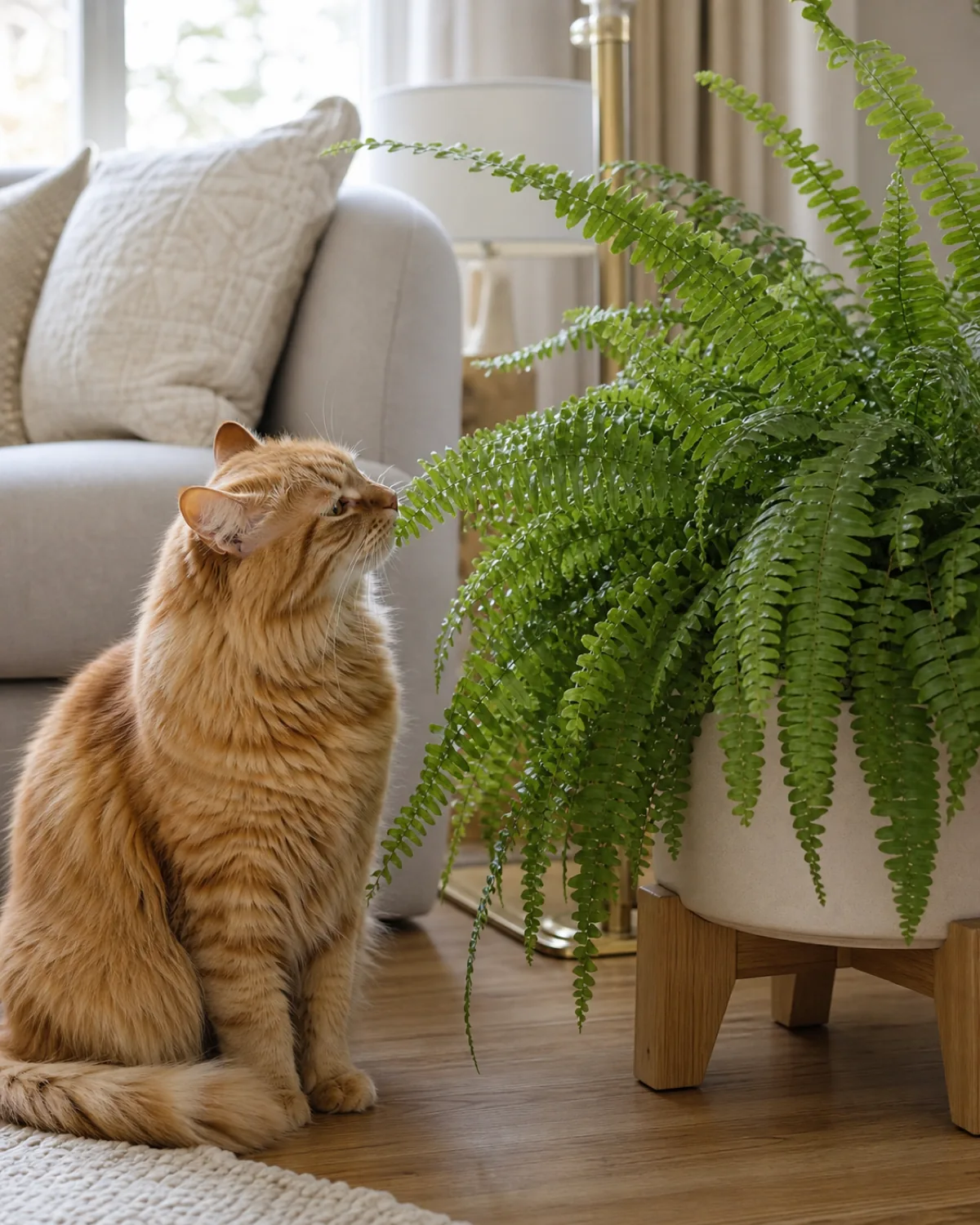
Most common indoor ferns — Boston fern, maidenhair fern, bird's nest fern, staghorn fern, rabbit's foot fern — are classified as non-toxic to cats, dogs, and children by the ASPCA.
This makes ferns one of the safest plant groups you can grow in a home with pets. The entire aroid family that dominates indoor plant collections — monstera, philodendron, pothos, peace lily, anthurium — contains calcium oxalate crystals that cause mouth pain if chewed.
Ferns contain none of it.
The critical exception is the asparagus fern, which is not a true fern at all. Asparagus setaceus and Asparagus densiflorus belong to the lily family (Asparagaceae). They look fern-like with their feathery needle-shaped foliage, but they produce berries that are toxic to cats and dogs.
The easiest way to tell: if it produces berries or flowers, it is not a fern.
If you have cats or dogs and want greenery without worry, any fern genus — Nephrolepis, Adiantum, Asplenium, Platycerium, Davallia — is a safe choice.
Fern Care: The Quick Reference
- 1360 million years, zero flowersFerns reproduce through spores, not seeds. The brown dots on frond undersides are sori — completely normal.
- 2Fiddleheads are the signatureNew fronds unfurl from tightly coiled spirals called crosiers. No other plant group does this.
- 3Low to medium indirect lightNorth or east window. No direct sun. Bird's nest ferns handle the darkest spots in your home.
- 450-80% humidity is non-negotiableBathroom, pebble tray, humidifier, or terrarium. Misting is useless. Winter heating kills ferns.
- 5Keep soil consistently moistNever bone-dry, never soggy. Check daily. One complete dry-out triggers weeks of leaf drop.
- 660-75°F, no draftsCold windows, AC vents, and ceiling fans desiccate thin fern fronds. Stability matters most.
- 7Peat + perlite + compost mixFine fibrous roots need moisture-holding soil, not chunky bark. Wide shallow pots work best.
- 8Half-strength fertilizer monthlySpring through fall only. Quarter-strength for maidenhair. Skip winter entirely.
- 9Brown frond dots = healthy plantSori are symmetrical, underside-only, consistent in color. Disease is random, both sides, spreads unevenly.
- 10Leaf drop = humidity firstBelow 40% humidity is the leading cause. Inconsistent watering is second. Inner-frond shedding is normal.
- 11Divide to propagateSplit at the rhizome in spring. Boston ferns also root from runners. Spore growing is slow and advanced.
- 12True ferns are pet-safeASPCA non-toxic for cats and dogs. Asparagus fern is the exception — it is not a true fern.
- 13Start with Boston or bird's nestBoston is the most forgiving on humidity. Bird's nest handles the lowest light. Graduate to maidenhair.
kultivy.com
Best indoor fern varieties for beginners
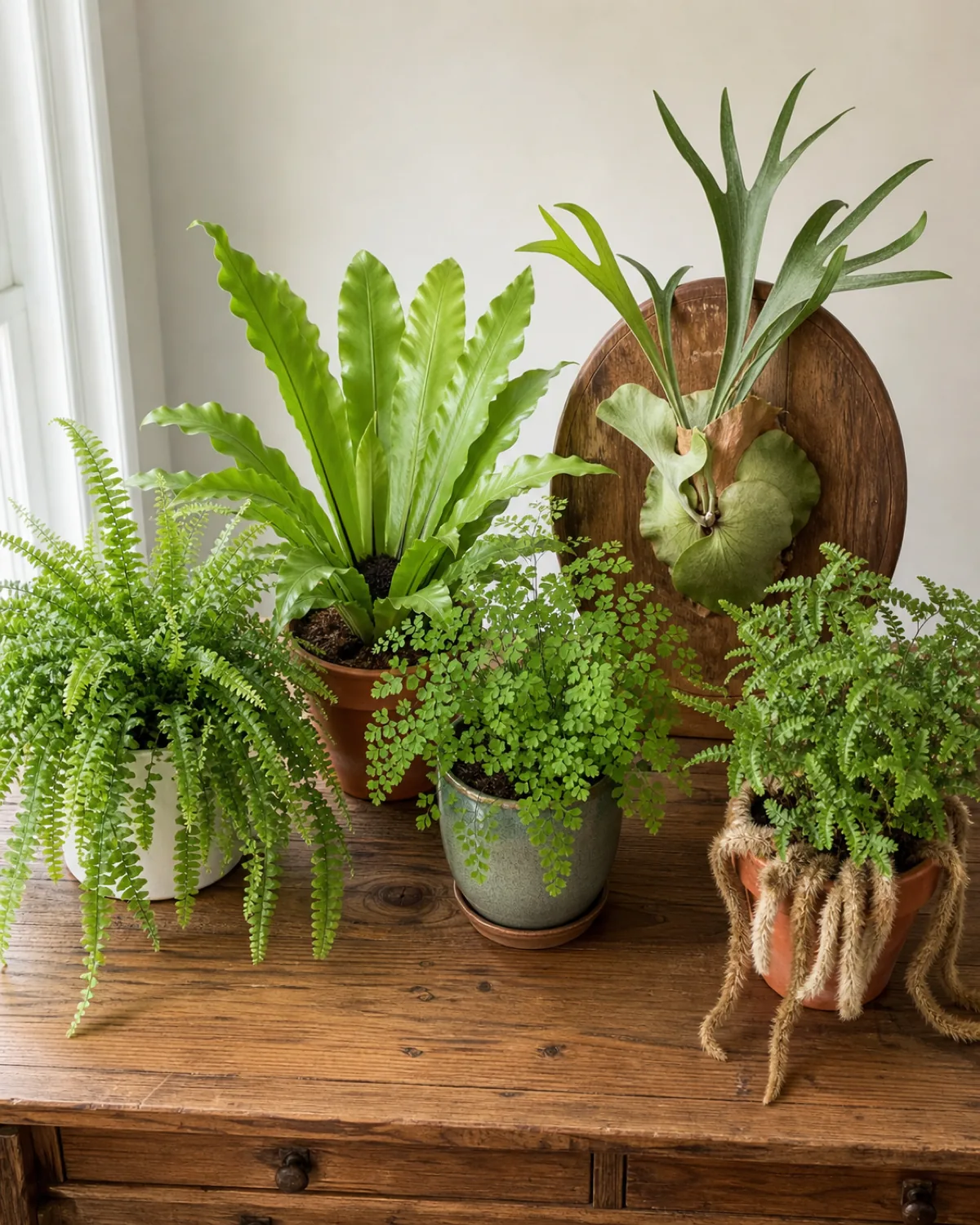
Boston fern (Nephrolepis exaltata) is the classic indoor fern and the best starting point. Its arching sword-shaped compound fronds cascade beautifully from hanging baskets and elevated shelves. It is the most forgiving species on humidity, tolerating forty percent where most ferns need fifty or higher.
The trade-off is leaf litter — Boston ferns shed more individual leaflets than any other species. Consider it the price of admission.
Bird's nest fern (Asplenium nidus) is the low-light champion. Its broad, smooth, undivided fronds grow upward in a rosette from a dark fibrous central cup — a completely different silhouette from the feathery look most people associate with ferns.
It sheds fewer leaves, grows slowly, and tolerates dimmer conditions than any other fern. If you want a fern for a dark corner where nothing else survives, this is the one.
Rabbit's foot fern (Davallia) gets its name from the fuzzy tan rhizomes that creep over the pot edge and dangle down the sides. These furry surface roots are the main attraction — the fronds are attractive but small and fine-textured. It is an excellent conversation piece and moderate in its care requirements: less demanding than maidenhair, slightly more than Boston.
Maidenhair fern (Adiantum) is the most beautiful indoor fern. Tiny fan-shaped leaflets on jet-black wiry stems create a cloud-like texture that no other plant replicates. It is also the most demanding — it requires consistently high humidity, consistent moisture, filtered or rainwater, quarter-strength fertilizer, and stable temperature. It should be your second or third fern, not your first.
Staghorn fern (Platycerium) is a mounted epiphyte that grows on a board like living wall sculpture. Its forked, antler-shaped fertile fronds and flat round basal fronds create a dramatic silhouette. Watering means soaking the entire mount in a bucket. It works best in bright indirect light and high humidity — a bright bathroom wall is the ideal spot.
Start with Boston or bird's nest to build confidence. Graduate to maidenhair once you have humidity consistently above fifty percent. Add a staghorn when you want a living art piece on your wall.

Mara Quinn edits Kultivy, where she shares houseplant care, propagation, beginner-friendly plant picks, and plant-styling ideas for anyone who wants their indoor plants to actually thrive. Every guide is image-led and reviewed for clarity, usefulness, image accuracy, and Pinterest-to-page alignment before it goes live. Visit the About page.