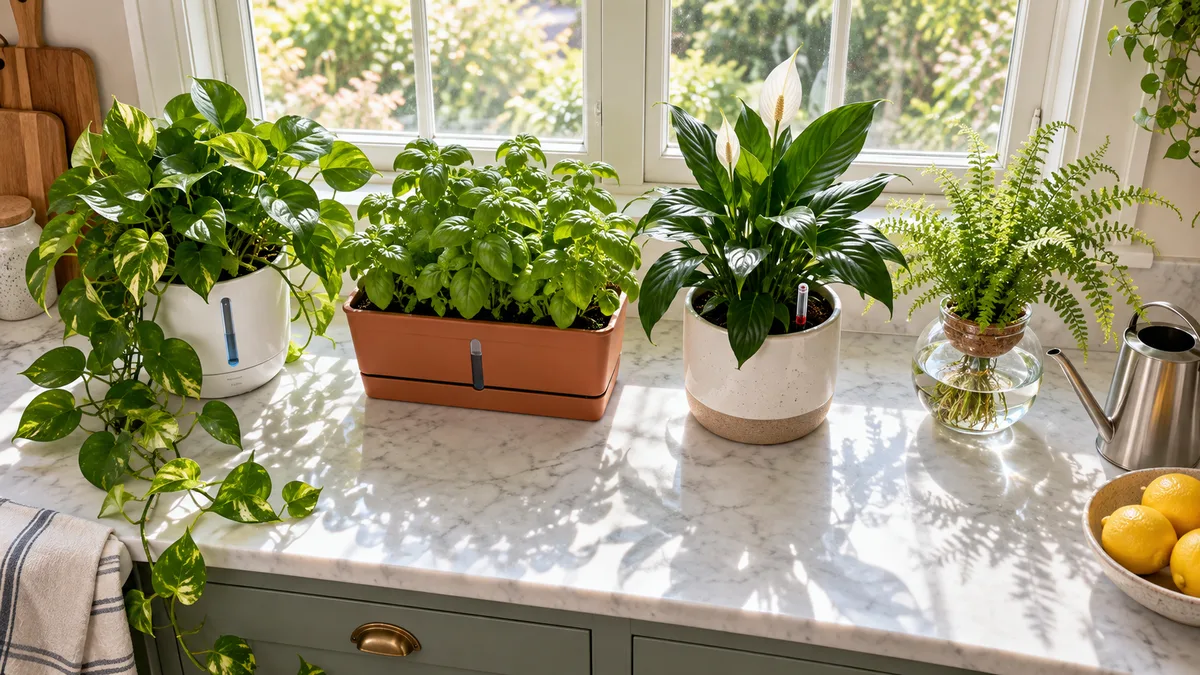
Every cat owner has pulled a shredded leaf from a guilty mouth and wondered if the plant was toxic. Most popular houseplants — pothos, peace lily, snake plant — sit on the ASPCA danger list.
These thirteen are ASPCA-confirmed non-toxic. Some taste bitter enough that cats walk away, others have leaves too thick to puncture, and a few grow without soil.
Every plant below is confirmed non-toxic by the ASPCA Poison Control Center. Tap any name to jump straight to its care summary.
Spider plant as the cat-proof classic that handles nibbling
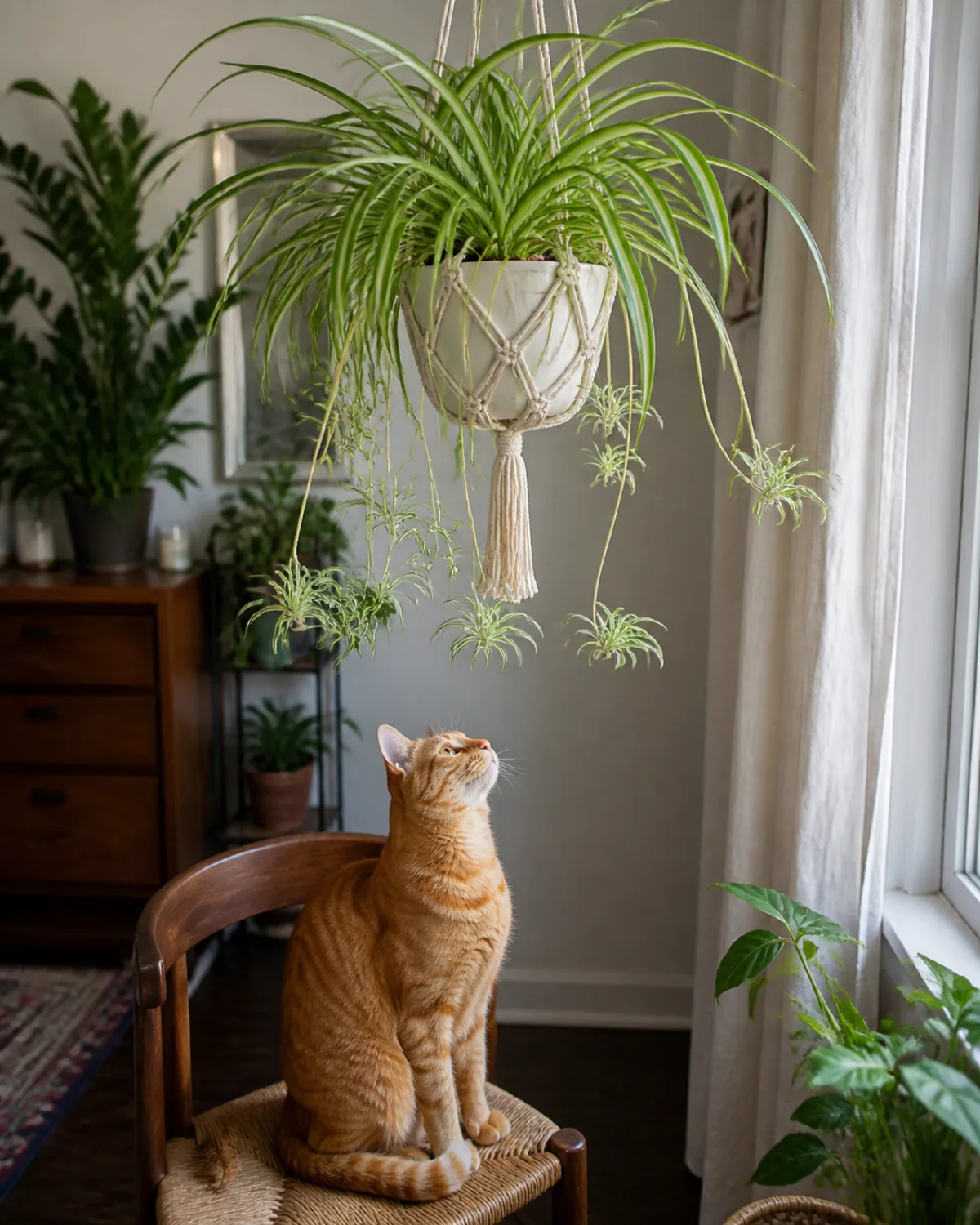
Chlorophytum comosum is probably the most chewed houseplant on Earth. Cats find the long, arching leaves irresistible — the movement triggers the same pounce reflex as a feather wand. The good news is that spider plant is completely non-toxic according to the ASPCA.
Cats may experience a mild euphoric response after chewing spider plant foliage, similar to the reaction catnip produces. The effect is harmless and short-lived, but it does mean your cat will come back for more. This makes spider plant the one case where "non-toxic" does not automatically mean "leave it on the floor."
Hang your spider plant in a macrame planter or place it on a high shelf where the dangling plantlets stay above swatting range. The tuberous root system survives rough handling — even if your cat topples the pot, the plant recovers within days. That resilience is what makes it the default recommendation for cat households.
Different cats destroy plants in different ways. Pick the species that matches your cat's style.
Boston fern as the lush shower-room plant cats ignore
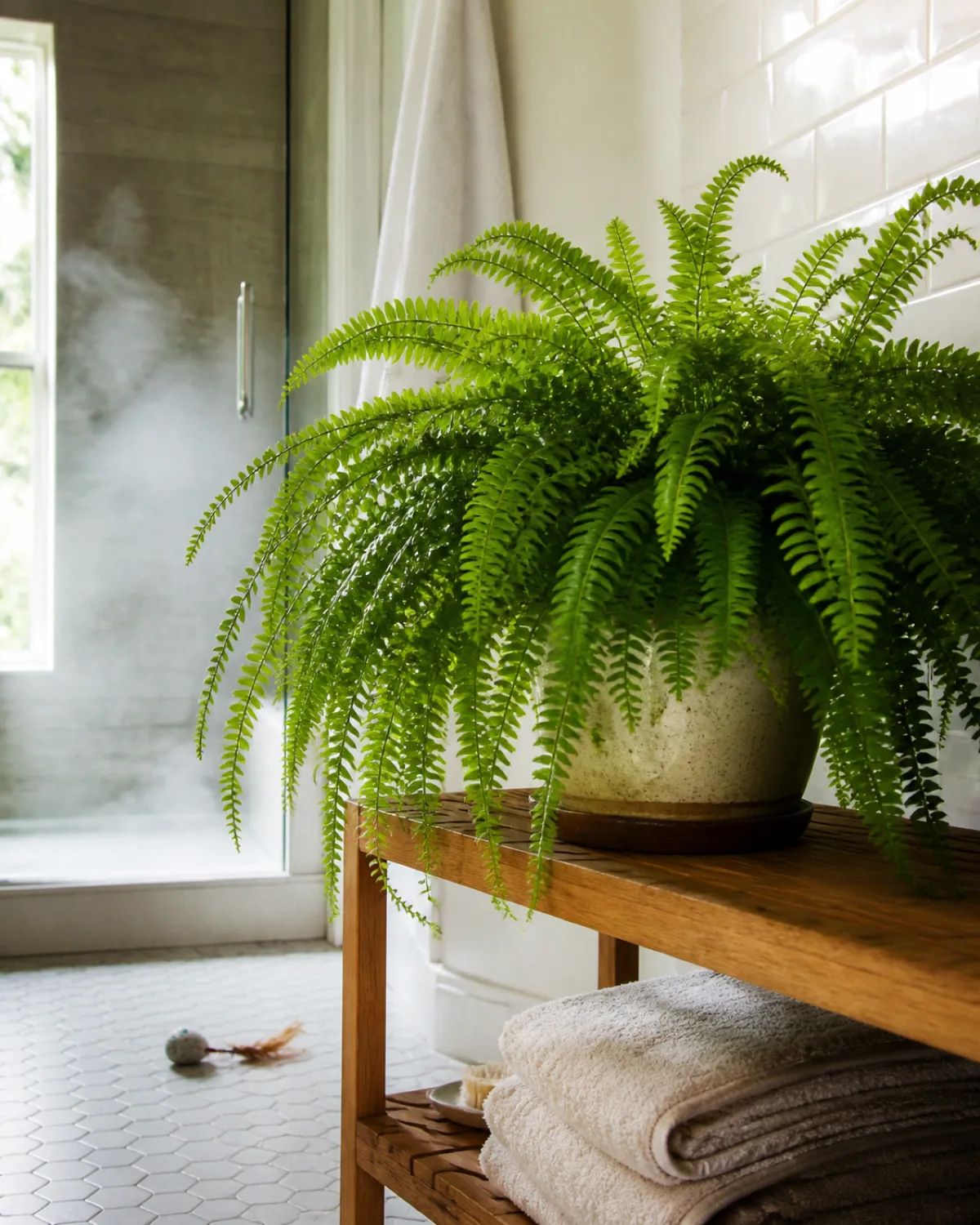
Nephrolepis exaltata produces dense cascading fronds that look appetizing from across the room but taste bitter enough that most cats lose interest after one exploratory nibble. The bitterness comes from tannins in the frond tissue — harmless to cats, but deeply unappealing to their palate.
Boston fern thrives in the same conditions that make bathrooms uncomfortable for most houseplants: high humidity, moderate warmth, and indirect light. Placing it in the bathroom accomplishes two things at once — the plant gets the moisture it craves from shower steam, and the cat encounters it less often because most cats avoid the dampest room in the house.
The brown dots that appear on the undersides of mature fronds are sori — clusters of spore-producing structures, not disease. They are completely harmless. If your cat does brush against the fronds and dislodges spores, the dust is inert.
Shedding is the main annoyance. Boston ferns drop small leaflets when stressed by dry air or inconsistent watering. In a cat household, the dropped leaflets become cat toys — harmless ones, but you will find them batted under furniture.
Areca palm creating a cat-safe tropical screen
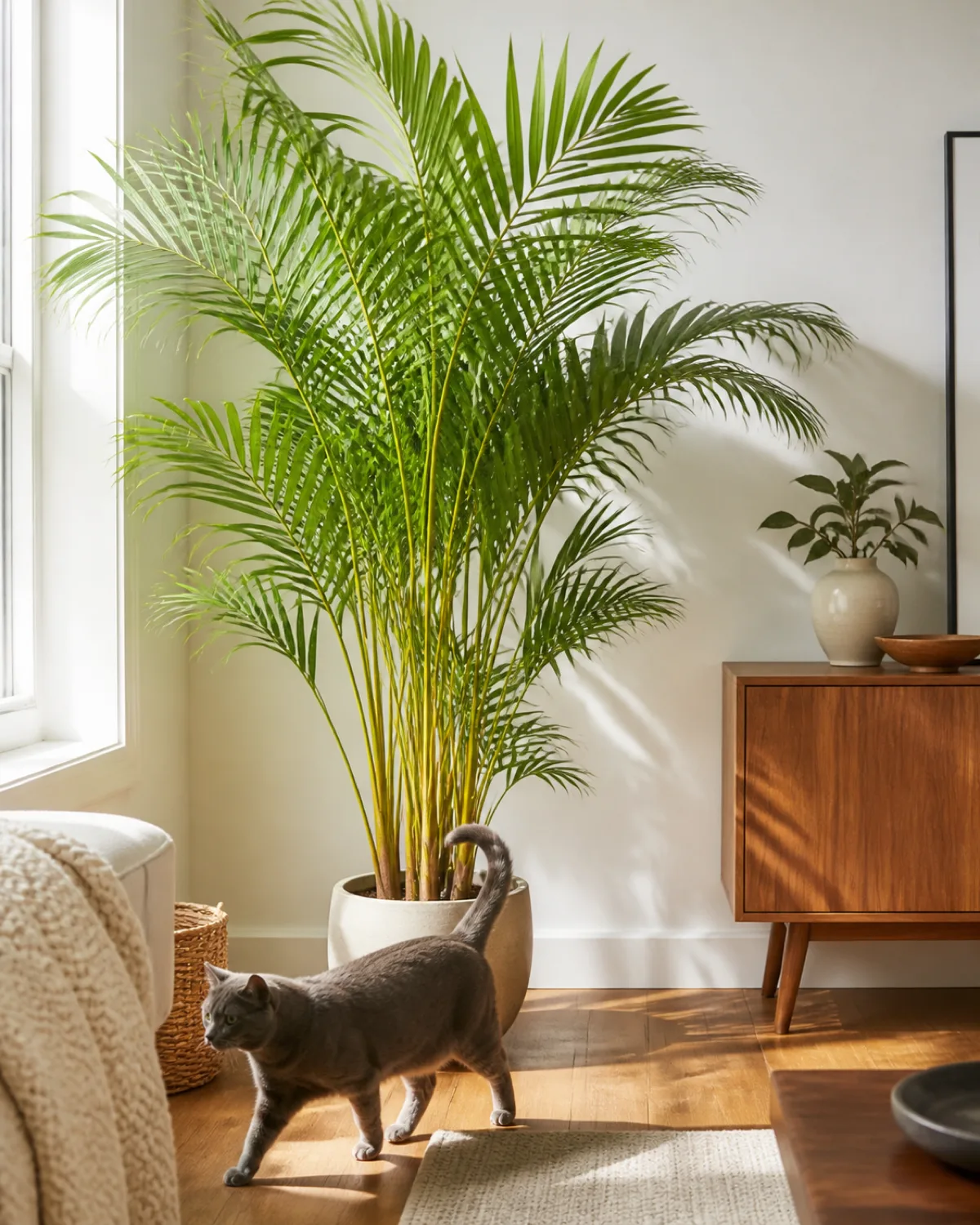
Dypsis lutescens grows feathery fronds that sway with every air current — ceiling fan, open window, even the draft from a door closing. To a cat, this is a full-body interactive toy that never stops moving.
The fronds are completely non-toxic, so the chewing itself causes no harm. The damage is to the plant: a cat that bats at areca palm fronds daily will shred the tips into brown tatters within weeks.
The solution is placement. Position the palm where its lower fronds extend into space the cat does not patrol — behind a sofa, in a corner blocked by furniture, or raised on a plant stand that lifts the lowest fronds above tail height.
Areca palm grows relatively fast in bright indirect light, producing new fronds from the center of each cane cluster. Even if your cat damages outer fronds, fresh growth replaces them. Trim any shredded frond tips cleanly with scissors to prevent the torn edges from browning further up the leaflet.
Non-toxic means safe to eat — it does not mean your cat will leave the plant alone. These four measures reduce the destruction.
Prayer plant with leaves that move more than your cat
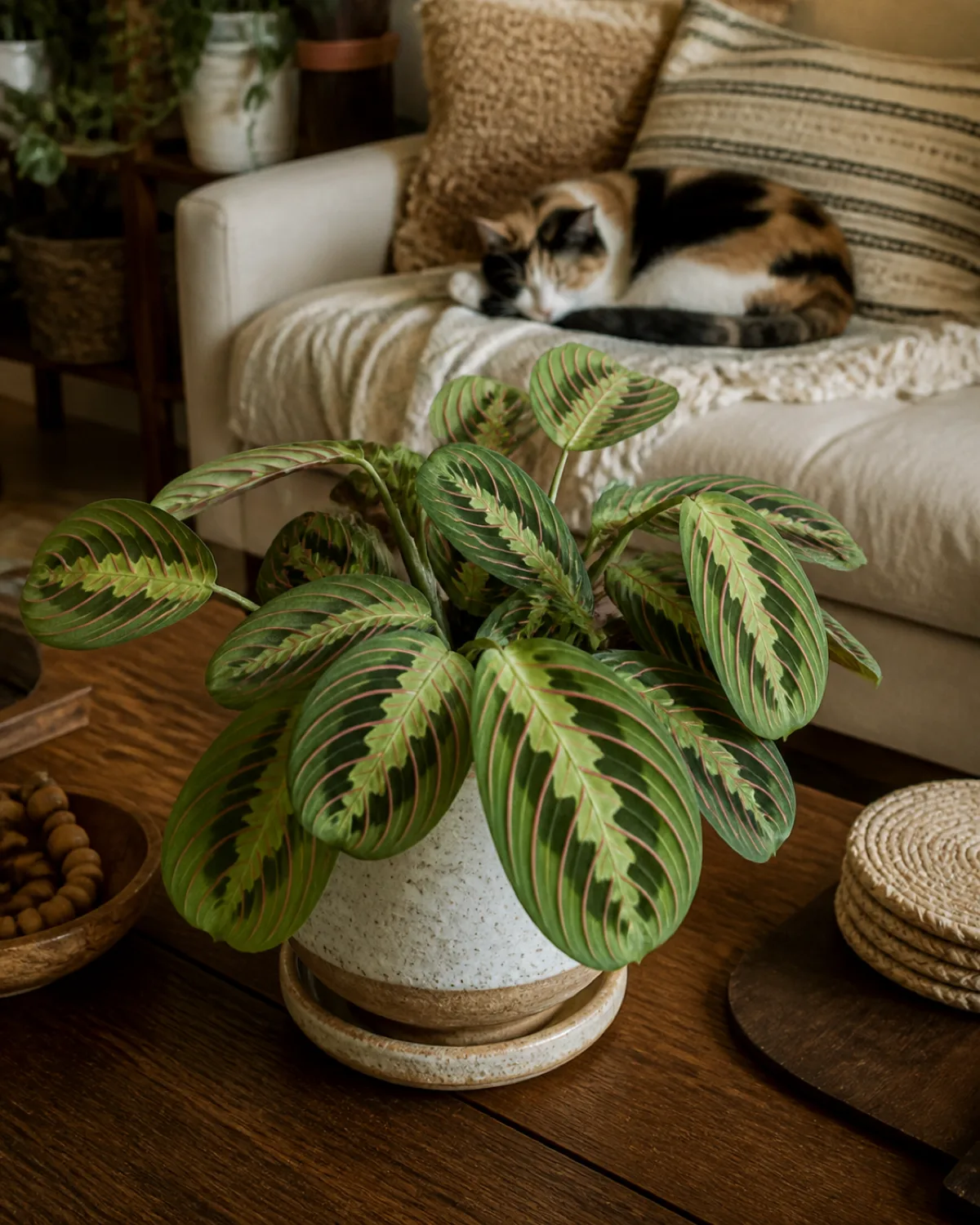
Maranta leuconeura performs nyctinasty — the leaves fold upward each evening like hands pressed together in prayer, then flatten again at dawn. The movement is driven by pulvinus joints at the base of each leaf that respond to changes in light intensity throughout the day.
This built-in animation fascinates cats. Many cat owners report their cat sitting and watching the prayer plant leaves rise at dusk, which is exactly the kind of low-impact feline entertainment that keeps claws away from furniture. The plant is completely non-toxic according to the ASPCA, so even if curiosity escalates to a taste test, no harm results.
Prayer plant's thick, patterned leaves resist casual tooth marks better than thin-leaved plants like pothos or philodendron. The herringbone variety — with its signature red veins on dark green — is the most common in stores and also the most durable against cat interaction.
Keep prayer plant in indirect light and maintain humidity above fifty percent. Dry air causes brown leaf edges that make the plant look ragged, and a ragged plant invites more cat attention because the curling edges resemble something worth batting.
Parlor palm as the low-light safe pick for dark corners
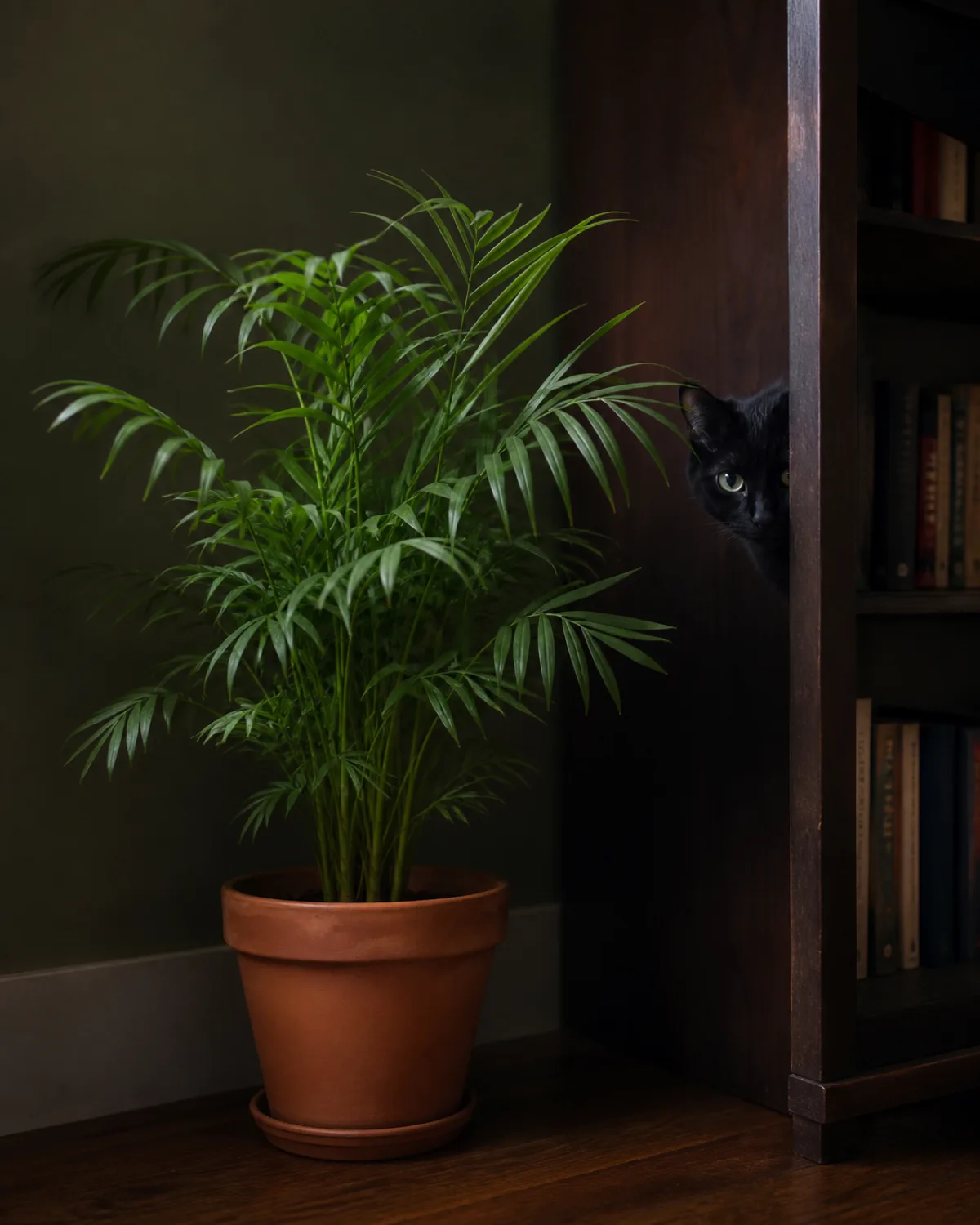
Chamaedorea elegans is one of the few cat-safe plants that genuinely thrives in low light — not "tolerates" it while slowly declining, but actually maintains healthy fronds in the kind of dim corner where most houseplants would stretch into leggy embarrassments.
Parlor palm produces thin, flexible canes that bend rather than snap when a cat inevitably bumps into the plant. This matters more than it sounds. A snapped dracaena cane leaves a sharp point that can scratch a cat's face or eye. Parlor palm's canes flex and bounce back, so collisions are harmless in both directions.
The fronds reach high enough on a mature specimen that cats lose interest — there is nothing dangling at paw level to trigger the swat reflex. New growth emerges from the center of the plant and extends upward, so even a small parlor palm keeps its foliage above the critical cat-interaction zone within a year of purchase.
Water when the top inch of soil dries. Parlor palm is one of the few palms that prefers slightly moist soil — unlike areca palm, which wants to dry out more between waterings. In a dim corner, the soil dries slowly, so you may only water every ten to fourteen days.
Peperomia as the bite-proof succulent cats lose interest in
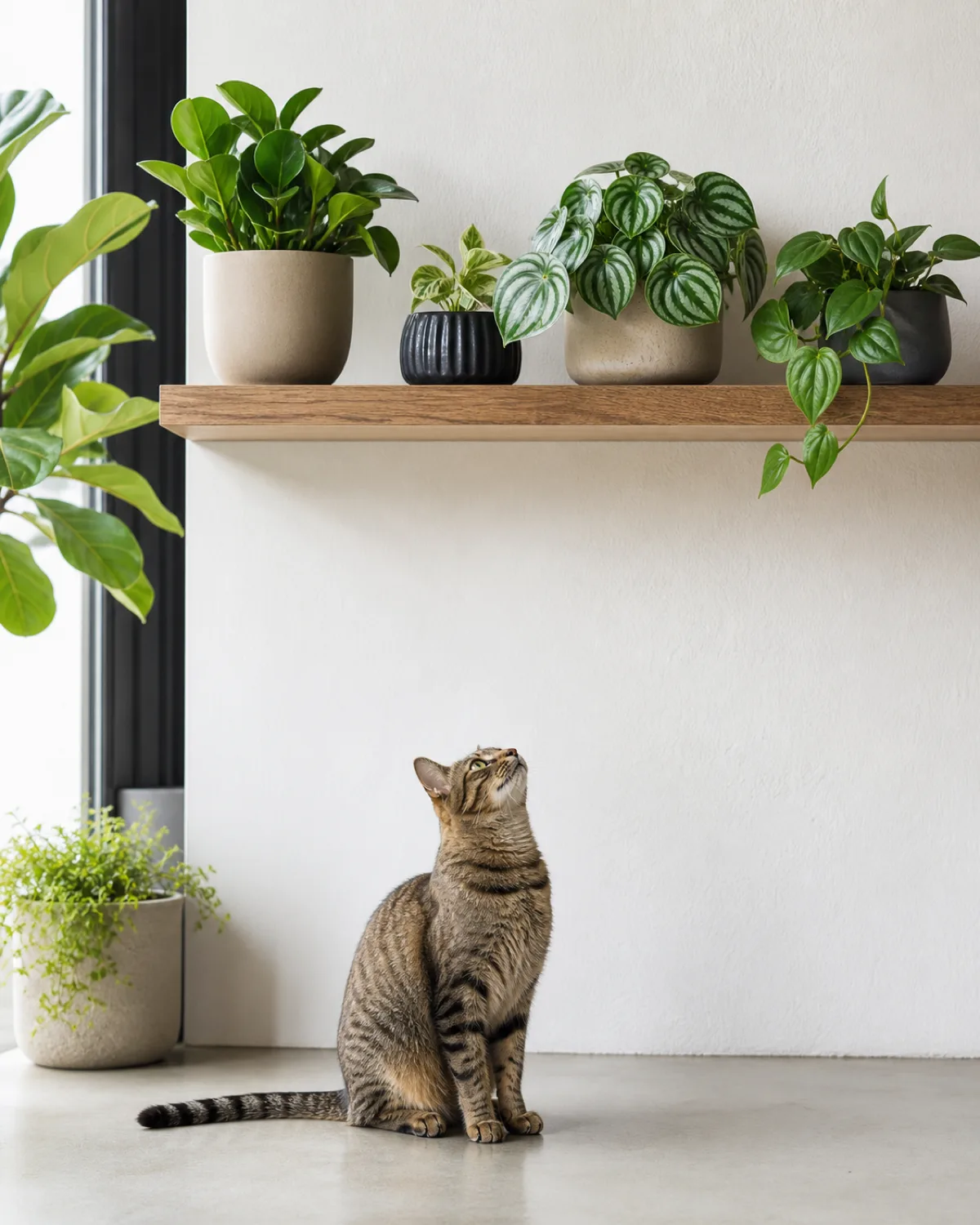
Peperomia species store water in their semi-succulent leaves, creating a rubbery texture that cats find deeply unsatisfying to chew. There is no rewarding crunch like a pothos leaf and no soft tear like a philodendron — just a bland, waxy resistance that offers no sensory feedback.
After one experimental bite, most cats walk away permanently. The watermelon peperomia (Peperomia argyreia) is the most cat-resistant variety because its thick, round leaves are too wide for a cat mouth to get proper purchase on. The obtusifolia varieties have similarly thick leaves that resist puncture.
Peperomia's compact growth habit makes it ideal for high shelves and floating shelf displays where cats cannot reach. A mature watermelon peperomia rarely exceeds eight inches in diameter, and the rosette form stays tidy without pruning. Even if a cat does manage to reach one, the thick leaves show only minor tooth impressions that heal over within a week.
The entire Peperomia genus — all one thousand-plus species — is confirmed non-toxic by the ASPCA. This is rare. Most large genera contain at least a few toxic species. With peperomia, you can buy any variety in any store without checking the specific species name against a database.
Calathea as the thick-leafed showpiece cats cannot chew through
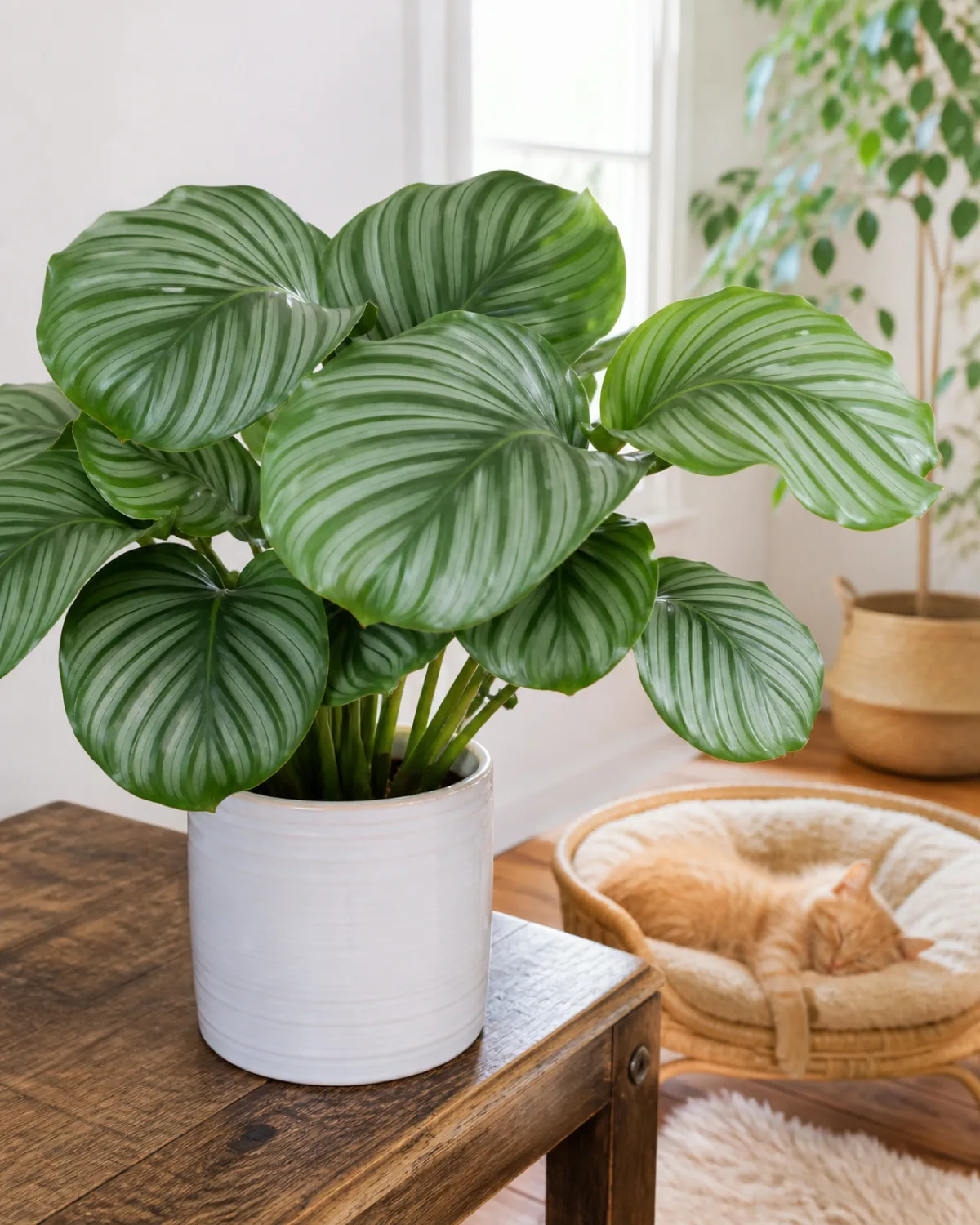
Calathea species grow leaves with a rigid lamina structure thick enough that cat teeth cannot puncture them. Unlike the soft, thin leaves of toxic plants like dieffenbachia or syngonium that shred easily, a calathea leaf resists like a playing card.
There is no satisfying tear, no juice release, and no tactile reward.
The leaf undersides display deep purple coloring that distinguishes calathea from its close relative the prayer plant (Maranta), which shares the same family Marantaceae but produces thinner, more flexible foliage. Both are non-toxic. Both perform nyctinastic leaf movements. But calathea's thicker leaves survive cat encounters with less visible damage.
Position calathea on stable, heavy surfaces. The wide leaf rosette form catches air currents and can act like a sail — a cat jumping onto a narrow shelf near a large calathea orbifolia might send both plant and cat off the edge. A sturdy side table or a wide windowsill with a weighted pot eliminates this risk.
Calathea demands higher humidity than most cat-safe options — fifty percent minimum, sixty to seventy percent ideal. Brown, crispy leaf edges are the classic humidity-stress signal. A pebble tray beneath the pot or a small humidifier nearby solves it without creating the kind of standing water that attracts cat drinking.
Money tree as the large cat-safe floor plant
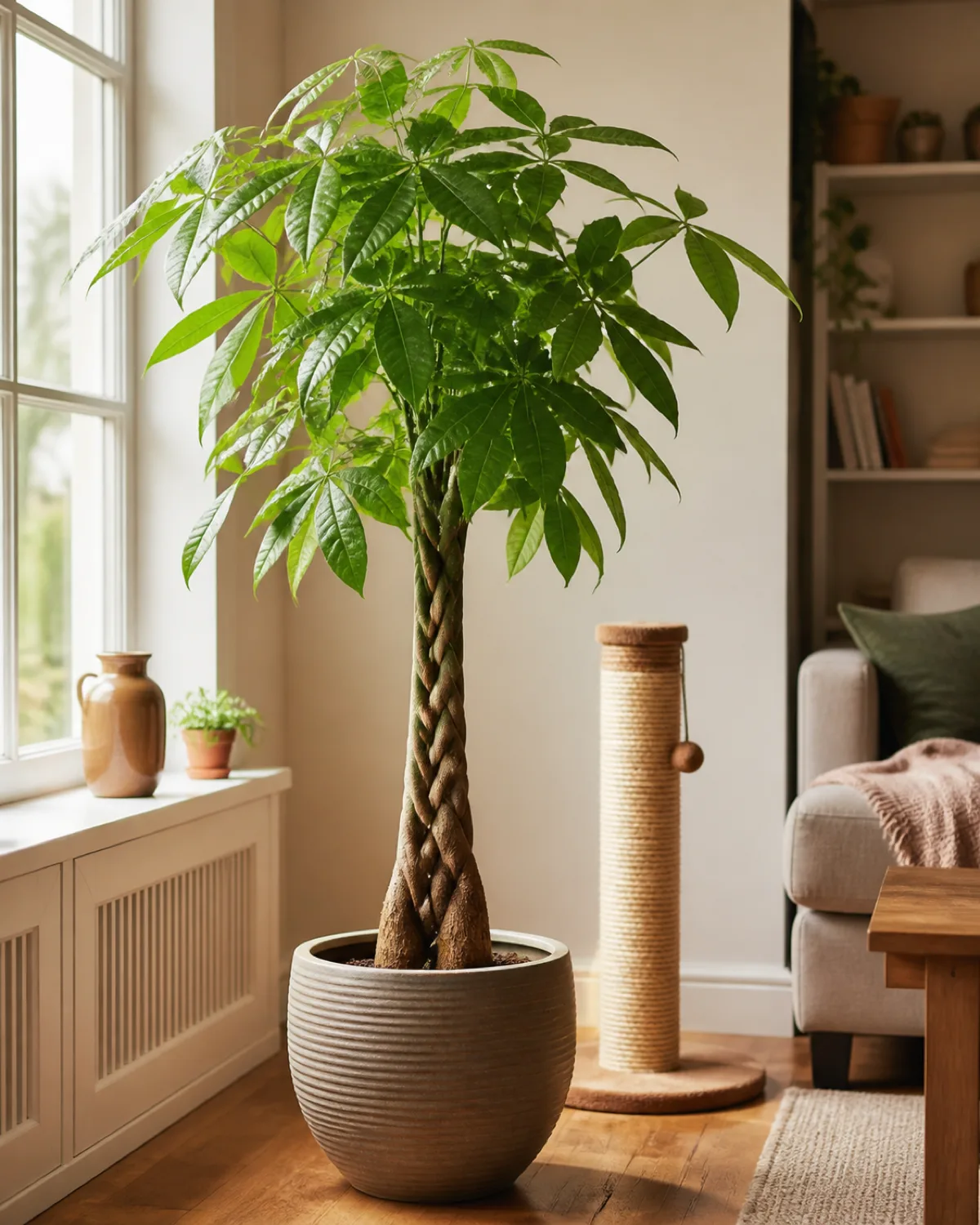
Pachira aquatica is one of the few large floor plants that the ASPCA confirms as non-toxic to both cats and dogs. Most statement-sized houseplants — fiddle leaf fig, rubber plant, dracaena — contain irritants or toxins. Money tree is the exception.
The braided trunk is too thick and solid for a cat to topple. Where a single-stem fiddle leaf fig can be rocked off balance by a determined jumper, the three-to-five woven trunks of a braided money tree create a wide, stable base. The palmate leaves grow high on the trunk, well above typical cat-reach height on a mature specimen.
Money tree tolerates bright indirect light and lets soil dry halfway between waterings — an easy-care profile that cat owners appreciate because the plant does not punish the kind of benign neglect that cat emergencies cause. Forgotten to water for a week because the cat needed a vet visit? The money tree barely notices.
The main risk is overwatering, which rots the braided trunk from the inside out at the crevices where the woven stems press together. The decay hides between the trunks where you cannot see it. Stick to the halfway-dry rule and ensure the pot has drainage holes.
Hoya as the waxy trailing vine cats leave alone
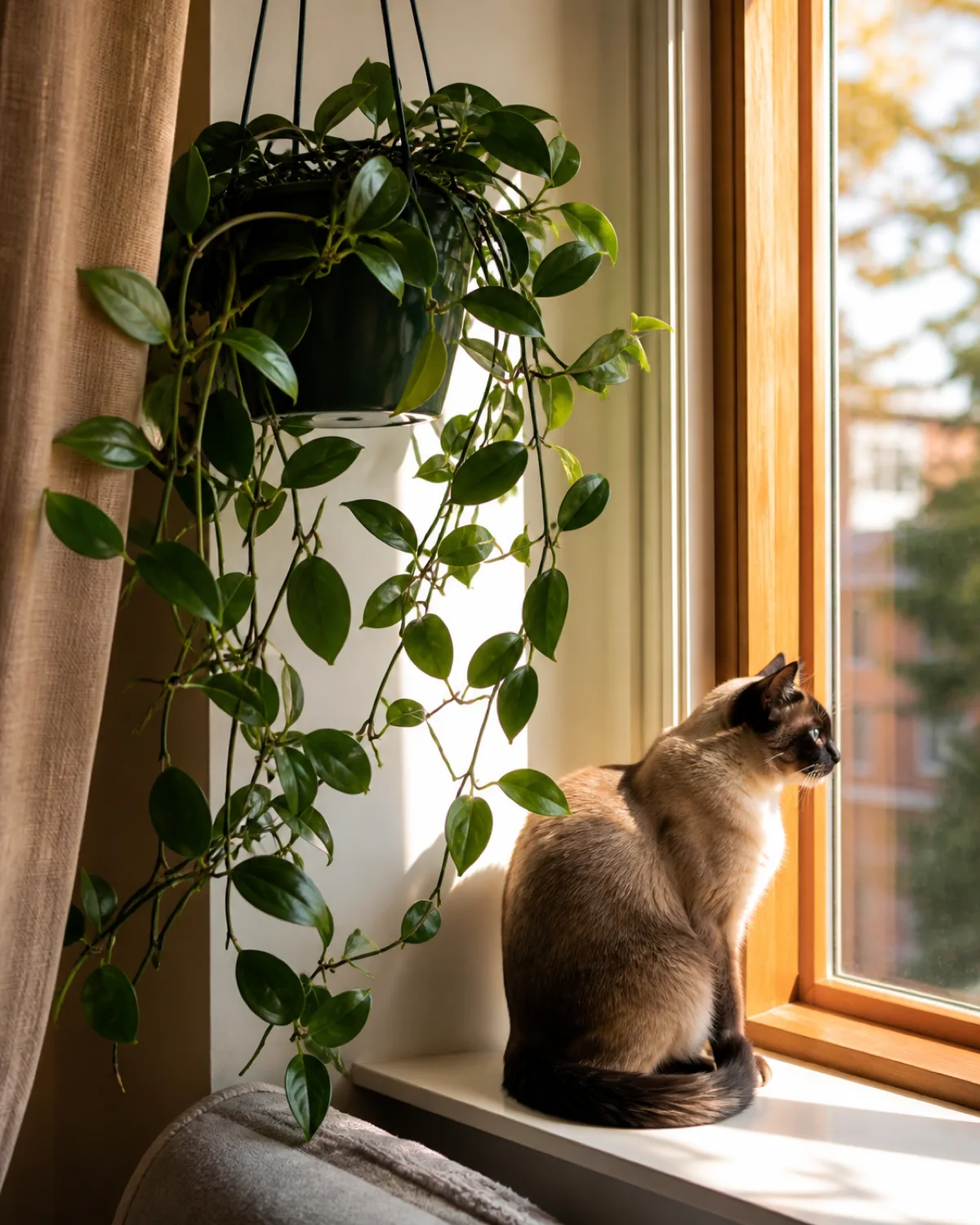
Hoya carnosa produces leaves with a thick, waxy cuticle that gives them a plastic-like texture. Cats investigate by mouthing the leaf, feel the unyielding waxy surface, and move on. There is nothing to tear, nothing to crunch, and no scent that attracts repeat visits.
Hoya is one of the best trailing plants for cat households because it hangs high and grows slowly. Unlike fast-growing trailing plants that quickly send vines down to cat-accessible heights, hoya adds only a few inches of vine growth per month. A hanging planter mounted at ceiling height keeps the foliage above cat range for years before the vines need trimming.
The ASPCA lists hoya as non-toxic. If your cat does manage to reach a vine and chew a leaf, the worst result is a slightly mangled leaf with tooth impressions in the wax. The plant's slow growth means damaged leaves stay visible for a long time, but new leaves eventually push from the nodes behind the damage.
Never cut the peduncle — the woody stub from which hoya flowers emerge. Hoya blooms from the same peduncle year after year. Cutting it eliminates flowering from that node permanently. If your cat snaps a peduncle by pulling on the vine, the plant will eventually grow a new one from a different node, but the process takes months.
Pilea peperomioides as the quirky cat-safe conversation piece
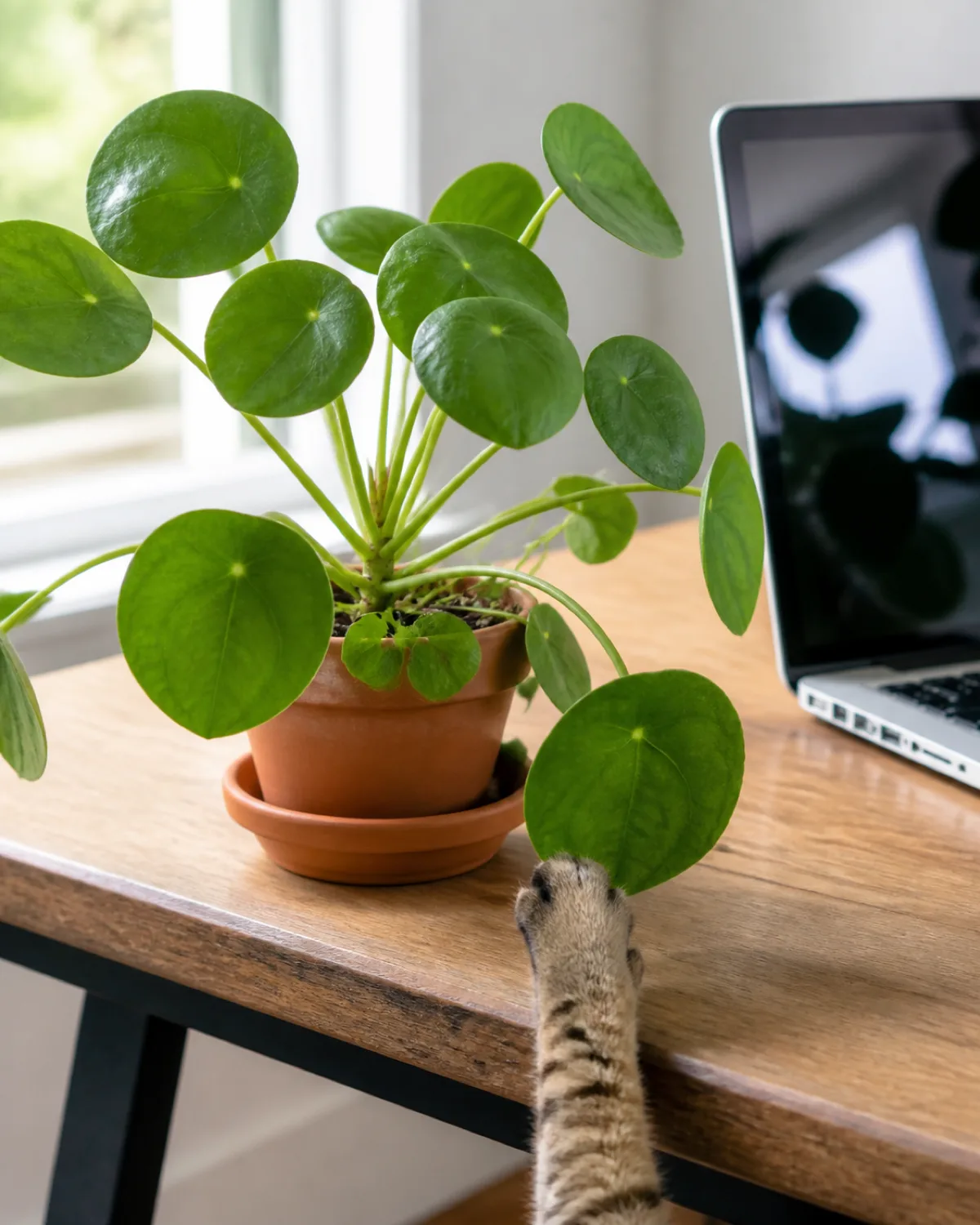
Pilea peperomioides — the Chinese money plant — features round, disc-shaped leaves on thin petioles that bounce and wobble at the slightest touch. To a cat, this is mesmerizing. Each bat of a paw sets off a chain reaction of wobbling leaves that takes several seconds to settle.
The plant is completely non-toxic even when chewed. The leaves have a mild, grassy taste with no bitterness or irritation, which means cats may chew more than one leaf before losing interest. This is fine from a safety perspective but can leave a pilea looking ragged.
The built-in insurance policy is pilea's prolific pup production. Underground rhizomes push new baby plants up through the soil surface every few weeks during the growing season. Even if your cat destroys the mother plant's lower leaves, the pups provide a steady supply of replacements.
Separate pups when they reach two to three inches tall and pot them individually. You will never run out of pilea.
For cat households, the best placement is a high shelf where the cat can see the wobbling leaves but cannot reach them. The visual entertainment value works at a distance — cats will watch from the floor as air currents set the disc leaves swaying.
Choosing a non-toxic plant is only step one. These four oversights still create problems.
Air plant as the soil-free option cats can bat around
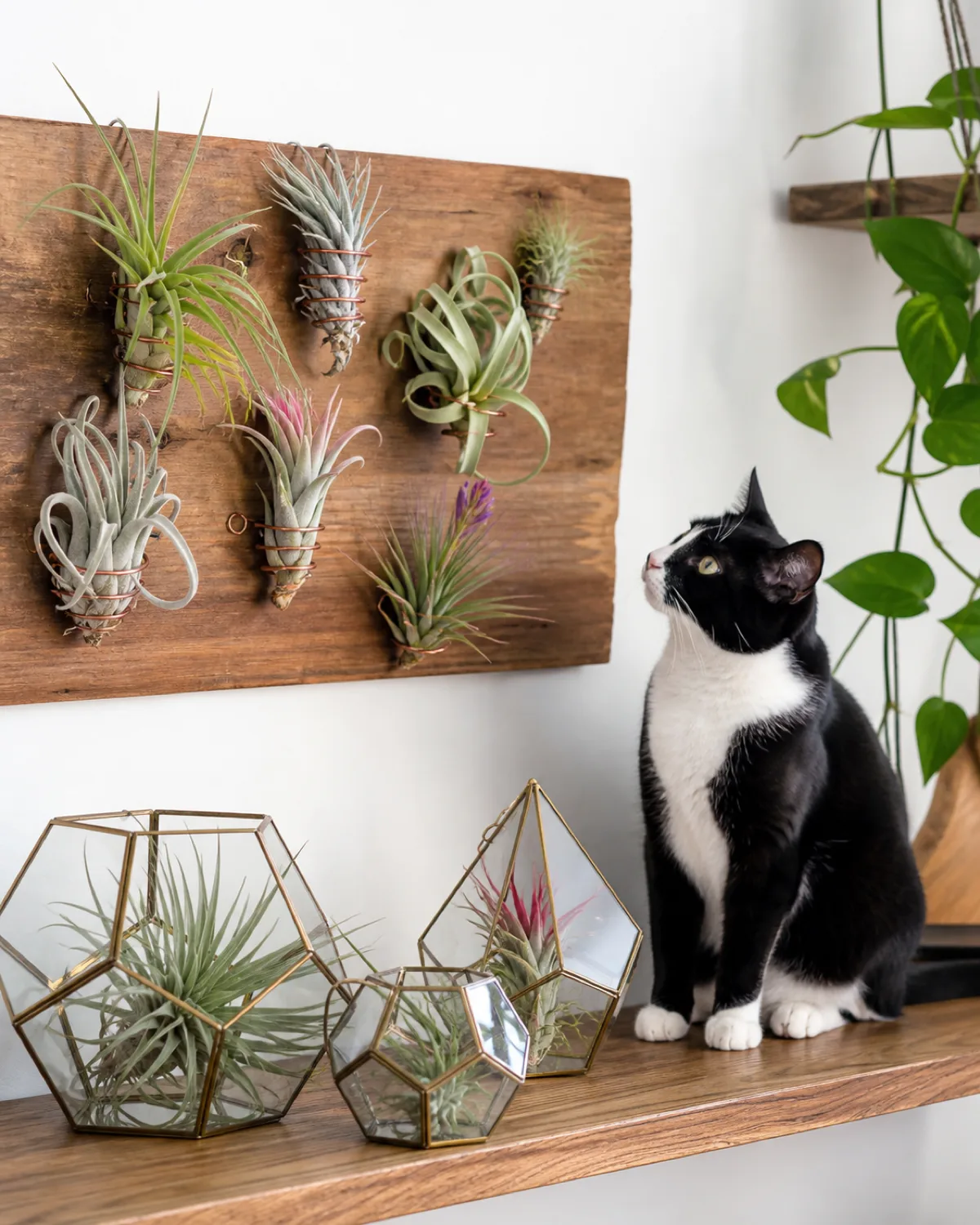
Tillandsia species eliminate the digging problem entirely because they grow without soil. Air plants absorb water and nutrients through specialized trichomes — tiny scales covering the leaf surface — and anchor themselves to bark, rock, or wire rather than rooting into a growing medium. No soil means no digging, no scattered dirt, and no fungus gnat habitat.
Air plants are lightweight enough to survive being knocked off a shelf without damage. A ceramic pot full of wet soil hits the floor and shatters. A tillandsia bounces. For households with cats that patrol shelves and nightstands, this durability-through-lightness is a genuine advantage.
The ASPCA confirms tillandsia as non-toxic to cats. The leaves are tough and fibrous — not the kind of soft tissue that invites chewing — so most cats investigate once and ignore them afterward.
Care is simple: soak the entire plant in room-temperature water for twenty to thirty minutes once a week, shake off excess water, and let it dry completely within four hours in a spot with good air circulation.
The "dry within four hours" rule is critical — sitting in trapped moisture causes crown rot, the most common way air plants die indoors. Display them in open-front terrariums, on driftwood mounts, or clipped to wall-mounted wire grids where air circulates freely.
Cast iron plant as the indestructible cat-proof survivor
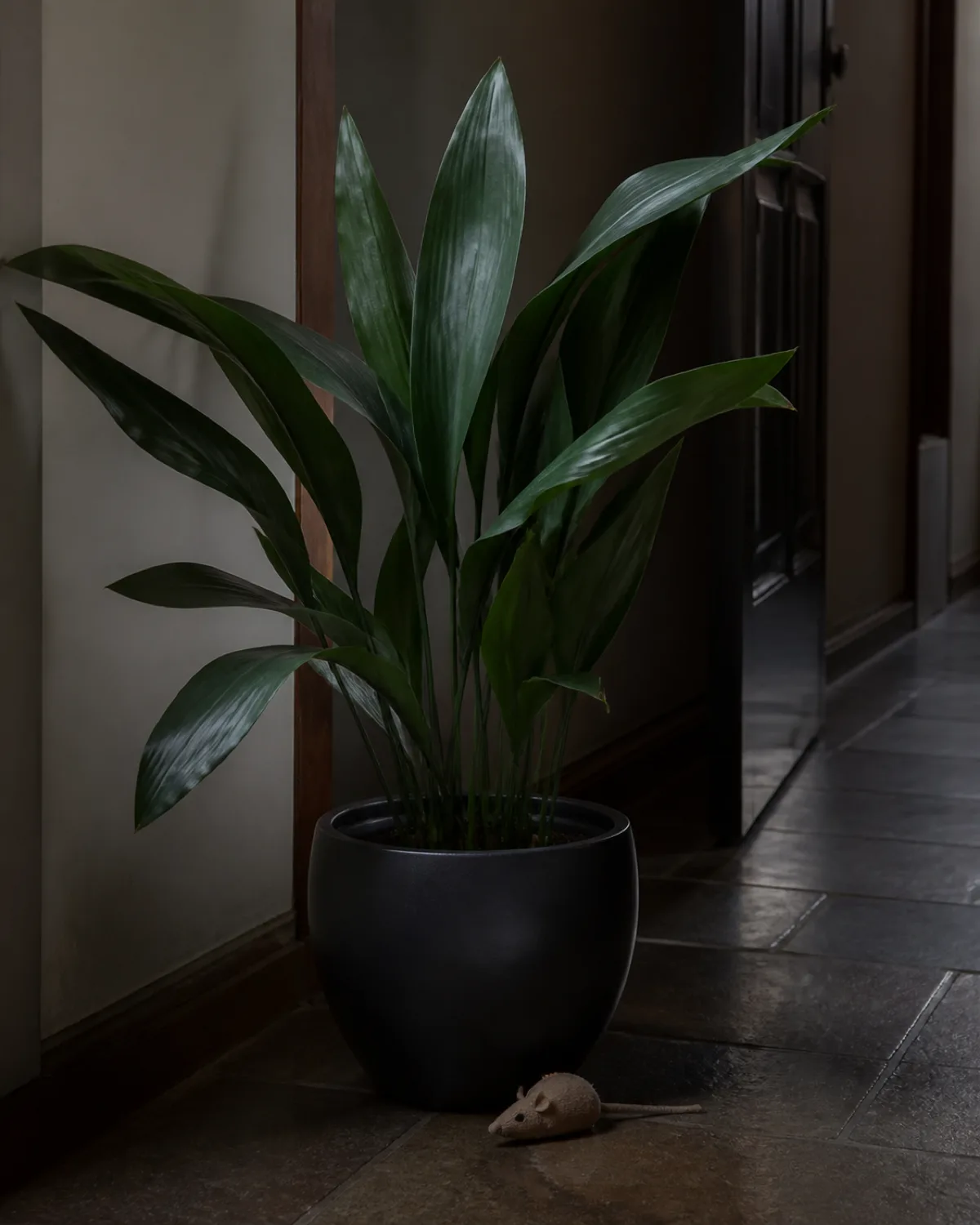
Aspidistra elatior earned its common name by surviving conditions that kill everything else — deep shade, drought, temperature swings, poor soil, and now cats. The thick, leathery leaves grow directly from the rhizome at soil level and stand upright like dark green leather paddles. Cat claws may leave faint surface scratches but cannot puncture or tear the leaf tissue.
Cast iron plant is the ultimate low-maintenance option for cat households that want green without any of the fuss. It tolerates the dimmest corners in your home — genuinely low light, not the "bright indirect" that most care guides call low light. It survives weeks without water. It does not drop leaves, shed fronds, or produce dangling bits that attract cat attention.
The ASPCA confirms Aspidistra elatior as non-toxic to cats and dogs. Combined with its indestructibility, this makes it the safest possible choice for a floor-level plant in a multi-cat household. No other houseplant offers this combination of physical toughness, shade tolerance, drought resistance, and confirmed non-toxicity.
Growth is glacially slow — perhaps two to four new leaves per year — which means damage stays visible for a long time but also means the plant requires almost zero active care. Water when the soil is completely dry. Fertilize once or twice during the growing season with a diluted balanced fertilizer. That is the entire care routine.
How to cat-proof any houseplant setup
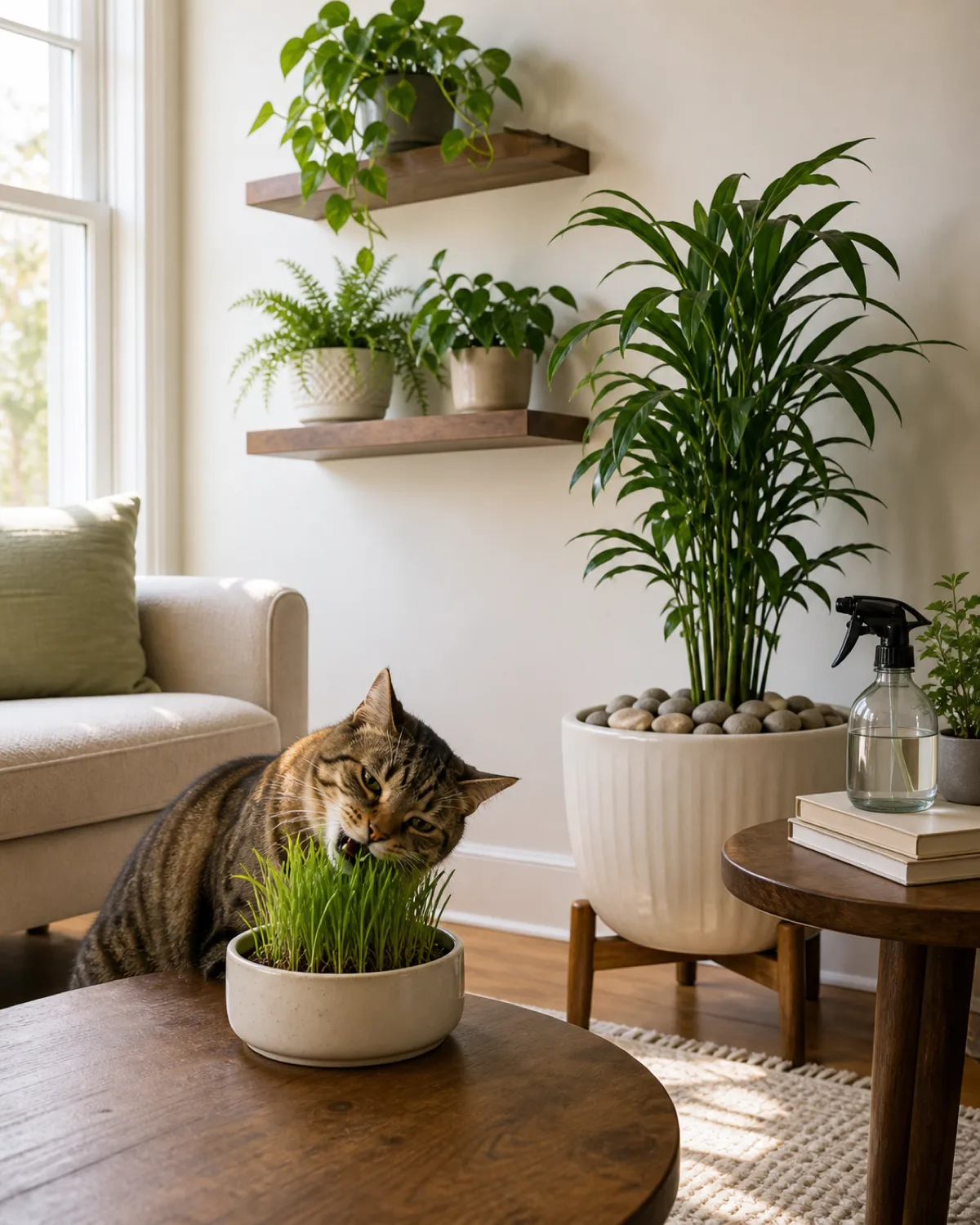
Even with an entirely non-toxic plant collection, practical cat-proofing reduces the mess, the broken pots, and the shredded leaves that make cat-and-plant coexistence frustrating.
Elevation is the most effective strategy. Floating shelves, ceiling-mounted hanging planters, and tall plant stands move plants above the critical zone — roughly zero to four feet from the floor — where cats operate. Wall-mounted shelves with a lip or rail prevent pots from being nudged off the edge.
Macrame hangers work for lightweight trailing plants but need a ceiling hook rated for the combined weight of plant, pot, and wet soil.
Cover exposed soil with decorative stones or river rocks. Cats dig in soil for the same reason they use litter boxes — loose, scratchable substrate triggers the digging instinct. A layer of smooth stones one to two inches deep eliminates the texture cue without affecting drainage or root health. The added weight also stabilizes pots against tipping.
Offer dedicated cat grass as a redirect. A pot of wheatgrass (Triticum aestivum) or oat grass (Avena sativa) on a low surface gives your cat a designated chewing target. Most cats prefer the tender, sweet grass blades over tougher houseplant foliage when both options are available. Replace the grass every two to three weeks as it yellows.
Apply bitter apple spray to high-value plants. If you have one plant your cat fixates on, bitter apple spray (a pet-safe taste deterrent available at any pet store) makes the leaf surface taste terrible without harming the plant's tissue. Reapply after watering or rain, as water dilutes the coating.
Stabilize floor pots. Heavy ceramic or concrete pots resist tipping. For lighter pots, add a layer of decorative stones inside the bottom before adding soil — this lowers the center of gravity. Pot feet or grip pads prevent sliding on hard floors when a cat launches off the pot rim.
Watch drainage trays. Cats drink from saucers. Standing water in a drainage tray may contain fertilizer salts or organic decomposition byproducts that are not safe to ingest. Empty trays within thirty minutes of watering, or switch to self-draining cache pots that elevate the grow pot above the water line.
Save this list: 13 cat-safe houseplants
- 1Spider plantNon-toxic classic cats love to chew — hang it high
- 2Boston fernBitter fronds cats self-deter from — thrives in bathroom humidity
- 3Areca palmFeathery fronds create a tropical screen — flexible, not brittle
- 4Prayer plantLeaves fold at dusk for built-in cat entertainment
- 5Parlor palmTrue low-light survivor with flexible canes that bend, not snap
- 6PeperomiaRubbery leaves cats bite once and abandon forever
- 7CalatheaThick patterned leaves too rigid for cat teeth to puncture
- 8Money treeLarge floor tree with a braided trunk cats cannot topple
- 9HoyaWaxy trailing vine with a texture cats find unappealing
- 10PileaWobbling disc leaves that mesmerize — unlimited pup replacements
- 11Air plantNo soil, no digging, survives being knocked off shelves
- 12Cast iron plantIndestructible shade survivor cats cannot damage
- 13Cat-proofing tipsElevation, soil covers, cat grass, and bitter spray
All plants verified non-toxic by the ASPCA Animal Poison Control Center