Peperomia is one of the few houseplants that actually stays small. Most varieties top out under twelve inches, the leaves handle missed waterings, and the whole genus is safe for cats and dogs.
The catch: the watering schedule that works for most tropicals will kill a peperomia. The semi-succulent leaves store water like a jade plant, and the small roots rot before the foliage shows it.
Peperomia is a semi-succulent that stays compact, thrives on neglect, and is completely non-toxic to pets. These thirteen sections cover the overwatering trap most people fall into, the leaf-cutting propagation trick, and which varieties work best in small spaces.
What makes peperomia different from other houseplants
Peperomia belongs to the Piperaceae family — the same family as black pepper — and contains over 1,500 species. Only about a dozen have become popular indoor plants, but those dozen share traits that set them apart from everything else on the houseplant shelf.
The defining feature is a semi-succulent nature. Peperomia leaves are thick and fleshy. They store water the way succulent leaves do, which means the plant needs less water and is more drought-tolerant than tropical foliage plants like ferns, calatheas, or philodendrons.
Most peperomias stay compact — eight to twelve inches tall and wide at maturity. This is genuinely small, not "small for now." A monstera will eventually need a floor spot. A pothos will trail several feet. A peperomia stays the size it is, on the desk or shelf where you put it, for years.
The common name "radiator plant" comes from the Victorian era, when these plants were placed on radiator covers because they tolerated the warm, dry air that killed most other houseplants. That tolerance still applies — peperomia handles normal household conditions without misting, humidity trays, or special attention.
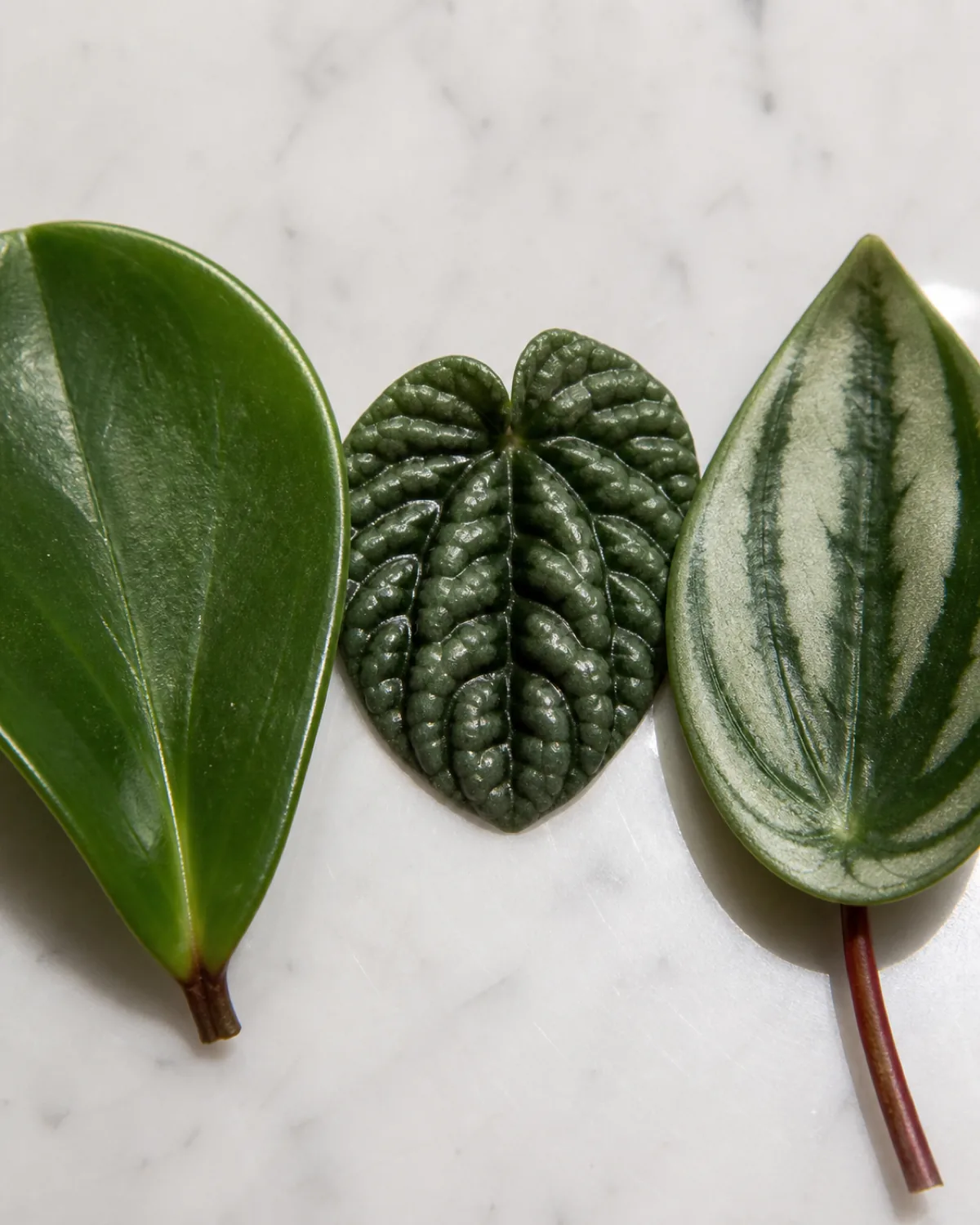
No other single genus offers as much leaf texture diversity. Peperomia obtusifolia has thick, smooth, glossy oval leaves. Peperomia caperata has deeply corrugated, quilted surfaces. Peperomia argyreia has silver and green stripes that look exactly like a watermelon rind.
Peperomia polybotrya has large teardrop shapes. And Peperomia prostrata has miniature trailing leaves with turtle-shell vein patterns. The range within one genus is wider than many entire plant families.
Peperomia thrives in small spaces, tolerates neglect, and is completely safe around pets — but its semi-succulent roots rot easily if you water like a tropical.
Light: match it to the leaf pattern
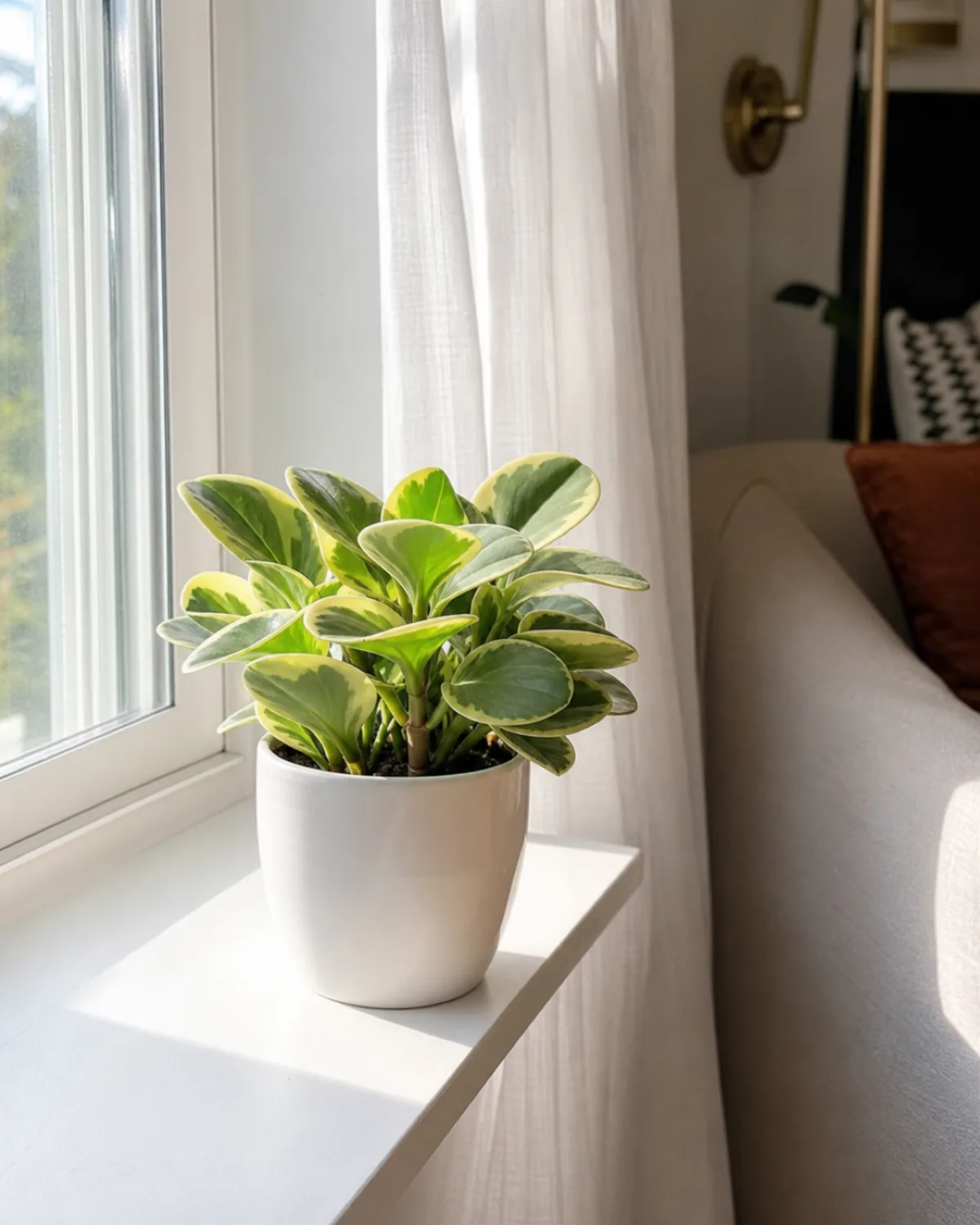
Peperomia thrives in bright indirect light — the kind you get within three to five feet of an east-facing window or behind a sheer curtain on a south window. But the specific variety you have shifts the range.
The general rule: the more colorful or patterned the leaf, the more light it needs. Solid green varieties like Peperomia obtusifolia tolerate medium-low light and do fine in spots where most plants would struggle.
Variegated varieties — cream-and-green obtusifolia, silver-striped watermelon peperomia — need brighter spots to maintain their patterns. In dim light, variegated leaves gradually revert to solid green as the plant compensates with more chlorophyll.
Direct sun is too harsh for all peperomias. The thick fleshy leaves scorch easily — you will see brown crispy patches that do not recover. A north or east window gives good results for most varieties. A west window works if you filter the afternoon sun with a sheer curtain.
Peperomia does genuinely well under artificial office lighting. LED desk lamps and overhead fluorescent lights provide enough energy for healthy growth because peperomia's light needs are moderate. This is not a marketing claim — the plant evolved as a tropical understory species accustomed to filtered light.
Signs of too little light: leggy stretched stems, leaves losing variegation, and slow or stalled growth. Signs of too much light: bleached or faded leaf color, brown crispy edges.
For a deeper dive on measuring light levels without a meter and matching plants to positions, see our houseplant light guide.
Watering: the number one care mistake
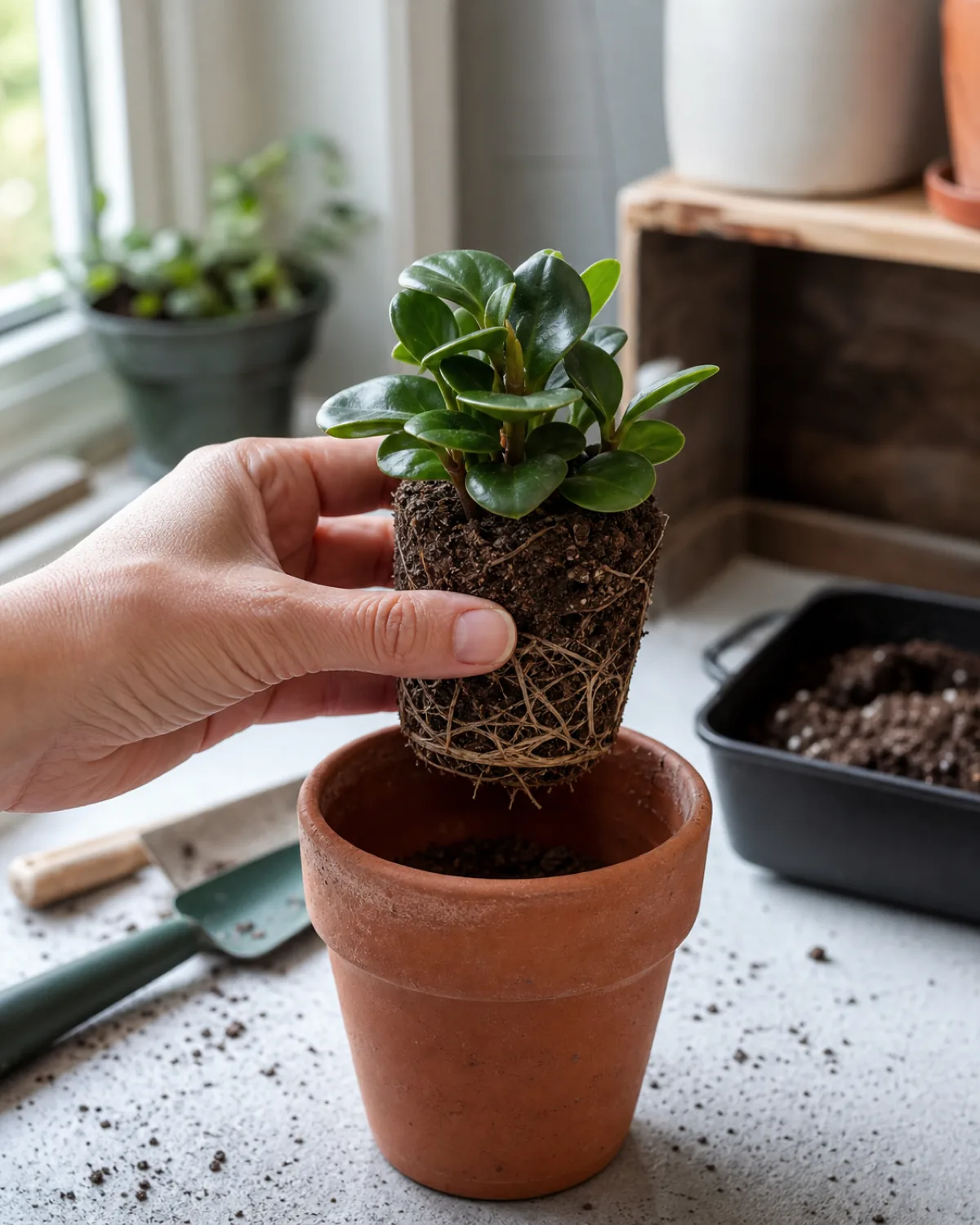
Overwatering kills more peperomias than every other problem combined. The thick semi-succulent leaves store water efficiently, which means the plant needs far less than you expect if you are used to watering tropical foliage plants.
Let the top fifty to seventy-five percent of the soil dry out between waterings. Not just the top inch — most of the pot should feel dry before you water again. In practice, this means roughly every ten to fourteen days in summer and every three to four weeks in winter.
When you do water, water thoroughly until liquid drains from the bottom, then do not water again until the soil is mostly dry. The rhythm is closer to a succulent than a tropical.
The tricky part is that overwatering symptoms hide. The roots rot quietly underground while the fleshy leaves still look fine — they are living off stored water. By the time you see mushy, translucent lower leaves falling off with a light touch, or soft blackened stems at the base, the root system may already be mostly gone.
If the leaves feel firm and plump when you squeeze them gently, the plant has enough water. If they feel slightly softer than usual or look subtly wrinkled, it is time to water.
Underwatering is less common and less dangerous. A peperomia that has gone too dry shows wrinkled or puckered leaves and drooping stems, but it bounces back within hours of a good watering. Overwatering damage is permanent.
For more on matching watering frequency to pot type and season, see our watering guide.
Soil and potting: the mix matters more than for most plants
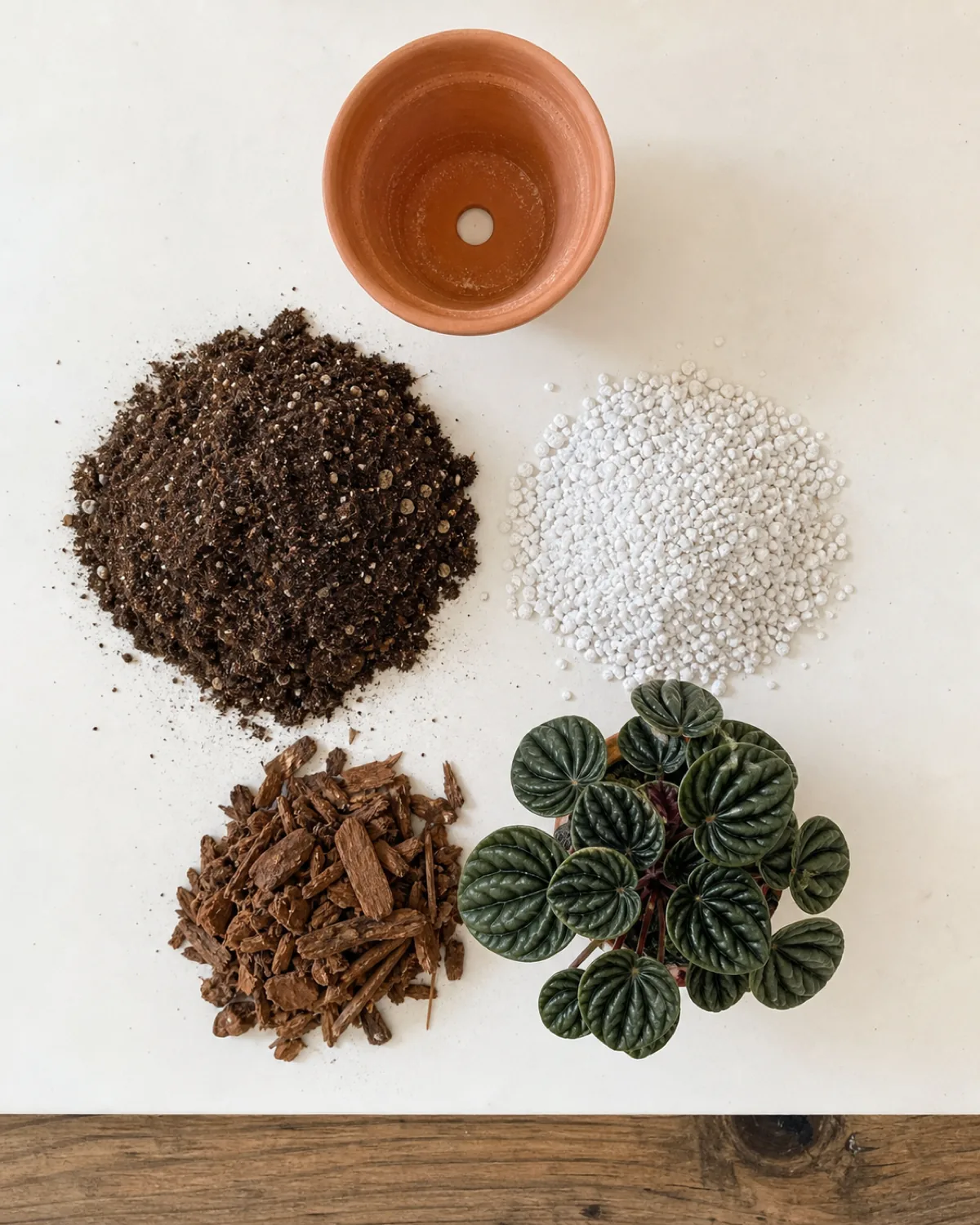
Peperomia needs an extremely well-draining mix because the small semi-succulent roots sit in a much smaller root zone than most houseplants, and they rot quickly in waterlogged soil.
The ideal mix is fifty percent standard potting soil, twenty-five percent perlite, and twenty-five percent orchid bark. The orchid bark creates large air pockets that prevent waterlogging while still holding some moisture. A commercial succulent or cactus mix is a reasonable alternative if you do not want to blend your own.
Pot size matters more for peperomia than for most plants. Use a pot only slightly larger than the root ball — one inch of clearance on each side at most. The root system is shallow and compact, and excess soil in a too-large pot holds moisture that the roots cannot absorb. That extra wet soil becomes a rot incubator.
Terracotta is the best pot material for peperomia. The porous clay wicks moisture away from the root zone, adding a layer of rot protection that glazed ceramic and plastic do not provide. Drainage holes are non-negotiable.
Repotting cadence is slow. Peperomia grows slowly and does not mind being slightly rootbound. Repot only when roots circle the drainage holes or when you notice growth has completely stalled despite adequate light and fertilizer — usually every two to three years.
Propagation: the leaf-cutting trick
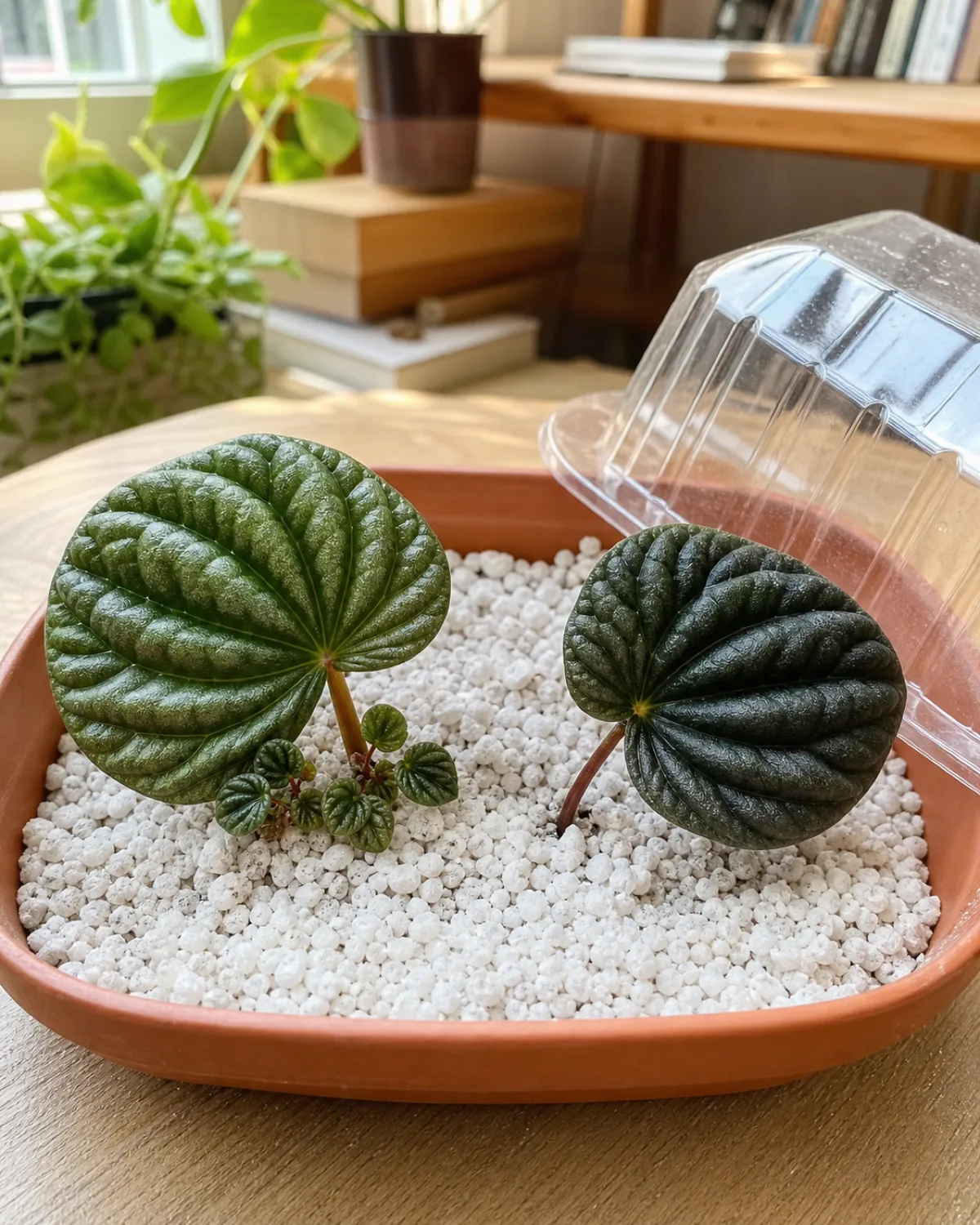
Peperomia propagation is one of the most satisfying experiments in houseplant keeping because many varieties can grow entirely new plants from a single leaf. It is slower than tradescantia or pothos stem cuttings, but the process of watching a tiny plantlet emerge from the base of a parent leaf feels almost magical.
Leaf cutting works best with caperata, obtusifolia, and argyreia. Cut a healthy leaf with one to two inches of petiole. Dip the cut end in rooting hormone (optional but it improves the odds), then insert the petiole into moist perlite or a fifty-fifty mix of perlite and peat. Cover loosely with a clear plastic bag or dome to hold humidity.
Roots appear in three to four weeks. The moment worth waiting for: tiny plantlets emerge from the base of the petiole at six to eight weeks, miniature versions of the parent leaf pushing up through the perlite surface.
For watermelon peperomia specifically, you can cut a leaf in half horizontally and plant the cut edge. Each half can produce its own plantlet. This is one of the few houseplants where you can literally multiply from half a leaf.
Stem cutting works better for obtusifolia, polybotrya, and the trailing varieties. Cut a three-to-four-inch stem section with two or three leaves. Remove the bottom leaf. Insert into moist potting mix or place in water — roots develop in two to three weeks.
Propagated peperomia grows slowly. Do not expect a full plant for several months after the plantlet emerges. But the propagation itself is nearly guaranteed to succeed if you keep the medium moist and the humidity up.
For a comprehensive look at propagation methods across houseplant species, see our propagation guide.
Temperature and humidity: the low-maintenance advantage
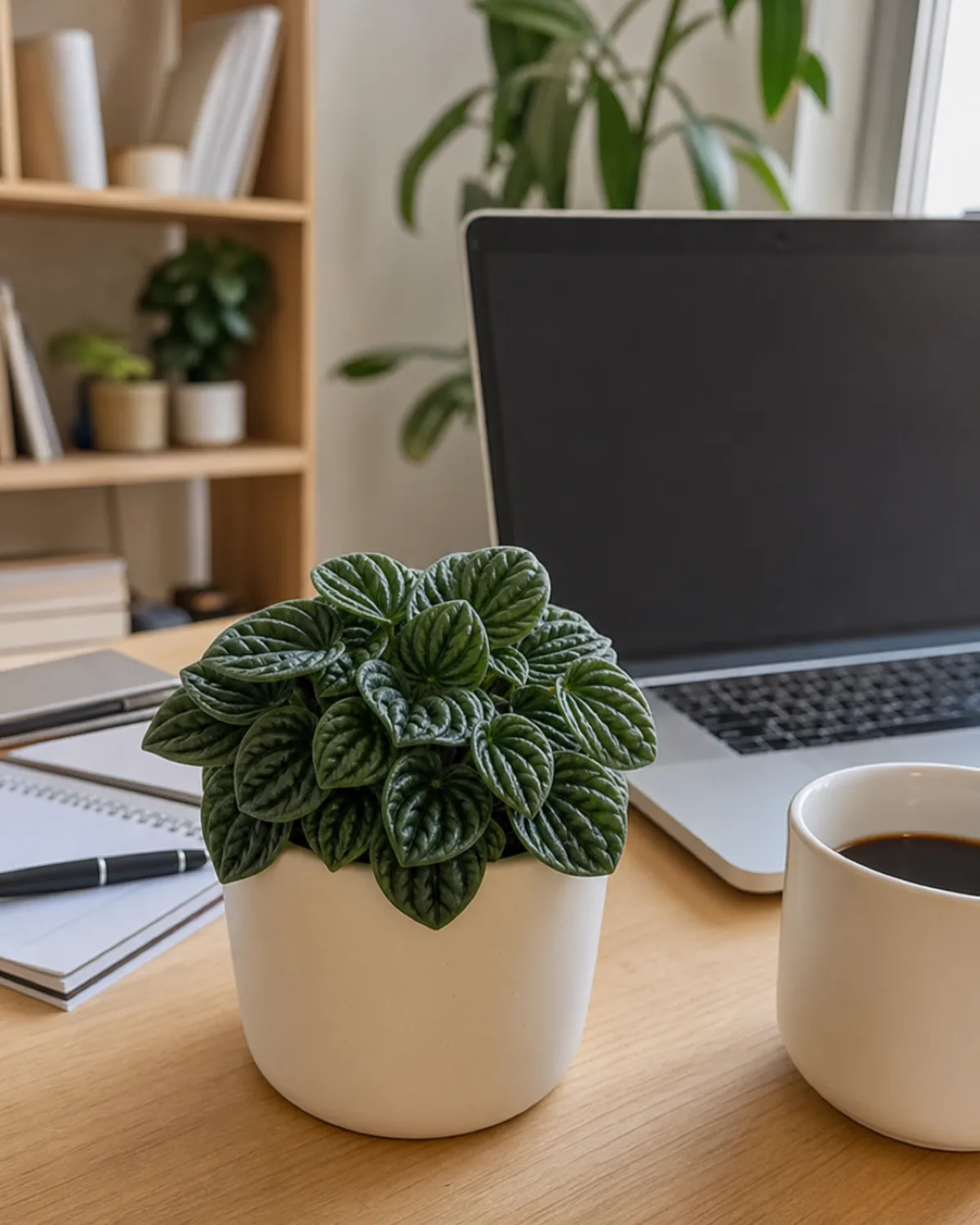
Peperomia prefers sixty-five to eighty degrees Fahrenheit. It stops growing below fifty-five and suffers cold damage — blackened, mushy leaves — below fifty. Keep it away from cold window drafts in winter and direct air conditioning vents in summer.
Humidity is where peperomia breaks from most tropical houseplant advice. It does not need high humidity. Average household humidity of forty to fifty percent is perfect, and it tolerates even drier air without complaint.
This is a genuine practical advantage. Ferns need sixty percent humidity or higher and crisp at the edges in dry winter air. Calatheas curl and brown in anything below fifty percent. Prayer plants demand constant moisture in the air. Peperomia does not care.
The reason is its semi-succulent adaptation. The thick, waxy leaf surfaces reduce water loss through transpiration, the same way succulents survive arid conditions. Peperomia evolved in tropical understories but on rocks and tree bark — epiphytic conditions where air circulation matters more than constant humidity.
In fact, too much humidity combined with poor air circulation can cause problems in peperomia — particularly leaf and stem rot in the deeply corrugated caperata varieties, where water droplets get trapped in the leaf folds and never evaporate.
No misting. No pebble trays. No humidifier. No grouping with other plants to create a microclimate. Peperomia is the anti-humidity-drama houseplant.
Why peperomia needs almost no fertilizer
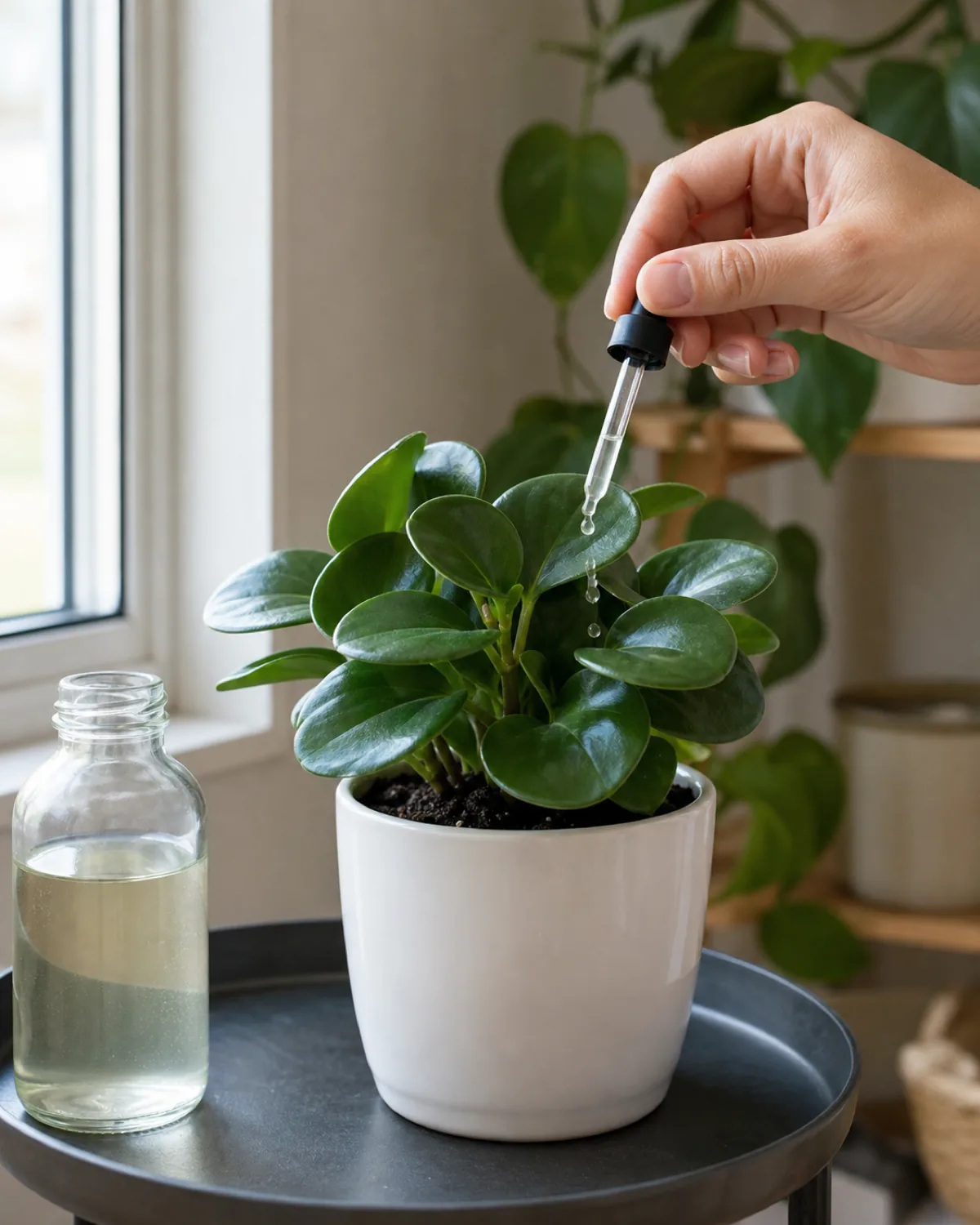
Peperomia's ancestry is epiphytic — its roots evolved on tree bark and leaf litter where nutrients are scarce and intermittent, not in rich garden soil. This means its feeding requirements are fundamentally lower than heavy feeders like monstera or fiddle-leaf fig.
Half-strength balanced liquid fertilizer once a month during spring and summer is the ceiling, not the starting point. Many experienced growers feed even less and see no difference in growth.
Skip fertilizer entirely from October through February. Peperomia enters near-dormancy in winter and cannot process the nutrients, which accumulate as salts in the small root zone.
The telltale sign of over-fertilization in peperomia is specific: a crispy brown margin that advances inward from the leaf edge toward the midrib. This pattern is distinct from the soft, translucent damage of overwatering. The shallow, fine root system has almost no buffer for salt concentration spikes — what a monstera can absorb without issue will burn peperomia roots.
If you see white crystal deposits on the soil surface or terracotta rim, flush the pot with four full volumes of plain water to leach the accumulated salts before they damage the root hairs.
A single application of slow-release granules in spring can replace monthly liquid feeding for the entire growing season. For a plant this slow-growing, less is genuinely more.
Common problems and what they actually mean
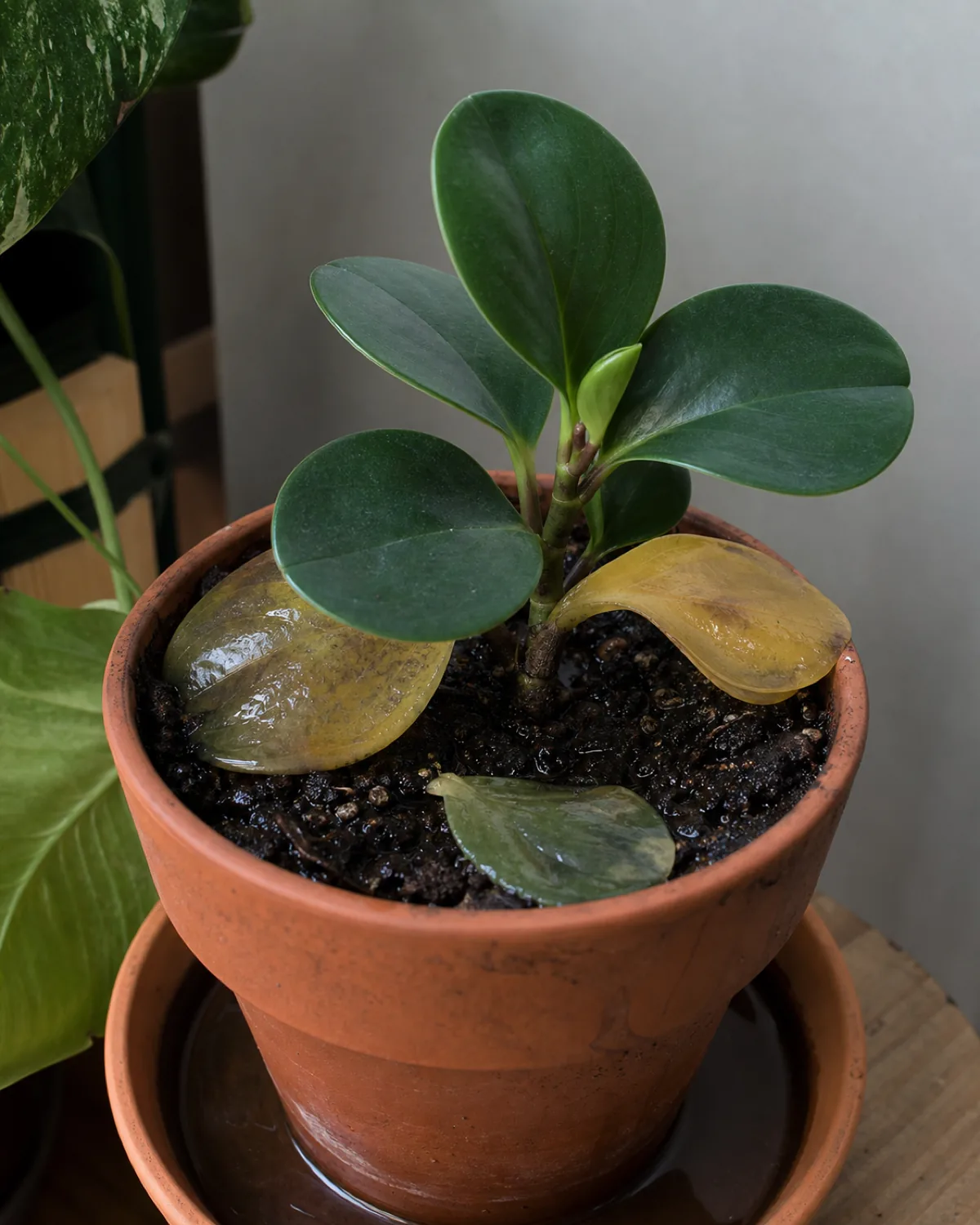
Mushy, translucent lower leaves falling off. This is overwatering and root rot — the number one killer. The roots die underground while the fleshy upper leaves look healthy for weeks, living off stored water. By the time the lower leaves go soft, significant root damage has already occurred.
The fix: stop watering immediately. Unpot and inspect the roots. Healthy roots are white and firm; rotten roots are black, mushy, and sour-smelling. Cut off all rotten sections, air-dry the root ball for a day, and repot in fresh fast-draining mix. If most roots are gone, take cuttings from the healthy top growth and propagate.
Leggy, stretched growth. Insufficient light. The stems elongate as the plant reaches toward the nearest light source. Move to a brighter spot and the new growth will be compact.
Leaf curling. Usually underwatering or very low humidity in winter. Less common than overwatering problems because most people err on the wet side.
Brown, dry leaf edges. Over-fertilization, salt buildup, or extremely dry winter air. Flush the soil with plain water and reduce feeding.
Circular ring spots on leaves. This is Peperomia ring spot virus — a viral infection specific to the genus. The marks are concentric circles or irregular rings that look like water stains but do not wipe off. Unfortunately, it is incurable. Isolate the plant to prevent spread and discard if the infection is severe. This is a problem unique to peperomia that other houseplants do not get.
Drooping despite moist soil. The roots are dead from rot and can no longer absorb water. The soil stays wet because nothing is drinking from it. At this stage, the root system is too damaged to save — take healthy cuttings and start over.
For broader pest and disease identification, see our houseplant pests and diseases guide.
The pet-safety advantage
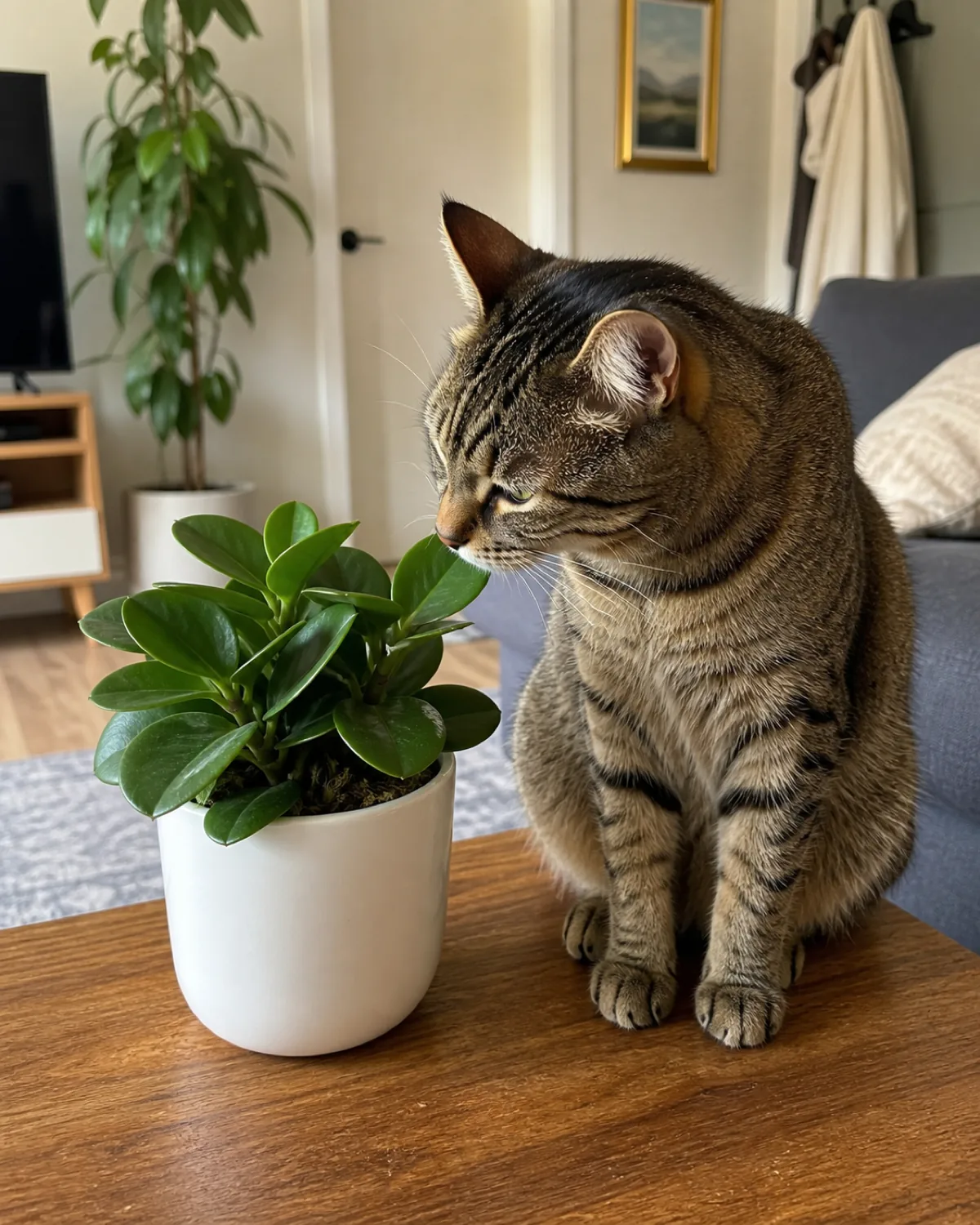
Peperomia is ASPCA-verified non-toxic to both cats and dogs — a genuine rarity among attractive houseplants. Pothos, philodendron, monstera, ZZ plant, and snake plant all contain compounds that cause oral irritation or worse.
But the practical advantage of peperomia goes beyond the toxicity question. The thick semi-succulent leaves resist casual nibbling damage far better than thin-leaved plants. A cat bite dents a peperomia leaf but rarely shreds it, whereas a single chomp destroys a calathea or fern frond entirely. The leaves are sturdy enough to survive investigation without falling apart.
The compact mound growth habit also keeps peperomia low-profile. Unlike trailing plants such as pothos — whose dangling vines actively trigger feline hunting instincts — a peperomia sitting on a shelf does not move, dangle, or invite batting.
For households with persistent plant-chewing pets, peperomia is one of the most practical choices on this site. Pair it with equally non-toxic spider plant for a hanging position and prayer plant for decorative leaf patterns to build a fully pet-safe collection with three different visual textures.
Peperomia as a genuine desk and shelf plant
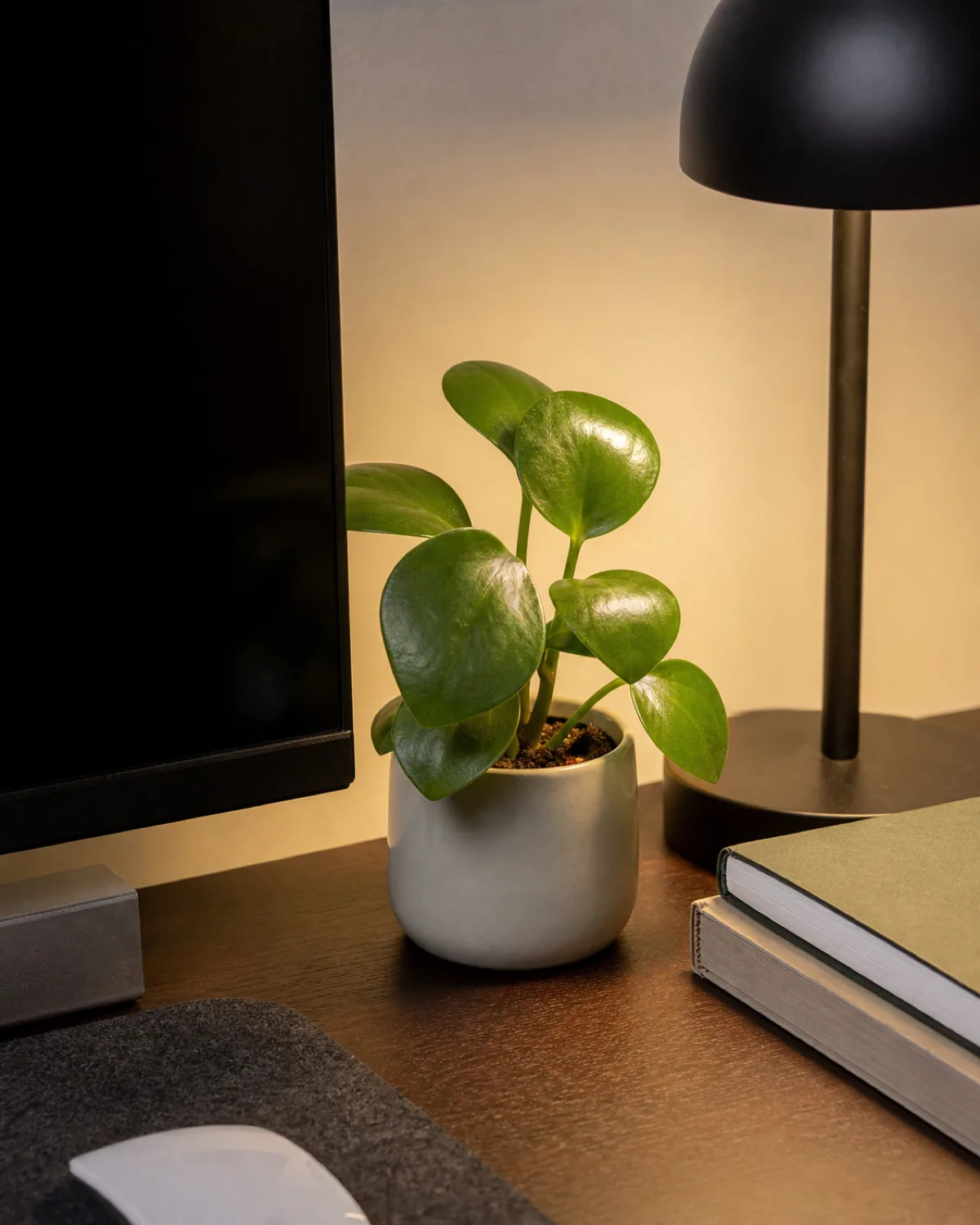
Most houseplants are marketed as "desk plants" when they are small at the nursery, then outgrow the desk within a year. Monstera starts on a shelf and ends up claiming a floor corner. Pothos trails three feet within months. Fiddle-leaf fig becomes a six-foot tree.
Peperomia does not do this. Most varieties max out at eight to twelve inches in every direction and then stop. The growth rate is slow enough that a peperomia placed on a desk today will still fit that desk three years from now without pruning, repotting, or rearranging the workspace.
This makes peperomia genuinely suitable for spaces where other plants fail:
Office desks under artificial light — peperomia handles fluorescent and LED overheads. Bookshelves with limited headroom — it never pushes past twelve inches. Bathroom counters with a window — tolerates occasional humidity spikes but does not need them. Bedroom nightstands — compact and clean-looking. Kitchen windowsills — handles the warmth.
The slow growth rate means it does not consume the soil nutrients quickly, does not outgrow its pot, and does not need a moss pole, trellis, or regular pruning. For someone who wants a living plant in a small space without ongoing space management, peperomia delivers what other plants only promise at the point of sale.
Trailing peperomia varieties
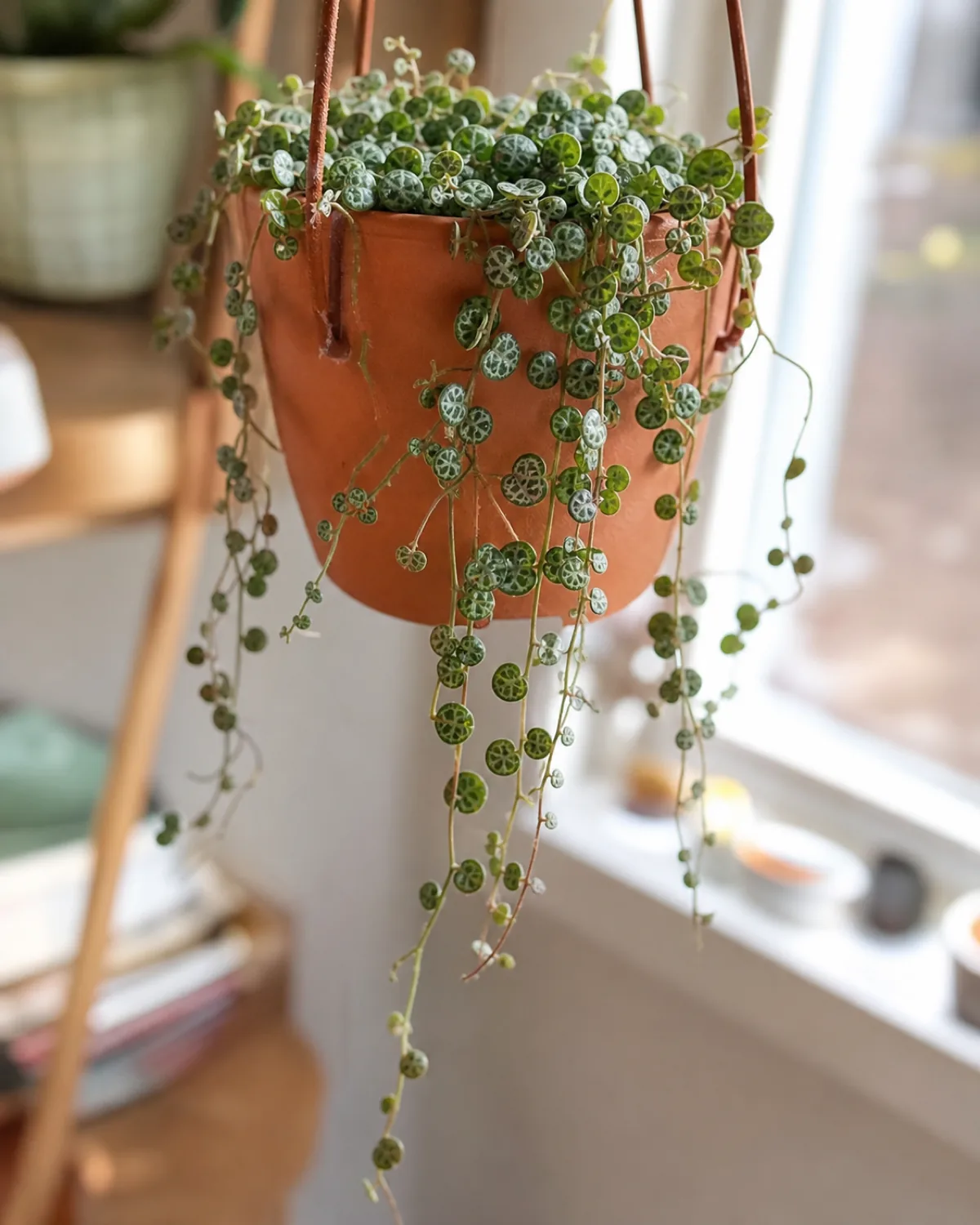
Not all peperomias are compact mounds. Several varieties trail beautifully and work as small hanging plants or shelf-edge trailers.
Peperomia prostrata (string of turtles) is the standout. Tiny round leaves — each less than a centimeter across — display dark green vein patterns that look like miniature turtle shells. The stems are thin and delicate, trailing eight to twelve inches at maturity.
It is slower-growing and needs more careful watering than the mound varieties (the tiny leaves dry out faster), but the visual reward is worth the extra attention.
Peperomia rotundifolia (trailing jade) has small, round, solid green leaves on thin wiry stems. It grows faster than prostrata and is more forgiving. The look is minimalist — thin green lines of small round leaves — rather than the intricate patterning of string of turtles.
Peperomia quadrangularis (beetle peperomia) has slightly larger oval leaves with dark stripes on trailing stems. The striped pattern is bold for a trailing peperomia.
All trailing peperomia varieties share the same semi-succulent care profile as the mound types: less water, well-draining soil, bright indirect light. The main difference is that trailing varieties dry out faster due to greater surface area and thinner stems, so they need slightly more frequent watering — but still far less than a pothos or tradescantia.
They work best in small hanging planters or positioned on a high shelf where the stems can trail over the edge. They do not produce the long cascading curtains that pothos or tradescantia create — the trails stay compact, which fits small spaces.
Peperomia vs. similar compact houseplants
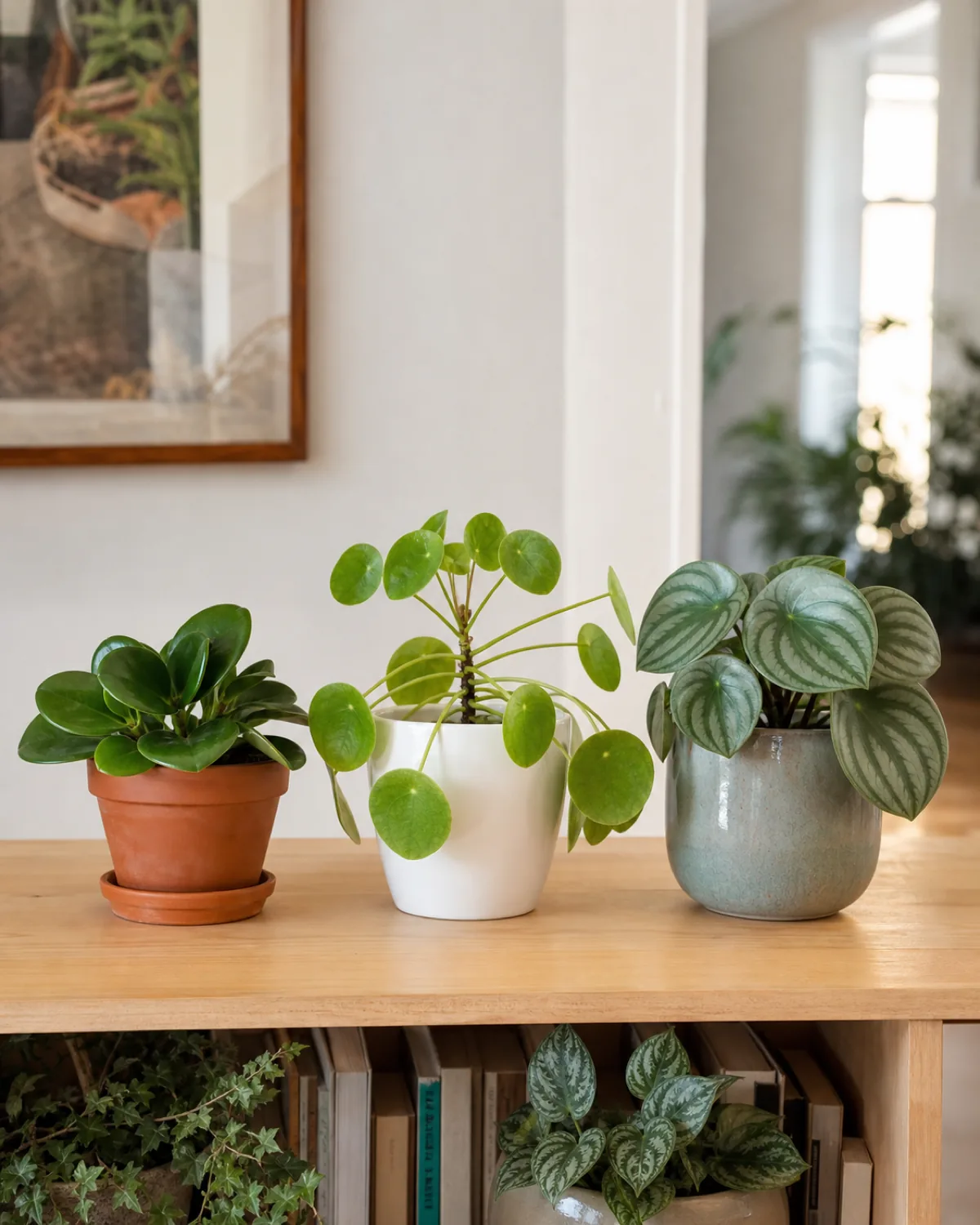
Peperomia vs. pilea. Both stay small and both are pet-safe. Pilea produces pups from underground rhizomes that can be divided; peperomia propagates from leaf cuttings, a slower but equally reliable method.
The key care difference: pilea needs more consistent moisture and does not tolerate drying out as well as peperomia. If you tend to forget to water, peperomia is the better choice.
Peperomia vs. succulents (jade plant, string of pearls). The watering rhythm is similar — let it dry, water thoroughly, repeat — but peperomia tolerates lower light than most true succulents.
Jade plant wants bright direct light; string of pearls needs intense brightness or it etiolates. Peperomia thrives in the bright indirect to medium range that most indoor spaces actually provide. If your bright window is already taken, peperomia fits where a succulent would stretch.
Peperomia vs. calathea. Both have striking decorative leaves — caperata's corrugated surface and calathea's painted stripes are equally eye-catching. But calathea demands high humidity, consistent soil moisture, and filtered water to avoid leaf browning.
Peperomia tolerates dry air, dry soil, and tap water without complaint. If you want visual impact without the maintenance commitment, peperomia is the dramatically easier plant.
Peperomia Care: The Quick Reference
- 1Semi-succulent rootsLet 50-75% of the soil dry between waterings. Every 10-14 days in summer, 3-4 weeks in winter.
- 2Overwatering is the #1 killerMushy translucent lower leaves = root rot already advanced. The fleshy upper leaves hide the damage.
- 3Bright indirect lightEast window ideal. Patterned/variegated varieties need more light. Does well under office LEDs.
- 4Fast-draining soil in small pots50% soil, 25% perlite, 25% orchid bark. Terracotta pot. One inch of clearance. No overpotting.
- 5Leaf-cutting propagationCut a leaf with petiole, insert in perlite, tiny plantlets in 6-8 weeks. Watermelon peperomia grows from half a leaf.
- 6No humidity drama40-50% is fine. No misting, no trays, no humidifier. Too much humidity causes rot in corrugated varieties.
- 7Minimal fertilizerHalf-strength monthly in spring-summer only. Skip winter. Epiphytic roots burn easily from salt buildup.
- 8ASPCA non-toxicCompletely safe for cats and dogs. Thick leaves resist nibble damage. Compact shape does not trigger chase instincts.
- 9Genuinely stays small8-12 inches max. Real desk plant, not a desk plant that becomes a floor plant. No moss pole or pruning needed.
- 10Watch for ring spot virusCircular marks on leaves that look like water stains. Incurable and specific to peperomia. Isolate if found.
- 1165-80°F, no cold draftsFleshy leaves blacken below 50°F. Keep away from cold windowpanes and AC vents.
- 12Repot every 2-3 yearsSlow grower. Tolerates being slightly rootbound. Only upsize when roots circle the drainage holes.
- 13Start with obtusifoliaToughest, most forgiving, widest availability. Add caperata for texture and argyreia for color.
kultivy.com
Best peperomia varieties for beginners
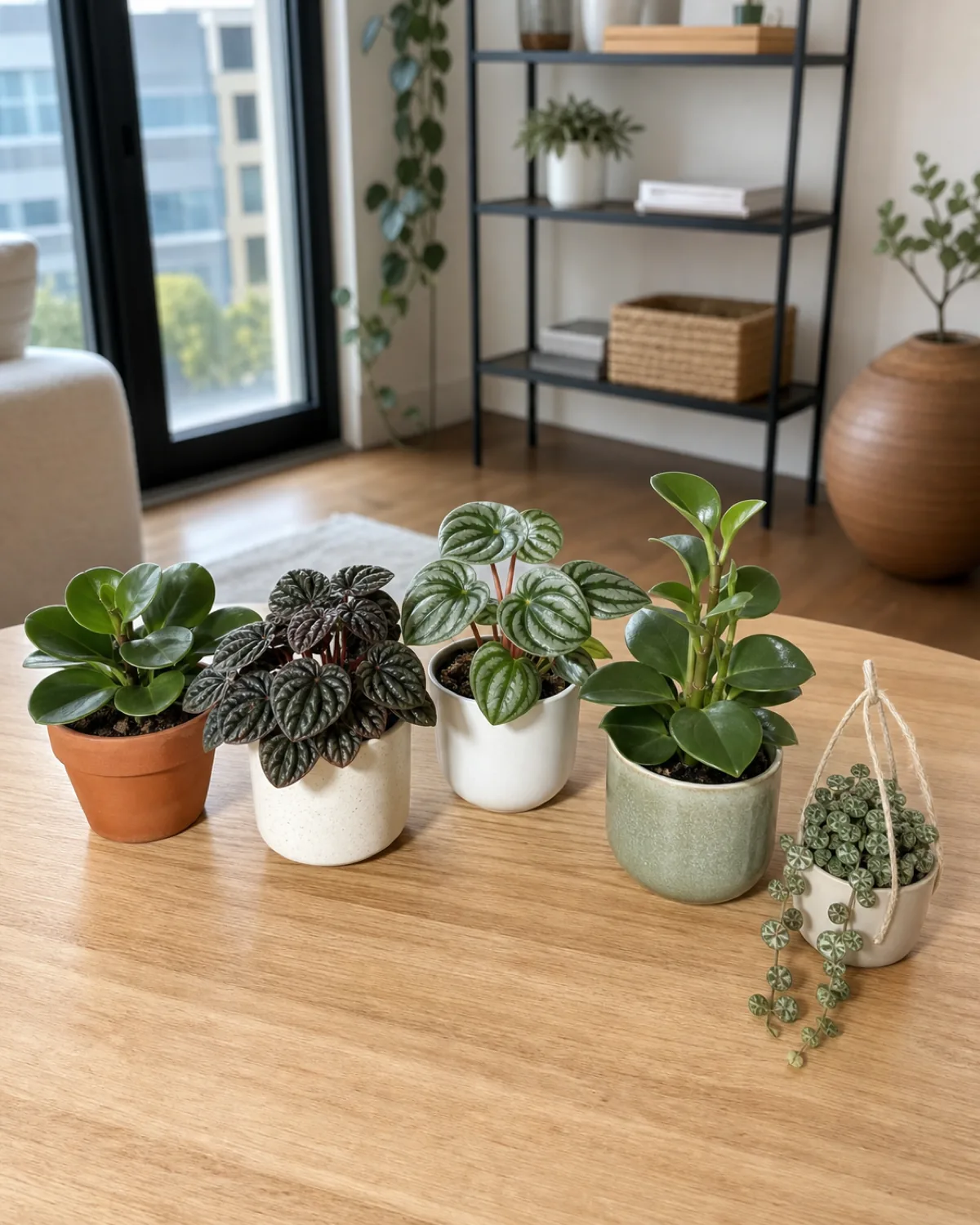
Peperomia obtusifolia (baby rubber plant) is the one to start with. Thick, glossy, dark green oval leaves on short upright stems. It is the toughest variety — the most forgiving of watering mistakes, the most tolerant of lower light, and the most widely available.
The variegated form (cream and green leaves) adds visual interest while keeping the same easy care profile. If you can only grow one peperomia, this is the safe bet.
Peperomia caperata (ripple peperomia) is the textural showpiece. The leaves are deeply corrugated — ridged and wrinkled like crumpled fabric — in dark green, dark red, or silver-green depending on the cultivar. The compact rosette growth habit is tight and neat.
Caperata produces distinctive flower spikes: thin, elongated rat-tail structures that rise above the foliage. They are not showy like an orchid or anthurium bloom, but they are a charming oddity.
Peperomia argyreia (watermelon peperomia) is the most visually striking. Oval leaves carry silver and dark green curved stripes that look exactly like a watermelon rind, mounted on distinctive red petioles.
The care is slightly more demanding — it is more sensitive to overwatering and needs brighter light than obtusifolia — but the visual payoff is worth the attention.
Peperomia polybotrya (raindrop peperomia) has the largest leaves in the commonly sold varieties — glossy, dark green teardrops that create a bold, clean aesthetic. The upright growth habit makes it look like a miniature tropical plant. It is easy to care for and dramatic in a way that the smaller varieties are not.
Peperomia prostrata (string of turtles) is for collectors. Tiny round leaves with intricate dark vein patterns trail on thin stems, creating a miniature cascade. It is the most finicky variety — more sensitive to overwatering and less tolerant of dry air than the mound types — but the turtle-shell leaf pattern is unlike anything else in the houseplant world.
Start with obtusifolia for confidence. Add caperata when you want texture contrast. Graduate to argyreia when you have a reliably bright spot. Collect prostrata when you want a challenge and a conversation piece.

Mara Quinn edits Kultivy, where she shares houseplant care, propagation, beginner-friendly plant picks, and plant-styling ideas for anyone who wants their indoor plants to actually thrive. Every guide is image-led and reviewed for clarity, usefulness, image accuracy, and Pinterest-to-page alignment before it goes live. Visit the About page.