A string of pearls is the houseplant that makes people stop and stare. Round succulent leaves strung along thread-thin stems, spilling over a pot's edge like a living beaded curtain.
But it's one of the most-killed houseplants for a reason: overwatering turns those pearls to mush, and it needs more light than its trailing habit suggests.
This guide covers light, watering, shriveling, soil, propagation by butterfly cut, bald stems, mealybugs, toxicity, and varieties.
String of pearls rewards the right light and a hands-off watering style with some of the most striking trailing growth you can grow indoors. The thirteen sections below cover identification, light, watering, and everything else that keeps one full and cascading.
What a string of pearls actually looks like
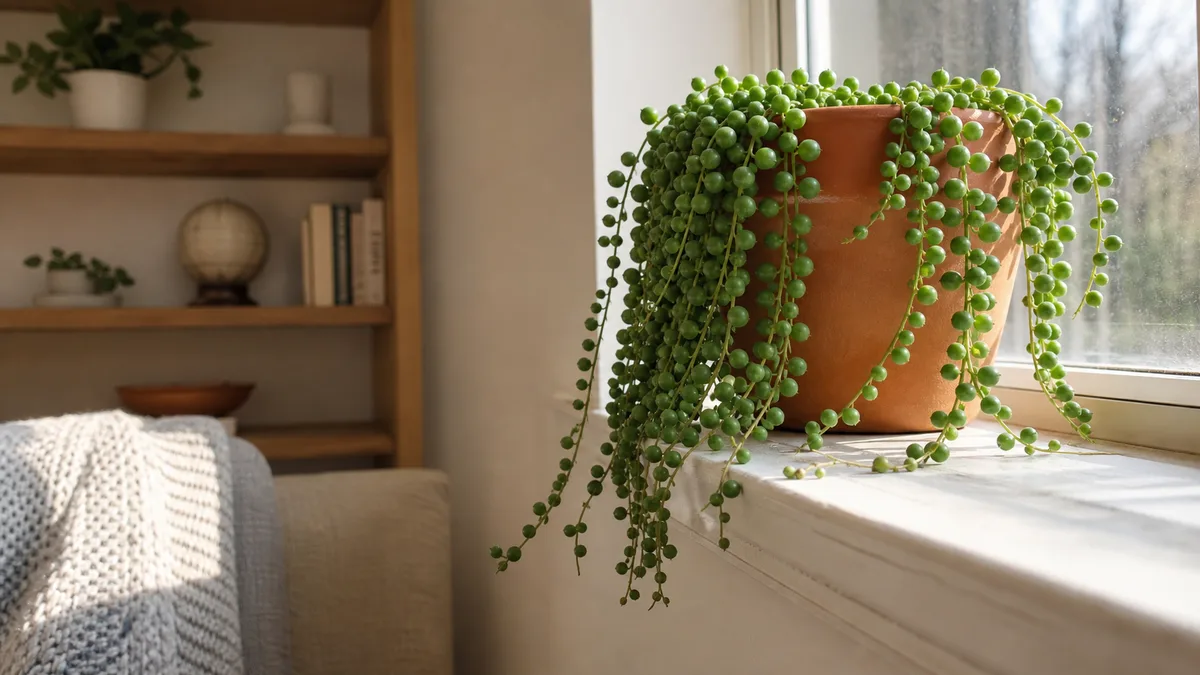
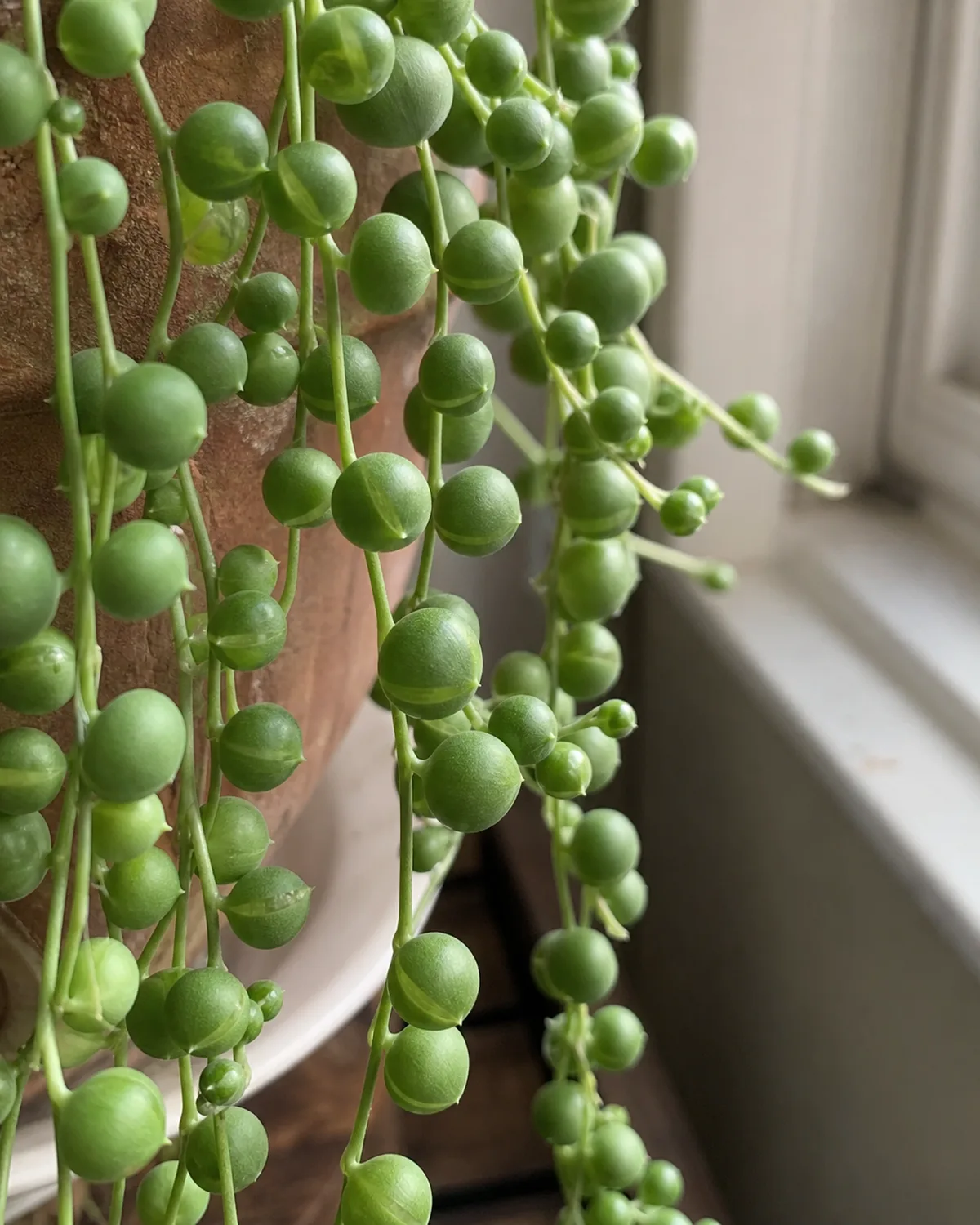
A string of pearls grows thin, wiry trailing stems lined with perfectly spherical, pea-sized succulent leaves that look like a beaded curtain spilling over the pot's edge. Each pearl has a tiny translucent stripe running along one side — an epidermal window that lets light reach the interior chloroplasts, a desert adaptation no other plant on this site shares.
Healthy strands can trail three feet or more from a hanging pot. The stems are so thin they're nearly invisible at a distance, which creates the illusion that the pearls are floating in a green cascade. The plant belongs to the Asteraceae (daisy family) — the first and only member of that family covered on this site.
- Perfectly round, pea-sized succulent leaves strung along thread-thin trailing stems.
- Each pearl has a translucent epidermal window — a desert adaptation for interior photosynthesis.
- Asteraceae (daisy family) — unlike every other plant on this site, which are aroids, asparagus relatives, or palms.
Light: brighter than you think
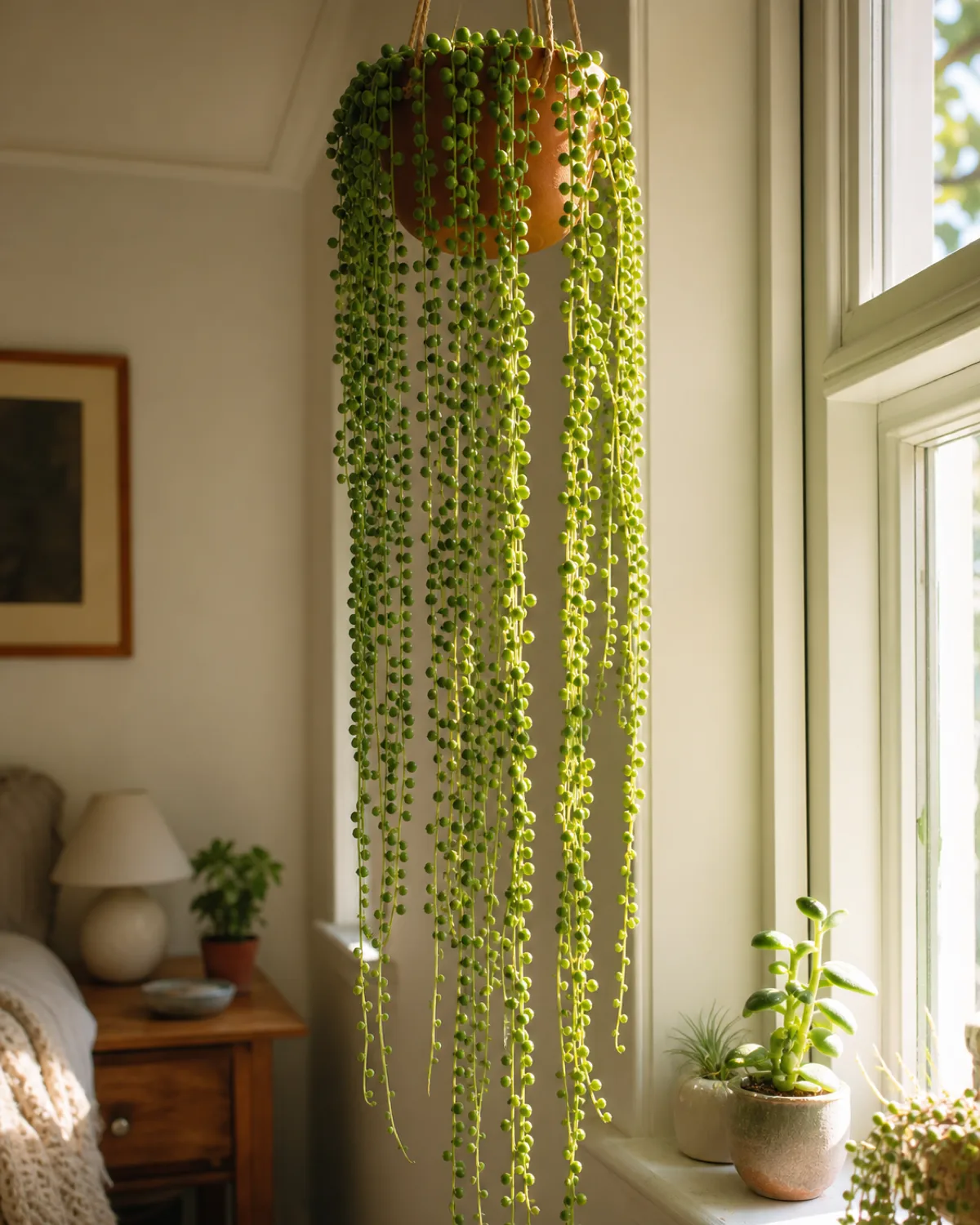
String of pearls evolved as semi-arid South African ground cover, not a forest-floor dweller. It needs bright indirect light with some direct morning sun — an east-facing windowsill or a spot two feet from a south window works well. This is more light than most trailing houseplants need.
Too little light is the most common reason for sparse, leggy growth. The pearls space out on the stem, leaving visible gaps of bare wire — the classic balding look that signals the plant is stretching toward any light it can find. Too much harsh afternoon sun, on the other hand, shrivels and browns the pearls.
The sweet spot is bright indirect light with a few hours of gentle direct morning sun. Think of it as the opposite of a pothos, which thrives in the shadowy corners where a string of pearls would starve.
- Bright indirect light with some direct morning sun — more than most trailing plants need.
- Too little light causes the classic balding look — pearls space out, leaving bare stem.
- East-facing windowsill is the sweet spot; harsh afternoon sun shrivels the pearls.
How to water without killing the pearls
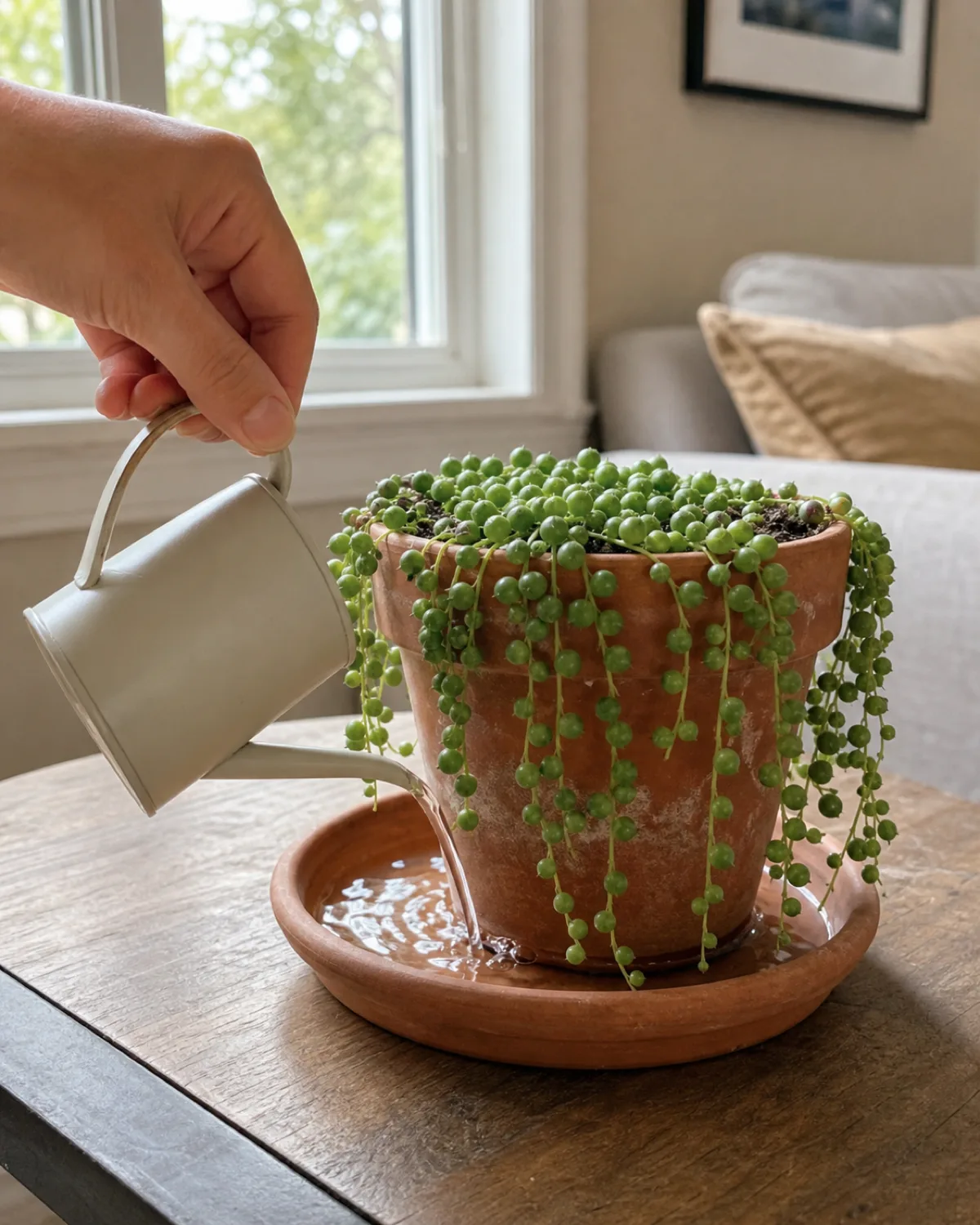
Overwatering is the number-one killer. Those round pearls are water storage organs — each one holds enough moisture to sustain the plant for days. When the soil stays wet too long, the pearls absorb more water than they can hold, turn mushy and translucent, and the stem rots from the soil up. One heavy-handed week can destroy months of growth.
Water only when the pearls themselves tell you they're ready: they lose their perfect roundness and start to look slightly oval or deflated, like grapes drying into raisins. In summer, that's usually every two to three weeks. In winter, once a month or less.
Bottom watering is the safest method — set the pot in a shallow saucer of water for 10 to 15 minutes, let the soil wick up moisture, then remove it. This keeps the stems and crown dry, which prevents rot at the soil line where the stems are most vulnerable.
- Overwatering is the number-one killer — pearls turn mushy, translucent, then the stem rots.
- Water when pearls lose their roundness — slightly oval or deflated means it's time.
- Bottom watering is safest — keeps stems and crown dry, preventing rot at the soil line.
String of pearls is one of the most visually striking trailing plants you can grow — but it's less forgiving than a pothos or a spider plant.
Why your string of pearls is shriveling
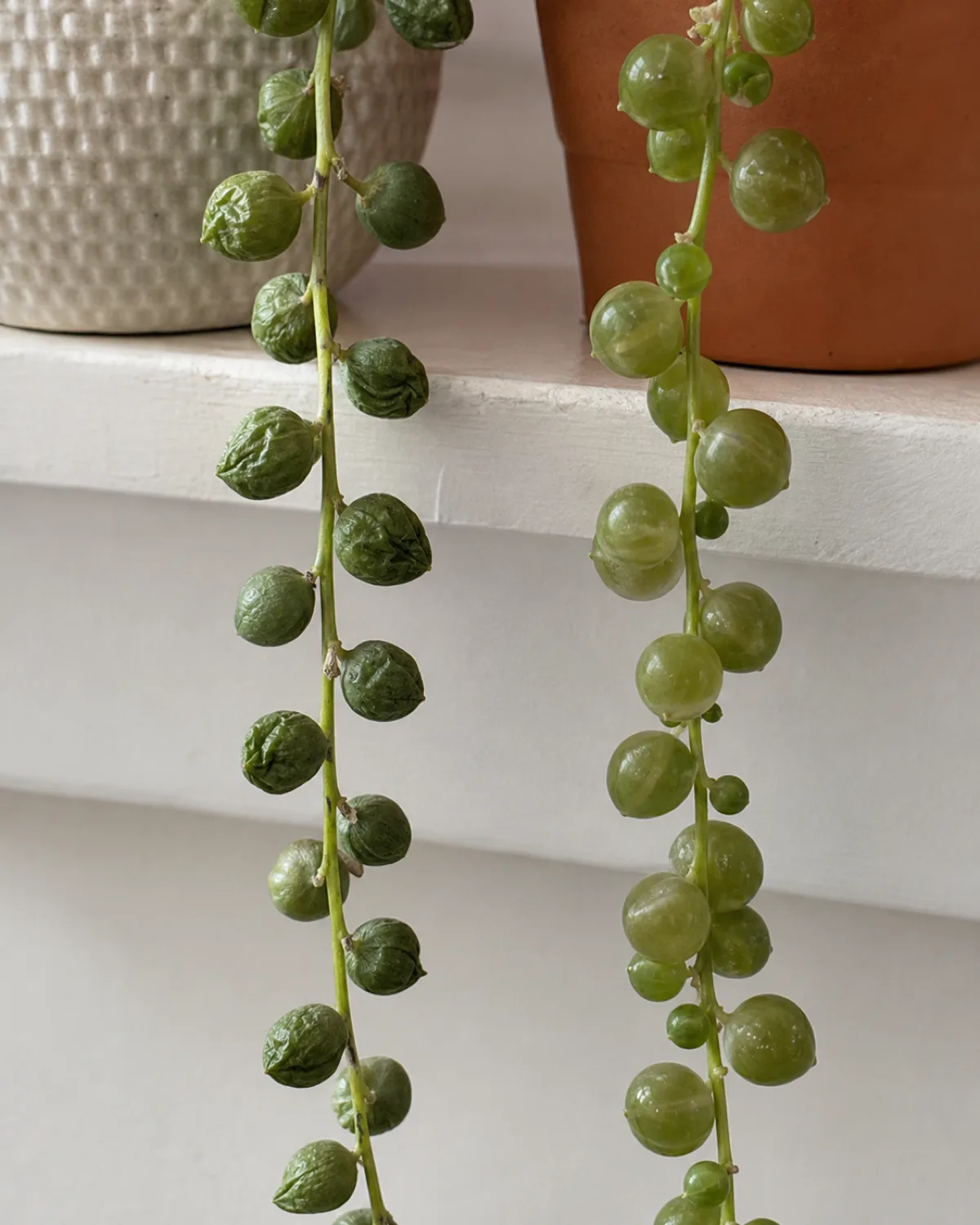
Shriveled pearls can mean two opposite things, and the fix for one makes the other worse.
Underwatered pearls deflate and wrinkle like tiny raisins — they lose their roundness but stay firm to the touch, and the stems remain green and intact. A thorough bottom watering brings them back to full roundness within hours. This is the easy fix.
Overwatered pearls go mushy and translucent, like tiny water balloons about to burst. The stems turn brown and soft near the soil. This is rot, and the damage is irreversible in the affected sections. Cut the stems above the rot line, let the cut ends callus for a day, and re-root the healthy sections in fresh, dry soil.
The difference is touch: firm and wrinkled means thirsty, soft and translucent means drowning.
- Firm and wrinkled = underwatered — soak it and they plump back within hours.
- Soft and translucent = overwatered — that's rot, and those sections are gone.
- The touch test is definitive — squeeze a pearl gently to know which problem you have.
Soil: gritty and fast-draining
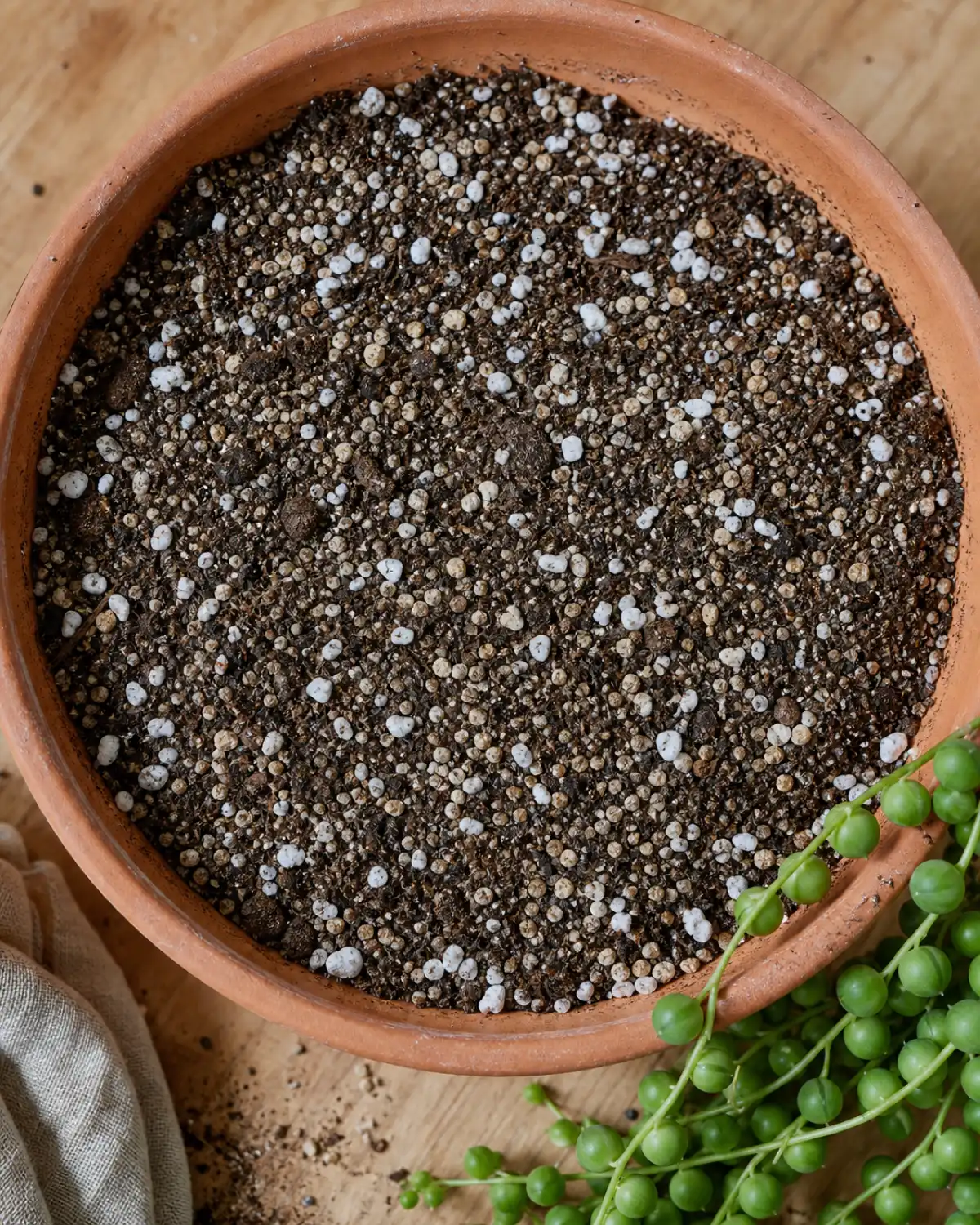
Standard potting mix holds far too much moisture for succulent roots. A string of pearls needs soil that dries out quickly and completely between waterings — sitting in damp soil for more than a day or two starts the rot cycle.
Use a 50/50 mix of commercial succulent or cactus soil and perlite (or pumice) for a gritty blend that drains almost immediately when you water. Some growers add a thin layer of coarse sand or small pebbles at the surface to keep the crown — where the stems meet the soil — dry and ventilated. Crown rot from moisture sitting against the stems is one of the most common failure points.
- 50/50 succulent soil and perlite — drains fast and dries completely between waterings.
- Standard potting mix is too moisture-retentive for succulent roots.
- A thin gravel or sand layer at the surface keeps the crown dry and prevents stem rot.
Temperature and humidity: dry warmth
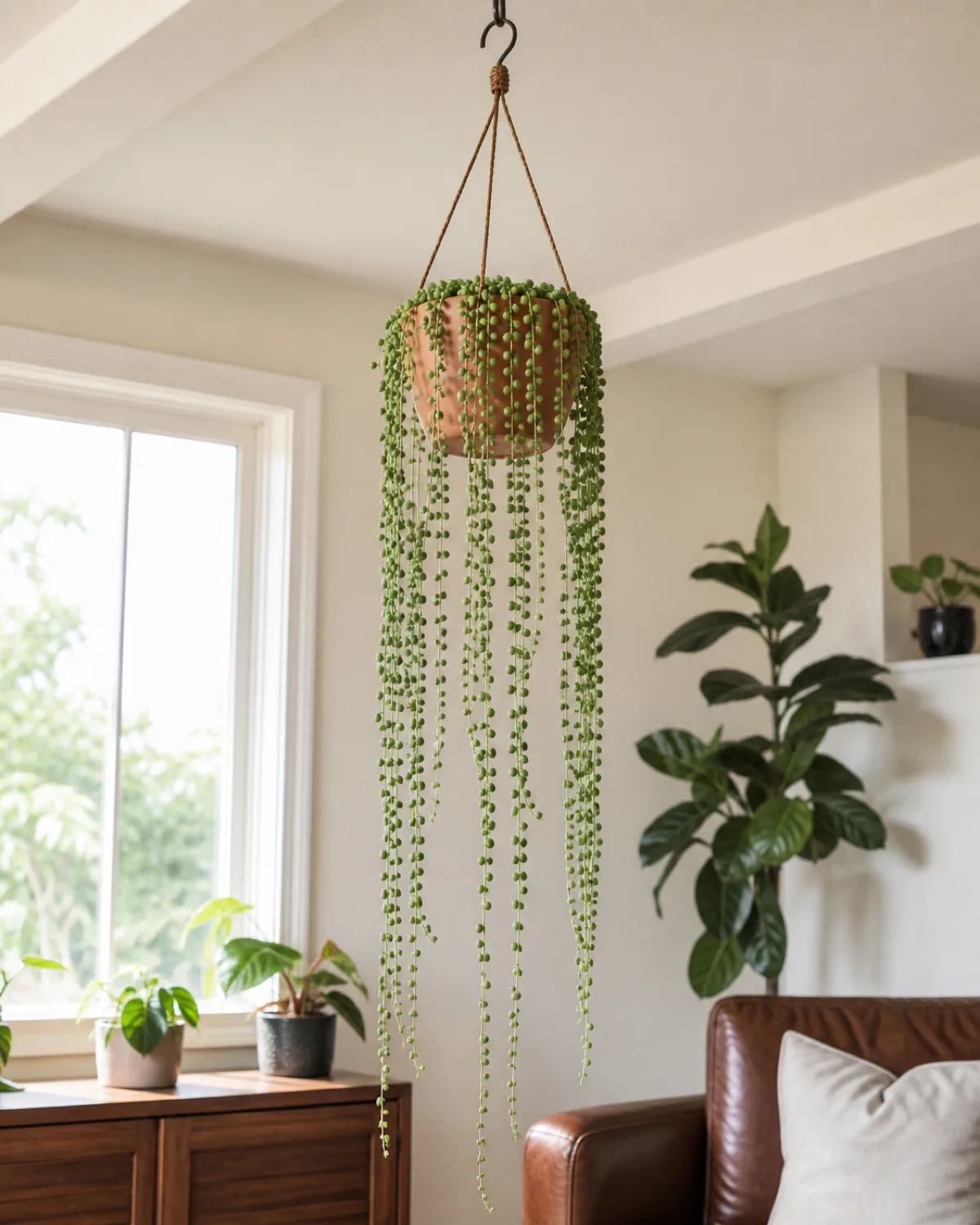
String of pearls prefers 65 to 80°F (18 to 27°C) and low to moderate humidity — 40 to 50 percent is fine. This makes it an outlier on this site: unlike alocasia, calathea, or ferns that demand humid air, a string of pearls actively dislikes high humidity. Moisture sitting on the pearls encourages fungal problems.
Keep it away from bathrooms, humidifiers, and any enclosed humid microclimate. Good air circulation around the trailing stems helps prevent the stagnant dampness that triggers rot. A dry, bright room with occasional air movement is exactly what it evolved for in the semi-arid South African landscape.
- 65-80°F (18-27°C) and low humidity — the opposite of most tropical houseplants on this site.
- Dislikes high humidity — moisture on pearls encourages fungal problems.
- Good air circulation prevents the stagnant dampness that triggers rot.
Most string of pearls failures trace back to one of four missed conditions. Hold these four and it rewards you with the cascading bead curtain everyone wants.
Fertilizing: less is more
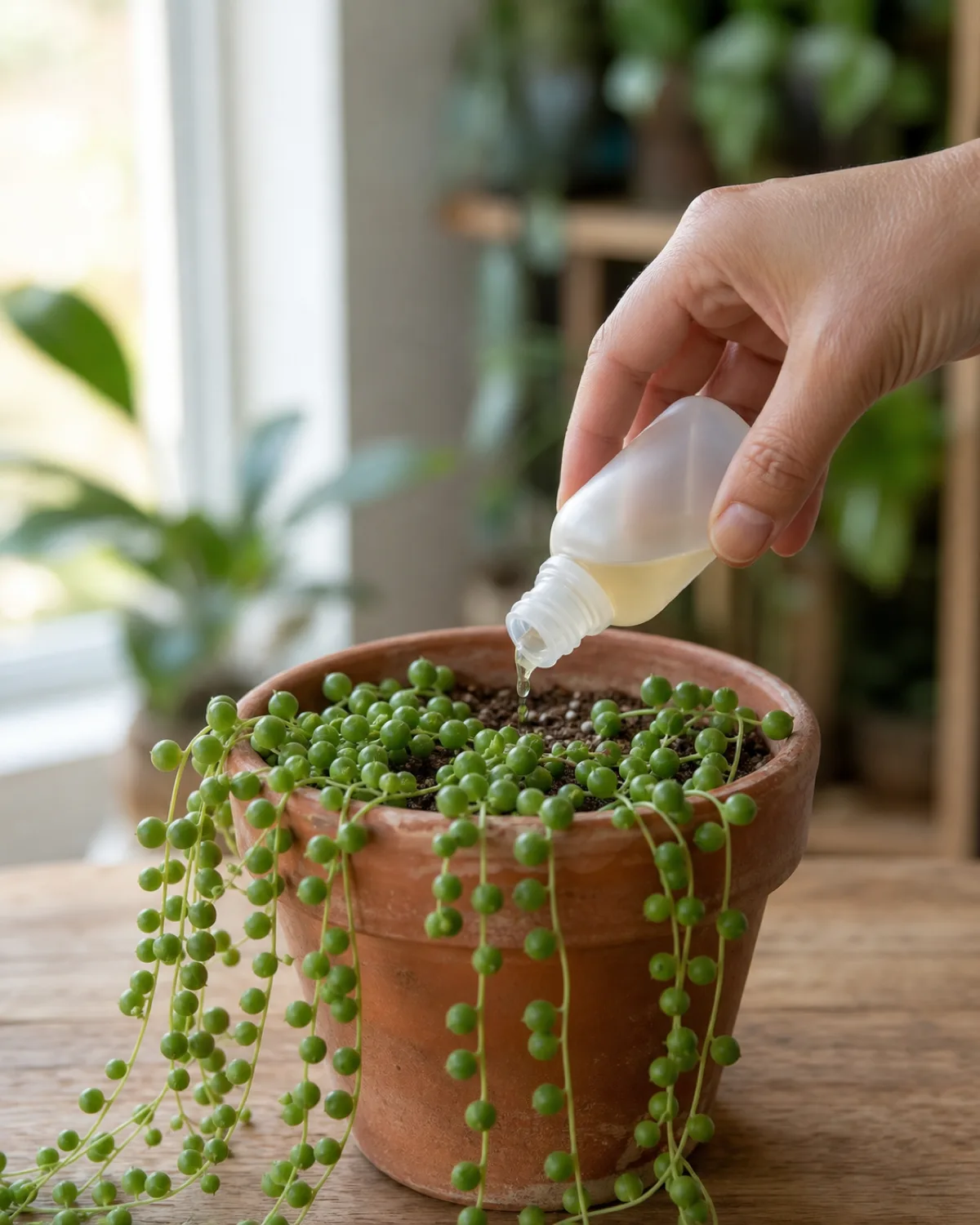
Feed once a month during spring and summer with a balanced liquid fertilizer diluted to half strength. String of pearls has a small, shallow root system that burns easily from concentrated nutrients — if pearl tips turn brown after feeding, you've used too much. Flush the soil with plain water and skip the next scheduled feeding.
Stop fertilizing entirely in fall and winter. Growth slows dramatically in low light and cool temperatures, and unused fertilizer salts accumulate in the soil, damaging the delicate roots. A light touch during the growing season is all this plant needs.
- Once a month, spring and summer, at half strength — less is genuinely more.
- Brown pearl tips after feeding = too much — flush the soil and skip the next round.
- Stop entirely in fall and winter — unused salts damage the shallow root system.
Propagation: the butterfly cut
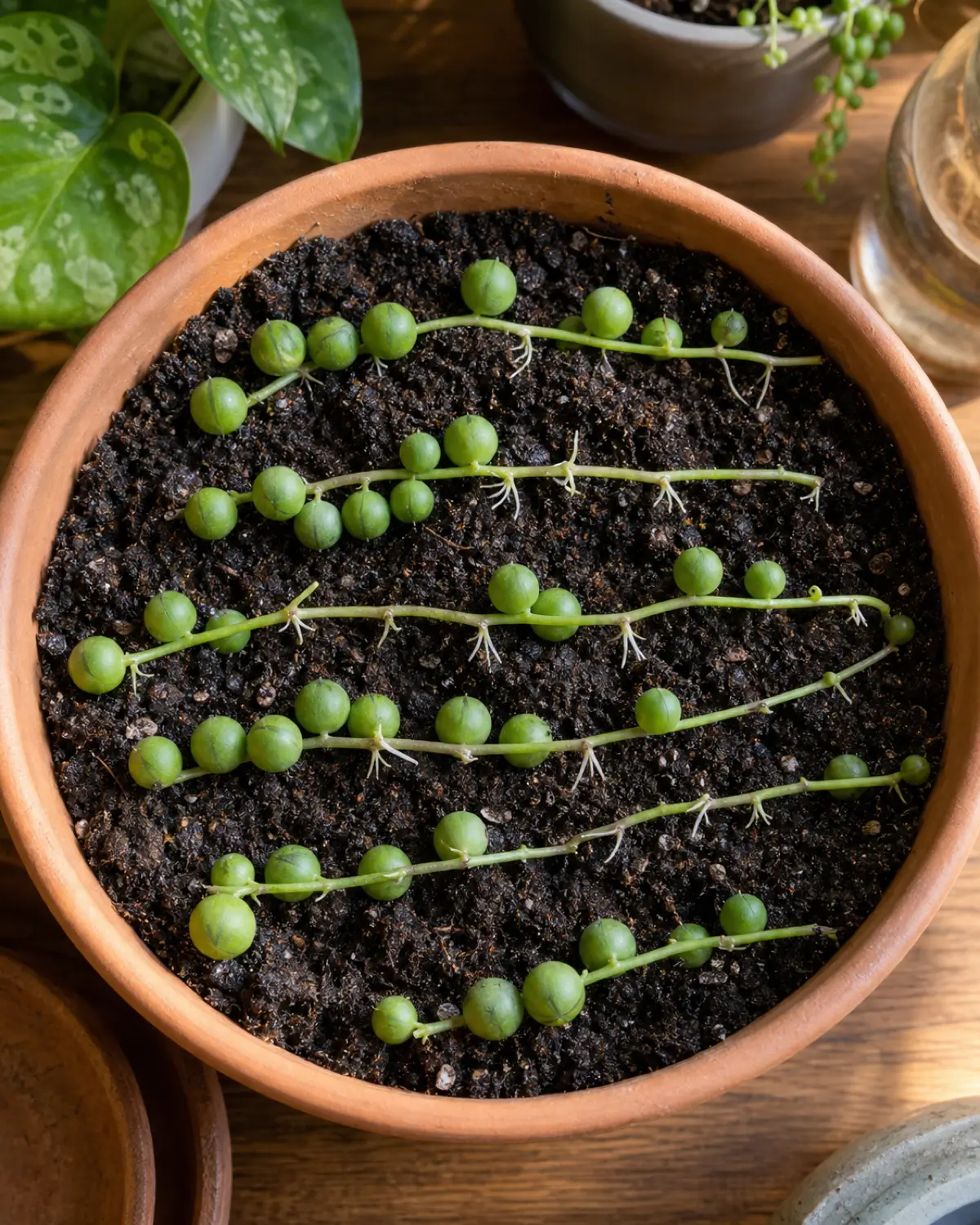
The fastest way to fill a sparse pot or start new ones. Cut 3 to 4 inch stem sections from healthy trailing strands, strip the bottom few pearls to expose the nodes, and lay the stripped end on the surface of moist soil — or press it gently just below the surface. Roots emerge from the nodes within one to two weeks without rooting hormone, water propagation, or any fuss.
Multiple cuttings arranged in a single pot creates that full, cascading look fast. You can also coil a long, healthy strand back on top of the soil in the same pot and pin it down with a small U-shaped wire — it roots at every node that touches soil, filling bare spots from within.
This is one of the easiest plants to propagate — the success rate with stem cuttings on soil is higher than almost any other method for any other species on this site.
- Cut 3-4 inch sections, strip bottom pearls, lay on moist soil — roots in 1-2 weeks.
- Multiple cuttings in one pot creates the full cascading look fast.
- Coil long strands back onto soil to fill bare spots from within the same pot.
Repotting: shallow and snug
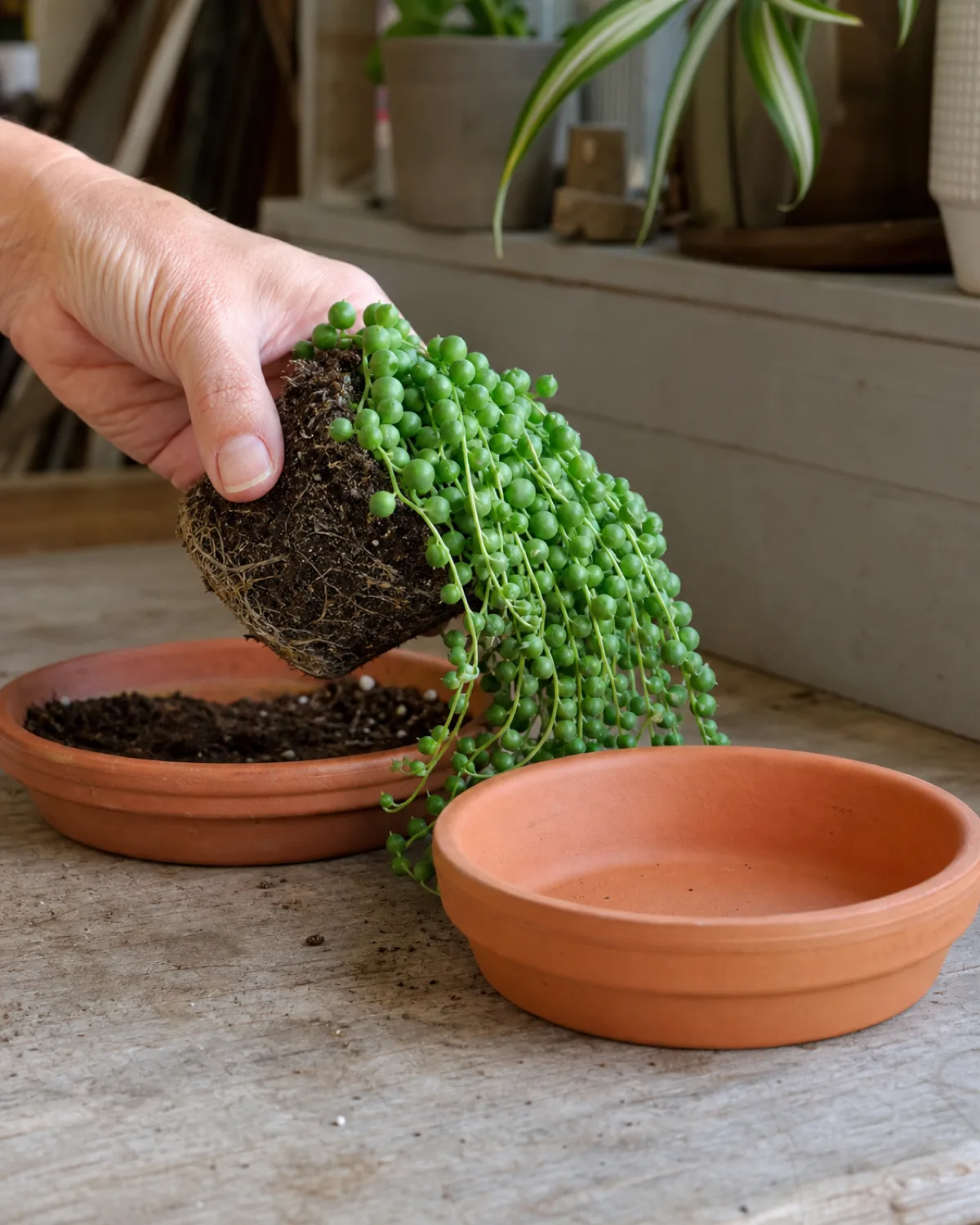
String of pearls has a shallow root system and actually prefers being slightly root-bound. Repot only when roots circle the drainage holes or the plant dries out within a day of watering — usually every two to three years, not annually.
Use a shallow, wide pot rather than a deep one. The roots don't reach the bottom of a deep pot, which means the lower soil stays wet and becomes a rot reservoir. Terracotta is the best material because it wicks moisture away from roots — plastic and glazed ceramic hold too much water for this succulent.
Handle the trailing strands gently during repotting. The stems are delicate and snap easily at the nodes. Lay the strands carefully over the pot's edge, repot the root ball, and drape the strands back into place.
- Shallow, wide terracotta pot — deep pots hold excess moisture the roots can't reach.
- Repot every 2-3 years only when roots circle the drainage holes.
- Handle gently — the thin stems snap easily at the nodes.
Why your stems are going bald (and how to fix it)
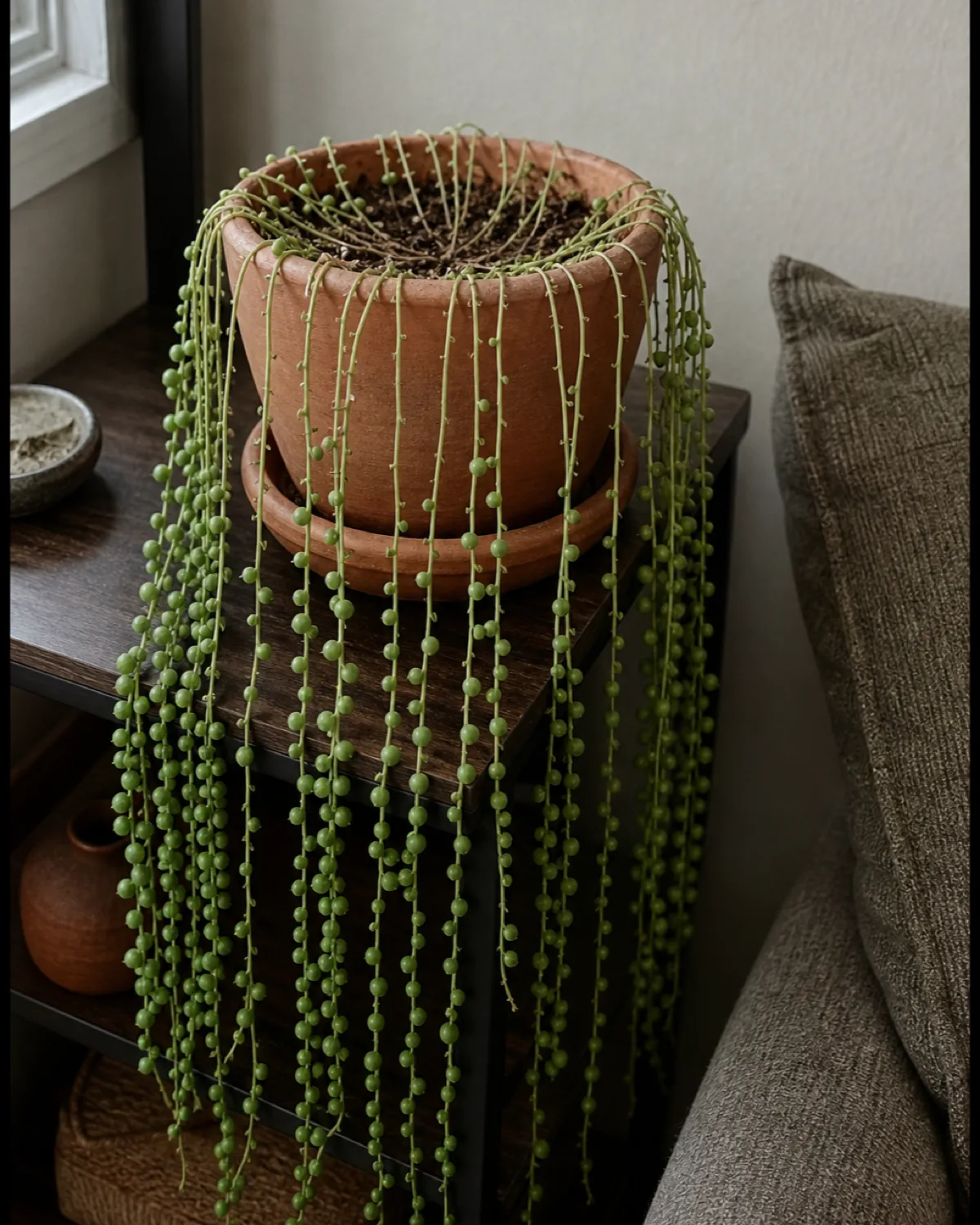
Stems that lose pearls near the crown — the top of the pot, closest to the soil — while the tips keep growing with healthy pearls are showing a light-deficiency pattern. The plant sacrifices older, shaded pearls to push energy toward the tips that are catching more light. The result is long, bare stems with a tuft of pearls at the end, like a green ponytail.
The fix is two steps. First, move the plant to brighter light so new growth comes in full from the start. Second, use the butterfly cut from section 8: trim the healthy, pearl-covered tips, strip the bottom few pearls, and lay or press those cuttings onto the bare soil at the top of the pot. They'll root and fill in the bald crown within a few weeks, giving you a full pot again.
Prevention is simple: enough light from the beginning. A string of pearls in the right light stays full from crown to tips without intervention.
- Bald near the crown, full at the tips = not enough light.
- Butterfly-cut the healthy tips and re-root them on the bare soil to fill in the crown.
- Prevention: enough light from day one keeps the entire strand full.
Common pests: mealybugs in the pearl clusters
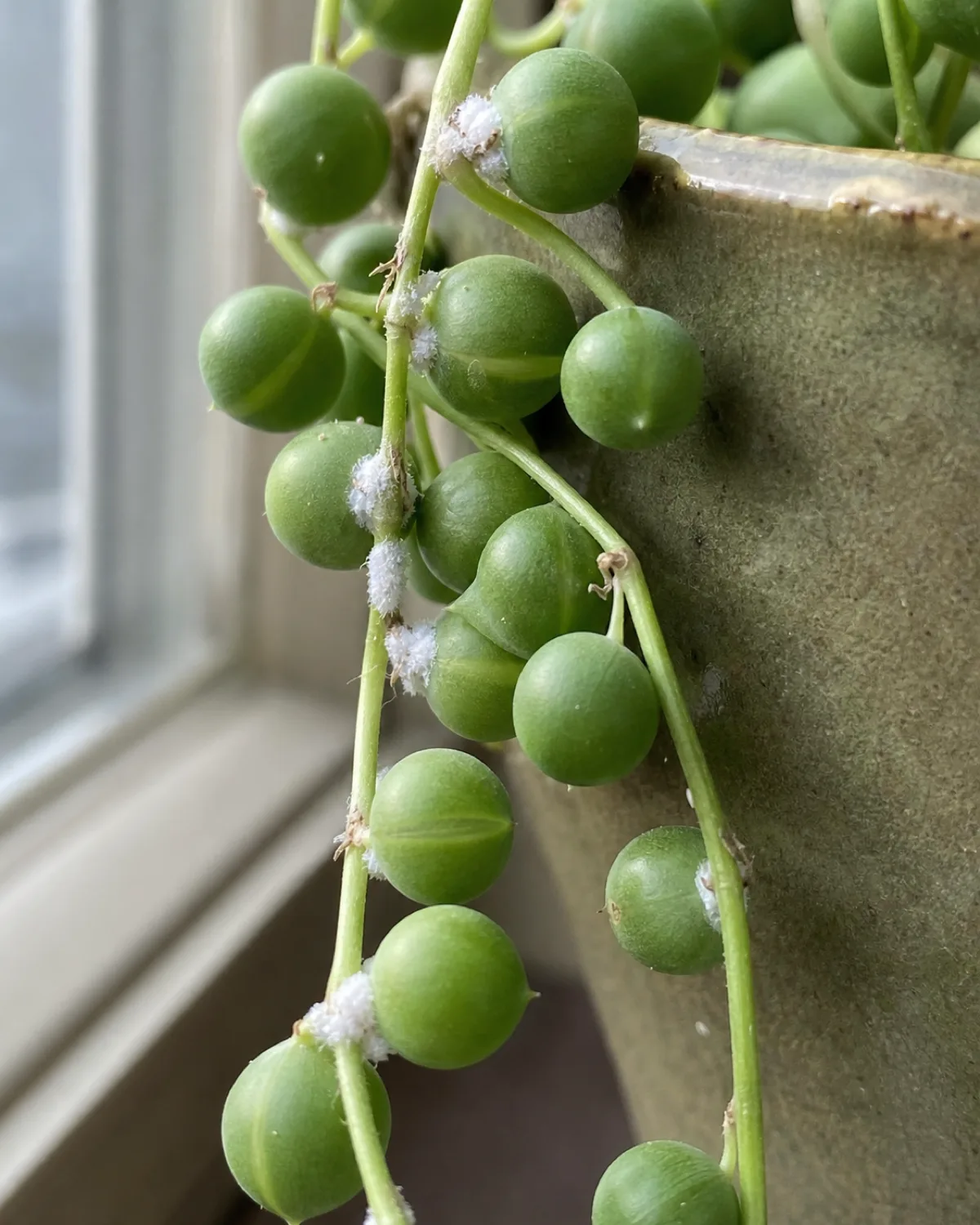
Mealybugs love the tight spaces between pearls and along stem joints where they can feed undisturbed. Look for white, cottony patches — they're easy to miss between the densely packed pearls until the infestation is established.
Treat individual mealybugs with isopropyl alcohol on a cotton swab applied directly to each bug. For larger infestations, a dilute neem oil spray works, but avoid drenching the pearls — moisture trapped between them can trigger fungal problems. A light misting of the affected stems, then wiping, is better than a soak.
Aphids occasionally target new growth tips but are less common than mealybugs. The best prevention is regular inspection: tilt the hanging pot and look between the pearl clusters every time you water.
- Mealybugs hide between pearls — look for white cottony patches at stem joints.
- Isopropyl alcohol on a cotton swab for individual bugs; light neem spray for infestations.
- Avoid drenching — trapped moisture between pearls causes fungal issues.
Is string of pearls toxic?
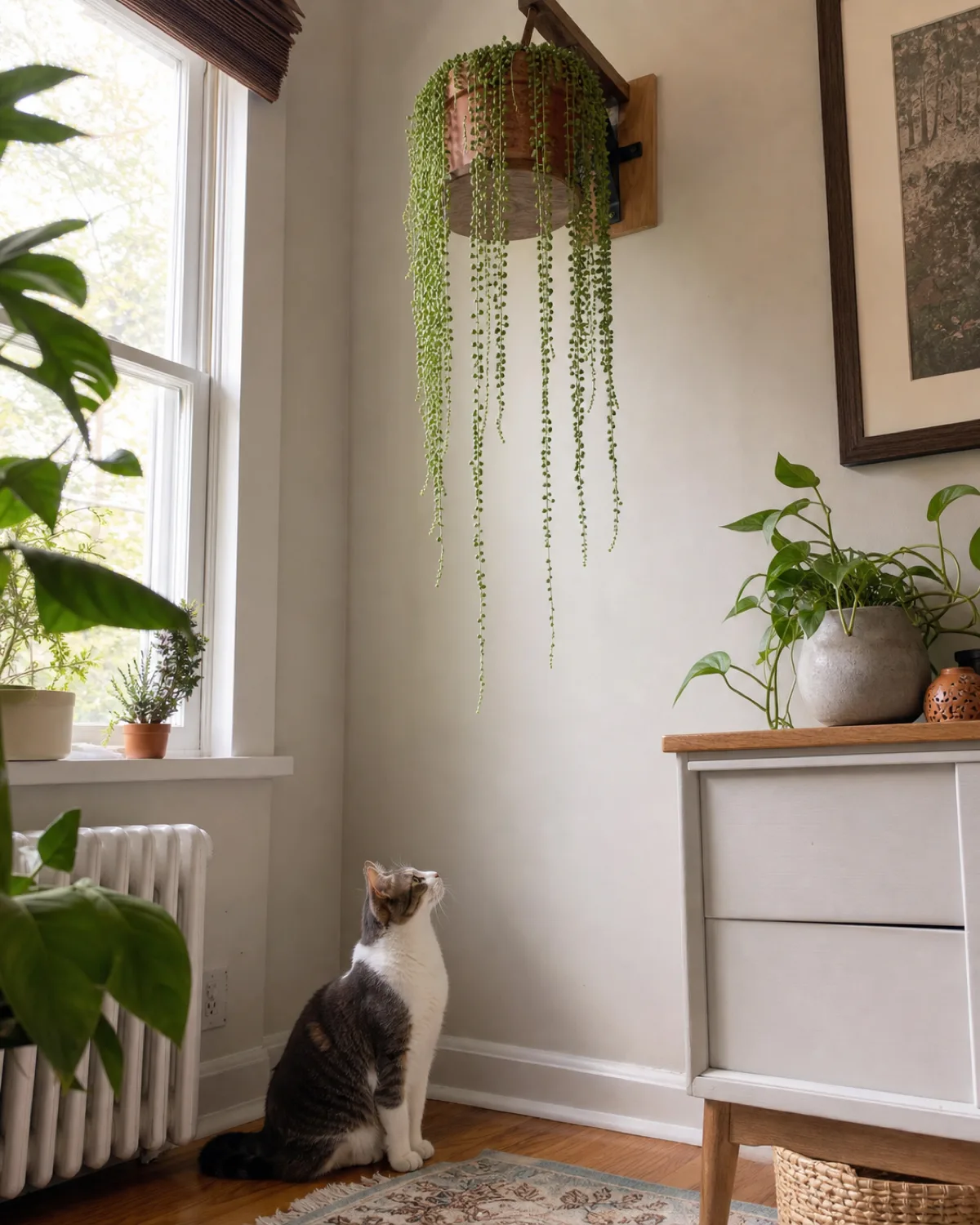
Yes. All Curio (formerly Senecio) species are toxic to cats and dogs if ingested, causing vomiting, drooling, and lethargy. The trailing strands are particularly dangerous because they swing and sway — irresistible to cats who treat them as toys.
The safest placement is a high wall-mounted shelf or a ceiling hook well out of jumping range. A room the cat doesn't access is the only reliable solution for persistent climbers.
For a pet-safe trailing alternative, spider plants provide similar cascading drama without the toxicity risk.
- All Curio/Senecio species are toxic to cats and dogs — vomiting, drooling, lethargy.
- Trailing strands attract cats as toys — hang high or keep in a pet-free room.
- Spider plant for a pet-safe trailing alternative, though it looks nothing alike.
String of pearls varieties and lookalikes
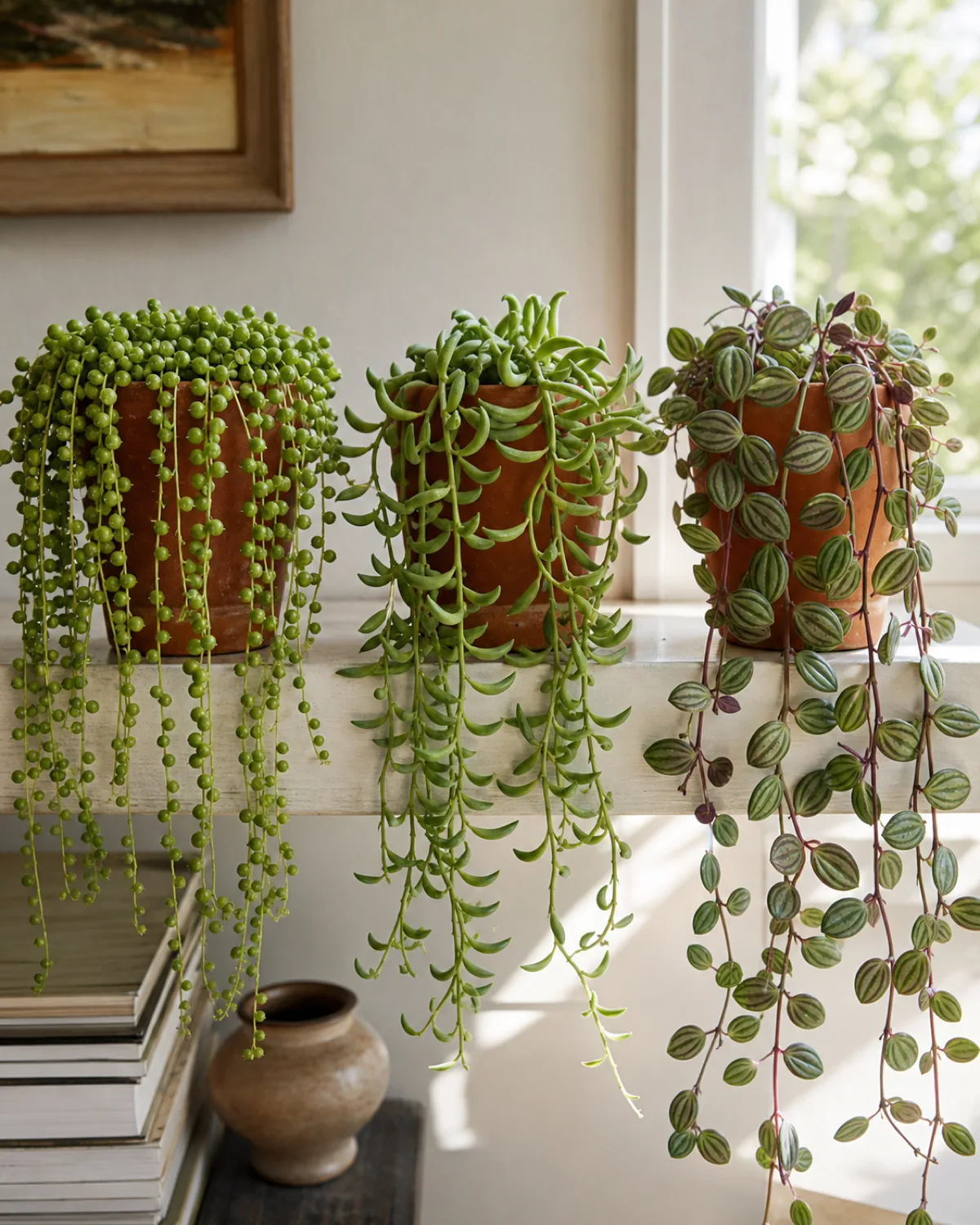
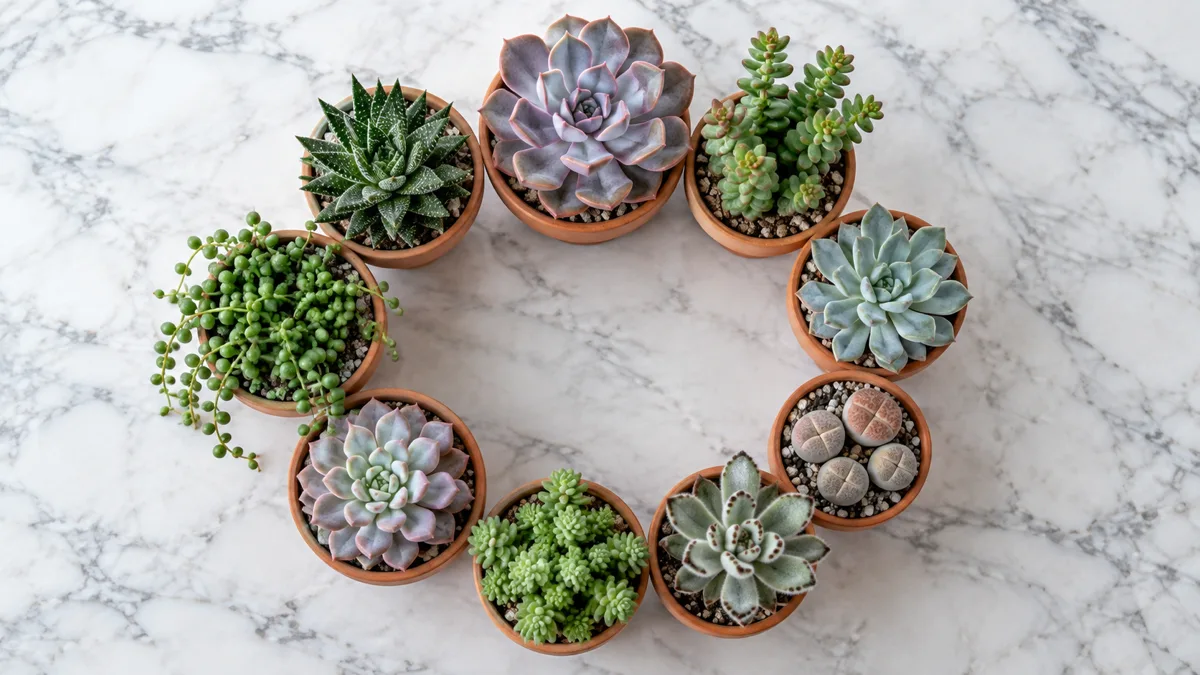
Curio rowleyanus (classic string of pearls) is the one everyone knows — perfectly round, smooth green pearls with the translucent window stripe. This is the species this guide covers, and the most widely available.
Curio herreanus (string of watermelons) has oval pearls with purple-striped markings that look like tiny watermelons. Slightly more forgiving than the classic and tolerates a touch less light.
Curio radicans (string of bananas) grows curved, banana-shaped leaves instead of round pearls. It's often called the easier cousin — more tolerant of irregular watering and lower light. A good starter if classic string of pearls keeps dying on you.
Senecio citriformis (string of teardrops) produces teardrop-shaped, slightly pointed leaves with a blue-green waxy coating. More upright growth habit than the others.
Ceropegia woodii (string of hearts) belongs to a completely different family (Apocynaceae). Heart-shaped leaves with silver markings on purple stems — different care needs entirely. It was one of the eight hanging specialists covered alongside string of pearls.
- Classic round pearls (rowleyanus) — the standard, most available, this guide's subject.
- String of bananas (radicans) — the easier cousin for beginners, banana-shaped leaves.
- String of hearts (Ceropegia woodii) — completely different family, heart-shaped leaves, different care.
String of Pearls Care: The Quick Reference
- 1Round succulent pearls on trailing stemsEach pearl has a translucent window stripe — a desert photosynthesis adaptation.
- 2Bright light with morning sunMore light than most trailing plants — east-facing windowsill is ideal.
- 3Water only when pearls deflateEvery 2-3 weeks in summer, monthly in winter — bottom watering is safest.
- 4Firm wrinkled = thirsty, soft translucent = rotThe touch test tells you which problem you have — the fixes are opposite.
- 5Gritty, fast-draining succulent soil50/50 cactus mix and perlite — standard potting soil holds too much water.
- 6Low humidity, good air circulationUnlike most houseplants on this site — keep away from bathrooms and humidifiers.
- 7Feed monthly in spring and summer onlyHalf-strength liquid fertilizer — brown tips mean too much.
- 8Propagate with butterfly cuts on soil3-4 inch cuttings root in 1-2 weeks without hormone or water propagation.
- 9Shallow wide terracotta potShallow roots, prefers snug — repot every 2-3 years, not annually.
- 10Bald crown = not enough lightButterfly-cut healthy tips and re-root on the bare soil to fill in.
- 11Watch for mealybugs between pearlsWhite cottony patches at stem joints — isopropyl alcohol on a swab.
- 12Toxic to cats and dogsTrailing strands attract cats as toys — hang high or keep in a pet-free room.
- 13Start with string of bananas if this one keeps dyingCurio radicans is the more forgiving cousin with similar trailing charm.
kultivy.com

Mara Quinn edits Kultivy, where she shares houseplant care, propagation, beginner-friendly plant picks, and plant-styling ideas for anyone who wants their indoor plants to actually thrive. Every guide is image-led and reviewed for clarity, usefulness, image accuracy, and Pinterest-to-page alignment before it goes live. Visit the About page.