Dieffenbachia is the houseplant equivalent of a bold statement piece. Large cream-and-green leaves give any room instant tropical drama.
The catch: every part of this plant is intensely toxic, and the bottom leaves will yellow no matter what you do.
That second part trips up most new owners. The yellowing is normal. The toxicity is manageable with gloves and awareness.
Dieffenbachia is a fast-growing tropical aroid with dramatic variegated leaves and the most intense toxicity of any common houseplant. These thirteen sections cover the yellowing-leaf panic everyone goes through, how to handle the sap safely, and how to turn one leggy plant into three full ones.
What makes dieffenbachia different from other tropical houseplants
Dieffenbachia is a genus of tropical perennials in the Araceae family — the same family as monstera, philodendron, and pothos — native to Central and South America and the Caribbean. The common name "dumb cane" comes from the plant's intense toxicity: chewing any part causes the mouth and throat to swell so severely that the person temporarily cannot speak.
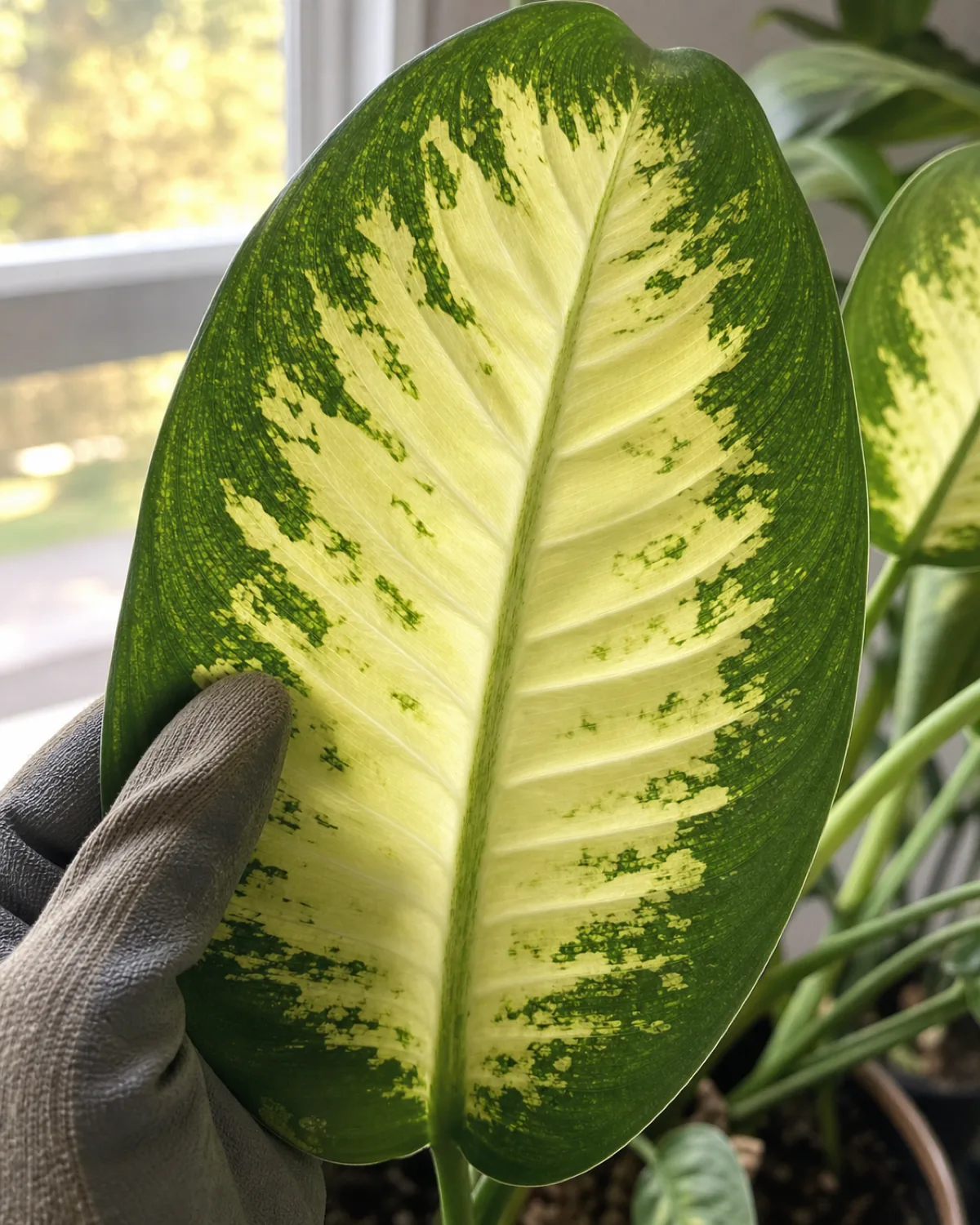
The defining visual feature is bold, broad leaves with dramatic cream, white, yellow, or lime-green variegation patterns that differ by cultivar. Some have nearly all-white centers with thin green edges. Others have dark green leaves heavily splashed and spotted with cream.
Unlike most aroids that climb or trail, dieffenbachia grows as a thick, upright, unbranching cane — a single fleshy stem that thickens with age, topped by a rosette of large leaves. This growth habit means the plant naturally sheds its lower leaves as it grows taller, developing a "palm tree" silhouette over time.
In favorable indoor conditions, dieffenbachia is one of the fastest-growing houseplants. A healthy plant can add two feet of height in a single growing season.
That pace makes it one of the most immediately rewarding plants on this site. Where a ZZ plant or peperomia might take a year to produce a few new leaves, dieffenbachia pushes out new foliage every couple of weeks during summer.
It has been a staple of indoor gardening since the Victorian era because it tolerates a wide range of indoor light conditions while providing instant tropical drama that few other plants match at its price point.
Dieffenbachia delivers fast-growing tropical drama with bold variegated leaves — but the intense toxicity and natural leaf-shedding are non-negotiable.
Light: the variegation-preserving balance
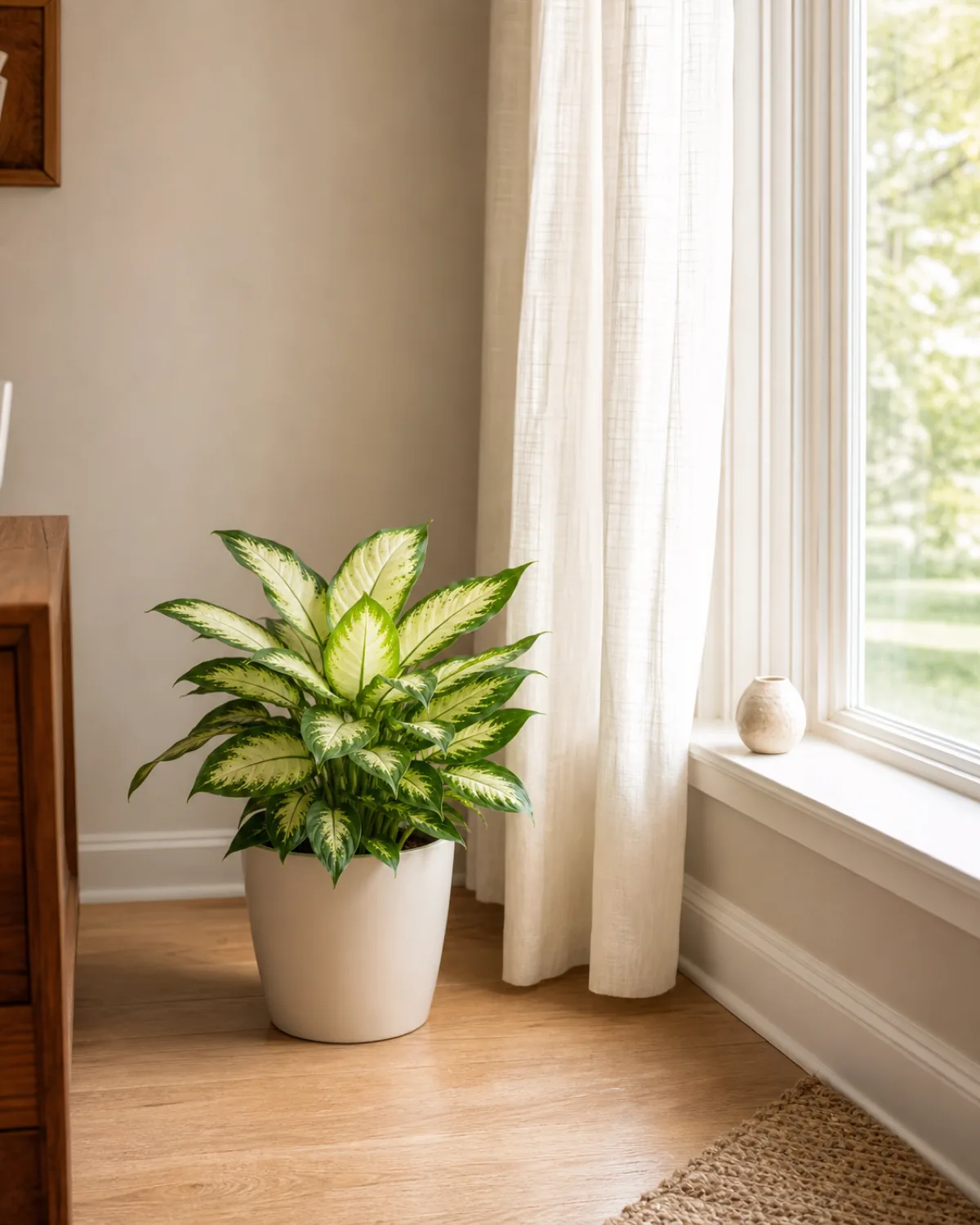
Dieffenbachia thrives in bright indirect light but tolerates medium light better than most variegated plants. The key trade-off: more light produces more vivid variegation and faster growth, while less light means the plant survives but new leaves emerge greener and smaller.
Direct sun scorches the large thin leaves within hours — brown papery patches that never recover. North or east windows work well. South or west windows need a sheer curtain to filter the intensity.
The large leaf surface area makes dieffenbachia efficient at capturing available light, which is why it can tolerate lower light than its variegation would suggest. But tolerance is not the same as thriving. A plant that was once compact and full but now looks sparse and top-heavy needs more light.
Signs of too little light: smaller new leaves, loss of variegation contrast, leggy stretched stem with wider gaps between leaf nodes. Signs of too much light: faded or bleached leaf color, brown crispy edges, washed-out variegation pattern.
For a deeper dive on measuring light levels without a meter and matching plants to window positions, see our houseplant light guide.
Watering: the even-moisture sweet spot
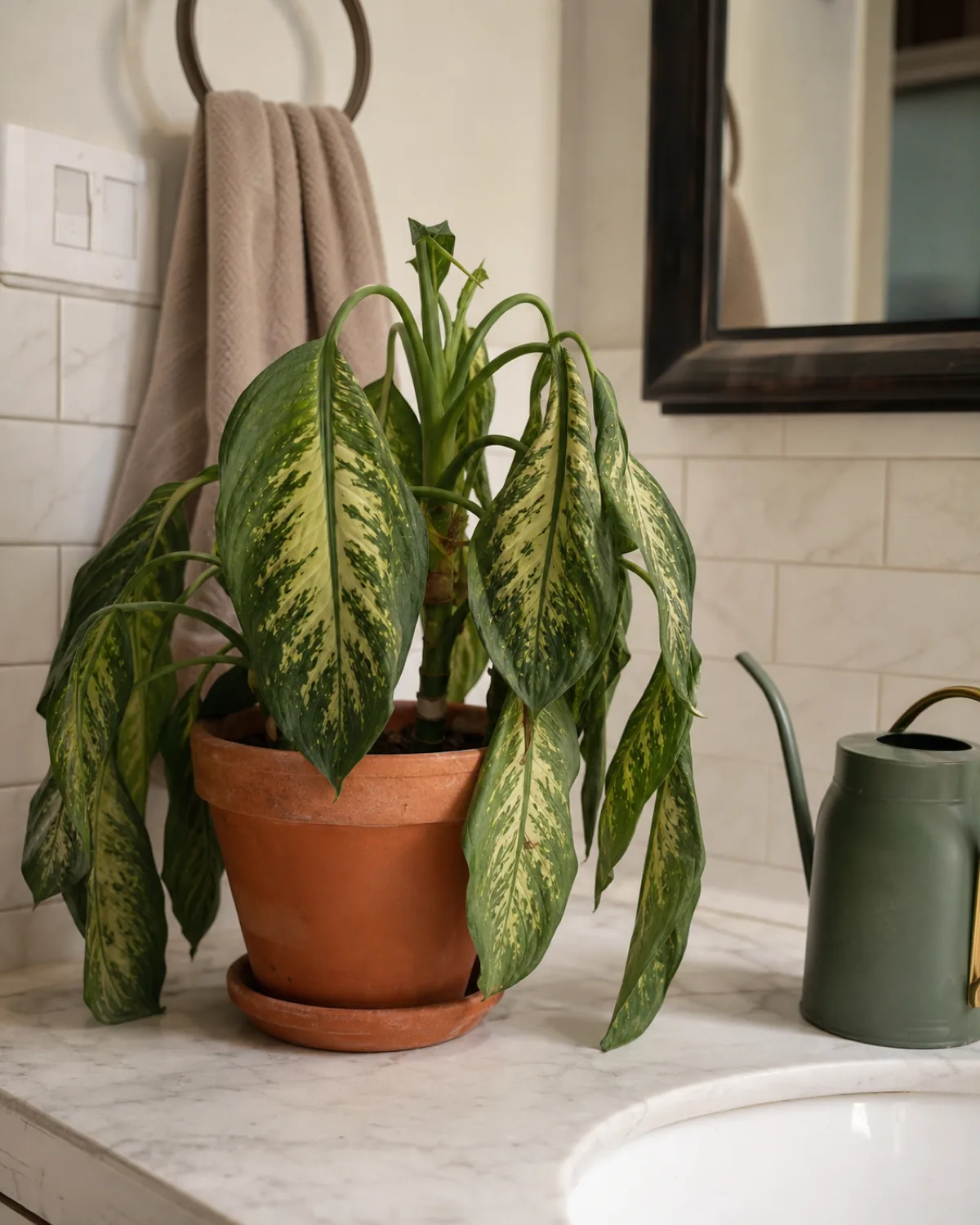
Dieffenbachia prefers consistently moist — not wet — soil. This is a narrower watering window than drought-tolerant plants like ZZ plant or snake plant, but more forgiving than fussy tropicals like calathea.
Let the top inch of soil dry between waterings. In practice, this means water roughly every seven to ten days in summer and every fourteen to twenty-one days in winter. The thick fleshy stem stores some water but not enough to survive extended drought.
Underwatering shows as dramatic drooping — the large leaves wilt visibly, hanging down instead of standing upright. This looks alarming but is actually one of the clearest watering signals of any houseplant. Water thoroughly, and the leaves recover within hours.
Overwatering is more dangerous. Root rot causes the base of the cane to turn soft and mushy, and once the cane itself rots the plant is usually beyond saving. The first sign is often a musty smell from the soil.
Yellow lower leaves can mean overwatering or natural leaf shedding — the distinction is whether the leaves are soft and mushy (overwatering) or firm and dry-papery (normal shedding). See the section on yellowing leaves below for the full diagnostic.
For a broader guide on watering frequency by pot material, season, and environment, see our indoor plant watering guide.
Soil and potting for a heavy cane
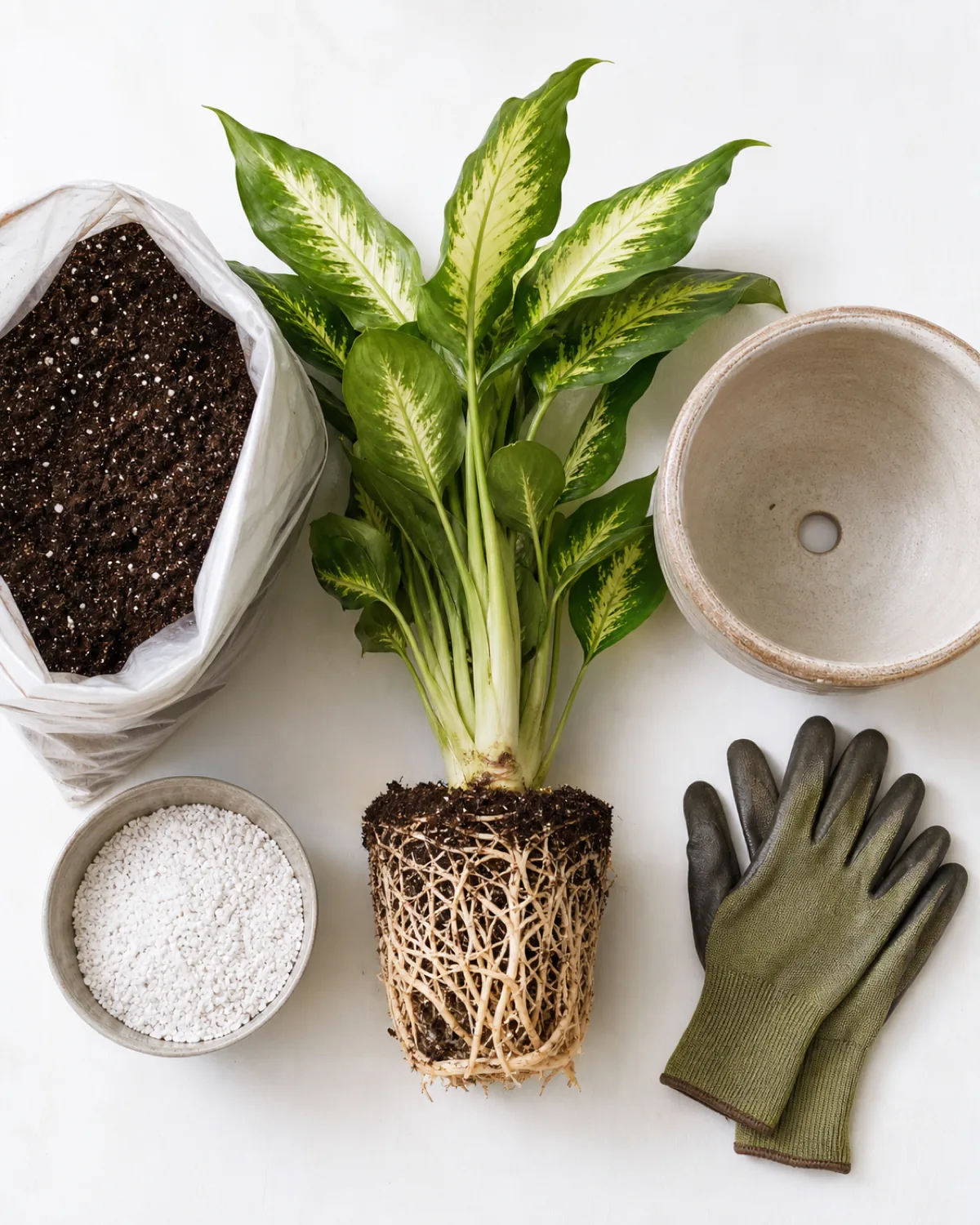
A standard well-draining potting mix works well: two parts potting soil plus one part perlite. Dieffenbachia has a relatively normal root system — not epiphytic like orchids, not shallow like peperomia — but the heavy cane makes pot weight and stability important.
A tall dieffenbachia in a lightweight plastic pot will topple. Use a heavier ceramic or terracotta pot, or nest the nursery pot inside a weighted decorative planter.
Drainage holes are essential because the even-moisture preference means you water frequently, and standing water at the bottom causes root rot quickly. Never let the pot sit in a saucer of collected water for more than thirty minutes.
Repot every one to two years — faster than slow-growers like ZZ or peperomia — because dieffenbachia's fast growth fills the pot quickly. Go up one pot size, about two inches larger in diameter. Signs it needs repotting: roots circling the drainage holes, water running straight through without absorbing, and the plant becoming top-heavy and unstable.
Always wear gloves when repotting. The roots and stem ooze sap that can cause skin irritation.
Toxicity: the most dangerous common houseplant
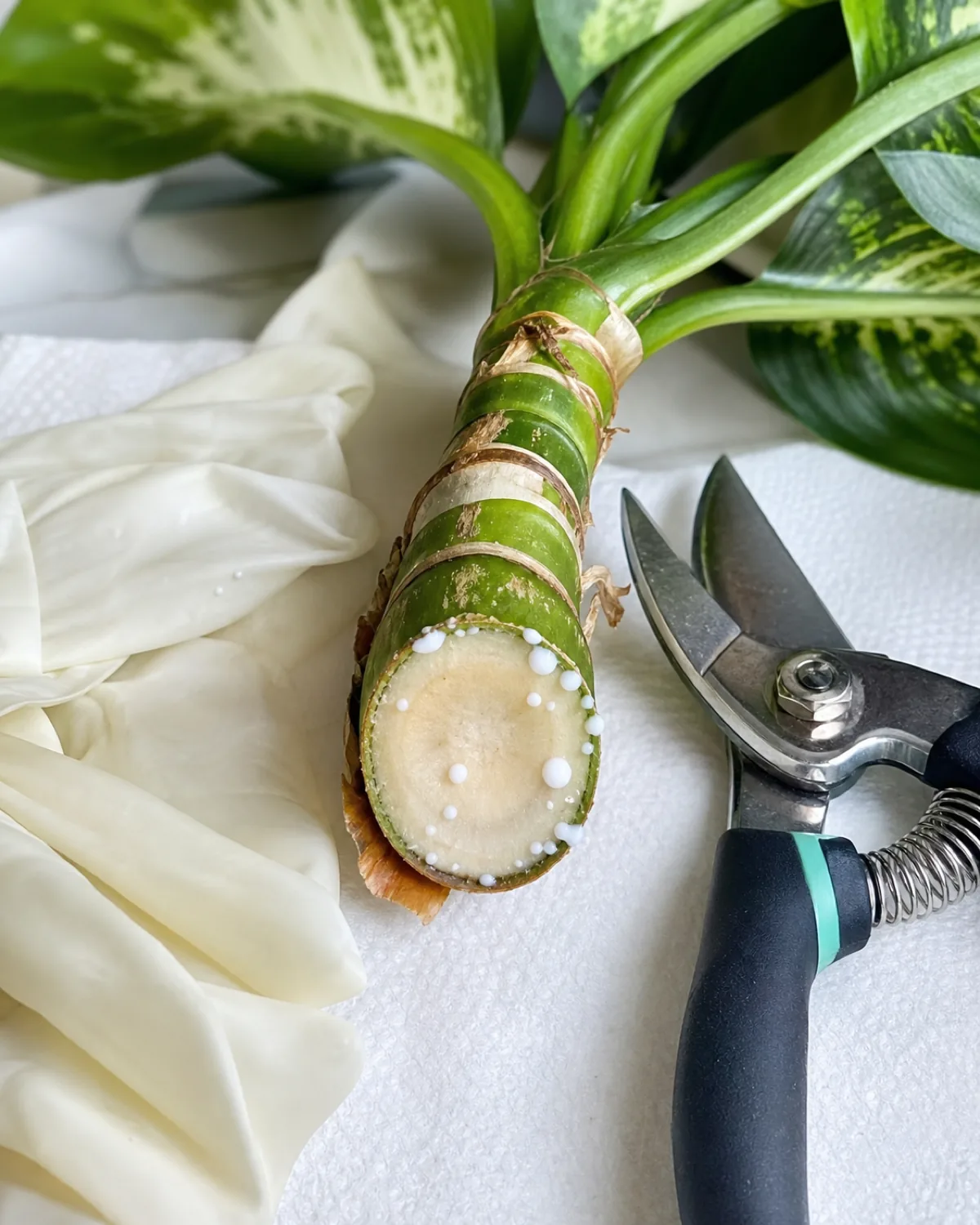
Dieffenbachia is not "mildly toxic" like pothos or philodendron. It contains dense concentrations of calcium oxalate raphides — microscopic needle-shaped crystals — plus proteolytic enzymes that actively break down tissue.
When any part of the plant is chewed or the sap contacts mucous membranes, the raphides literally inject into the tissue like thousands of tiny needles while the enzymes cause inflammation.
The result in humans: immediate intense burning pain in the mouth and throat, excessive drooling, tongue and lip swelling, difficulty swallowing, and in severe cases temporary inability to speak lasting hours to days.
The effect on cats and dogs is similar: oral pain, drooling, pawing at the mouth, vomiting. Fatalities are extremely rare — the pain is severe enough that children and pets usually spit it out immediately — but the experience is deeply unpleasant.
The sap can also cause contact dermatitis on skin. Always wear gloves when pruning, propagating, or repotting. Wash hands immediately after handling, even with gloves. Keep the plant out of reach of children and pets — a high shelf, a room they cannot access, or a hanging position if the plant is young and small enough.
Despite all this, dieffenbachia has been a popular houseplant for over 150 years. The toxicity is manageable with awareness, not a reason to avoid the plant entirely. Millions of households keep dieffenbachia safely by following one rule: wear gloves, and do not let anyone chew it.
Why the bottom leaves turn yellow (and why it is usually normal)
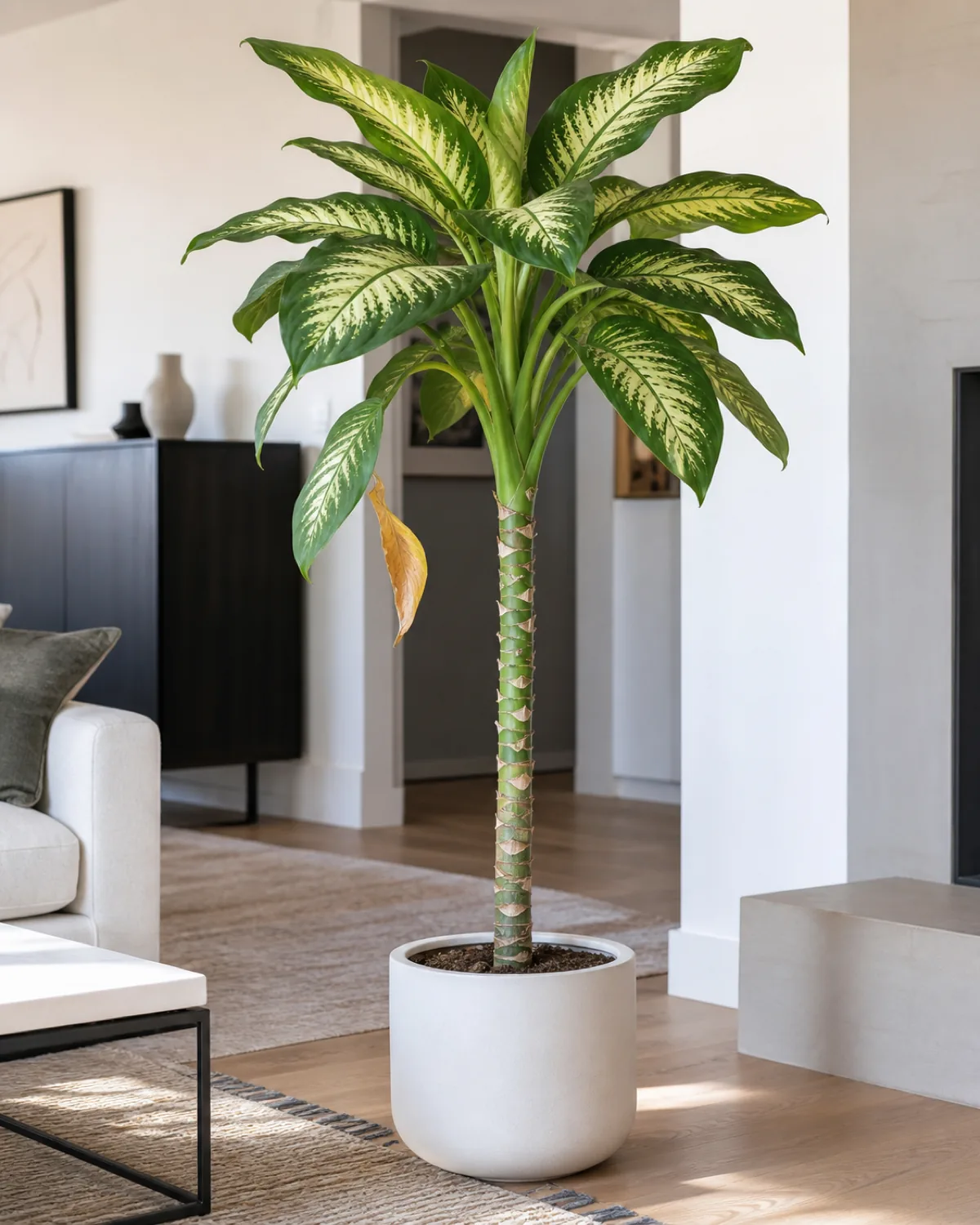
This is the single most common dieffenbachia question and the most commonly misdiagnosed problem.
Dieffenbachia naturally sheds its lowest leaves as it grows. The plant redirects energy to new growth at the top, and the oldest leaves at the bottom gradually yellow, dry, and drop off. This is normal physiology, not a care failure.
The result over time is the characteristic "palm tree" look: a bare cane below with a crown of leaves at the top. This is identical to the natural leaf-shedding pattern in dracaena marginata — it is how these cane-type plants grow.
How to tell normal shedding from a problem:
Normal shedding: Only the very lowest one to two leaves yellow at a time. They yellow gradually over weeks. The leaf becomes dry and papery. The rest of the plant looks healthy and is actively producing new leaves at the top.
Overwatering: Multiple leaves yellow at once, not just the bottom. Leaves are soft and mushy, not dry. The cane base feels soft when you press it. The soil smells musty.
Underwatering: Leaves droop dramatically and may yellow, but they are dry and crispy, not mushy. The soil is bone-dry throughout the pot.
Too little light: Upper leaves lose variegation and shrink. The spacing between new leaves increases as the stem stretches.
If only the bottom one or two leaves are slowly yellowing while the plant is pushing out healthy new growth at the top, leave it alone. It is doing exactly what dieffenbachia does.
Temperature and humidity: the tropical that actually adapts
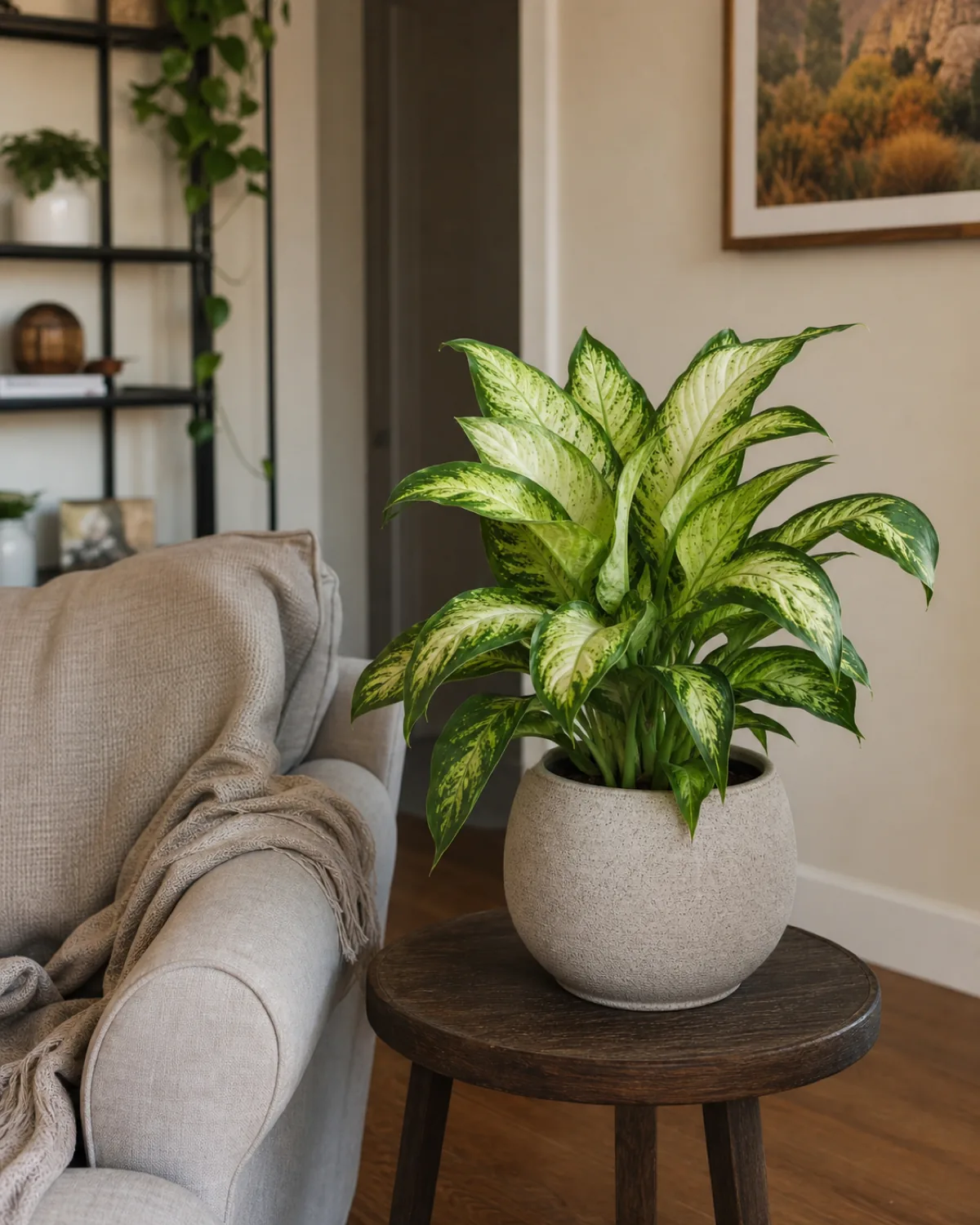
Dieffenbachia prefers 65-80°F (18-27°C). It tolerates briefly down to 55°F but growth stalls. Below 50°F causes cold damage — leaves develop brown or black patches, especially along the edges.
Dieffenbachia is extremely sensitive to cold drafts. Keep it away from exterior doors in winter, air conditioning vents in summer, and cold windowpanes. A sudden temperature drop causes more damage than a consistently cool room.
Humidity: dieffenbachia prefers 50-60% but adapts to average household humidity around 40% better than most tropicals. This is a significant practical advantage over calathea, fern, or prayer plant, all of which demand higher humidity.
In very dry air — common during winter heating season — leaf edges may brown. A humidifier near the plant helps, or group it with other plants to create a humidity microclimate. Misting is less effective for dieffenbachia than for plants with smaller leaves because the large flat surfaces shed water quickly.
Fertilizing a fast grower
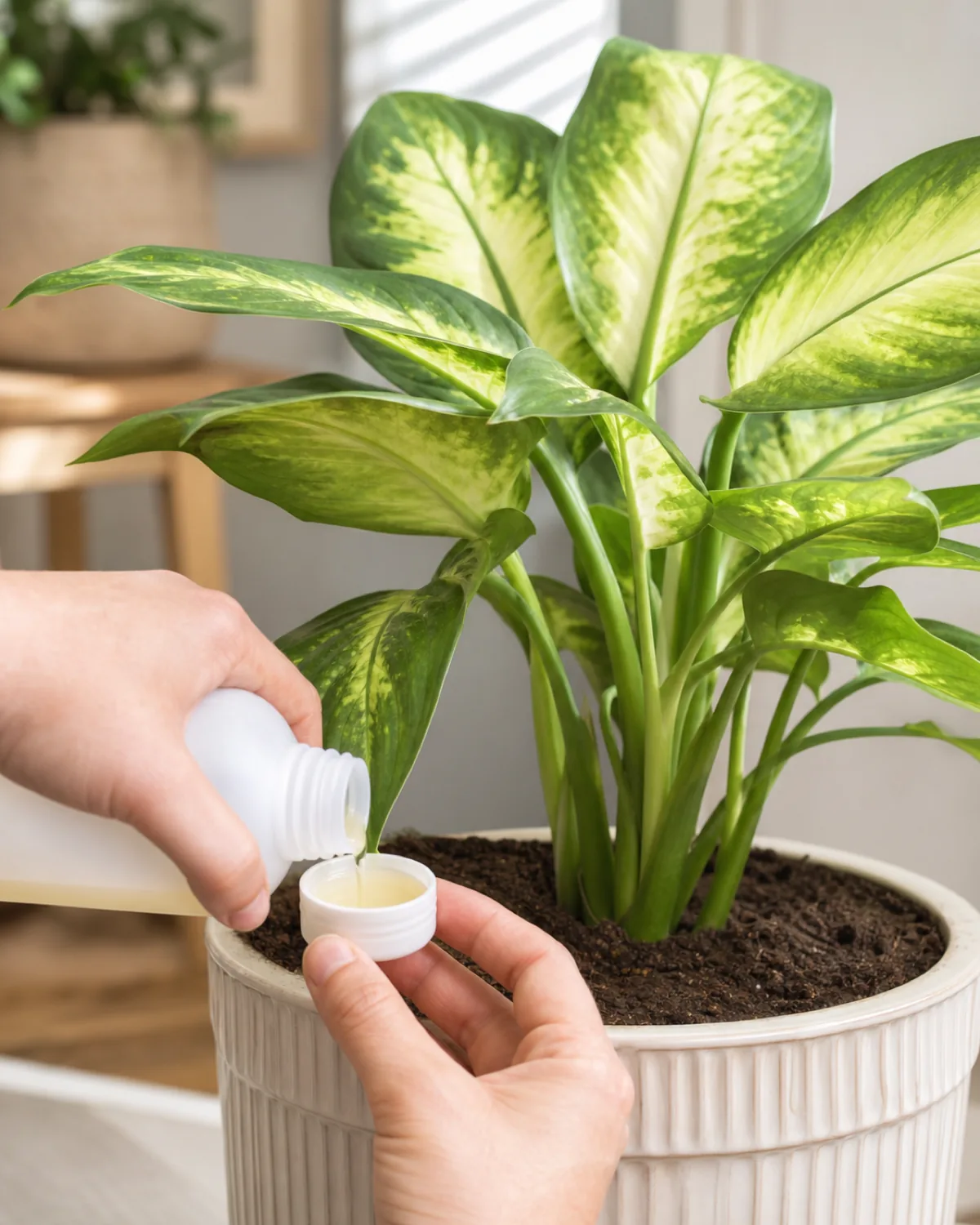
Dieffenbachia's fast growth rate means it actually benefits from regular feeding more than slow-growing plants. Use a balanced liquid fertilizer (20-20-20 or 10-10-10) at half strength every two to three weeks during the growing season, spring through early fall.
This is more frequent than recommended for slow growers like ZZ or peperomia. The rapid leaf production genuinely consumes nutrients, and a hungry dieffenbachia shows it: slowed growth, pale new leaves, and smaller leaves than previous ones.
Reduce to monthly in late fall. Stop entirely in winter when growth stalls — the plant is not using nutrients and they will accumulate as salts in the soil.
Signs of over-fertilizing: brown leaf edges and tips (salt burn), white crusty deposits on the soil surface. Flush the soil thoroughly with plain water — run several pots worth of water through the drainage holes to dissolve and wash out accumulated salts.
Newly repotted plants need no fertilizer for six to eight weeks. Fresh potting mix contains enough nutrients to sustain initial growth.
For a broader guide on houseplant feeding schedules, NPK ratios, and the weakly-weekly approach, see our fertilizing houseplants guide.
Propagation: the cane-cutting method
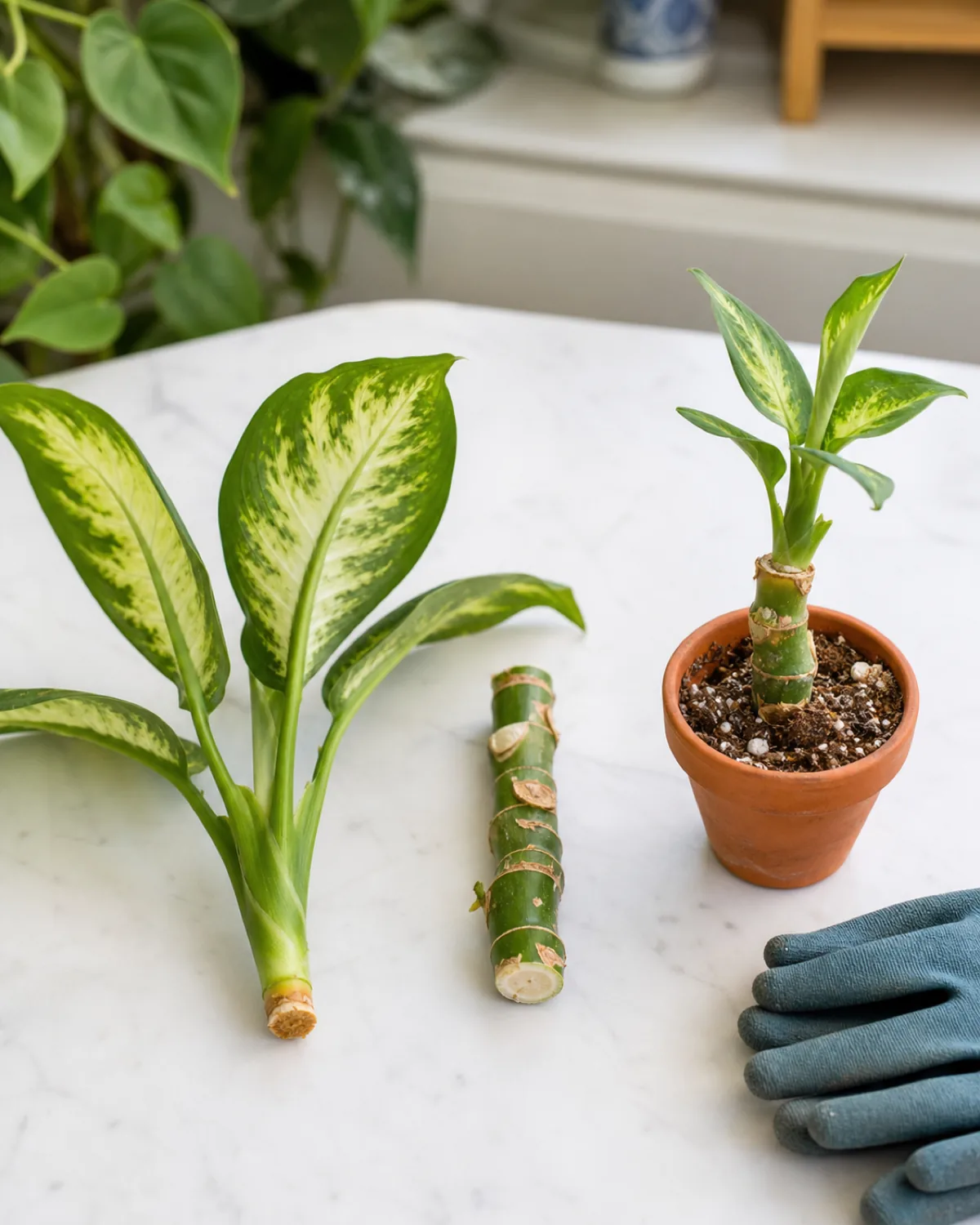
Dieffenbachia is propagated by stem (cane) cuttings, which also doubles as a way to rejuvenate a leggy plant. There are three usable parts from a single plant.
Top cutting. Cut the top six to eight inches of the cane, including the leaf crown. Let the cut end callous for a few hours, then root in water or moist perlite. This is the fastest method — roots appear in two to three weeks.
Cane sections. Cut the bare trunk into three- to four-inch segments, each with at least one visible node (the slight bumps or rings on the cane where leaves once attached). Lay these horizontally on moist perlite or peat, half-buried. Each node can sprout a new plant in four to six weeks.
The original stump. When you cut the top off a dieffenbachia, the remaining stump will almost always sprout new growth from dormant nodes below the cut — often multiple new shoots, resulting in a bushier plant than the original.
Always wear gloves during propagation. The exposed cut surfaces weep sap that causes skin irritation. Use a clean sharp knife or pruners to avoid crushing the fleshy cane.
This is the most common practical use of propagation: rejuvenating a tall, leggy dieffenbachia that has lost its lower leaves. One leggy plant becomes three to five new ones. For more propagation techniques across different houseplant types, see our plant propagation guide.
Common pests and problems
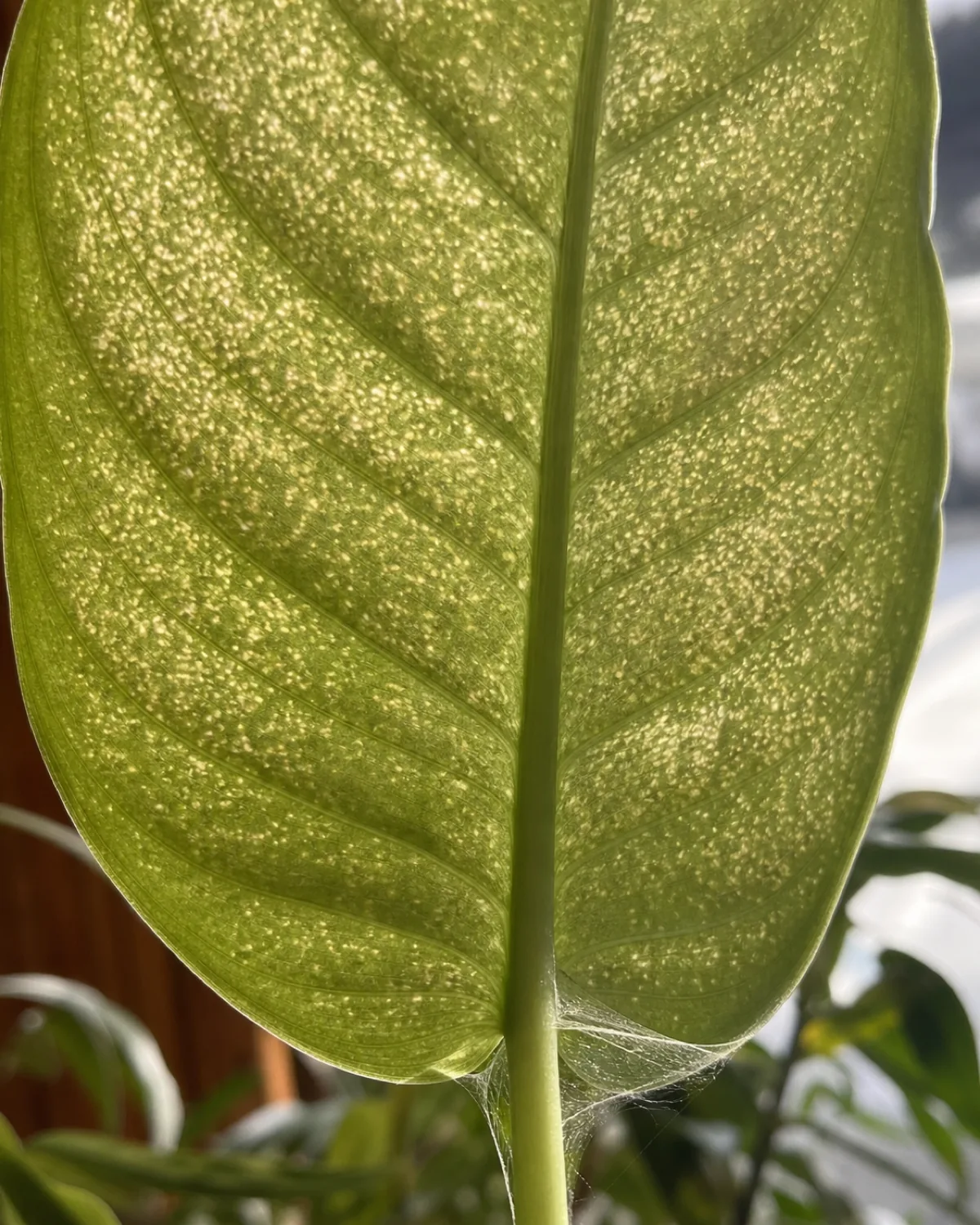
Spider mites are the number one pest for dieffenbachia, especially in dry indoor air. Signs: fine webbing between leaves, tiny stippled yellow dots on leaf surfaces. Treatment: shower the plant with water to dislodge mites, then apply neem oil spray weekly for three weeks to break the reproductive cycle.
Mealybugs appear as white cottony clusters in leaf axils and under leaves. Treat small infestations with isopropyl alcohol on a cotton swab. For larger infestations, use neem oil.
Root rot from overwatering is the most common non-pest problem. Signs: soft mushy cane base, multiple yellowing leaves, musty soil smell. Unpot the plant (wearing gloves), cut away rotted roots with clean shears, and repot in fresh dry mix. Reduce watering going forward.
Bacterial leaf spot shows as brown spots surrounded by yellow halos, often caused by water sitting on leaves. Improve air circulation, water at the soil level rather than overhead, and remove affected leaves.
Leggy growth — a tall bare cane with leaves only at the top — is the most common aesthetic concern. It is not a pest problem. See the next section for the fix.
For a full diagnostic framework covering identification, quarantine, and treatment across houseplant species, see our pests and diseases guide.
Cutting back a leggy dieffenbachia
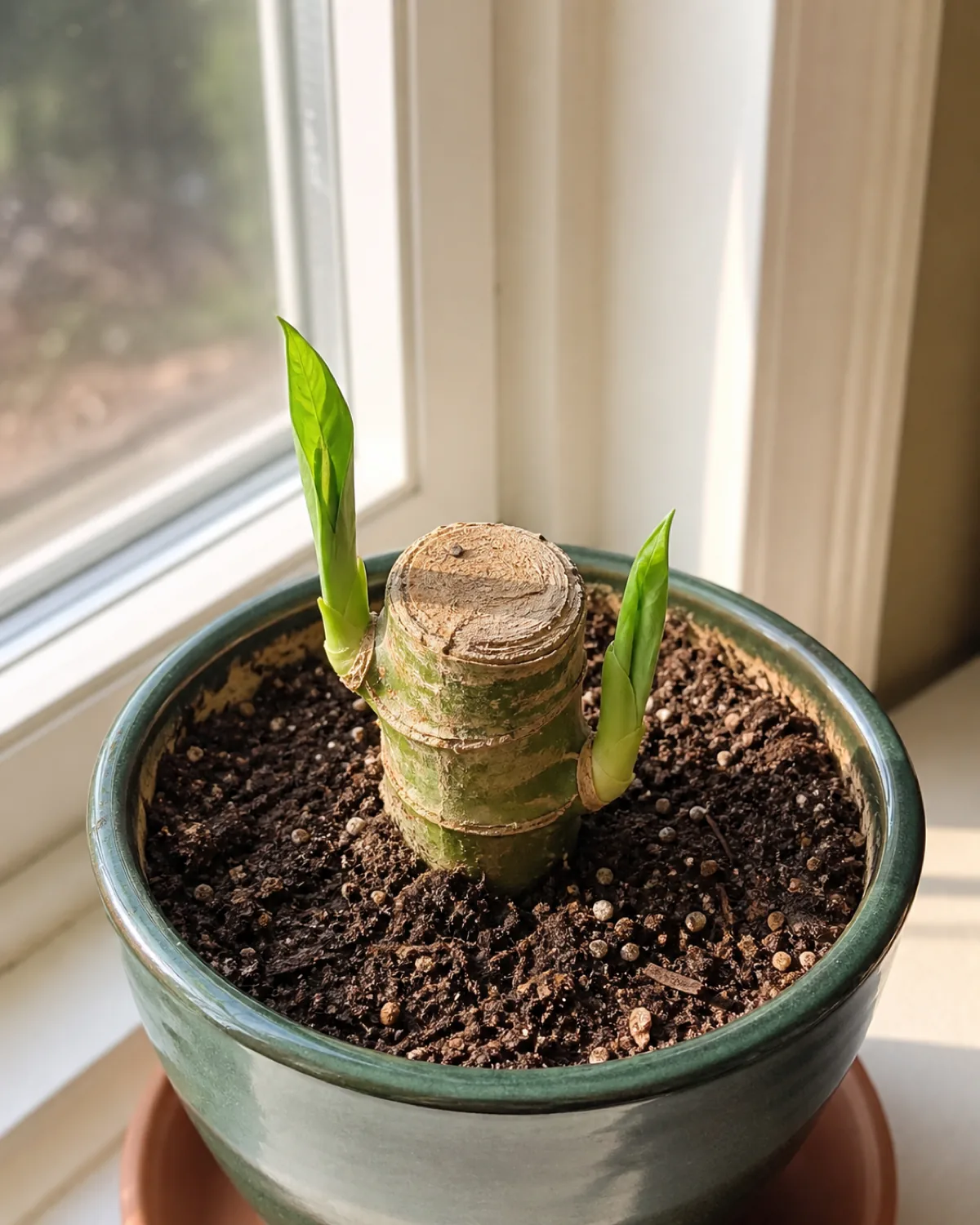
As dieffenbachia grows, it naturally develops a tall bare cane with a tuft of leaves at the top. This is normal growth, not a problem — but it is not always the look you want.
The fix is simple and reliable. Cut the cane back to six inches above the soil line in spring. The stump will sprout new growth from dormant nodes within two to four weeks, usually producing two to three new shoots instead of one. The result is a fuller, bushier plant than you started with.
Meanwhile, root the top cutting — the crown with its leaves — in water or perlite as described in the propagation section. Now you have two plants.
You can even cut the bare middle section of cane into segments and propagate those, turning one leggy plant into three to five new ones.
Timing matters. Do this in spring or early summer when growth is strongest. Avoid cutting back in winter when the plant is semi-dormant — regrowth will be slow or may not happen until spring.
Always wear gloves. The fresh cuts ooze sap. Use sharp, clean pruners to avoid crushing the fleshy cane, which increases the chance of infection at the cut site.
Dieffenbachia vs. similar large-leaf tropicals
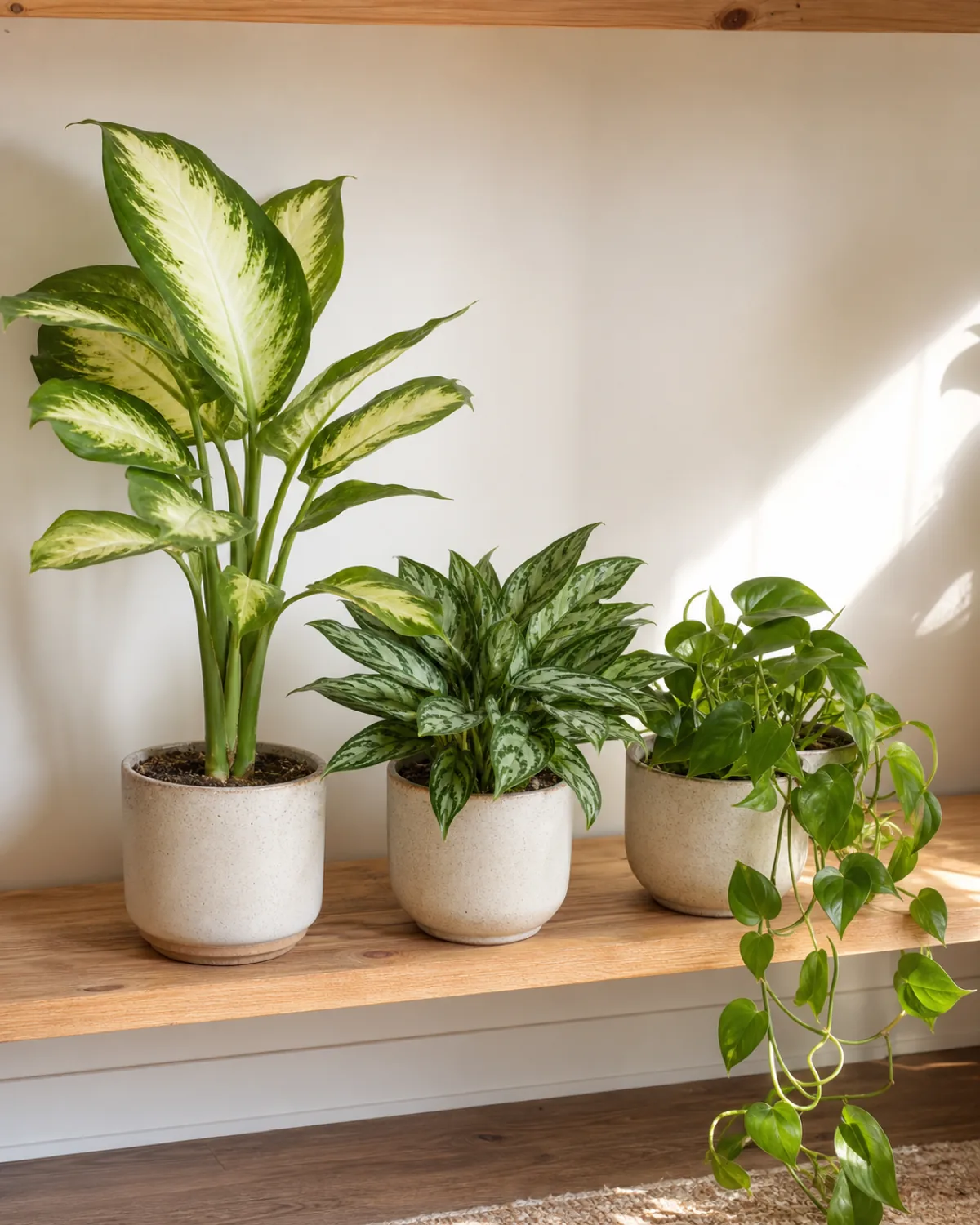
Dieffenbachia vs. Chinese evergreen (aglaonema). Same family, similar care profile, but aglaonema stays much smaller — twelve to twenty-four inches versus dieffenbachia's three to six feet. Aglaonema tolerates lower light, grows slower, and is less toxic.
If you want the variegated tropical look in a compact, lower-maintenance package, aglaonema is the easier choice.
Dieffenbachia vs. philodendron. Philodendrons typically climb or trail; dieffenbachia grows as a single upright cane. Philodendrons are generally easier and more drought-tolerant. But dieffenbachia's broad, flat leaves create more visual impact per plant — one large dieffenbachia fills the same visual space as three trailing philodendrons on a shelf.
Dieffenbachia vs. monstera. Monstera develops fenestrations — those distinctive leaf splits — which dieffenbachia never does. Monstera climbs and needs a moss pole or support; dieffenbachia stays upright on its own. Monstera is less toxic. Both are aroids, both want bright indirect light, and both grow fast.
Dieffenbachia vs. dracaena marginata. The most useful comparison. Both develop the "palm tree" silhouette from natural lower-leaf shedding. But dracaena is far more drought-tolerant and is not toxic to pets.
Dieffenbachia has much larger, more dramatic tropical leaves and grows faster. Choose dracaena for set-and-forget resilience; choose dieffenbachia for bold tropical impact.
Dieffenbachia Care: The Quick Reference
- 1Intensely toxic sapWear gloves for pruning, repotting, propagation. Calcium oxalate raphides cause mouth swelling and temporary inability to speak if chewed.
- 2Keep soil evenly moistTop inch dry between waterings. Every 7-10 days summer, 14-21 days winter. Not drought-tolerant.
- 3Bright indirect lightMore light = more vivid variegation. East or filtered south window. Direct sun scorches the thin leaves fast.
- 4Bottom leaves yellow normallyNatural shedding: 1-2 lowest leaves, dry and papery, while top grows. Multiple mushy leaves = overwatering.
- 5Fast grower — feed regularlyHalf-strength balanced fertilizer every 2-3 weeks in growing season. More frequent than slow growers.
- 6Heavy pot for a heavy caneCeramic or terracotta. Lightweight plastic pots topple as the plant grows tall. Drainage holes non-negotiable.
- 7Dramatic droop = water meLeaves wilt visibly when thirsty. Looks alarming but recovers in hours after watering. A clear honest signal.
- 8Cut back to rejuvenateCut leggy cane to 6 inches in spring. Stump sprouts 2-3 new shoots. Root the top cutting for a second plant.
- 9Spider mites love dry airCheck leaf undersides for stippling and webbing. Shower the plant, then neem oil weekly for 3 weeks.
- 1065-80°F, no cold draftsBelow 50°F causes brown/black leaf patches. Keep away from cold windows, AC vents, and exterior doors.
- 11Adapts to normal humidityPrefers 50-60% but handles 40% household humidity. Easier than calathea, fern, or prayer plant.
- 12Repot every 1-2 yearsFast growth fills pots quickly. Go up one pot size. Roots circling drainage holes = time to repot.
- 13Start with CamilleCompact, forgiving, widely available. Tropic Snow for a larger statement. Always check leaf variegation health at purchase.
kultivy.com
Best dieffenbachia varieties for indoors
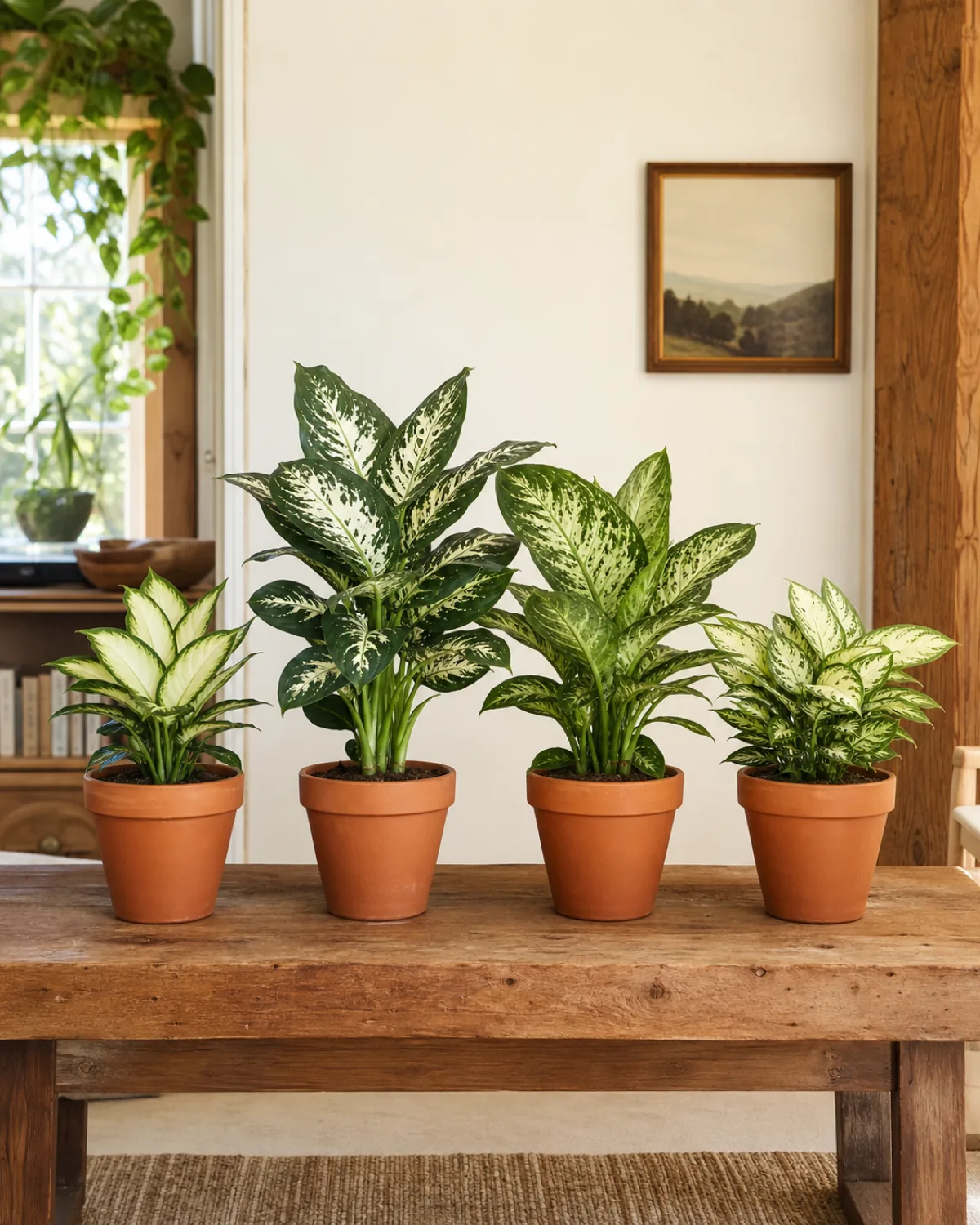
Dieffenbachia 'Camille' is the one to start with. Compact growth, topping out at two to three feet. The leaves have broad cream centers with thin green margins — the variegation is clean and consistent. It is the most popular cultivar, the most widely available, and the most forgiving of care mistakes.
Dieffenbachia 'Tropic Snow' is the statement plant. It grows larger — up to five to six feet indoors — with dark green leaves carrying dramatic white and cream blotches. The variegation pattern is bolder and more random than Camille's neat gradient. This is the classic dieffenbachia that fills a corner with tropical presence.
Dieffenbachia seguine is the original species. Large green leaves with cream splashing, vigorous grower, can reach six feet or more indoors. Less precisely patterned than the named cultivars, but the fastest and most vigorous grower.
Dieffenbachia 'Compacta' does what the name promises — stays small and bushy with heavy variegation. Ideal for desks, shelves, and spaces where a full-size dieffenbachia would overwhelm. It is the closest this genus gets to a true compact houseplant.
Dieffenbachia 'Star Bright' is unusual for the genus: narrow, pointed leaves with white centers and green edges, creating a more open, airy growth habit. It looks different enough from other dieffenbachia that people often do not recognize it as the same plant.
Start with 'Camille' for confidence. Graduate to 'Tropic Snow' when you want a floor-standing tropical that commands attention. Add 'Compacta' when you want the dieffenbachia look in a small space.

Mara Quinn edits Kultivy, where she shares houseplant care, propagation, beginner-friendly plant picks, and plant-styling ideas for anyone who wants their indoor plants to actually thrive. Every guide is image-led and reviewed for clarity, usefulness, image accuracy, and Pinterest-to-page alignment before it goes live. Visit the About page.