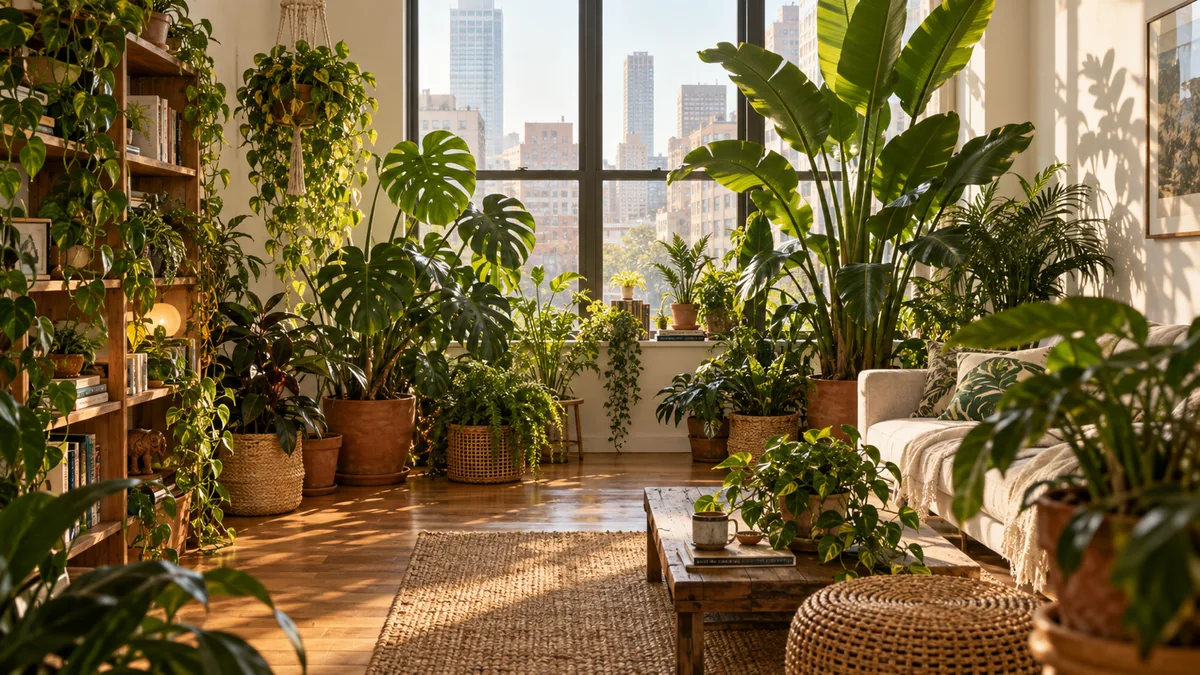
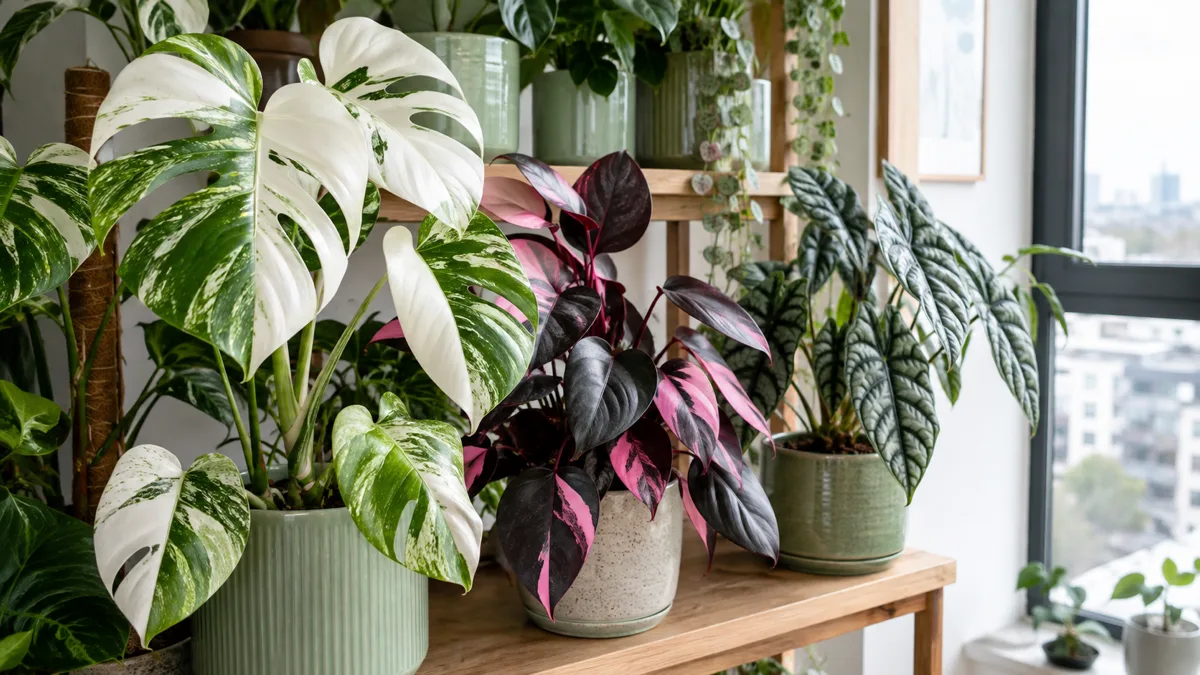
A tall plant changes a room the way a rug or a painting never can. It fills vertical dead space, draws the eye up, and makes low ceilings feel taller. One well-placed floor plant turns a flat corner into a living focal point.
These fourteen tall indoor plants range from four-foot tabletop-graduates to eight-foot ceiling-grazers — each matched to a light level, growth rate, and the specific room conditions where it actually thrives.
Each pick includes its indoor height potential, light needs, and growth speed — so you can match the plant to the room and the timeline. Jump to any plant below.
Fiddle leaf fig as a 6-foot living sculpture
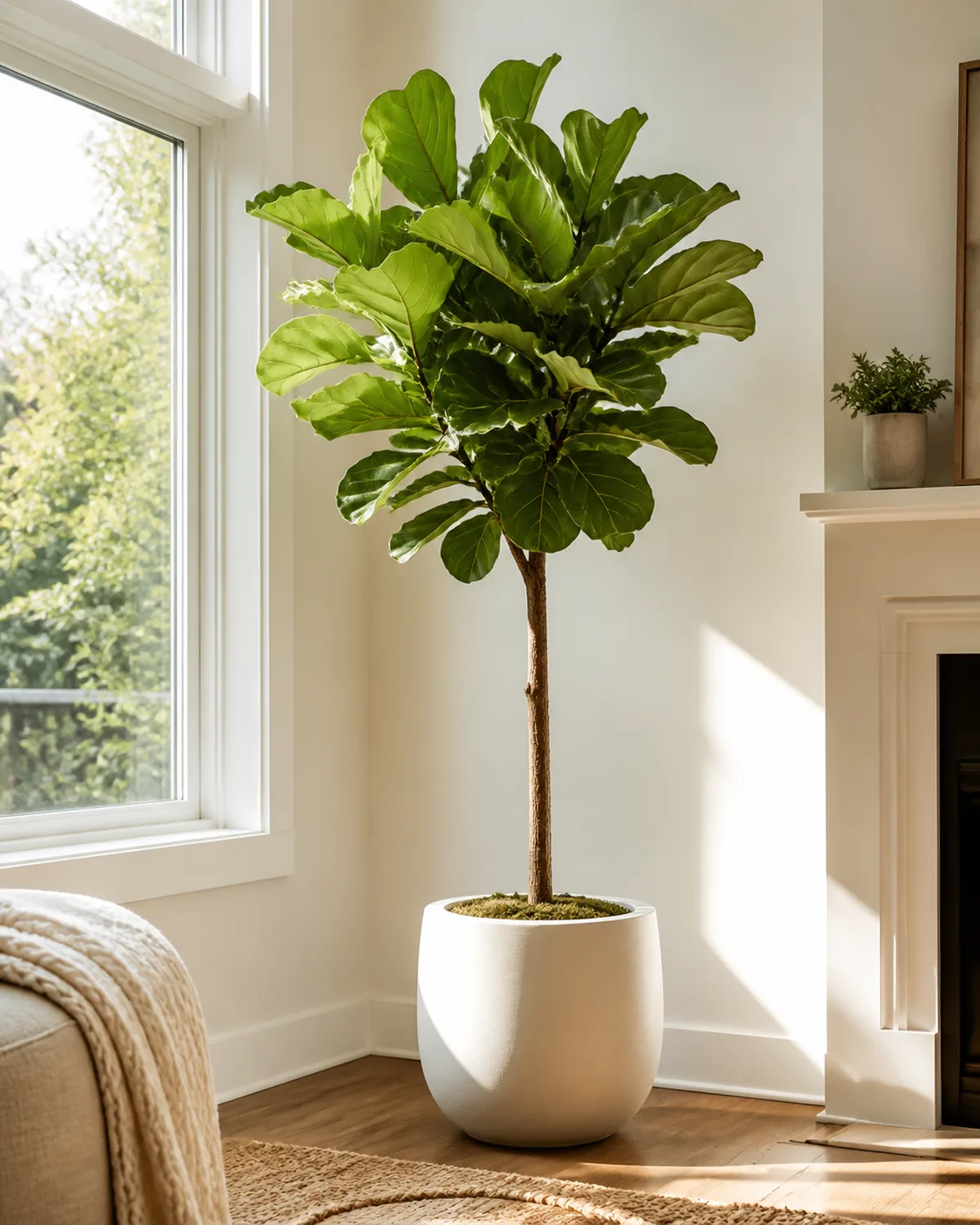
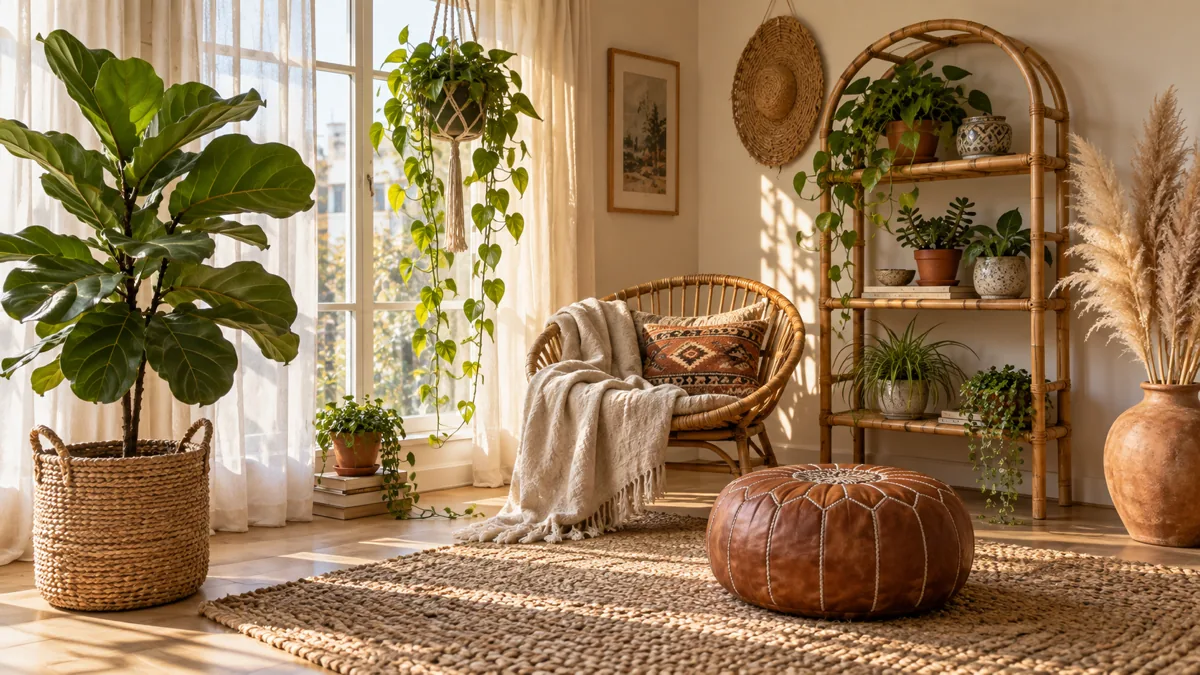
The fiddle leaf fig (Ficus lyrata) is the statement tree that turned indoor plants into an interior design category. A mature specimen reaches six to ten feet indoors on a single woody trunk topped with broad violin-shaped leaves that can span fifteen inches across.
That dramatic silhouette comes with conditions. Fiddle leaf figs need bright direct light — a south-facing window within three feet, not the middle of the room. They are slow growers indoors, taking three to five years to reach ceiling height from a nursery-size start.
Stake young stems early for a straight trunk. Once the trunk lignifies (hardens into wood), it holds its shape permanently. Without staking, the trunk bends toward the window and stays bent.
The most common killer is inconsistent conditions. Fiddle leaf figs drop leaves when moved, when drafts hit, when watering schedules change. Pick one spot with good light, set a watering routine, and leave the plant alone. Full care details in our fiddle leaf fig care guide.
Monstera deliciosa climbing a moss pole to the ceiling
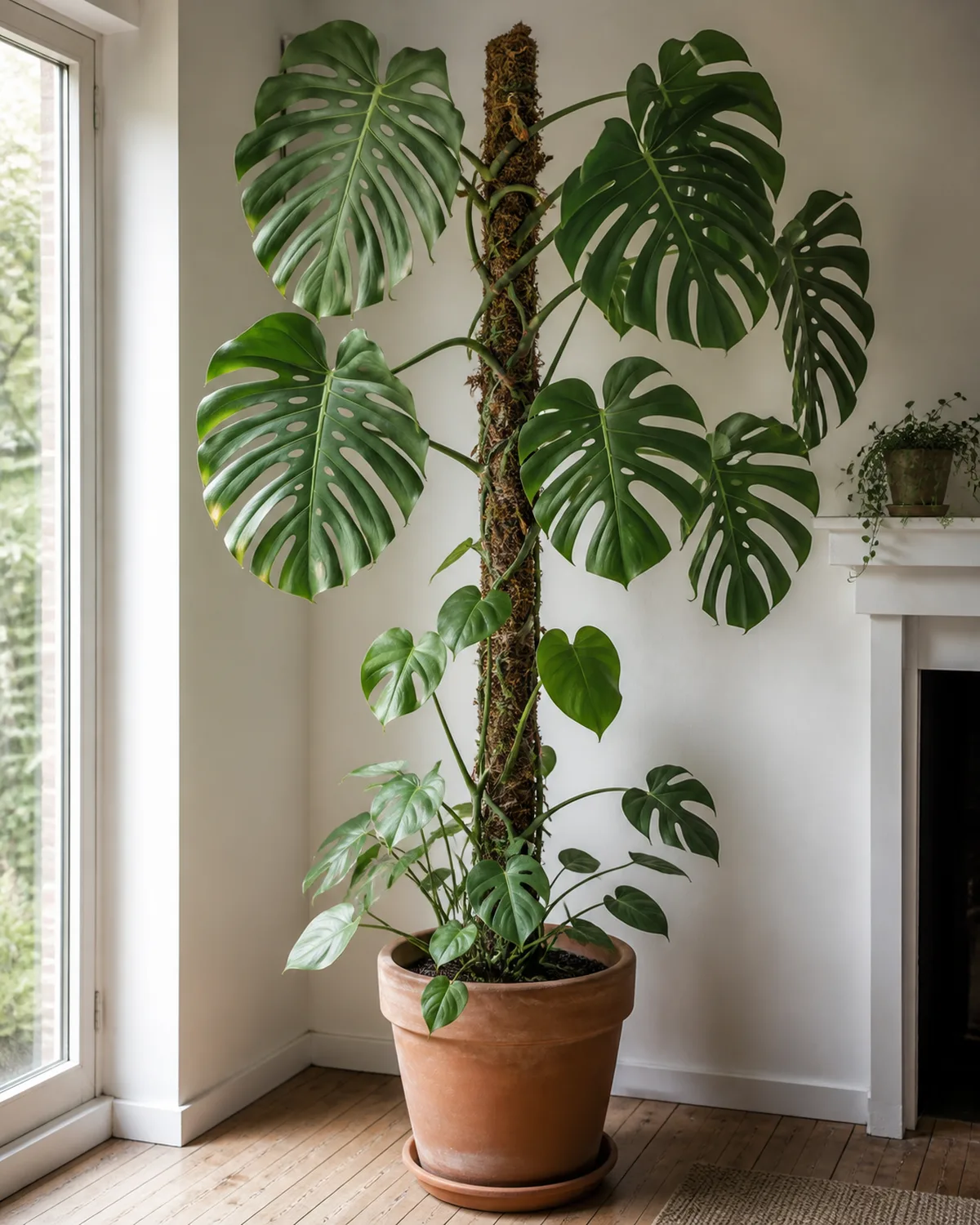
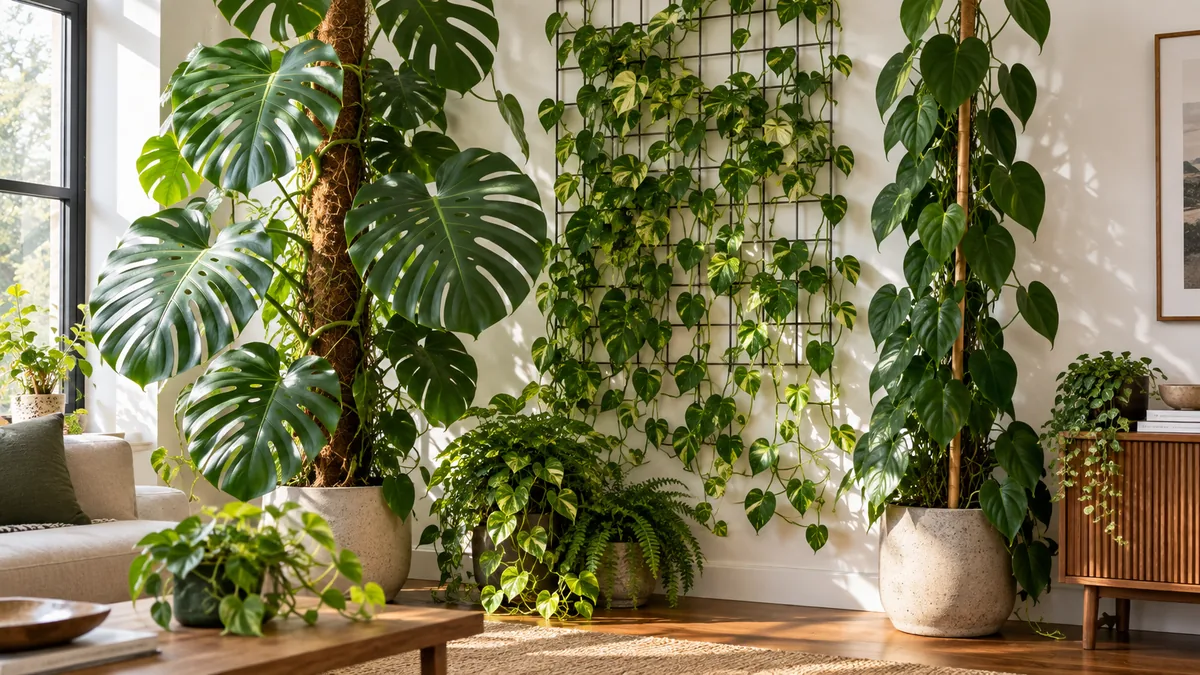
A monstera without support sprawls outward. A monstera on a moss pole climbs upward — and that single change turns a bushy tabletop plant into a six-to-eight-foot vertical statement.
The aerial roots grip the damp sphagnum moss on the pole, anchoring each new node higher than the last. As the plant climbs, its leaves get progressively larger and develop deeper fenestrations (the signature splits). The difference between a three-foot unsupported monstera and a six-foot pole-trained monstera is not just height — the top leaves can be three times the size of the bottom ones.
Growth rate is fast for a tall plant: one to two feet per year in bright indirect light. The tradeoff is width. A mature monstera spreads three to four feet from the pole, so it needs a corner, not a narrow gap.
Repot when roots circle the bottom of the pot — usually every two years. Go up one pot size (two inches in diameter), not more. Full propagation and care details in our monstera care guide.
Bird of paradise reaching toward a south-facing window
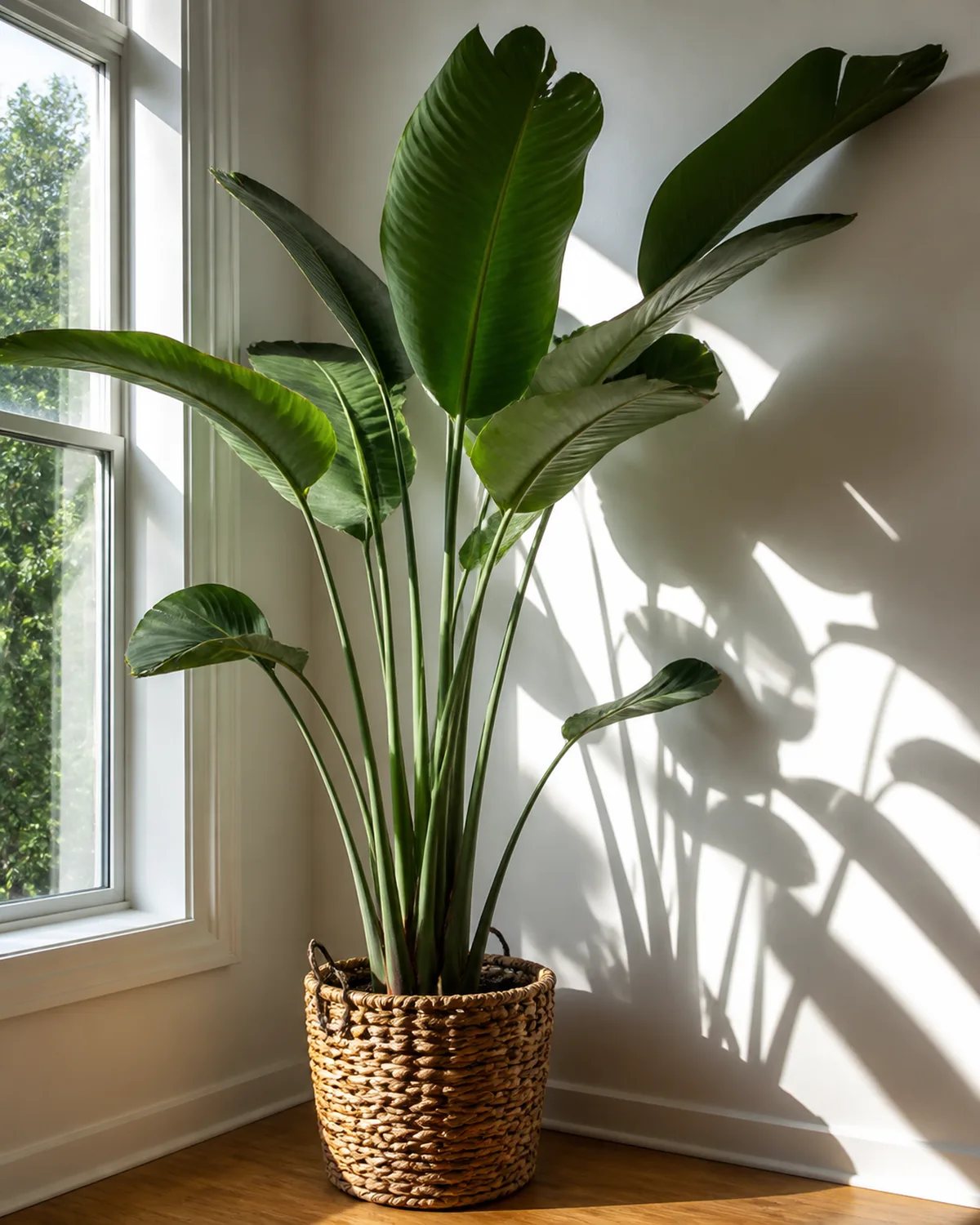
The bird of paradise (Strelitzia nicolai or S. reginae) is the tropical drama plant — giant paddle-shaped leaves on upright stems that reach five to seven feet indoors, creating a silhouette that reads as vacation even in a city apartment.
It rarely flowers indoors. That is fine. The foliage alone is the point — each leaf unfurls like a banana frond and holds its upright posture without staking or support.
The catch is light. Bird of paradise needs the brightest spot in the house: four to six hours of direct sun through a south or west window. In anything less, it stretches toward the light, the leaves stay small, and new growth slows to one or two leaves per year instead of one per month.
Leaf splitting is cosmetic, not a disease. Low humidity and air movement cause the leaf edges to tear along the veins — the same thing happens outdoors in wind. Raising humidity to fifty percent reduces it but does not eliminate it.
Rubber plant filling a tall narrow gap with glossy leaves
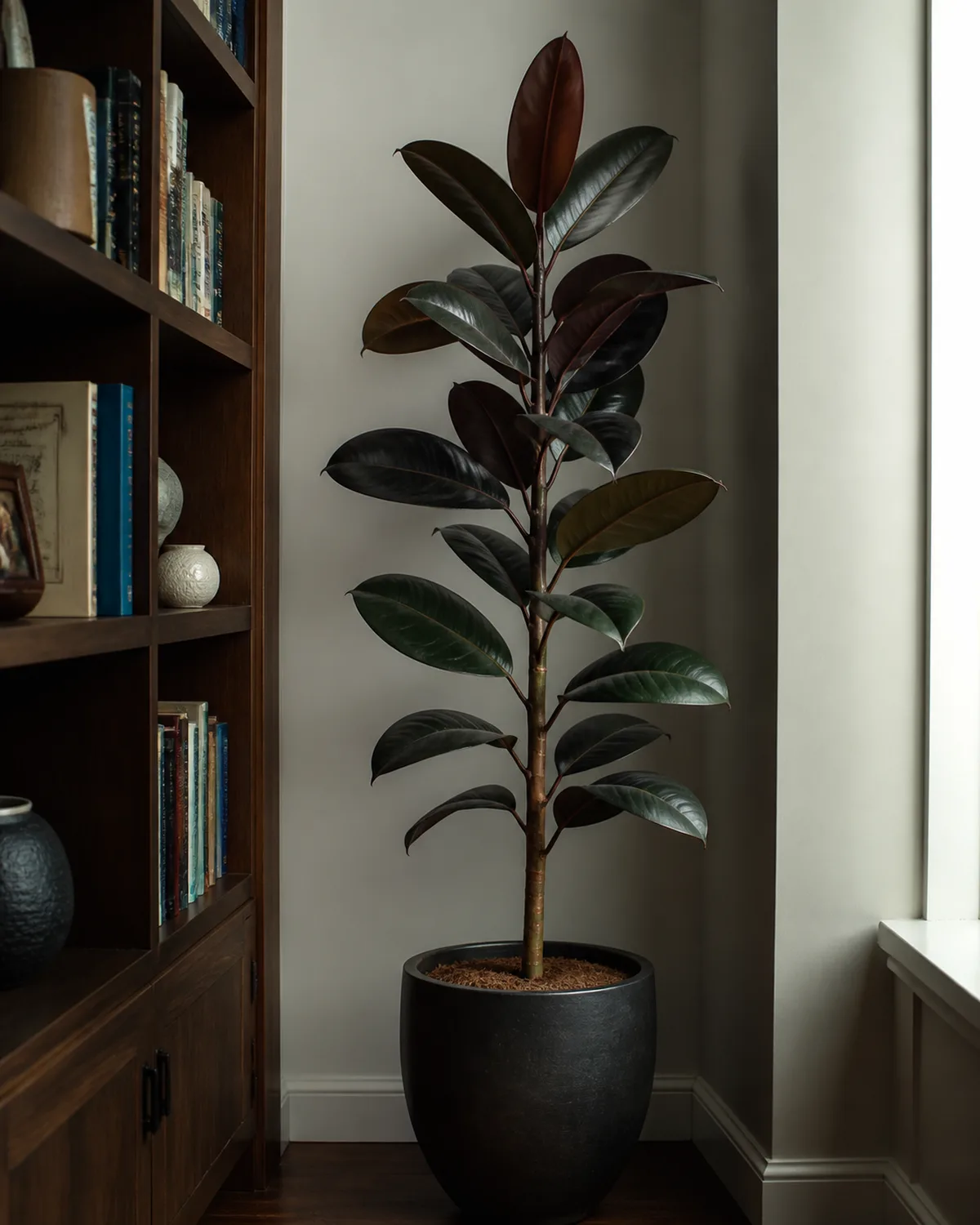
The rubber plant (Ficus elastica) is the beginner-friendly alternative to the fiddle leaf fig — same Ficus genus, similar single-trunk tree form, but far more forgiving of imperfect conditions.
Indoor potential is six to ten feet. The thick oval leaves are glossy dark burgundy-green (or variegated in cultivars like 'Tineke' and 'Ruby'), each one eight to twelve inches long. New leaves emerge wrapped in a red sheath called a cataphyll that falls off as the leaf unfurls.
Rubber plants tolerate medium indirect light, which is the level that kills fiddle leaf figs slowly. They grow at a moderate pace — one to two feet per year — and respond well to pruning. Cut the top to force branching at whatever height you want. The milky white latex sap that oozes from cuts is a skin irritant, so wear gloves when pruning.
Water when the top two inches of soil are dry. The most common mistake is overwatering: the first sign is lower leaves turning yellow and dropping. Our rubber plant care guide covers the full watering schedule and pruning technique.
Light is the single biggest factor in whether a tall plant thrives or stretches into a leggy disappointment. Start with what your room actually delivers.
Dracaena marginata as a dramatic spiky silhouette
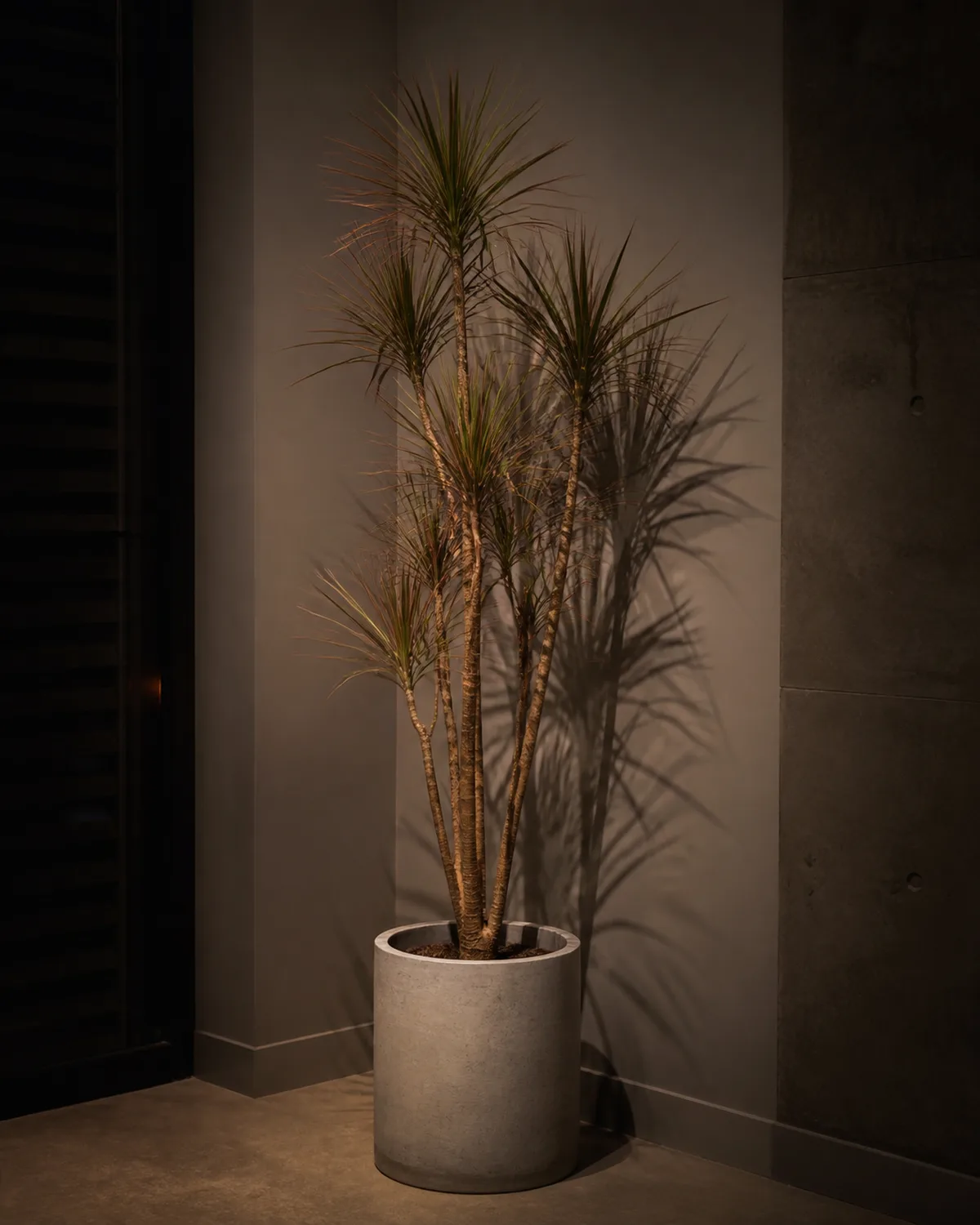
The dragon tree (Dracaena marginata) earns its spot on this list for one reason: it is one of the very few tall plants that genuinely thrives in low to medium light.
Indoor potential is six to eight feet. The silhouette is palm-like — multiple slender woody canes topped with tufts of thin, spiky leaves edged in dark red. The multi-trunk form happens naturally, making it one of the most architecturally interesting tall plants without any pruning or training.
Growth is slow — about six to eight inches per year indoors. That sounds like a disadvantage, but it means a four-foot specimen stays manageable for years before it pushes against the ceiling.
The one weakness is fluoride sensitivity. Tap water with high fluoride content causes brown tips on the leaf margins. Use filtered water or let tap water sit uncovered for twenty-four hours to let the chlorine evaporate (fluoride remains, but the overall chemical load drops). Our dracaena marginata care guide covers the watering and light details.
Areca palm creating a feathery green screen
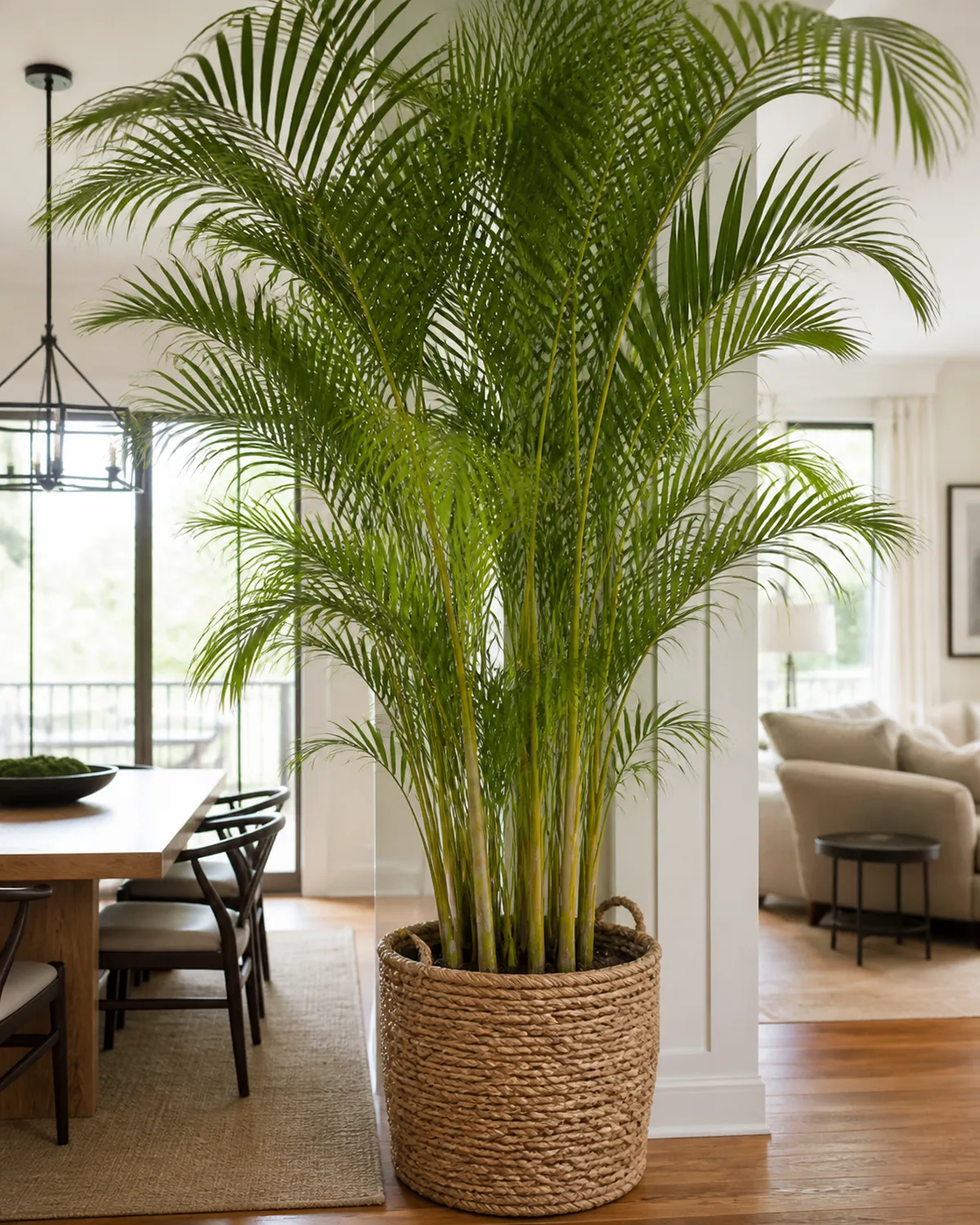
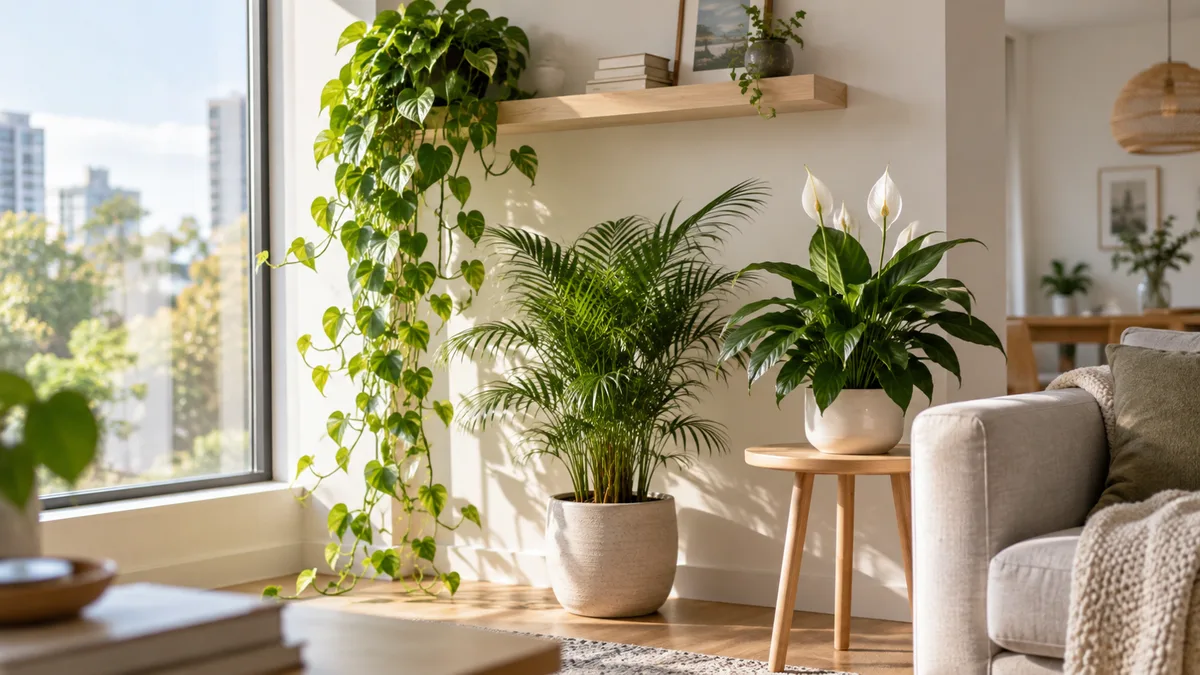
The areca palm (Dypsis lutescens) is the natural room divider. Its clumping growth habit — multiple bamboo-like golden-green canes sprouting from a shared root mass — produces a dense wall of arching feathery fronds that blocks sightlines without blocking airflow.
Indoor potential is six to seven feet. Growth speed is moderate to fast with adequate light (bright indirect, no direct sun — the fronds scorch in direct rays). In a dim room it stalls and the lower fronds yellow faster than new ones emerge.
Yellowing lower fronds are normal at any light level — it is how the palm ages. Trim them at the base when they are fully brown. The concern starts when multiple fronds yellow at once: that signals overwatering, underwatering, or too little light.
Spider mites are the primary pest, especially in dry indoor air during winter. Mist the fronds weekly or set the pot on a pebble tray to raise local humidity. For the full watering and feeding schedule, see our areca palm care guide.
Corn plant as the office-friendly tall survivor
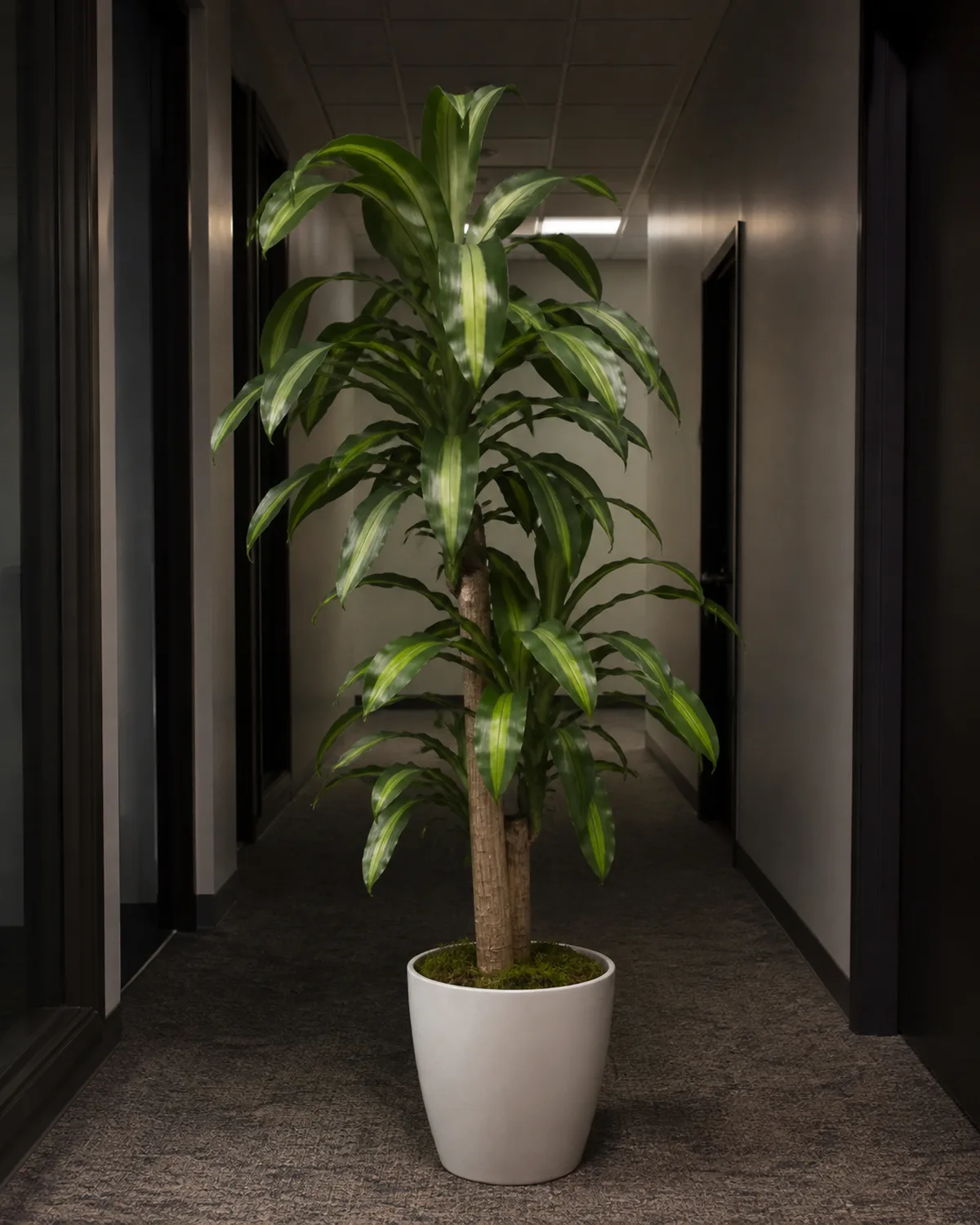
The corn plant (Dracaena fragrans) is the tall plant that thrives where almost nothing else will — dim offices, interior hallways, north-facing rooms with no direct sun. It has legendary low-light tolerance because it evolved on the forest floor of tropical West Africa under a dense canopy.
Indoor potential is four to six feet. The form is a thick woody cane (sometimes multiple canes at staggered heights) topped with broad strap-like leaves that arch outward. The most common cultivar, 'Massangeana', has a cream-yellow stripe running down the center of each leaf.
Growth is very slow indoors — a few inches per year. That is actually an advantage: a four-foot corn plant stays four feet for years before needing ceiling clearance planning.
The surprise: mature corn plants occasionally produce clusters of small white flowers that are intensely fragrant — strong enough to scent an entire room. It happens unpredictably, usually when the plant is slightly stressed by a temperature drop or drought. Thick stems store water efficiently, making drought tolerance another strong point.
Money tree with a braided trunk centerpiece
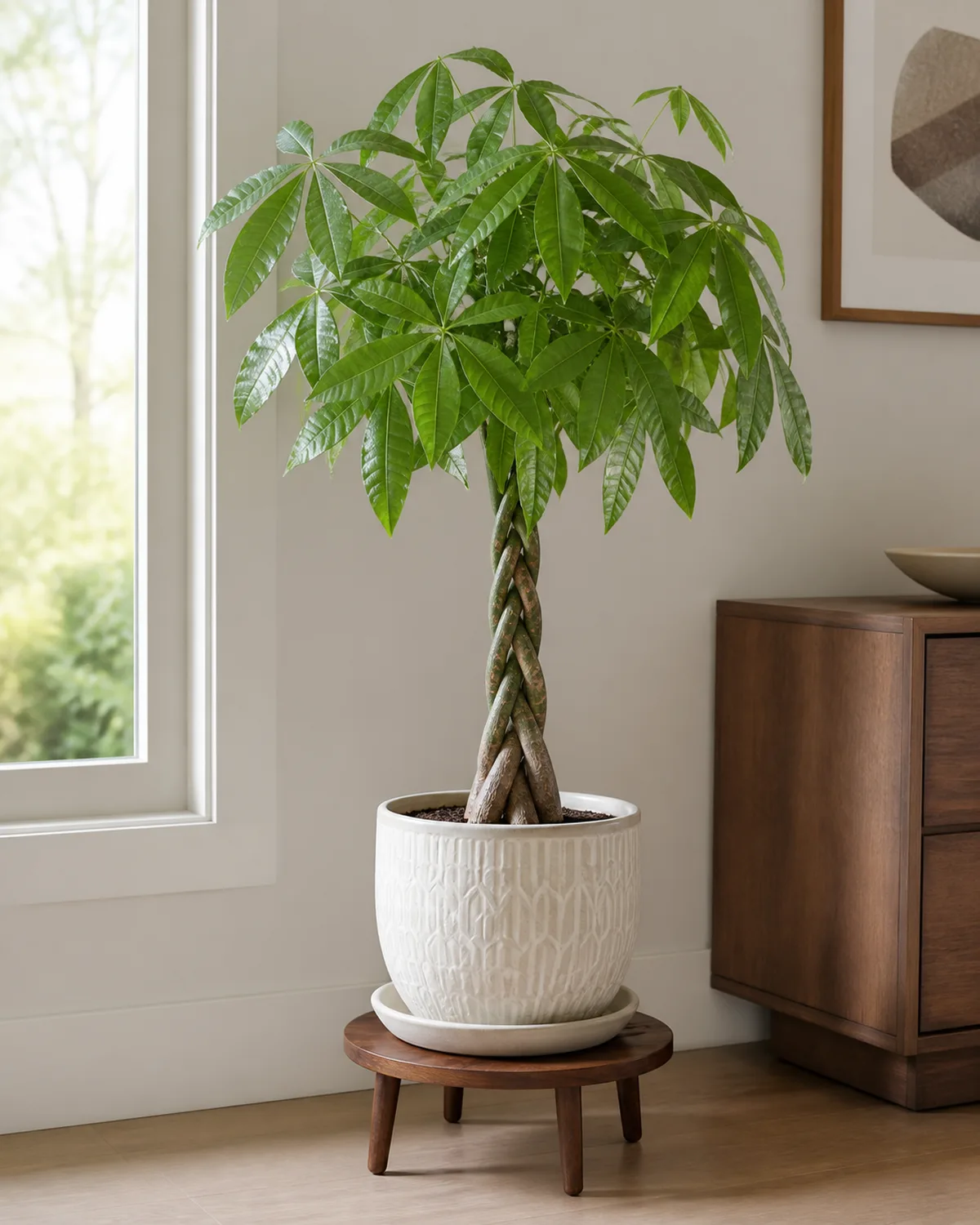
The money tree (Pachira aquatica) stands out among tall plants for two reasons: its braided trunk is a genuine conversation piece, and it is ASPCA non-toxic — rare for a plant that reaches four to six feet indoors.
The braid is not natural. Nurseries weave three to five young flexible stems together before the trunks harden, then the braid holds permanently. As the trunks thicken with age, the braid loosens slightly — that is normal growth, not damage.
Each stem produces a canopy of palmate leaves — five leaflets radiating from a central point like an open hand. The overall effect is lush and tropical without the width that monstera or areca palm demands.
Light needs are moderate: bright indirect light for balanced growth. The plant originates in semi-aquatic swamp environments, but indoors it needs well-draining soil — the paradox is real. Water when the top fifty percent of soil is dry, then soak thoroughly. Full watering and care details in our money tree care guide.
Norfolk Island pine as a living indoor evergreen
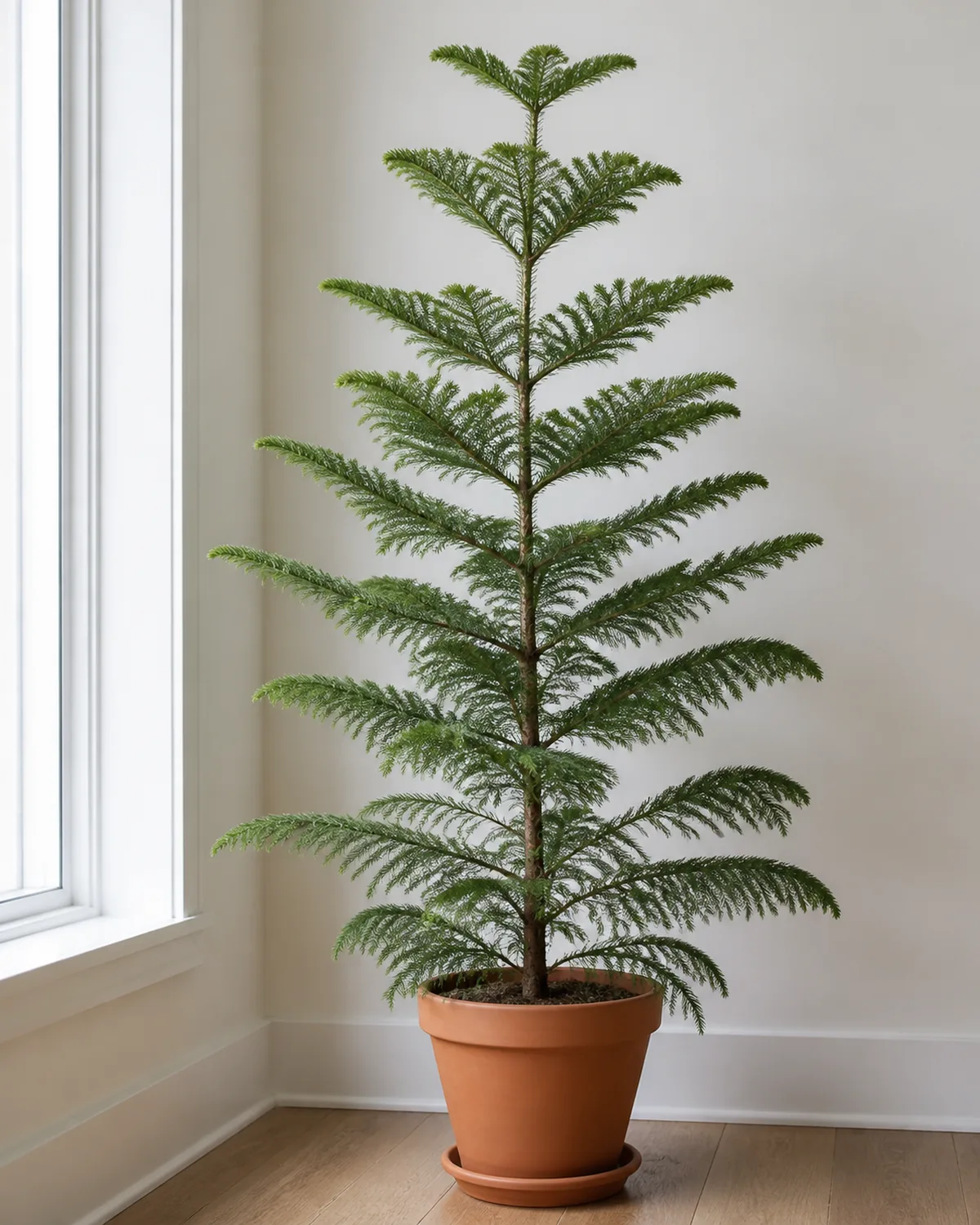
The Norfolk Island pine (Araucaria heterophylla) is not actually a pine — it is a tropical conifer from a Pacific island. But it looks like a perfectly symmetrical miniature Christmas tree year-round, and that silhouette makes it the most architecturally distinctive plant on this list.
Indoor potential is four to six feet, growing very slowly. The symmetrical tiered branches create horizontal layers that no other indoor plant replicates — think of a natural shelving system made of soft green needles.
The care catch is consistency. Norfolk Island pines cannot recover from wilting the way tropical plants can. If the root ball dries out completely, the lower branches go brown and drop — permanently. They never regrow from those nodes. Consistent moisture (moist but not waterlogged) is non-negotiable.
Temperature preference is cool: sixty to seventy degrees Fahrenheit. They struggle in rooms above seventy-five. Bright indirect to direct light (east or south window) keeps the growth tight and the branch spacing even. In low light, the tiers stretch apart and the plant looks sparse.
Parlor palm as the low-light tall option that actually works
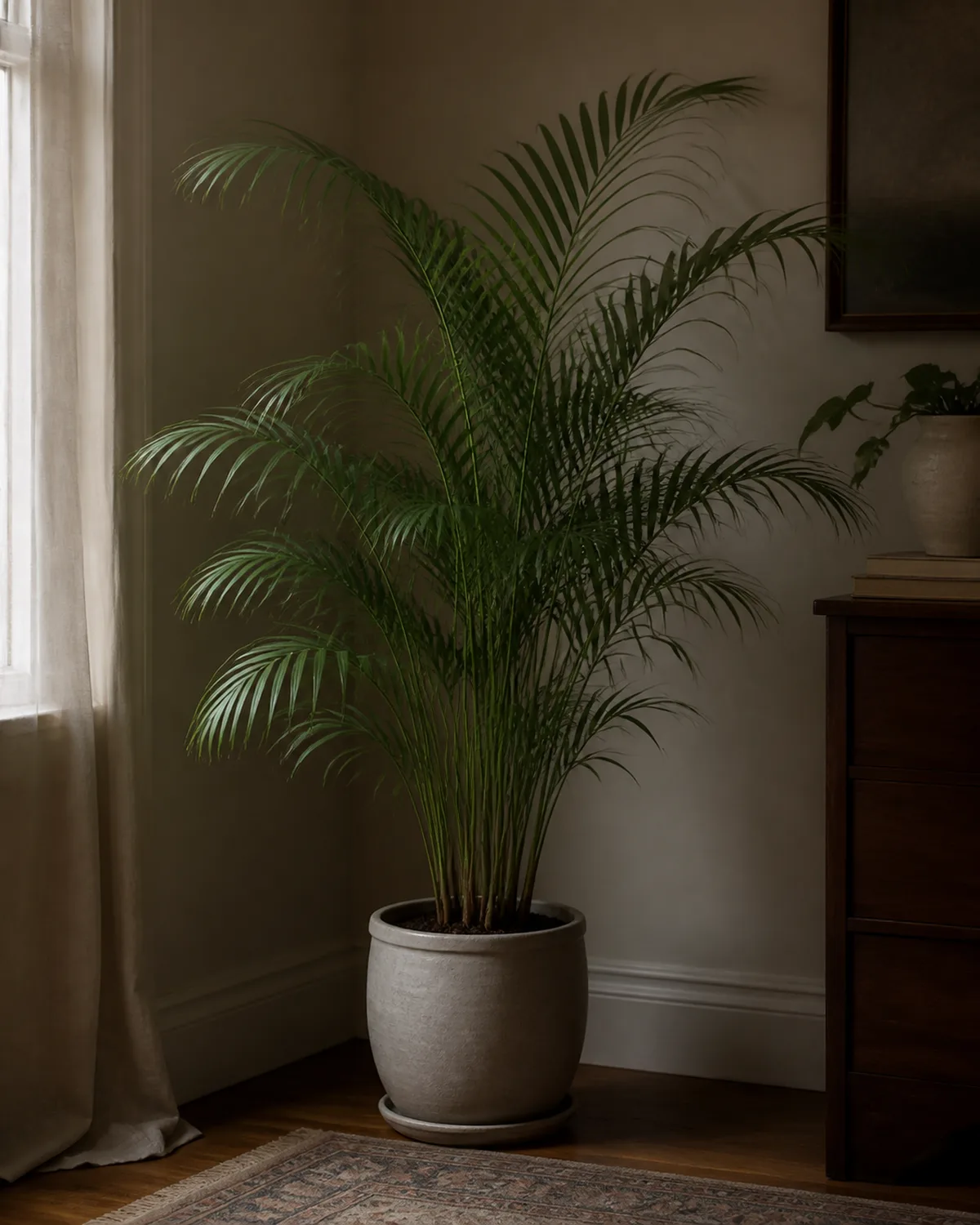
Most tall plants tolerate low light. The parlor palm (Chamaedorea elegans) genuinely thrives in it — a distinction that matters when the only available spot is a north-facing room or an interior hallway with no window in sight.
Indoor potential is four to six feet. Multiple thin clustered stems produce graceful arching fronds that create a soft, feathery texture. The overall form is elegant without being dramatic — it fills a corner with warmth rather than making a bold architectural statement.
Growth is slow but steady. No pruning is needed — remove only fronds that have turned fully brown (never trim green fronds, even partially yellow ones, because the palm is reabsorbing nutrients from them).
The parlor palm is ASPCA non-toxic, making it one of the few tall plants safe for homes with cats and dogs. It has been grown indoors since the Victorian era — a track record that speaks for itself. Full care details in our parlor palm care guide.
Umbrella tree as the fast-growing vertical filler
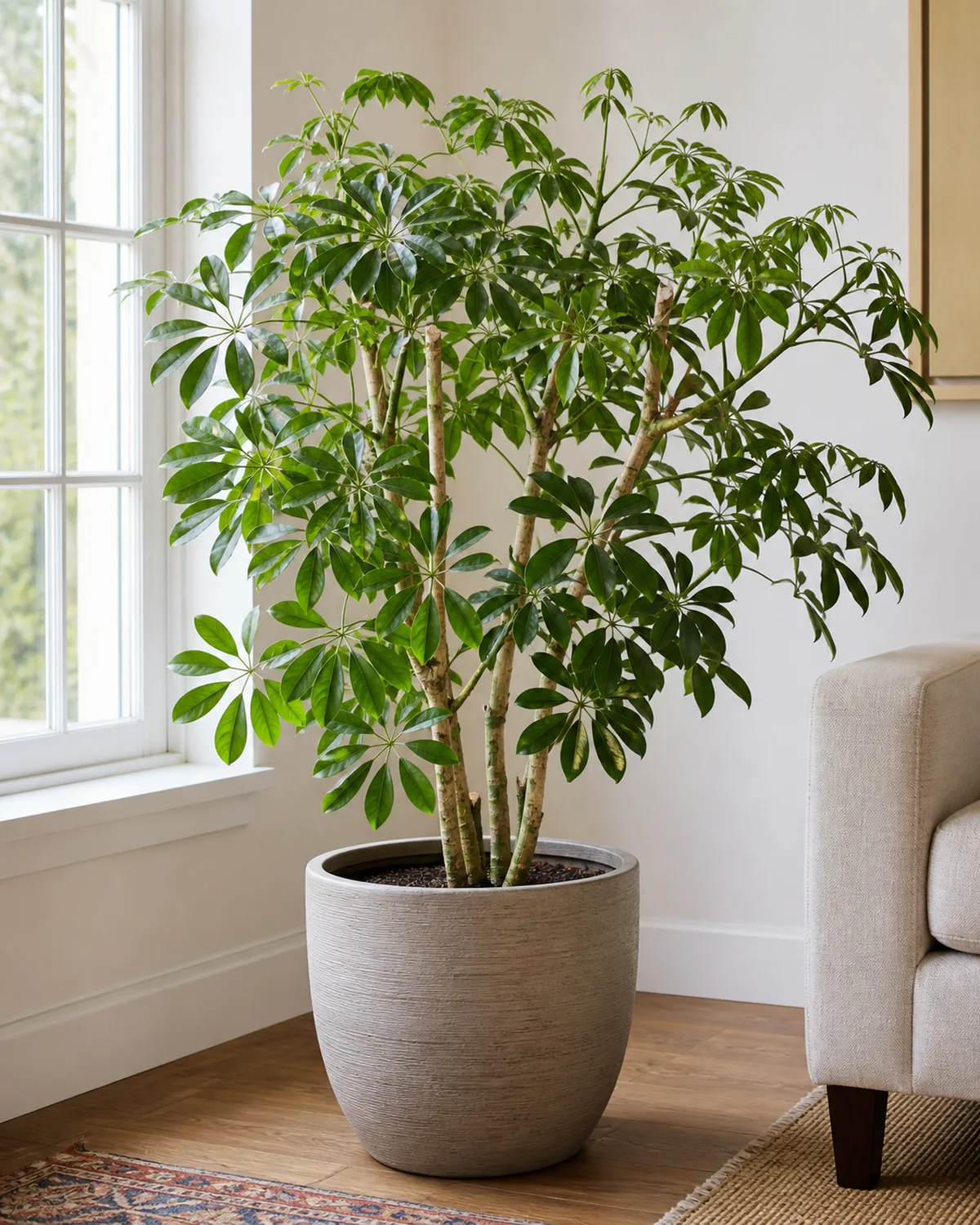
The umbrella tree (Schefflera actinophylla or the smaller S. arboricola) is the speed option. Where fiddle leaf figs and bird of paradise take years to reach floor-to-ceiling status, umbrella trees can add two to three feet per year in bright light.
Indoor potential is six to eight feet. Palmate compound leaves radiate from each stem node like the spokes of an open umbrella — a repeating pattern up the trunk that creates visual density even with a single stem.
That speed demands aggressive pruning. Without it, the plant grows straight up with sparse branching, looking more like a pole than a tree. Cut the main stem at the height you want — the plant responds by pushing multiple side shoots from the nodes below the cut, creating the bushy crown that makes it look like an actual tree.
Umbrella trees tolerate medium light but get leggy in low light. They are mildly toxic (calcium oxalate crystals) — the same irritant class as philodendrons, causing mouth and throat irritation if chewed.
Yucca plant standing like a desert sentinel
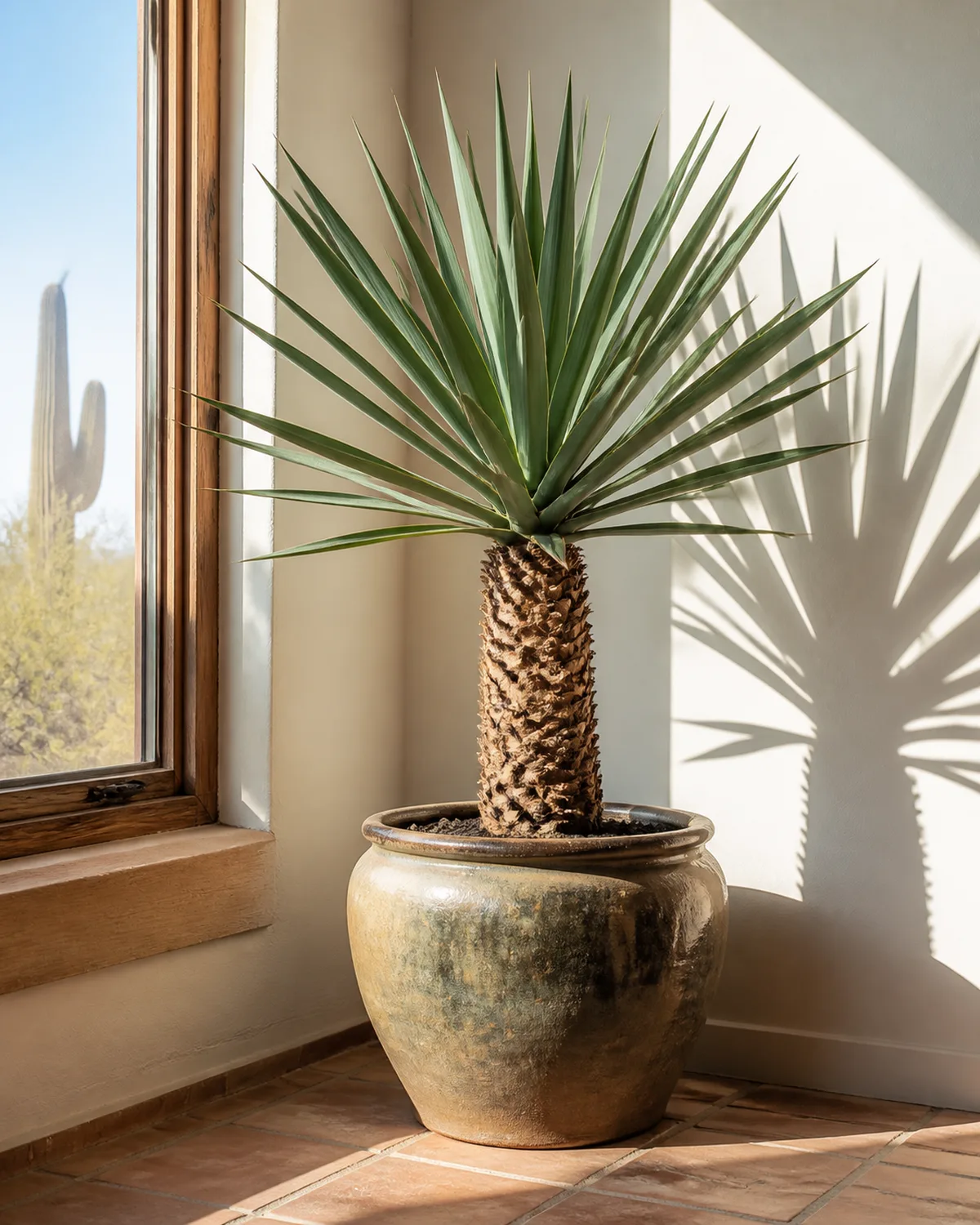
The yucca (Yucca elephantipes, the spineless variety sold for indoor use) is the zero-fuss tall plant. It needs bright direct light, water every two to three weeks, and almost nothing else. No misting, no humidity trays, no fertilizer drama.
Indoor potential is four to six feet. The form is a thick woody trunk — sometimes sold as a bare log with leaf tufts sprouting from the top — topped with a starburst of rigid sword-shaped blue-green leaves. The silhouette is architectural and desert-inspired, a sharp contrast to the soft tropical look of palms and ferns.
Growth is very slow indoors. A three-foot yucca stays roughly three feet for two to three years before adding noticeable height. That makes it one of the most manageable tall plants for small apartments where ceiling clearance is tight.
The one practical concern: the leaf tips are sharp enough to poke skin and snag clothing. Keep yuccas away from high-traffic walkways and doorways. Virtually pest-free — spider mites and scale occasionally appear but rarely cause serious damage.
Tall plants fail differently than small ones — the stakes are higher and the mistakes are harder to reverse.
Croton as a 4-foot burst of living color
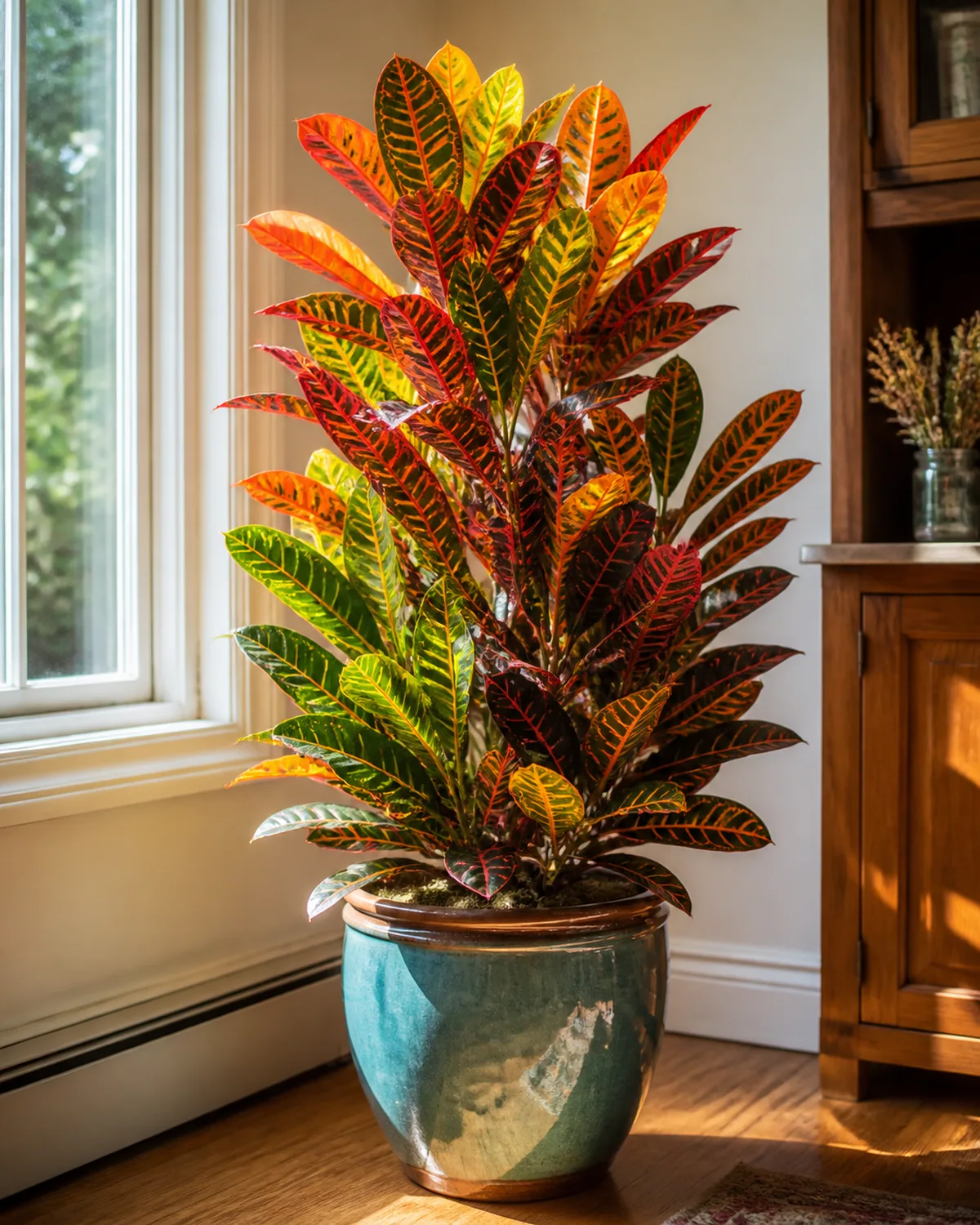
The croton (Codiaeum variegatum) is the most colorful plant on this list — and it is not close. A single croton displays leaves in red, orange, yellow, green, and sometimes purple simultaneously, all on the same branch. No other tall indoor plant delivers that spectrum.
Indoor potential is three to five feet, making it compact-tall — a category that fills the gap between tabletop plants and floor trees. The woody stem eventually develops bark, and mature specimens branch freely into a shrub-like form.
The color is tied directly to light intensity. In bright direct sun, the leaves blaze with saturated reds and oranges. Move the same plant to medium light and the new leaves emerge increasingly green — color reversion that is not reversible on those specific leaves. If you buy a croton for its color, it needs a south or west window permanently.
Temperature sensitivity is the other catch. Cold drafts (below sixty degrees) cause sudden, dramatic leaf drop — sometimes overnight. Keep crotons away from exterior doors, single-pane windows in winter, and air conditioning vents. The white sap is a skin irritant (Euphorbiaceae family). Full details in our croton care guide.
How to keep tall indoor plants from falling over
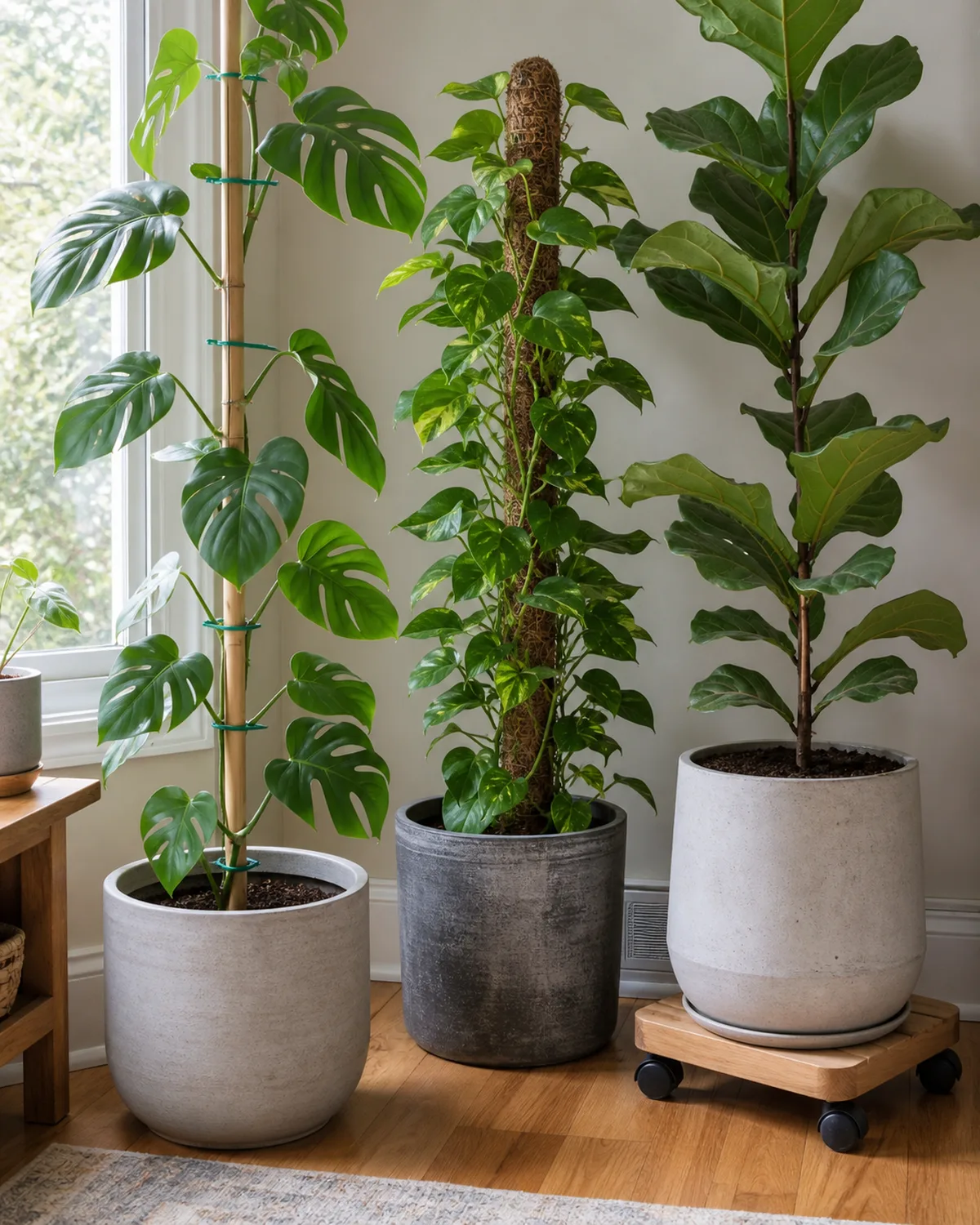
A five-foot plant in a twelve-inch pot has a high center of gravity. Without the right support strategy, it topples when someone brushes past, a pet investigates, or the soil dries out and gets lighter.
Heavy pots are non-negotiable for top-heavy trees. Ceramic, concrete, or stone planters add ballast at the base. Lightweight plastic nursery pots belong inside a heavy decorative cachepot, not sitting exposed on the floor. The general rule: the planter should weigh at least a quarter of the total plant height in pounds.
Stake single-trunk trees early. A bamboo stake inserted beside the trunk, secured with soft plant ties in a figure-eight pattern (the loop around the trunk should be loose enough to slide a finger through), keeps the trunk vertical while it lignifies. Remove the stake once the trunk holds its own weight — leaving it indefinitely prevents the trunk from building structural strength.
Moss poles for climbers (monstera, philodendron) serve a different function: they provide a textured surface for aerial roots to grip. Insert the pole before the plant outgrows a standard stake, and keep the moss moist by misting it during watering sessions.
Rotating a quarter turn weekly prevents the plant from leaning permanently toward the light source. Every tall plant near a window develops one-sided growth without rotation.
Moving day for tall plants: tilt the pot onto the rim and roll it across the floor on a furniture dolly or thick towel. Lifting a six-foot plant by the trunk risks breaking stems and dislodging roots. Dolly-mounted saucers (available at any hardware store) make routine cleaning underneath possible without moving the plant at all.
Tall Indoor Plants: The Quick Reference
- 1Fiddle leaf fig (6-10 ft)Statement tree. Bright direct sun only. Slow grower. Stake young trunks for straight form.
- 2Monstera on moss pole (6-8 ft)Climber. Bright indirect light. Fast grower 1-2 ft/year. Needs 3-4 ft horizontal spread.
- 3Bird of paradise (5-7 ft)Architectural foliage. Brightest spot in house. Slow grower. Rarely flowers indoors.
- 4Rubber plant (6-10 ft)Beginner-friendly tree. Medium to bright light. Prune to branch. Latex sap irritant.
- 5Dracaena marginata (6-8 ft)Low-light champion. Multi-trunk palm silhouette. Slow grower. Fluoride-sensitive tips.
- 6Areca palm (6-7 ft)Natural room divider. Bright indirect light. Moderate grower. Spider mites in dry air.
- 7Corn plant (4-6 ft)Office-proof. Legendary low-light tolerance. Very slow grower. Fragrant blooms possible.
- 8Money tree (4-6 ft)Braided trunk. Bright indirect light. Non-toxic. Moderate grower.
- 9Norfolk Island pine (4-6 ft)Living Christmas tree silhouette. Cool bright spot. Never let it wilt — lost branches are permanent.
- 10Parlor palm (4-6 ft)True low-light grower. Non-toxic. No pruning needed. Victorian-era proven.
- 11Umbrella tree (6-8 ft)Fastest grower: 2-3 ft/year. Prune hard to force branching. Mildly toxic.
- 12Yucca (4-6 ft)Desert sentinel. Direct sun. Water every 2-3 weeks. Virtually pest-free. Sharp tips.
- 13Croton (3-5 ft)Most colorful. Direct sun for full color. Cold-draft sensitive. Toxic sap.
- 14Stability basicsHeavy ceramic pots. Figure-8 staking. Moss poles for climbers. Quarter-turn weekly rotation.
kultivy.com
What is the easiest tall indoor plant for beginners?
The rubber plant. It tolerates medium light (most tall plants need bright), grows at a manageable pace, recovers from missed waterings, and responds to pruning predictably. If you have killed a fiddle leaf fig, the rubber plant is the forgiving alternative from the same Ficus family.
What tall indoor plant grows the fastest?
The umbrella tree (Schefflera) can add two to three feet per year in bright light — faster than any other common indoor tree. The tradeoff is that it needs regular pruning to stay bushy rather than growing into a single spindly pole.
What tall plants are safe for cats and dogs?
Parlor palm and money tree are both ASPCA non-toxic and reach four to six feet indoors. The parlor palm is the better choice for low-light homes; the money tree needs bright indirect light.
Can tall plants survive in apartments with no direct sun?
Parlor palm, dracaena marginata, and corn plant all genuinely grow in low indirect light. They will not grow fast, but they will stay healthy and upright for years in a north-facing room or an interior space that relies on ambient light from adjacent rooms.
For broader plant-styling ideas beyond tall specimens, our living room plants guide matches plants to specific room positions — from trailing shelf accents to compact side-table pieces — covering the full range of sizes that make a room feel complete.

Mara Quinn edits Kultivy, where she shares houseplant care, propagation, beginner-friendly plant picks, and plant-styling ideas for anyone who wants their indoor plants to actually thrive. Every guide is image-led and reviewed for clarity, usefulness, image accuracy, and Pinterest-to-page alignment before it goes live. Visit the About page.