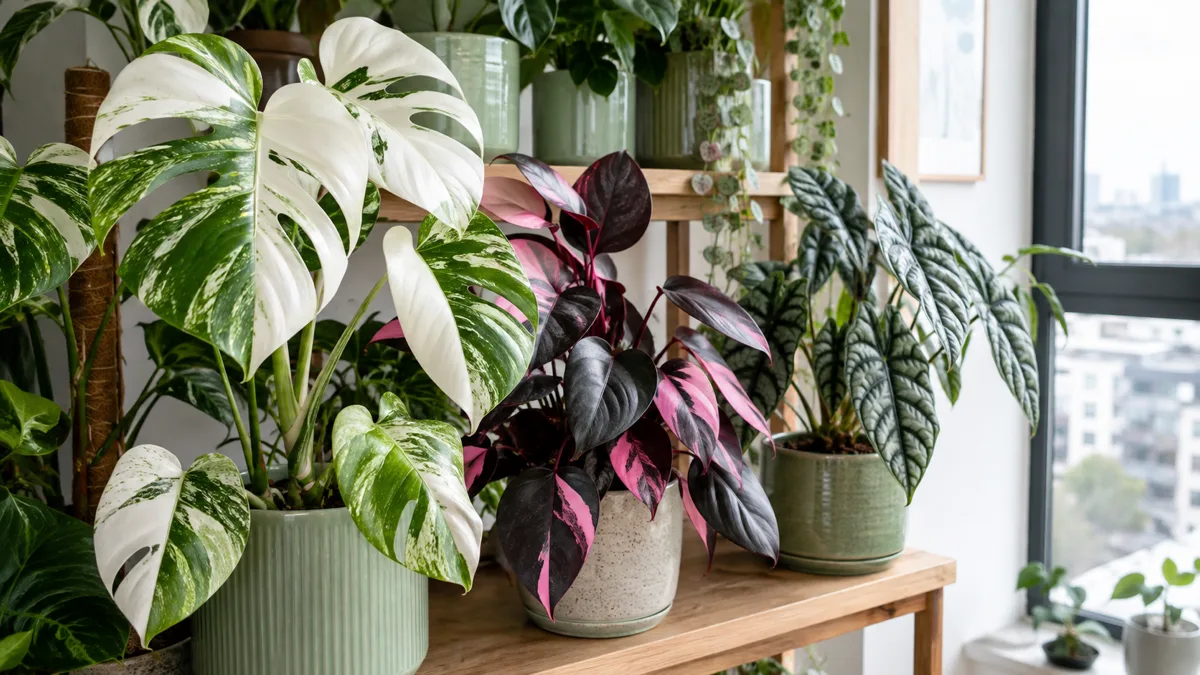
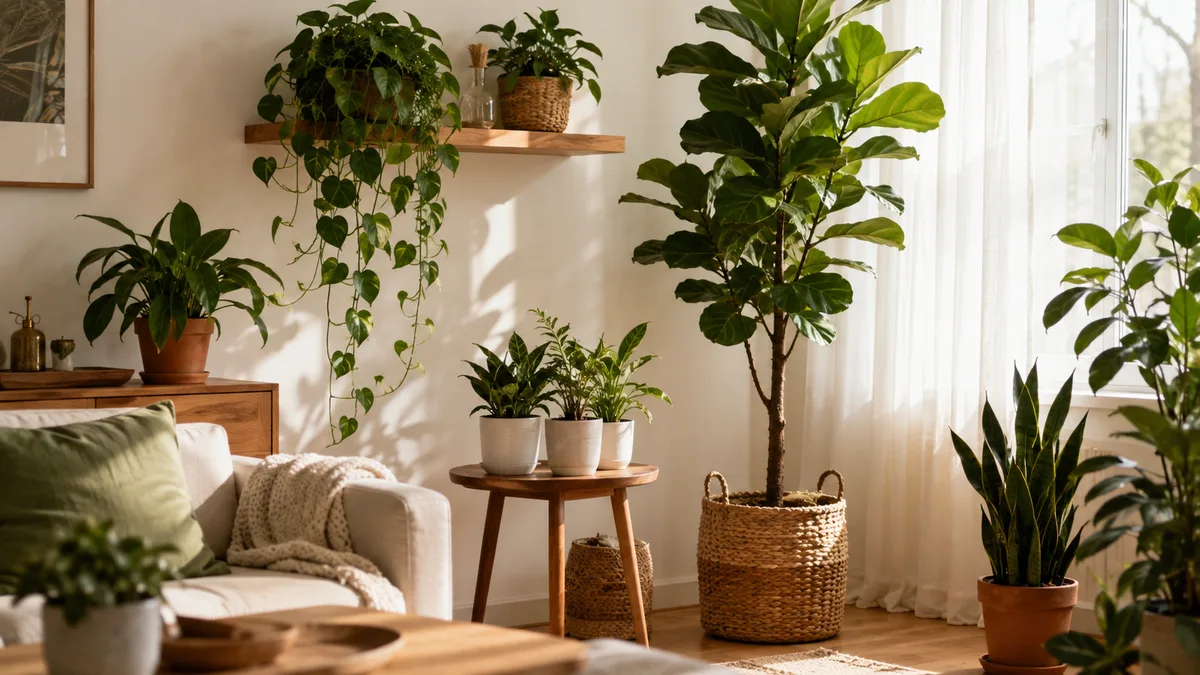
Your apartment has a north-facing window, a radiator that kicks on at midnight, and a landlord who would rather you did not drill into anything. None of that means you cannot have plants.
The right apartment plants are built for these constraints — small root systems, low-light tolerance, and growth habits that climb or trail without demanding floor space. These 14 picks are matched to real apartment limitations.
From trailing vines for curtain rods to indestructible picks for dark hallways and windowsill succulents for harsh afternoon sun. Jump to the one that fits your space.
Pothos — The Trailing Vine That Goes Anywhere You Point It
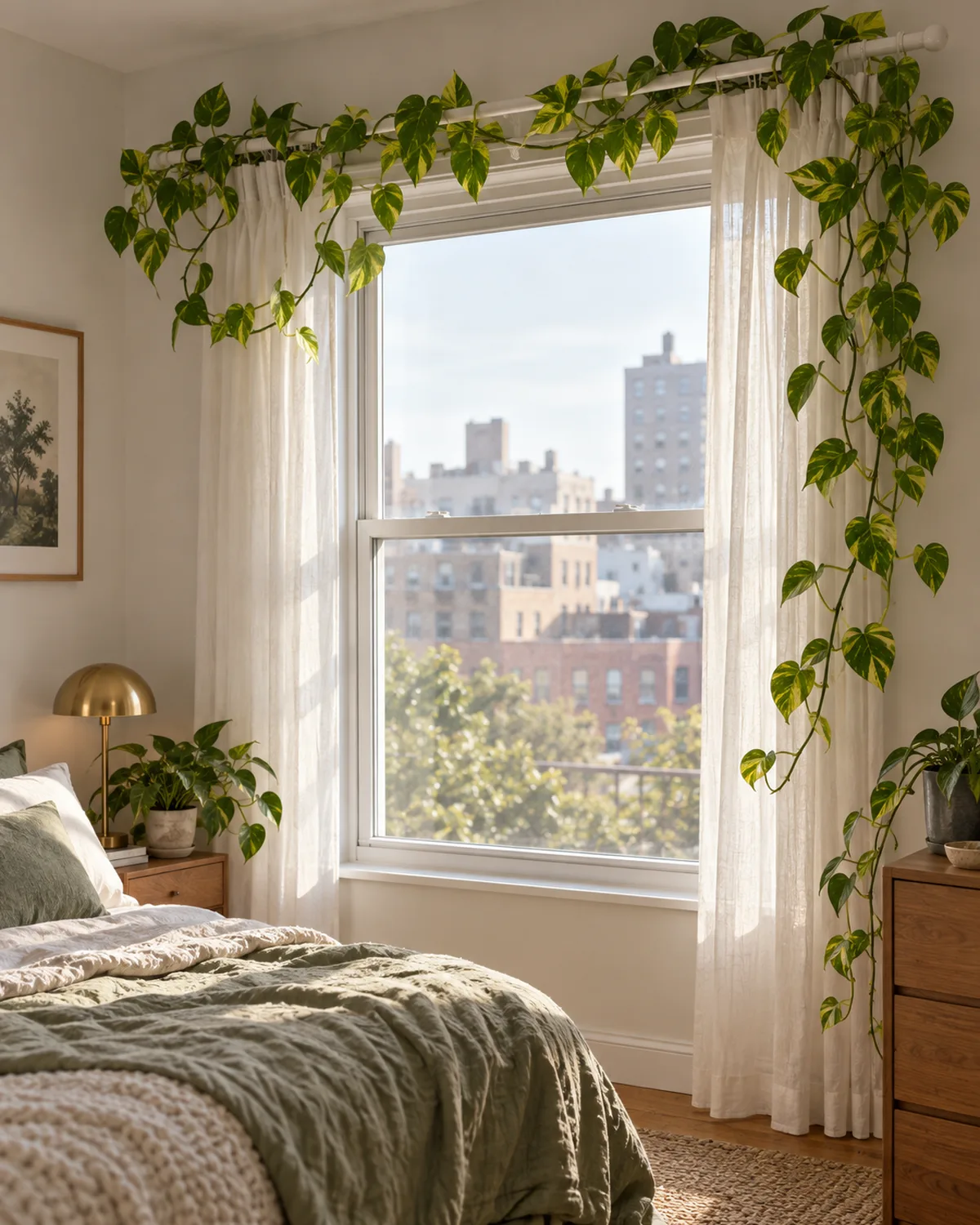
Pothos is the plant that makes apartment living with greenery look effortless. Its trailing vines grow in any direction you train them — along a curtain rod, down a bookshelf, across a kitchen cabinet top — without hardware that would make a landlord nervous.
The reason it works so well in apartments comes down to light flexibility. Pothos photosynthesizes under conditions that would starve most houseplants. A north-facing window, a bathroom with a frosted glass panel, even a hallway lit only by a ceiling fixture — pothos will grow in all of them.
- Light: low to bright indirect; avoid direct afternoon sun which bleaches the variegation
- Water: let the top inch of soil dry out, then drench; in a dim apartment this may be every 10–14 days
- Space trick: train vines along 3M Command hooks pressed into the wall — no drilling, no damage, full jungle effect
Variegation fades in very low light. If you want the golden streaks to stay pronounced, give the plant a spot within 5 feet of a window. If you only have a dark corner, go with solid green Jade pothos — it holds color where golden and marble queen cannot.
Match your biggest apartment limitation to the plant that handles it best — no guessing required.
Calathea — Living Art for Shaded Apartment Corners
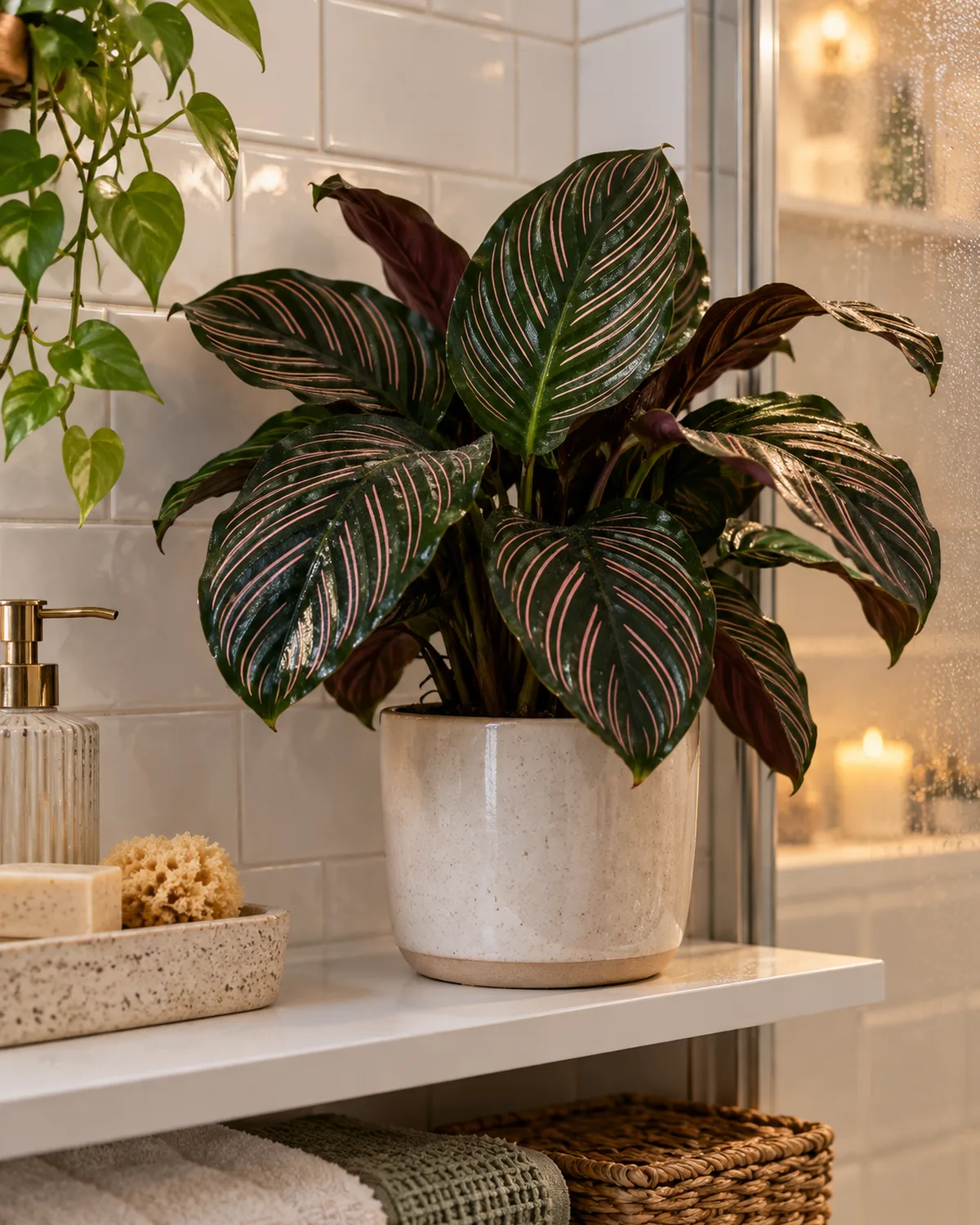
Calathea brings pattern and color into rooms where most plants would need a grow light to compensate. The undersides of its leaves are often deep purple, and the top surfaces carry painted-on stripes in pink, silver, or cream that look too precise to be natural.
What makes calathea uniquely suited to apartments is its relationship with humidity. Small apartment bathrooms naturally hold moisture from showers, and calathea thrives in exactly that environment. A bathroom shelf near the mirror gets indirect light from overhead fixtures and humidity levels that outdoor-garden plants would envy.
- Light: medium indirect; direct sun scorches the patterned leaves and fades the color contrasts
- Water: keep soil consistently moist but never waterlogged — calathea will not forgive a dry-out-and-drench cycle
- Humidity: 50% minimum; below 40% the leaf edges brown and curl
The nightly leaf-folding behavior — called nyctinasty — is a bonus that makes calathea feel alive in a way most houseplants do not. The leaves lift upward at dusk and lower at dawn, driven by a water pressure mechanism in the pulvinus joint at the base of each leaf stalk. It is subtle enough to miss if you are not watching, but once you notice it, the plant becomes a living clock on your shelf.
Calathea ornata (the pinstripe variety) is the most forgiving for apartment beginners. Calathea lancifolia (rattlesnake plant) handles slightly lower humidity. Avoid calathea white fusion as a first pick — it is beautiful but punishes every watering mistake.
Dracaena Marginata — The Vertical Accent That Fits Anywhere
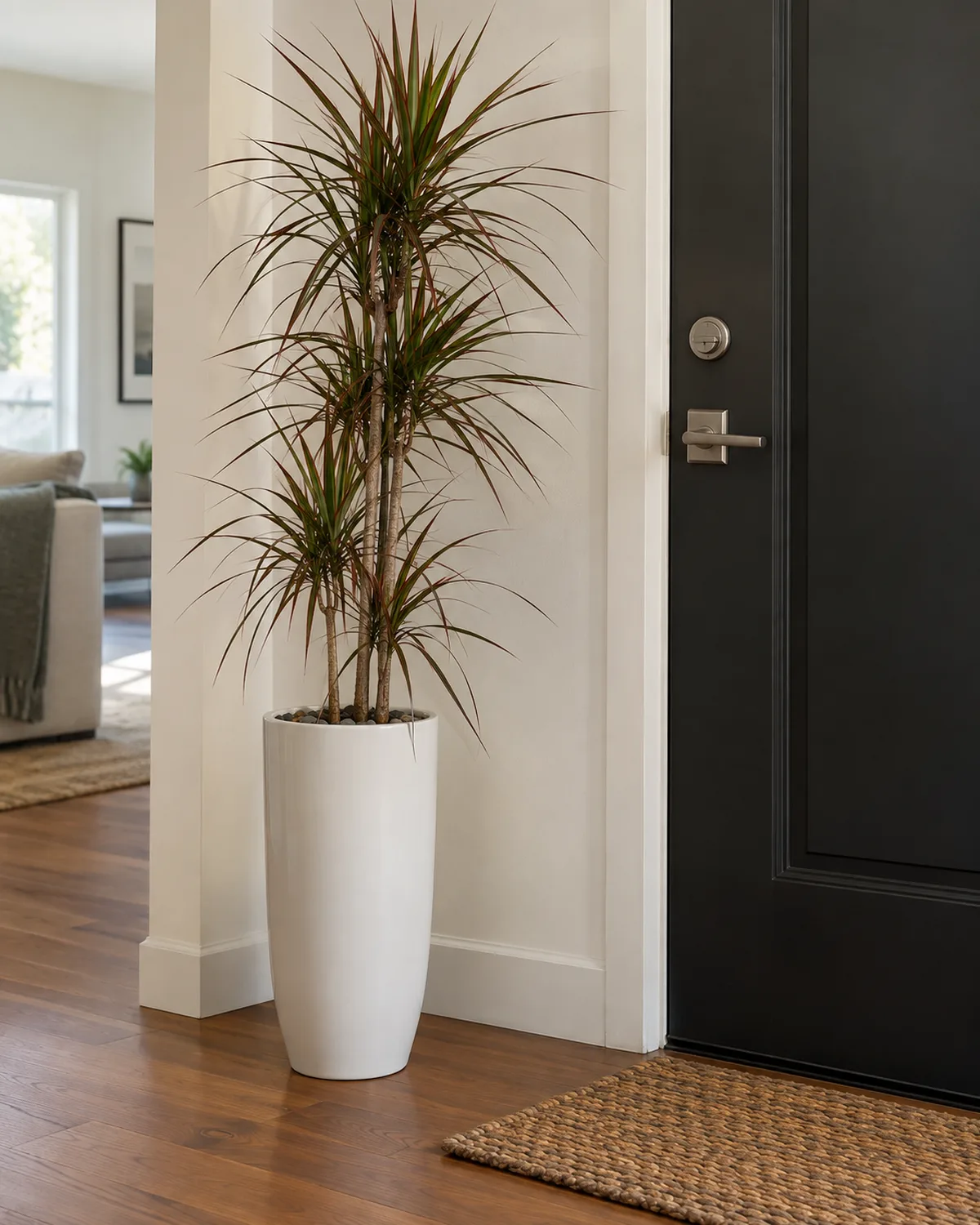
Dracaena marginata grows like an architectural element, not a bush. A bare woody cane topped with a starburst of thin red-edged leaves — it looks intentionally placed whether it is next to a door frame, wedged between a bookcase and a wall, or standing alone in a corner.
The footprint is the real apartment advantage. A mature dracaena marginata occupies about 6 inches of floor space in a narrow pot while reaching 4–6 feet tall. That ratio of vertical impact to horizontal real estate is hard to match with any other indoor tree.
- Light: medium indirect to low; survives north-facing windows but grows faster with an east-facing spot
- Water: let the top half of the soil dry between waterings; overwatering causes root rot faster than underwatering causes stress
- Growth rate: slow enough that it stays in the same pot for 2–3 years without outgrowing its position
Dracaena marginata is sensitive to fluoride in tap water, which shows up as brown leaf tips. If your apartment's water is heavily treated, let it sit uncovered overnight before watering — the fluoride does not evaporate, but the chlorine does, reducing one of the two common irritants.
Get these three right and everything else — pots, soil, fertilizer — becomes a minor detail.
Spider Plant — The Hanging Basket That Handles Drafty Windows
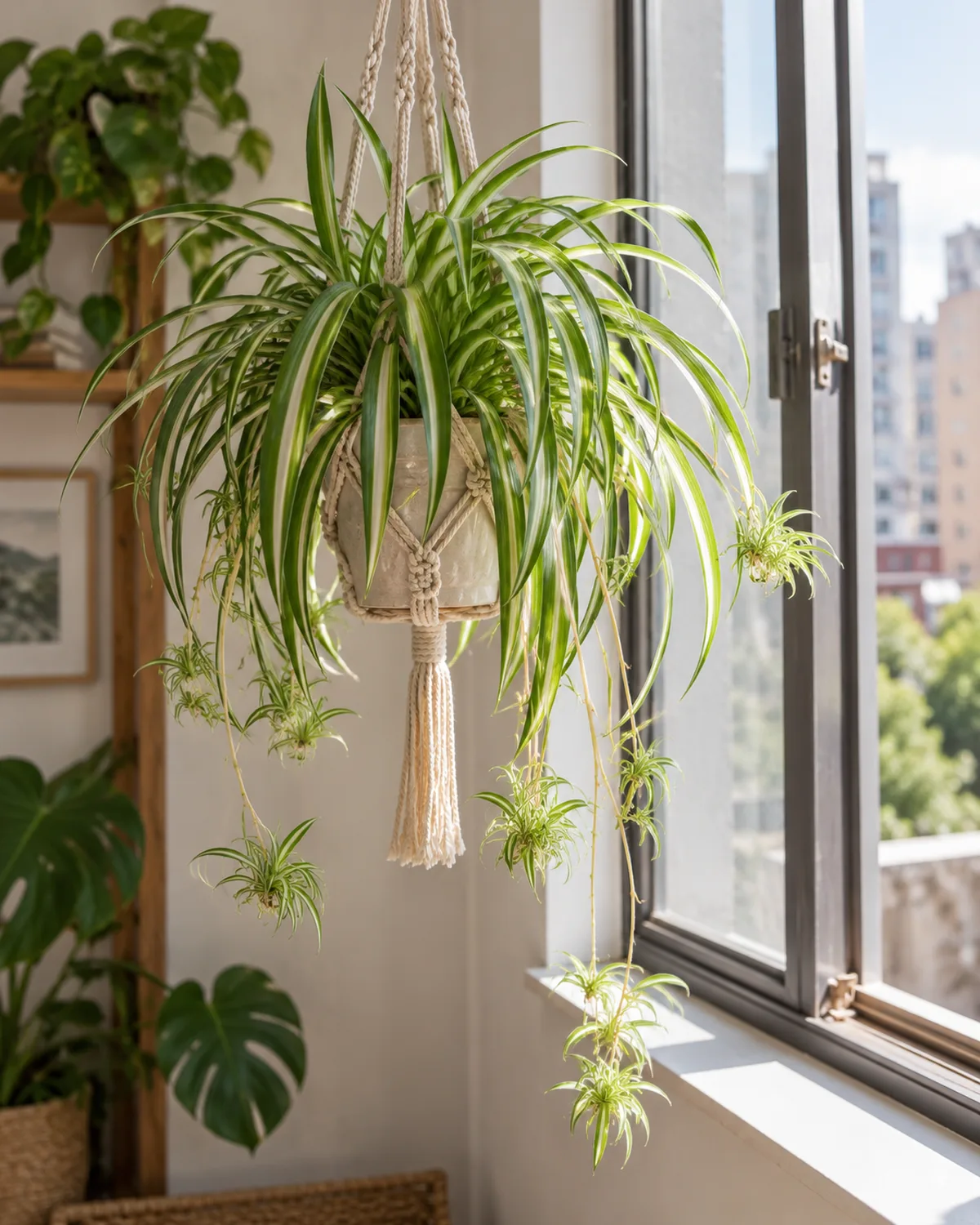
Spider plants do two things that make them ideal for apartments: they grow upward and outward from a hanging position, using zero shelf or floor space, and they produce pups — small plantlets that dangle from arching stems like a living mobile.
The temperature tolerance is what separates spider plants from other hanging options. Apartments with old windows, drafty seals, or radiator-driven temperature swings between 55°F and 80°F throughout the day do not bother this plant. It evolved in the coastal and mountainous regions of southern Africa, where temperature fluctuations of 30 degrees in a single day are normal.
- Light: bright indirect is ideal; tolerates low light but produces fewer pups
- Water: let the top inch dry out; the thick tuberous roots store water, so erring on the dry side is safer than overwatering
- Propagation: snip a pup with visible root nubs and place it in a small pot of moist soil — rooting takes about two weeks
Brown leaf tips are almost unavoidable with tap water. Spider plants are sensitive to fluoride and chlorine, and most municipal water contains both. The browning is cosmetic, not dangerous. Trim the tips with clean scissors at an angle that mimics the natural leaf taper and the plant looks fine.
A single spider plant in a macrame hanger near a bright window will produce 5–10 pups per growing season. Each pup is a new plant. Within a year, one purchase turns into enough greenery for every room in the apartment.
Heartleaf Philodendron — The Bookcase Cascade
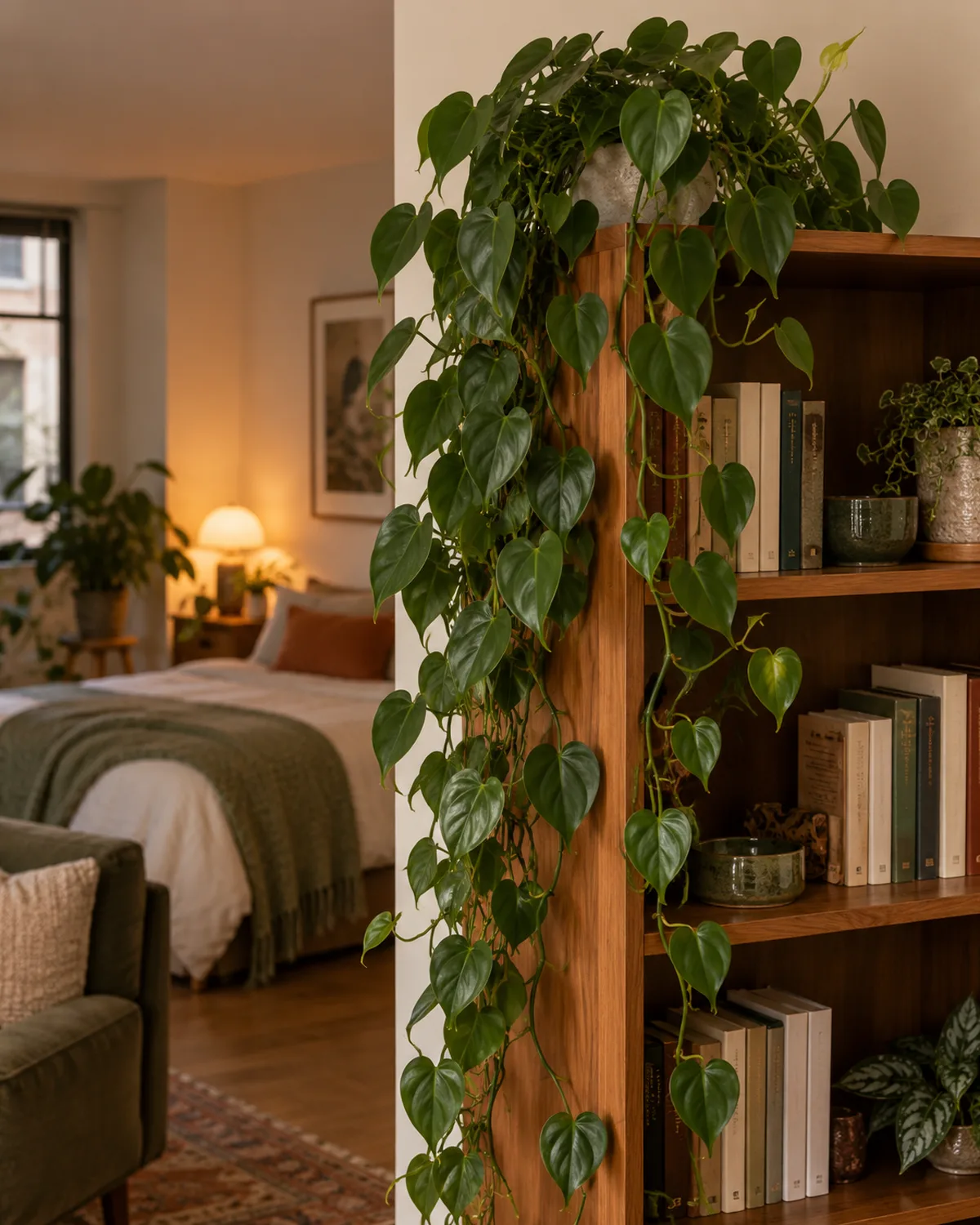
Heartleaf philodendron grows faster than any other plant on this list, which is either a feature or a problem depending on what you need. In a studio apartment where one tall bookcase is the only vertical surface, a single heartleaf philodendron placed on top will send trailing vines down both sides within a few months, creating a curtain of heart-shaped leaves that softens the entire room.
It tolerates fluorescent light — the kind in apartment hallways, closets, and interior rooms — better than almost any other tropical plant. The leaves are a uniform dark green that does not fade or bleach under artificial lighting the way variegated plants do.
- Light: low to bright indirect; one of the few tropicals that actually grows (not just survives) in fluorescent-only rooms
- Water: let the top inch dry; the plant droops visibly when thirsty and rebounds within hours of watering
- Training: wrap vines around a shelf bracket or tuck them behind picture frames for a controlled cascade instead of a tangle
Propagation is trivially easy. Cut a stem with 2–3 nodes, drop it in a glass of water on the kitchen counter, and roots appear within a week. This is the plant you give to neighbors, leave in the break room, and use to fill every empty corner — because making more costs nothing.
The only real failure mode is overwatering in a pot without drainage. Heartleaf philodendron rots fast in standing water. If your apartment aesthetic demands a decorative pot without a hole, keep the plant in a nursery pot inside it and lift it out to water over the sink.
Peace Lily — The One Flowering Option for North-Facing Apartments
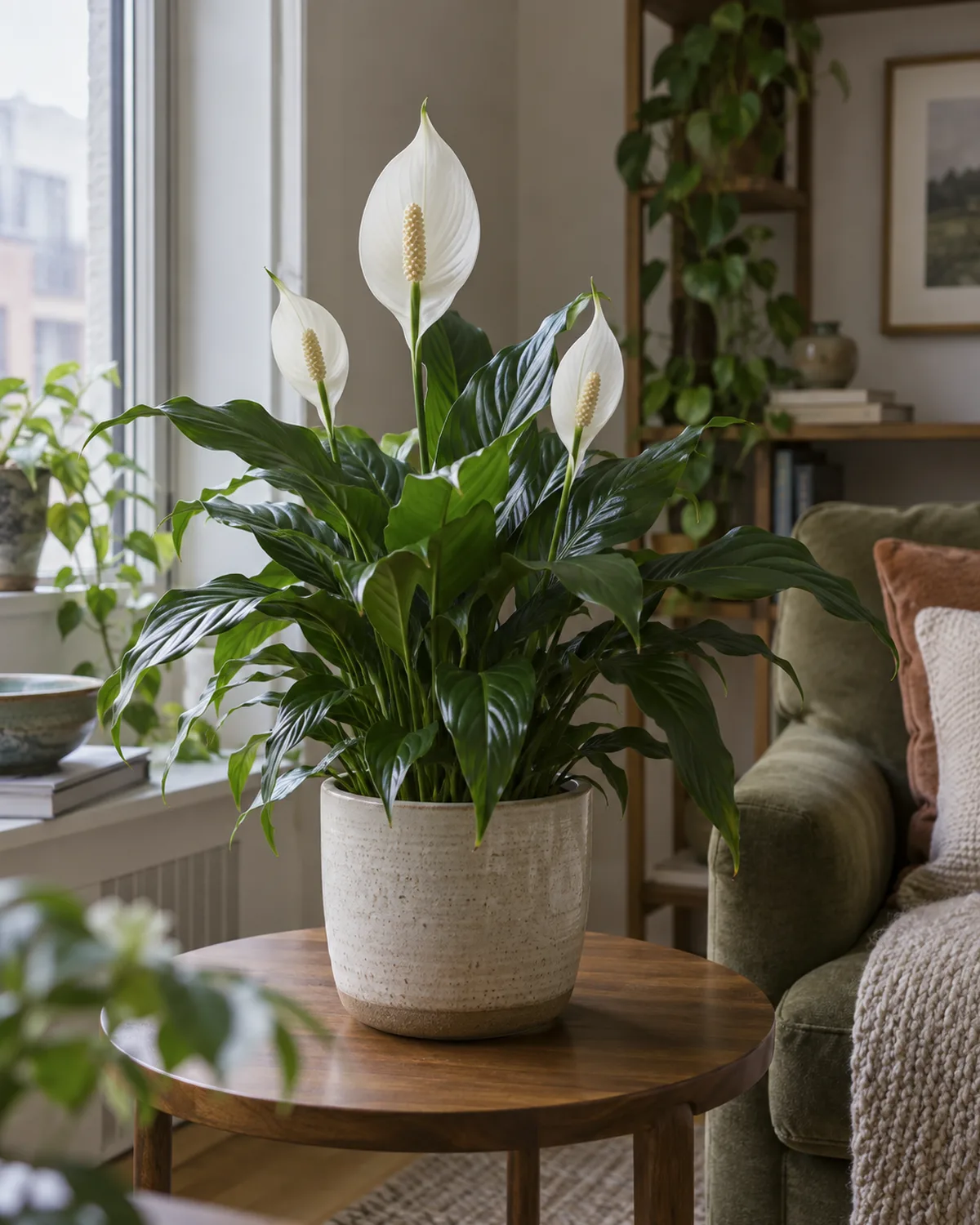
Most flowering houseplants demand south-facing windows and six hours of bright light. Peace lily is the exception. It blooms — white spathe flowers that last for weeks — in the soft, indirect light of a north-facing apartment window.
The droop signal is what makes peace lily renter-friendly. When it needs water, the entire plant wilts dramatically, leaves hanging limp. Water it, and within two hours the plant stands fully upright again. This is not damage — it is a built-in communication system that removes all guesswork about when to water.
- Light: low to medium indirect; will bloom in north-facing rooms, blooms more in east-facing spots
- Water: when the leaves droop, water thoroughly; in a dim apartment this is roughly every 7–10 days
- Toxicity: mildly toxic to cats and dogs — keep on an elevated shelf if you have pets
Peace lily also handles the dry air problem that forced-air heating creates in winter apartments. It tolerates humidity levels down to 30% without browning leaf edges, which puts it well below the threshold that calathea and ferns demand.
- One white spathe can last 4–6 weeks before fading to green
- Spent flowers should be cut at the base of the stalk, not just at the flower head
- Repotting every 2–3 years is enough — peace lily prefers being slightly root-bound
The compact varieties — Spathiphyllum 'Wallisii' in particular — stay under 16 inches tall and fit comfortably on a nightstand or bathroom shelf. The larger varieties like 'Sensation' reach 4 feet and work as floor plants, but they need more light to bloom consistently.
Chinese Evergreen — Color Without a Single Hour of Direct Sun
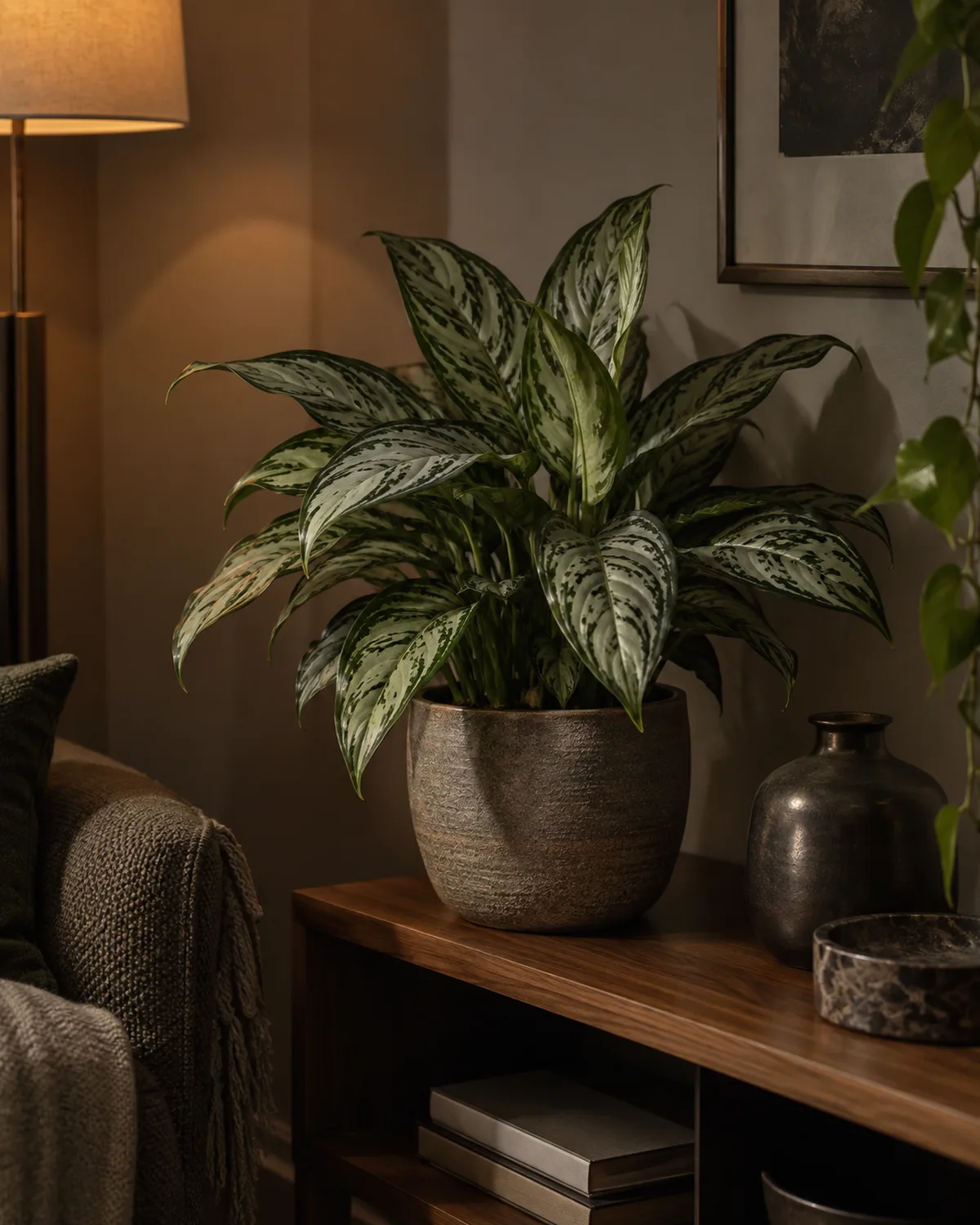
Chinese evergreen is the plant for the apartment corner that gets zero direct sunlight and barely enough ambient light to read by. It not only survives those conditions — it stays colorful, with patterned leaves in silver, green, and sometimes pink that look as if someone hand-painted each one.
The counterintuitive rule with Chinese evergreen is that darker-leaved varieties handle less light. The deep green cultivars like 'Maria' and 'Emerald Beauty' thrive in the dimmest corners. The pink and red varieties like 'Siam Aurora' need brighter spots to hold their color.
- Light: low to medium indirect; dark-leaf varieties handle near-darkness, pink varieties need a window within 6 feet
- Water: let the top 2 inches dry out between waterings; this plant rots quietly without obvious distress signals
- Growth: extremely slow — a Chinese evergreen stays in the same pot and the same shelf position for years without outgrowing it
That slow growth is a feature in an apartment. You do not need to repot it every spring, it does not send runners across the shelf, and it does not drop leaves that litter the floor. It sits where you place it and looks polished with almost no maintenance.
The one vulnerability is cold drafts. Chinese evergreen is tropical and shows cold damage — yellow blotches on the leaves — when exposed to temperatures below 55°F. Keep it away from drafty windows and exterior doors in winter.
Parlor Palm — The Compact Tropical That Handles Forced Air
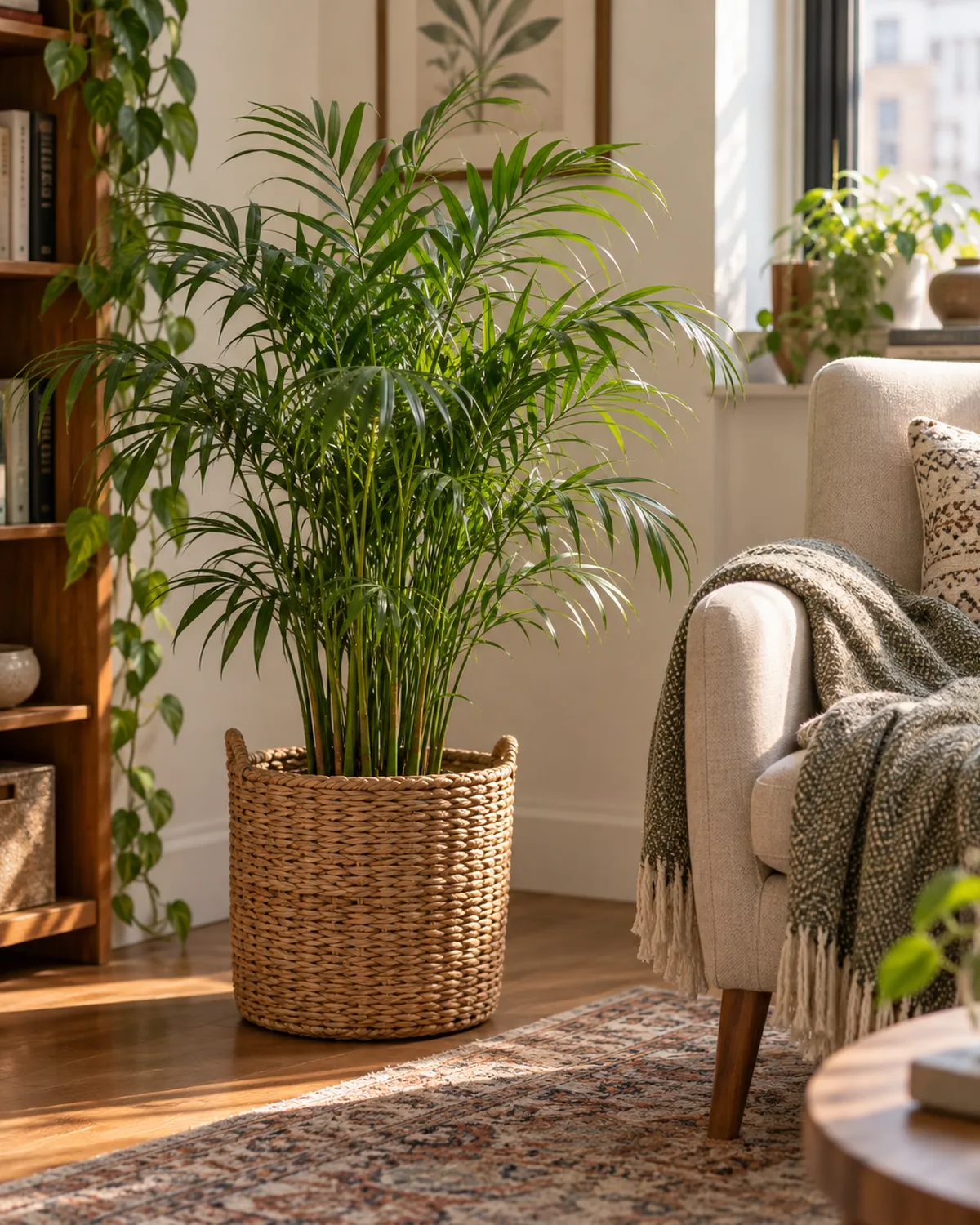
Parlor palm has been the default apartment plant since the Victorian era, and the reason is simple: it looks like a tropical tree but stays under 4 feet tall, tolerates low light, and does not die when the heating system drops indoor humidity to 25%.
Most palms fail indoors because they cannot handle dry air. Parlor palm evolved in the understory of Mexican and Guatemalan rainforests — shaded, humid, protected. But unlike its rainforest relatives, it has adapted to indoor conditions better than any other palm species commercially available.
- Light: low to medium indirect; tolerates north-facing windows and interior rooms with overhead fixtures
- Water: keep soil evenly moist but not soggy — this is one of the few apartment plants that does not want to dry out between waterings
- Humidity: tolerates 25–30% without leaf tip browning, though 40%+ produces lusher fronds
The fronds arch outward in a fan shape that fills a corner visually without taking up much floor space. A 6-inch nursery pot in a woven basket planter gives the full tropical effect — no 14-inch planter required.
- Never trim brown frond tips — cutting a palm frond triggers no new growth from that point, unlike most houseplants
- Remove entire dead fronds at the base instead
- Parlor palms grow from a single growing point at the crown; damage that point and the plant cannot recover
Spider mites are the main pest threat in dry apartment air. Check the undersides of fronds monthly during winter and mist occasionally to discourage infestations before they establish.
Cast Iron Plant — Named for Being Nearly Indestructible
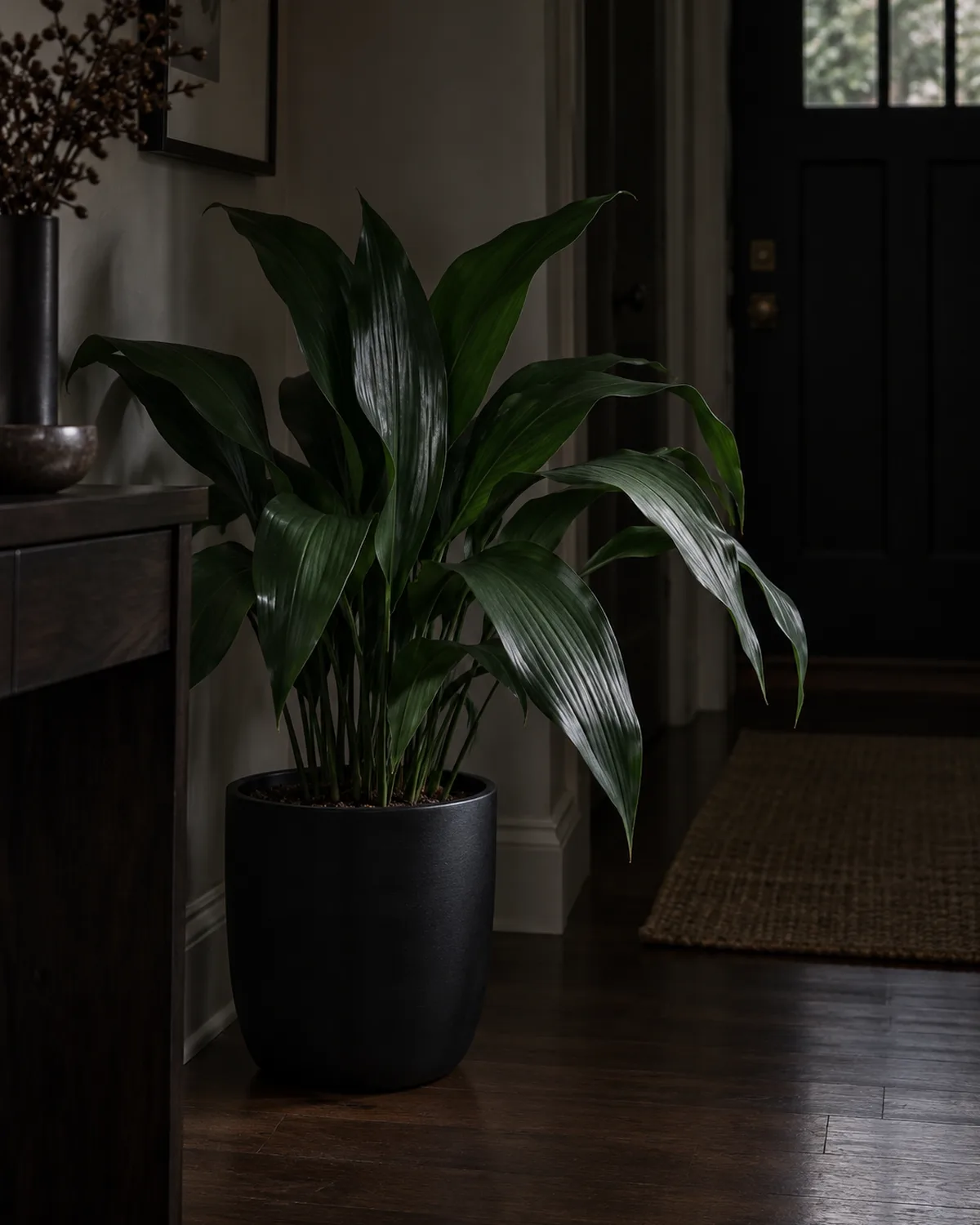
Cast iron plant earns its name. Dark corners, temperature swings, weeks without water, dust accumulation, fluorescent light — it handles conditions that would kill every other plant on this list except possibly the jade plant.
The growth habit is simple: dark green, lance-shaped leaves rise directly from the rhizome at soil level. There are no stems, no branches, no flowers (indoors), and no drama. It grows slowly, stays upright, and does not shed.
- Light: low to medium indirect; one of the few plants that genuinely thrives in near-darkness
- Water: let the soil dry out almost completely between waterings; every 2–3 weeks in a dim spot
- Temperature: handles 45°F to 85°F without visible stress — ideal for drafty entryways and unheated hallways
For renters who travel frequently, cast iron plant is the closest thing to a maintenance-free living decoration. Two weeks away in summer, three weeks in winter — it will look the same when you come back.
- Wipe dust off the broad leaves with a damp cloth once a month to keep photosynthesis efficient
- Repot only when the rhizome is literally pushing out of the pot — this plant dislikes root disturbance
- The variegated cultivar 'Variegata' has cream stripes but needs more light to maintain the pattern
The only way to reliably kill a cast iron plant is to overwater it in a pot without drainage and leave it sitting in a saucer of water. The rhizome rots slowly and silently, with no droop signal like a peace lily. By the time the leaves yellow, the rot is advanced. Use a pot with drainage and water less often than you think you should.
Jade Plant — The Desktop Succulent That Feels Like a Bonsai
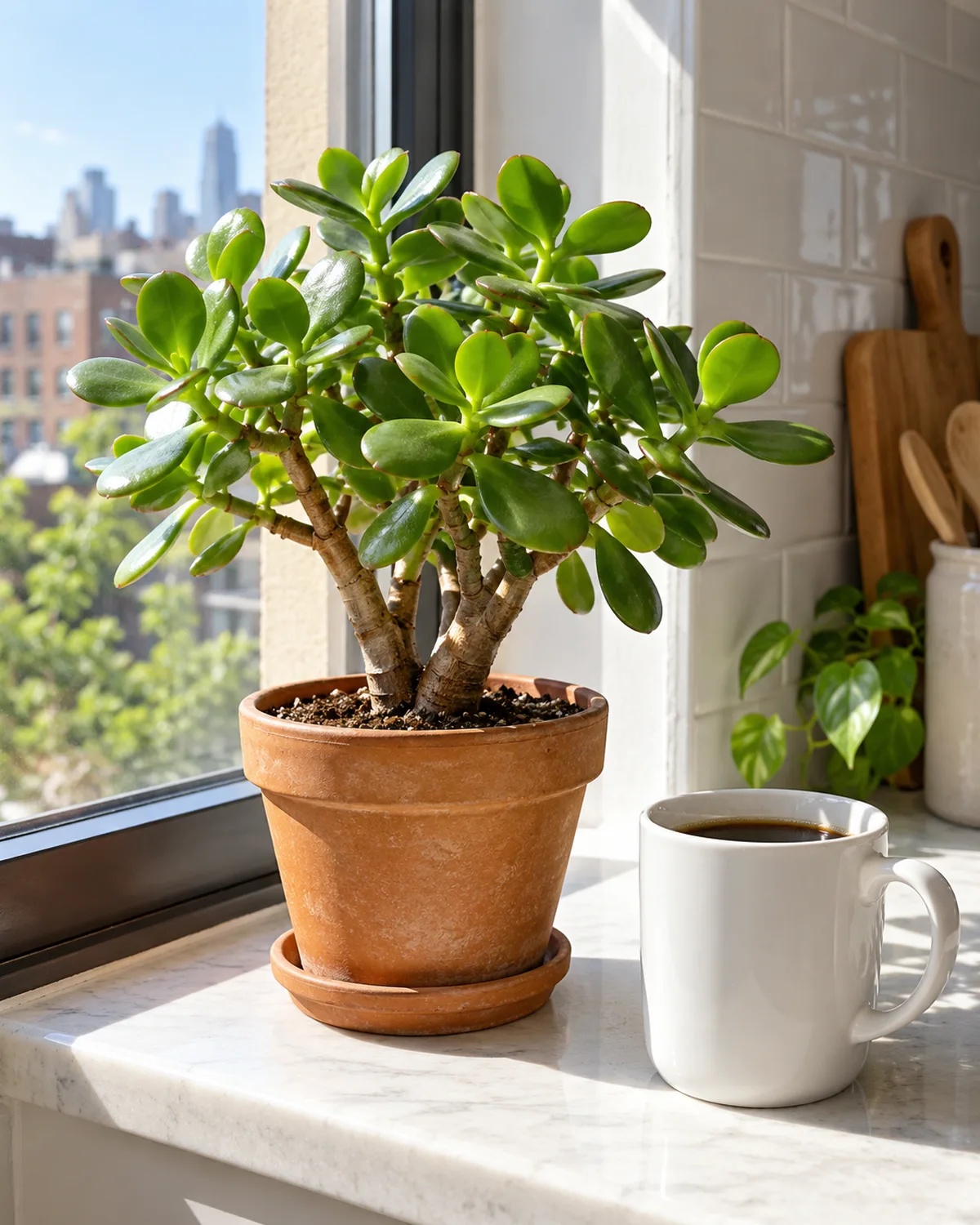
Jade plant turns a windowsill into a display without needing anything more than a 4-inch terra cotta pot and a spot that gets a few hours of direct sun. Over years, the stems thicken and woodify, developing the gnarled trunk structure of a miniature tree — an accidental bonsai that requires none of the skill.
The water storage mechanism is what makes jade apartment-proof. Each thick, glossy leaf is a reservoir. In a sunny apartment with dry winter heating, jade plant needs water roughly every two weeks. Miss a watering and the leaves get slightly soft — water it and they firm back up within a day.
- Light: bright direct to bright indirect; a south or west-facing windowsill is ideal, east-facing works
- Water: soak the soil completely, then let it dry out fully before watering again — the classic succulent cycle
- Size: stays under 12 inches for years in a small pot; can reach 3 feet in a large pot over a decade
The wrinkle test is the most reliable watering indicator. Squeeze a lower leaf gently between your fingers. If the surface gives slightly or shows fine wrinkles, the plant is ready for water. If the leaf is firm and smooth, wait.
- Jade drops leaves when overwatered — if leaves fall off easily when touched, reduce watering immediately
- The woody stem takes years to develop; a young jade looks like a small succulent with fleshy stems
- Non-toxic to humans but mildly toxic to cats and dogs
Jade plant is one of the few apartment plants that benefits from some temperature drop at night. A windowsill that cools to 55°F overnight while the apartment stays 70°F during the day mimics its native South African habitat and encourages compact growth.
Air Plants — No Soil, No Pot, No Drilling Required
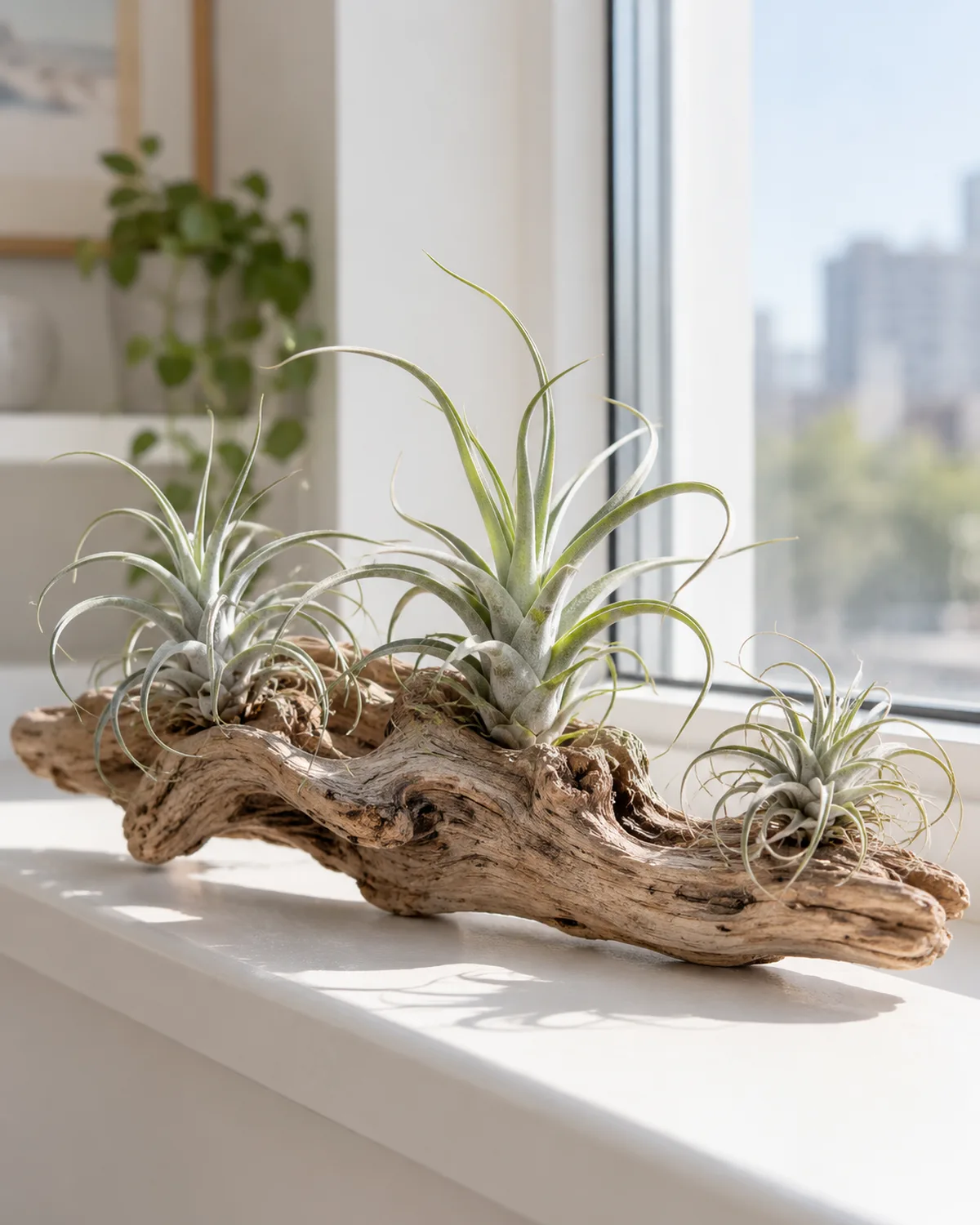
Air plants solve the one problem that stops many renters from keeping plants at all: they need no pot, no soil, no drainage saucer, and no surface that might get water-stained. Place them on a piece of driftwood, in a glass bowl, on a magnetic holder stuck to the refrigerator, or directly on a shelf. They anchor themselves with roots that exist only for grip, not for water absorption.
Tillandsia absorbs water and nutrients through specialized cells on its leaves called trichomes — the silvery fuzz visible on most species. This means watering is a weekly soak-and-shake: submerge the plant in room-temperature water for 20–30 minutes, then shake off the excess and set it somewhere with airflow to dry within 4 hours.
- Light: bright indirect; a spot within 3 feet of a window works well, direct afternoon sun dries them out too fast
- Water: weekly 20–30 minute soak, then shake dry; misting alone is not enough for long-term health
- Air circulation: critical — a closed terrarium with no airflow will rot an air plant within weeks
The drying step is the one most apartment growers skip. If water sits in the base of the leaf rosette overnight, the core rots. After soaking, turn the plant upside down on a towel near a window or a fan for 2–4 hours before returning it to its display spot.
- Tillandsia ionantha is the easiest species for beginners — small, hardy, turns red before blooming
- Tillandsia xerographica is the showpiece — large silver curling leaves, dramatic, and more drought-tolerant than most species
- Air plants are monocarpic: each plant blooms once, then slowly dies while producing 2–3 pups at its base
Peperomia — The Compact Desk Plant That Forgives Everything
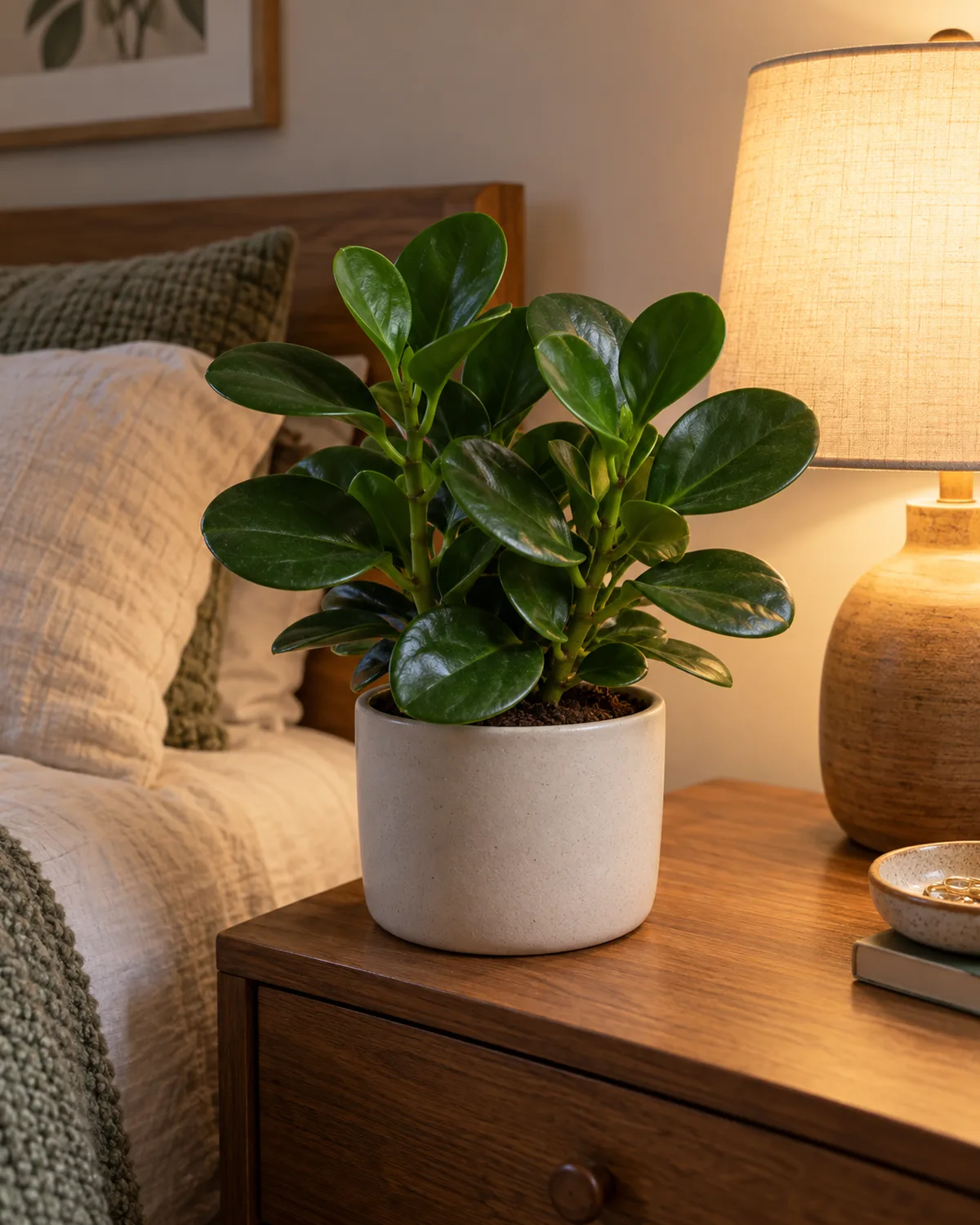
Peperomia obtusifolia stays small, stays compact, and stays alive under conditions that would stress most tropical houseplants. Its thick, semi-succulent leaves store water, which means it handles the kind of irregular watering that apartment life imposes — a week of attention followed by ten days of forgetting it exists.
The size is the apartment advantage. A mature peperomia in a 4-inch pot fits on a nightstand, a desk, a bathroom shelf, or a kitchen windowsill without competing for space with anything else. It does not trail, it does not climb, and it does not outgrow its position for years.
- Light: medium indirect to fluorescent; handles offices, interior rooms, and north-facing windows
- Water: let the top inch dry out; thick leaves mean it stores enough water to tolerate a skipped week
- Toxicity: non-toxic to cats and dogs — one of the safest options for pet-friendly apartments
Peperomia rarely has pest problems. The thick, waxy leaf surface makes it unattractive to spider mites, and its compact size means you can inspect the entire plant in ten seconds during your weekly watering.
- The leaves can propagate from a single leaf cutting — tuck a leaf into moist soil and a new plant grows from the base
- Peperomia 'Rosso' has red undersides for color; Peperomia watermelon has silver-striped leaves
- Overwatering is the main killer — mushy stems at the soil line mean root rot has already started
Monstera Deliciosa — The Statement Corner Plant
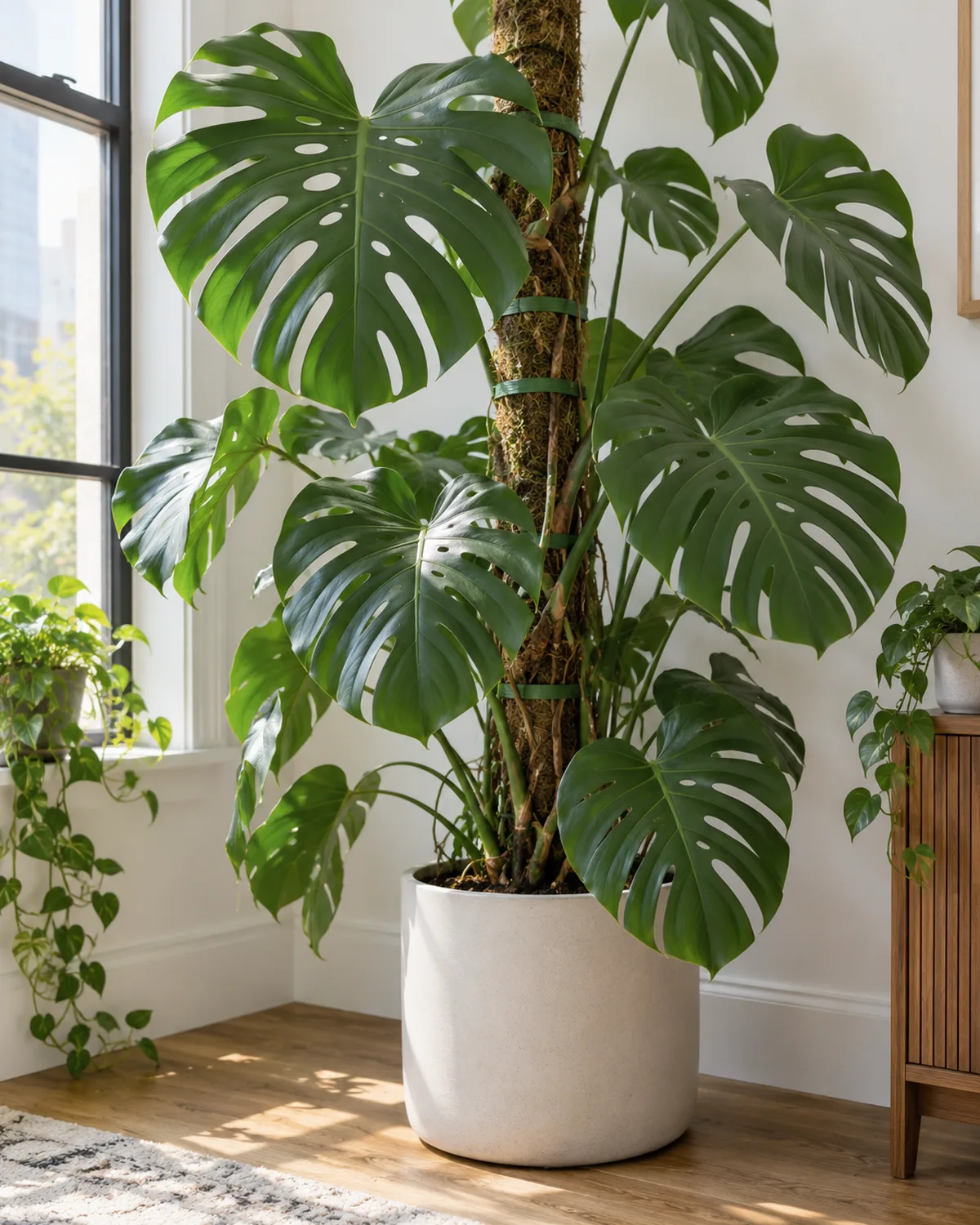
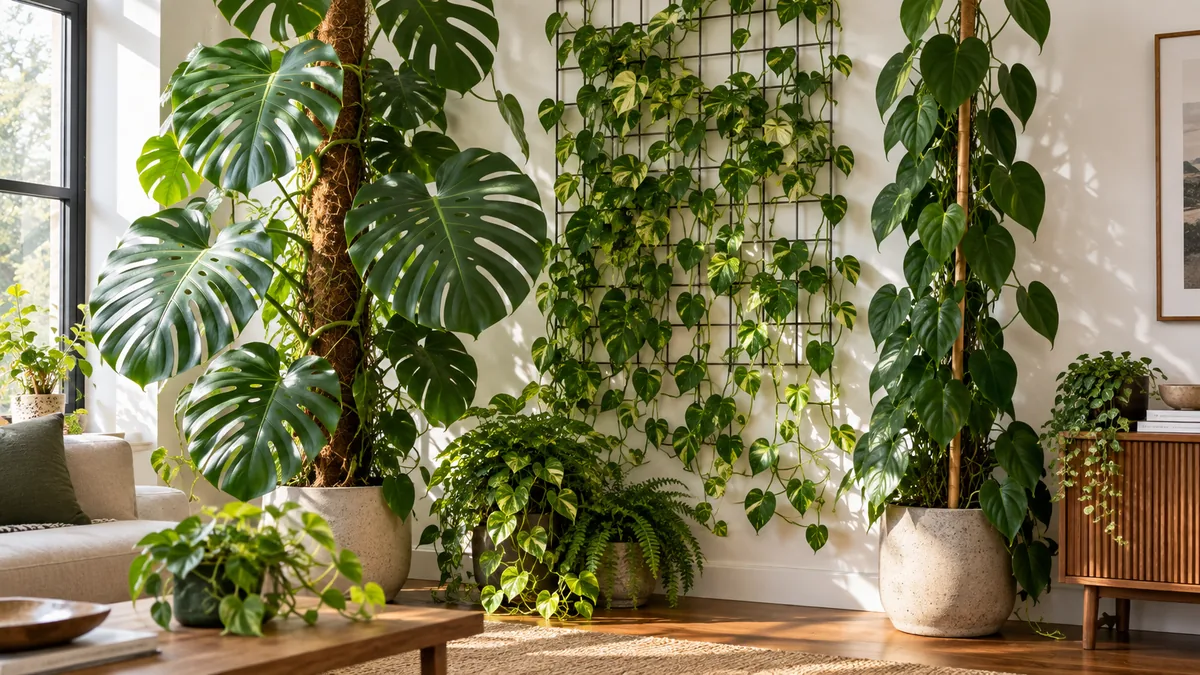
Monstera is the plant that turns a bare apartment corner from forgettable to intentional. One large monstera on a moss pole in a white ceramic pot does more for a room than most furniture purchases, and it grows fast enough that you see results within a single growing season.
The fenestrations — the holes and splits in the mature leaves — are monstera's signature. Young plants produce solid, heart-shaped leaves. As the plant matures and climbs, each new leaf emerges with more splits and holes. This progression is part of the appeal: the plant changes visibly over months.
- Light: bright indirect; within 4–6 feet of a south or east-facing window
- Water: let the top 2 inches dry out between waterings; monstera's thick aerial roots tolerate brief dry periods
- Support: a moss pole or wooden plank keeps the plant vertical and compact instead of sprawling sideways
Without a support structure, monstera sprawls. The aerial roots reach outward instead of upward, and the plant takes over the corner horizontally. A single moss pole keeps the footprint to about 18 inches of floor space while the leaves spread vertically.
- Monstera grows aerial roots from every node — these are normal, not a sign of distress
- Wipe dust from the large leaves monthly with a damp cloth for maximum photosynthesis
- Propagate by cutting below a node with an aerial root and placing it in water
The one caveat for apartments is that monstera needs more light than most plants on this list. A truly dark apartment corner will keep a monstera alive but it will produce small, unfenestrated leaves — defeating the visual purpose. If your brightest spot gets at least 200 foot-candles for 6 hours a day, monstera will thrive.
Haworthia — The Windowsill Succulent for Harsh Afternoon Sun
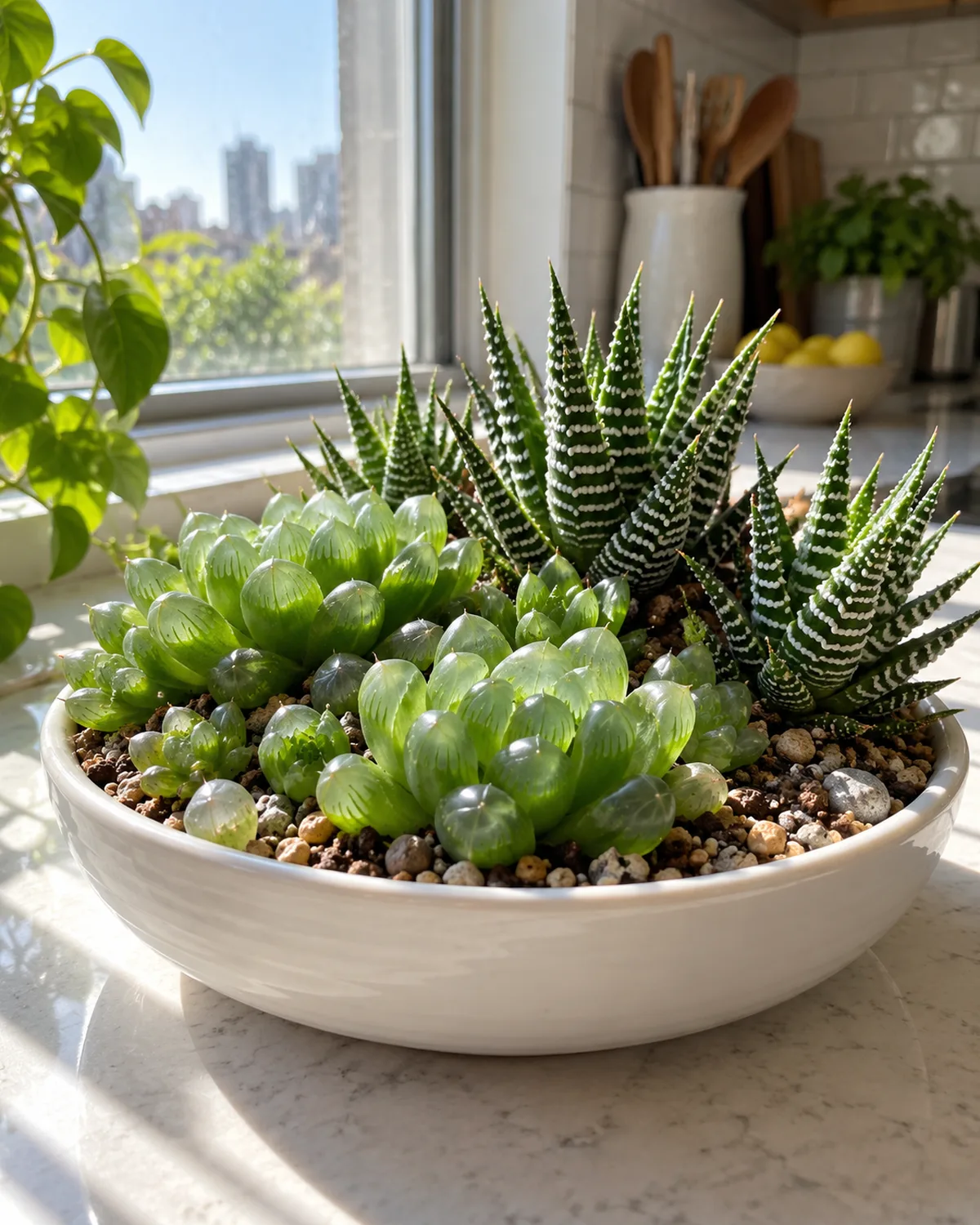
Most plants on this list avoid direct sun. Haworthia is the pick for the opposite problem: a south or west-facing windowsill that gets intense afternoon light where other plants burn, crisp, or bleach.
Haworthia cooperi has translucent leaf tips that act as windows, letting light penetrate deep into the leaf tissue. Haworthia fasciata (the zebra plant) has raised white tubercles on dark green leaves that regulate moisture loss. Both stay tiny — a mature plant fits in a 3-inch pot and never outgrows it.
- Light: bright indirect to direct; handles the harsh afternoon sun that burns most houseplants
- Water: every 2–3 weeks; let the soil dry completely between waterings
- Size: stays under 4 inches tall indefinitely; a cluster of offsets in a shallow dish looks like a miniature succulent garden
Haworthia produces offsets — baby plants that emerge from the base of the mother plant. These can be separated and potted individually, or left clustered for a fuller display. A single purchase slowly fills a shallow dish over two years.
The only real threat is overwatering. In a bright, dry apartment windowsill, the soil dries fast and watering every two weeks is usually right. In a dim spot with less airflow, the interval stretches to three or four weeks. Err on the side of dry — haworthia recovers from drought but not from root rot.
The most common questions about keeping plants in an apartment come down to getting started, managing water, and dealing with limited light. Here are the answers.
- How many plants should a beginner start with? Two or three in the same room. Pick one low-maintenance option (pothos or cast iron plant) and one that gives a watering signal (peace lily droops when thirsty). Add a third after keeping the first two alive through a full heating season.
- Do apartment plants improve air quality? Not meaningfully — apartment air exchanges with the outside too frequently for plants to make a measurable difference. The real benefit is psychological: reduced stress and improved focus in rooms with greenery.
- Best pot for apartments? A nursery pot with drainage holes inside a decorative cachepot without a hole. Water over the sink, swap the outer pot whenever your style changes.
- Plants in a windowless bathroom? Only with supplemental light. An LED bulb on for 10–12 hours a day sustains pothos, heartleaf philodendron, and cast iron plant. No plant survives true darkness indefinitely.
- Preventing water damage? Cork or felt pads under every saucer, empty saucers 30 minutes after watering, and avoid terracotta directly on wood — it sweats moisture through its walls.
Save for Reference
Apartment Plants — 14-Pick Quick Reference
- 1PothosTrailing vine that grows along shelves and curtain rods in low light — trains anywhere without drilling holes.
- 2CalatheaPink-striped living art for shaded corners and humid bathrooms — folds its leaves up at night.
- 3Dracaena MarginataSpiky vertical accent that fits a 6-inch footprint beside a door frame and grows slowly for years.
- 4Spider PlantHanging basket pick that handles drafty windows and temperature swings while producing free pups.
- 5Heartleaf PhilodendronFastest grower on the list — cascades from bookcases and tolerates fluorescent-only rooms.
- 6Peace LilyThe only flowering option for north-facing apartments — droops when thirsty, rebounds in two hours.
- 7Chinese EvergreenPatterned foliage that brings color to dim corners without direct sun — darker leaves for darker rooms.
- 8Parlor PalmCompact tropical that stays under 4 feet and tolerates the dry air from forced-air heating systems.
- 9Cast Iron PlantNearly indestructible — handles dark corners, travel absences, and temperature swings without complaint.
- 10Jade PlantDesktop succulent that develops a woody bonsai-like trunk over time on a bright windowsill.
- 11Air PlantsNo soil, no pot, no drilling — display on driftwood or a shelf with a weekly soak-and-shake routine.
- 12PeperomiaCompact desk plant with thick succulent leaves — non-toxic, pest-resistant, fits a 4-inch pot for years.
- 13Monstera DeliciosaStatement corner plant with split leaves — one moss pole keeps it vertical in an 18-inch footprint.
- 14HaworthiaTiny windowsill succulent for harsh afternoon sun — water every 2–3 weeks, never outgrows a 3-inch pot.
Save this list · Kultivy
Mara writes about indoor plants for people who want honest answers without the jargon. She covers houseplant care, propagation, and plant styling at Kultivy, testing every method she recommends in her own apartment first. More about Mara