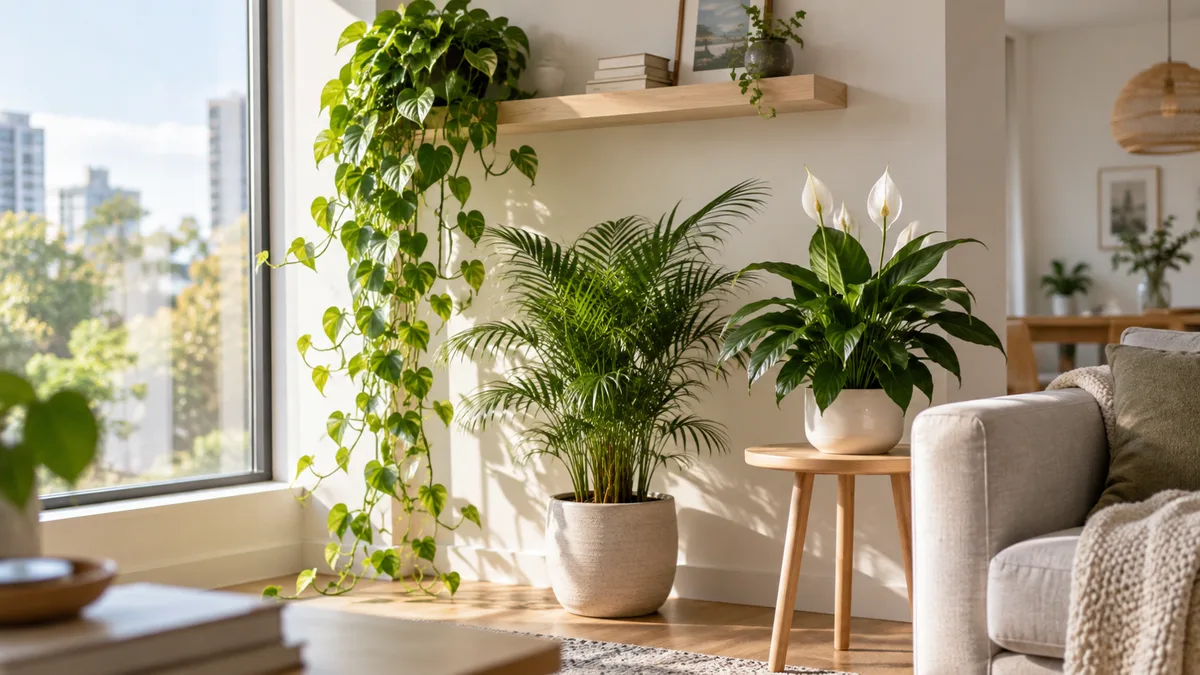
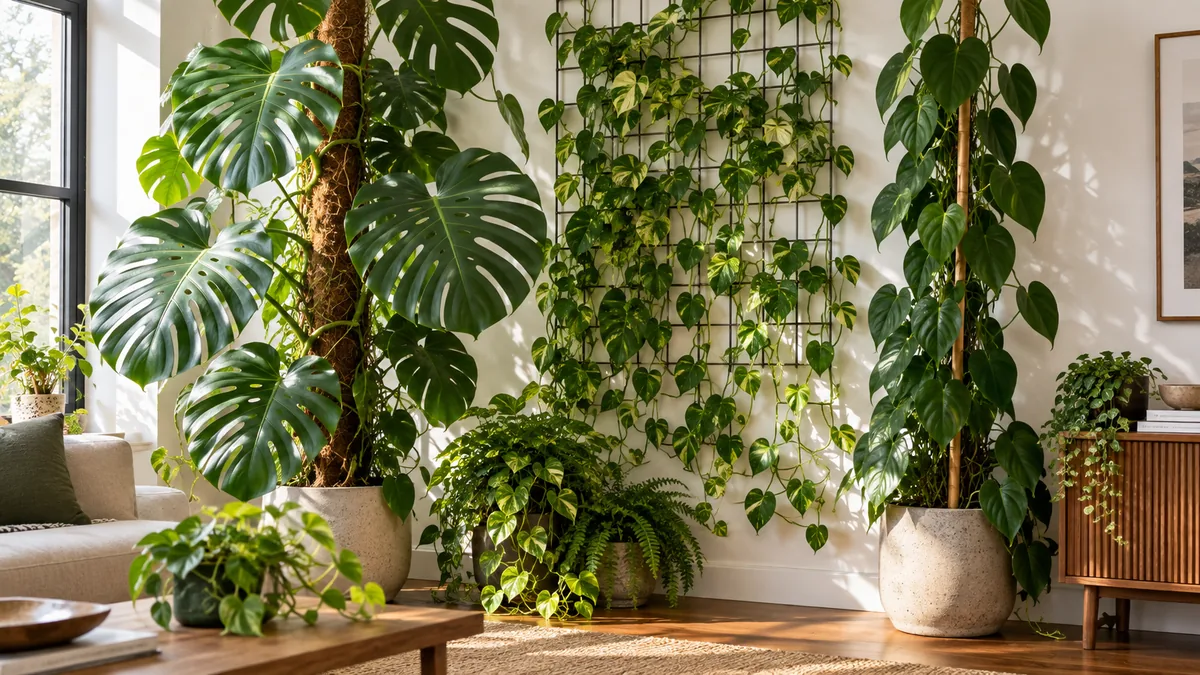
Trailing plants change a room by moving in a direction most houseplants ignore. Instead of reaching toward the ceiling, they pour over edges — off bookshelves, out of hangers, along mantels, and down cabinet sides.
That downward growth turns dead vertical space into living texture. A single trailer on a high shelf creates more impact than three upright plants on the floor.
This is not the same list as hanging plants — that guide covered methods. This one is about the plants: which species trail, how far, and which trailing habit suits which spot.
Pothos — the indestructible trailer that grows in any light
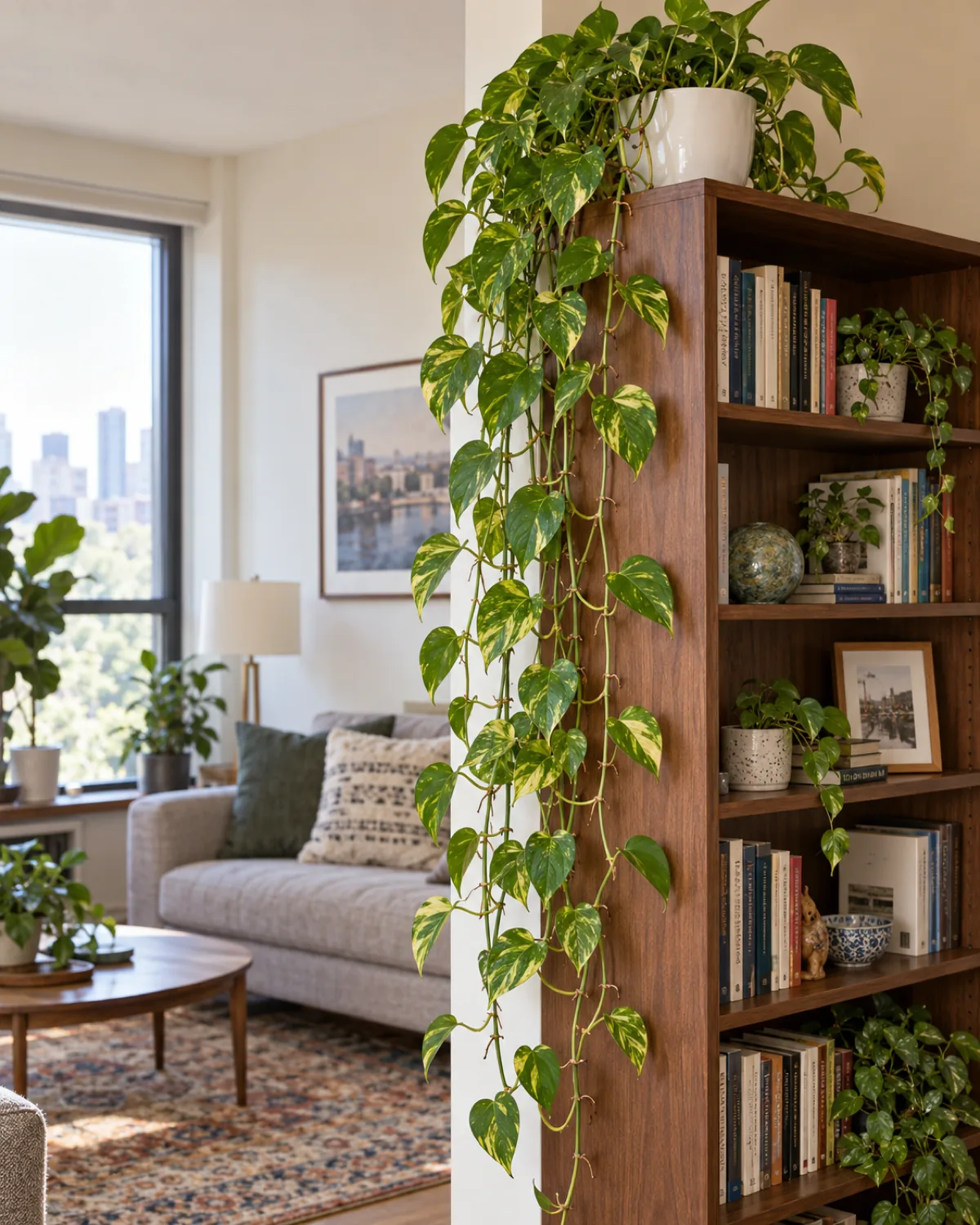
Pothos is the plant most people picture when they hear the word trailing. The vines grow long enough to frame a doorway from a single pot, and the aerial root nodes at each leaf junction mean every stem is a potential cutting waiting to happen.
Golden pothos is the baseline, but the genus offers a full spectrum of variegation. 'Marble Queen' pushes the white-to-green ratio past fifty percent, 'Neon' drops the variegation entirely for an electric chartreuse, and 'Manjula' swirls silver, cream, and green on wide, wavy leaves. All of them trail with the same aggressive energy.
- Trail length indoors: 180–300 cm from a single pot, the longest on this list alongside string of hearts
- Light tolerance: The widest range of any trailer — survives a windowless bathroom, thrives in bright indirect
- Growth speed: A healthy pothos in good light can push 30 cm of new vine per month in spring and summer
- Propagation: Cut below any node, root in water in seven to ten days — the fastest-rooting trailer here
What separates pothos from every other plant on this list is resilience. It tolerates low light, inconsistent watering, and the kind of casual neglect that kills succulents. The pothos care guide covers the full range of varieties and the watering rhythm that keeps them growing without root rot.
String of Pearls — the bead-chain succulent for bright south-facing shelves
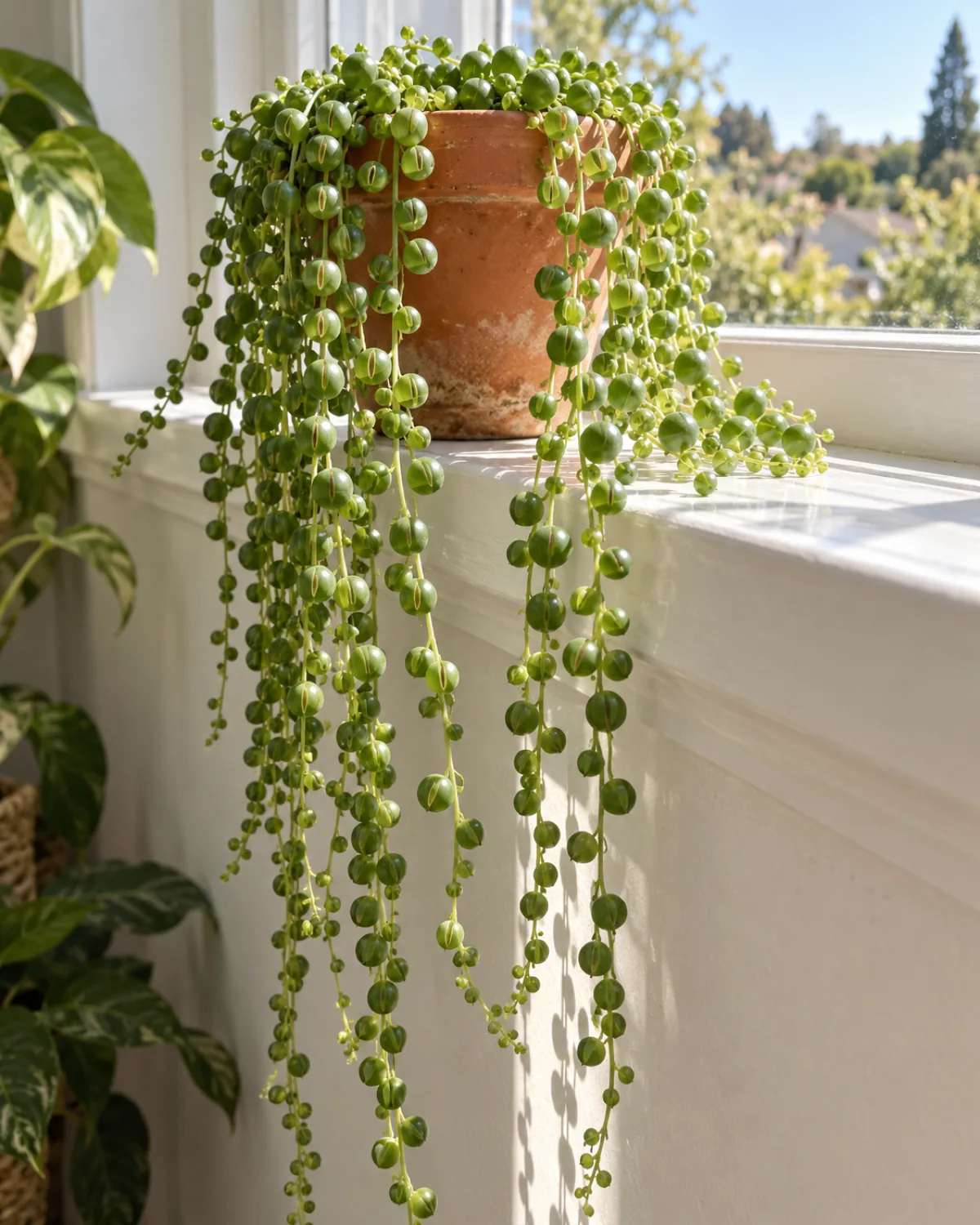
String of pearls does not trail the way vines do. The stems hang straight down under the weight of the water-filled spheres, and each sphere carries a translucent epidermal window — a slit-like strip that lets light reach the chloroplasts inside without exposing the entire surface to desiccation.
That window is the species' defining adaptation. It evolved in the dry scrublands of southwest Africa, where compact shape and reduced surface area keep water loss low. The same adaptation makes the plant sensitive to overwatering indoors — the pearls already hold more water than they need, and soggy soil pushes them past their storage capacity.
- Trail length: 60–90 cm, rarely more indoors — shorter than most vines on this list but visually dense
- Light needs: Bright indirect to direct morning sun — low light causes gapping between pearls and spindly stems
- Watering rhythm: Let the soil dry completely, then soak — the pearls wrinkle slightly when thirsty
- Fragility: The stems snap easily at the junction between pearl and stem when handled roughly
String of pearls is the trailer people photograph most and kill most often. The care guide breaks down the watering signal — slightly wrinkled pearls versus fully plump — that makes the difference between a thriving strand and a rotting one.
String of Hearts — the wire-thin vine with silver-marked heart-shaped leaves
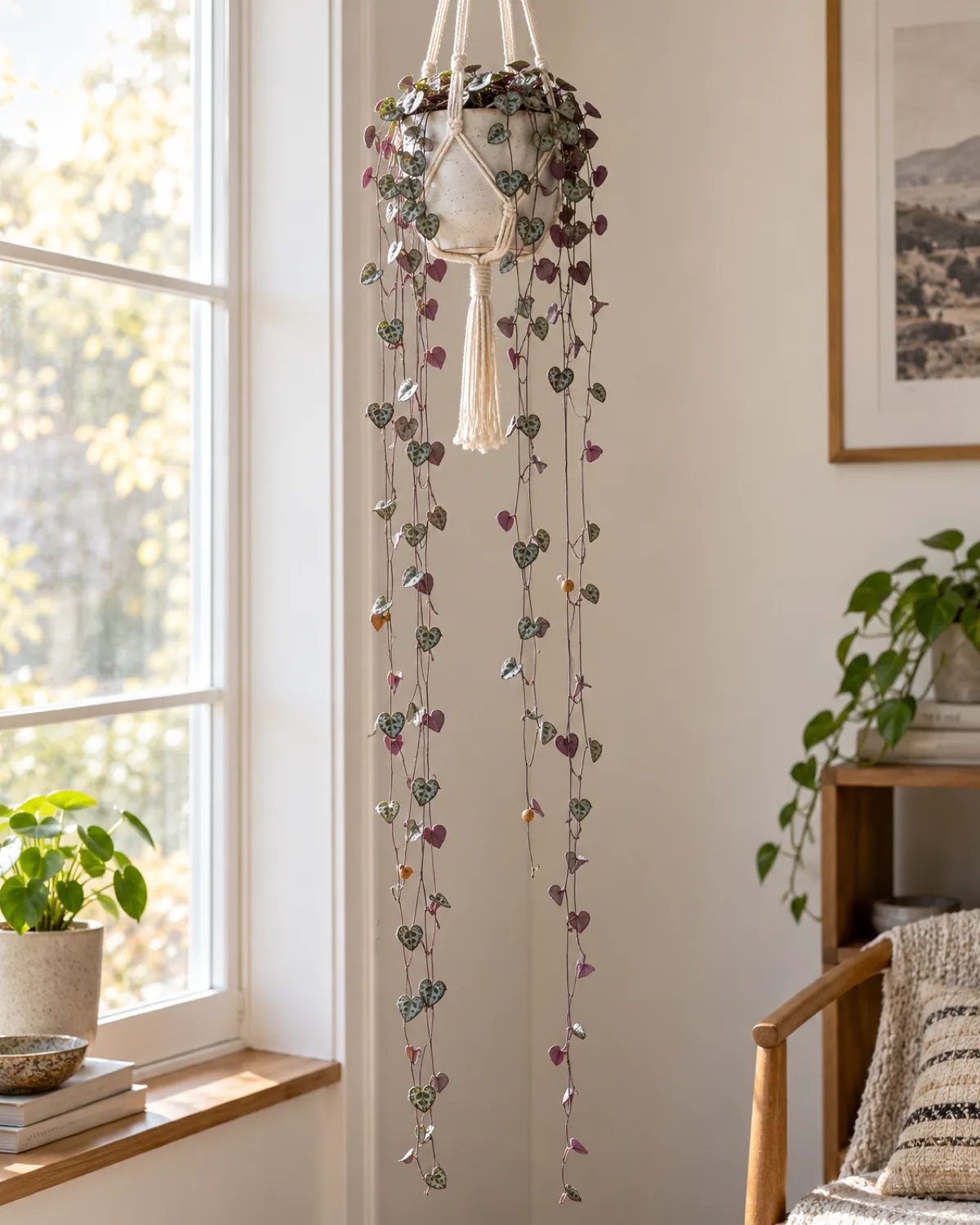
String of hearts produces the most delicate-looking trail of any houseplant, but the plant itself is tougher than it appears. Ceropegia woodii stores water in a woody caudex at the soil surface and develops small aerial tubers along the vines — each one a backup water reservoir and a ready-made propagation point.
The leaves are tiny, heart-shaped, and marked with silver-gray patterns on top with purple undersides. When backlit, the silver markings catch light in a way that makes the entire vine sparkle. The stems themselves are thin enough to be nearly invisible, so from a distance the leaves appear to float in midair.
- Trail length: 120–360 cm, the thinnest and potentially longest trailer on this list
- Aerial tubers: Small round bulbils along the vine — press one against soil and it roots within weeks
- Caudex: The woody tuber at the surface stores water and nutrients, making the plant surprisingly drought-tolerant
- Propagation: Butterfly cut method — cut between nodes, lay flat on moist soil, each node roots independently
The combination of extreme trail length and nearly invisible stems makes string of hearts the best option for creating a curtain of foliage from a single small pot. The full care guide covers the caudex, the tubers, and the watering rhythm that keeps the stems from thinning out.
Heartleaf Philodendron — the lacy cascade for bookcases and dark corners
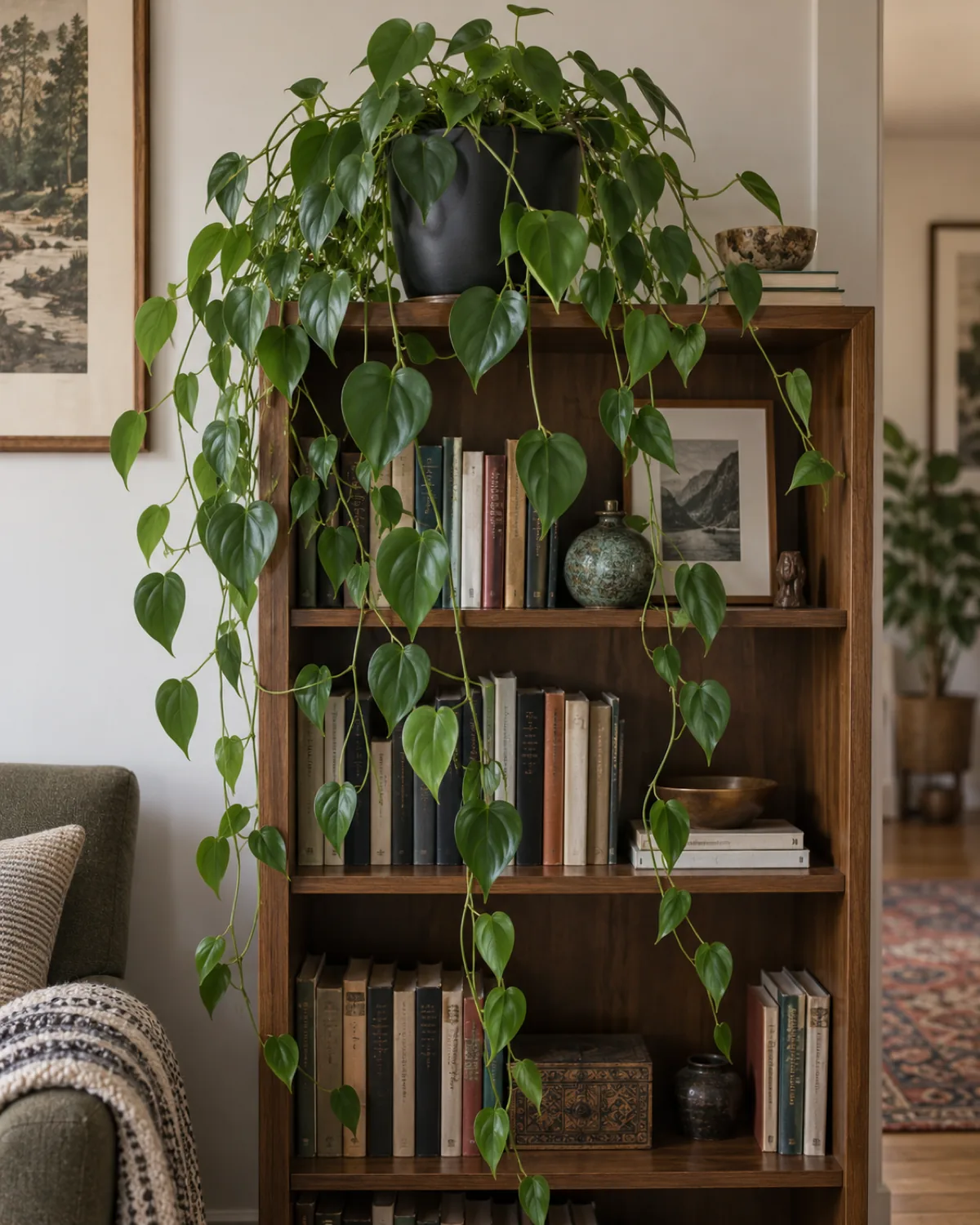
Heartleaf philodendron trails differently from pothos, even though the two are often confused at the nursery. Where pothos pushes one or two dominant vines that grow into thick ropes, Philodendron hederaceum sends multiple thinner stems that fan outward from the pot. Each leaf hangs on a longer petiole than a pothos leaf, which creates a softer, lacier silhouette overall.
That branching habit is what makes heartleaf philodendron better than pothos for wide coverage. A single pot on a bookcase can send vines in three or four directions, draping across shelves and down the sides. Pothos creates a single dramatic rope; heartleaf creates a curtain.
- Trail length: 120–240 cm, with stems that branch more freely than pothos
- Light tolerance: Handles low light better than most tropicals — medium indirect light keeps it growing steadily, dim corners slow it but do not kill it
- Leaf distinction from pothos: Matte finish, thinner texture, deeper heart shape with a more defined pointed tip
- Growth habit: Multiple thinner vines fan outward rather than one or two thick dominant stems
The philodendron care guide covers the full genus, but heartleaf is the species that earns its spot specifically as a trailer. It grows fast enough to fill a blank wall in a single growing season and tolerates the low light that kills most succulent trailers.
Tradescantia — the fast-growing rainbow trailer that roots at every node
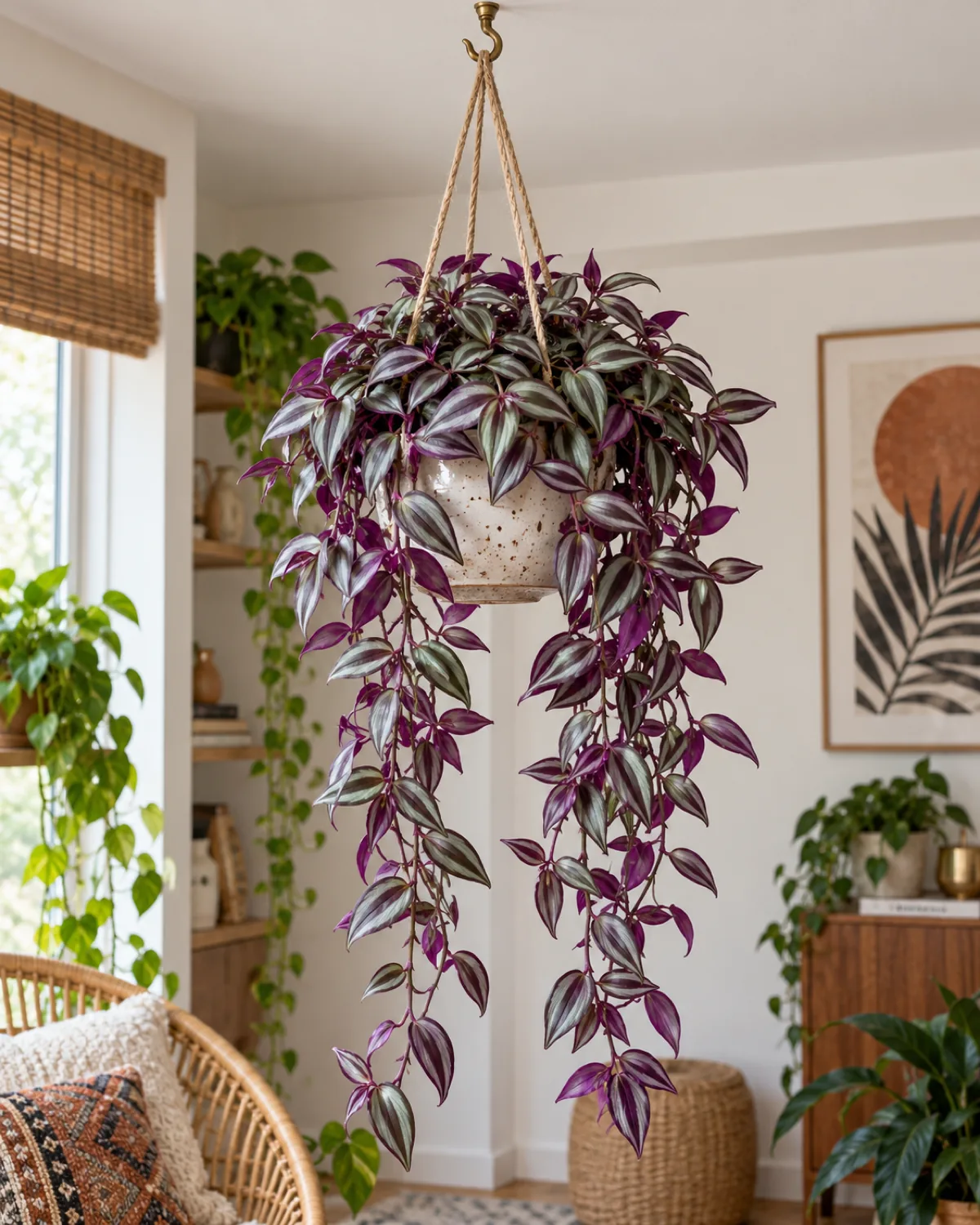
Tradescantia is the fastest trailer on this list and the most demanding about one thing: pinching. Left unpruned, a stem grows long and bare at the base within months — older leaves drop while the tip keeps pushing, leaving a bald crown trailing one leggy vine.
Regular pinching at the nodes forces branching, and each cut tip roots in days when stuck back into the soil.
Tradescantia zebrina is the most common species, carrying metallic silver stripes against deep purple-green foliage. Tradescantia pallida pushes the purple further — the entire leaf is a saturated plum, and the undersides glow when backlit. Both root at every node that touches damp soil, which is why a pot of tradescantia fills in so fast.
- Trail length: 60–120 cm before the stems need pinching — the shortest functional trail here
- Growth speed: The fastest grower on this list — stems can add 15 cm per week in good light during summer
- Pinching interval: Every four to six weeks during the growing season to keep the crown dense
- Color dependency: Silver and purple intensity is directly proportional to light — low light turns the leaves solid green
The tradescantia care guide covers the three-to-five-day rooting speed and the pinching schedule that keeps the plant from going leggy. This is the trailing plant for people who want fast, dramatic color and do not mind a regular trim.
English Ivy — the cool-climate classic with adventitious rootlets
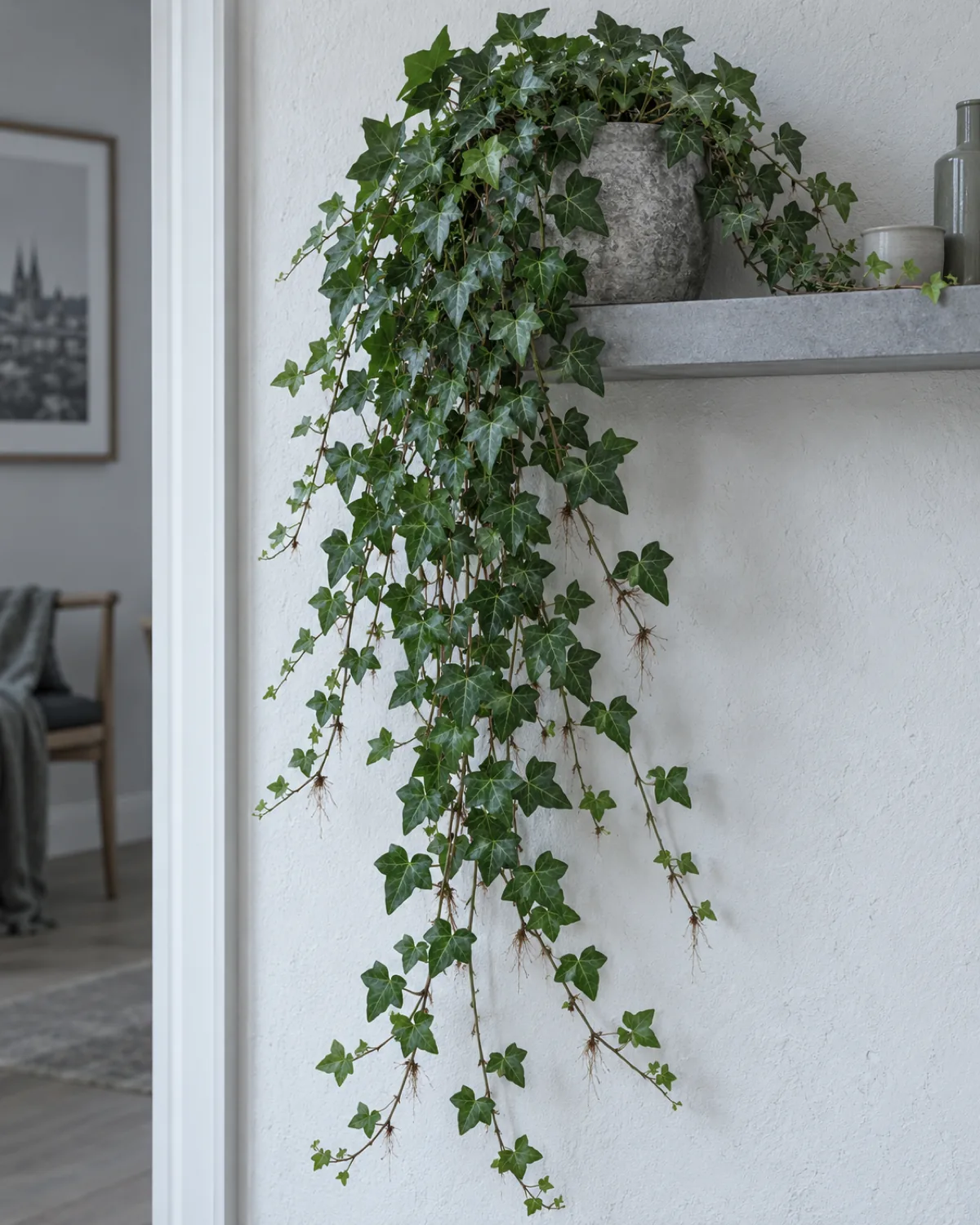
English ivy is the trailing plant that behaves most like an outdoor vine grown indoors. Hedera helix produces adventitious rootlets — small aerial roots that grip surfaces on contact — which means a trailing stem left near a wall will eventually attach itself. Those rootlets are what give ivy its dense, layered trailing coverage: the stems do not just hang, they spread and anchor.
The trade-off is temperature. Ivy evolved in cool, humid European forests and struggles in the warm, dry air of a heated apartment. The ideal range is 15–21°C, and rooms above 24°C with forced-air heating invite spider mites faster than almost any other houseplant. Ivy is the trailer for a cool bedroom, a north-facing bathroom, or a drafty hallway — not a spot next to a radiator.
- Trail length: 120–240 cm indoors, with stems that branch and layer for dense coverage
- Temperature preference: 15–21°C — the only trailing plant on this list that genuinely prefers cool rooms
- Pest magnet: Spider mites are ivy's chronic weakness — regular misting and weekly leaf checks are non-negotiable
- Varieties: 'Glacier' (silver-edged), 'Needlepoint' (tiny star-shaped leaves), 'Goldchild' (gold-margined)
The English ivy care guide covers the spider mite problem in detail and the misting rhythm that reduces the risk. This is a gorgeous trailer in the right conditions, but a frustrating one in a warm, dry room.
Hoya Linearis — the curtain-maker with soft needle-thin leaves
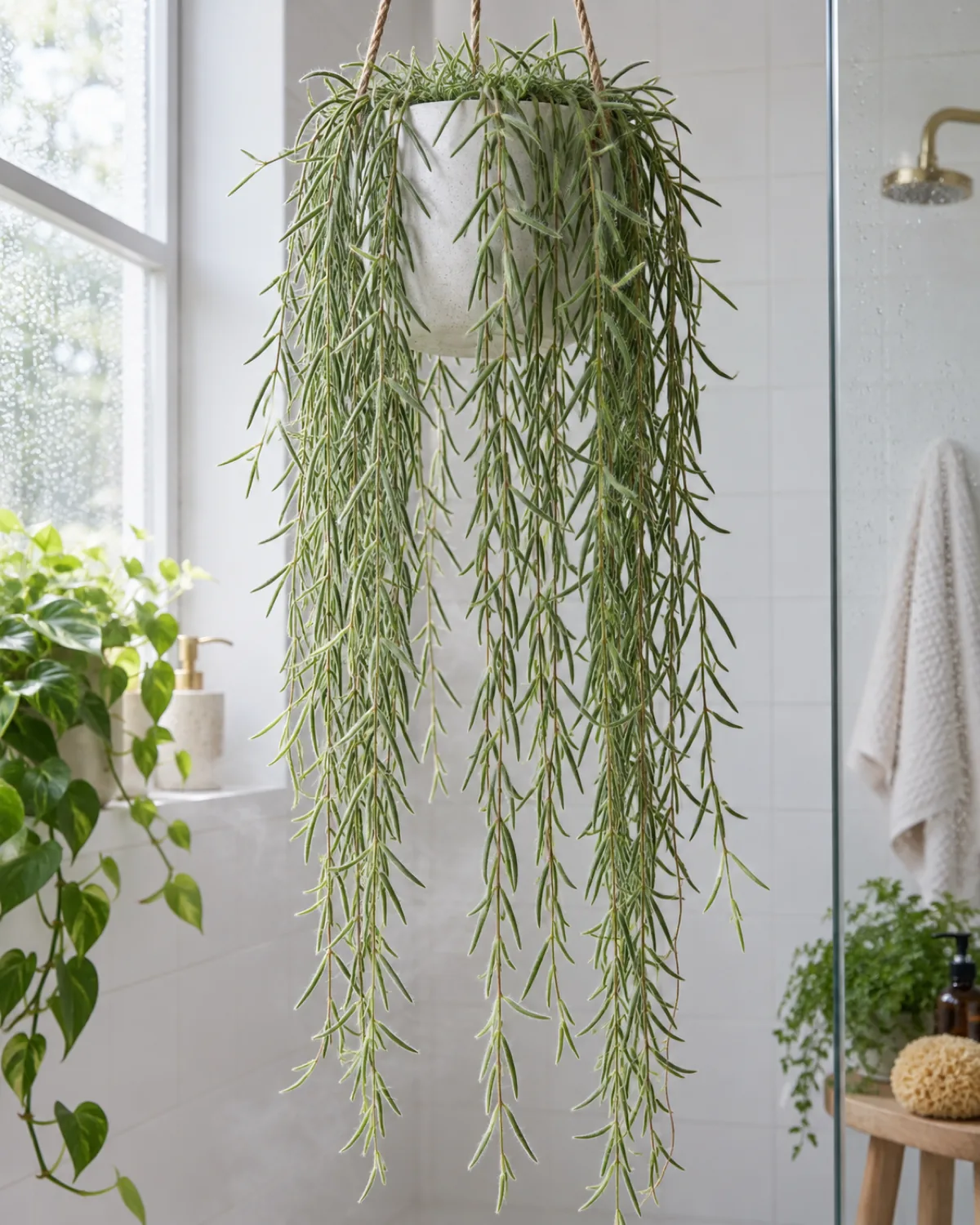
Hoya linearis looks nothing like the thick, waxy hoyas most people know. Instead of rigid, succulent-like leaves, linearis produces soft, narrow, slightly fuzzy foliage on pendant strands that drape straight down like a curtain. The overall effect is closer to Spanish moss than to a typical hoya.
This species needs more humidity than other hoyas because those thin leaves have far less water-storage capacity than a waxy hoya leaf. A bathroom with good light is the ideal spot. In dry air below forty percent humidity, the leaf tips brown and the strands thin out at the base — a slow decline that looks like neglect but is actually a humidity problem.
- Trail length: 90–180 cm, with strands that hang parallel for a fringe or curtain effect
- Leaf texture: Soft, slightly fuzzy, and needle-thin — the opposite of typical waxy hoya foliage
- Humidity requirement: Above fifty percent — the highest humidity demand of any trailer on this list
- Flowers: Small white star-shaped clusters with a honey scent, produced on mature plants in bright light
Linearis is the trailing hoya for a bright, humid room. If your bathroom gets good indirect light, this plant will create a living curtain that no other species on this list can match. In a dry living room, choose pothos or heartleaf philodendron instead.
Burro's Tail — the succulent braid that snaps at a touch
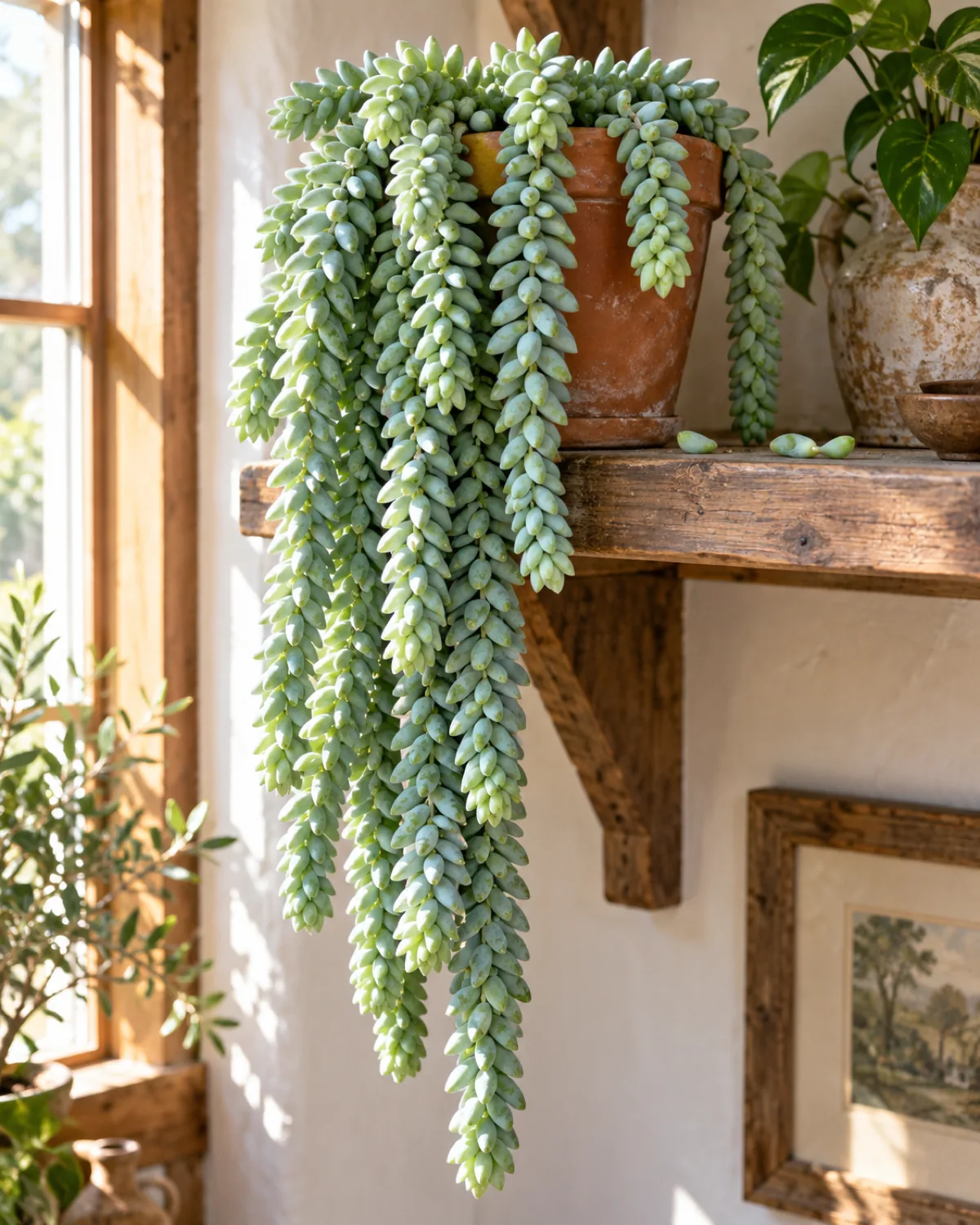
Burro's tail is the most visually dense trailer on this list and the most fragile. Each stem is packed with overlapping, plump, blue-green succulent leaves so tightly that the strand looks braided. The weight of those water-filled leaves pulls the stems straight down, creating heavy ropes that hang with a gravity that vining plants cannot match.
The fragility is the price of that density. Individual leaves detach at the slightest bump — brushing past the plant, moving the pot, even a strong vibration from closing a door can leave a trail of fallen leaves on the floor. The good news: every fallen leaf can root. Press it onto the surface of dry, gritty soil, and it will sprout a new plant in two to three weeks.
- Trail length: 60–120 cm, with thick braided stems that hang vertically under their own weight
- Fragility: The most touch-sensitive plant on this list — place it where nobody will bump it
- Light needs: Bright direct to bright indirect — the succulent leaves need strong light to stay compact
- Propagation: Fallen leaves root on contact with dry soil — the easiest accidental propagation of any succulent
Burro's tail belongs on a high shelf or in a hanging planter in a corner nobody walks past. The visual payoff is extraordinary — a mature plant with six or eight thick ropes hanging sixty centimeters is one of the most striking sights in indoor gardening. Just do not move it.
Peperomia Prostrata — the miniature turtle-shell trailer for terrariums
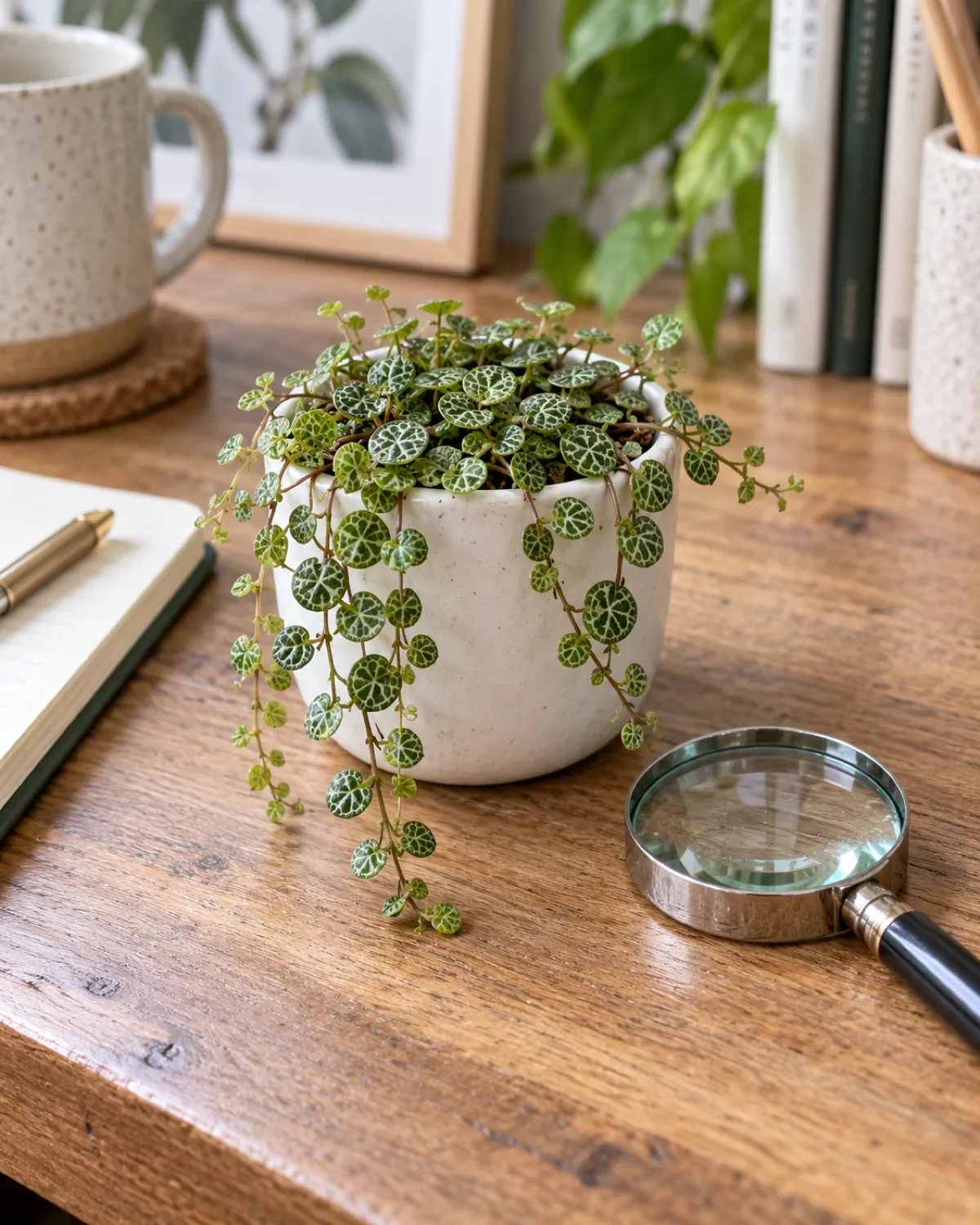
Peperomia prostrata — string of turtles — is the smallest trailer on this list by a wide margin. The leaves are under a centimeter across, and each one carries a network of white veins against a dark green background that looks exactly like a turtle shell under magnification.
The trail length tops out at fifteen to thirty centimeters in most indoor conditions, which makes this a tabletop plant or a terrarium accent rather than a shelf-draper. That scale is the point. Where pothos and philodendron fill a room, prostrata fills a six-inch pot with intricate detail that rewards close looking.
- Trail length: 15–30 cm, the shortest on this list — not a statement trailer but a detail plant
- Leaf size: Under 1 cm across, with vein patterns visible only at close range
- Best display: Open terrariums, small pots on desks, or as a groundcover in a larger planter
- Water sensitivity: The thin trailing stems rot easily if the soil stays wet — treat it like a peperomia, not a fern
Prostrata is the trailing plant for people who garden on a desk. It will never cascade off a bookshelf like pothos, but it creates a miniature trailing landscape that no other plant can match at this scale.
Rhipsalis — the jungle cactus that drapes like Spanish moss
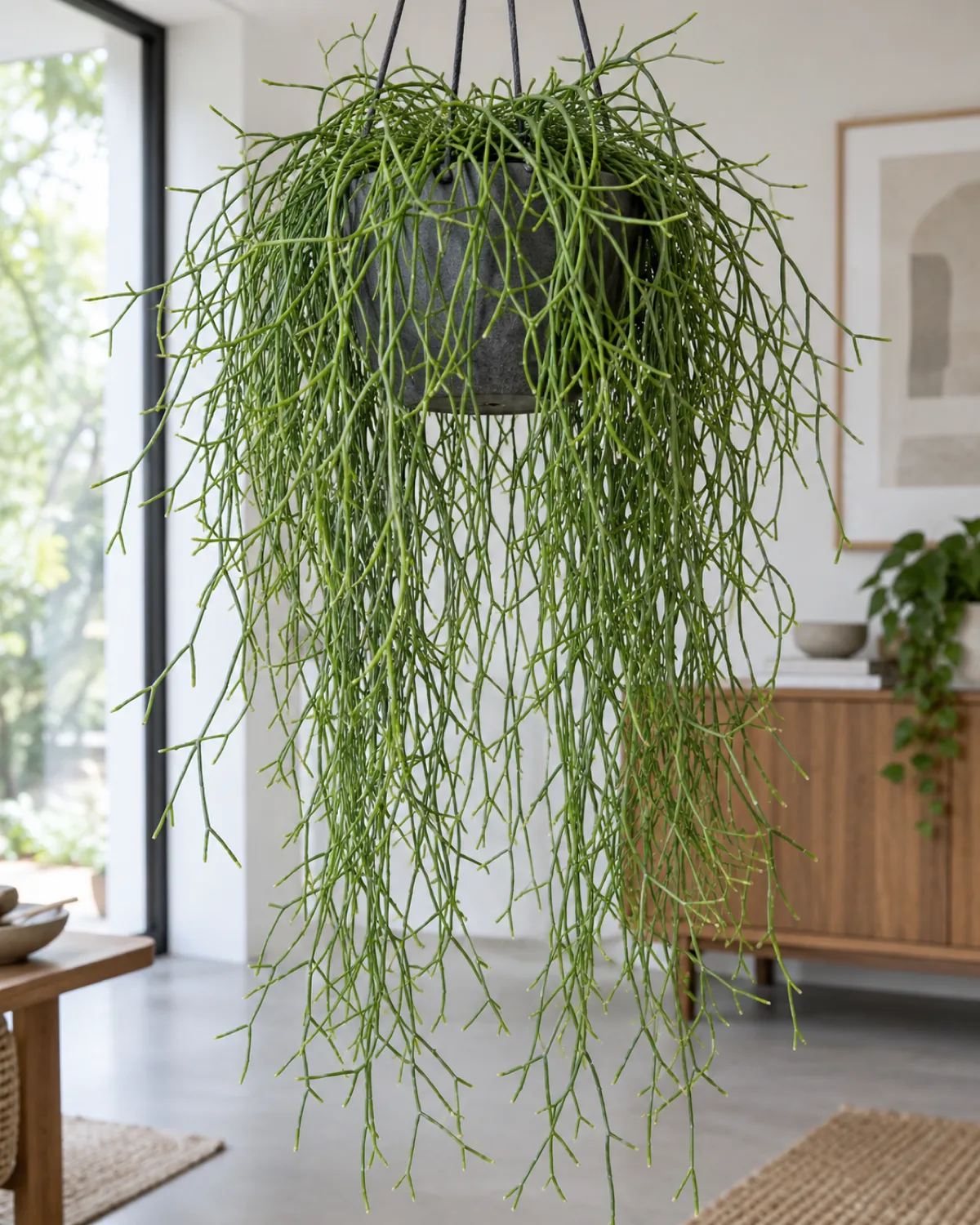
Rhipsalis is the trailer that looks the least cultivated. The pencil-thin, cylindrical stems branch and drape in every direction without the orderly pattern of a vine. A mature rhipsalis in a hanging pot looks like a green cloud — tangled, soft-edged, and completely unlike anything else on this list.
The plant is an epiphytic cactus from tropical forests, not a desert. It has no spines. The smooth, round stems photosynthesize along their entire length, and the branching habit means a single plant can produce hundreds of stems that layer over each other for depth. Unlike desert cacti, rhipsalis wants more water and less direct sun.
- Trail length: 90–180 cm, with stems branching so heavily that the silhouette is a sphere rather than a rope
- Growth form: Wild and untamed — the stems do not hang neatly like vines, they tangle and layer
- Watering: More than a desert cactus, less than a tropical vine — let the top centimeter dry, then water
- Light: Bright indirect — direct sun scorches the thin stems, and low light thins the branching
Rhipsalis is the trailing plant for someone who wants texture over neatness. It fills a hanging pot with a sculptural mass that catches light differently from every angle, and the care is forgiving once you stop treating it like either a desert cactus or a tropical vine.
String of Bananas — the faster, tougher sibling of string of pearls
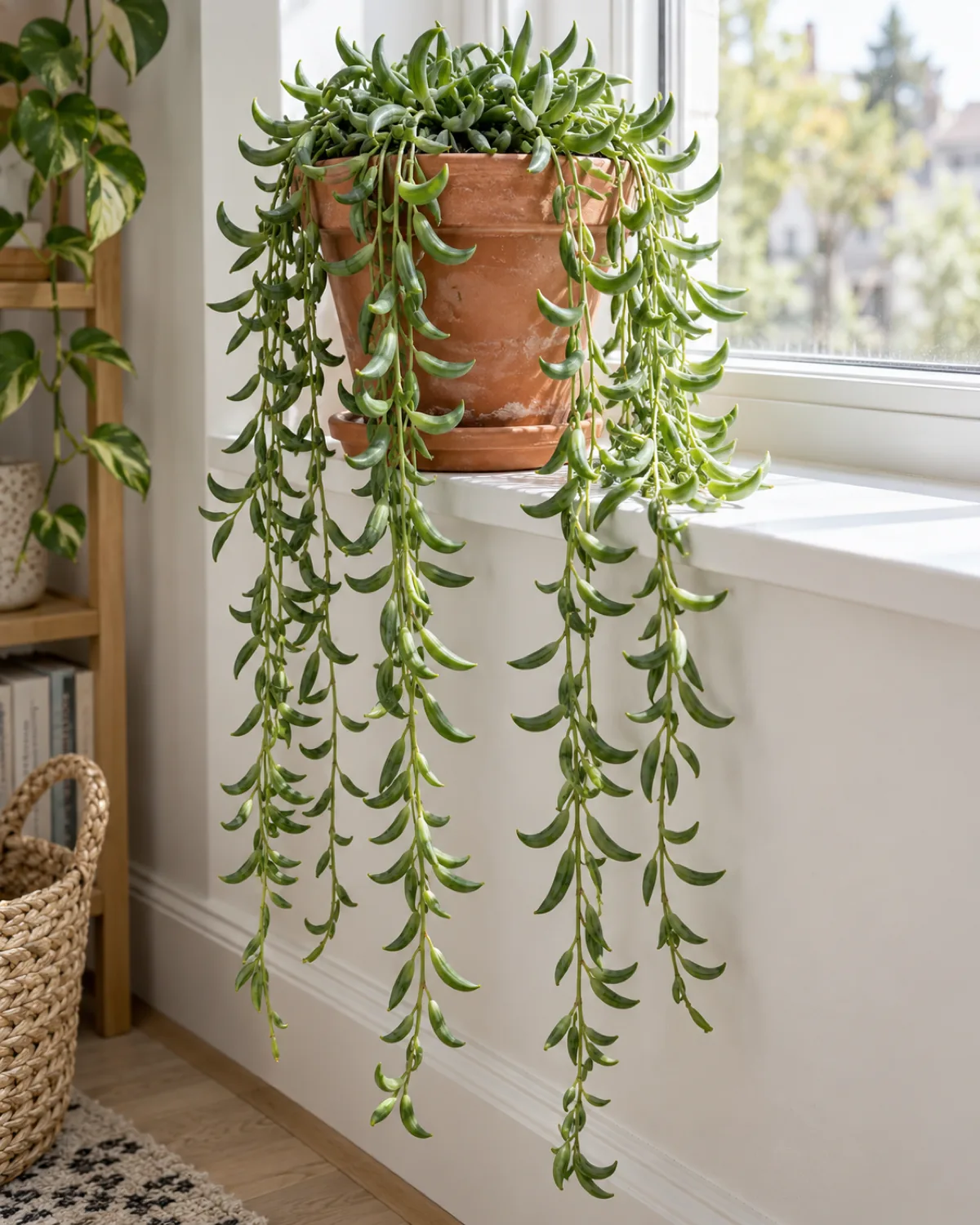
String of bananas does everything string of pearls does, but with a wider margin for error. Curio radicans has elongated, banana-shaped leaves that photosynthesize more efficiently than the spherical pearls because more of the leaf surface faces the light source. That efficiency translates to faster growth and better tolerance for imperfect conditions.
The banana shape also stores water slightly differently. Where string of pearls wrinkles visibly when thirsty — a reliable signal — string of bananas shows subtler signs. The bananas flatten slightly and lose their glossy sheen. Once you learn that signal, the watering becomes predictable.
- Trail length: 90–150 cm, longer and faster than string of pearls in the same conditions
- Light tolerance: Handles slightly lower light than pearls without the gapping and stretching
- Growth speed: Noticeably faster than string of pearls — fills in a hanging pot within a single growing season
- Thirst signal: Leaves flatten slightly and lose gloss rather than wrinkling — subtler than pearls
If you have tried string of pearls and watched it die, string of bananas is the second attempt that usually succeeds. The care requirements overlap almost completely, but bananas gives you a wider window between too wet and too dry.
Lipstick Plant — the trailing bloomer with scarlet tubular flowers
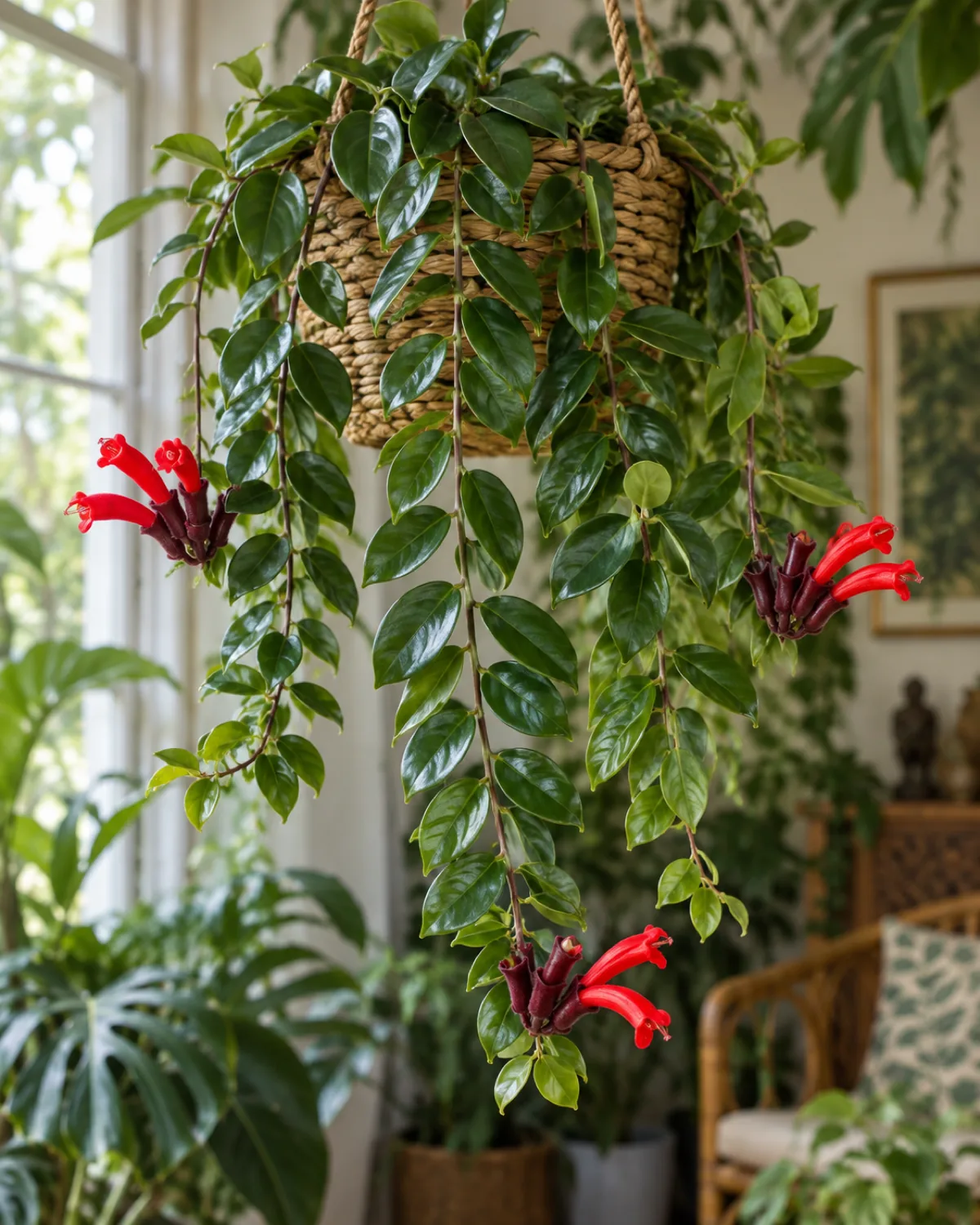
Lipstick plant is the only flowering trailer on this list. Aeschynanthus radicans produces clusters of scarlet tubular flowers from dark maroon calyces — the calyx-to-flower emergence looks exactly like a tube of lipstick being pushed up, and that resemblance gives the plant its common name.
The trailing stems reach sixty to ninety centimeters and carry glossy, dark green, opposite leaves that look good even when the plant is not blooming. But the bloom is the reason to grow it. A well-lit lipstick plant can flower on and off throughout the year, and the combination of red flowers against dark green trailing foliage is striking in a way that no other indoor trailing plant offers.
- Trail length: 60–90 cm, with stems that benefit from hard pruning after each bloom cycle
- Bloom trigger: Bright indirect light — the more light, the more frequent the blooms
- Calyx detail: The dark maroon calyx is the signature — flowers emerge from it like lipstick from a tube
- Post-bloom pruning: Cut stems back by a third after flowering to encourage bushier regrowth and the next round of buds
The lipstick plant care guide covers the post-bloom pruning that keeps the plant cycling between growth and flower. This is the trailer for someone who wants color beyond foliage — the scarlet flowers against dark green leaves create a contrast that photographs as well as it looks in person.
12 Trailing Plants Worth Growing
- 1Pothos — the indestructible trailerTrails 3 meters in any light. The most forgiving trailing plant for beginners.
- 2String of Pearls — the bead-chain succulentTranslucent windows in each pearl. Needs bright light and careful watering.
- 3String of Hearts — the wire-thin vineSilver-marked hearts on nearly invisible stems. Trails up to 3 meters.
- 4Heartleaf Philodendron — the lacy cascadeMultiple thin vines fan outward for curtain-like bookcase coverage.
- 5Tradescantia — the rainbow trailerFastest grower. Metallic purple-silver stripes. Needs regular pinching.
- 6English Ivy — the cool-climate classicDense layered coverage with adventitious rootlets. Prefers cool rooms.
- 7Hoya Linearis — the curtain-makerSoft needle-thin strands create a fringe effect. Needs high humidity.
- 8Burro's Tail — the succulent braidDense plump braids that snap at a touch. Place where nobody bumps it.
- 9Peperomia Prostrata — the miniature turtleUnder-1-cm leaves with turtle-shell veins. Best for desks and terrariums.
- 10Rhipsalis — the jungle cactusWild pencil-thin stems drape like Spanish moss. No spines, easy care.
- 11String of Bananas — the tougher siblingFaster and more forgiving than string of pearls. Banana-shaped leaves.
- 12Lipstick Plant — the trailing bloomerThe only flowering trailer. Scarlet tubular flowers from dark calyces.
Save this list · Kultivy
FAQ
How do I make trailing plants fuller?
Pinch the growing tip of each vine at a node. The stem below the cut sends out two new branches, doubling the trailing points. For faster results:
- Cut the tips you remove and root them in water for a week
- Plant the rooted cuttings back around the pot edges
- Repeat each spring — one growing season takes a single vine to a full cascade
Can trailing plants grow in low light?
Some of them handle it well:
- Low-light tolerant: Pothos, heartleaf philodendron, English ivy — slower growth and less variegation, but they survive
- Need bright light: String of pearls, burro's tail, string of bananas — they stretch, gap, and collapse without strong light
The low light plants guide covers the full list of species that tolerate less than 100 foot-candles.
How do I hang trailing plants without drilling?
Three options that leave no holes:
- Adhesive hooks: 3M Command hooks rated for the pot weight, attached to the wall or the underside of a shelf
- Tension rods: A rod across a window frame holds several lightweight pots in individual hangers
- High shelves: The simplest solution — place the pot on a high bookshelf, mantel, or cabinet and let the vines cascade naturally over the edge
The macrame plant hanger guide covers hanging methods in detail, including weight limits for each attachment type.

Mara Quinn edits Kultivy, where she shares houseplant care, propagation, beginner-friendly plant picks, and plant-styling ideas for anyone who wants their indoor plants to actually thrive. Every guide is image-led and reviewed for clarity, usefulness, image accuracy, and Pinterest-to-page alignment before it goes live. Visit the About page.