English ivy thrives where most tropical houseplants struggle — cool hallways, north-facing rooms, and unheated bedrooms where other plants refuse to grow.
Hedera helix is a true vine that grips surfaces with its own adhesive rootlets. That makes it fundamentally different from trailing aroids that hang by gravity alone.
The biggest mistake in english ivy care is treating it like a tropical. It evolved under cool forest canopies, and warm dry rooms invite spider mites while cooler spaces keep it lush.
Hedera helix is the only common houseplant that actively climbs walls on its own — here is everything it needs to thrive in cooler rooms.
What makes English ivy different from other trailing houseplants
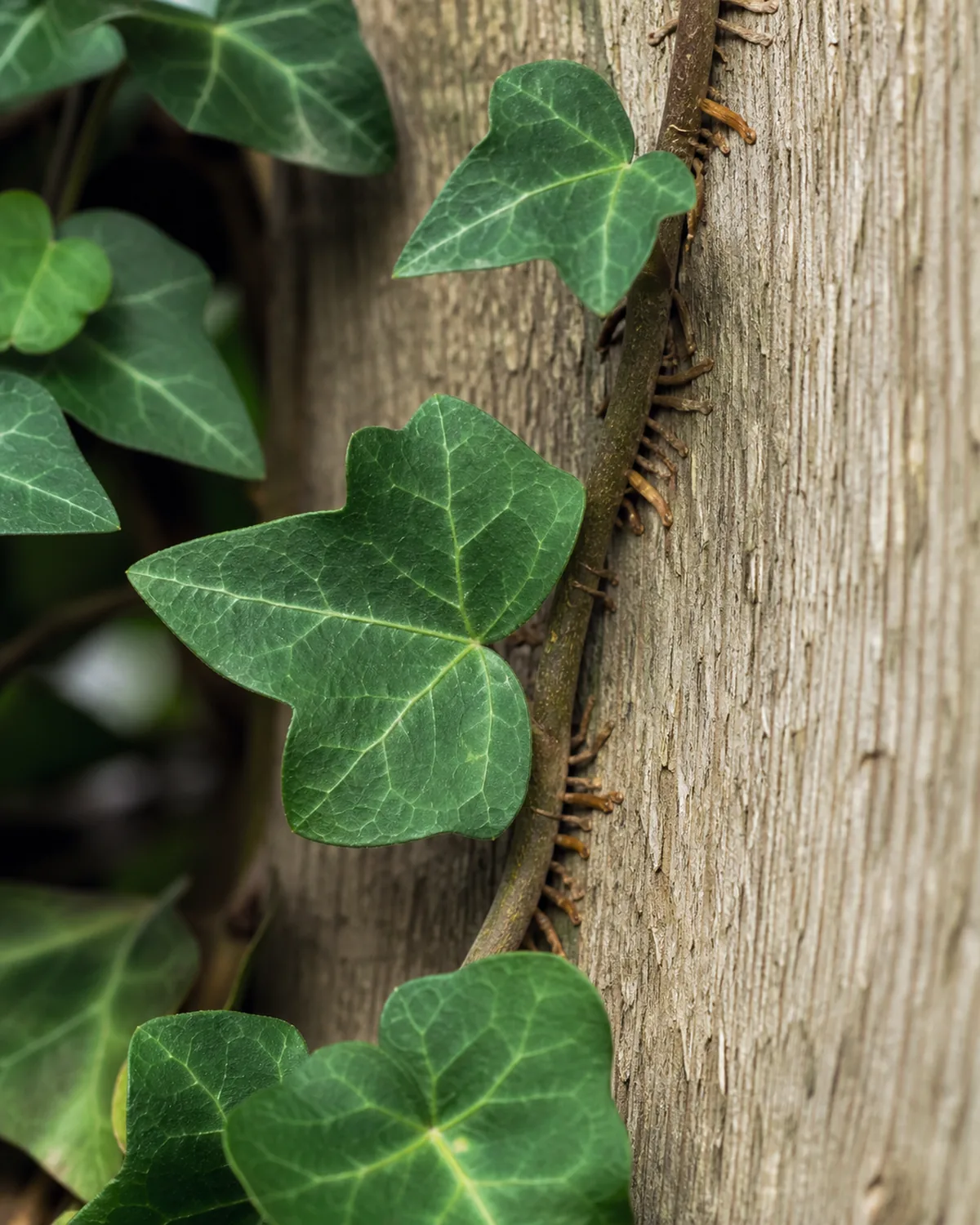
Hedera helix is a true vine — not a trailing plant that drapes by gravity, but an active climber equipped with tiny aerial rootlets that function as adhesive pads. These rootlets grip bark, stone, brick, and textured surfaces without any support structure. No other common houseplant does this.
Ivy belongs to Araliaceae, the same family as schefflera. It is native to the forests of temperate Europe and western Asia, where it grows as a ground cover and climber beneath deciduous tree canopies — cool, shaded conditions that differ radically from the tropical origins of most popular houseplants.
The plant has a feature most growers never witness: juvenile versus adult leaf dimorphism. The familiar three-to-five-lobed palmate leaves are the juvenile form. When ivy climbs vertically for several years, it transitions to an adult phase with completely different unlobed, elliptical leaves, flowers, and small black berries.
Indoors, this transition almost never occurs. It requires years of uninterrupted vertical growth and outdoor light levels that no window can replicate.
English ivy appeared on NASA's Clean Air Study for its ability to filter formaldehyde and benzene from indoor air. It is one of the fastest-growing indoor vines, adding three feet or more per year in good conditions.
One important caveat: ivy is considered invasive outdoors in many regions of the United States, particularly the Pacific Northwest and Southeast. Never plant indoor cuttings in the ground outside — they can escape cultivation and displace native plant communities.
Four cultivars that cover the most common indoor situations — pick the one that fits where your ivy will live.
Light that keeps the variegation sharp
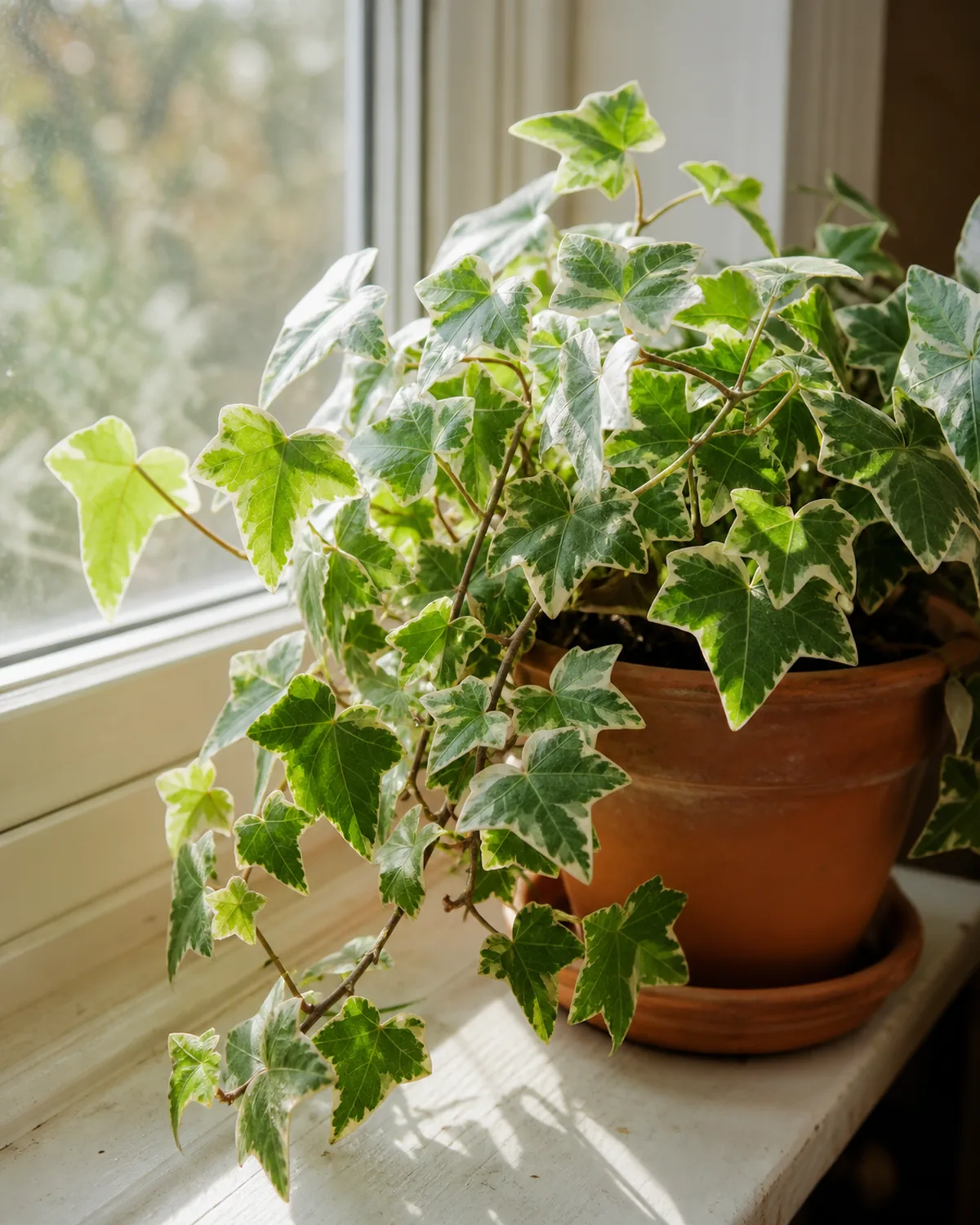
Bright indirect light is the ideal for most english ivy varieties. An east-facing window provides the perfect combination — direct morning sun followed by diffused afternoon light. A spot a few feet from a south or west window works equally well.
Ivy tolerates lower light better than most variegated houseplants, but there are limits. Green varieties like 'Baltic' handle moderate shade without complaint. Variegated cultivars such as 'Glacier' and 'Gold Child' need more light to maintain their white or yellow edges.
In low light, variegated leaves gradually revert to solid green. That color loss is permanent on existing foliage — only new leaves grown in better light will carry the pattern.
Direct afternoon sun, particularly through south or west windows in summer, can scorch the leaves. The damage appears as brown, papery patches — distinct from the crispy edges caused by dry air or the stippling caused by spider mites.
The sweet spot is morning direct sun plus afternoon shade. Rotate the pot quarterly for even growth across the plant.
Two signs tell you light is insufficient: leggy growth with long stretches of bare stem between leaves, and new leaves that emerge noticeably smaller than older ones. Both indicate the plant is stretching toward a light source it cannot find.
English ivy is one of the best true-office plants. It grows well under fluorescent or LED lighting, thriving alongside pothos and ZZ plants in spaces where natural light is limited. For guidance on supplemental lighting setups, see the grow light guide.
For a broader look at matching plants to your specific light conditions, the houseplant light requirements guide covers every window direction.
The watering rhythm ivy actually needs
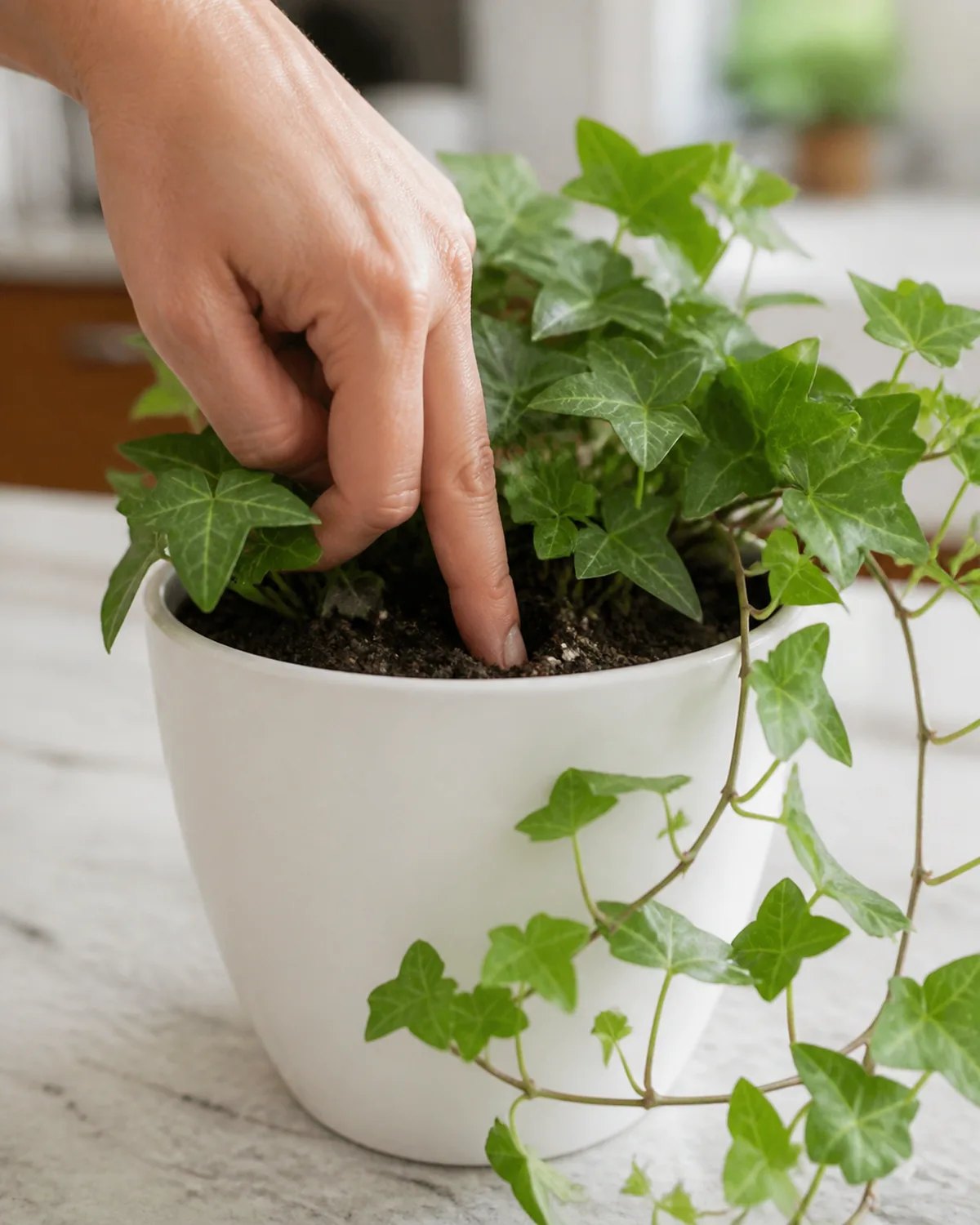
Let the top inch of soil dry between waterings, then water thoroughly until liquid drains from the bottom holes. This rhythm keeps ivy consistently moist without the soggy conditions that invite root rot.
Ivy sits in the moderate-water middle ground among houseplants. It needs more frequent watering than succulents or snake plants, but far less than ferns or prayer plants. If you are used to tropical aroids, water ivy slightly less often — it prefers a brief dry period between drinks.
Reduce watering in winter as growth slows, but never allow the root ball to go completely bone-dry. Unlike drought-adapted succulents, ivy has no water-storage mechanism in its leaves or stems. Extended dryness causes permanent leaf drop that the plant recovers from slowly.
Two distinct damage patterns help you diagnose watering problems:
Overwatering shows as yellowing lower leaves, mushy stems near the soil line, and soil that stays wet for days after watering. Root rot often follows — the roots turn dark and soft, and the plant declines rapidly despite adequate light.
Underwatering creates dry, crispy leaf edges that progress inward. The leaves feel papery and brittle. This looks different from spider mite damage, which produces tiny yellow stippling dots scattered across the upper leaf surface rather than edge-to-edge browning.
The pot-weight test works well for ivy: lift the pot after watering to register how heavy "fully hydrated" feels, then water again when the pot feels significantly lighter.
One practical tip: avoid getting water on the leaves repeatedly, especially in cool rooms with limited air circulation. Wet foliage in stagnant conditions promotes bacterial leaf spot — small dark lesions that spread across the leaf surface.
For a deeper look at moisture management across different plant types, the watering indoor plants guide covers tools, methods, and seasonal adjustments.
Temperature and humidity: the cool-room advantage
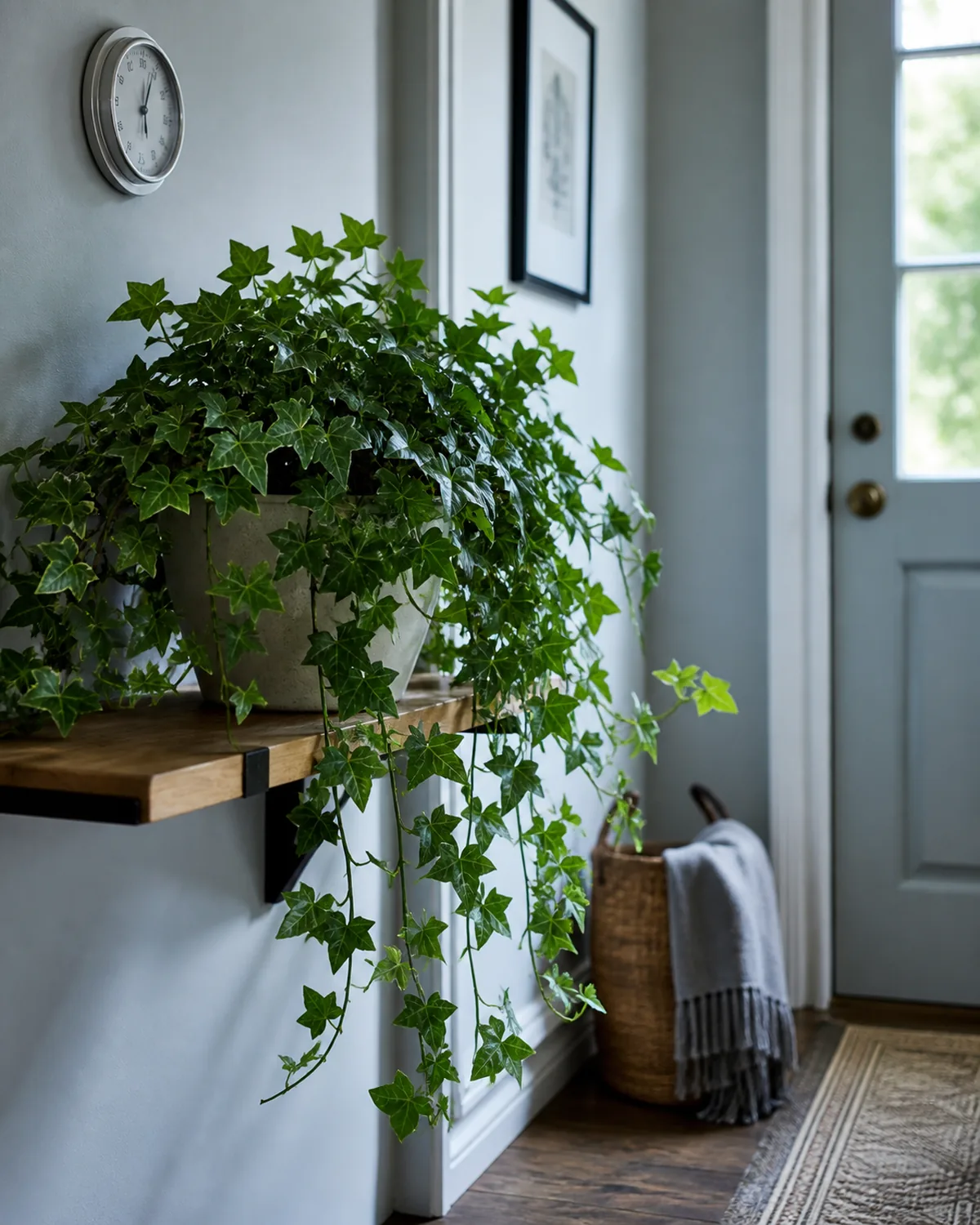
Temperature is the single most overlooked aspect of indoor ivy care, and it is the one factor that separates growers who keep ivy thriving from those who fight spider mites all winter.
The ideal range is 50 to 65°F (10 to 18°C). That is dramatically cooler than the 65 to 80°F that most tropical houseplants prefer. Rooms that feel uncomfortable for a monstera or philodendron are exactly where ivy belongs.
Temperatures consistently above 75°F stress the plant. You will see it in yellowing leaves, sparse new growth, and increased pest vulnerability. The warm-and-dry combination that describes most heated homes in winter is not just suboptimal for ivy — it is its primary death sentence.
The best rooms for ivy are the ones most tropicals refuse: unheated bedrooms, cool hallways and entryways, north-facing rooms that never get warm, and covered porches in mild climates. If your heating system makes every room 72°F, ivy will struggle no matter how perfectly you water and light it.
Humidity needs are moderate — 40 to 60 percent. That is lower than the 60 to 80 percent that tropical plants demand, but higher than the 20 to 30 percent common in heated winter homes.
Dry heated air in winter is the number-one ivy killer. Not cold — ivy handles cold well — but the combination of warm and dry. Central heating strips the air of moisture and raises the temperature simultaneously, creating the exact conditions that spider mites thrive in and ivy suffers under.
Mist the foliage frequently in heated rooms, or better yet, move ivy to the coolest room in the house during heating season. A pebble tray beneath the pot raises local humidity slightly, but cool air matters more than any humidity trick.
Consider pairing ivy with other cool-preferring plants — cyclamen, Norfolk Island pine, jasmine — rather than grouping it with tropical aroids that want warmth.
Soil mix and container choices
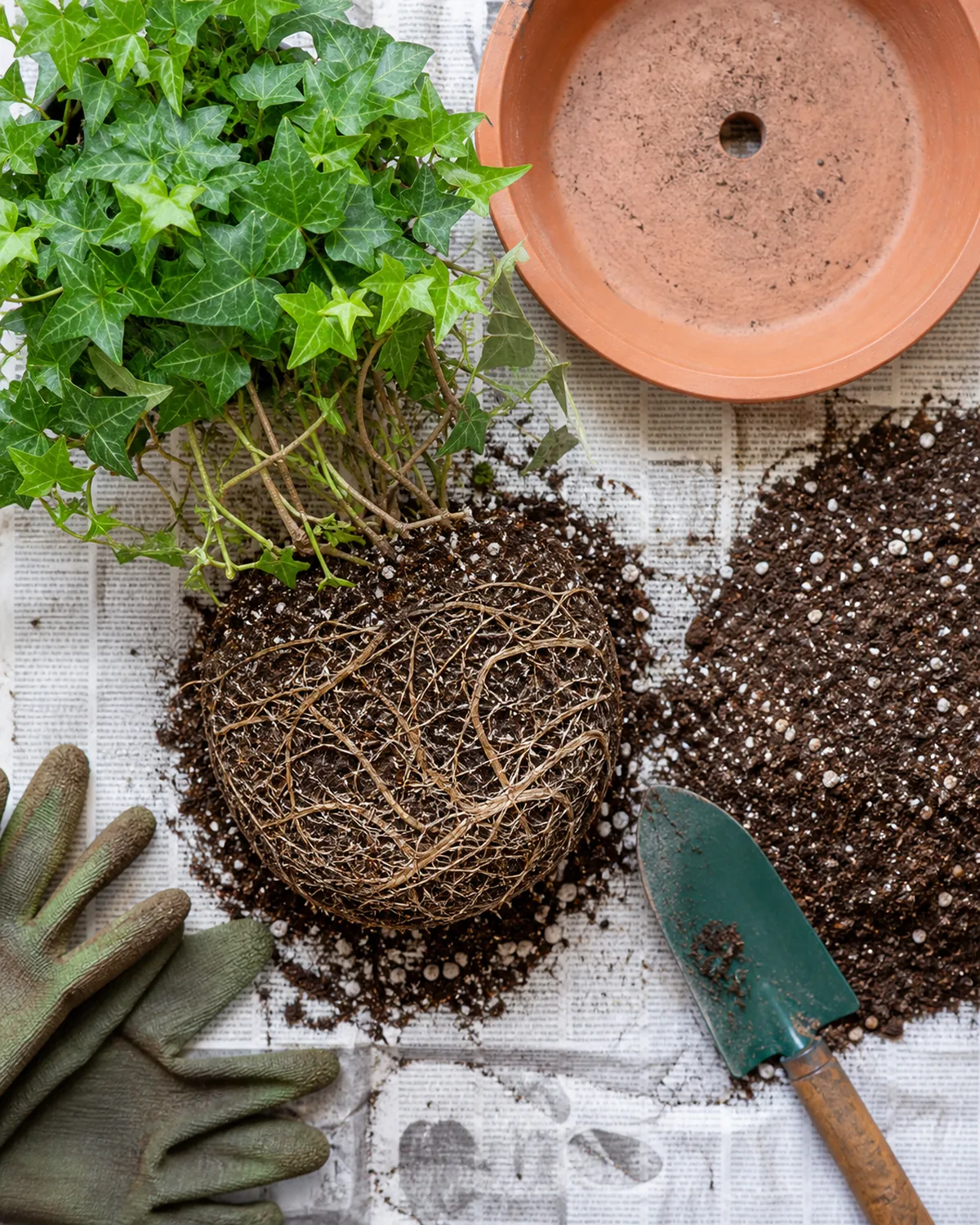
English ivy does not need a specialized soil blend. A standard well-draining potting mix works well. If your mix retains too much moisture — the soil stays wet for more than three or four days after watering — add 20 to 30 percent extra perlite to improve drainage and aeration.
Ivy has a relatively shallow root system compared to deep-rooted plants like rubber plants or fiddle leaf figs. Wide, shallow pots suit it better than tall, deep containers. The classic ivy container is a hanging basket, which displays the trailing growth to best effect and keeps the rootlets from attaching to nearby surfaces.
Terracotta pots are an excellent choice for ivy. The porous clay wicks excess moisture away from the soil, reducing the risk of overwatering — a common problem with plastic pots that hold moisture longer.
Repot every one to two years in spring, when you see roots circling the bottom of the pot or emerging from the drainage holes. Ivy tolerates being slightly root-bound, so there is no rush to upsize. When you do repot, go up only one pot size — one to two inches larger in diameter. An oversized pot holds too much moisture around the roots, which increases rot risk.
For a step-by-step walkthrough of the repotting process that applies across plant types, see the repotting indoor plants guide.
Feeding schedule through the seasons
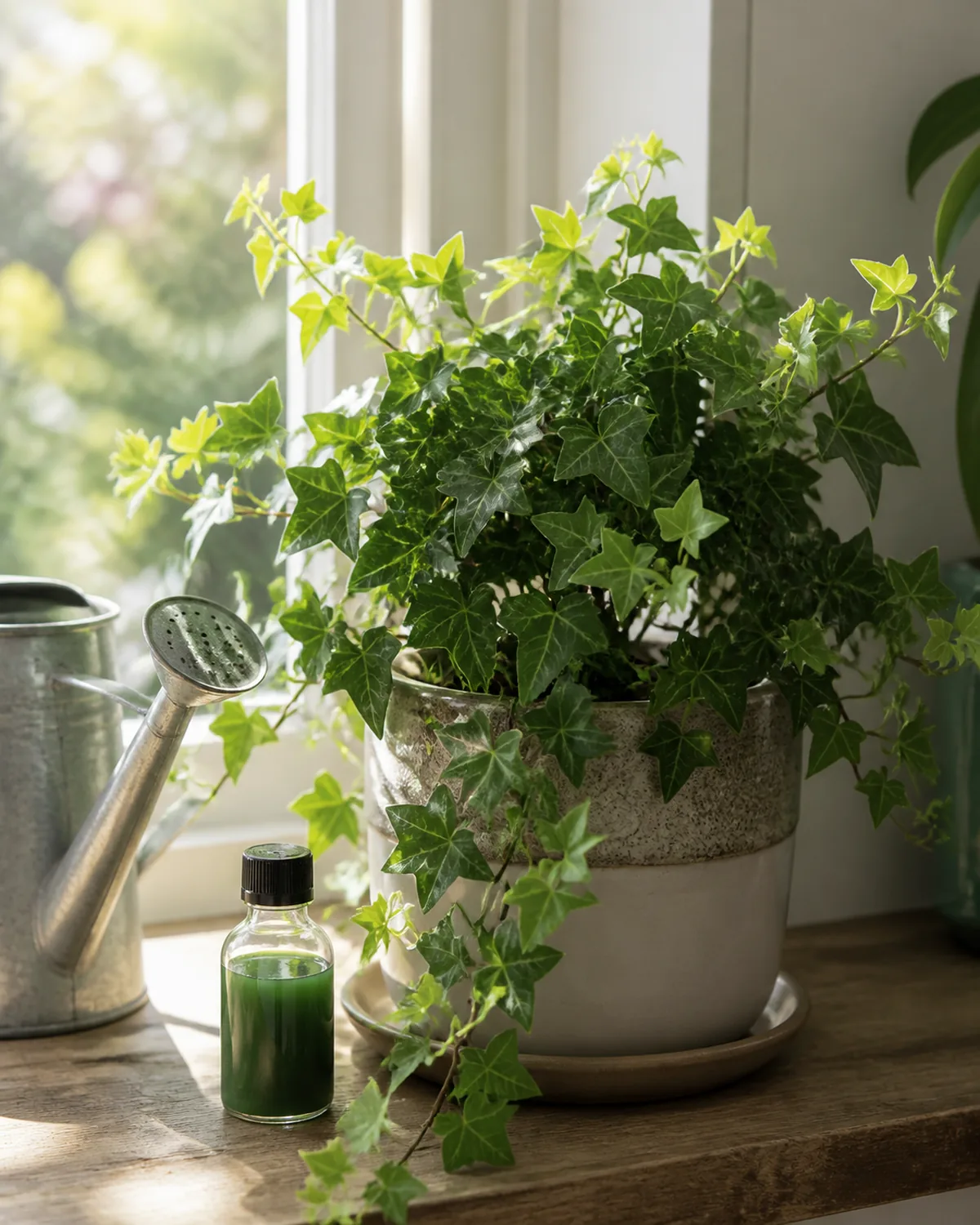
Feed ivy with a balanced liquid fertilizer — 10-10-10 or 20-20-20 — diluted to half the label strength. Apply monthly during spring and summer, when the plant is actively producing new leaves and extending its vines.
Stop fertilizing entirely from November through February. Ivy's natural rest period coincides with the cool-season slowdown, and feeding during dormancy pushes weak growth that the plant cannot sustain under reduced winter light.
Overfertilizing shows as brown, crispy leaf edges and a white salt crust on the soil surface. If you see these signs, flush the soil by running plain water through the pot for several minutes to wash out excess salts. Skip the next two scheduled feedings and resume at a lower dilution.
Slow-release granules applied once in spring are a low-maintenance alternative to monthly liquid feeding. A single application covers the entire growing season without the risk of forgetting or double-dosing.
Ivy growing in low light needs even less fertilizer than ivy in bright conditions. Reduce feeding to every six to eight weeks — the plant is growing more slowly and cannot process nutrients as quickly.
Never fertilize a stressed, sick, or freshly repotted plant. Wait until you see signs of active new growth before resuming feeding. A plant fighting root rot or recovering from a move does not benefit from fertilizer — it benefits from stable conditions and time.
For a complete look at fertilizer types, dilution ratios, and burn-recovery protocols, see the fertilizing houseplants guide.
Pruning and training for the shape you want
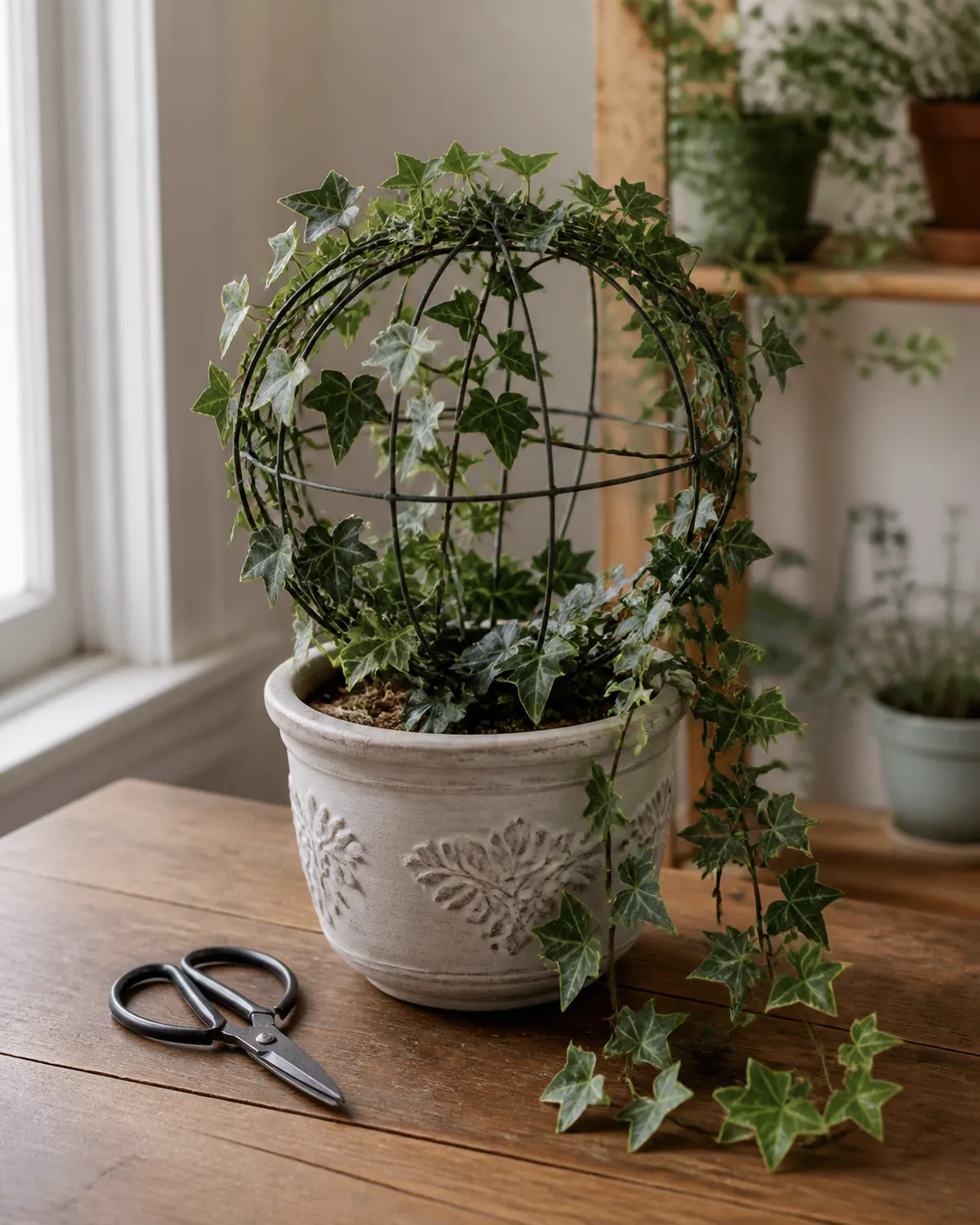
Ivy responds to pruning better than almost any other houseplant. Every cut stimulates dormant buds below the cut point, producing two or more new side branches. This makes it one of the most forgiving plants to shape.
Prune any time of year, but the heaviest pruning is best done in spring when growth resumes and the plant can fill back in quickly. Pinch growing tips regularly to encourage side branching — without pruning, ivy grows long single vines that become bare and leggy as older leaves drop.
Three training styles are available with ivy — options not possible with most other houseplants because ivy is one of the few that genuinely self-attaches:
Trailing from a hanging basket or shelf edge is the simplest approach. Let the vines grow long and cascade downward. Pinch tips to encourage fullness. This style works well in hanging plant displays.
Climbing a moss pole, trellis, or textured surface. Ivy grips with its aerial rootlets, which need a rough surface to attach — smooth plastic poles will not work. A cork bark panel, a jute-wrapped dowel, or a small wooden trellis are better options.
Topiary form, wrapped around a wire frame. This is where ivy's adhesive rootlets truly shine. You can train it into sphere, heart, cone, or animal shapes by wrapping young vines around the frame and securing them loosely with twine until the rootlets grip on their own. Ivy topiaries are a classic indoor display that few other plants can replicate.
If you have a variegated cultivar, remove any all-green stems as soon as they appear. Green shoots grow faster than variegated ones and will eventually overtake the plant if left unchecked.
For leggy, bare-stemmed ivy that has lost its lower leaves, the remedy is aggressive pruning: cut the vines back to four to six inches from the soil line. The plant will regrow from dormant buds along the remaining stems. The result is a fuller, bushier plant within a few months.
Use sharp, clean scissors or pruning shears. Ivy stems become woody with age, and dull scissors crush rather than cut — creating ragged wounds that heal slowly and invite disease.
Propagation from stem cuttings
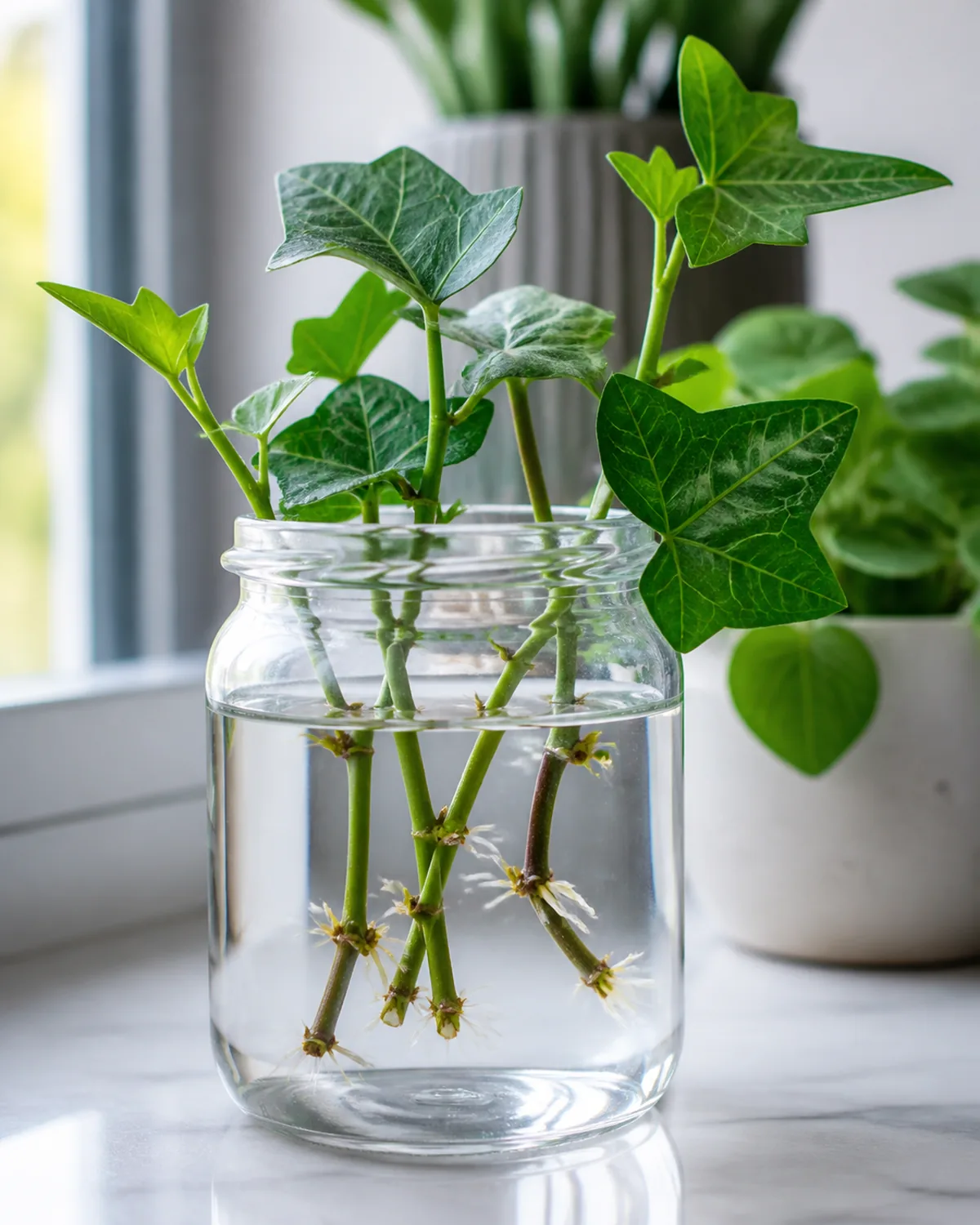
English ivy is one of the easiest houseplants to propagate. Stem cuttings root reliably in water or soil, and a single pruning session can produce a dozen new plants.
Cut four-to-six-inch stem sections just below a node — the bump where a leaf attaches to the stem. The node is where roots will emerge. Remove the bottom two or three leaves to expose the nodes that will be submerged in water or buried in soil.
Water propagation is the simplest method. Place the cuttings in a jar of clean water with at least two nodes submerged. Roots appear in two to three weeks at room temperature, faster during the warm growing season. Change the water weekly to prevent stagnation and bacterial growth. Transplant to soil when roots reach one to two inches long.
Soil propagation skips the transplant step. Dip the cut end in rooting hormone, insert it into moist potting mix with the exposed nodes buried, and keep the soil evenly moist. Covering the pot with a clear plastic bag creates a humid microclimate that speeds root development. New leaf growth at the top signals that roots have established.
Putting multiple cuttings in one pot creates a fuller plant faster — a useful trick when you want a bushy specimen rather than a single vine.
One detail specific to ivy: root cuttings in cool temperatures, around 60 to 65°F. This is one of the few plants where cool water rooting actually beats warm. The temperate heritage of ivy means its root-initiation enzymes work most efficiently at temperatures that would slow tropical plants like pothos or philodendron.
For a broader look at propagation methods across different plant types — stem cuttings, division, layering, and more — the plant propagation guide covers the full toolkit.
Spider mites and the pests that target ivy first
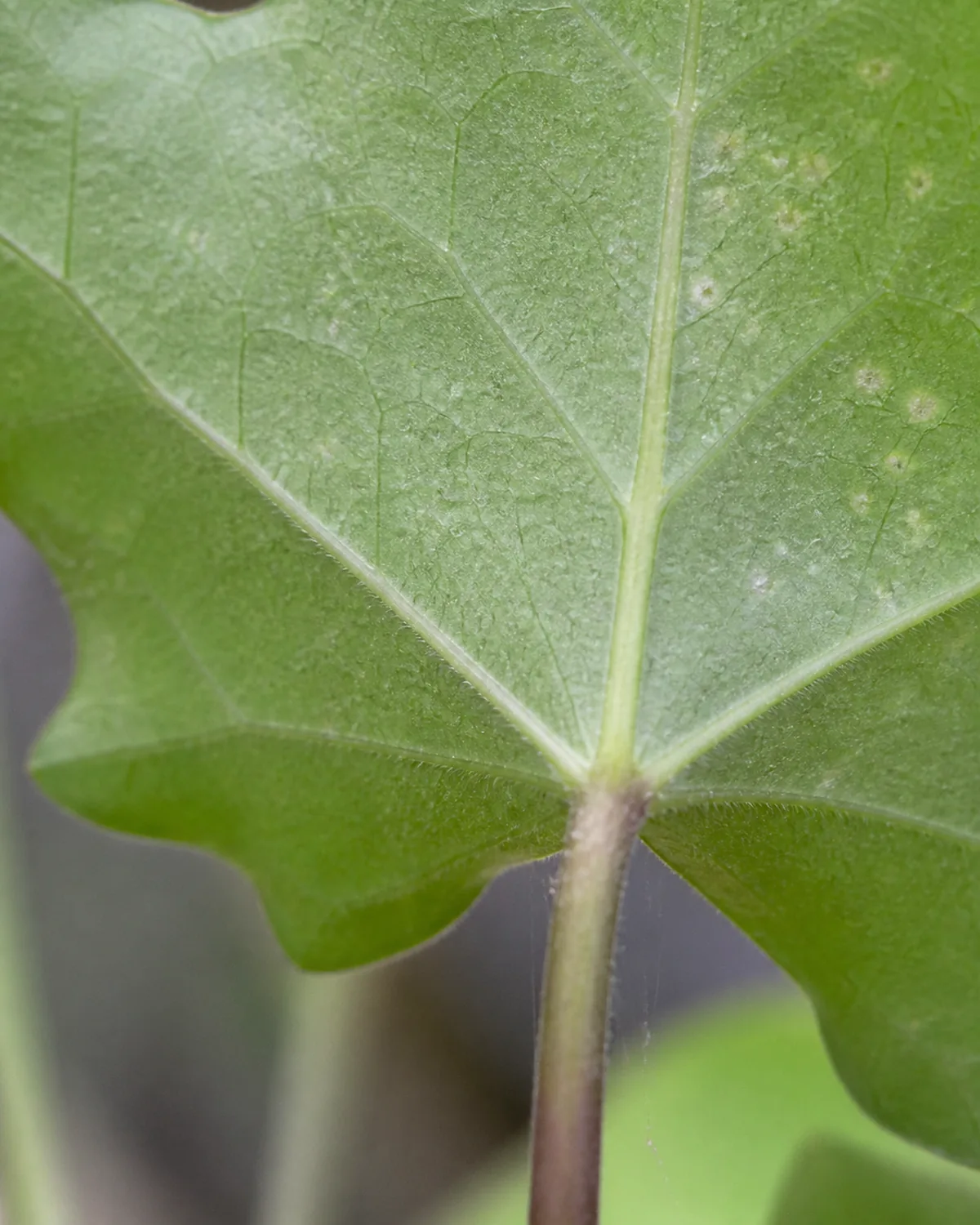
Spider mites are ivy's nemesis. No other common houseplant attracts them as reliably or suffers as severely.
The reason is environmental: spider mites reproduce fastest above 70°F and below 40 percent humidity. That is exactly where most heated homes sit in winter, and exactly the environment that stresses ivy most.
The plant is weakened by warmth and dryness at the precise moment its primary predator is thriving. This feedback loop is more extreme in ivy than in any other common houseplant.
Early detection is everything. The first signs are tiny yellow speckles on the upper leaf surface — stippling. Each speck is a cell that a mite has punctured and drained. Fine webbing between leaves and stems follows as the population grows. The webbing is often mistaken for dust or cobwebs. By the time webbing is obvious, the infestation is advanced.
To check for mites, hold a white piece of paper under a branch and tap the stems. Tiny moving dots on the paper — smaller than a grain of sand — are mites.
Prevention is more effective than treatment:
- Shower the foliage monthly in a sink or bathtub with lukewarm water. This physically dislodges mites, eggs, and dust.
- Keep ivy in the coolest room possible. Below 65°F, mite reproduction slows dramatically.
- Maintain humidity above 40 percent with a nearby humidifier.
- Mist the leaves several times per week during heating season.
Treatment when mites have already colonized: apply insecticidal soap or neem oil every five to seven days for three consecutive weeks. The three-week cycle is critical — it covers the mite lifecycle from egg to adult. A single treatment kills active mites but leaves eggs unharmed, and the population rebounds within days.
Isolate any infested ivy immediately. Mites spread to neighboring plants via wind currents and physical contact.
Scale insects are the second most common pest on ivy, particularly on older woody stems. They appear as small brown or tan bumps that do not move. Scrape them off with a cotton swab dipped in rubbing alcohol, and follow with horticultural oil to suffocate any remaining crawlers.
Aphids occasionally cluster on soft new growth tips. A strong spray of water knocks them off, and neem oil prevents recurrence.
For the complete pest identification and treatment protocol, see the houseplant pests and diseases guide.
Four ivy mistakes almost everyone makes
- 1Placing ivy near a heating ventWarm dry air is spider mite paradise. Within weeks, you will see stippling on the leaves and fine webbing on the stems. Move ivy to the coolest room instead.
- 2Treating it like a tropicalIvy wants 50-65°F, not 70-80°F. It wants moderate humidity, not tropical dampness. Grouping it with aroids in a warm humid corner stresses it more than helping.
- 3Never pruningUnpruned ivy becomes a single long vine with bare stems and leaves only at the tips. Pinch or cut the growing tips monthly — every cut forces two or more side branches.
- 4Ignoring tiny yellow leaf specksThose are spider mite feeding marks, not nutrient deficiency. Flip the leaf and look for webbing. Early detection saves the plant — a month of delay can mean total defoliation.
kultivy.com
Toxicity and skin reactions to watch for
English ivy is mildly toxic to cats, dogs, and humans. The ASPCA lists it as toxic, and the primary compounds responsible are triterpenoid saponins — specifically hederagenin.
If a pet or child ingests ivy leaves, symptoms include drooling, vomiting, abdominal pain, and diarrhea. The effects are usually self-limiting and rarely severe, but veterinary or medical guidance is appropriate for any ingestion.
The more common concern for plant owners is contact dermatitis. Ivy sap contains falcarinol, a compound that triggers allergic skin reactions in sensitive individuals. The result is a red, itchy rash that can progress to blisters in severe cases. The reaction can take 24 to 48 hours to appear, so people often do not connect the rash to their pruning session two days earlier.
Wear gloves when pruning, propagating, or repotting ivy. Wash your hands thoroughly after handling the plant, even if you did not break any stems — the sap can transfer from cut surfaces to skin through casual contact.
An important clarification: English ivy (Hedera helix) is completely unrelated to poison ivy (Toxicodendron radicans). They share the common name "ivy" but belong to different plant families — Araliaceae and Anacardiaceae, respectively.
Poison ivy causes a far more severe allergic reaction through urushiol. English ivy's skin irritation is milder and does not produce the characteristic blistering rash.
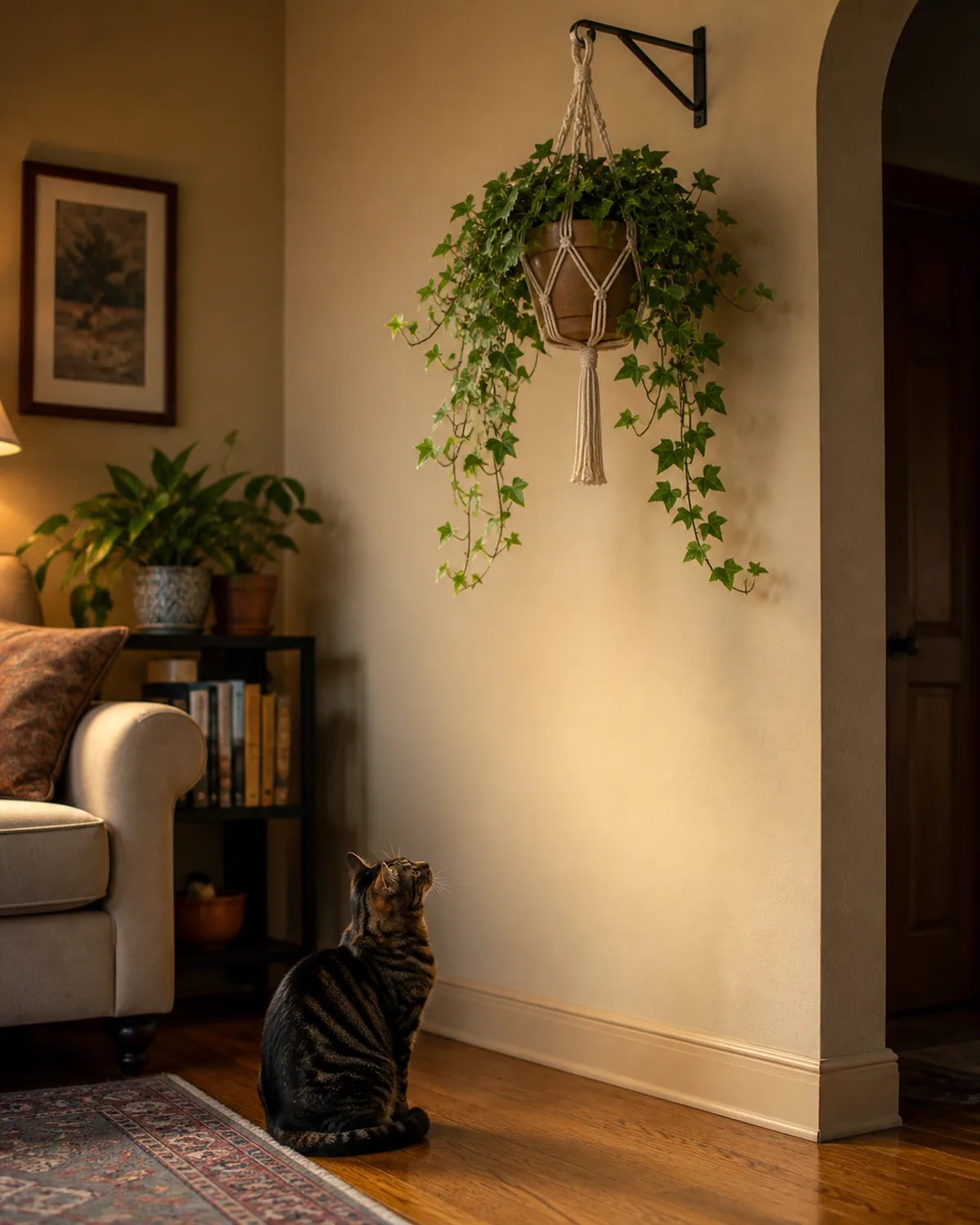
The practical safety approach: hang ivy baskets high enough that trailing vines stay out of reach. Cats are particularly attracted to dangling ivy leaves — the movement triggers their prey instinct. A wall-mounted hook or a high shelf works best.
If you have a pet-safe household and need alternatives, the plants safe for cats guide covers species that pose no risk.
Varieties that work best indoors
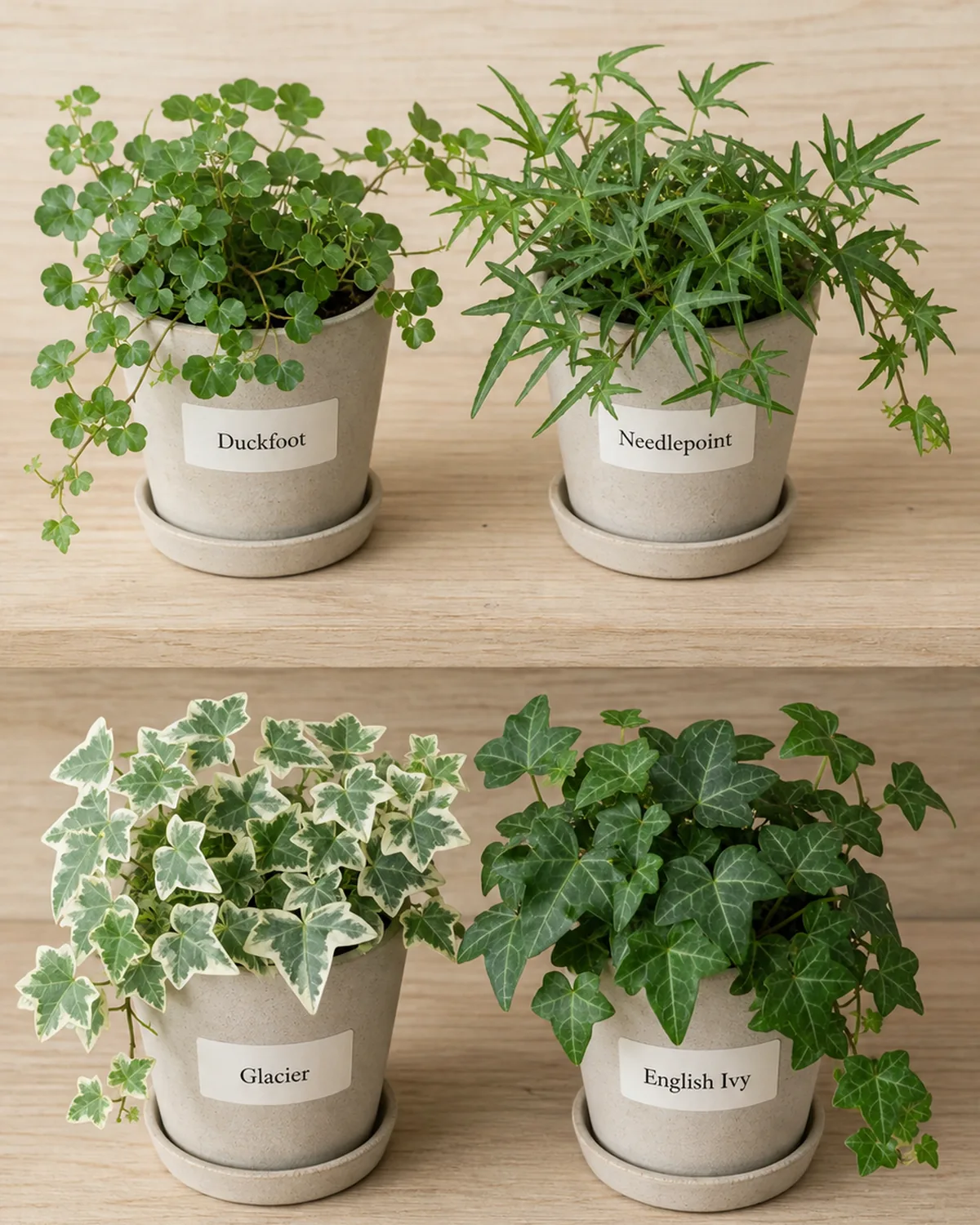
Hundreds of ivy cultivars exist, but a handful dominate the houseplant market. Each has distinct growth habits, leaf shapes, and light requirements that make some better fits for indoor conditions than others.
'Glacier' is one of the best variegated forms for indoors. Silver-green leaves with crisp white edges, compact growth habit, and good tolerance for moderate light. It trails gracefully from hanging baskets without becoming leggy as quickly as some cultivars. If you can only grow one variegated ivy, this is the one.
'Gold Child' carries green leaves with golden-yellow margins — warm-toned variegation that stands out against the cool green of standard ivy. It needs brighter light than 'Glacier' to hold its color. In low light, the gold fades to a greenish-cream, and eventually the leaves revert to solid green.
'Needlepoint' has deeply cut, narrow lobes that give each leaf a lacy, delicate appearance. The effect is elegant and refined — quite different from the broader-lobed look of standard ivy. It is particularly attractive in hanging baskets where the fine-textured foliage creates a feathery cascade.
'Duckfoot' is a miniature cultivar with tiny, rounded lobes that resemble a duck's foot. Its compact growth habit makes it ideal for terrariums, fairy gardens, and small pots where a full-sized ivy would quickly outgrow the container.
'Baltic' is the cold-weather champion. Small dark green leaves, vigorous growth, and the highest tolerance for cool temperatures of any common cultivar. If your ivy will live in an unheated room, 'Baltic' is the most reliable choice.
'Ivalace' has curly, ruffled leaf edges that create an architectural texture unlike any other ivy variety. It grows more slowly than straight-leaved cultivars, which makes it easier to maintain in a defined shape. The ruffled leaves catch light differently, adding visual depth.
Common green English ivy — the species type Hedera helix — is the most vigorous, most shade-tolerant, and least fussy variety. If you are growing ivy for the first time or want a low-maintenance trailing plant for a dim corner, start here.
Persian ivy (Hedera colchica) is a related species with dramatically larger leaves — up to ten inches across. It makes a bold climbing display but needs more light and space than English ivy. Best for a dedicated plant wall or large trellis rather than a hanging basket.
As a general rule: small-leaved varieties trail more gracefully from hanging baskets, large-leaved varieties make better climbing displays, and variegated types need brighter spots than their green counterparts.

Mara Quinn edits Kultivy, where she shares houseplant care, propagation, beginner-friendly plant picks, and plant-styling ideas for anyone who wants their indoor plants to actually thrive. Every guide is image-led and reviewed for clarity, usefulness, image accuracy, and Pinterest-to-page alignment before it goes live. Visit the About page.