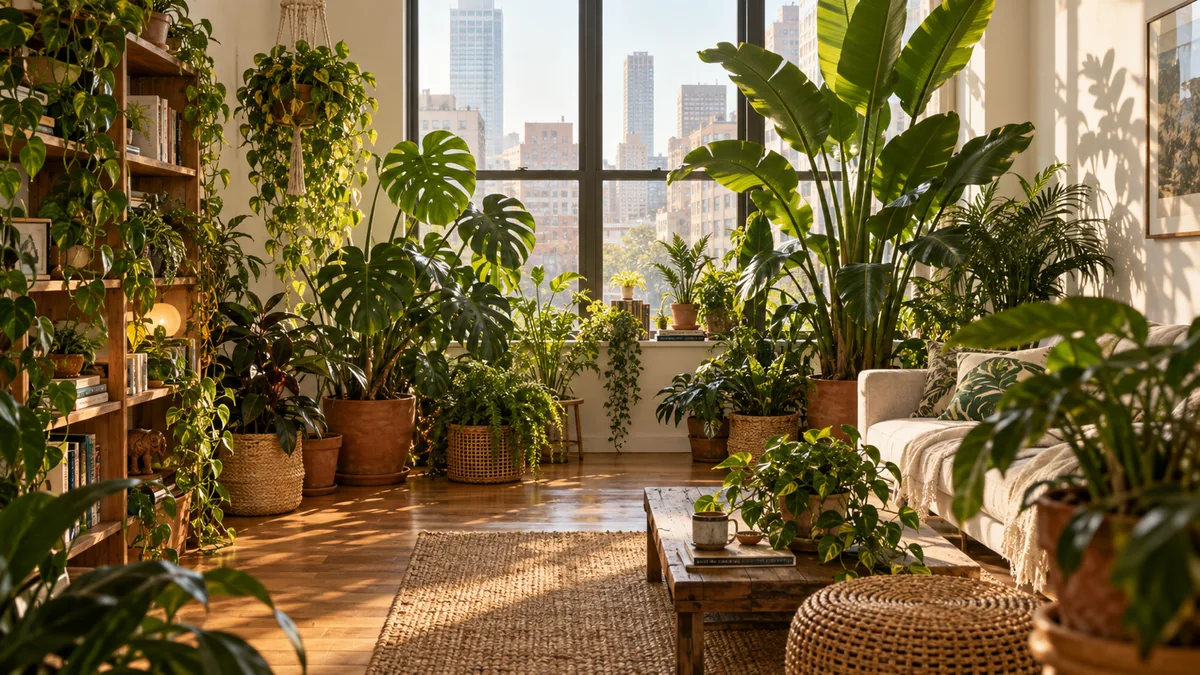
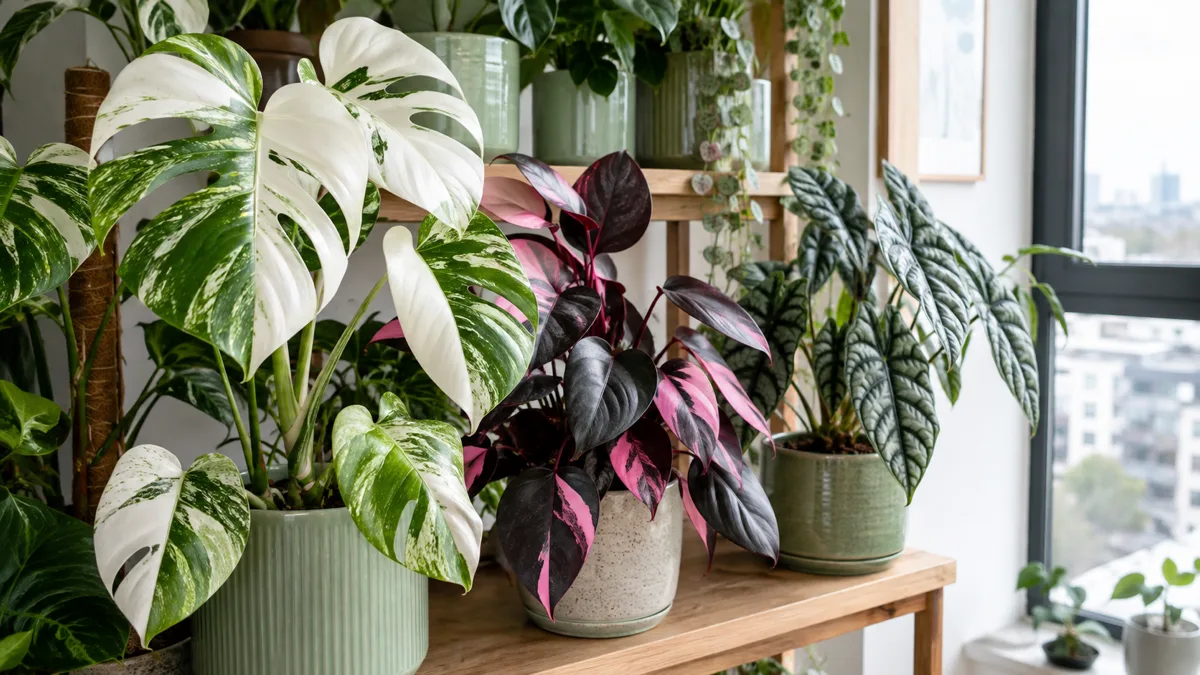
The living room is where every light condition meets every piece of furniture. Bright south windows, shaded corners behind the sofa, and drafty spots near doors all share the same room.
These fifteen plants are matched to specific living room spots — with the mechanism behind why each one works exactly there.
Each pick is paired with the living room spot where it works best — a floor anchor, a trailing shelf accent, a dark-corner survivor, or a windowsill conversation starter. Jump to any plant below.
- 1Monstera beside the sofa
- 2Fiddle leaf fig by a window
- 3Snake plant in a dark corner
- 4Pothos trailing from a shelf
- 5ZZ plant in the entryway
- 6Bird of paradise by a south window
- 7Rubber plant in a furniture gap
- 8Peace lily on a console table
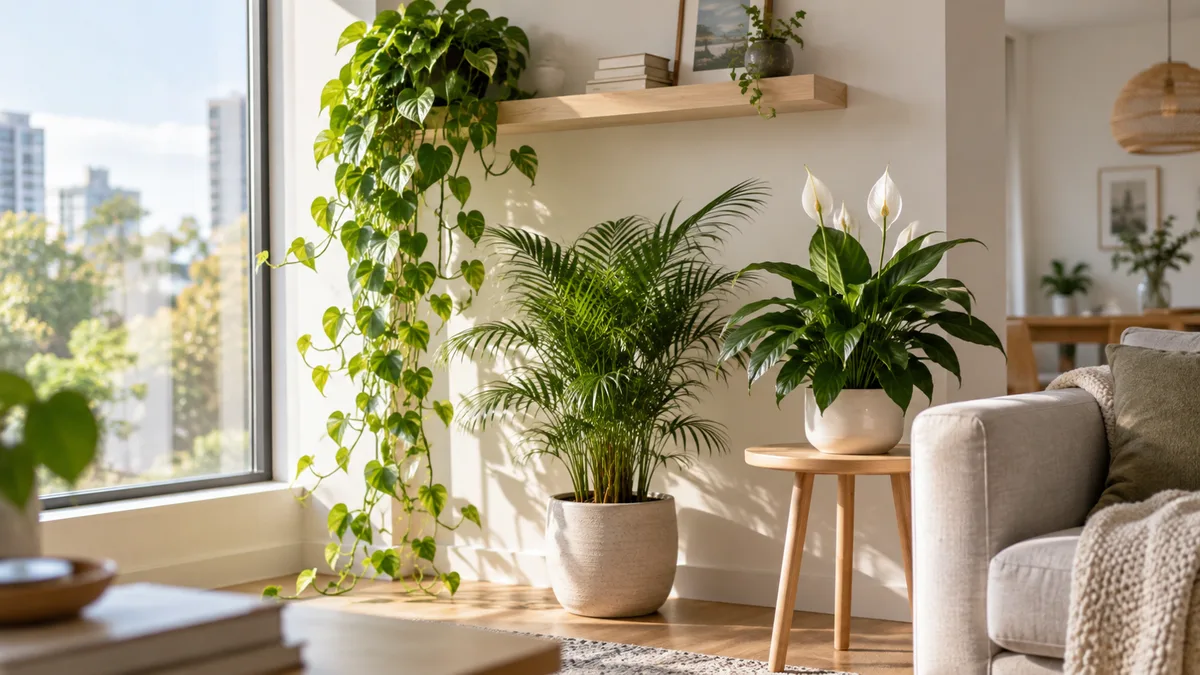
- 9Parlor palm on a side table
- 10Philodendron on a plant stand
- 11Chinese evergreen on a coffee table
- 12String of pearls on a floating shelf
- 13Calathea on a side table
- 14Areca palm as room divider
- 15Pilea on a windowsill
Monstera deliciosa: the floor statement beside the sofa
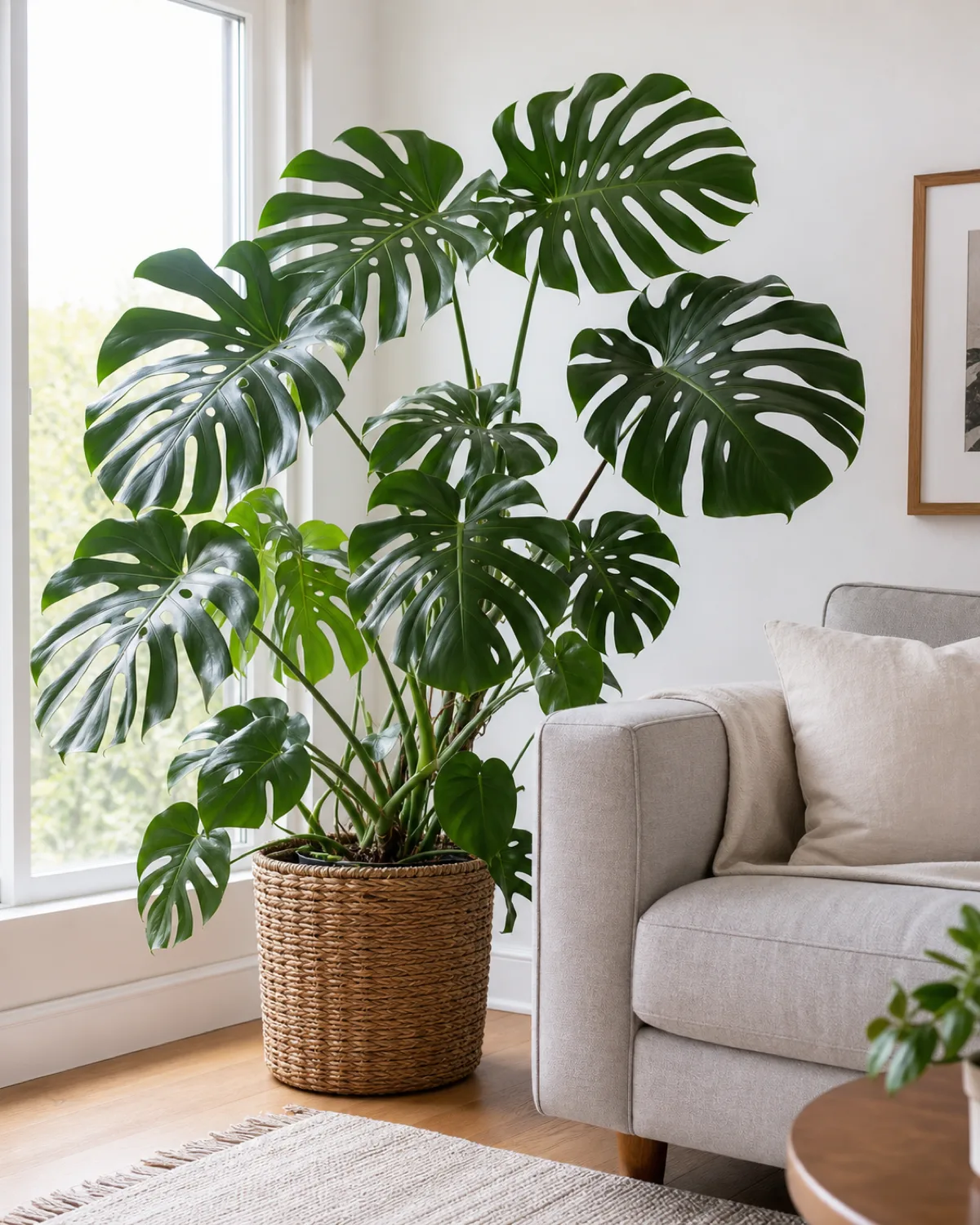
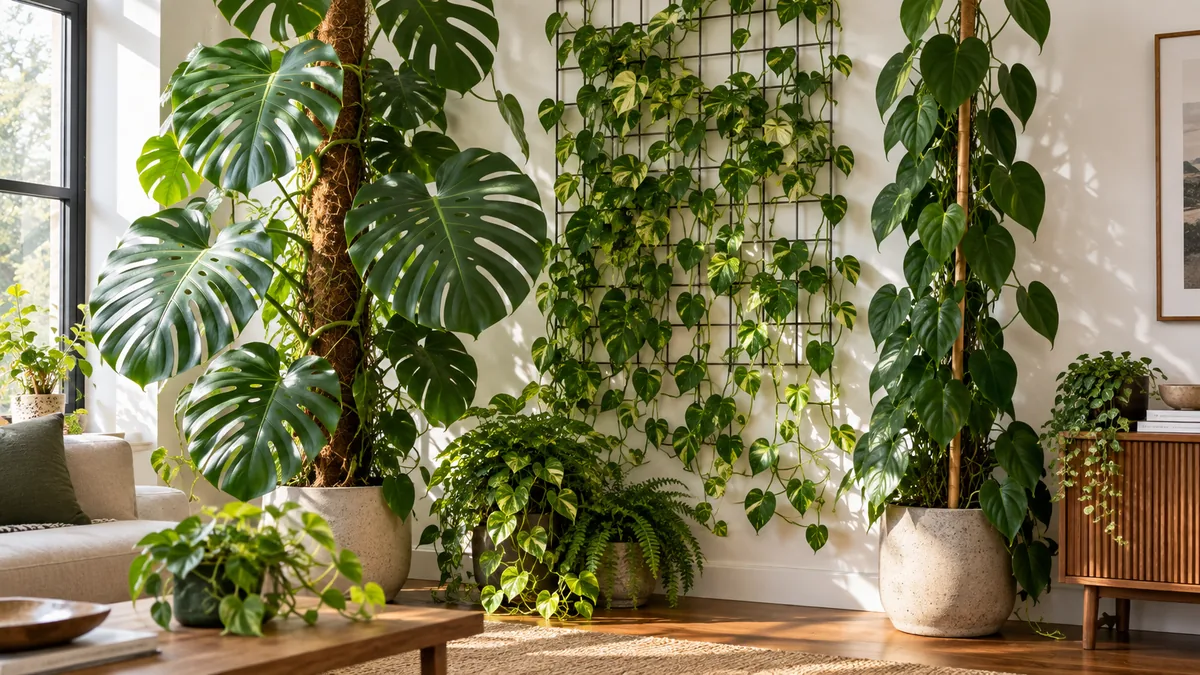
A monstera earns its spot next to the sofa because its fenestrated leaves spread at eye level when you are seated, creating a living backdrop that changes shape as each new leaf unfurls with deeper splits.
Position it two to four feet from a south or west window — far enough to avoid scorching but close enough for the bright indirect light that drives fenestration development.
The wide leaf spread means it needs floor space, not height, making it a better sofa companion than a fiddle leaf fig in rooms with lower ceilings. A mature monstera in a twenty-four-inch pot fills a three-foot radius, so give it room to spread rather than crowding it against the wall.
Our monstera care guide covers the full watering, light, and support details.
Match the plant to the light your specific spot actually gets — not the light you wish it had.
Fiddle leaf fig: the tall sculptural accent by a sunny window
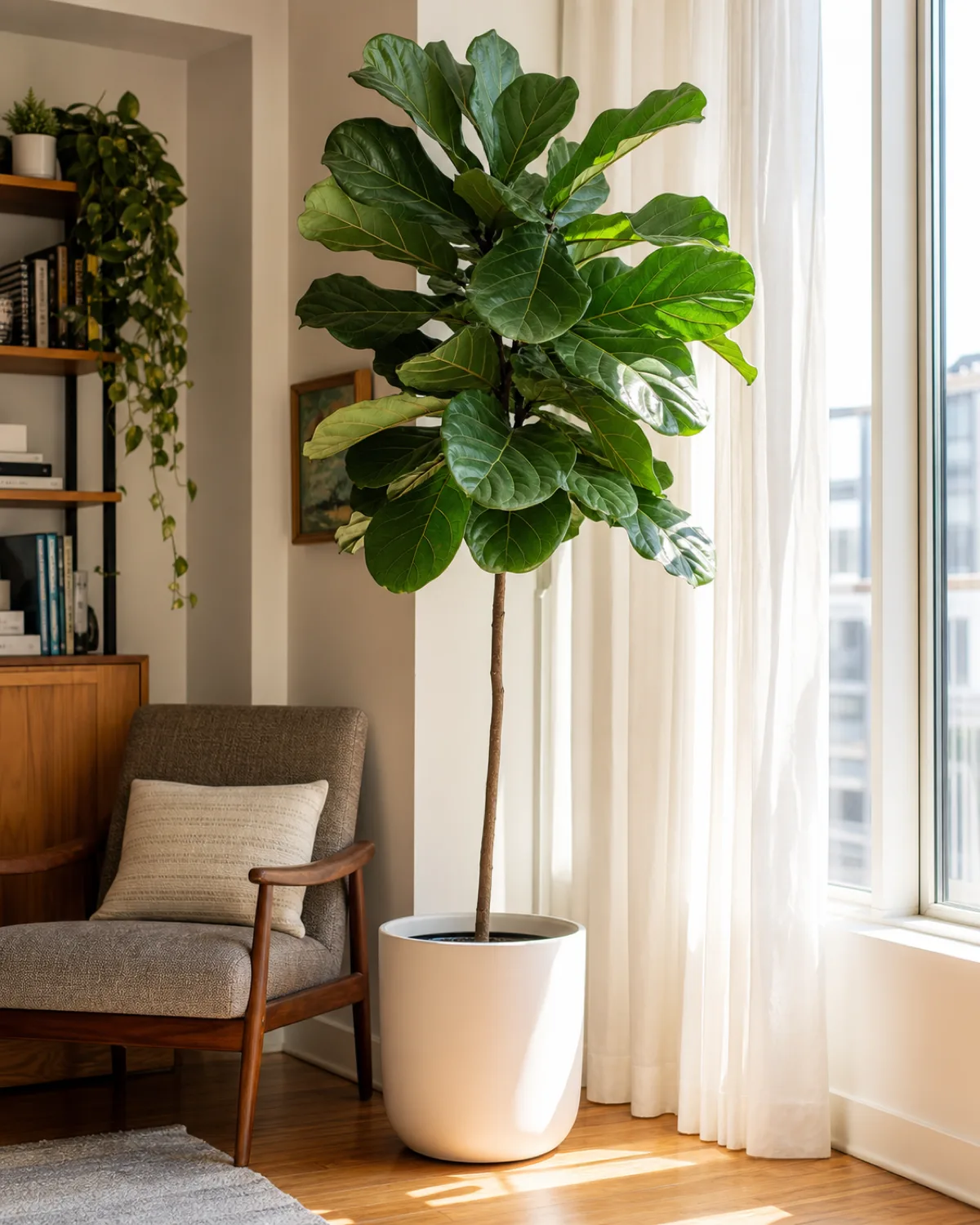
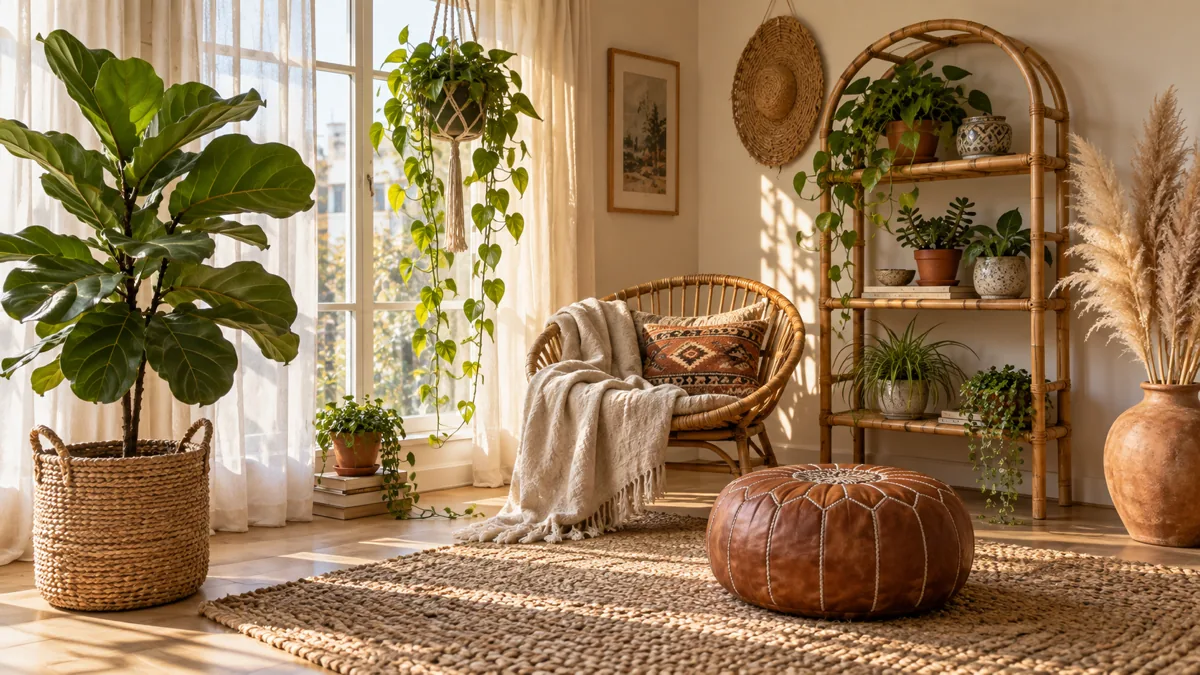
The fiddle leaf fig is a single-trunk tree with violin-shaped leathery leaves that adds vertical drama next to a tall window. It demands a permanent position with at least six hours of bright direct light — once placed, the tree calibrates its leaf angle to that exact light source, and moving it triggers stress-dropping.
In a living room, this no-move rule means choosing its spot is a one-time architectural decision, not a seasonal rotation. A heavy ceramic pot prevents tipping when guests brush past. Our fiddle leaf fig care guide covers the brown-spot diagnosis and the watering rhythm that keeps it healthy long-term.
Snake plant: the dark-corner floor plant for dead zones
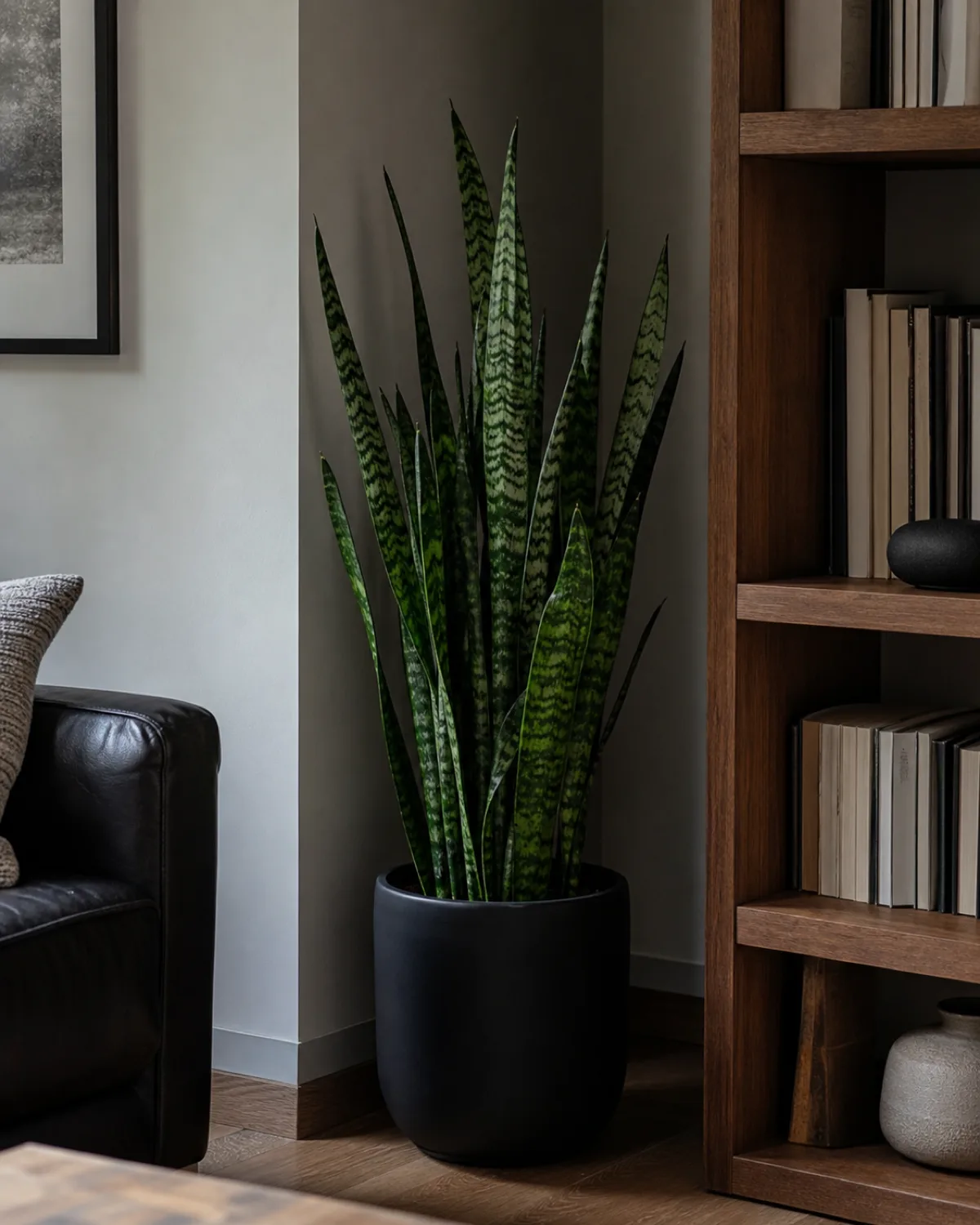
Living rooms always have at least one dead zone — behind the armchair, beside the media console, in the hallway transition where no light reaches. Snake plants colonize these spots because their CAM photosynthesis pathway lets them open stomata only at night, making them uniquely efficient at converting minimal light into growth.
Their rigid vertical blades add architectural line without occupying horizontal floor space, which matters in tight corners between furniture. Water every two to three weeks or when the soil is bone dry. The snake plant care guide covers the full details.
Pothos: trailing from a high bookshelf across the wall
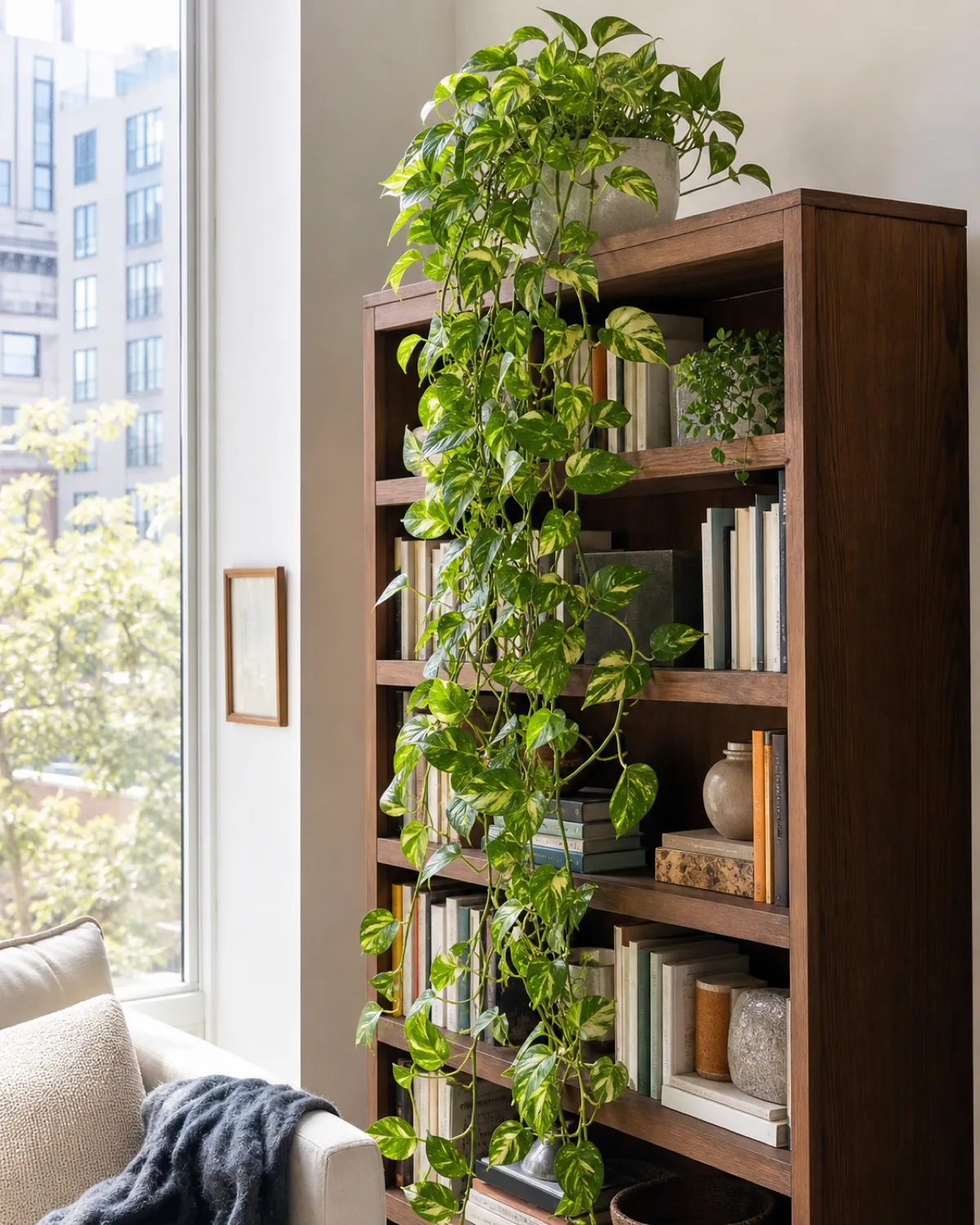
Pothos vines drape six feet or more from a high shelf, softening the hard horizontal lines of bookshelves and entertainment centers with cascading foliage. In a living room, the trailing effect fills vertical dead space between the shelf top and ceiling that no piece of furniture or decor can reach.
Train the vines along adhesive hooks for a directed cascade, or let them hang freely for a looser look. Pothos signals thirst by wilting visibly, then rebounds within hours of watering — a self-reporting system that makes it nearly impossible to kill from neglect. More trailing options in our hanging plants guide, and full care details in the pothos care guide.
ZZ plant: the entryway accent that thrives on neglect
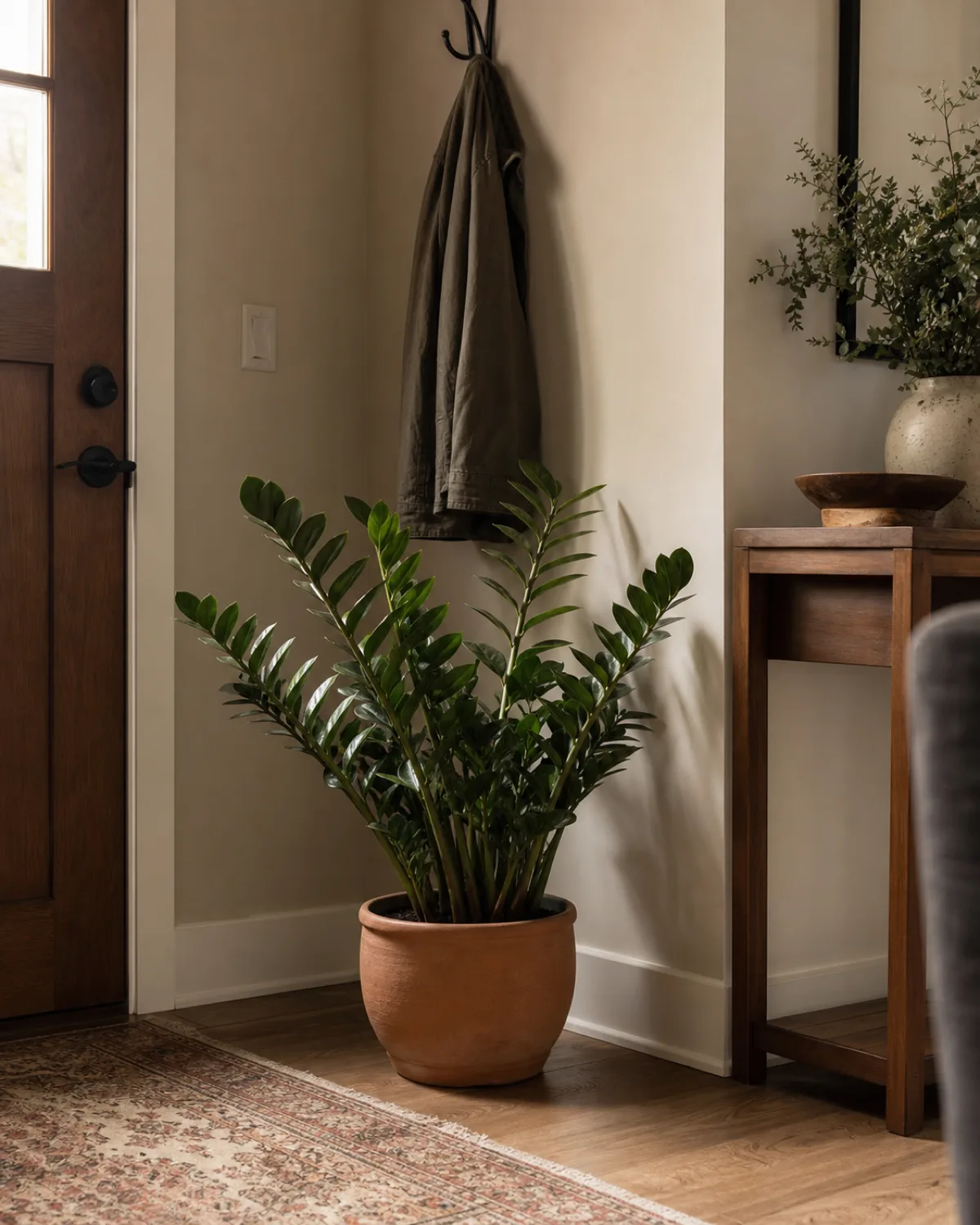
The entryway corner of a living room — where the front door opens, foot traffic flows, and direct light never reaches — is where most plants fail. The ZZ plant claims this spot because its underground potato-like rhizomes store enough water to survive a month without attention, and its waxy dark leaflets reflect ambient light to look polished even in shade.
The architectural wand-shaped stems emerging from a squat pot make a clean visual statement without the height or width that would block a walkway. See the ZZ plant care guide for the full watering and light details.
Bird of paradise: the ceiling-height drama plant by a south window
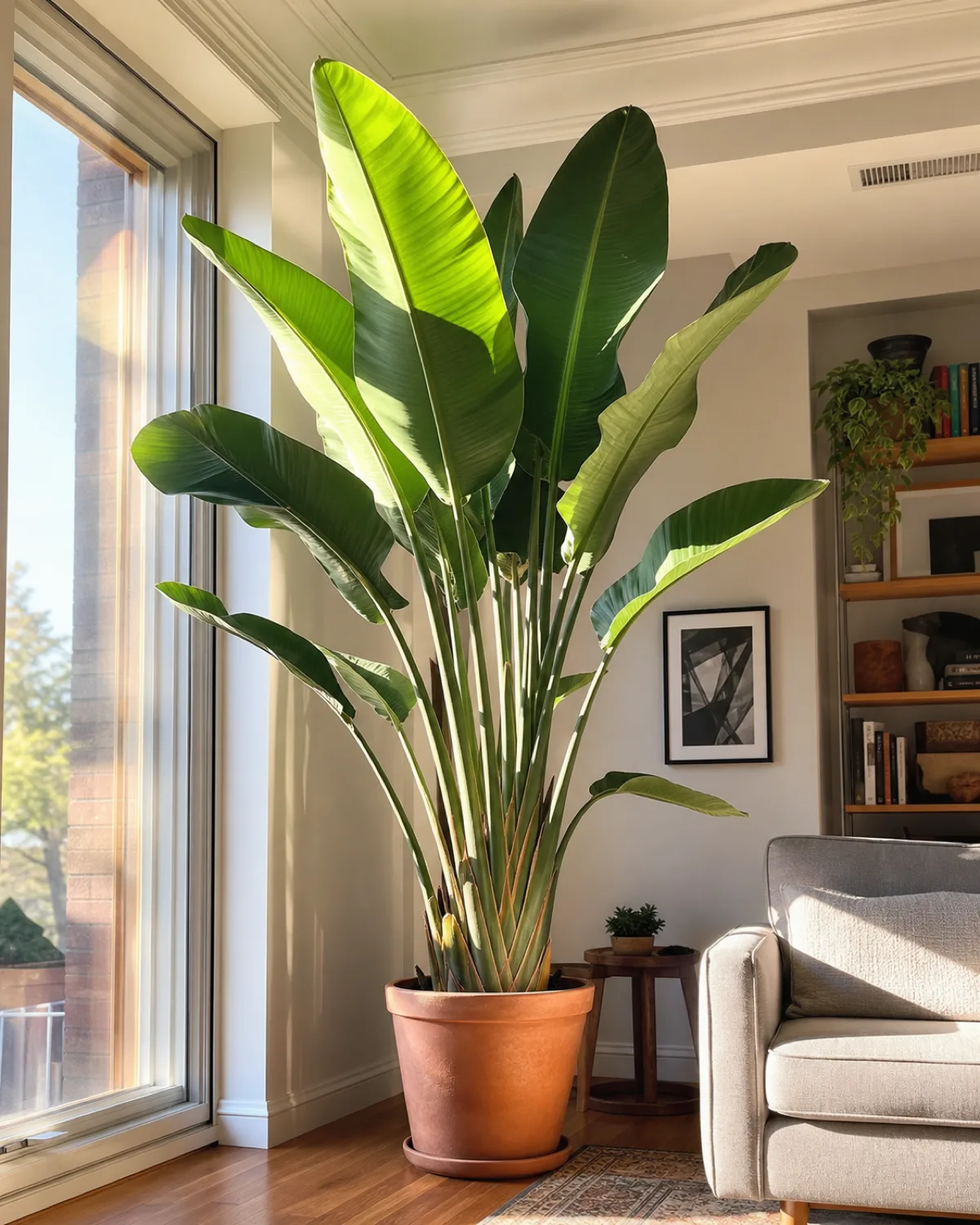
Strelitzia nicolai grows six to eight feet tall indoors with banana-like leaves that fan outward, creating a tropical canopy effect that fills the vertical space between furniture and ceiling. It is the living room anchor for a bright south-facing window — nothing else delivers this much visual mass in a single container.
The leaves naturally orient toward light, creating an asymmetric fan shape that frames the window rather than blocking it. Needs at least six hours of direct sun and a heavy pot that resists tipping when brushed.
Rubber plant: a polished vertical accent for tight furniture gaps
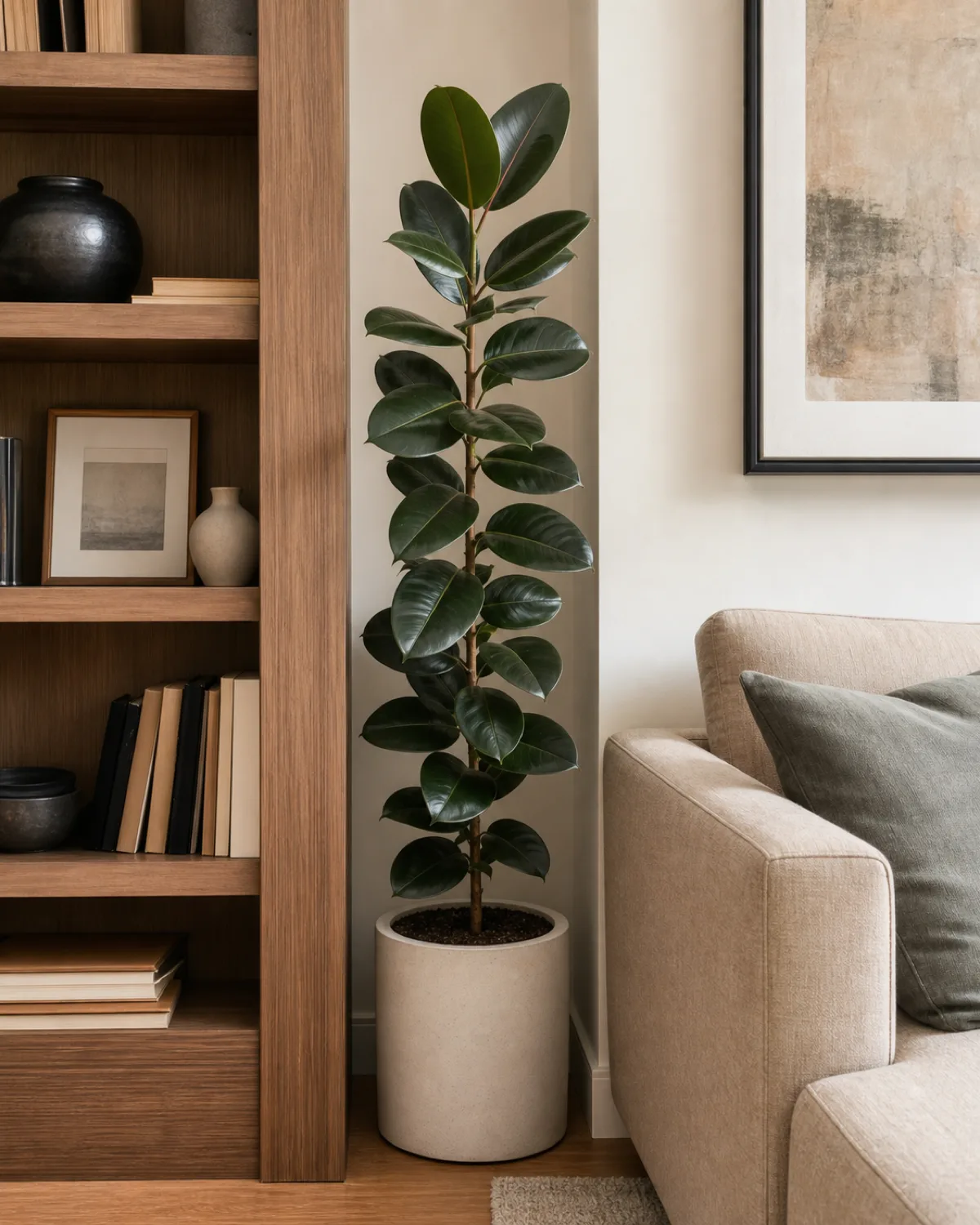
The rubber plant solves a specific living room geometry problem: the eighteen-inch dead slot between a bookcase and a wall, or the narrow gap beside an armchair where a side table would not fit. Its single columnar trunk stays slim while thick oval leaves stack densely along the stem, filling vertical space without sprawling sideways the way a monstera or palm does.
The waxy cuticle on each leaf bounces ambient room lighting, giving the foliage a lacquered finish that reads as deliberate interior styling rather than afterthought greenery.
It tolerates the medium-low conditions typical of these furniture gaps, making it one of the few floor-standing options that does not demand a premium spot near a window. Full care in our rubber plant care guide.
Peace lily: the flowering accent on a console table
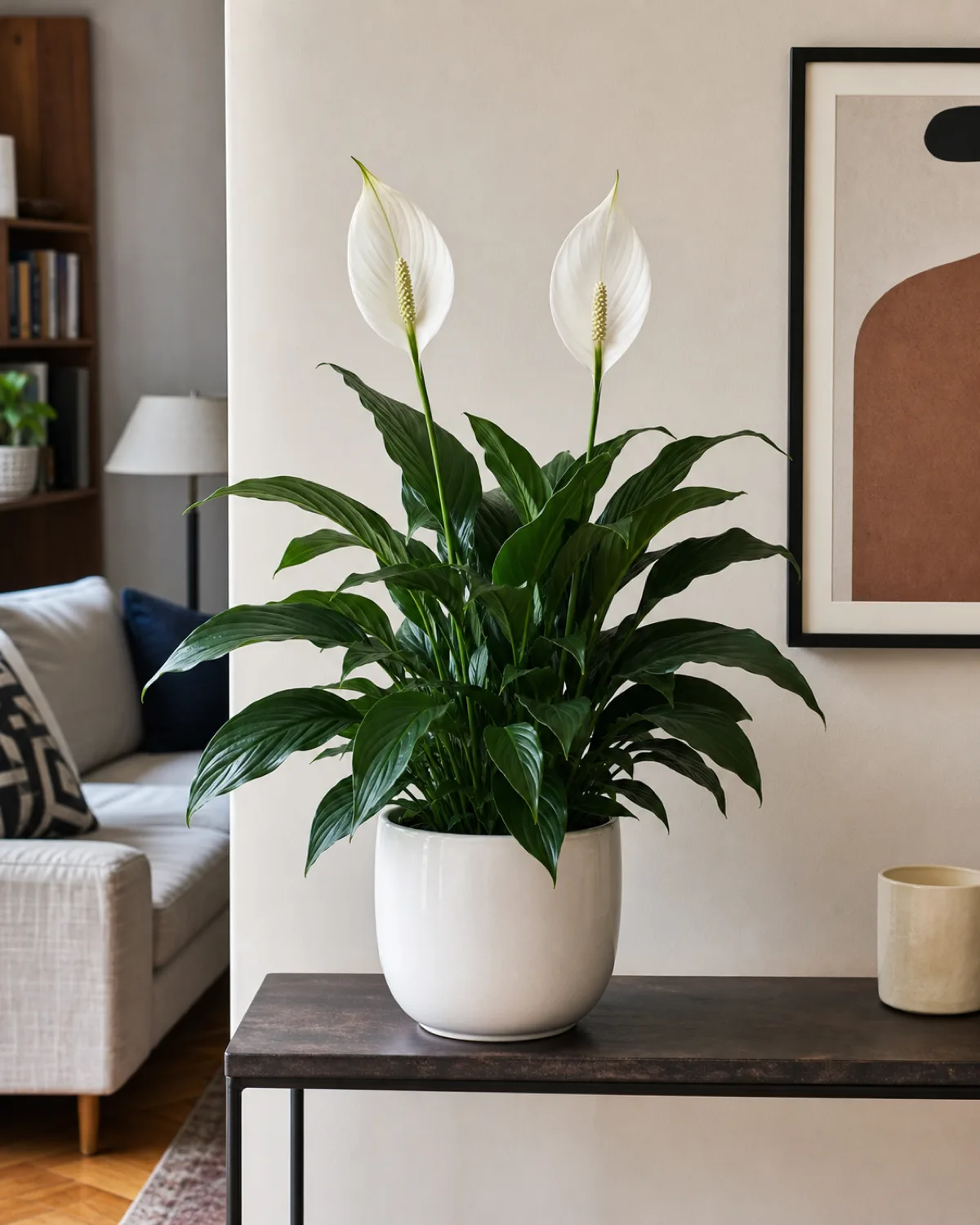
The peace lily produces white spathes that last for weeks in low to medium light — a rare combination that lets it bloom on a console table, mantel, or bookshelf away from direct sun. Its most useful living room feature is its dramatic thirst signal: the entire plant droops when it needs water, then perks up within an hour.
This self-reporting mechanism eliminates guesswork in a room where you might not check on plants daily. Our peace lily care guide covers the full watering rhythm and the flowering cycle.
Parlor palm: a soft textural cluster on a side table
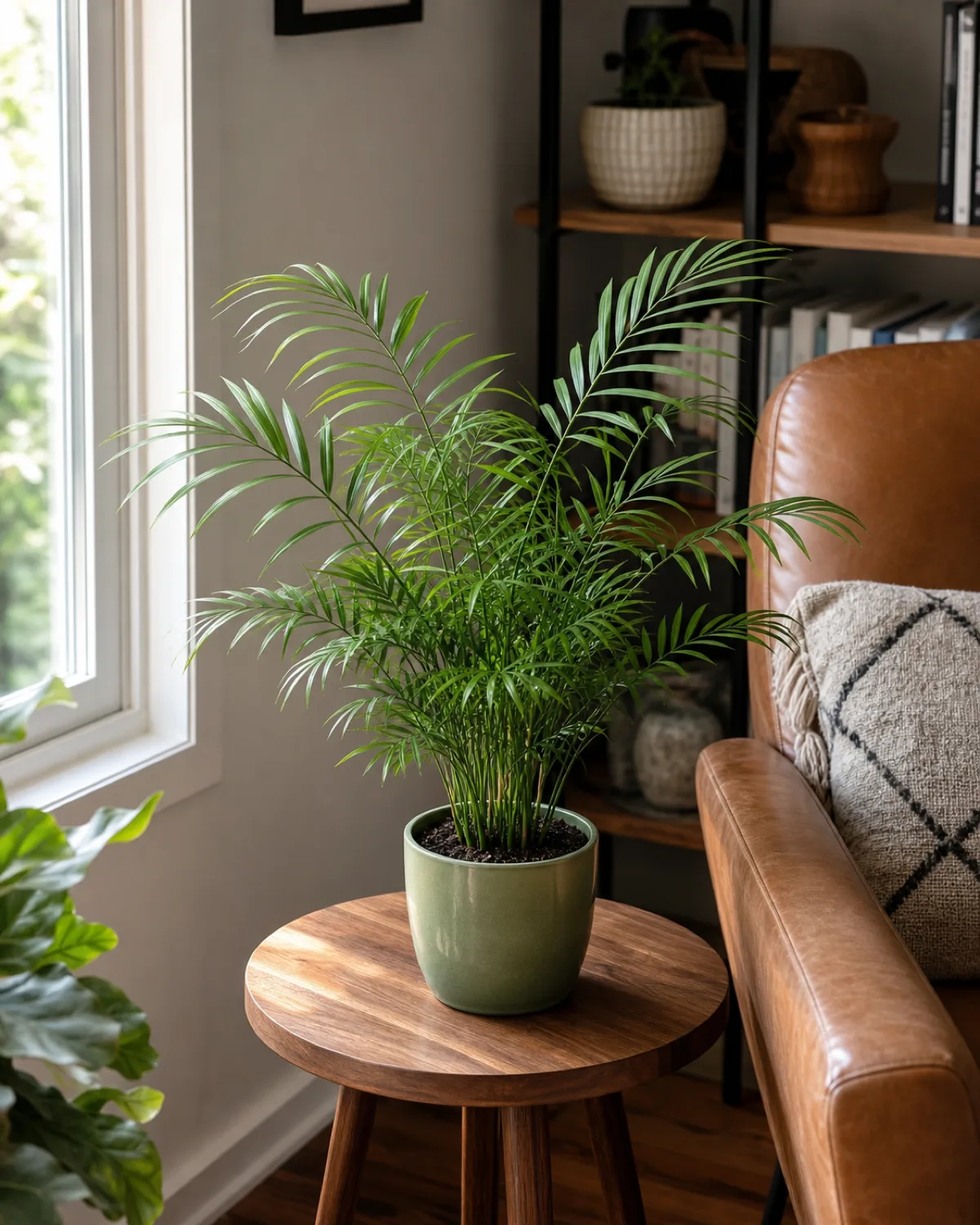
Parlor palms bring feathery arching fronds to side tables and console tops, adding tropical texture at a scale that stays proportional to the furniture beneath. Unlike areca palms that quickly outgrow tabletop containers, parlor palms grow slowly enough to stay in the same pot for two to three years.
They tolerate the lower light levels typical of side tables positioned between furniture, away from windows. See the parlor palm care guide for watering details.
Philodendron: a trailing or climbing vine for a tall plant stand
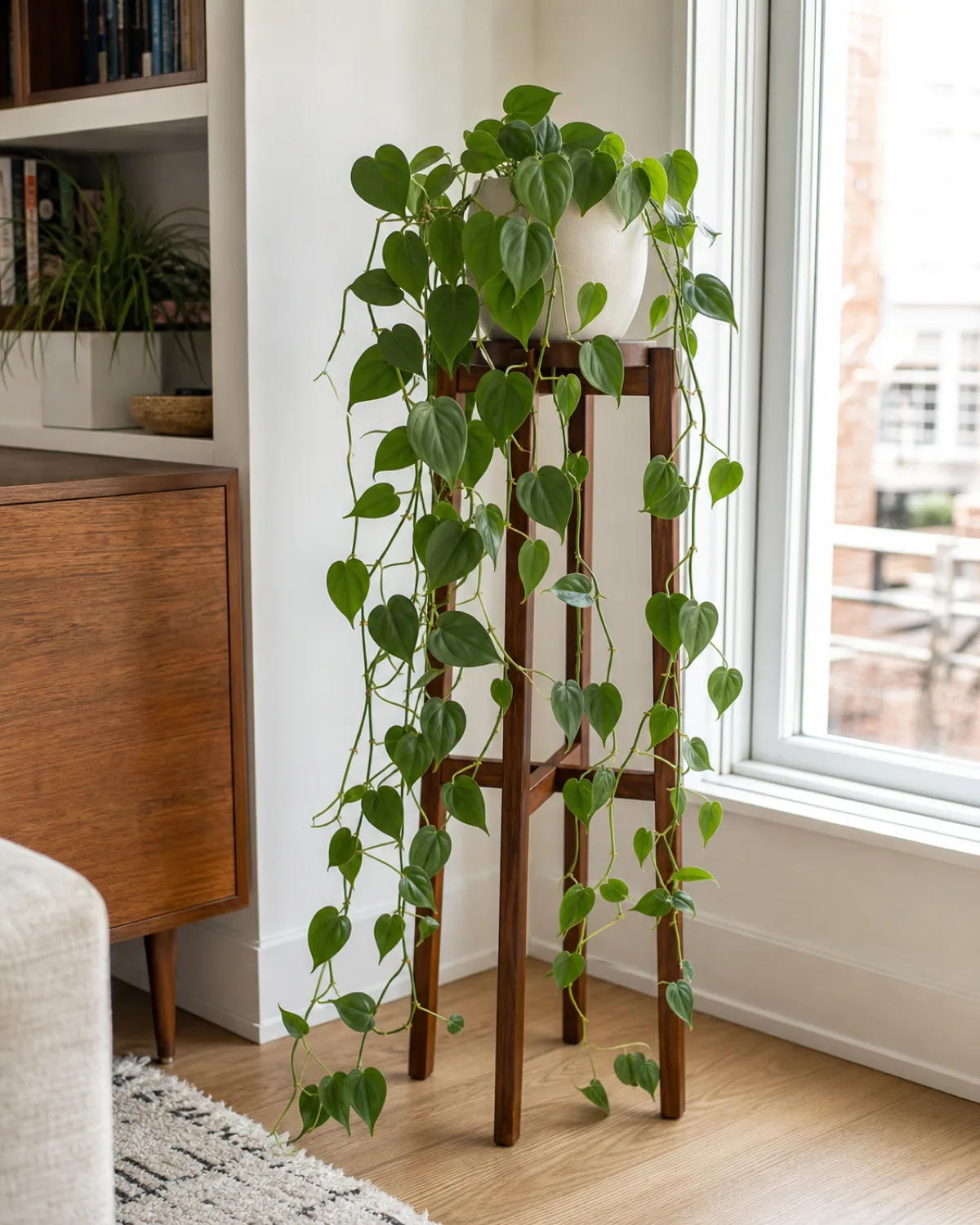
Heart-leaf philodendron adapts its growth habit to whatever support you provide — give it a moss pole and it climbs with aerial roots, remove the support and it cascades downward. On a tall plant stand in a living room, this dual nature lets you choose vertical or trailing growth depending on the surrounding furniture.
Its thin velvet-textured leaves are visually softer and more delicate than pothos, offering a different trailing texture for the same low-maintenance effort. See the philodendron care guide for the full details.
Chinese evergreen: colorful foliage for a coffee table
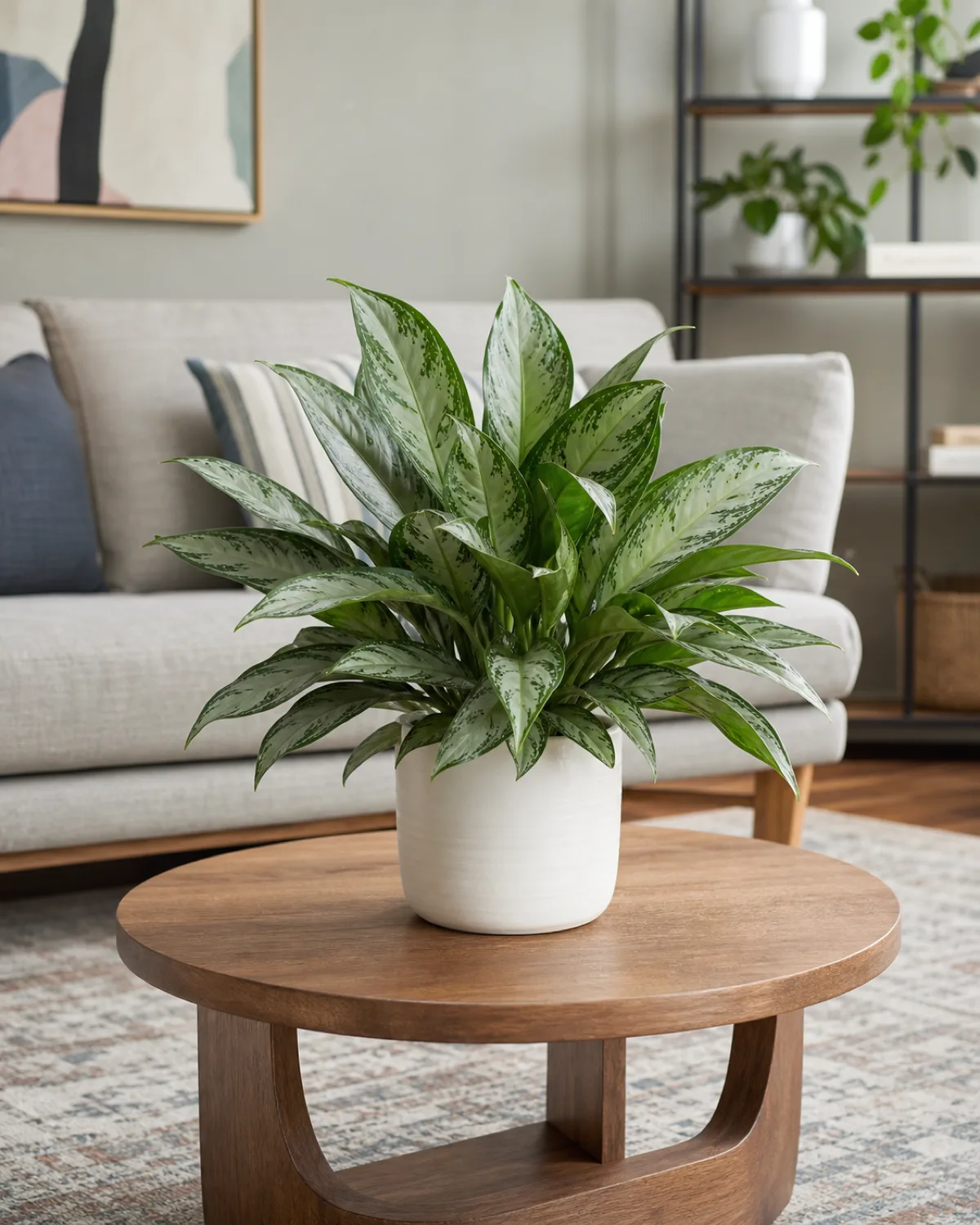
Most plants that tolerate coffee-table distance from a window are plain green. Chinese evergreen breaks this pattern with leaves splashed in silver, pink, or red — and here is the counterintuitive rule: the darker the base green, the less light the variety needs.
A deep-green-and-silver variety thrives on a coffee table six feet from a window, while a pink-and-red variety needs a spot closer to bright indirect light to hold its pigmentation. This inverse relationship makes it easy to match variety to distance from the window. Full care in our Chinese evergreen care guide.
These are the patterns that kill living room plants within the first few months — and the fix for each.
String of pearls: a cascading accent for a floating shelf
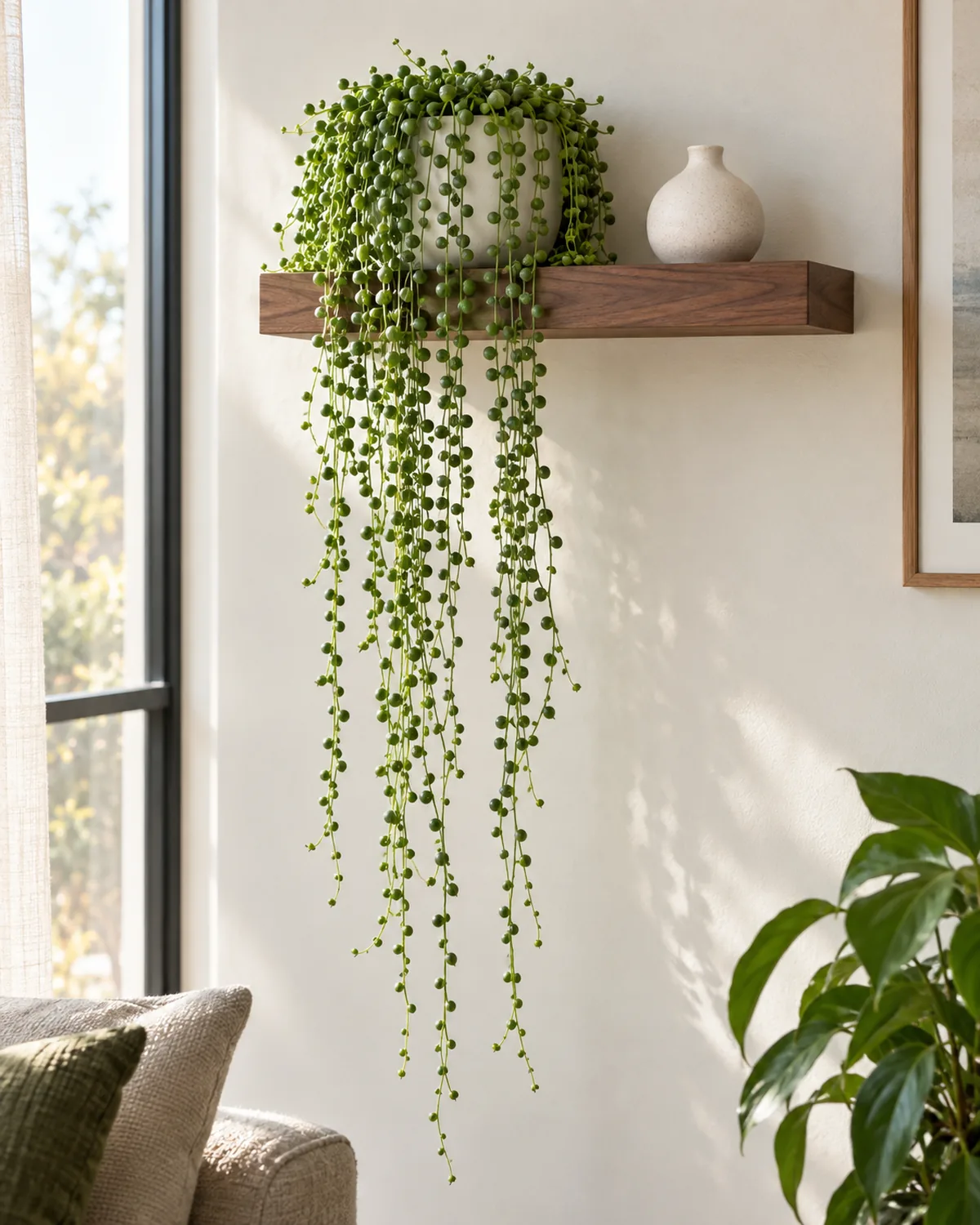
String of pearls drapes from a floating shelf in bead-like chains, creating a living curtain effect that no trailing plant quite matches. Each spherical leaf has a translucent epidermal window that lets light reach the chlorophyll packed inside the bead shape — an adaptation for surviving intense desert sun with minimal surface area.
In a living room, this means it needs the brightest indirect spot you have, typically a floating shelf within three feet of a south or west window. Overwatering, not low light, is the primary killer. See the string of pearls care guide for the full watering method.
Calathea: the living-art piece on a side table
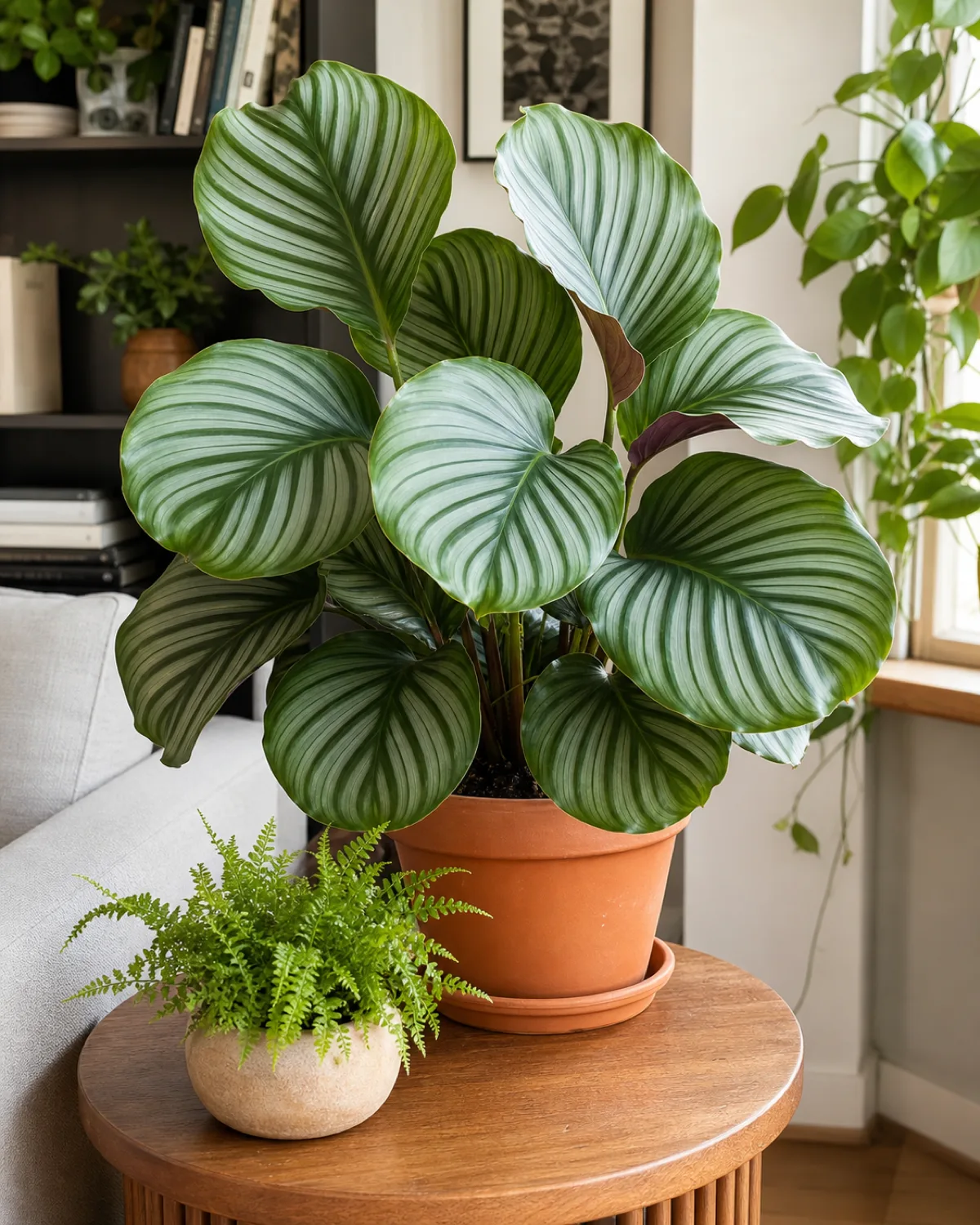
Calathea leaves display geometric stripes and deep purple undersides that make them look hand-painted. More visually interesting than their pattern is their daily movement: each evening the leaves fold upward along the midrib, then open flat again at dawn — a behavior called nyctinasty driven by a pressure organ at the base of each leaf stalk.
In a living room, this movement makes calathea a genuinely interactive element that guests notice. Needs higher humidity than a typical living room provides, so group it with other plants to create a shared humidity micro-climate. Our calathea care guide covers the humidity requirements in detail.
Areca palm: the natural room divider between seating zones
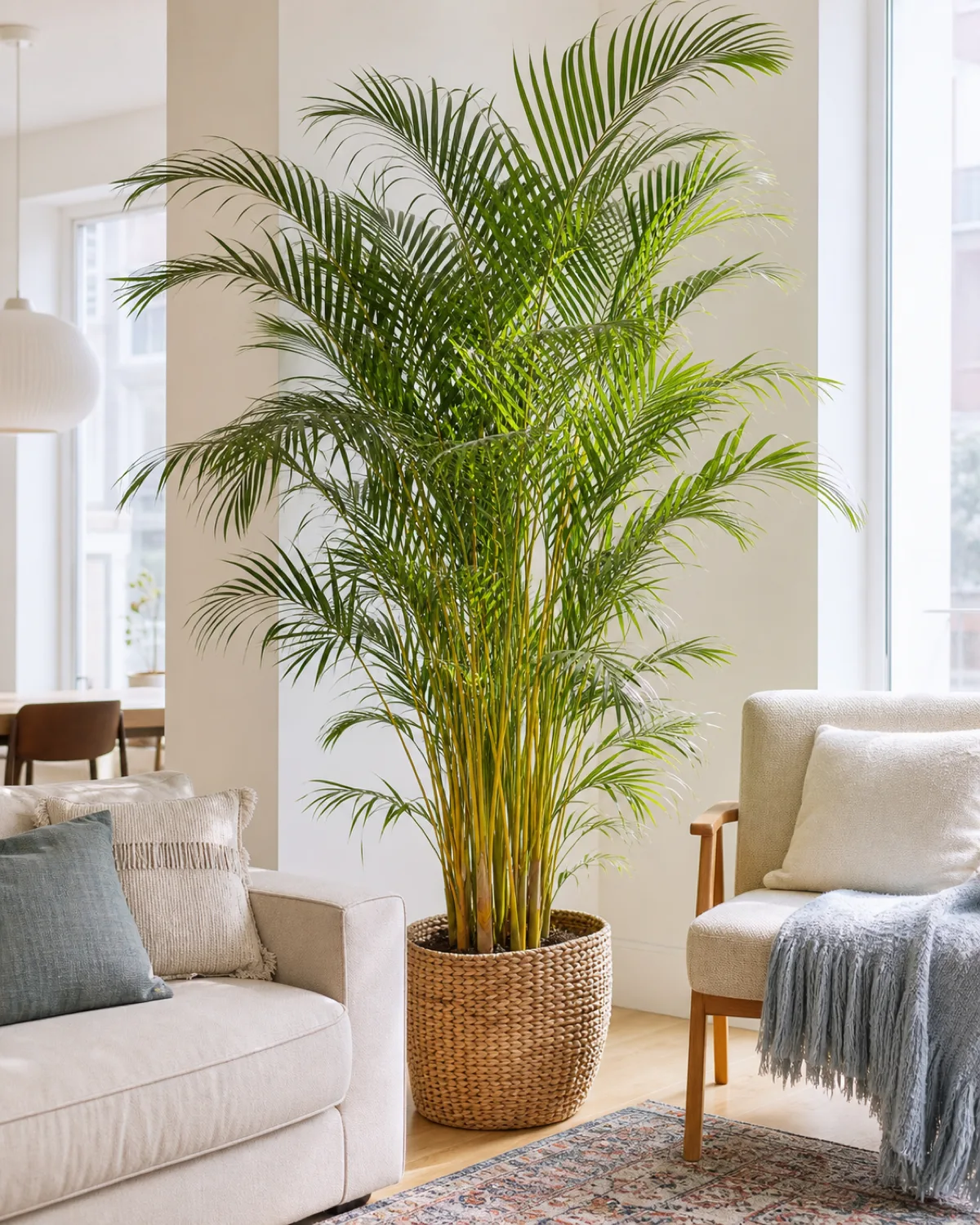
The areca palm grows as a cluster of golden-yellow canes with feathery fronds that fan outward, forming a natural privacy screen between seating areas. A mature areca in a fourteen-inch pot reaches five to six feet tall and fills a three-foot-wide zone — enough to visually separate a reading nook from the main seating area without blocking sightlines or light.
This makes it the living room equivalent of a room divider that also improves air quality. Bright indirect light and consistently moist soil prevent the frond-tip browning that plagues under-watered arecas. See the areca palm care guide for the full details.
Pilea peperomioides: the windowsill conversation starter
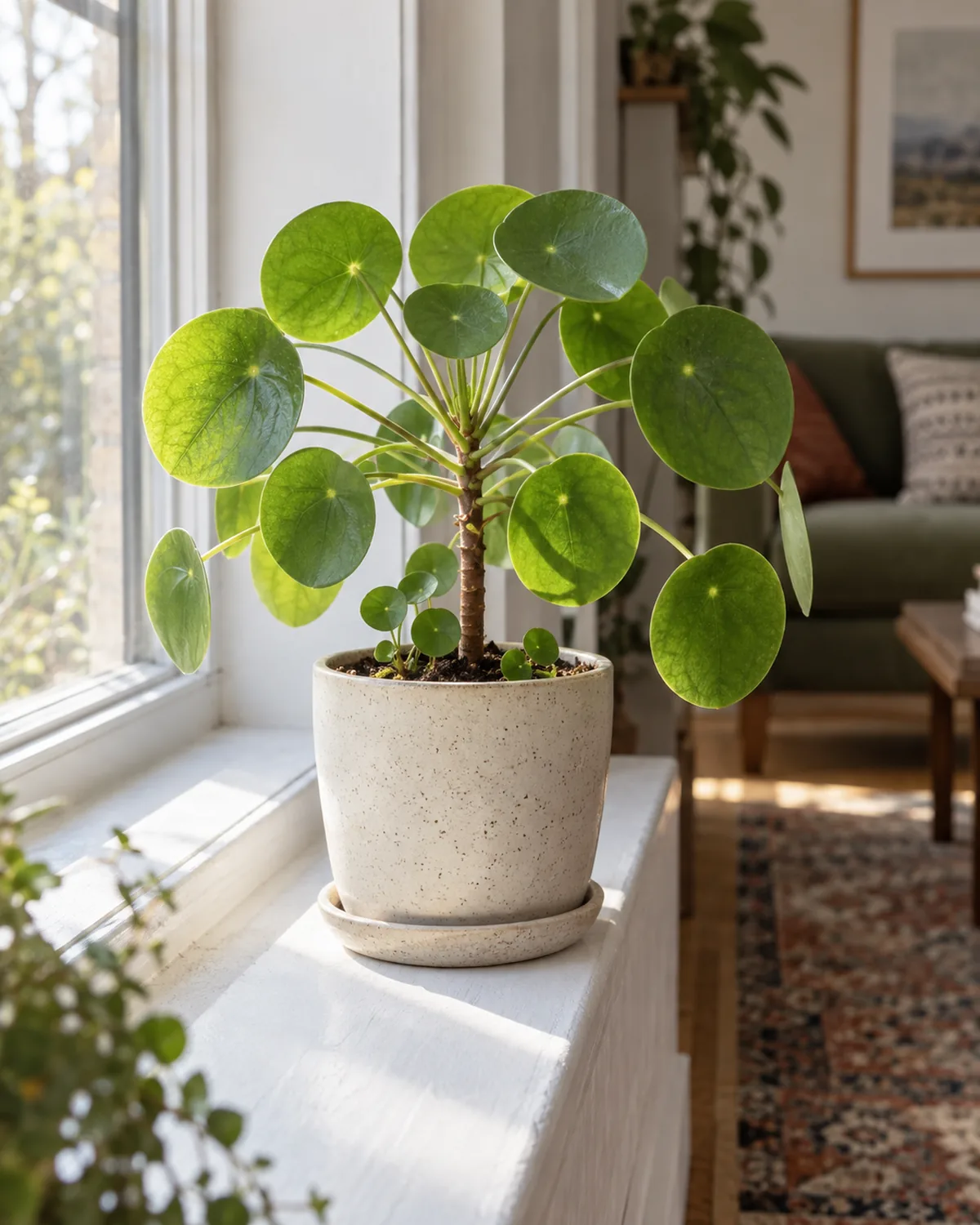
Pilea produces perfectly round disc-shaped leaves on thin petioles radiating outward from a single central stem — a flying-saucer silhouette unlike anything else on a windowsill. In a living room window, it earns its spot as a conversation piece because visitors always ask what it is.
It produces offset pups at its base constantly, which you can separate and share. Rotate the pot a quarter turn weekly or it leans dramatically toward the light. Full care details in the pilea peperomioides care guide.
How to arrange living room plants so they actually last
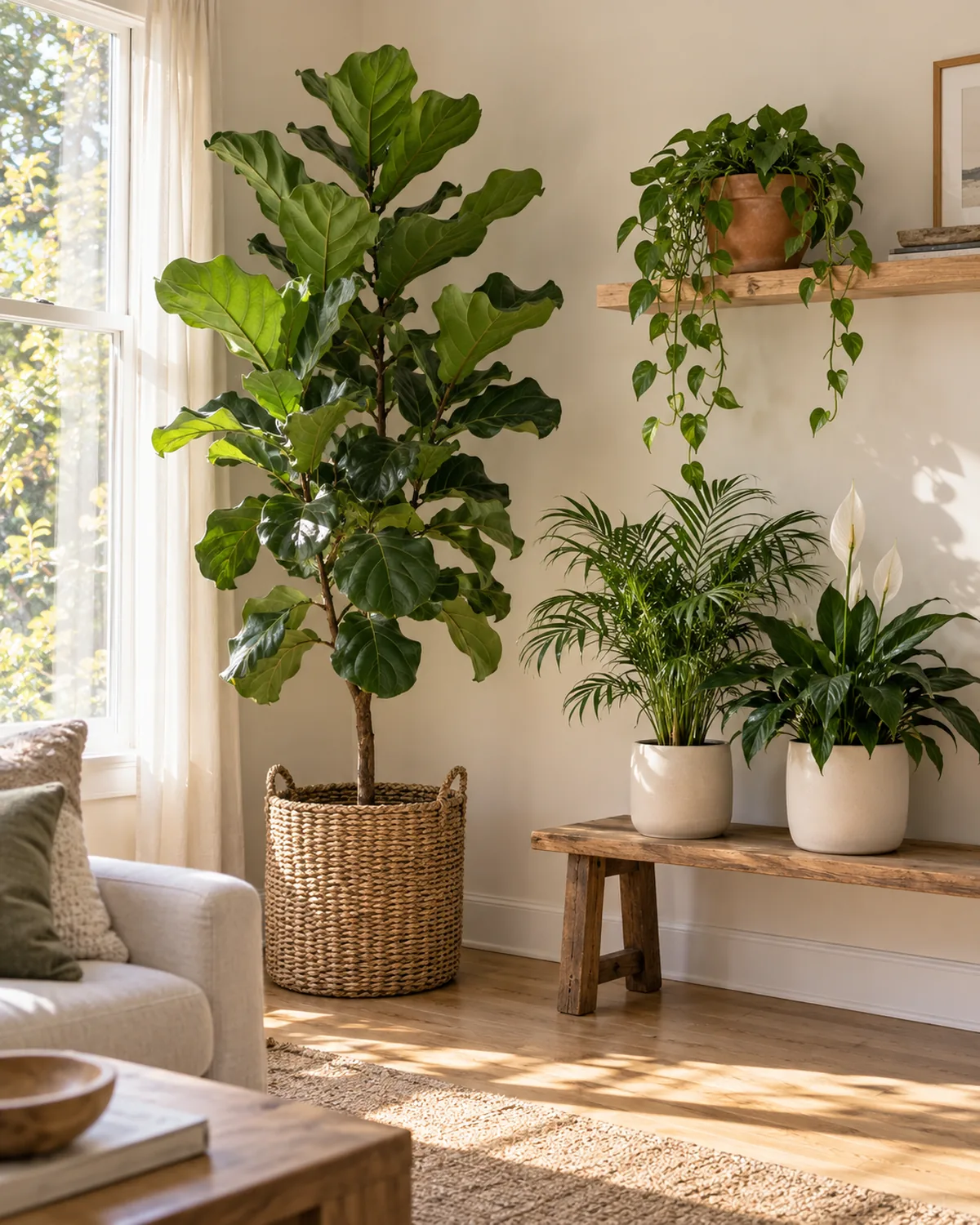
Matching individual plants to spots is half the job. The other half is treating the room as a connected system.
Map your light zones first. Stand in each potential plant spot at midday and note whether you see direct sun, bright ambient light, or shadow. Our houseplant light requirements guide explains how to read light levels without a meter.
Group plants by watering rhythm. Drought-tolerant plants — snake plant, ZZ, string of pearls — share a corner with a once-every-three-weeks cycle. Moisture-loving plants — calathea, parlor palm, peace lily — cluster together where you will naturally check them more often.
Mixing rhythms across the room leads to over-watering the dry group or under-watering the thirsty group. Our watering indoor plants guide covers how to read each plant's signals.
Use height variation deliberately. One tall floor plant (monstera, fiddle leaf fig, bird of paradise) anchors a corner. Two or three medium plants fill a shelf or table. Small accent plants (pilea, trailing pothos vine) draw the eye to specific spots. Without height layers, a room full of plants still looks flat. For shelf arrangement ideas, see our plant shelf ideas guide.
Limit pot materials to two or three: matte ceramic, terracotta, and woven baskets create cohesion. Ten different pot finishes create visual noise regardless of how healthy the plants are.
If a plant starts struggling in its spot, move it to a recovery zone with better conditions rather than letting it decline in place. Living rooms have enough micro-climates that a simple swap — from the dark side table to the bright window for a few weeks — often saves a plant entirely.
Living Room Plants: The Quick Reference
- 1Floor statements: monstera, fiddle leaf fig, bird of paradiseLarge plants that anchor corners and fill vertical space beside sofas and windows.
- 2Dark-corner survivors: snake plant, ZZ plantThe only two that genuinely thrive in the spots between and behind furniture where no light reaches.
- 3Trailing accents: pothos, philodendron, string of pearlsDrape from high shelves and plant stands to fill vertical dead space between shelf and ceiling.
- 4Tabletop texture: parlor palm, calathea, Chinese evergreen, peace lilyMedium plants for coffee tables, side tables, and console tops at arm's reach.
- 5Room divider: areca palmFive to six feet tall, three feet wide. Separates seating zones without blocking light.
- 6Windowsill accent: pilea peperomioidesRound disc leaves on a single stem. Conversation starter that produces pups to share.
- 7Furniture-gap filler: rubber plantNarrow columnar trunk fits the 18-inch slot between bookcase and wall.
- 8Map light before buyingStand in each spot at midday. Direct sun, ambient, or shadow? Match plant to actual conditions.
- 9Group by water scheduleDrought plants together, moisture-lovers together. Mixed schedules kill the outlier.
- 10Layer heights for depthTall floor anchor + medium shelf filler + small accent = visual depth. All one height = flat.
kultivy.com
What is the best low-maintenance plant for a living room?
Snake plant. It tolerates low light, infrequent watering, and temperature swings better than any other option on this list. If you want something that looks good and is nearly impossible to kill, start there.
How many plants should a living room have?
There is no formula. One large floor plant in a corner has more visual impact than ten small pots scattered around the room. Start with one statement plant and one trailing vine, then add as the room needs it.
Which living room plants are safe for cats and dogs?
Spider plant, parlor palm, calathea, and areca palm are non-toxic to cats and dogs according to the ASPCA. Avoid pothos, philodendron, peace lily, ZZ plant, and string of pearls if pets have access.
Can living room plants survive in a room with no natural light?
No plant thrives in total darkness. Snake plants and ZZ plants tolerate very low light but still need some ambient light to survive long-term. If your living room has no windows at all, consider a grow light or rotating plants to a brighter room every few weeks.
How do I keep living room plants alive in winter?
Move plants away from cold drafts near windows and exterior doors. Reduce watering — most plants grow slower in winter and need less water. Avoid placing plants near heating vents that blast dry hot air. Humidity drops significantly in heated homes, so grouping plants together helps create a shared humid micro-climate.

Mara Quinn edits Kultivy, where she shares houseplant care, propagation, beginner-friendly plant picks, and plant-styling ideas for anyone who wants their indoor plants to actually thrive. Every guide is image-led and reviewed for clarity, usefulness, image accuracy, and Pinterest-to-page alignment before it goes live. Visit the About page.