The braided trunk is the signature, but it starts in a nursery — not in nature. Wild Pachira aquatica grows as a solitary wetland tree up to sixty feet tall.
Nurseries weave three to five young saplings together while the stems are still pliable, then sell the bundle as one plant. Every braided money tree is actually a small colony.
Pachira tolerates lower light than most tropicals and forgives missed waterings better than a fiddle leaf fig. Unlike jade plant, it is non-toxic to cats and dogs.
Pachira aquatica is one of the easiest statement trees to grow indoors — here is everything it needs to stay compact, green, and braided.
How to read your money tree's light needs
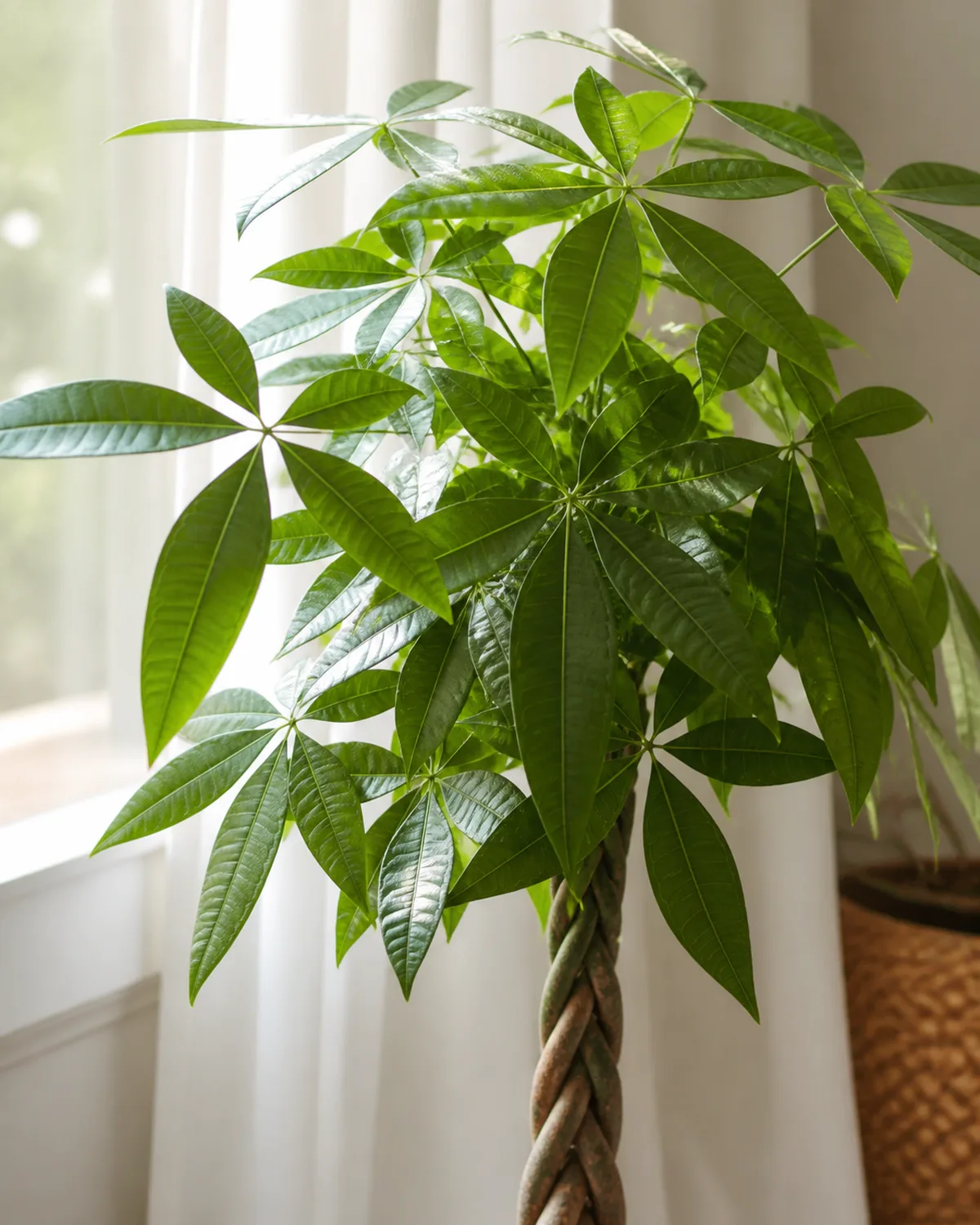
Bright indirect light produces the best growth — a compact canopy of glossy palmate leaves on a thickening trunk. Money tree handles this range more gracefully than most tropicals. An east or north-facing window works. A south or west window works too, as long as a sheer curtain softens direct afternoon rays.
Direct midday sun for extended hours scorches the thin, five-lobed leaves. You will see bleached yellow-white patches that turn papery and brown — damage that does not heal. Morning direct sun is fine. Afternoon direct sun through glass in summer is too much for most specimens.
The opposite problem is more common indoors: not enough light. When a money tree stretches toward a window with long, bare internodes between leaves, the light is too low. The palmate leaf clusters grow smaller and the trunk stays thin.
Rotate the pot a quarter turn each week. Money tree grows toward its light source faster than most houseplants, and without rotation the canopy develops a heavy lean within a month. The braided trunk cannot self-correct once it bends — the lean becomes permanent.
In winter, when natural daylight drops below ten hours, consider supplementing with a grow light positioned twelve to eighteen inches above the canopy. Four to six hours of supplemental light maintains the growth rate and prevents the lanky stretching that winter darkness encourages.
Pachira aquatica forgives a lot — but it has a few firm requirements that rule out certain spaces.
Watering a money tree without rotting the trunk
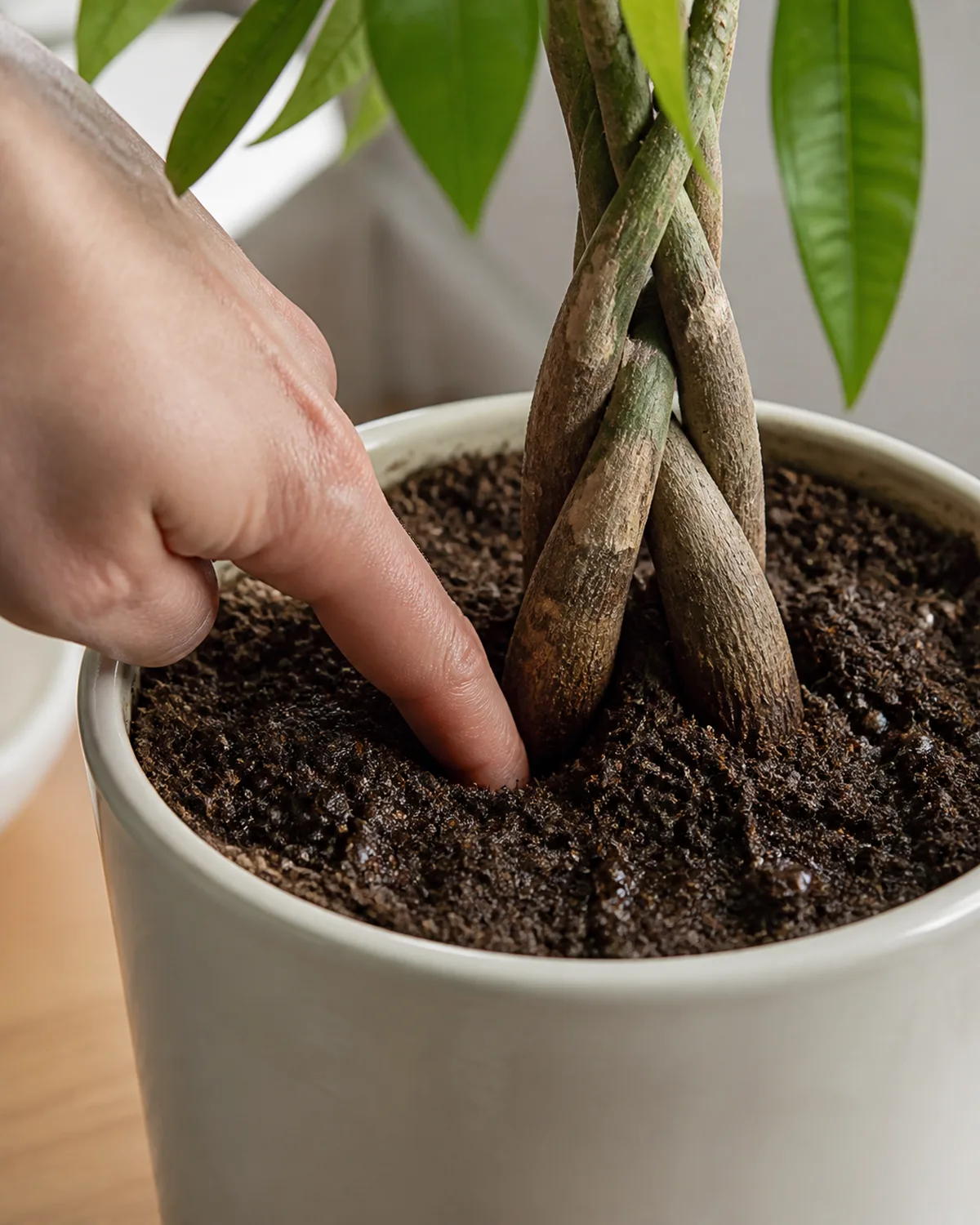
Let the top half of the soil dry between waterings. Push your finger in to the second knuckle — if the soil at that depth still feels damp, wait another day or two. When it feels dry at that depth, soak the entire pot until water runs from the drainage holes, then let it drain completely.
This halfway-dry cadence works because Pachira aquatica evolved in seasonally flooded wetlands. In nature, its roots spend part of the year submerged and part of the year in dry riverbank soil. Indoors, the plant retains that dual tolerance — it handles short dry spells better than most tropicals, but sustained saturation still kills the roots.
The braided trunk adds a specific risk that single-trunk plants do not face. Water collects in the crevices where the woven trunks press together. If the soil stays wet, those crevices become permanently moist zones that breed fungal rot. The decay starts between the trunks where you cannot see it, and by the time the outer bark softens or discolors, the damage is often irreversible.
Yellow lower leaves that feel soft and limp mean overwatering. Brown, crispy leaf edges mean underwatering or low humidity. The two signals are distinct enough that you can diagnose from the texture alone — limp yellow versus dry brown.
Reduce watering by half in winter. The plant's growth slows in shorter days, the soil stays wet longer, and the root system absorbs less water. A thorough watering guide covers the universal principles; the money tree-specific rule is simply this: the braided trunk makes overwatering more dangerous than for any single-trunk tropical.
Always empty the saucer within thirty minutes of watering. Standing water wicks back into the soil through capillary action and keeps the bottom of the pot saturated — exactly the condition that rots the base of the braid.
Humidity and temperature for a tropical wetland tree indoors
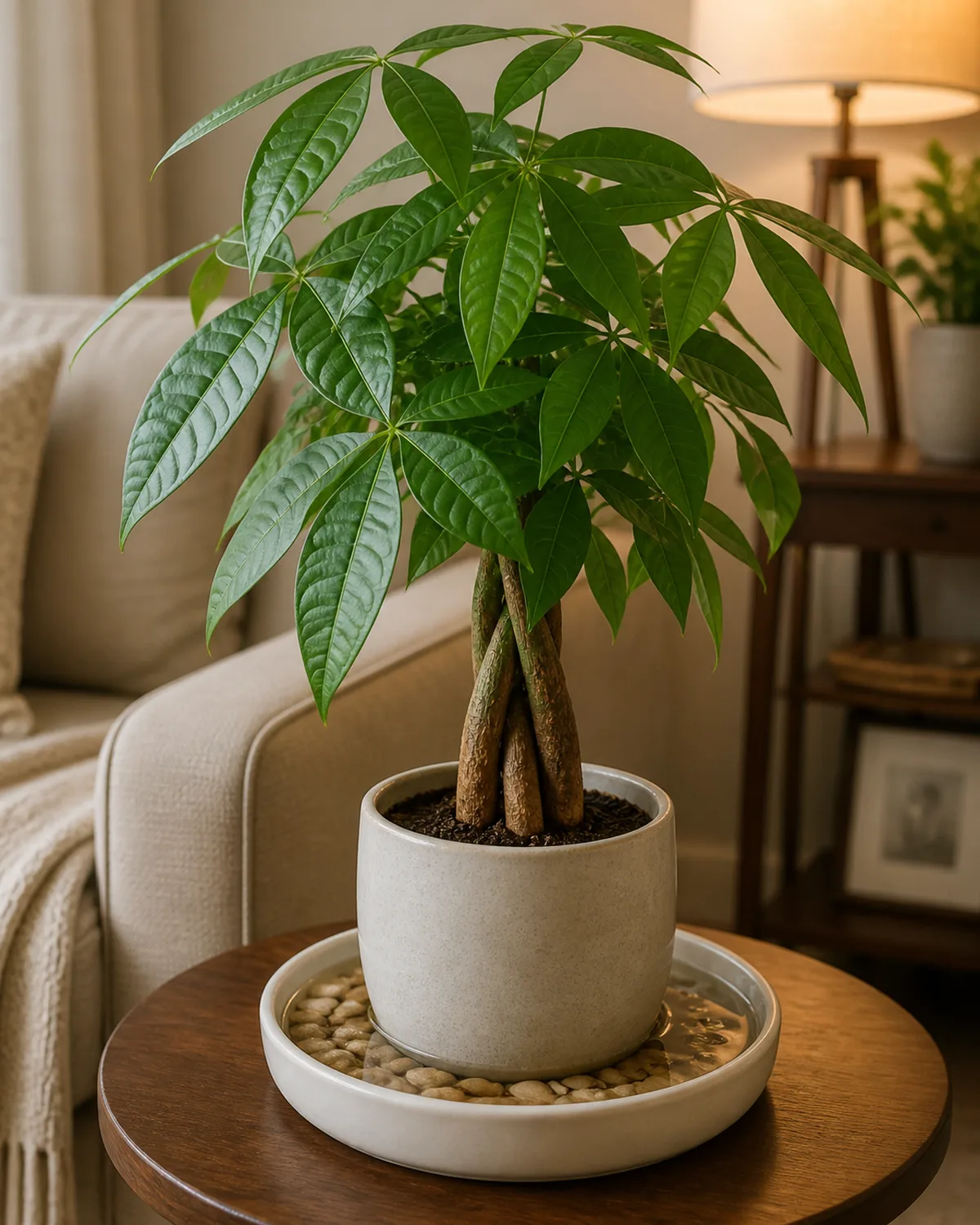
Money tree adapts to average home humidity better than its swamp-dwelling origins would suggest. Fifty to eighty percent humidity is ideal, but most specimens hold up at forty percent without visible stress — a tolerance that separates it from humidity-demanding relatives like calathea and alocasia.
Below thirty percent, you will see brown, crispy tips forming on the edges of the palmate leaflets. This is cosmetic but permanent — the tissue will not regenerate.
A pebble tray beneath the pot raises local humidity by a few percentage points. Grouping money tree with other tropicals creates a microclimate through collective transpiration.
Misting does almost nothing. The water droplets evaporate within minutes, and the brief humidity spike is too short for the plant to register. Skip it.
Temperature matters more than humidity for this species. Money tree is comfortable between sixty-five and eighty degrees Fahrenheit — the same range as a climate-controlled home. Below fifty degrees, the metabolic processes that drive growth stall, and the plant begins dropping leaves as a survival mechanism.
Cold drafts are the most common temperature threat. A money tree placed near an exterior door, a single-pane window in winter, or an air conditioning vent receives intermittent cold blasts that mimic the temperature swings that trigger leaf drop in the wild. Move it at least three feet from any draft source.
The opposite extreme — heat above eighty-five degrees — accelerates transpiration beyond what the root system can replace, causing wilting even in moist soil. Avoid placing money tree directly above a radiator or in a south-facing window alcove that traps summer heat.
The right soil and pot for a braided money tree
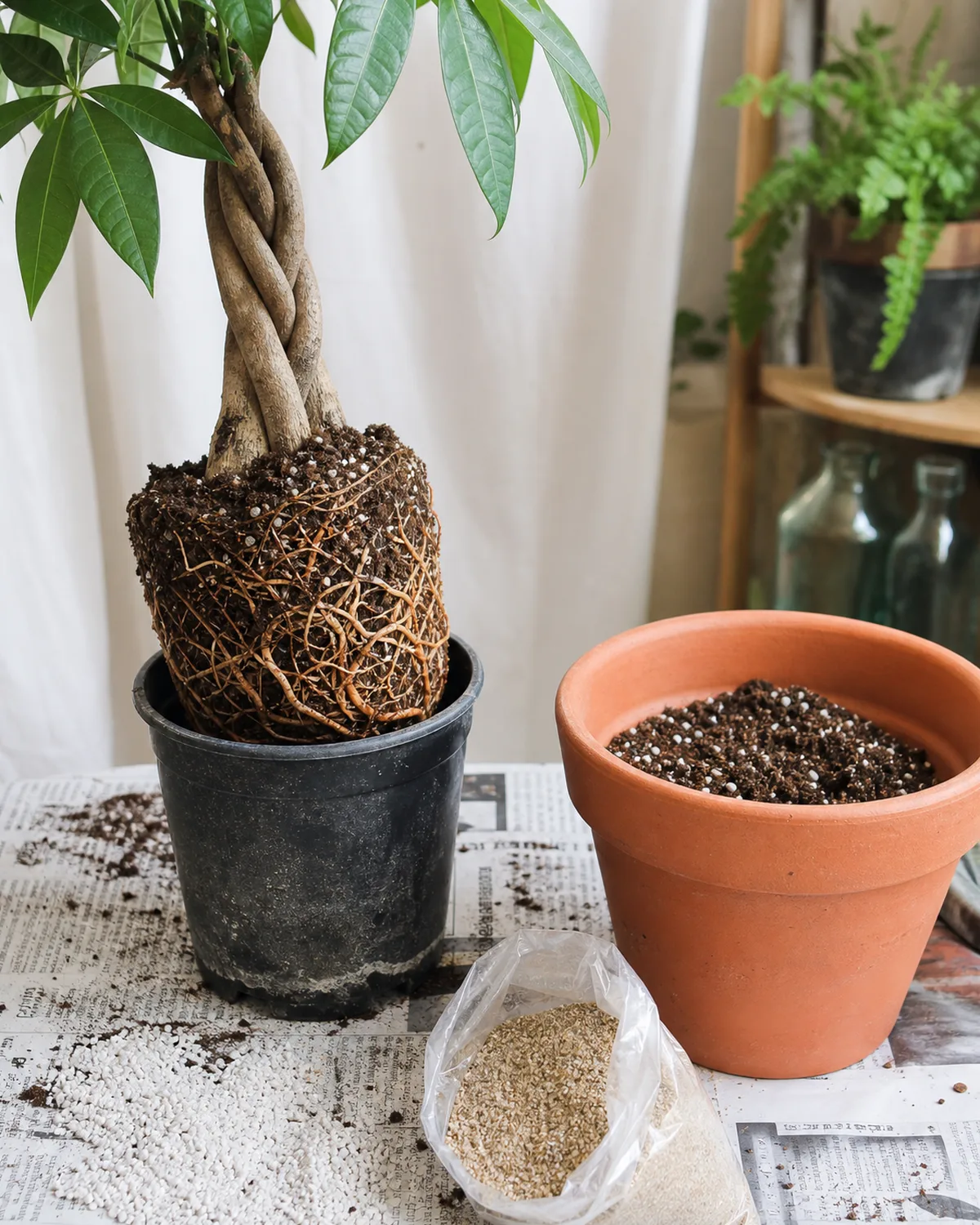
A well-draining mix is the foundation. Combine two parts peat-based potting soil, one part perlite, and one part coarse sand. The peat holds enough moisture to sustain the plant between waterings, the perlite creates air pockets that prevent compaction, and the sand adds weight and drainage speed.
Standard potting soil straight from the bag is too dense for a braided money tree. It holds water for too long, especially around the base of the braided trunk where multiple root systems converge. The extra perlite and sand create the drainage speed that keeps those trunk crevices from staying waterlogged.
Drainage holes are mandatory — not optional, not "preferred." Without them, excess water has nowhere to go, and the bottom third of the pot stays saturated between waterings. This is the zone where root rot starts, and with a braided money tree, rot in one trunk's root system can spread to the others through the shared soil.
Choose a pot only one to two inches wider in diameter than the current root ball. An oversized pot holds more soil than the roots can access, which means more moisture sitting unused around the root zone — extending the dry-down time and increasing rot risk.
Material matters. Terracotta is the safest choice because its porous walls wick moisture out of the soil, accelerating the drying cycle. Glazed ceramic and plastic hold moisture longer, which works if you consistently underwater but becomes a liability if you water on a schedule rather than by soil moisture.
Nursery pots — the thin plastic containers money trees arrive in from the store — are often the worst offenders. They lack adequate drainage, the soil mix is typically peat-heavy, and the pot is frequently sized too large for the plant's root system. After the plant acclimates to your home for two to three weeks, repot it into a properly sized container with fresh mix.
Feeding your money tree through the growing season
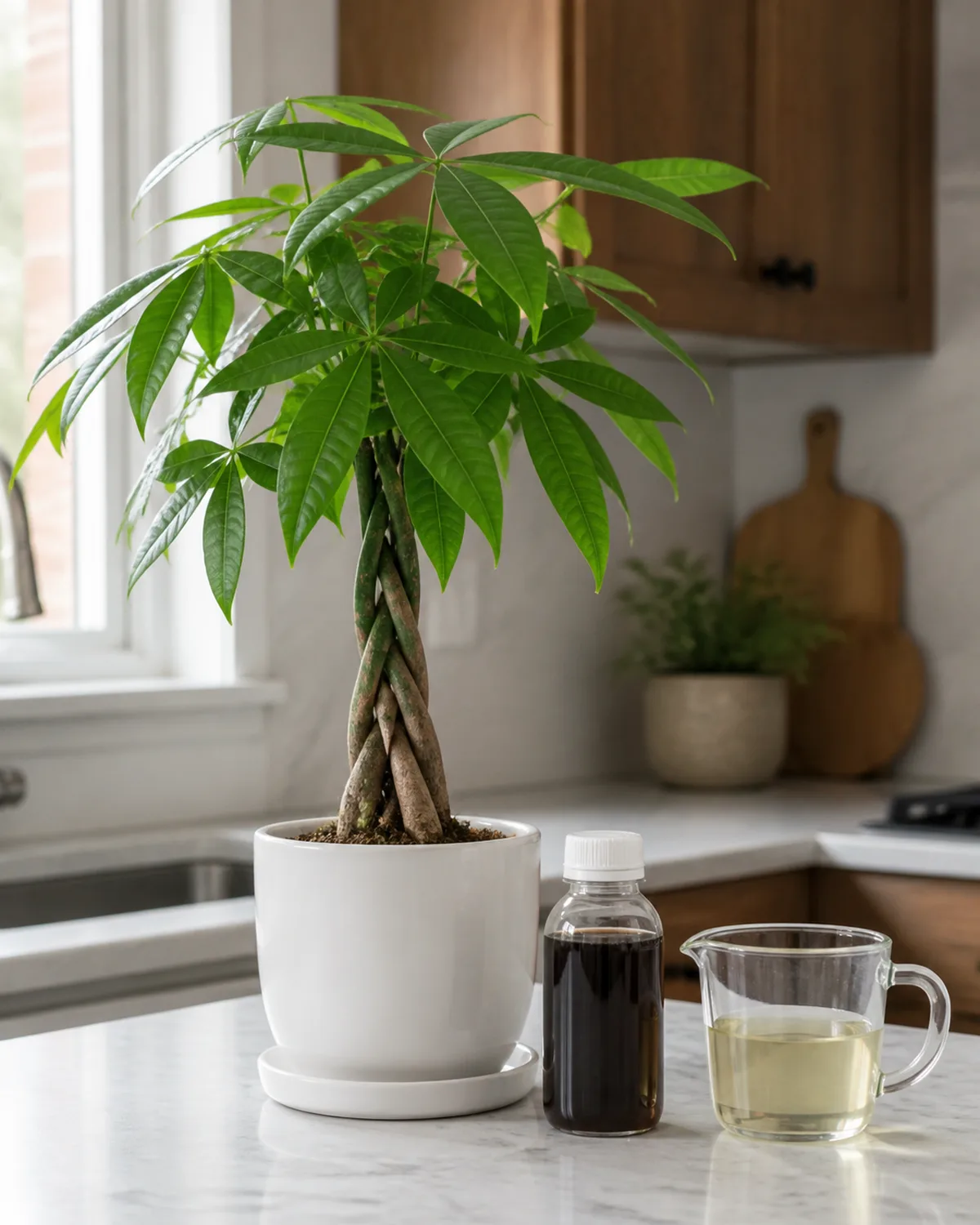
Apply a balanced liquid fertilizer — 10-10-10 or 20-20-20 diluted to half the label strength — once a month from April through September. That covers the growing season when the plant is actively producing new leaves and extending its canopy.
Half strength matters. Money tree is a moderate feeder with a relatively small root system for its above-ground size, and the braided configuration means three to five root systems sharing a single pot. Full-strength fertilizer concentrates salts in a confined space faster than a single-root plant would experience.
Salt buildup causes brown leaf tips that look identical to humidity damage. The difference: humidity-caused browning responds to increased moisture in the air, while fertilizer burn persists until you flush the soil.
Every two to three months during the growing season, run plain water through the pot — twice the pot's volume — to dissolve accumulated mineral salts. The fertilizing guide covers the flush technique in detail.
Stop all feeding from October through March. The plant's metabolism slows in shorter days, it produces fewer new leaves, and it cannot use the nutrients efficiently. Fertilizer sitting in slow-drying winter soil breaks down into salts that accumulate unchecked.
New plants — anything purchased within the last two months — should skip fertilizer entirely. Nurseries fertilize heavily before shipping, and the residual nutrients remain for weeks after purchase.
Adding more on top of nursery loading risks overwhelming the roots during the stress of adapting to a new environment.
Understanding and maintaining the braided trunk
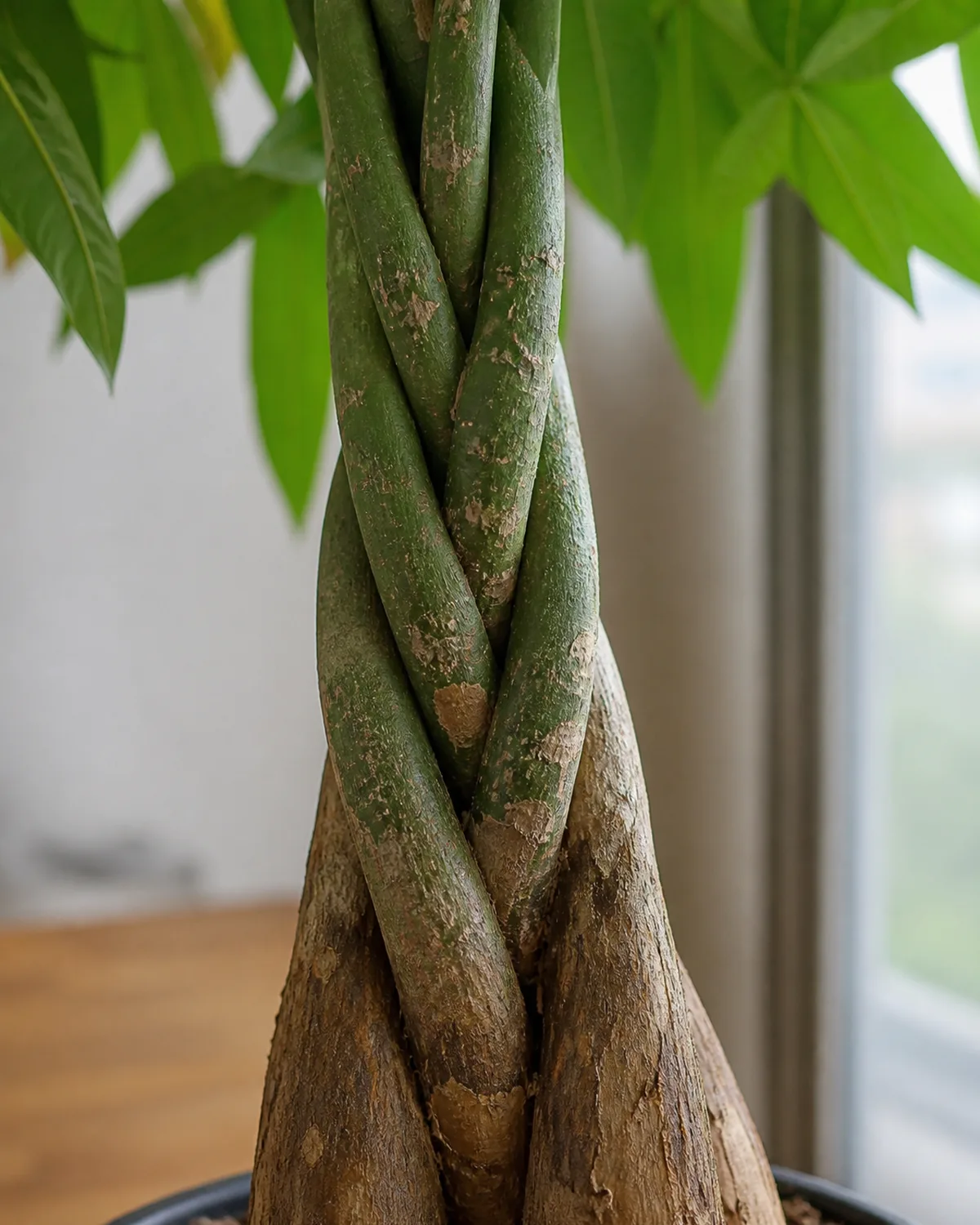
The braid is the defining visual of a commercial money tree, but it is entirely a human creation. In nature, Pachira aquatica grows as a solitary tree with a single thick trunk that swells at the base to store water — a common adaptation among tropical wetland species.
Nurseries start the braid early, when the seedlings are a few months old and the stems are green, flexible, and about as thick as a pencil. Three to five seedlings are planted close together and woven into a simple braid pattern, then tied loosely at the top to hold the shape as the stems thicken and lignify. Over time, the bark hardens and the braid becomes permanent.
You can continue braiding new growth at home. Wait until the uppermost section produces six or more inches of soft, green stem above the last braid point.
Gently weave the new growth into the pattern — each trunk crosses over its neighbor — and tie the top loosely with soft twine. Remove the tie after the section hardens, which takes two to three months.
Never force woody sections. Once the bark has turned brown and rigid, the trunk will snap rather than bend. If you missed the braiding window on a section of growth, leave it — the new section will braid above the gap.
One trunk dying within the braid is not uncommon. The individual trunks are separate trees with separate root systems. Overwatering, root damage, or bad luck can kill one while the others survive.
A dead trunk turns soft and dark while its neighbors remain firm. You can remove it by cutting at the base and easing it out of the weave — the remaining living trunks will continue growing normally.
If you prefer a natural, unbraid look, you can grow money tree from a single cutting. The result is a straight-trunked specimen with a swollen base that develops character as it matures — closer to how the plant actually grows in the wild.
Pruning and shaping your money tree
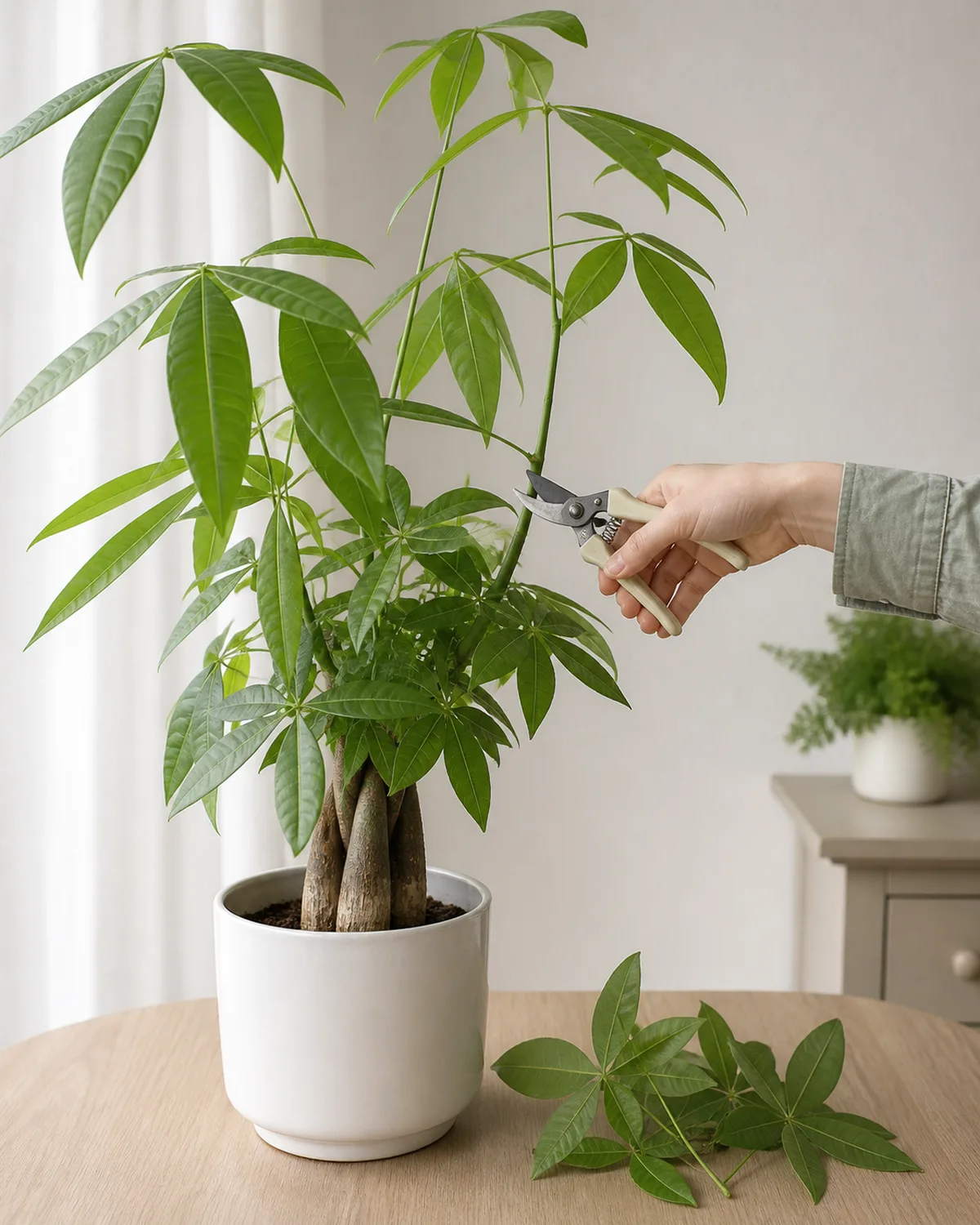
Money tree responds well to pruning — better than most large houseplants. Each cut above a leaf node stimulates two or three dormant buds below the cut to break, producing branches that fill the canopy and create a fuller, bushier shape.
Prune in spring at the start of active growth. This timing gives the maximum recovery window: the newly activated buds have six months of long days and warm temperatures ahead to develop into established branches before winter slows things down.
For a leggy specimen with long bare stems and a sparse top, cut each affected stem back to just above a visible leaf node — the slight swelling on the stem where a leaf attaches or once attached. Make the cut at a forty-five degree angle, about a quarter inch above the node. The angled cut sheds water and reduces the risk of fungal infection at the wound site.
You can remove up to a third of the total canopy in one session without stressing the plant. More aggressive pruning is survivable but risks triggering leaf drop from shock — the same response money tree shows when relocated. Space heavy pruning sessions across two or three springs if the plant needs a major reshape.
Pinching — removing the growing tip of a stem with your fingers — is less dramatic than pruning but effective for shaping a young plant. Pinch the terminal bud (the tiny new leaf emerging at the tip) and the stem will branch at the next lower node. Done consistently over a growing season, pinching creates a dense, rounded canopy without the bare-stem phase that follows hard pruning.
Save the pruned cuttings for propagation. Any section with two or more leaf nodes can root in water or soil — the same material you would discard becomes a new plant.
Money Tree Care: The Quick Reference
- 1Bright indirect light, rotate weeklyEast or filtered south window. Direct afternoon sun scorches thin palmate leaves. Rotate quarter turn each week to prevent permanent lean. Grow light in winter for 4-6 hours.
- 2Top half dry, then thorough soakFinger test to second knuckle. Braided trunk traps moisture — overwatering rots faster than single-trunk plants. Empty saucer in 30 minutes. Cut frequency by half in winter.
- 3Adapts to average humidity, prefers 50-80%Handles 40% without drama. Below 30% causes crispy tips. Pebble tray or grouping. Temperature 65-80°F, never below 50°F. Avoid cold drafts and heating vents.
- 4Well-draining mix, drainage holes mandatoryPeat, perlite, sand (2:1:1). Pot 1-2 inches wider than root ball. Terracotta safest for braided specimens. Nursery pot usually too dense — repot after acclimation.
- 5Half-strength monthly, April through SeptemberBalanced 10-10-10 or 20-20-20. Flush soil every 2-3 months to prevent salt buildup. Zero fertilizer October through March. Skip feeding for first 2 months after purchase.
- 6Braid is nursery-made, you can continue itWeave soft green growth only — woody sections snap. Tie loosely with twine, remove after 2-3 months. One trunk dying is normal. Dead trunk can be removed without killing others.
- 7Prune in spring for a fuller canopyCut above a leaf node at 45 degrees. Up to one-third of canopy per session. Pinch tips for bushier shape. Save cuttings for propagation.
- 8Repot every 2-3 years in springOne pot size up. Keep soil line at same trunk depth. Loosen circling roots gently. Support braided trunk during the process. Top-dress annually if not repotting.
- 9Stem cuttings root in 4-6 weeks6-inch cutting with 2-3 nodes. Water or moist perlite. Change water weekly. Rooting hormone helps but optional. Propagated plants grow single-trunk, no braid.
- 10Spider mites, mealybugs, and fungus gnatsSpider mites from dry air — check leaf undersides. Mealybugs in leaf joints. Fungus gnats from wet soil. Neem oil every 7 days for 3 weeks. Inspect trunk crevices.
- 11Yellow leaves usually mean overwateringSoft yellow = too wet. Crispy brown edges = too dry or low humidity. Mass leaf drop = temperature shock or relocation. Soft trunk = advanced root rot.
- 12Non-toxic to cats and dogsASPCA safe. One of few large statement trees that are genuinely pet-friendly. Safe alternative to toxic fiddle leaf fig and jade plant.
kultivy.com
When and how to repot
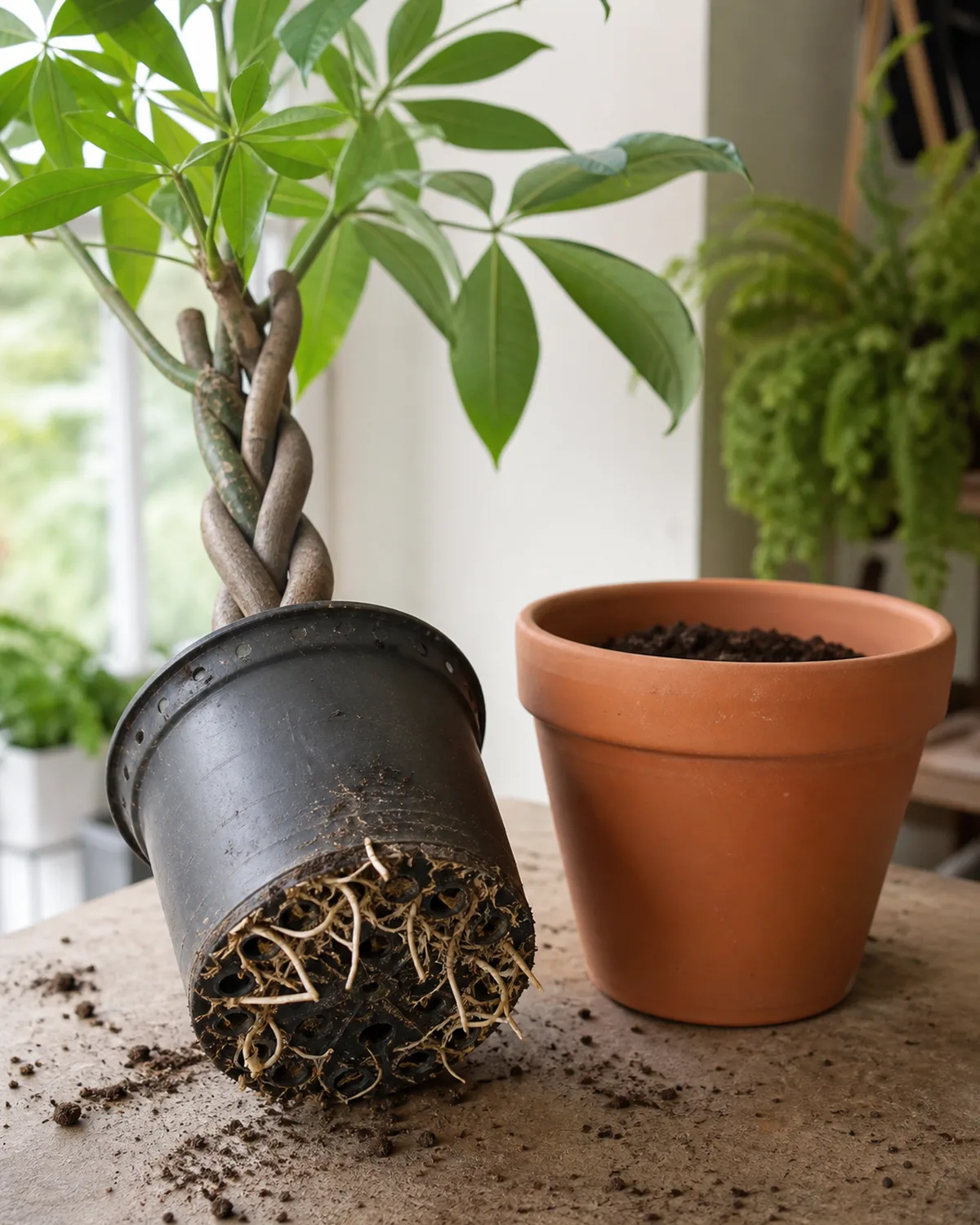
Repot every two to three years, or sooner if roots circle the inside of the pot, emerge from the drainage holes, or push the soil surface upward. Money tree signals its need by slowing growth even during the active season and drying out within a day or two of watering — there is not enough soil left to hold moisture.
Spring is the only safe repotting window. The plant is entering six months of active growth and can recover from root disturbance before winter arrives. Repotting in fall or winter — when growth has stalled — leaves the disturbed roots sitting in wet soil with no active absorption, which invites rot.
Go up one pot size only — two inches wider in diameter than the current container. An oversized pot holds too much wet soil for the root system to access, extending the dry-down cycle and creating the saturated conditions that rot braided trunks.
Handle the braided trunk gently during the process. Tip the pot on its side and ease the root ball out rather than pulling from the trunk — tugging upward on the braid can separate the individual trunks and tear roots. If the root ball is stuck, run a butter knife around the inside edge of the pot to loosen it.
Examine the roots. Healthy roots are white or tan and firm. Brown, mushy, or foul-smelling roots are rotted — trim them back to healthy tissue with clean shears. Gently loosen any roots that have circled the bottom of the pot; circling roots will continue circling in the new pot and eventually strangle themselves.
Set the plant at the same soil depth as before. Burying the trunk deeper introduces moisture to bark that was previously above the soil line, creating new rot entry points. Fill around the root ball with fresh mix, tap the pot on the table to settle soil into air pockets, and water thoroughly.
If the plant does not need repotting but the soil surface is compacted or depleted, top-dress instead: scrape away the top inch of soil and replace it with fresh mix. This refreshes nutrients and improves surface drainage without disturbing the roots.
Propagating money tree from stem cuttings
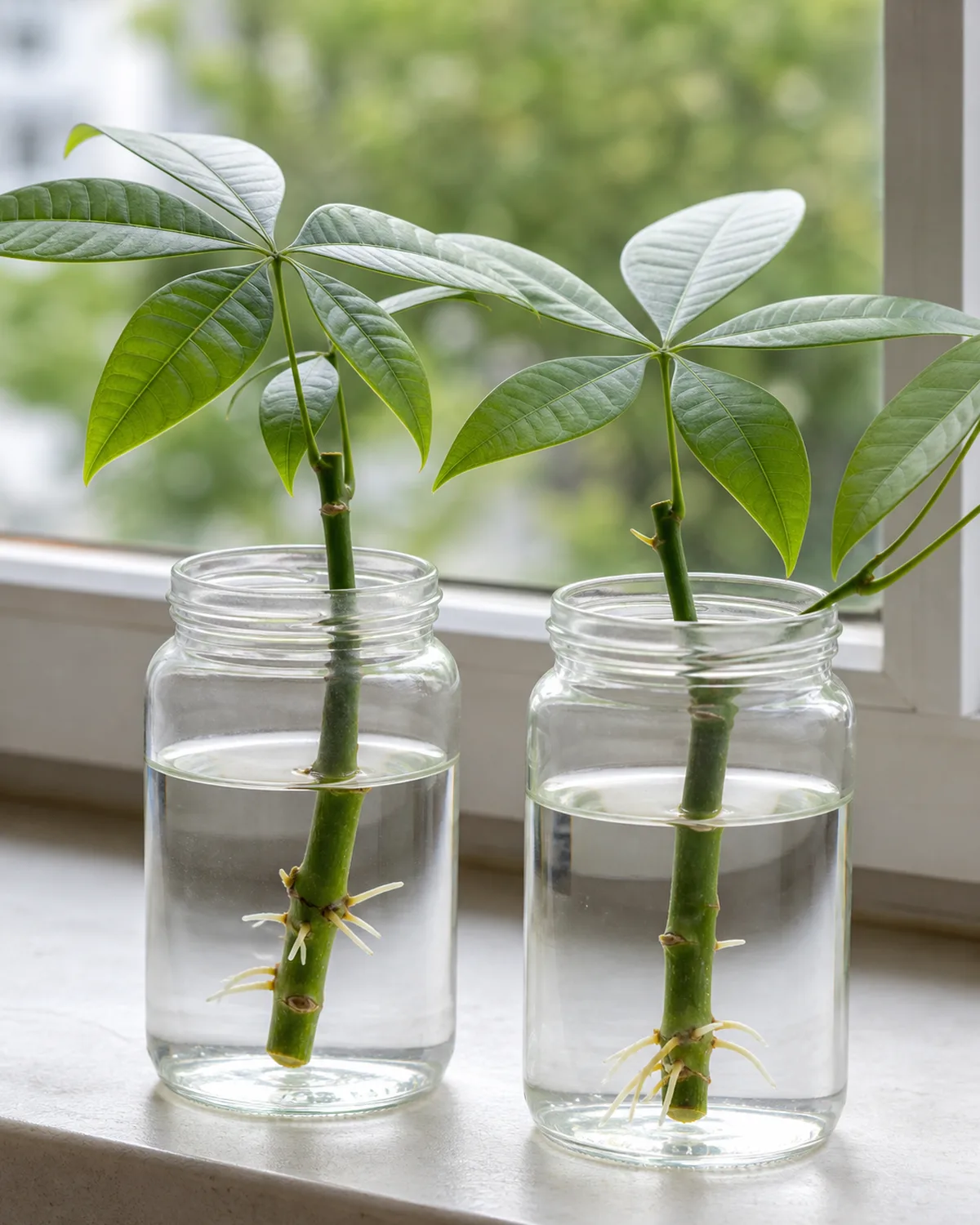
Take a six-inch cutting with at least two to three leaf nodes. Cut just below a node with clean, sharp shears — this is where the root cells are concentrated. Remove the leaves from the bottom one to two nodes so they do not rot when submerged.
Water rooting is the simplest method and works reliably with money tree. Place the cutting in a jar of room-temperature water so the bare nodes are submerged and the remaining leaves stay above the waterline. Set the jar in bright indirect light — not direct sun, which heats the water and encourages bacterial growth.
Change the water every five to seven days to keep it oxygenated and prevent the cloudy film that signals bacterial buildup. Roots typically appear within four to six weeks — small white nubs emerging from the submerged nodes.
Once the roots reach two inches long, transplant the cutting into a small pot with the same well-draining mix you use for the parent plant. Water it in and keep the soil slightly more moist than you would for an established plant — the newly formed roots need consistent moisture for the first two weeks as they transition from water to soil.
Rooting in moist perlite or a peat-perlite mix is more reliable for money tree than water rooting. Insert the cutting to the depth of two nodes, moisten the mix, and cover the pot with a clear plastic bag to create a humid microclimate. Vent the bag daily to prevent mold. The cutting roots at a similar pace — four to six weeks — and does not require the water-to-soil transition step.
Rooting hormone is optional but helpful. Money tree cuttings root without it, but a dip in powdered rooting hormone before planting increases the success rate, especially for semi-woody cuttings taken from older stems.
The propagated plant will grow as a single-trunk specimen — it will not spontaneously braid itself. If you want the braided look, root three to five cuttings, plant them together in one pot, and begin weaving them when the stems are long enough, exactly as nurseries do.
Seed propagation is nearly impossible indoors. Pachira aquatica rarely flowers in home conditions because it requires the seasonal light and temperature shifts that only occur in its native habitat. Even in greenhouses that simulate tropical conditions, flowering is uncommon. The braided forms are always produced from seed-grown seedlings at commercial nurseries, not from divisions or cuttings.
Common pests and how to treat them
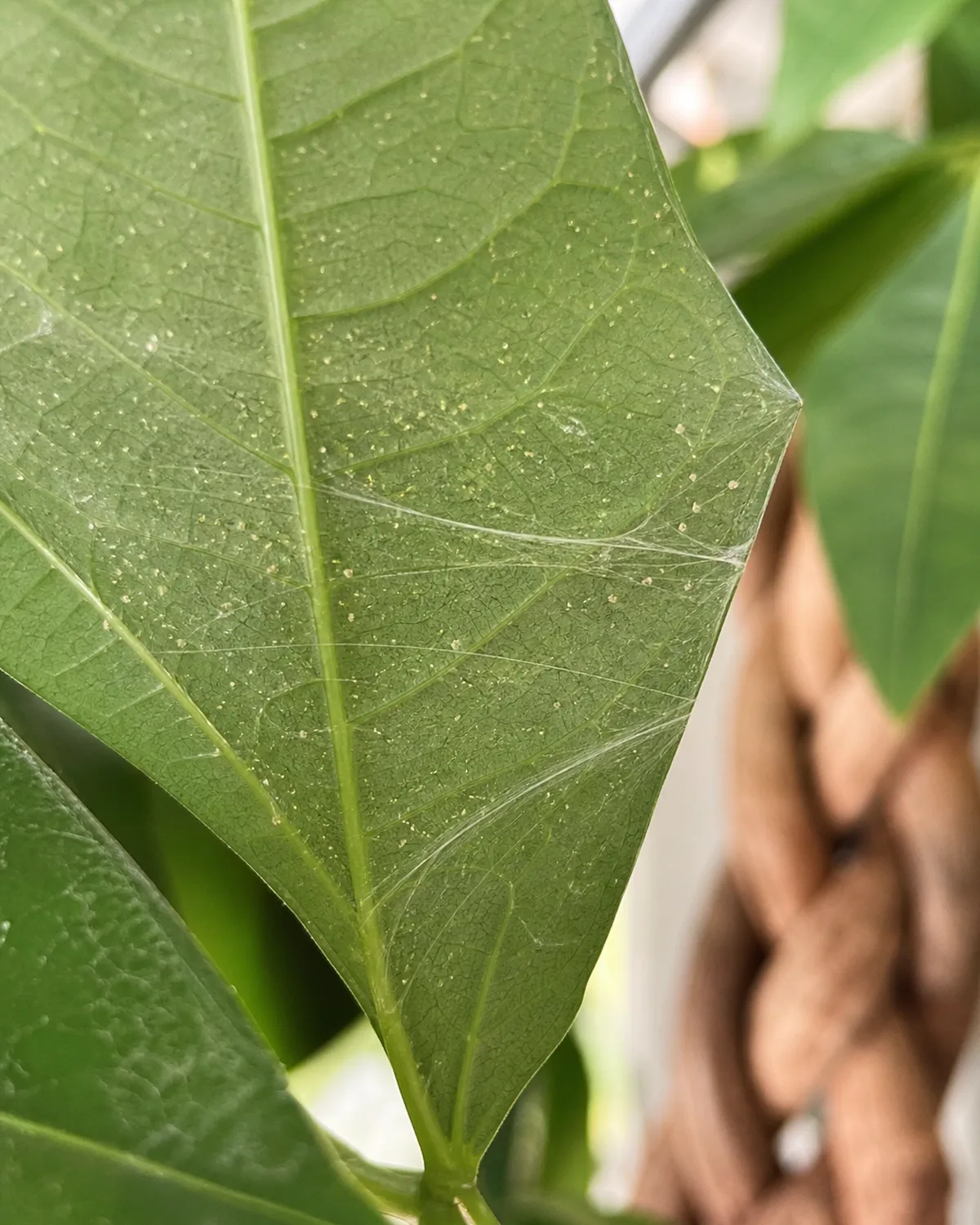
Spider mites are the most common pest on indoor money trees. They thrive in the warm, dry conditions that heated homes provide, especially in winter when humidity drops below forty percent. The mites feed on the undersides of leaves, puncturing cells to extract sap, and leave behind fine webbing stretched between leaf veins.
The first visible sign on the upper leaf surface is stippling — tiny yellow dots where each cell was drained. By the time you notice webbing, the colony is well established. Run your finger across the underside of a leaf: if you see tiny red or brown dots that scatter, those are spider mites.
Treatment follows the three-week cycle that matches the pest's reproductive timeline. Spray all leaf surfaces — top, bottom, and especially the crevices where the leaflets join the central stem — with neem oil or insecticidal soap. Repeat every seven days for three consecutive weeks. This catches newly hatched mites before they can reproduce, because a single treatment kills adults but not eggs.
Mealybugs form white, cottony clusters at leaf joints and in the gaps between the braided trunks. The trunk crevices are their favorite hiding spot because the tight spaces protect them from sprays and physical removal. Use a cotton swab dipped in rubbing alcohol to dissolve the waxy coating on each visible cluster, then follow with neem oil spray weekly for three weeks.
Scale insects appear as small brown bumps along stems and at the base of leaves. They are easy to miss because they resemble natural bark features. Scrape them off with a fingernail or a soft brush, then apply horticultural oil.
Fungus gnats — the tiny dark flies hovering around the soil surface — are a watering problem, not a pest problem. Their larvae feed on organic matter in consistently moist soil.
Let the top two inches dry completely between waterings and the gnats lose their breeding habitat. The full pest treatment guide covers each of these in detail.
Troubleshooting yellow leaves, leaf drop, and trunk problems
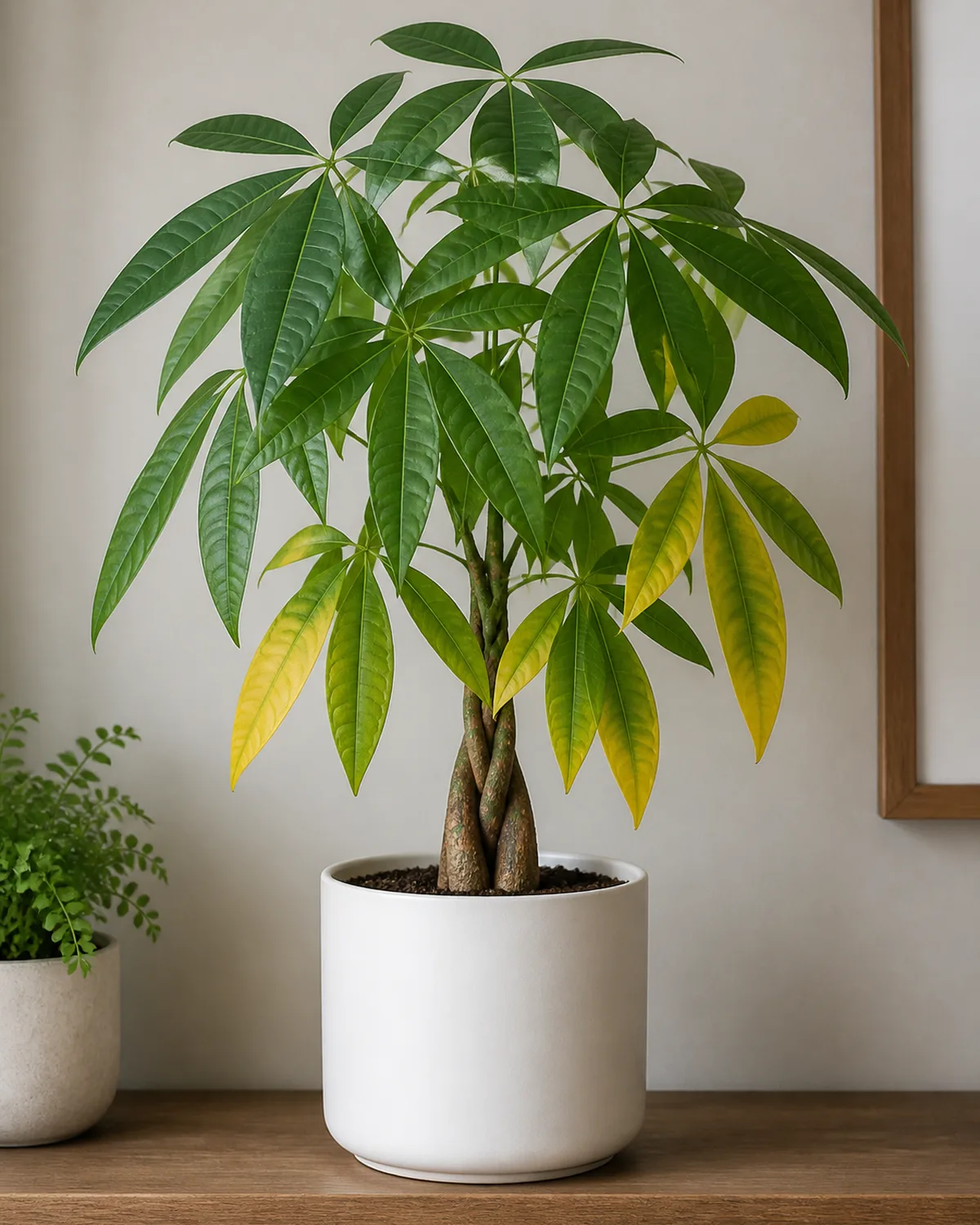
Yellow lower leaves are the most common complaint, and they almost always mean overwatering. The leaves feel soft and limp — not dry or crispy. Check the soil: if it is still moist at mid-depth despite several days since the last watering, the soil is staying too wet for too long. Reduce watering frequency and ensure the pot has adequate drainage.
A single yellow lower leaf dropping every few weeks is normal aging — the plant redirects resources from older leaves to new growth at the top. This is not a problem unless it accelerates to multiple leaves per week, which signals an environmental stressor.
Sudden mass leaf drop — ten or more leaves within a few days — has three likely causes. Temperature shock from a cold draft, a heating vent, or being left near an open window in winter. Relocation stress from moving the plant to a new room or rotating it dramatically. Or root rot so advanced that the root system can no longer sustain the canopy.
Check the trunk. Firm, woody bark with no give when you squeeze gently means the trunk is healthy, even if the plant looks bare. Soft, spongy trunk sections that depress under finger pressure mean rot has penetrated the wood. With a braided trunk, squeeze each individual trunk separately — rot often affects one trunk while the others remain firm.
If one trunk is rotted, you can sometimes save the plant by removing the dead trunk. Cut it at the soil line, ease it out of the braid as gently as possible, and check whether the remaining trunks have firm roots. Repot the survivors in fresh, well-draining mix and reduce watering significantly until new growth confirms recovery.
Brown leaf tips have two causes: low humidity (the air around the plant is too dry) or fertilizer salt buildup (the soil has accumulated mineral deposits). If increasing humidity with a pebble tray does not resolve it within two weeks, flush the soil with plain water — twice the pot's volume — to wash out salts.
Leaves curling inward along the midrib usually signal underwatering or cold stress. Check the soil: bone-dry soil means you waited too long between waterings. If the soil is moist, check for cold drafts reaching the plant from nearby windows or doors.
Is money tree safe for pets
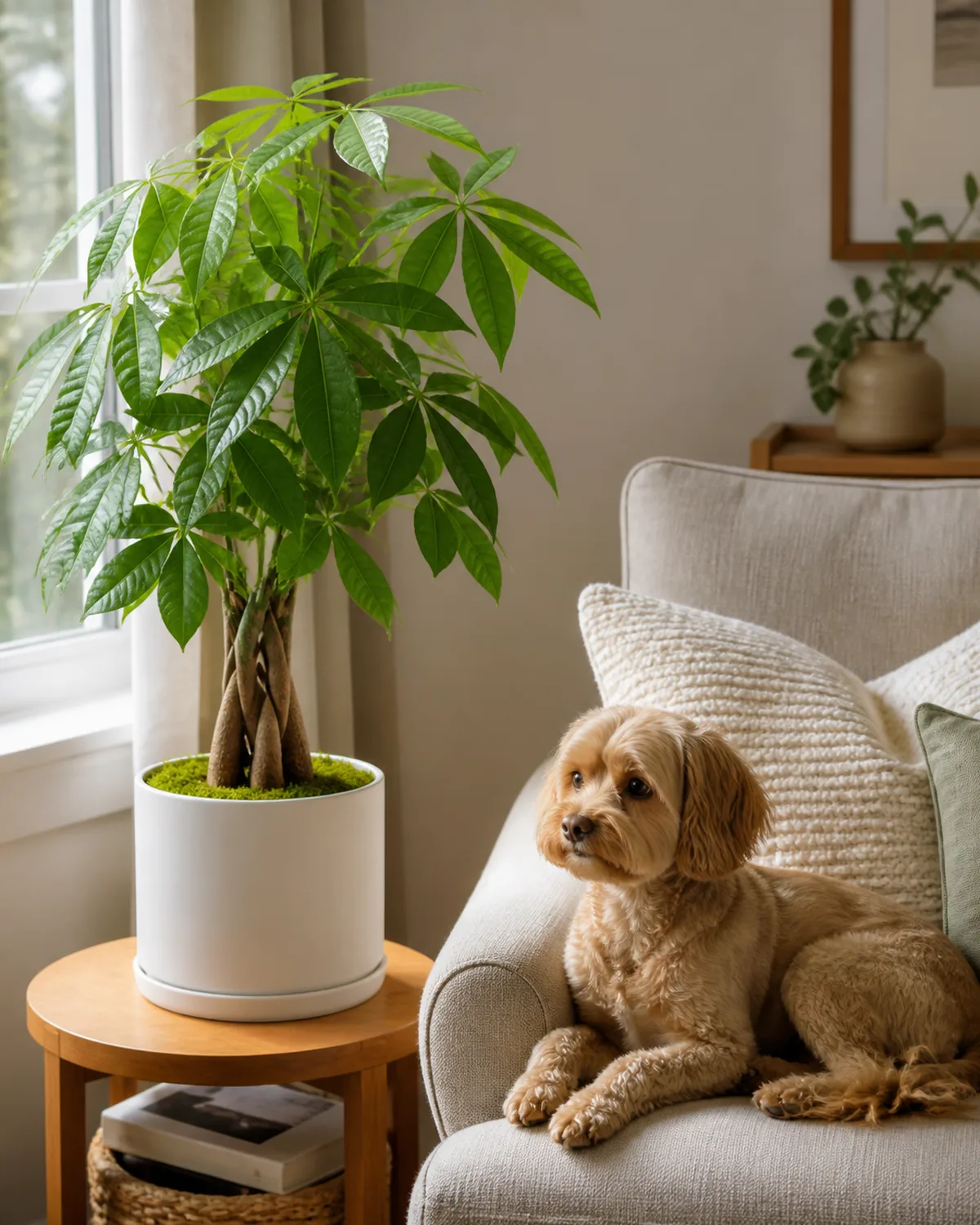
The ASPCA lists Pachira aquatica as non-toxic to both cats and dogs. This makes money tree one of the rare large statement trees that you can keep without worrying about pet safety.
Compare this to the alternatives. Fiddle leaf fig — toxic, causes oral irritation and vomiting if chewed. Jade plant — toxic to both cats and dogs, causes vomiting and depression. Dracaena — toxic, causes dilated pupils and excessive drooling. Money tree carries none of these risks.
That said, "non-toxic" does not mean "edible." A cat or dog that chews large quantities of money tree leaves may experience mild stomach upset — nausea, soft stool — simply from ingesting plant fiber that their digestive system is not designed to process. This is a mechanical issue, not a toxicity issue, and it resolves on its own.
The practical advantage is placement flexibility. Toxic plants need to be positioned out of reach — high shelves, hanging planters, closed rooms. Money tree can sit on a low table, on the floor, or anywhere else that suits the light conditions, without the constant calculation of whether a pet can access it.
For households that want large, floor-standing indoor trees and have pets, the shortlist of genuinely safe options is small: money tree, parlor palm, areca palm, and spider plant.
Money tree is the only one on that list with the distinctive braided trunk aesthetic — the default choice for pet owners who want a statement tree with visual character.

Mara Quinn edits Kultivy, where she shares houseplant care, propagation, beginner-friendly plant picks, and plant-styling ideas for anyone who wants their indoor plants to actually thrive. Every guide is image-led and reviewed for clarity, usefulness, image accuracy, and Pinterest-to-page alignment before it goes live. Visit the About page.