A syngonium starts as a compact rosette of arrow-shaped leaves. Let it climb and it becomes a different plant entirely — lobed, split, and twice the size.
The common name arrowhead plant only describes the baby stage. Give this vine a moss pole and it matures into something that looks like a different species — deeply divided leaves that spread wide and catch light from every angle.
The care is straightforward once you understand one thing: this plant changes form depending on how you grow it. Bush it, trail it, or climb it — the choice is yours, and the leaves follow.
Syngonium podophyllum is one of the few common houseplants that changes its leaf shape as it matures — from compact arrows to deeply lobed tropical foliage. These thirteen sections cover the transformation, variety selection, how light controls color, watering and humidity, soil and support structure, pruning and propagation, and toxicity.
What makes syngonium unique: the plant that changes its leaves as it grows
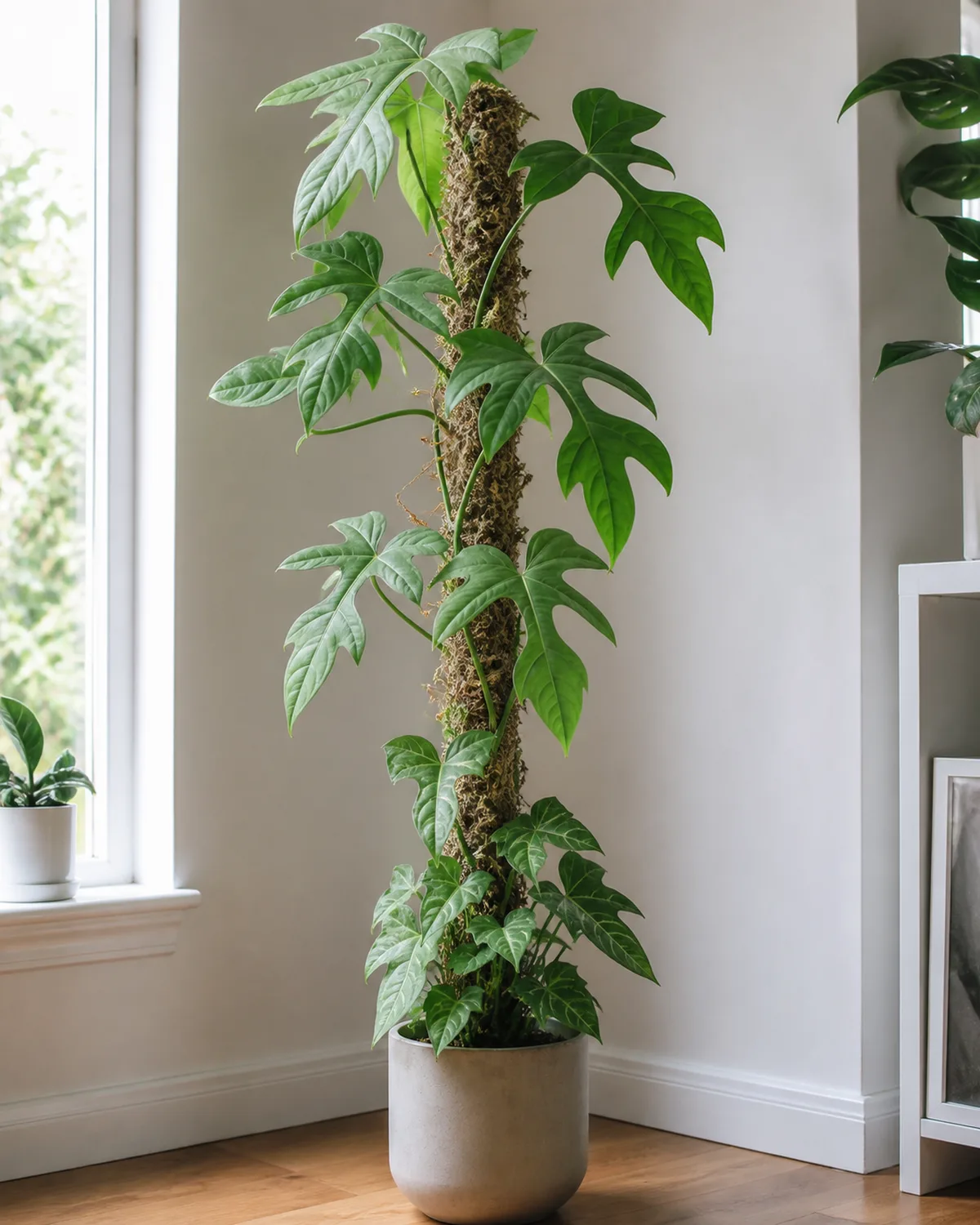
Syngonium podophyllum is one of the few common houseplants that undergoes heteroblastic leaf development — a botanical term for a plant that produces fundamentally different leaf shapes at different life stages on the same individual.
Juvenile syngonium produces the simple, symmetrical arrow-shaped leaves that give it the common name arrowhead plant. Each leaf is a clean spearhead, pointed at the tip with two backward-facing lobes at the base. This is the form you see at garden centers — compact, bushy, tidy.
As the vine matures and begins to climb, those same stems produce increasingly complex leaves. First three lobes, then five, and on a fully mature specimen climbing high enough, up to nine or eleven separate segments radiating from a single petiole.
The transformation happens on one plant at the same time. The bottom still shows compact arrows while the top displays deeply divided tropical foliage that looks like it belongs to a completely different species.
This is not damage, stress, or mutation. It is the plant's programmed growth sequence, triggered by stem length and climbing behavior. The taller it grows, the more complex the leaves become. Indoor plants kept pruned and bushy will stay in their juvenile arrow-shaped phase indefinitely — which is fine if you prefer the tidy look, but means you are seeing only the first act.
The family connection matters: syngonium belongs to Araceae, the same aroid family as philodendron and pothos. It shares their preference for chunky aroid soil, their climbing habit, and their tolerance for indoor conditions — but the heteroblastic leaf change is syngonium's signature trait that neither philodendron nor pothos displays to this degree.
Syngonium is one of the most adaptable aroids — forgiving of imperfect conditions while rewarding better care with faster growth and bolder color.
Best syngonium varieties: a color range from green to pink to white
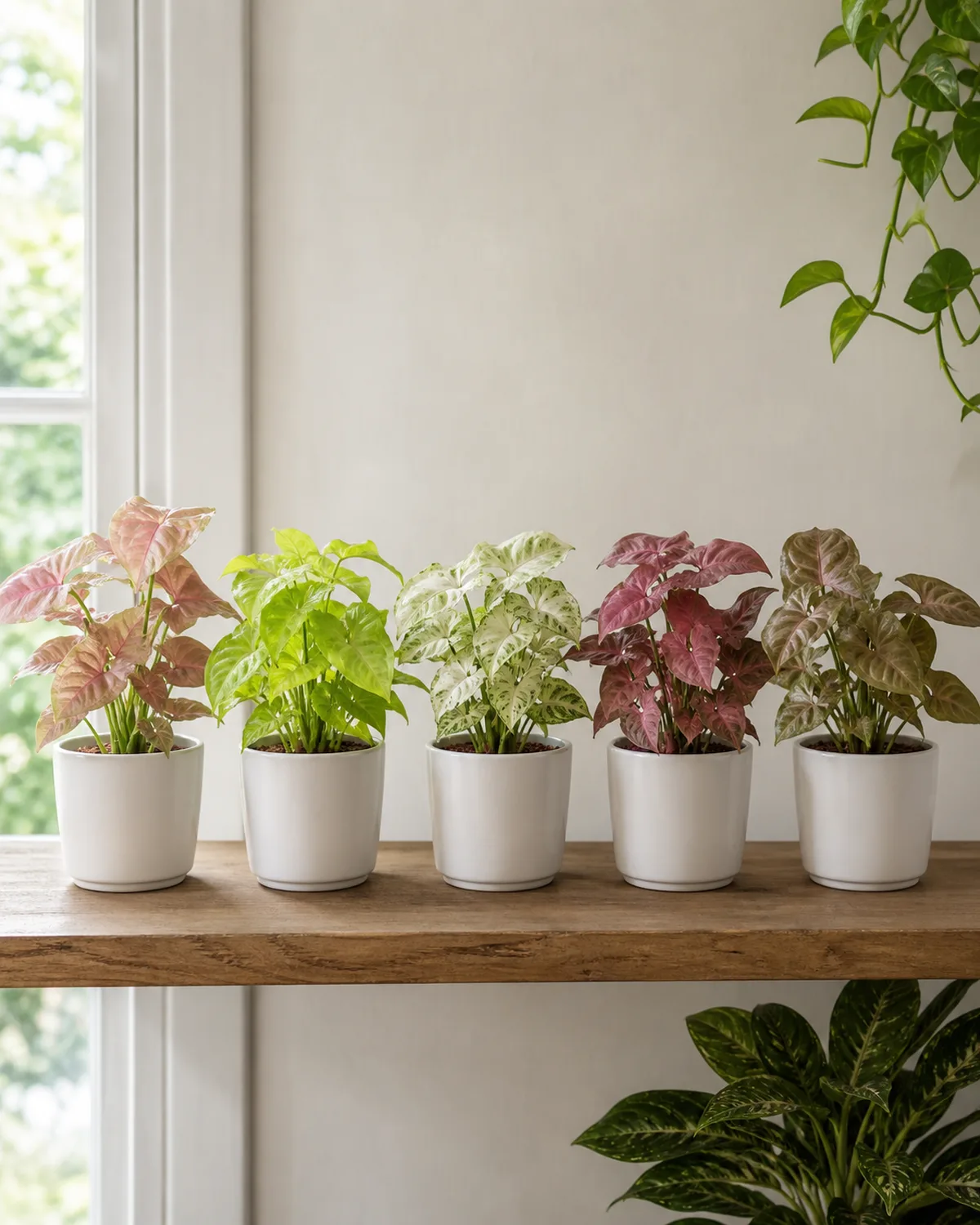
The species Syngonium podophyllum has produced dozens of cultivars spanning a color range that few other houseplant genera can match.
White Butterfly is the classic — silvery green centers with darker green margins and a pale central vein, the variety most garden centers stock. It is the most forgiving of lower light among the variegated types and the one to start with if you are new to syngonium.
Pink Allusion flushes soft pink through the leaf center, with the intensity deepening in brighter light. New leaves emerge almost entirely pink before maturing to a pink-green blend. This is the variety that made syngonium an Instagram favorite.
Neon Robusta pushes color further — vivid chartreuse-pink leaves that almost glow under good light. It is more compact than most syngonium, making it ideal as a desk or shelf plant that stays bushy without constant pruning.
Berry Allusion goes darker, with dusty rose undertones and deep green leaf edges. The color is more muted and sophisticated than Pink Allusion — less statement piece, more background warmth.
Maria Allusion carries bronze-green leaves with subtle pink veining, the most understated of the Allusion series. It handles lower light better than its pinker siblings because the higher chlorophyll content makes it less dependent on intense light to produce energy.
Batik stands apart with irregular creamy-white variegation splashed across dark green — no two leaves identical. It is slower growing and more sensitive to overwatering than the Allusion varieties, but the unpredictable patterns make every new leaf a surprise.
Light and the color paradox: why your pink syngonium turns green
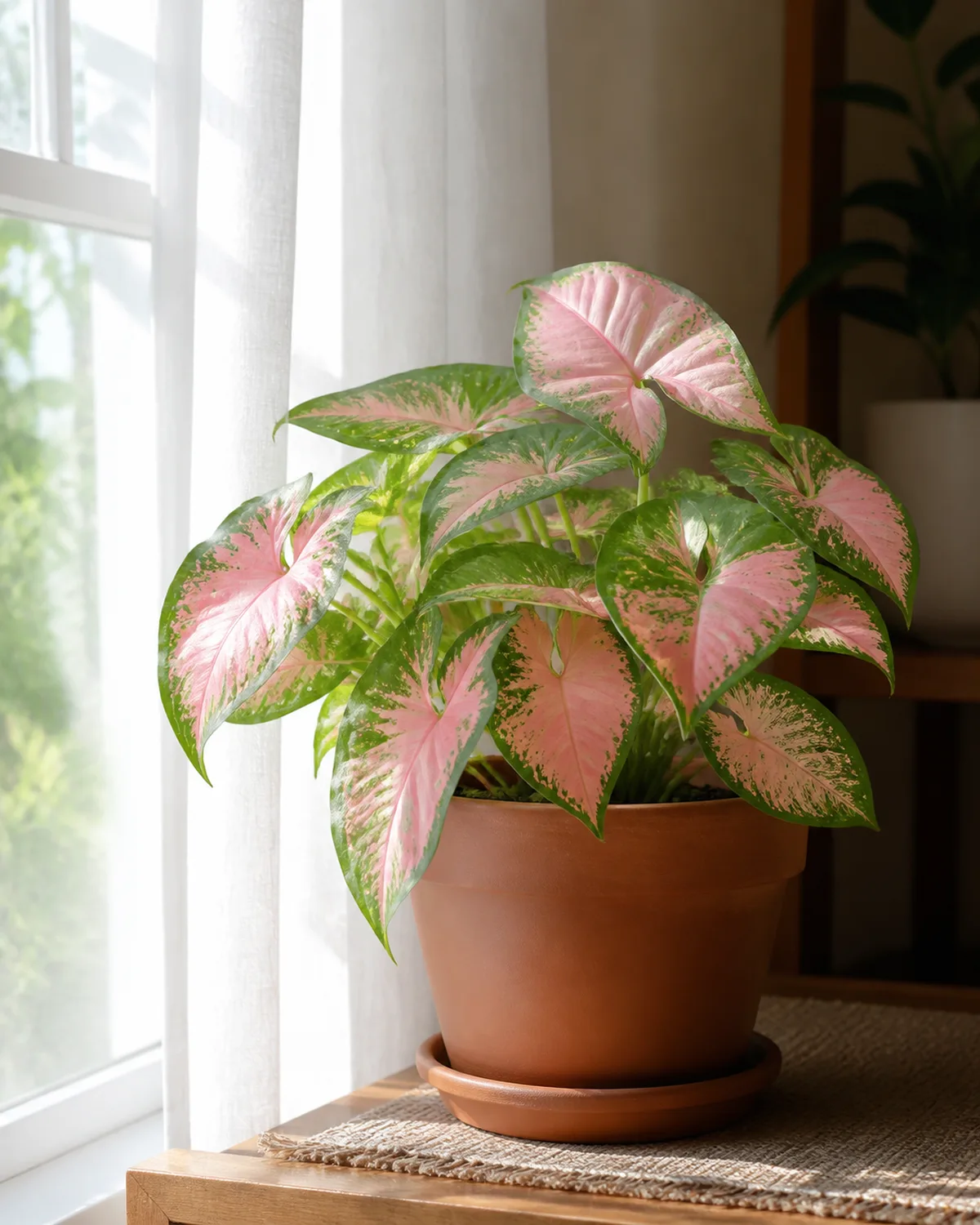
Syngonium has a light-color relationship that works the opposite of what most people assume. More light does not simply mean more growth — it determines whether your plant keeps its variegation or reverts to plain green.
Pink Allusion and Neon Robusta produce their signature colors only when chlorophyll production stays suppressed by sufficient light. The pink and white areas of a variegated leaf contain little to no chlorophyll — they rely on the green sections to power the plant. In adequate light, the green sections produce enough energy and the plant maintains its variegation pattern.
Move a variegated syngonium to a dim corner and the math changes. The plant needs more photosynthetic surface area to survive, so it increases chlorophyll production across the entire leaf. The pink fades. The white fills in with green. The next leaves emerge greener still. The color does not come back on those leaves — the plant has overwritten the variegation to stay alive.
The fix is not more light but the right light — 200 to 400 foot-candles of indirect exposure, roughly an east window or two feet from a south window with a sheer curtain. Direct afternoon sun is too much: it scorches the thin leaves into translucent brown patches that do not heal. Morning direct sun from an east window is fine.
Green varieties like the straight species are genuinely low-light tolerant, surviving under 100 foot-candles where most aroids stall. If you have only north-facing windows, stick to the all-green types — they will hold up where Pink Allusion would slowly turn plain.
The light level also controls leaf maturity. A climbing syngonium in bright conditions produces its fully lobed adult leaves faster than one struggling in shade, because the plant invests more growth energy when photosynthesis runs efficiently. See the broader framework in the houseplant light requirements guide.
Watering: top inch dry then thorough soak
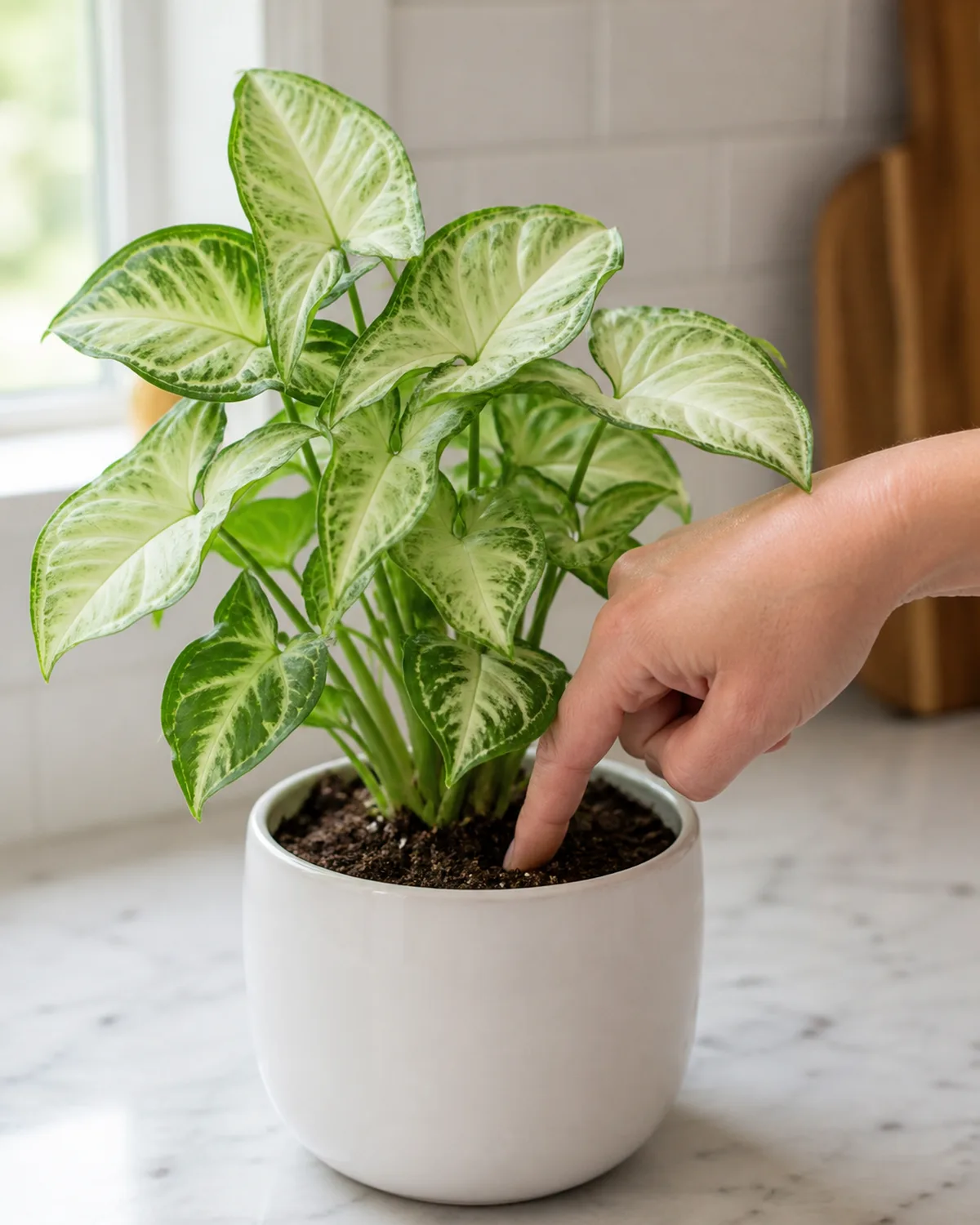
Syngonium sits in the middle of the watering spectrum — more forgiving than calathea, less drought-tolerant than pothos.
Let the top inch of soil dry before watering thoroughly until water runs from the drainage holes. The plant gives you a clear thirst signal: the leaves droop noticeably, going from upright and turgid to visibly wilted. They perk back up within hours of watering — one of the most dramatic turnaround responses in common houseplants.
Persistent drooping after watering usually means root rot from chronic overwatering. When roots are damaged, they cannot take up water even when it is available. The leaves droop not from thirst but from a damaged delivery system. If the soil feels wet and the leaves still droop, unpot immediately and check for brown mushy roots.
In winter, the soil stays wet longer because lower light and cooler temperatures slow transpiration. Extend the interval between waterings. A pot that needed water every five days in July might need water every ten days in January.
Syngonium does not store water in thick leaves or rhizomes the way ZZ plants or jade plants do. Letting it dry out completely for days causes crispy leaf edges that do not reverse. The damage stays on those leaves permanently — only new growth will emerge undamaged.
Terracotta pots speed drying and forgive a heavy hand. Glazed or plastic pots hold moisture longer and suit people who forget to water — but increase the risk of root rot if you water too frequently.
Humidity: the one variable that separates crispy edges from clean ones
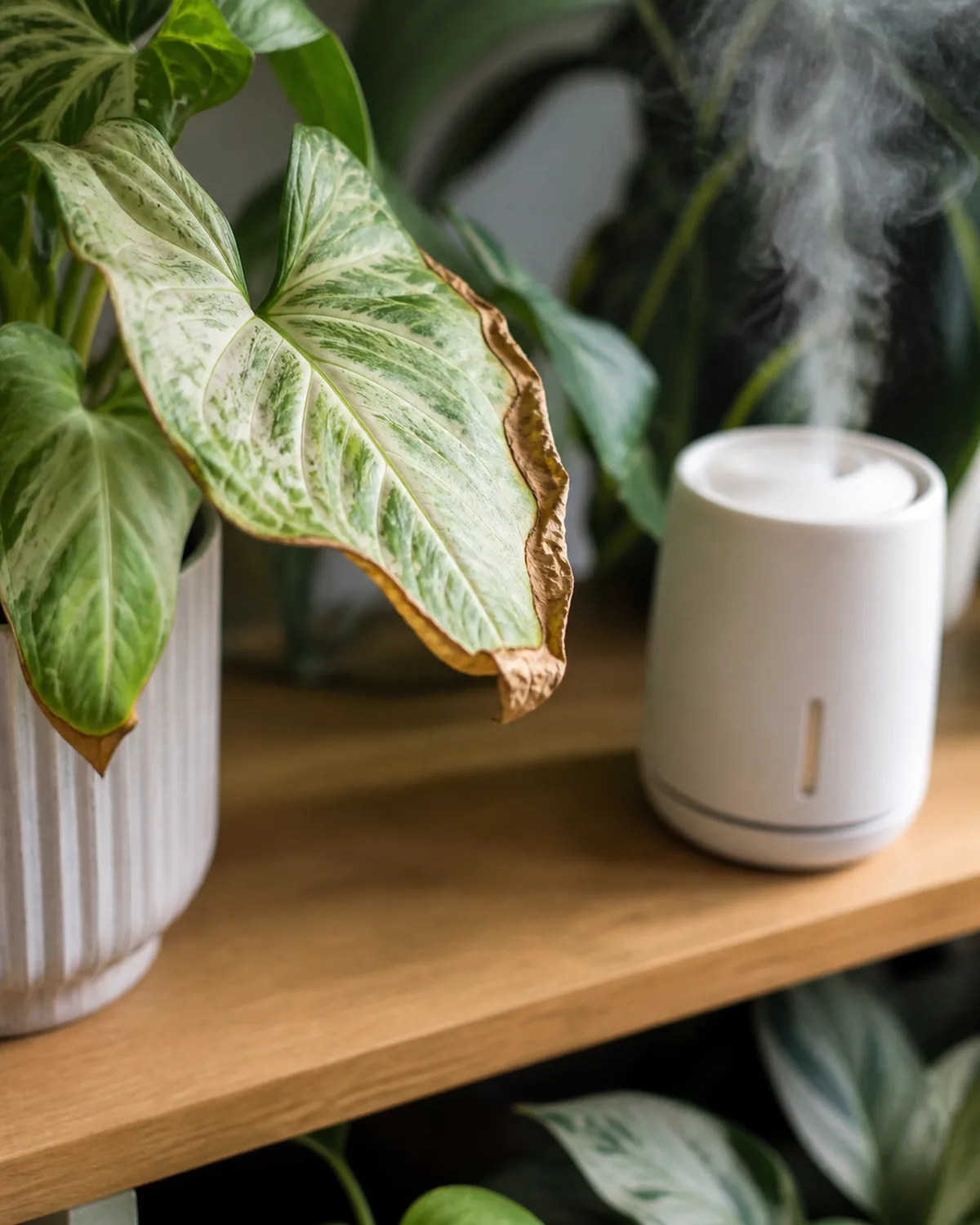
Syngonium tolerates average indoor humidity far better than its fellow aroids like anthurium or calathea — a trait inherited from its adaptability across altitudes in Central America, where it grows from sea-level rainforest up to drier mountain slopes.
At 40% humidity most syngonium hold fine. The problem shows up specifically on thin-leaved variegated cultivars: Pink Allusion and White Butterfly develop crispy brown margins at their leaf tips first, then the damage spreads inward along the edge. The variegated areas are more vulnerable because they have thinner cell walls with less structural integrity than the chlorophyll-rich green zones.
The damage is permanent on affected leaves but stops on new growth once humidity rises above 50%. This makes syngonium a useful humidity indicator plant — if its new leaves emerge clean while old ones stay crispy, your fix is working. If new leaves also develop brown edges, the humidity is still too low.
A small humidifier pointed at the plant canopy is the only solution that meaningfully raises local humidity. Pebble trays and misting are popular rituals that barely move the needle — a pebble tray raises humidity by roughly 2-3% in the immediate vicinity, and misted water evaporates within minutes.
Grouping several plants together creates a microclimate that helps marginally in winter when forced-air heating drops rooms to 25-30% humidity. Each plant releases moisture through transpiration, and the combined effect can raise the local humidity by five to eight percentage points in a tight cluster.
Soil: well-draining aroid mix that lets roots breathe
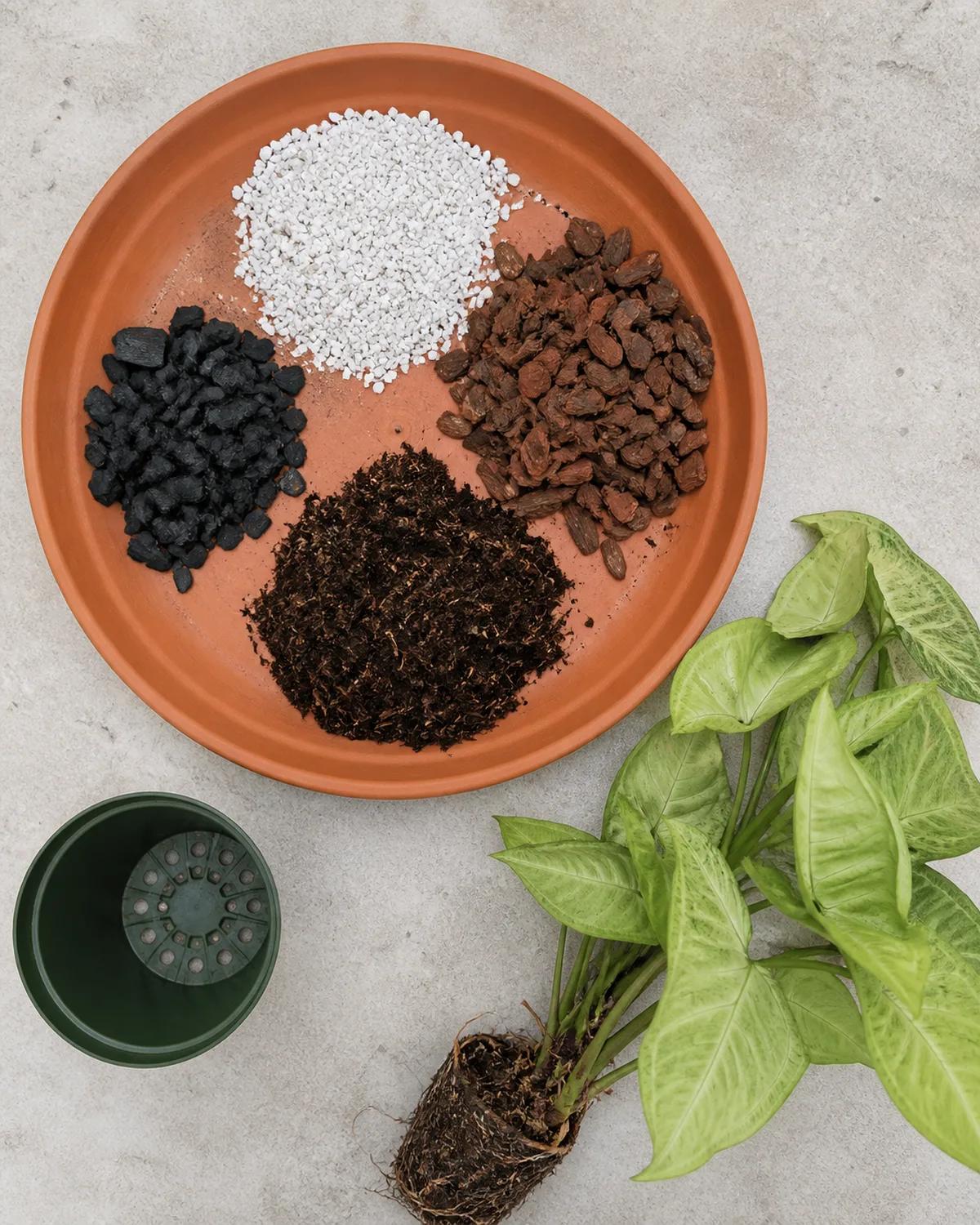
Standard potting soil retains too much moisture for syngonium roots, which are adapted to the airy conditions of climbing up tree trunks in the wild. In its natural habitat, syngonium is an epiphytic climber — its roots grip bark and absorb moisture from humid air, never sitting in waterlogged ground.
The aroid mix formula: one part standard peat-based potting soil, one part perlite, one part orchid bark. This creates the drainage and aeration that aroids need. The peat holds some moisture and nutrients, the perlite creates air pockets, and the bark chunks prevent compaction while slowly breaking down over time.
Adding a handful of horticultural charcoal helps absorb excess mineral salts from fertilizer and water, keeping the root zone cleaner between repottings. It is optional but useful if your tap water is hard.
The roots should never sit in waterlogged soil — this is the fastest path to root rot. Syngonium roots are finer than most aroids (finer than philodendron, much finer than monstera), which means they suffocate faster in heavy, saturated media.
Terracotta pots pull excess moisture away from roots through the porous clay walls. If using a glazed or plastic pot, ensure the drainage hole is large and unobstructed — syngonium is less forgiving of blocked drainage than its reputation as an easy plant suggests.
Repot every one to two years in spring, stepping up one pot size (two inches larger in diameter). Syngonium grows fast enough that it can become rootbound within a single growing season, showing roots circling the drainage hole and pushing up through the soil surface.
Climbing vs. bushing vs. trailing: you choose the plant's personality
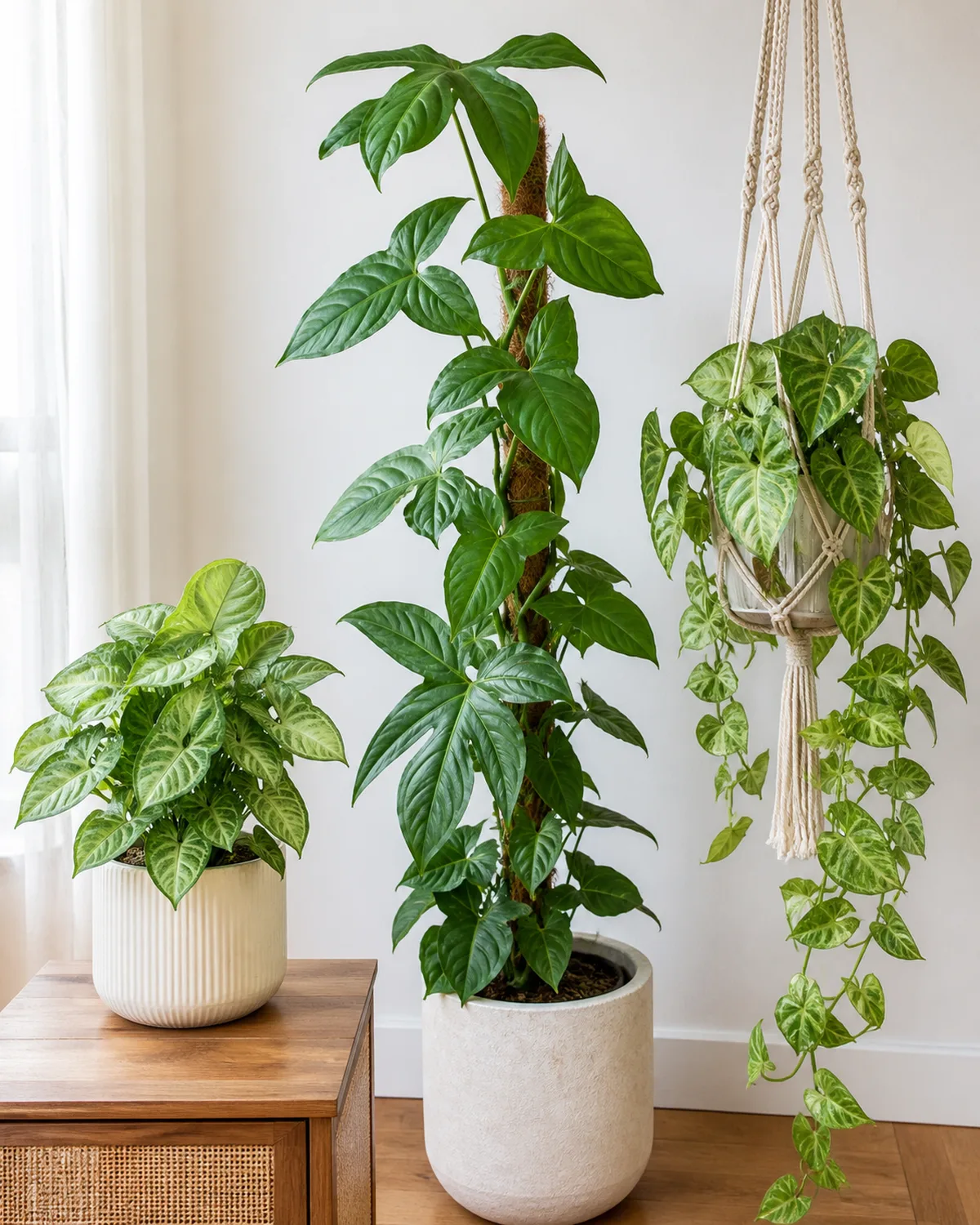
Syngonium is naturally a climbing vine, and its growth habit — and leaf shape — changes dramatically depending on whether you provide support.
Bushy (no support, regular pruning): Without a pole or trellis, syngonium stays compact with juvenile arrow-shaped leaves. Regular pinching of the growing tips forces branching, creating a full, mounded form. This is how most people grow syngonium on desks and shelves. The leaves stay small and arrow-shaped indefinitely. The tradeoff is that you never see the mature lobed leaves.
Climbing (moss pole or trellis): Give syngonium a damp moss pole and it transforms. Stems thicken, aerial roots embed into the moss, internodes shorten, and leaves mature into their full lobed form — three, five, even nine segments.
The climbing form produces the largest, most dramatic leaves. A moss pole that stays damp encourages the aerial roots to actually grip rather than air-prune. Mist the pole, not the leaves.
Trailing (hanging basket, no pruning): Let syngonium grow without support or pruning and it sends out long trailing stems that cascade from a hanging basket. The leaves stay relatively small — closer to the juvenile form — because trailing stems lack the upward momentum that triggers leaf maturation. The effect is graceful but more sparse than a pothos trail.
The choice is yours. Each form is the same plant expressing different growth programs. You can even change direction: a bushy syngonium given a moss pole will start climbing and transitioning to lobed leaves within a few months. A climbing syngonium taken off its pole and hung will revert to producing arrow-shaped leaves on its new trailing growth.
Pruning to keep compact: why it gets leggy and how to fix it
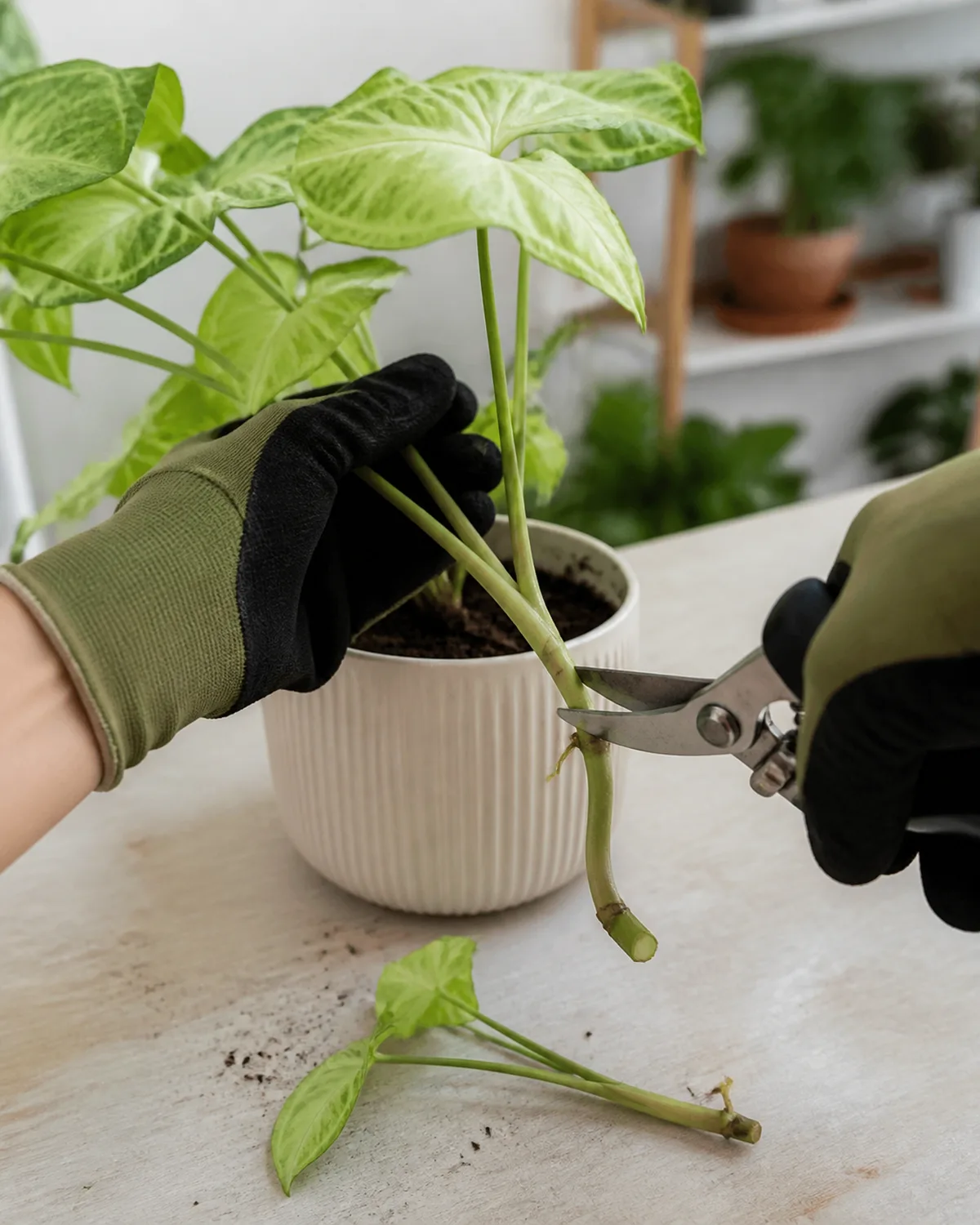
Without pruning, syngonium gets leggy fast — long bare stems with a cluster of leaves only at the tips. This is the vine's natural growth strategy: extend toward light, lose lower leaves once they are shaded by the canopy above, keep pushing upward.
Indoors without a support structure, this creates a plant that looks sparse and stretched within a single growing season.
Cut back leggy stems to just above a node — the small bump on the stem where a leaf attaches or once attached. This is where dormant buds sit. When you remove the growing tip, the plant redirects growth hormones (auxin) to these lower nodes, and new shoots push out below the cut. The result is a bushier shape with multiple growing points instead of one long leader.
Each cut stem becomes a propagation cutting — there is zero waste in syngonium pruning.
The best time to prune is spring or early summer when growth is active. Cutting in winter works but recovery is slower because the plant's metabolic rate drops with lower light and cooler temperatures.
Wear gloves. The sap contains calcium oxalate crystals that can irritate skin on contact — some people develop a mild rash, and the irritation is worse if you have cuts or abrasions on your hands.
Regular pinching of growing tips — removing just the newest unfurling leaf — prevents legginess before it starts. It takes less than a minute per plant per week and eliminates the need for hard cutback pruning later.
Propagation: one of the easiest plants to root in water
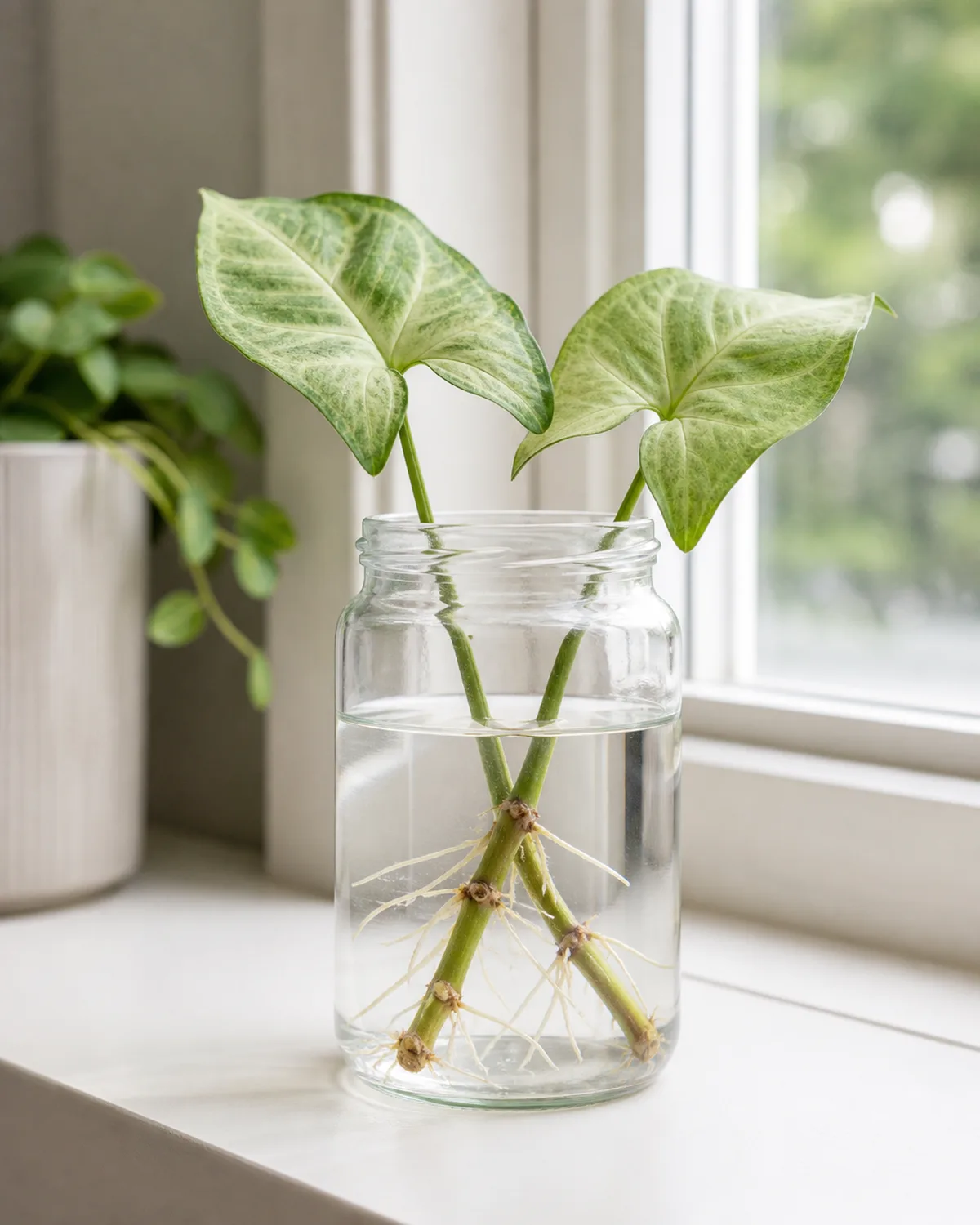
Syngonium is one of the easiest houseplants to propagate in water — reliably faster than philodendron and more forgiving of mistakes than pothos.
Cut a stem section that includes at least one node (the bump where a leaf meets the stem) and one or two leaves. The node is the critical piece — roots only emerge from nodes, never from the middle of a bare stem.
Place the cutting in a clear glass of water with the node submerged and the leaves above the waterline. Clear glass lets you watch root development and catch any bacterial cloudiness early. Position it in bright indirect light — the same conditions the parent plant prefers.
Roots appear in one to two weeks — visible white threads emerging from the node and extending into the water. Change the water weekly to prevent bacterial buildup, and top off between changes if the water level drops below the node.
Once roots reach two to three inches (roughly five to eight centimeters), the cutting is ready for soil. Plant it in moist aroid mix and keep the soil consistently moist — not wet, just moist — for the first two weeks while the water roots adapt.
Water roots are structurally different from soil roots: they are more fragile and need time to harden and develop root hairs for soil absorption. The transition period is when most propagation failures happen.
Spring and summer propagation succeeds at the highest rate because the plant's growth hormones are most active. Fall and winter propagation works but roots develop slower and the transition to soil takes longer.
For a deeper look at propagation methods across species, see the plant propagation guide.
Fertilizing a fast grower without burning the roots
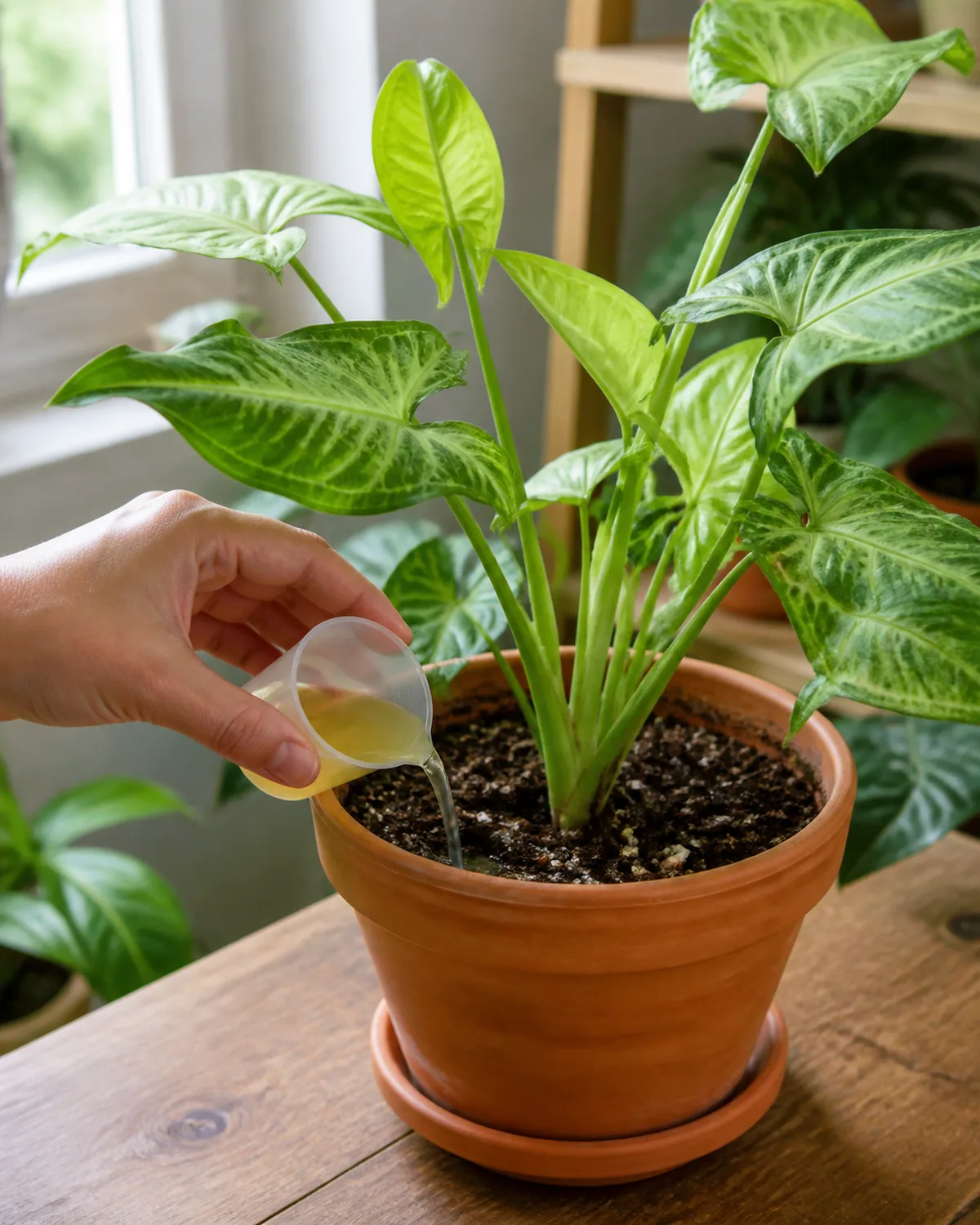
Syngonium is one of the faster-growing aroids indoors — a healthy plant in good light can push a new leaf every week during summer. That growth rate means it actually uses more nutrients than slow growers like ZZ plant or jade, but its fine root system burns easily if you overcorrect.
The formula that works: balanced liquid fertilizer (20-20-20 or similar) diluted to one-quarter strength, applied every two weeks during active growth from April through September. Quarter-strength biweekly feeds more evenly than half-strength monthly — the plant gets a steady trickle of nutrients instead of feast-and-famine cycles that spike salt concentration in the soil.
For variegated cultivars, avoid high-nitrogen formulas. Excess nitrogen pushes green growth at the expense of pink or white coloring — the plant uses the extra nitrogen to produce more chlorophyll, which is the opposite of what you want if you bought a Pink Allusion for its pink. A balanced or slightly higher-phosphorus formula maintains color better.
Stop all feeding from October through March. The plant's growth slows dramatically with shorter days and lower light angles, and unused nutrients accumulate as salts in the soil.
Flush accumulated salts by running water through the pot for three to four minutes every six to eight weeks during the feeding season. You will see the runoff become cloudy initially then clear — that cloudiness is dissolved mineral salts leaving the root zone.
Signs of overfertilizing: brown, dry leaf tips and margins (salt burn) and a white crusty deposit on the soil surface or the outside of terracotta pots. For the broader framework, see the houseplant fertilizing guide.
Common pests: what targets syngonium and how to treat it
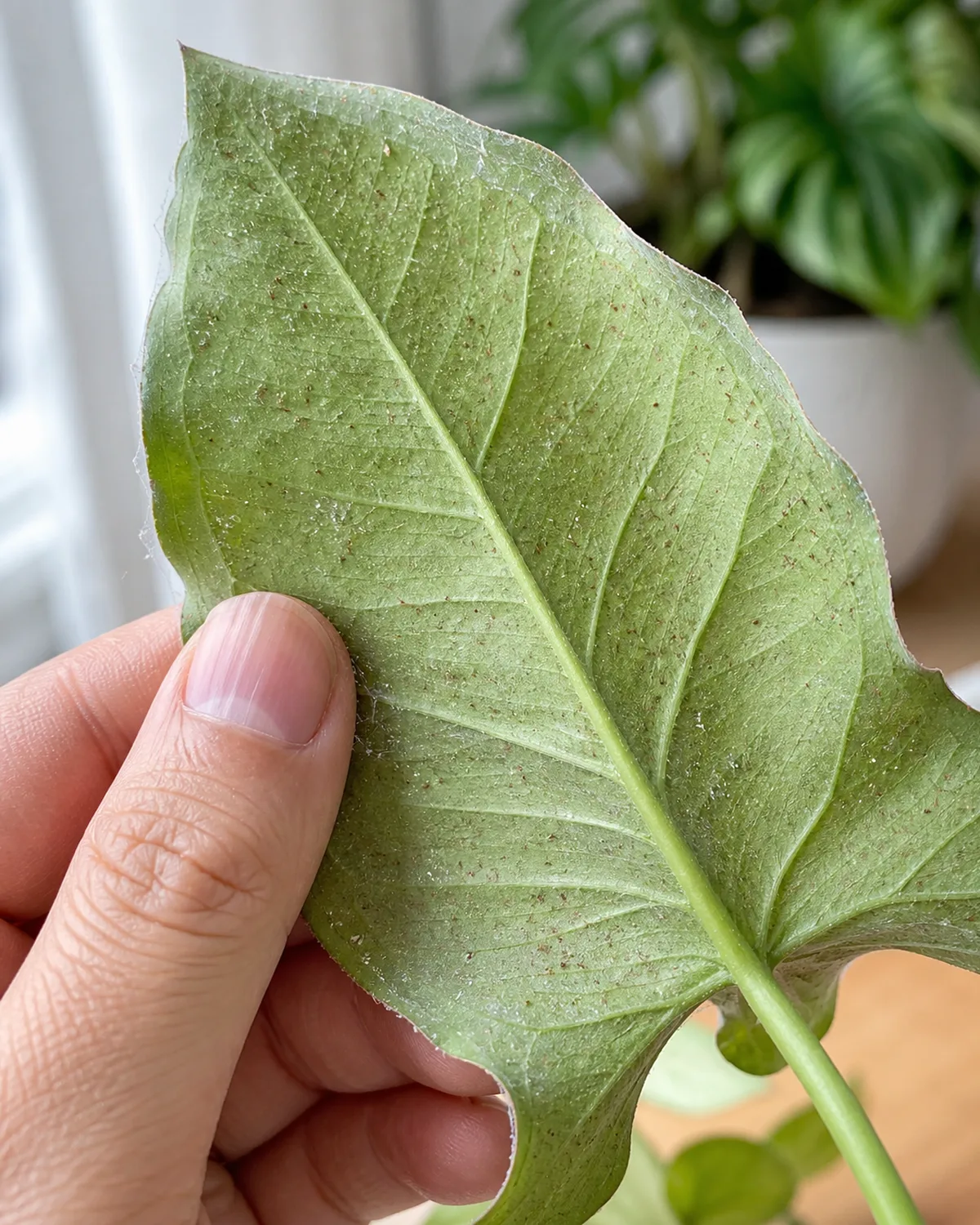
Spider mites are the most frequent pest on syngonium, congregating on leaf undersides where they spin fine webbing between leaf veins. The first sign is usually tiny yellow stippling marks on the leaf tops — each mark is where a mite punctured the leaf cell and sucked out the contents. By the time you see webbing, the infestation is established.
Flip leaves regularly to catch infestations early. Run a damp white cloth along the underside of a leaf — if it picks up tiny moving dots (red, brown, or translucent), you have mites.
Mealybugs cluster at nodes and in the crooks where leaves meet stems, hiding under white cottony masses. They look harmless but each one is draining sap and excreting honeydew that attracts sooty mold. Syngonium's branching nodes are ideal hiding spots because the bugs wedge into the tight angles where pruning shears cannot reach.
Scale insects attach to stems as immobile brown bumps that look like part of the plant. They are easy to miss because they do not move — many growers mistake them for bark texture or dried sap droplets.
Treat all three with neem oil spray applied every five to seven days for three consecutive weeks. The three-week cycle matters: neem oil kills adults and disrupts feeding, but eggs hatch on a roughly seven-day cycle. You need three applications to catch adults, then first-generation hatchlings, then any stragglers from late-hatching eggs.
Isolate infested plants immediately. Spider mites in particular spread through the air on silk threads, and a syngonium next to other aroids can infect the entire shelf within days. For the full treatment playbook, see the houseplant pests and diseases guide.
Why your syngonium leaves are yellowing: four causes, four patterns
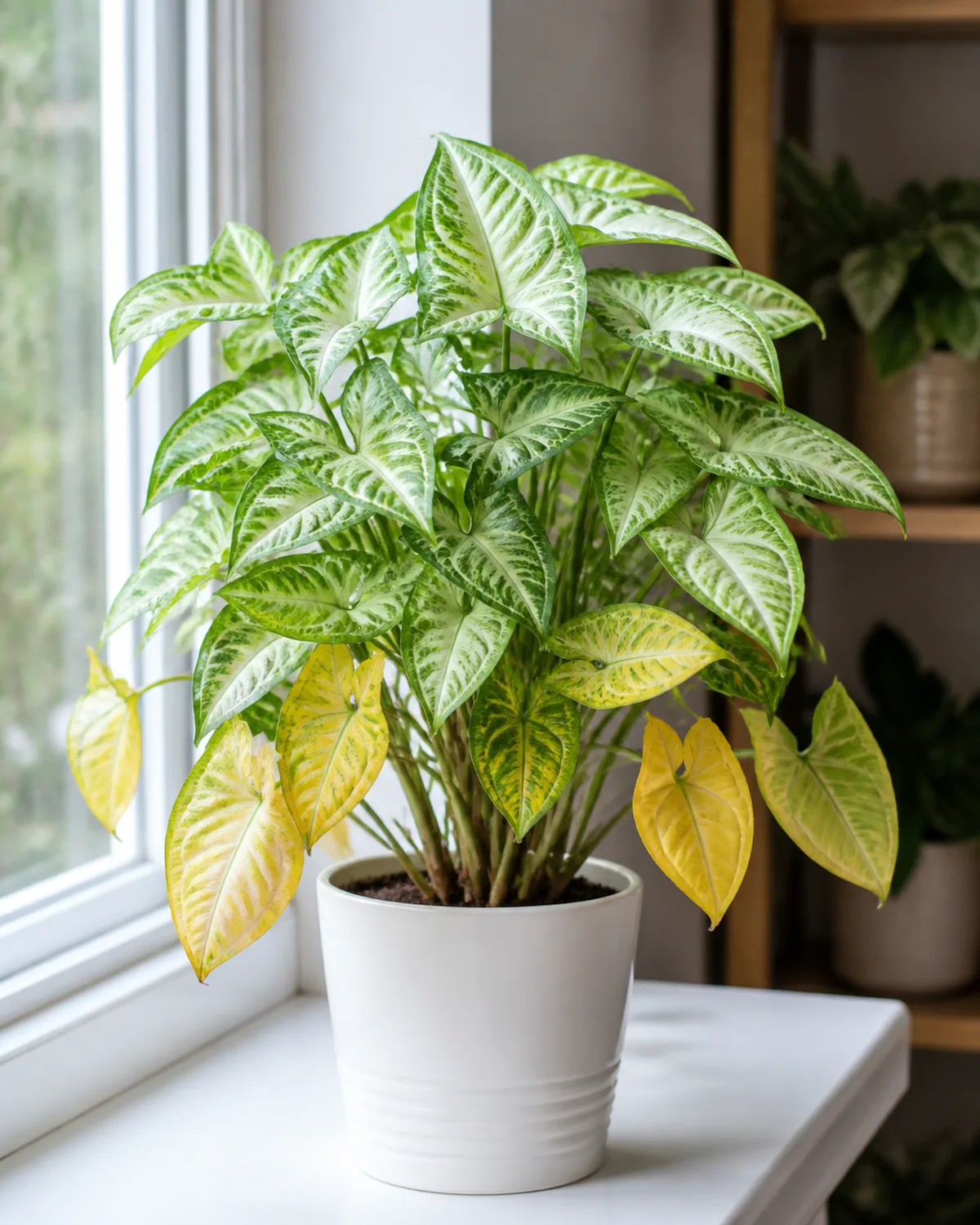
Yellowing leaves on syngonium always mean something — but the meaning depends on which leaves and how they yellow.
Lower leaves yellowing and dropping: This is natural aging. Syngonium is a vine that sheds its oldest foliage as it grows new leaves at the top. One or two lower leaves yellowing at a time, with healthy new growth emerging, is the plant functioning normally. No intervention needed.
Multiple leaves yellowing at once, soft and mushy: Overwatering. The roots are suffocating in waterlogged soil, possibly already rotting. The leaves turn a uniform dull yellow and feel soft rather than papery. Unpot, check for brown mushy roots, trim any rot with sterile scissors, repot in fresh dry aroid mix, and water less frequently going forward.
Yellowing with dry, crispy edges: Underwatering or low humidity (or both). The yellow has a parched quality — the leaf feels papery, not mushy. The crispy edges are the plant sacrificing leaf margins to conserve water for the central veins. Increase watering frequency and check humidity.
Uniform pale yellow across the whole plant, including new growth: Nutrient deficiency, usually nitrogen. This is distinct from overwatering yellow because it affects the entire plant evenly rather than starting at the bottom. Resume fertilizing with a balanced liquid formula — the plant should green up with new leaves within two to three weeks.
Yellowing with leggy, stretched growth: Low light. The plant is yellowing and stretching toward the nearest light source. Move it to a brighter spot. New growth will emerge greener and more compact once the light improves.
Syngonium Care: The Quick Reference
- 1Leaves change shape as the plant maturesJuvenile arrow-shaped leaves transform into deeply lobed leaves when the vine climbs. Pruning keeps it in the juvenile phase. A moss pole triggers the adult form.
- 2Dozens of varieties from green to pinkWhite Butterfly (classic), Pink Allusion (soft pink), Neon Robusta (chartreuse-pink), Berry Allusion (dusty rose), Batik (irregular cream variegation).
- 3Light controls color, not just growthVariegated types revert to green in low light. 200-400 foot-candles indirect. Green types survive under 100. No direct afternoon sun.
- 4Top inch dry, then thorough soakLeaves droop when thirsty and recover fast. Not drought-tolerant — complete dry-out causes permanent crispy edges. Terracotta forgives overwatering.
- 550%+ humidity for clean leaf edgesHandles 40% without drama. Variegated types show crispy margins below 40%. Humidifier works; pebble trays and misting barely register.
- 6Aroid mix: peat + perlite + barkOne part each. Never heavy soil. Fine roots suffocate faster than other aroids. Repot every 1-2 years in spring, one pot size up.
- 7You choose the growth formBushy with pruning (small arrow leaves). Climbing on a moss pole (large lobed leaves). Trailing from a basket (graceful cascade). Same plant, three looks.
- 8Cut above a node to prevent legginessEach cut forces branching from lower nodes. Every cut piece becomes a propagation cutting. Wear gloves — the sap irritates skin.
- 9Roots in water in 1-2 weeksStem cutting below a node in clear water. Change weekly. Transition to soil at 2-3 inches of root growth. Keep soil moist for the first two weeks.
- 10Quarter-strength fertilizer biweeklyApril through September. Balanced formula. Avoid high nitrogen on variegated types — it pushes green over pink. Stop feeding in winter. Flush salts bimonthly.
- 11Spider mites are the main threatCheck leaf undersides weekly. Neem oil every 7 days for 3 weeks kills the full lifecycle. Isolate infested plants. Mealybugs hide at nodes.
- 12Yellow leaves tell different storiesLower leaves = natural aging. Multiple + mushy = overwatering. Crispy edges = underwatering or low humidity. Pale across entire plant = nutrient deficiency.
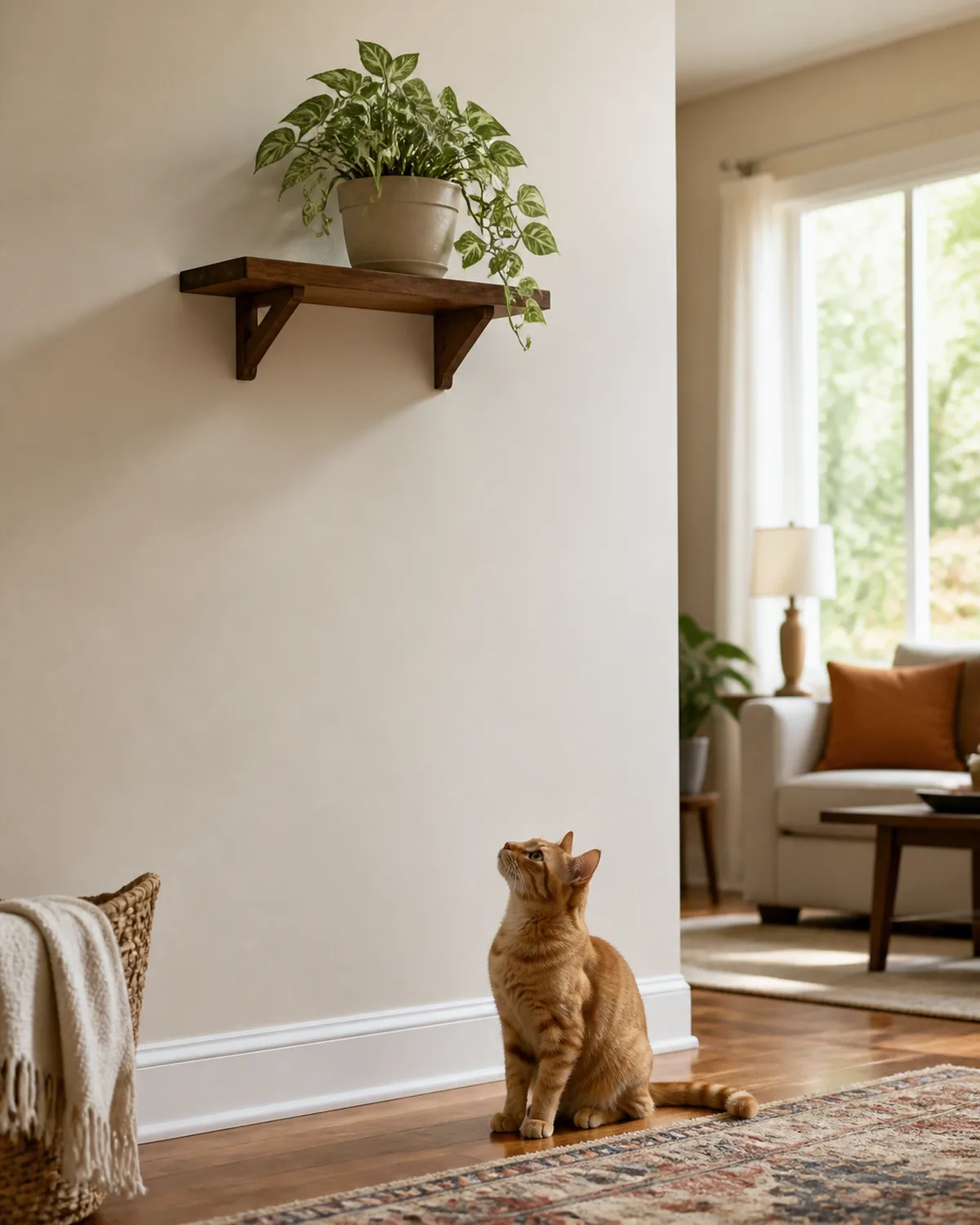
- 13Toxic to cats and dogsCalcium oxalate crystals in all plant parts. Causes oral burning, drooling, swelling if chewed. Keep on high shelves or in hanging baskets out of reach.
kultivy.com
Is syngonium toxic? Yes — keep it away from pets and children
Syngonium contains calcium oxalate crystals throughout all parts of the plant — leaves, stems, roots, and sap. These are the same microscopic needle-shaped crystals (raphides) found in philodendron and dieffenbachia, and they work the same way.
When a pet or child chews on a syngonium leaf, the pressure of biting ruptures specialized cells called idioblasts that eject the raphides like tiny projectiles. The crystals embed in the soft tissue of the mouth and throat, causing immediate intense burning, pain, and swelling. The reaction is mechanical, not chemical — the crystals physically puncture cells.
The ASPCA lists syngonium (and all Syngonium species) as toxic to both cats and dogs. Symptoms of ingestion include oral pain, excessive drooling, pawing at the mouth, difficulty swallowing, and vomiting. Most animals stop chewing quickly because the pain is immediate and intense, which limits the amount consumed.
Ingestion is rarely fatal but requires veterinary attention. The swelling can obstruct airways in small animals, and prolonged drooling can lead to dehydration. If you see your pet chewing syngonium, remove any remaining plant material from their mouth and contact your veterinarian.
The sap also irritates human skin. When you prune or propagate syngonium, wear gloves — the oxalate crystals in the sap can cause redness, itching, and a mild rash on contact, especially on abraded skin or around the eyes.
The practical solution: grow syngonium on high shelves, in hanging baskets, or in rooms your pets do not access. The trailing and climbing growth habits make it well-suited to elevated positions where curious cats and dogs cannot reach.

Mara Quinn edits Kultivy, where she shares houseplant care, propagation, beginner-friendly plant picks, and plant-styling ideas for anyone who wants their indoor plants to actually thrive. Every guide is image-led and reviewed for clarity, usefulness, image accuracy, and Pinterest-to-page alignment before it goes live. Visit the About page.