A bonsai is not a species. It is a technique. Any woody plant can become one, and the skills that keep it alive are closer to sculpture than gardening.
The word tells you what you are doing: bon (tray) sai (planting). The container limits roots, pruning controls the canopy, and time builds the character of a miniature ancient forest.
The care is not difficult once you know what a bonsai needs: fast-draining soil, bright direct light, watering that follows the tree, and seasonal pruning.
Bonsai is not a plant species — it is a practice that turns any woody plant into a living sculpture. These thirteen sections cover the technique behind the art, species that forgive beginner mistakes, the light and watering balance that keeps a miniature tree alive, and the pruning, wiring, and repotting skills that shape it over years.
What bonsai actually is: a technique, not a species
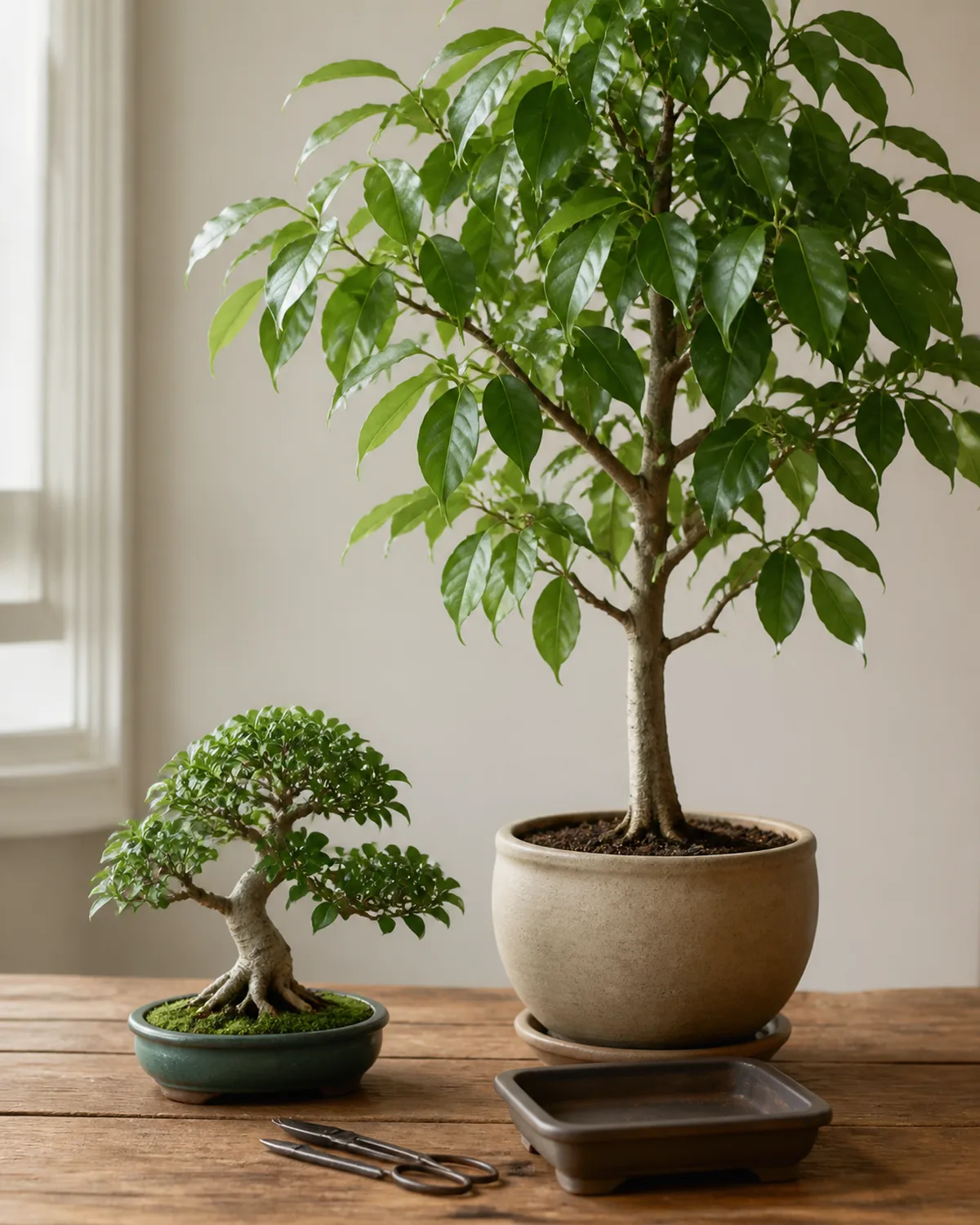
Bonsai is not a dwarf species bred to stay small. Any woody plant — ficus, elm, juniper, maple, jade — can become a bonsai through deliberate container restriction, root pruning, and branch training. The tree wants to grow full-sized. Your job is to shape it while keeping it healthy at miniature scale.
This is closer to sculpture than gardening. The three pillars are confinement (a shallow pot limits root spread and therefore top growth), pruning (controls canopy size and directs where new branches emerge), and time (a bonsai develops character over years, even decades — the gnarled trunk, the spreading surface roots called nebari, the aged bark texture).
The miniaturization works because root restriction controls top growth proportionally. A tree with fewer roots produces fewer and smaller leaves, shorter internodes (the gaps between leaves on a branch), and thicker proportional trunk-to-height ratios. Every part of the tree adjusts to the container size.
This means bonsai care is not about keeping a plant alive the way you keep a pothos alive. It is about managing a controlled stress — giving the tree enough resources to stay healthy while restricting its growth enough to maintain the miniature form. Too much restriction and the tree weakens. Too little and it outgrows the design.
Bonsai rewards patience and daily attention. It is not a low-maintenance plant — but the demands are brief, not difficult.
Best beginner species: start with something that forgives mistakes
The indoor versus outdoor distinction is the first decision, and getting it wrong is how most beginner bonsai die.
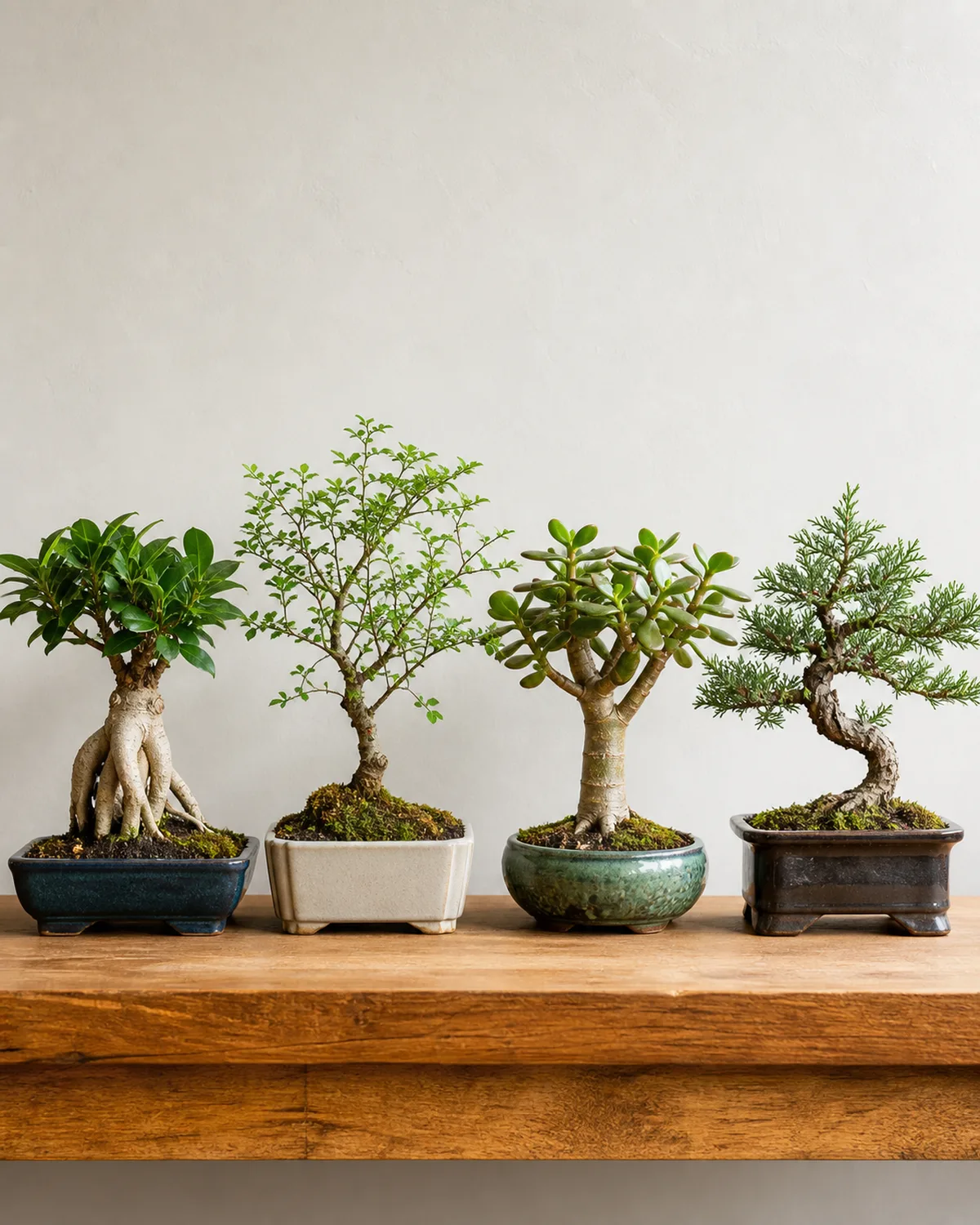
Tropical species live indoors year-round. They do not need cold dormancy, they tolerate the stable temperatures of a heated home, and they keep their leaves through winter. These are the only true indoor bonsai.
Ficus retusa (ginseng ficus) is the most forgiving indoor bonsai. Thick aerial roots give it an ancient look even when young. Waxy leaves tolerate lower humidity than most tropicals. It regrows vigorously after hard pruning, letting beginners practice without fear. Available everywhere, often sold at garden centers already shaped.
Chinese elm (Ulmus parvifolia) produces the classic bonsai silhouette — fine branching, tiny serrated leaves, beautiful bark that peels in patches. It is semi-deciduous indoors, sometimes dropping leaves in winter and regrowing in spring. More forgiving of imperfect watering than most bonsai.
Jade (Crassula ovata) doubles as a succulent bonsai. Its thick pachycaul trunk develops naturally with age, and it tolerates missed waterings better than any other bonsai species. The tradeoff: it grows slowly and the fleshy leaves look less like a traditional tree.
Temperate species must stay outdoors. Juniper, Japanese maple, pine, larch — these need full sun, wind, rain, and a cold winter dormancy below fifty degrees Fahrenheit for six to twelve weeks to complete their growth cycle. A juniper kept indoors year-round will slowly decline and die within one to two years. If a garden center sells you a juniper as an indoor bonsai, they are wrong.
The bonsai light paradox: a tree that needs full sun stuck behind glass
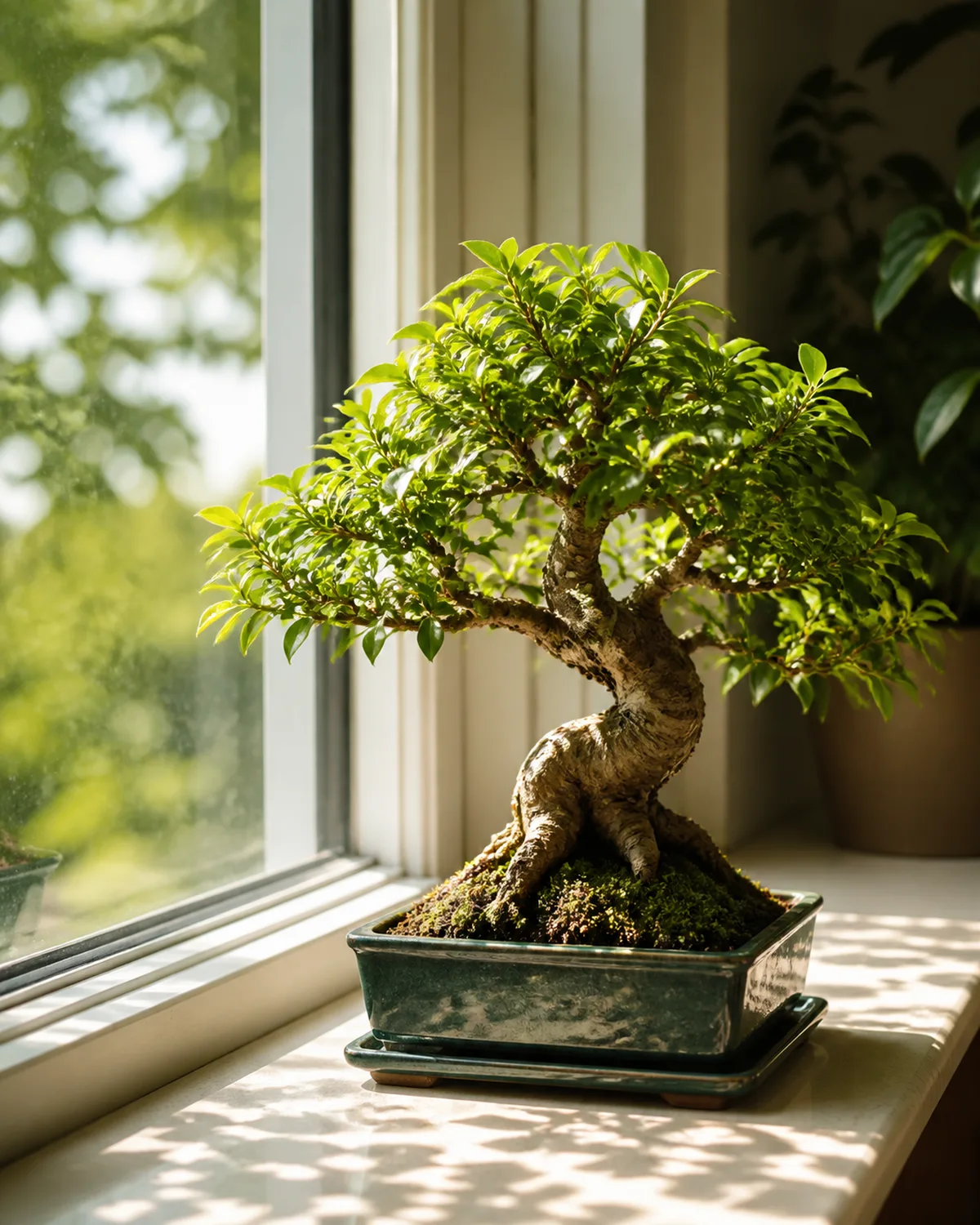
Trees are outdoor organisms that evolved under open sky — fitting one behind a window is the fundamental compromise of indoor bonsai. The challenge is unique to bonsai because you need compact internodes (the spaces between leaves on a branch), and internode length is directly controlled by light intensity.
A bonsai that gets two hours less light than optimal does not just grow slower — it grows leggier, with stretched-out gaps between leaves that ruin the proportional miniature-tree illusion years of pruning built. This is exactly the etiolation problem that affects all houseplants, but bonsai suffers it more visibly because the scale is so small.
South-facing glass transmits roughly fifty percent of outdoor light intensity, so a bonsai on a south windowsill gets what an outdoor tree would call partial shade. For a ficus bonsai, this is adequate. For a Chinese elm, it is the minimum. For a juniper, it is not enough — which is why junipers cannot live indoors.
The summer outdoor strategy — moving your bonsai outside from May through September, with two weeks of gradual sun acclimation to prevent leaf scorch — is not a luxury. It is how experienced growers get a full year of compact growth in five months, then maintain through winter indoors with supplemental LED at six to eight inches above the canopy.
A full-spectrum LED grow light running ten to twelve hours daily can replace or supplement window light entirely. Position it close — six to eight inches above the canopy — because light intensity drops dramatically with distance. A light two feet away delivers roughly one quarter the intensity of a light six inches away.
Rotate the pot a quarter turn weekly so all sides receive even light. Without rotation, the canopy develops unevenly — dense on the window side, sparse on the room side — and the trunk slowly curves toward the light source.
Watering: the single biggest killer of indoor bonsai
Bonsai soil dries out faster than any regular houseplant mix because it is designed to drain almost instantly. That means watering frequency depends on pot size, soil composition, species, and season — not a calendar schedule. A small bonsai in a shallow pot on a sunny windowsill in summer may need water daily. The same tree in winter may go three to four days between waterings.
Check the soil every day. Press the tip of a finger or a chopstick into the top half inch. When it feels dry, water. When it still feels slightly moist, check again tomorrow.
This is fundamentally different from the general houseplant approach where you might check weekly. A bonsai in a shallow pot with aggregate soil has so little moisture reserve that a missed day can cause damage.
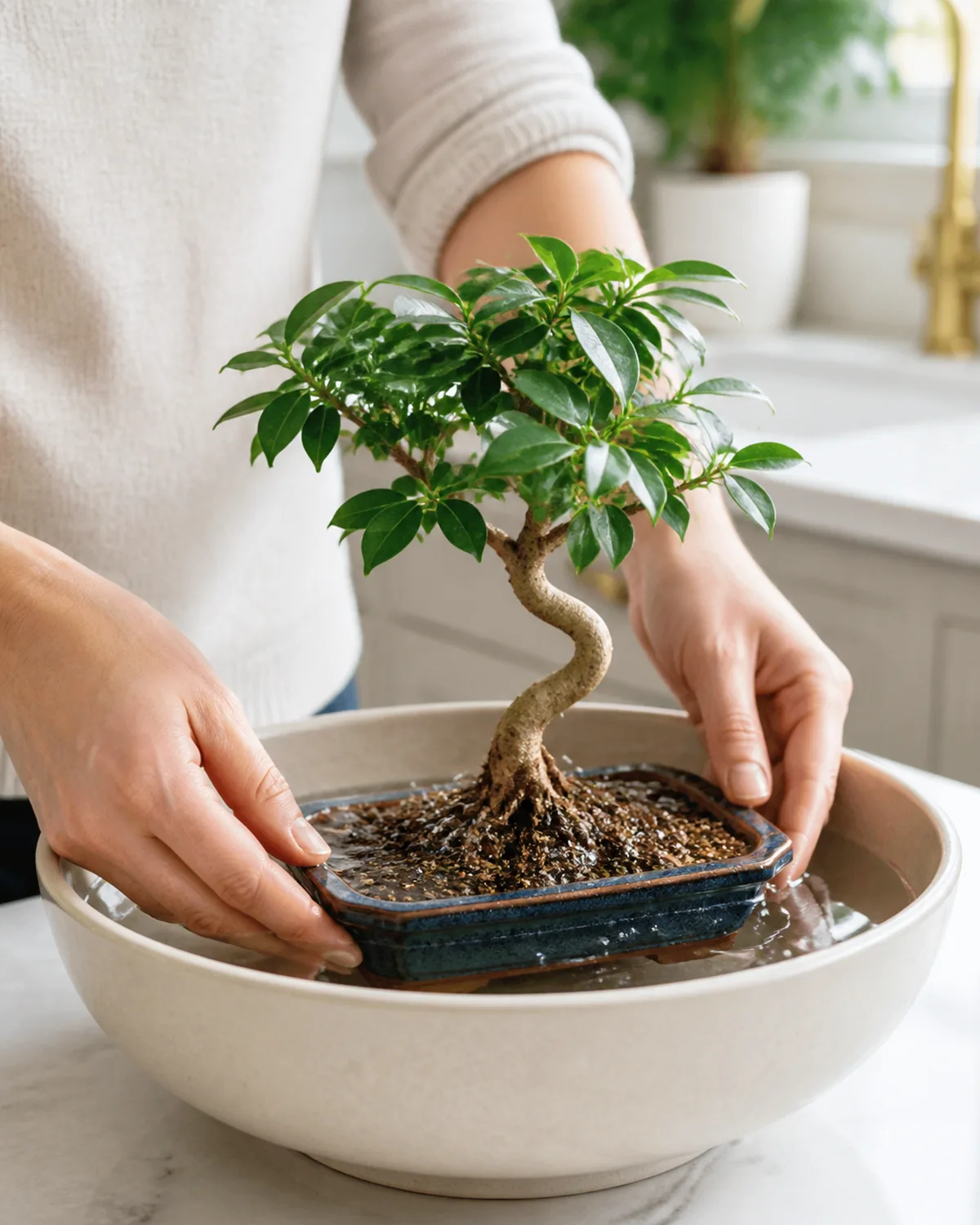
The full-soak method gives the most even moisture penetration: submerge the entire pot in a basin of water until air bubbles stop rising from the soil surface — usually one to two minutes. Lift the pot, let it drain completely, and return it to its spot. This ensures water reaches every corner of the root ball, not just the channels that form in fast-draining soil.
If soaking is impractical, water from the top with a fine-nozzle can, passing over the soil surface two or three times to let each pass absorb before adding more. One quick pour on aggregate soil runs straight through without saturating the interior.
A humidity tray — a shallow tray of pebbles with water below the pebble surface — raises the ambient humidity around the canopy without wetting the roots. This helps tropical bonsai species that need higher humidity than the typical heated home provides, especially in winter when indoor air is driest.
Soil: why regular potting mix will suffocate your bonsai
Standard potting soil retains too much moisture and compacts over time, cutting off oxygen to the fine root system bonsai depend on. A bonsai in potting mix develops root rot before you realize anything is wrong — the surface looks dry while the interior stays saturated.
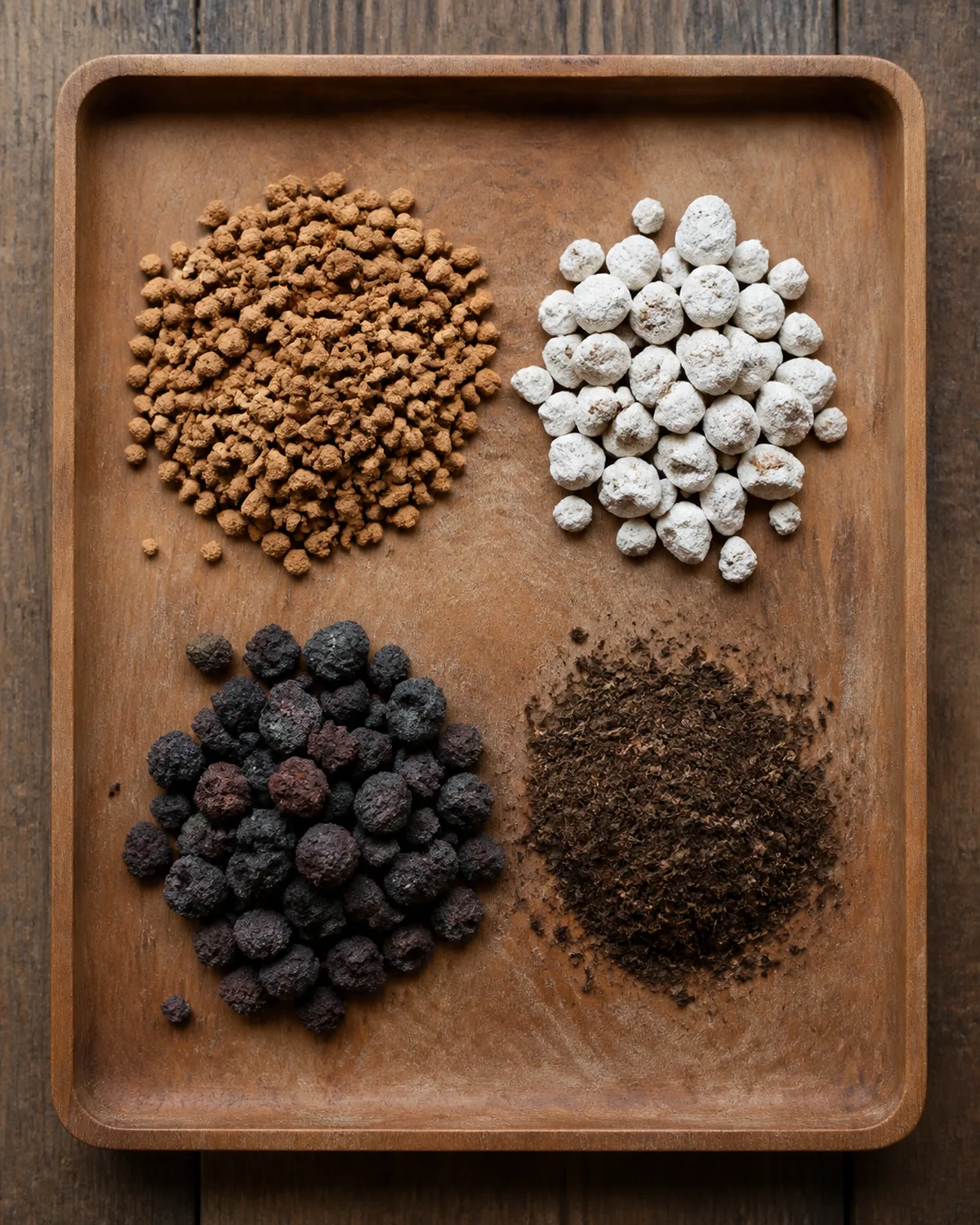
Bonsai soil is a particle mix designed for simultaneous drainage and aeration. The three main components:
Akadama is a fired Japanese clay granule that absorbs moisture and releases it slowly. It is the traditional backbone of bonsai soil. When fresh, the granules are reddish-brown; they darken when wet, giving you a visual moisture indicator. Over two to three years, akadama breaks down and compacts — this is one reason bonsai need periodic repotting.
Pumice is lightweight volcanic stone full of microscopic air pockets. It provides structural drainage and aeration without retaining too much water. It does not break down over time like akadama.
Lava rock is the heaviest component. It creates the macro-drainage channels that prevent waterlogging and adds weight to shallow pots that might blow over outdoors.
The classic mix for tropical bonsai (ficus, jade) is roughly equal parts akadama, pumice, and lava rock — 1:1:1. Some growers add a small fraction of organic material (fine bark or coconut coir) for tropical species that like slightly more moisture. For a deeper look at how repotting mechanics work across all houseplants, the general guide covers the fundamentals.
Pre-mixed bonsai soil from reputable suppliers works if you cannot source individual components. Avoid anything labeled "bonsai soil" that is mostly peat or coco coir with a few perlite flecks — that is houseplant mix in a misleading bag.
Pruning for shape: maintenance cuts vs. structural decisions
Pruning is how you keep a bonsai in miniature. Without it, the tree grows toward its genetic full size and the carefully shaped form disappears within a single growing season.
Maintenance pruning is ongoing throughout the growing season. When a shoot extends six to eight leaves, pinch or clip it back to two or three leaves.
This accomplishes two things: it keeps the canopy compact at the current size, and it triggers back-budding. Back-budding is new growth from dormant buds on older wood, which fills in gaps and creates the dense, layered canopy that distinguishes a refined bonsai from a plant that just had a haircut.
Structural pruning is seasonal and deliberate. For tropical species, early spring is the ideal time. Remove crossing branches (two branches that overlap from different angles), thin dense interior areas so light reaches inner leaves, and cut back to define the trunk line and primary branch structure. Structural pruning sets the architecture that maintenance pruning then maintains.
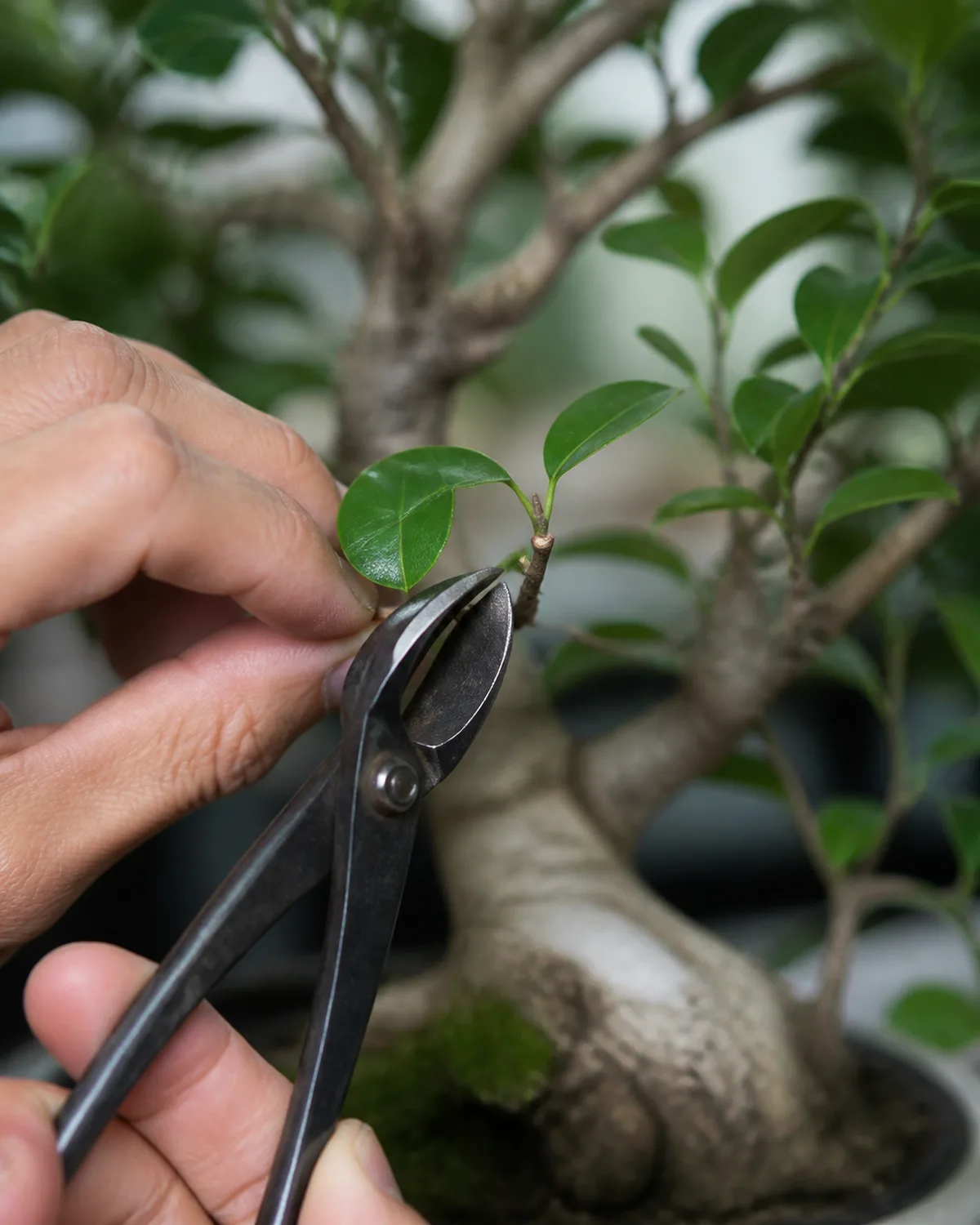
Cut technique matters. Always cut at a slight downward angle just above a node (the point where a leaf or branch joins the stem), and choose a node facing the direction you want new growth to go.
Bonsai concave cutters have a curved, concave blade that leaves a hollow wound. This heals flush with the bark instead of forming a raised bump. For cuts on thicker branches, seal the wound with cut paste to prevent dieback and block fungal infection from entering through fresh wood.
Never remove more than one third of the canopy in a single session. Heavy pruning weakens the tree by removing too much photosynthetic surface at once. Spread large reshaping over two to three sessions across a growing season.
Wiring branches into position
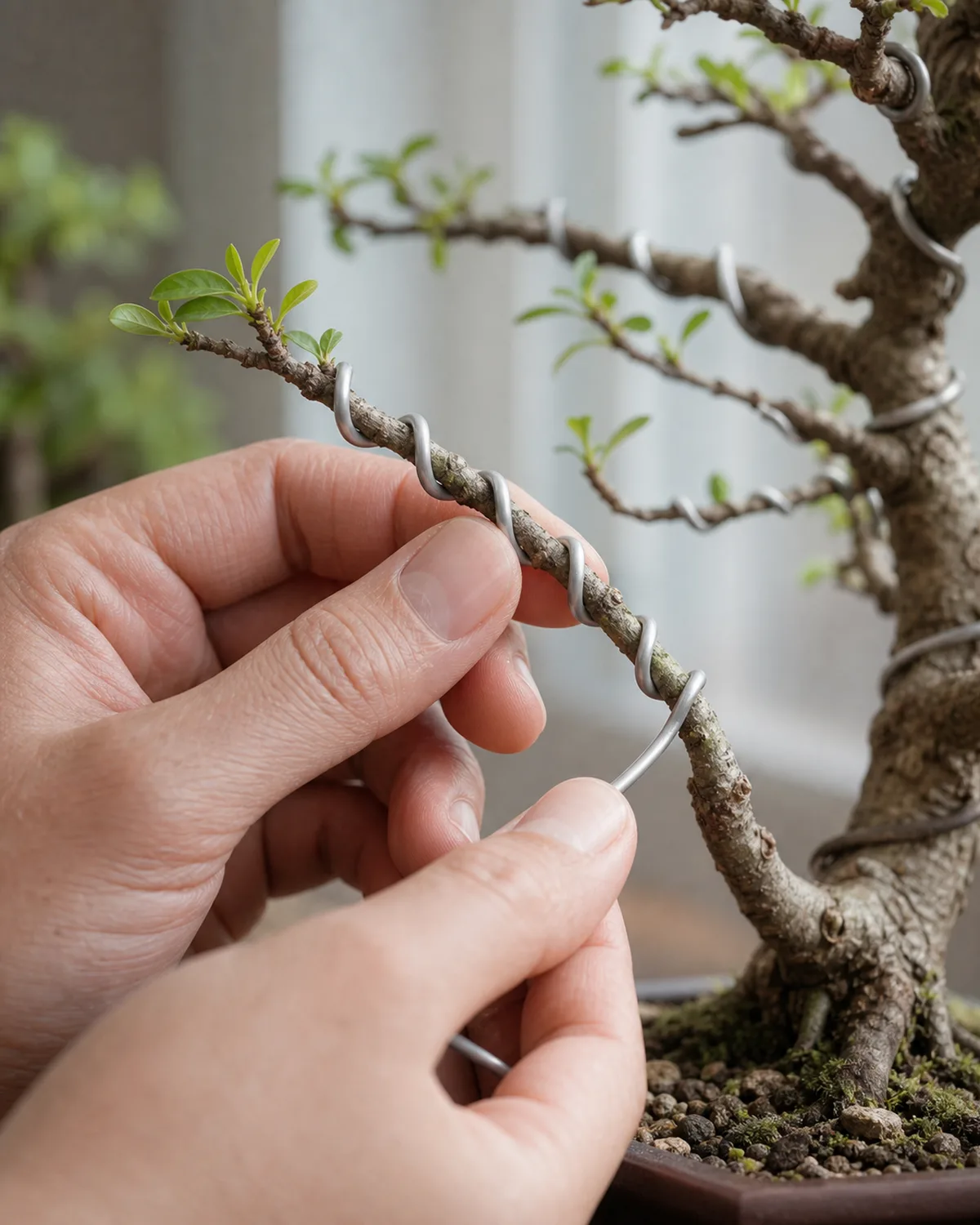
Wiring is how you bend branches into the shapes that give bonsai their distinctive windswept, cascading, or upright forms. Where pruning removes, wiring redirects.
Wire types. Anodized aluminum wire is the standard for deciduous and tropical species — it is soft enough to bend easily and is available in gauges from 1mm to 6mm. Annealed copper wire is used for conifers because it holds stronger branches in place; it is harder to work with but sets more firmly.
Wrapping technique. Anchor the wire at the trunk or a thicker branch, then wrap it around the target branch in a spiral at roughly forty-five degrees. Each wrap should be firm enough to hold position but not so tight that it compresses the bark. Think of the wire as a splint that holds the branch in its new angle while the wood slowly sets in position.
How long wire stays on. Tropical species like ficus typically take three to six months to set. Deciduous trees may set in one growing season. Check wired branches monthly — as the branch thickens with growth, wire can cut into the bark and leave permanent scars. The moment you see wire starting to press into the surface, remove it immediately. If the branch has not set, rewire it loosely.
Wire scars are permanent and are the most common beginner mistake. The wood grows around the indentation like a tree growing around a fence post. Once the scar forms, it never fills in. Removing wire early and rewiring is always better than removing wire late.
To remove wire, cut it off in small sections with wire cutters rather than unwinding it — unwinding risks snapping the branch you spent months shaping.
Repotting and root pruning: every two to three years
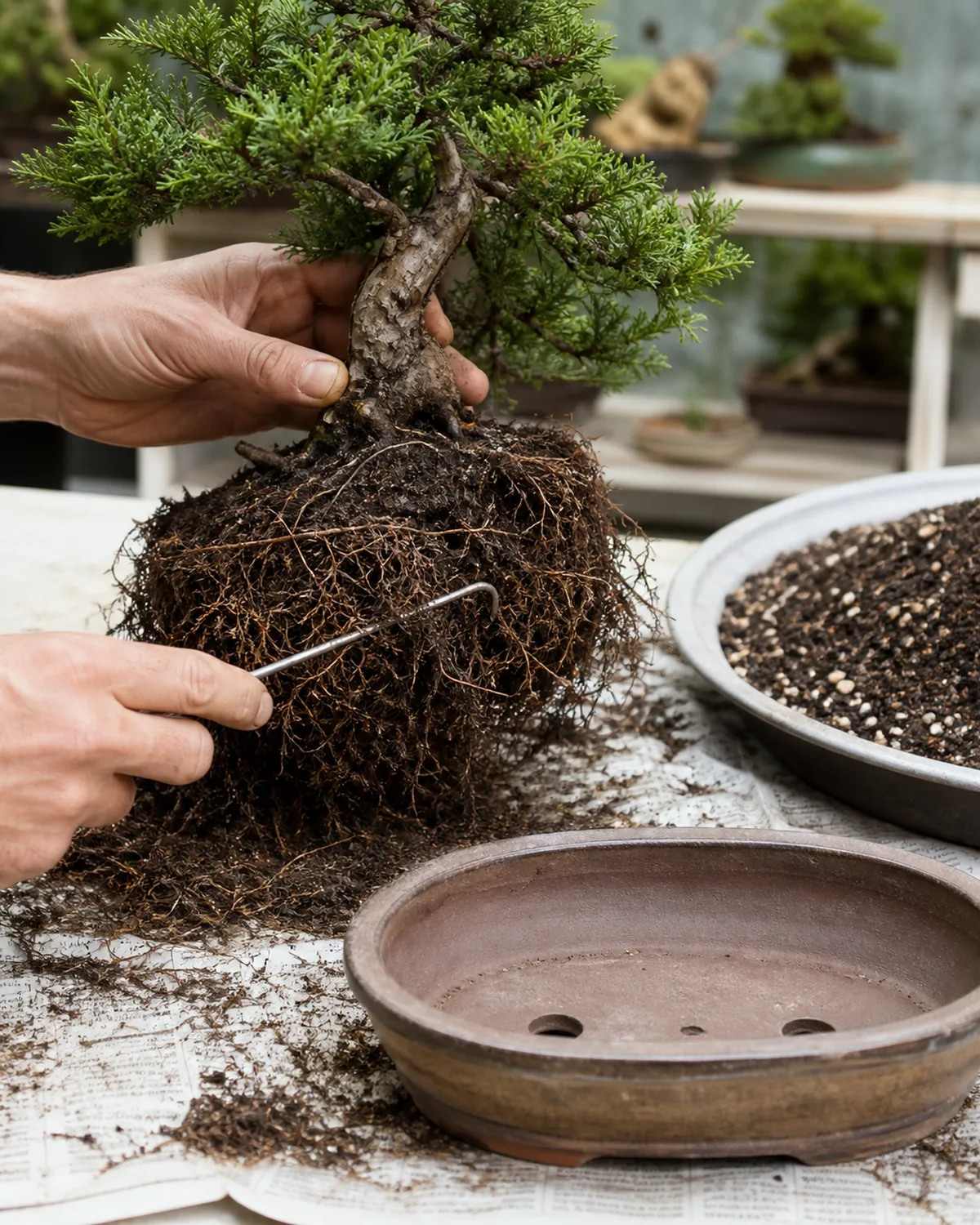
Bonsai are not repotted to move them to larger pots — the pot stays the same size or similar. They are repotted to refresh soil that has broken down and to prune roots that have filled the container.
Frequency. Tropical species (ficus, jade) typically need repotting every two to three years. Conifers every three to five. Young, fast-growing trees more often than mature, slow-growing ones. The signal: water runs straight through without being absorbed, or you see a dense mat of roots circling the bottom of the pot when you lift the tree.
Timing. Early spring, just before the growth flush, is ideal for most species. The tree is about to enter its most active growing period and will recover from root disturbance fastest.
The process. Remove the tree from its pot. Use a metal root hook or chopstick to comb out the root ball, working from the outside in. This loosens compacted soil and untangles circling roots.
Trim up to one third of the root mass with sharp scissors. Focus on thick downward-growing roots and any dead or mushy roots. Leave the fine feeder roots intact — these are the roots that actually absorb water and nutrients.
Repot into fresh bonsai soil, working the aggregate into the spaces between roots with a chopstick to eliminate air pockets. Tie the tree to the pot through the drainage holes with wire — this holds it stable until new roots anchor it, which takes four to six weeks.
After repotting, do not fertilize for four to six weeks. Fresh cuts on roots are vulnerable to chemical burn. Water gently but thoroughly, and keep the tree in bright indirect light (not full direct sun) for two weeks while it recovers.
Fertilizing: steady feeding through the growing season
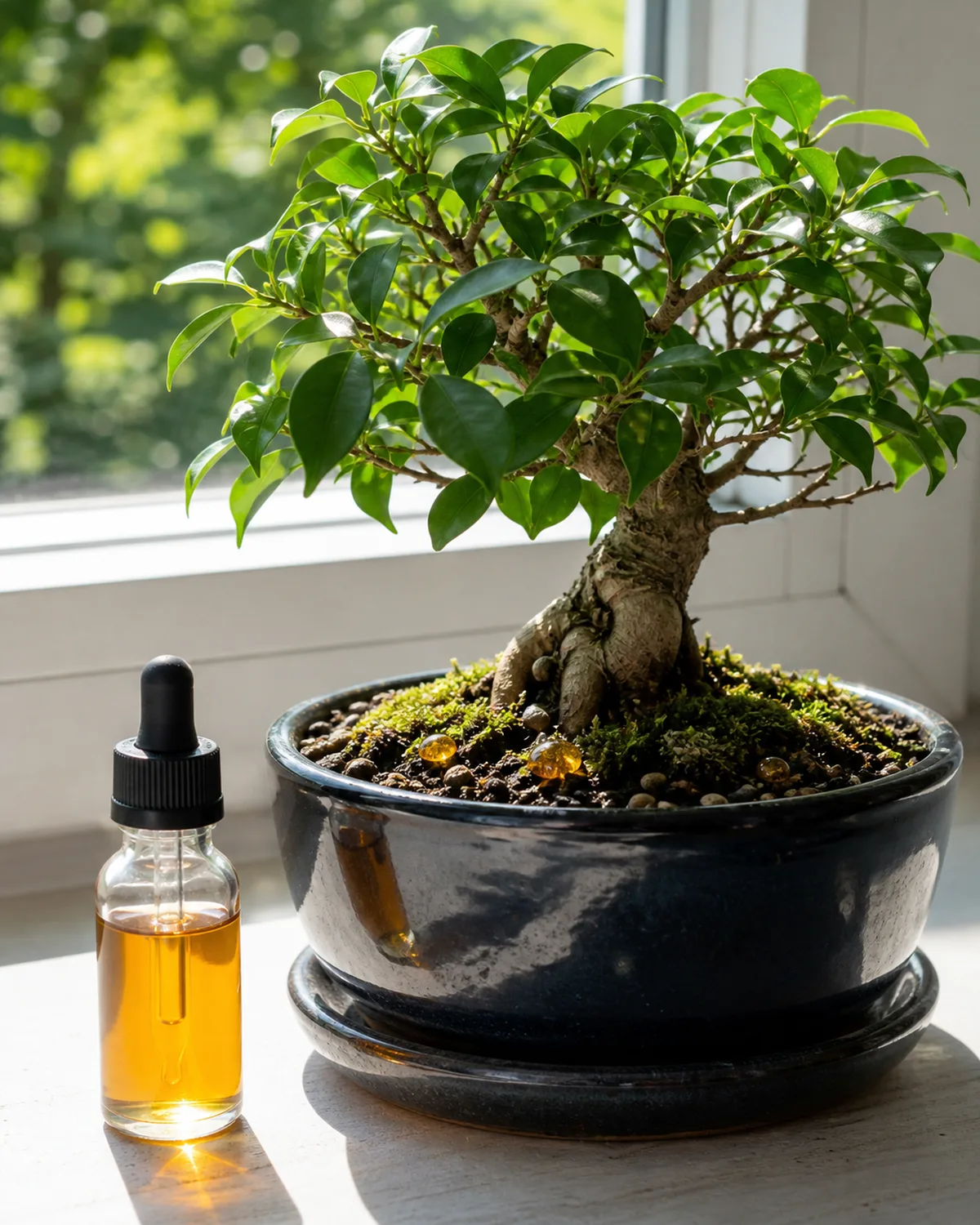
A bonsai in a small pot with fast-draining aggregate soil has almost no nutrient reserves. Every watering flushes minerals through the drainage holes. Without regular feeding, the tree slowly starves — growth slows, leaves pale, and branches thin.
Feed every two weeks during the active growing season (spring through early fall) with a balanced liquid fertilizer — a 10-10-10 or similar ratio — diluted to half the label strength. The equal nitrogen-phosphorus-potassium balance supports leaf growth, root development, and overall health simultaneously.
Slow-release organic cakes (like biogold or rapeseed cakes) are the traditional bonsai method. Place two to three small cakes on the soil surface; they dissolve gradually with each watering, providing a steady nutrient supply without the salt buildup that liquid fertilizer can cause. Replace cakes monthly during the growing season.
Seasonal adjustment. Reduce feeding to monthly in late fall. For tropical species that grow year-round indoors, continue light feeding through winter at monthly intervals. For deciduous species that drop leaves, stop feeding entirely during dormancy — the tree is not metabolizing and unused nutrients accumulate as harmful salts.
Never fertilize a stressed tree. A tree that has just been repotted, is dropping leaves, or has recently been moved to a new spot is redirecting its energy to survival, not growth. Fertilizer in these conditions burns already compromised roots.
Scale on the trunk, mites in the canopy, and rot below the soil line
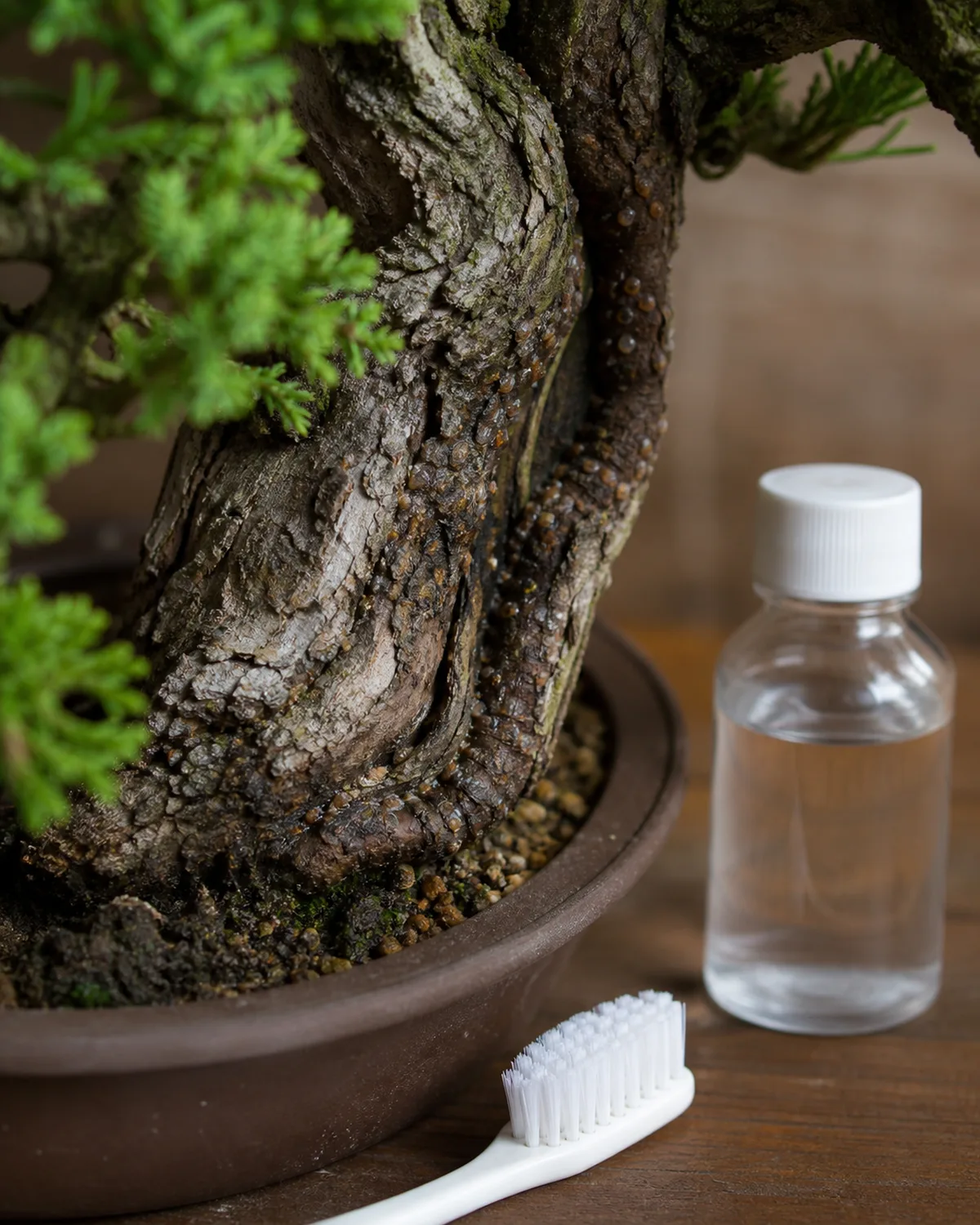
Bonsai pest problems concentrate where general houseplant pest guides never look: in the bark fissures of a mature trunk, along wire-scarred branches where insects hide in grooves, and in the shallow root zone of fast-draining aggregate soil.
Scale insects are the bonsai-specific nightmare. They anchor into woody bark crevices that a cotton swab cannot reach, appearing as flat brown or tan bumps that look like natural bark texture.
Treatment requires a soft toothbrush dipped in rubbing alcohol worked methodically into every trunk fold and branch junction. Check monthly. A few scales can multiply into an infestation before you notice the tree weakening.
Spider mites exploit the low humidity around indoor bonsai canopies. Fine webbing appears on leaf undersides, and leaves develop stippled yellowing. The dense foliage of a well-pruned bonsai tree traps webbing invisibly until damage is advanced. Rinse the canopy thoroughly under running water weekly as prevention — mites do not establish on leaves that get physically washed.
Root rot in bonsai is different from houseplants because the shallow pot and open soil dry the surface fast while the root ball center stays wet. A bonsai can look surface-dry and still be rotting at the core. Probe the root ball with a chopstick before concluding the soil is dry enough to water.
If you detect rot (soft dark roots and a sour smell), remove all affected tissue, treat cuts with fungicide, and repot in completely dry fresh soil. Do not water for five to seven days.
Fungal dieback enters through pruning wounds that were not sealed with cut paste. The infection travels down the branch to the trunk — always seal cuts larger than a pencil diameter.
Leaf drop decoded: seasonal cycle vs. stress signal in miniature trees
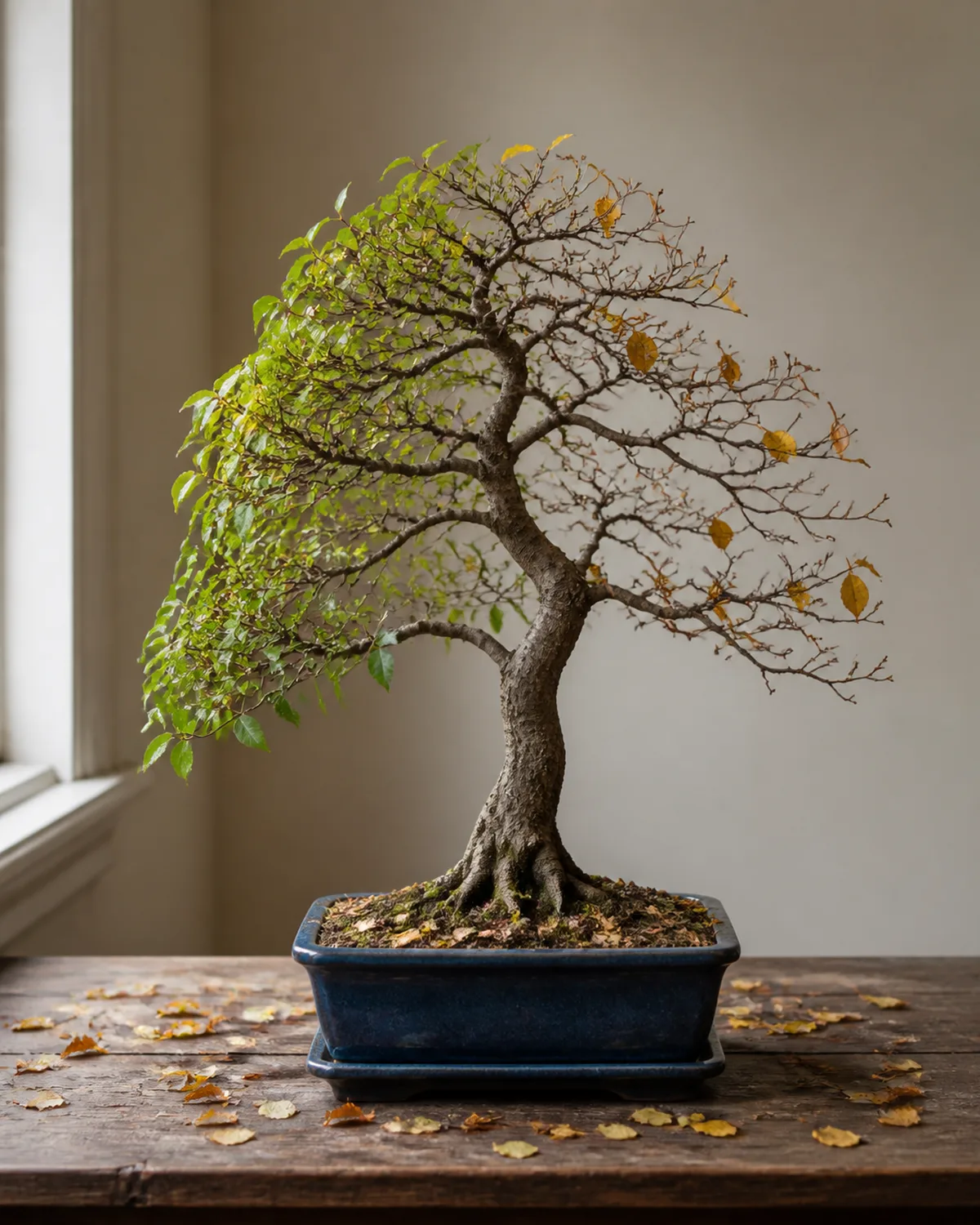
Bonsai leaf drop triggers panic that a full-sized houseplant never would, because every leaf on a miniature tree is visible and every bare twig feels like structural failure.
The critical distinction is species-linked. Deciduous bonsai (Chinese elm, trident maple) must drop their leaves in autumn for dormancy. This is not a problem — it is a requirement. Preventing leaf drop by keeping them warm and lit year-round actually weakens the tree by denying it the rest period it needs to regenerate.
Evergreen tropicals (ficus, jade) hold their leaves year-round but shed older interior foliage as canopy density increases after pruning. This thinning is the tree self-regulating light penetration to inner branches — it is healthy and expected after a pruning session.
Stress-driven leaf drop has a unique bonsai diagnostic advantage: the shallow pot lets you inspect roots directly. A bonsai can be lifted, tilted, and visually inspected in seconds. Dark mushy roots mean root rot (overwatering). White healthy roots with dry crumbly soil mean underwatering (the soil dried out completely and roots dehydrated).
Ficus drops leaves when moved to a new spot, when light changes suddenly, or when exposed to cold drafts near windows in winter. It typically regrows within two to four weeks if conditions stabilize. Do not adjust watering or fertilizing in response to relocation leaf drop — keep everything consistent and let the tree adapt.
Post-repotting leaf drop lasting two to four weeks is normal root recovery. Beyond four weeks with no new buds at all means the root pruning was too aggressive — the tree lost too much root mass relative to its canopy. Remove some canopy (prune lightly) to rebalance the root-to-shoot ratio and reduce the amount of foliage the depleted roots need to support.
Bonsai Tree Care: The Quick Reference
- 1Bonsai is a technique, not a speciesAny woody plant can become a bonsai. Container restriction, root pruning, and branch training create the miniature form. The tree wants to grow full-sized — you shape it.
- 2Start with ficus or Chinese elmFicus retusa is the most forgiving indoor bonsai. Chinese elm gives the classic silhouette. Juniper is outdoor-only — it will die indoors within two years.
- 3Brightest window you have4-6 hours direct sun minimum. South or west window. LED grow light at 6-8 inches if windows fall short. Outdoor summer for a growth boost.
- 4Check soil daily, water when dryFull soak until water runs from drainage. Never on a schedule. Shallow pots dry fast — daily checks in summer, every 2-3 days in winter.
- 5Aggregate soil onlyAkadama + pumice + lava rock, roughly 1:1:1. No standard potting mix. Fast drainage and oxygen to roots prevent rot.
- 6Pinch new growth to 2-3 leavesMaintenance pruning keeps the canopy compact. Structural pruning in spring sets the architecture. Never remove more than one third at once.
- 7Wire at 45 degrees, remove before scarringCheck monthly. Wire scars are permanent — if wire starts pressing into bark, cut it off immediately. Rewire loosely if the branch has not set.
- 8Repot every 2-3 yearsSame-size pot, fresh soil, trim one third of roots. Early spring timing. No fertilizer for 6 weeks after. Tie the tree to the pot for stability.
- 9Feed every 2 weeks in growing seasonBalanced liquid at half strength or slow-release organic cakes. Monthly in winter for tropicals. Never feed a stressed or freshly repotted tree.
- 10Check bark crevices for scaleScale hides in trunk folds. Toothbrush + rubbing alcohol. Spider mites: rinse canopy weekly. Seal pruning cuts to prevent fungal dieback.
- 11Deciduous leaf drop is requiredChinese elm, maple must drop leaves in fall. Preventing it weakens the tree. Evergreen tropicals shed interior leaves after pruning — that is normal thinning.
- 12Indoor = tropical onlyFicus, jade, schefflera live indoors year-round. Juniper, maple, pine need cold dormancy and full outdoor sun — no exceptions.
- 13Display at eye level, away from draftsTraditional stand, accent plant, clean background. Rotate weekly for even light. Keep away from heating vents and cold window drafts.
kultivy.com
Indoor vs. outdoor bonsai: the care split that beginners miss
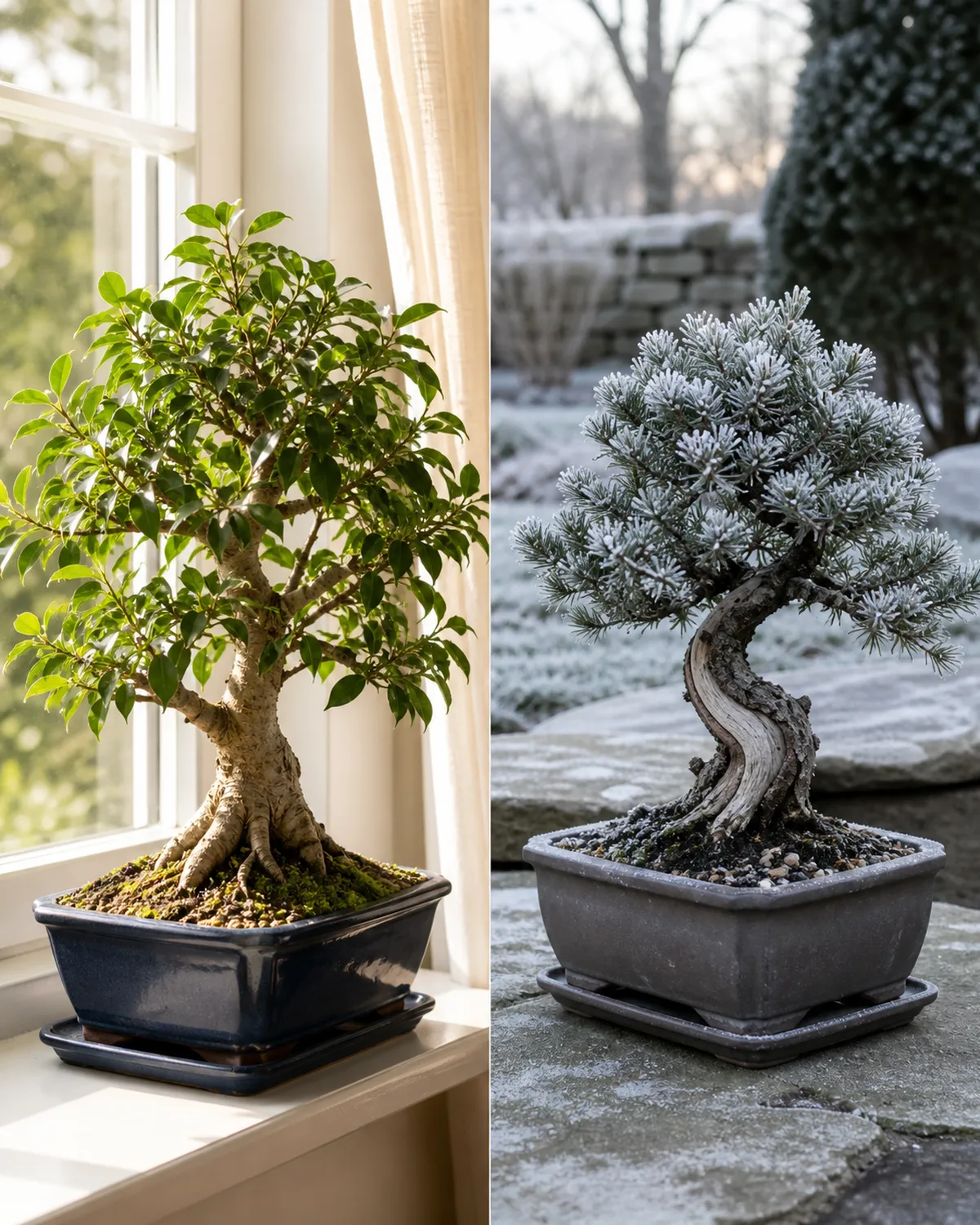
This is the single most important distinction in bonsai care, and the reason most juniper bonsai sold at garden centers do not survive.
Tropical species (ficus, jade, schefflera, Chinese elm in warm climates) can live indoors year-round because they do not need cold dormancy. They evolved in equatorial climates with stable temperatures and no hard frost. They need bright light and consistent warmth — above sixty degrees Fahrenheit at all times.
Temperate species (juniper, Japanese maple, pine, larch, beech) require outdoor conditions for the full calendar year except brief display periods. They need direct sun, wind exposure, rain, and a cold winter dormancy (temperatures below fifty degrees for six to twelve weeks) to complete their annual growth cycle.
A juniper bonsai kept indoors goes through a slow, invisible decline. The first year it may look fine. The second year growth slows and the foliage thins. By the end of the second winter it has usually died. The failure is dormancy deprivation — the tree never gets the cold rest its biology requires, and it exhausts itself trying to grow through a season when it should be dormant.
The confusion exists because garden centers and gift shops sell juniper bonsai — beautiful, inexpensive, and photogenic — as indoor plants. They are not. They are outdoor plants in small pots.
If you want an indoor bonsai, the species list is short but reliable: ficus, jade, Chinese elm (in warm environments), schefflera, fukien tea (Carmona), and Hawaiian umbrella (Schefflera arboricola). All are tropical. All stay indoors. All can produce beautiful bonsai that live for decades.
Displaying your bonsai: the final piece of the art
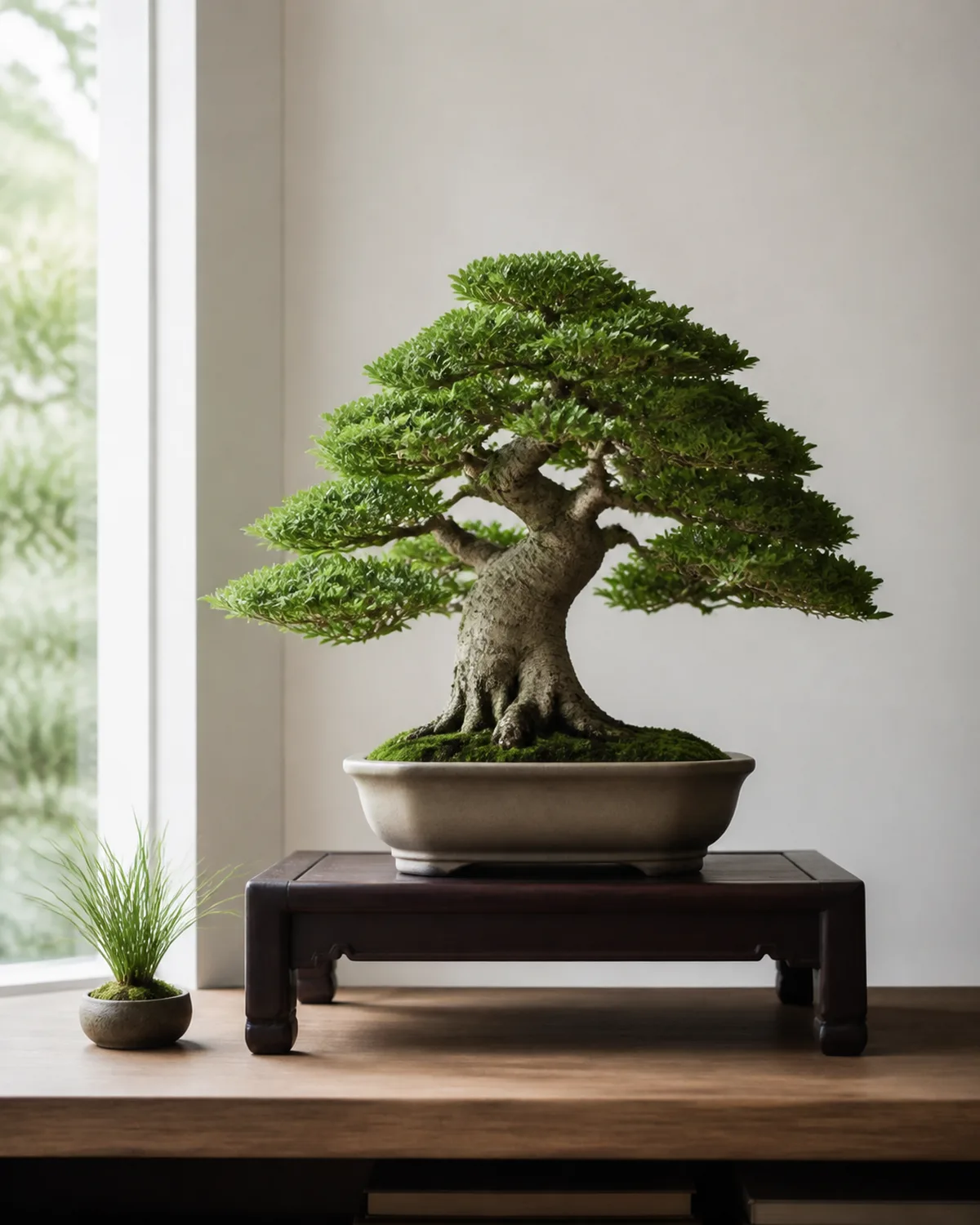
Display is where bonsai crosses from horticulture into art. The tree is the subject, and everything around it either supports or competes with that subject.
Height matters. Position the tree at eye level — this is the angle where the trunk, branching structure, and canopy read as a real tree in miniature. Looking down at a bonsai on a low table eliminates the illusion. A dedicated bonsai stand or a clean shelf at the right height transforms the viewing experience.
Accent plants are the traditional companion. A small clump of grass, a tiny moss mound, or a miniature seasonal flower in a proportionally small pot placed beside the bonsai suggests scale and season without competing for attention. The accent is the landscape; the bonsai is the tree in that landscape.
Negative space is as important as the tree itself. A bonsai on a cluttered shelf surrounded by books and picture frames reads as another houseplant. The same tree on a clean surface with empty space around it reads as a deliberate composition. Traditional Japanese display uses three elements only: tree, accent, and scroll or backdrop.
Environmental placement. Avoid heating vents and air conditioning outlets — the temperature swings stress the tree more than consistent cool or warm conditions. Avoid cold window drafts in winter (the gap between glass and frame can channel freezing air directly onto the canopy). Keep the tree where air circulates gently but does not blow directly.
Rotate the pot a quarter turn weekly so all sides receive even light and the canopy develops symmetrically.
Seasonal rotation is traditional practice for growers with both indoor and outdoor bonsai. Bringing an outdoor bonsai inside for a few days during peak beauty — autumn color, spring flowering — connects the living tree to your living space without harming it. Keep these displays brief (two to three days maximum for temperate species) and return the tree to outdoor conditions promptly.
For more ideas on arranging plants by room and purpose, see the living room plants guide or plant shelf ideas.

Mara Quinn edits Kultivy, where she shares houseplant care, propagation, beginner-friendly plant picks, and plant-styling ideas for anyone who wants their indoor plants to actually thrive. Every guide is image-led and reviewed for clarity, usefulness, image accuracy, and Pinterest-to-page alignment before it goes live. Visit the About page.