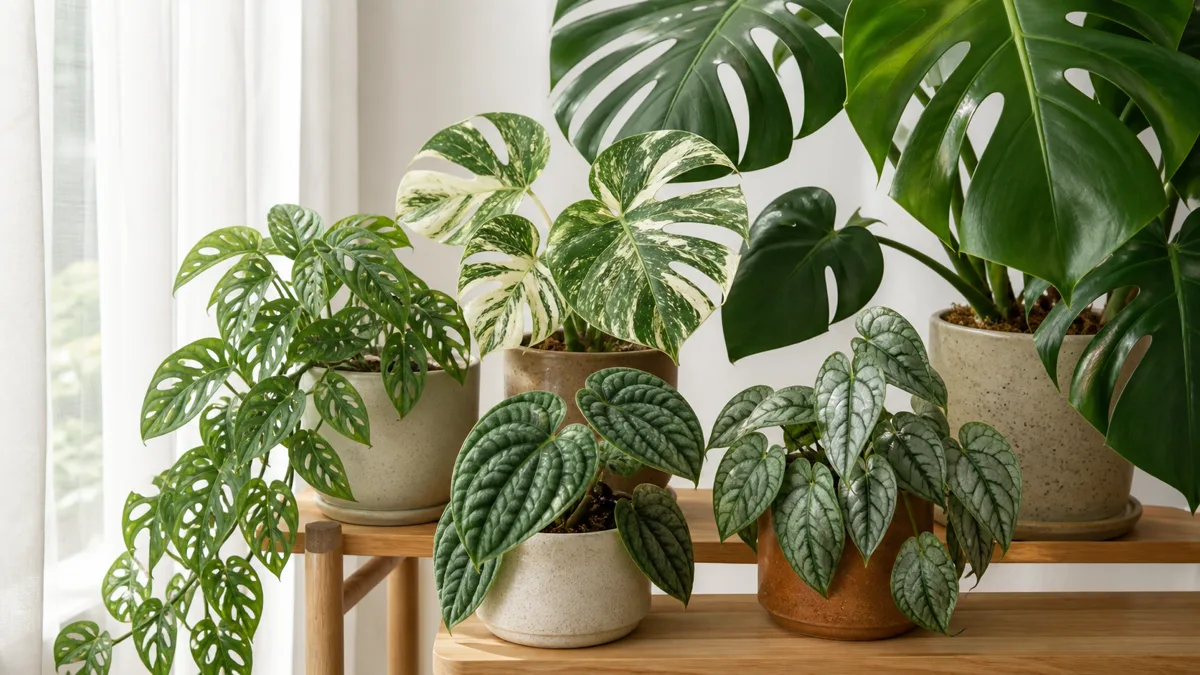
Most houseplants want moisture, humidity, and shade. Yucca wants the opposite of all three.
This desert-origin cane plant stores water in its trunk, demands direct sun, and punishes any attempt to keep the soil damp. Care runs closer to cacti than to any tropical.
The thick woody trunk topped by a starburst rosette of sword-shaped leaves competes with fiddle-leaf figs for the statement-plant spot.
What makes yucca different from every other houseplant
Yucca is a desert native from the American Southwest and Mexican highlands, where annual rainfall stays below ten inches and daytime temperatures hit 110 degrees Fahrenheit while nights drop near forty. That origin defines everything about its indoor care.
Where most houseplants evolved under a tropical canopy and want filtered light, consistent moisture, and high humidity, yucca evolved under open sky with full sun, bone-dry soil, and air so dry that misting would be a foreign concept.
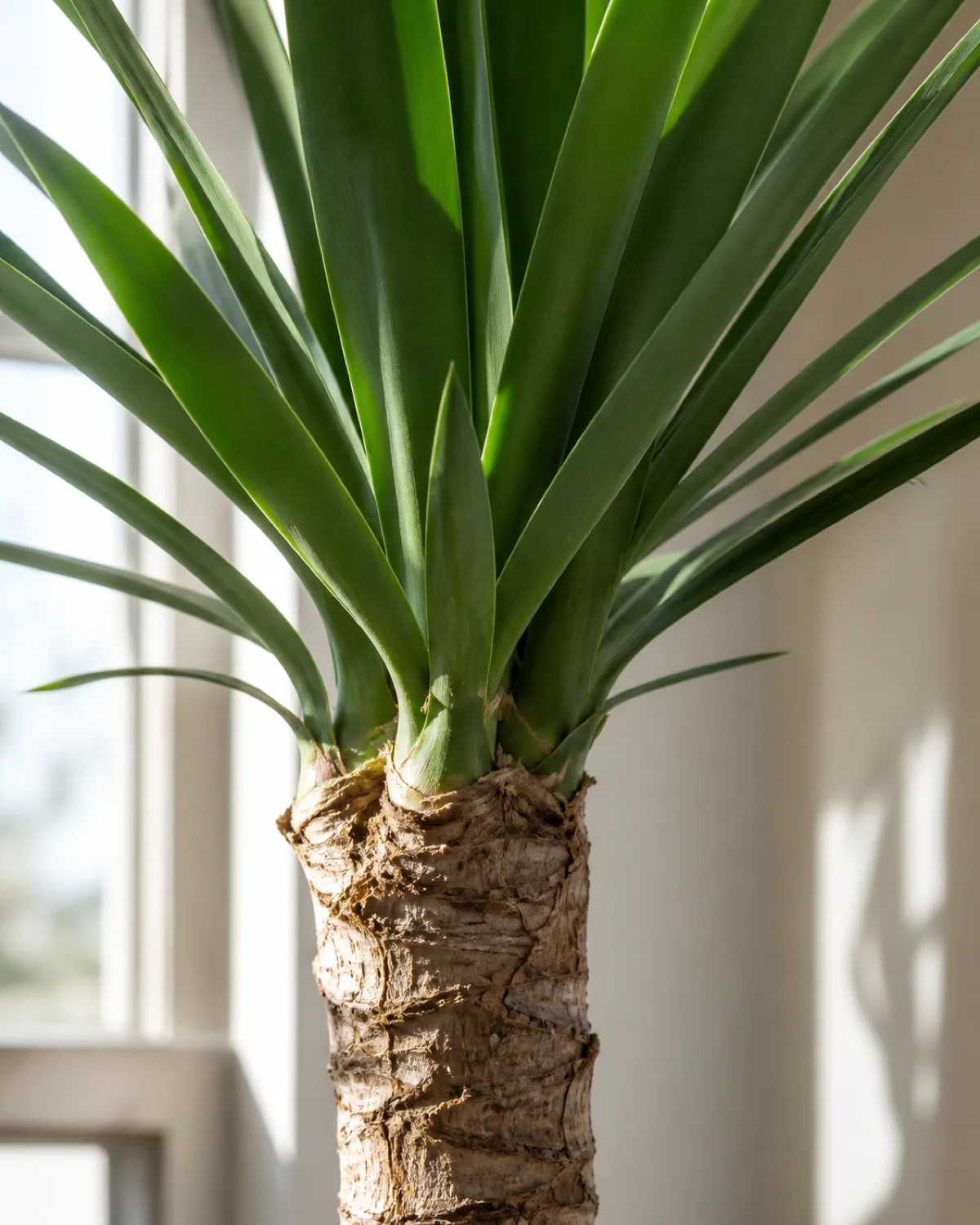
The result is a plant built around a thick woody cane trunk that stores water and a rosette of sword-shaped leaves with a waxy cuticle that prevents moisture loss. That combination makes it one of the lowest-maintenance large indoor plants available.
Yucca elephantipes — the most common indoor species — grows to six or eight feet indoors, develops a swollen trunk base that resembles an elephant's foot, and produces spineless leaves that are safe to brush past.
If you are looking at a cane plant with sword leaves and are not sure whether it is a yucca or a dracaena marginata, bend a leaf. Yucca leaves are thick and rigid. Dracaena leaves are thin and flexible.
Light: the one thing yucca refuses to compromise on
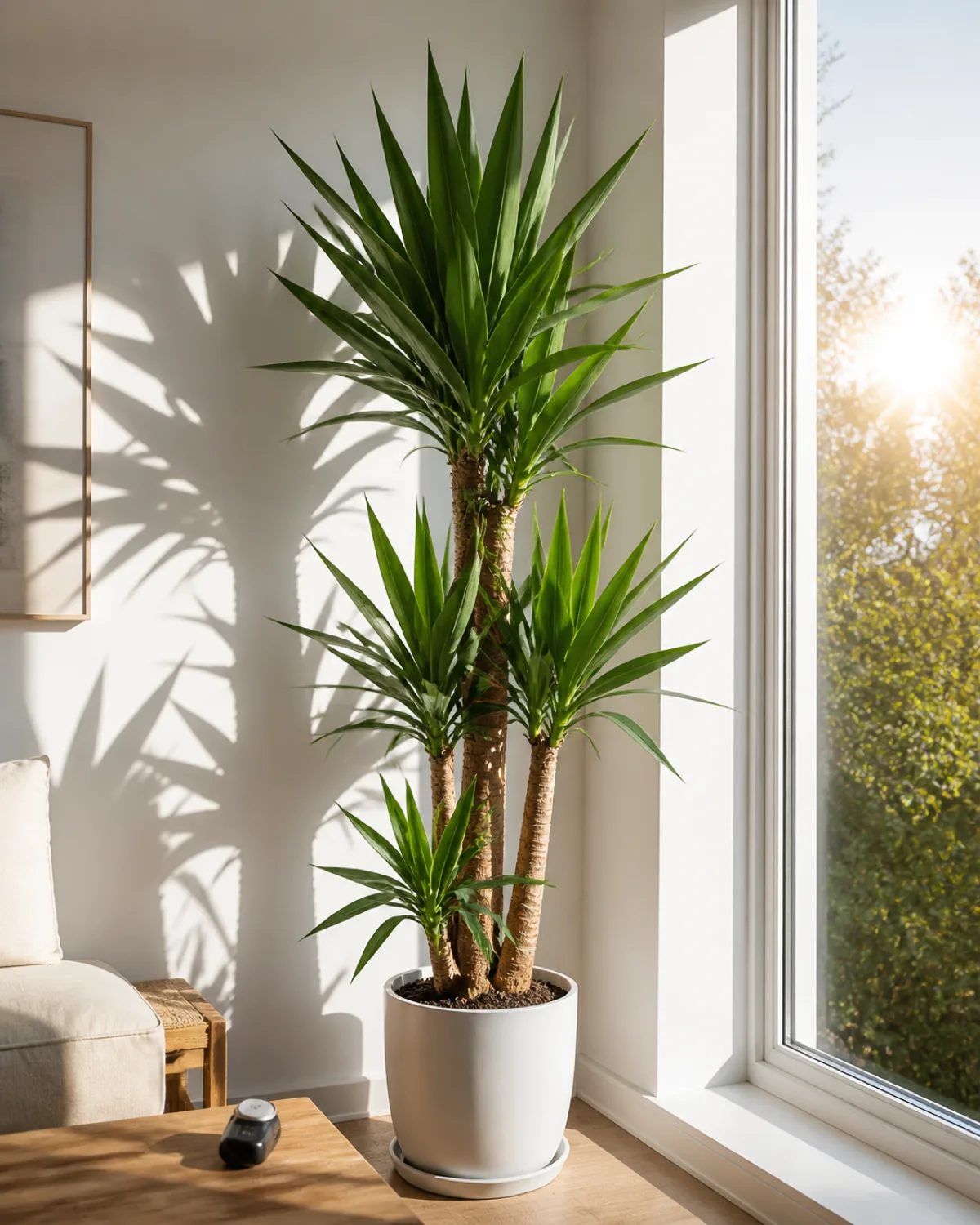
Four to six hours of direct sunlight per day is the non-negotiable requirement. This makes yucca one of the few indoor plants — along with cacti and succulents — that genuinely demands unfiltered sun rather than merely tolerating it.
A south-facing window is the first choice. West windows work if they deliver strong afternoon light. East windows provide only two to three hours of gentle morning sun, which keeps yucca alive but produces leggy, sparse growth. North windows are off the table entirely.
- Etiolation: The cane elongates between leaf nodes, leaves spread apart and point outward instead of upward, and the rosette loses its tight starburst shape — all signs the plant is reaching for more light
- Color fade: Deep green leaves shift to a washed-out yellow-green when photosynthesis drops below the threshold the plant needs
- Rosette loosening: Leaves that normally point upward at a steep angle begin to droop and splay outward, losing the compact architectural silhouette
- Adaptation period: A yucca moved from low light to full sun needs one to two weeks of gradual adjustment — move it closer to the window over seven days rather than placing it directly into full afternoon sun
If no window provides enough natural light, a high-output full-spectrum LED grow light running eight to ten hours daily can substitute. Place it twelve to eighteen inches above the rosette.
Watering: why bone-dry soil is the starting point
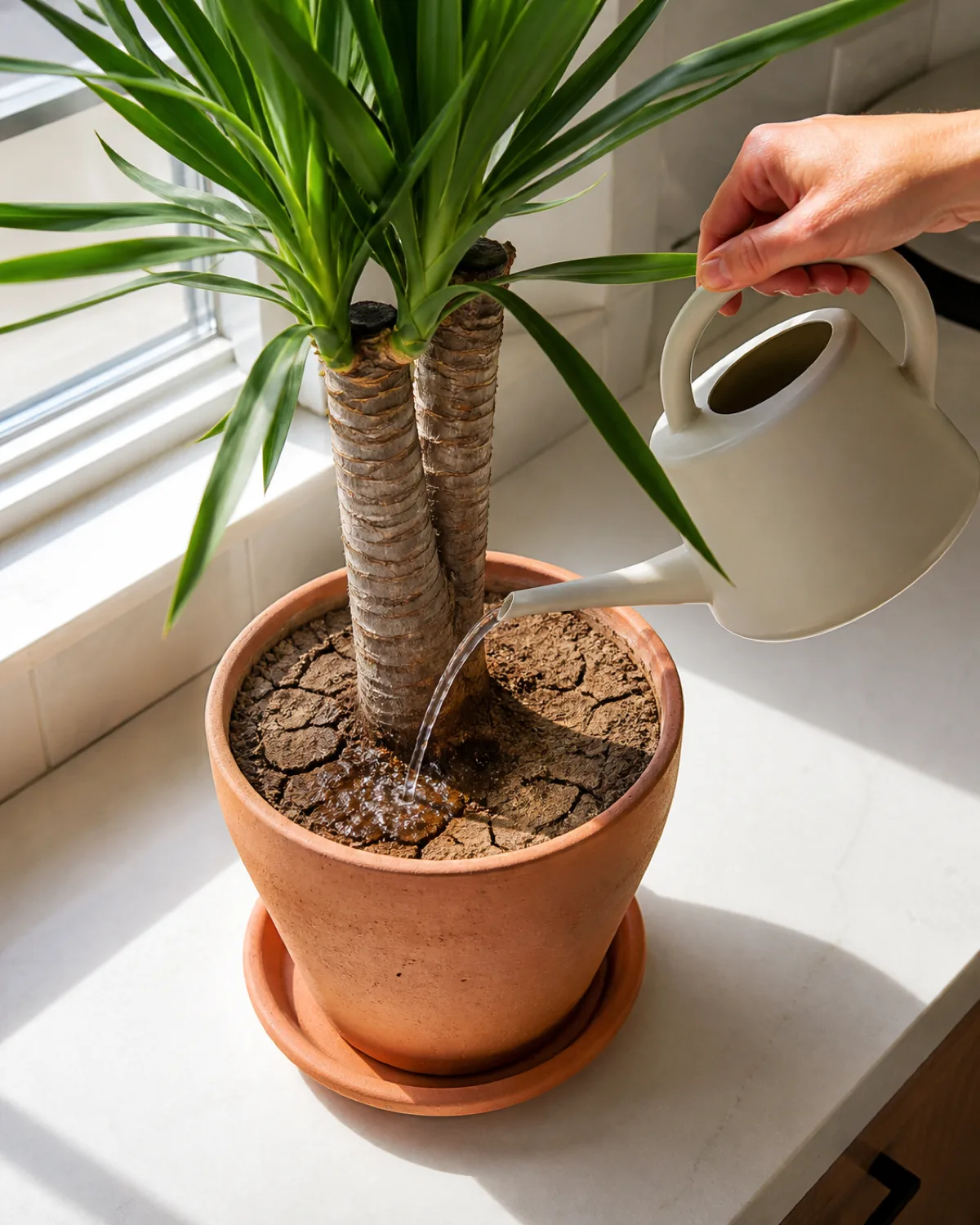
The watering rule for yucca is the opposite of what most tropical houseplant guides recommend. Instead of watering when the top inch is dry, wait until the soil is dry from the surface all the way to the bottom of the pot.
Lift the pot. A fully dried yucca pot weighs sixty to seventy percent less than it does after a thorough soak. That weight difference is the most reliable indicator.
Once the soil is completely dry, soak it thoroughly until water streams from the drainage holes. Let all excess water drain for ten to fifteen minutes and never leave the pot sitting in a saucer of standing water.
- Summer frequency: Every ten to fourteen days in a bright, warm spot
- Winter frequency: Every three to four weeks, sometimes longer — the cane stores enough water to go five or six weeks without harm
- Root rot: The number one killer of indoor yucca, caused by soil that stays damp for more than a few days — the cane base softens, darkens, and develops a sour smell
- Tap water: Unlike dracaena marginata, yucca is not sensitive to fluoride or chlorine in municipal water — straight from the tap is fine
When in doubt, wait another three days. Yucca forgives underwatering far more readily than overwatering.
Soil: fast-draining desert mix
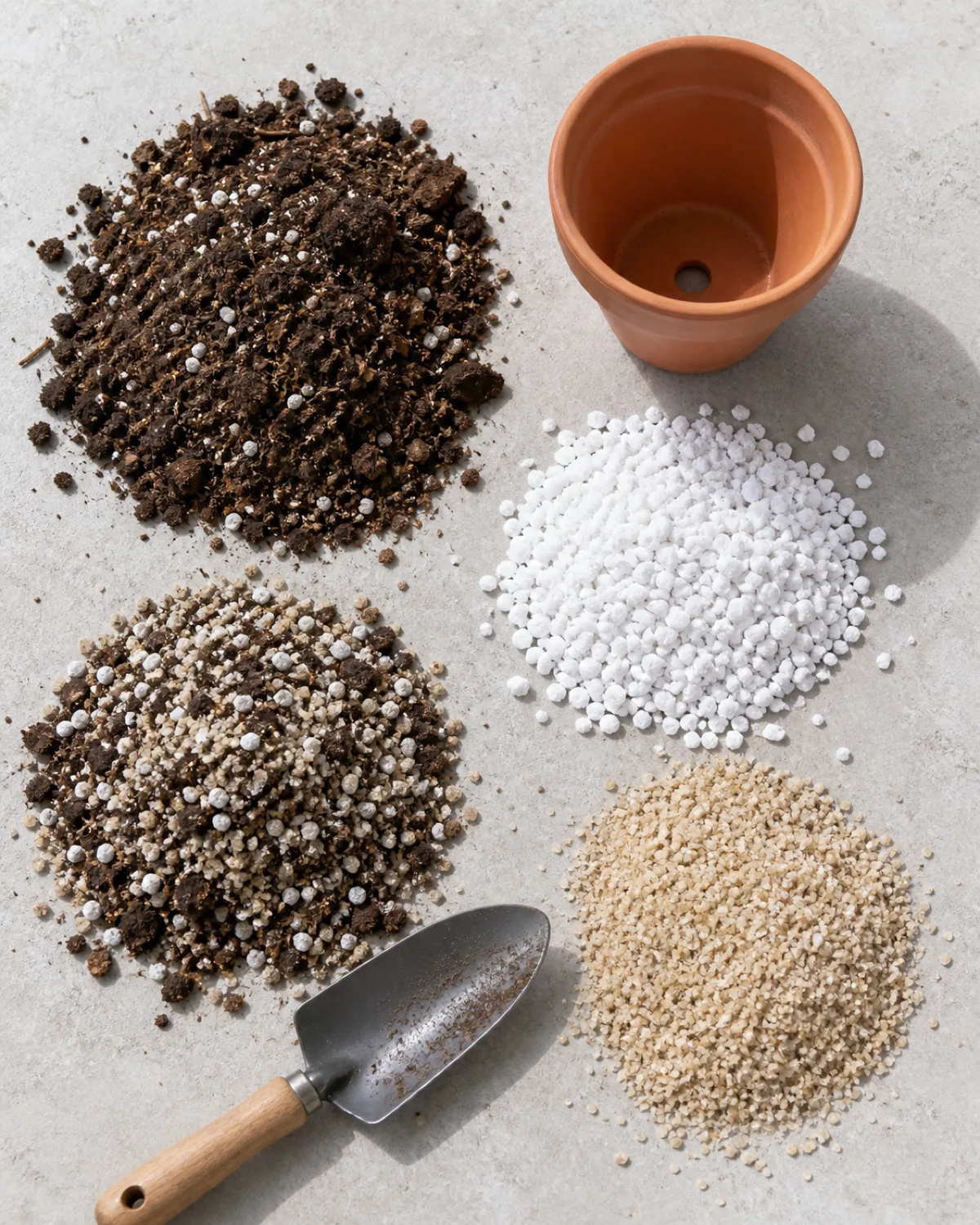
Standard houseplant potting soil holds too much moisture for yucca and will stay damp for days after watering. That sustained dampness is exactly what triggers root rot.
The mix that works is fifty percent cactus and succulent potting mix, thirty percent perlite, and twenty percent coarse sand. The same gritty, fast-draining formula that keeps succulents healthy applies here with one adjustment: yucca roots grow deeper and coarser than succulent roots, so the pot can be slightly larger without the same waterlogging risk.
When you repot, test the mix before planting. Pour water through the empty pot filled with the new soil blend. If water flows out the bottom within thirty seconds, the drainage is fast enough for yucca.
Temperature and humidity: desert comfort zone
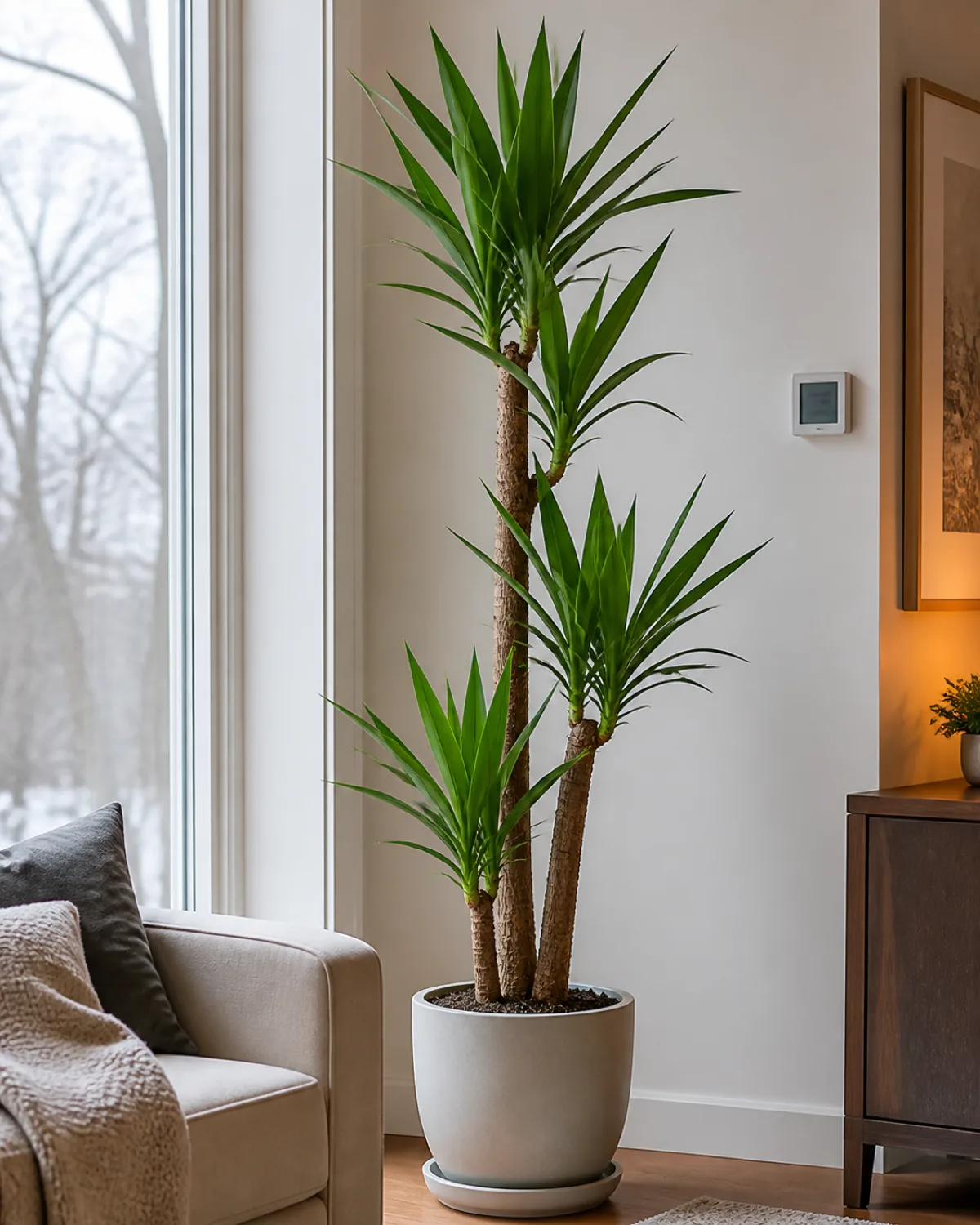
Yucca thrives in the sixty to ninety degree Fahrenheit range, which means standard indoor temperatures are already ideal. No special heating, no cooling mat, no temperature monitoring needed.
The real advantage is at both extremes. Yucca handles brief cold snaps down to thirty degrees — some outdoor species like Y. filamentosa survive negative twenty degrees — and shrugs off summer heat that would stress most tropical houseplants. This makes it one of the hardiest indoor plants through seasonal temperature swings.
Humidity is where yucca diverges most sharply from the tropical majority. Standard indoor air at thirty to fifty percent relative humidity is perfect. The plant does not want a pebble tray, does not want a humidifier running nearby, and absolutely does not want misting.
- Misting prohibition: Water collecting at the leaf base or in the center of the rosette leads to crown rot — a death sentence that starts where you cannot see it
- Heating vents: Keep the pot out of the direct blast from heating registers, which can desiccate leaf edges to a crisp brown
- Cold window glass: In winter, glass surface temperature can drop fifteen to twenty degrees below room temperature — leaves pressed against the pane risk cold damage
- Dry air tolerance: Where ferns struggle below sixty percent humidity and calatheas need constant monitoring, yucca actively prefers low humidity
Feeding your yucca without overfeeding
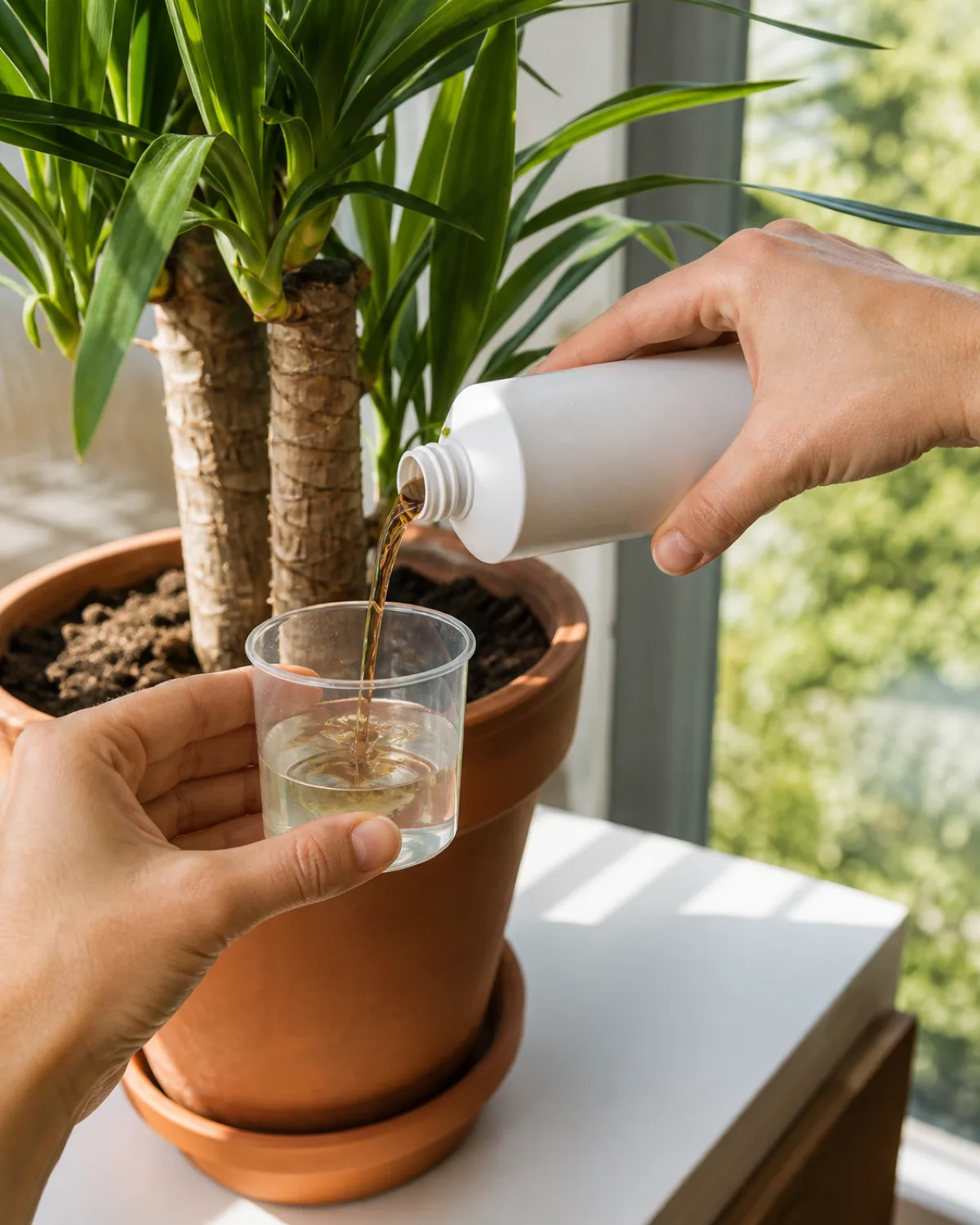
Yucca is a slow grower that adds height at roughly one-third the rate of a pothos or philodendron. That slow metabolism means it uses nutrients slowly, and overshooting on fertilizer does more damage than skipping it entirely.
Feed once per month during the growing season from April through September. Use a balanced liquid fertilizer — 10-10-10 or 20-20-20 — diluted to half the label-recommended strength.
Stop fertilizing completely from October through March. The plant enters a semi-dormant phase where nutrient uptake drops to near zero, and unused fertilizer salts accumulate in the soil.
- Salt flush: Every three to four months, water deeply with plain water two or three times in a row to flush accumulated salts from the soil — watch for white crust on the soil surface as a sign that salts are building up
- Overfertilizing symptoms: Brown, crispy leaf tips and edges surrounded by a yellow halo — similar to houseplant fertilizer burn in other species
- New pot grace period: After repotting, wait four to six weeks before the first feeding — fresh potting mix contains enough nutrients to carry the plant through the initial establishment phase
- Organic vs. synthetic: Yucca is not particular — either works, but liquid synthetic gives you more precise control over concentration
Snug roots, stable trunk: how yucca thrives in a crowded pot
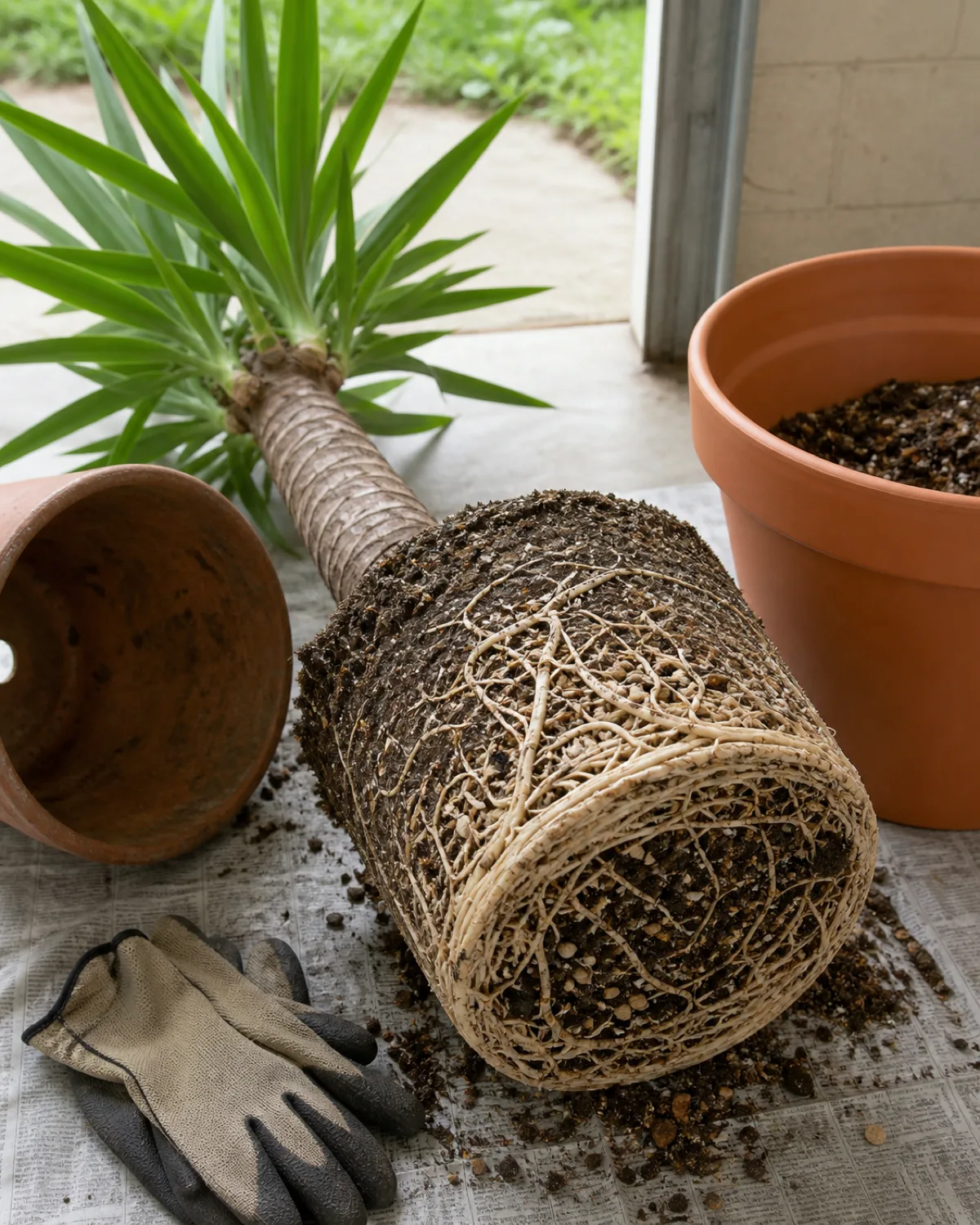
Unlike tropical aroids that signal distress the moment roots circle the pot, yucca actually performs better in a snug container. The desert logic is simple: fewer inches of soil surrounding the root ball means less moisture sitting where roots cannot reach it, which means less rot risk.
A five-foot yucca in a pot only one inch wider than its root ball is not neglected. It is in the exact condition the plant evolved for — sparse resources, tight quarters, zero excess.
The signals that force your hand after two or three years are mechanical, not botanical.
- Escape roots: White roots push out through drainage holes because the root mass has physically compressed all available soil
- Zero absorption: Water runs straight through the pot in seconds — not because of fast-draining mix but because roots have displaced every particle of soil that could hold moisture
- Topple risk: A six-foot cane with a two-pound root ball in a small pot becomes a lever. Any bump sends the whole plant crashing sideways. This is the most common reason tall yuccas get upsized — stability, not root health
When the time comes, go one size up, not two. A six-inch pot moves to an eight, never a ten. The stone-ballast trick used for tall bird of paradise works here too: a layer of river stones at the pot bottom drops the center of gravity below the top-heavy rosette.
Spring is the only safe window. Wear leather gloves — even spineless elephantipes leaves have micro-serrations that produce paper cuts during the wrestling match of extracting a root-bound yucca from its old home.
Check every root while the ball is exposed. Healthy yucca roots are white or light tan and snap cleanly when bent. Any root that is dark, soft, or smells sour is rot tissue that must be cut back to clean flesh and air-dried twenty-four hours before replanting in completely dry, fresh mix.
Pruning the cane: how one cut creates two heads
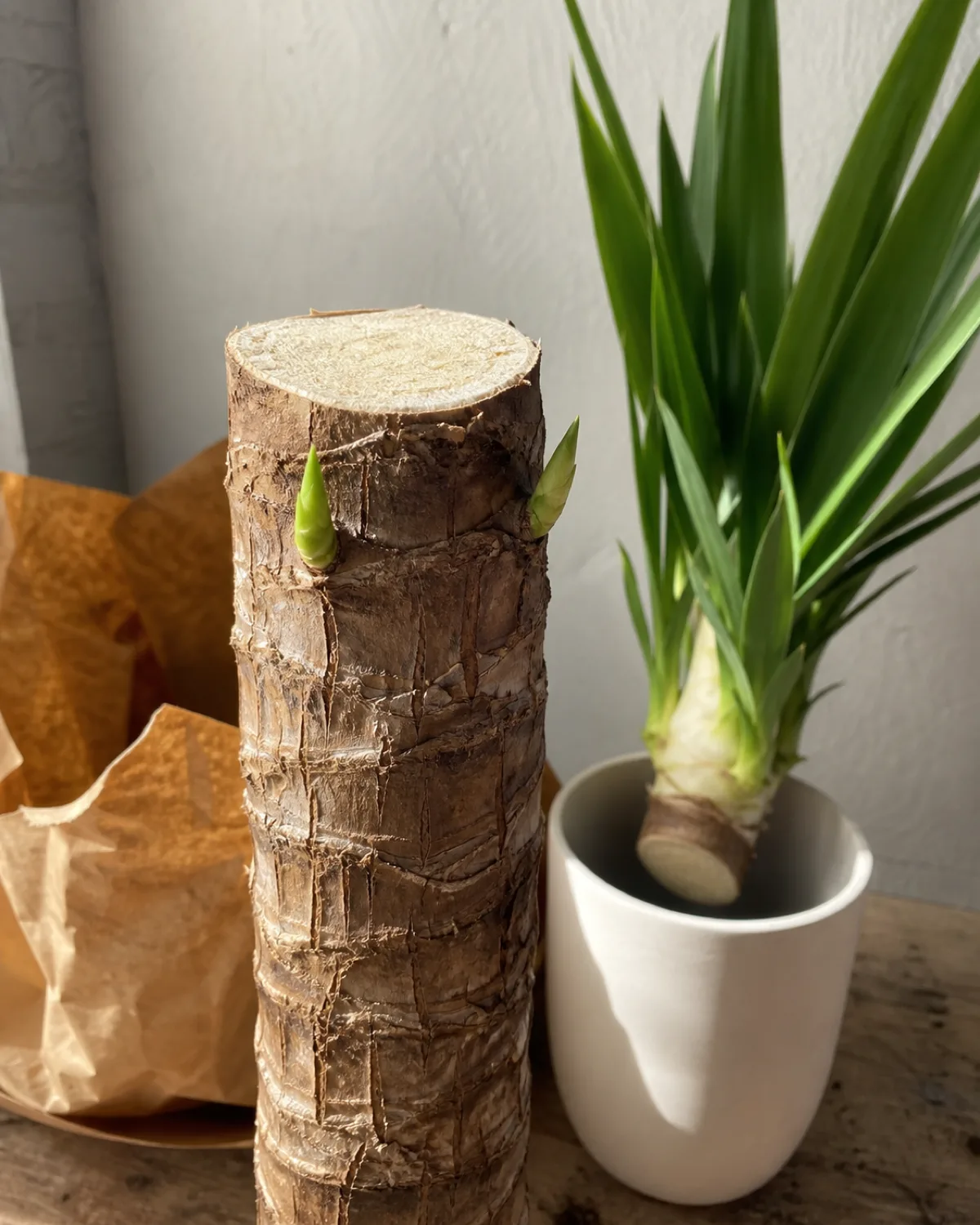
This is the most underappreciated feature of yucca care. When the plant grows too tall, becomes top-heavy, or develops a bare leggy trunk with all the foliage crowded at the top, you can solve every one of those problems with a single cut.
Saw through the cane at whatever height you want the plant to end up. Use a clean, sharp saw or heavy-duty pruning shears — yucca cane is woody and dense, not soft like tropical stems. Cut straight across to minimize exposed surface area.
What happens next looks alarming. You are left with a bare brown stump. No leaves, no green — just a flat cut surface on a woody cylinder. Every instinct says the plant is dead.
Within three to six weeks, two or three dormant buds below the cut point activate and push through the bark as bright green nubs. Each bud develops into a new rosette of leaves, turning one straight trunk into a branched, multi-headed plant with a dramatically different silhouette.
- Best timing: Late spring or early summer, when the plant is in peak active growth and recovery is fastest
- Cut surface treatment: Dust the cut with cinnamon powder or powite sulfur as a natural antifungal barrier — optional but reduces the small risk of fungal entry at the wound
- The crown lives too: The top section you cut off is not waste — it is a ready-made cutting for propagation (see next section)
- Repeat pruning: You can prune the same plant again if the new heads grow too tall — each cut triggers branching below, creating progressively fuller architecture over the years
Propagation: three methods from one plant
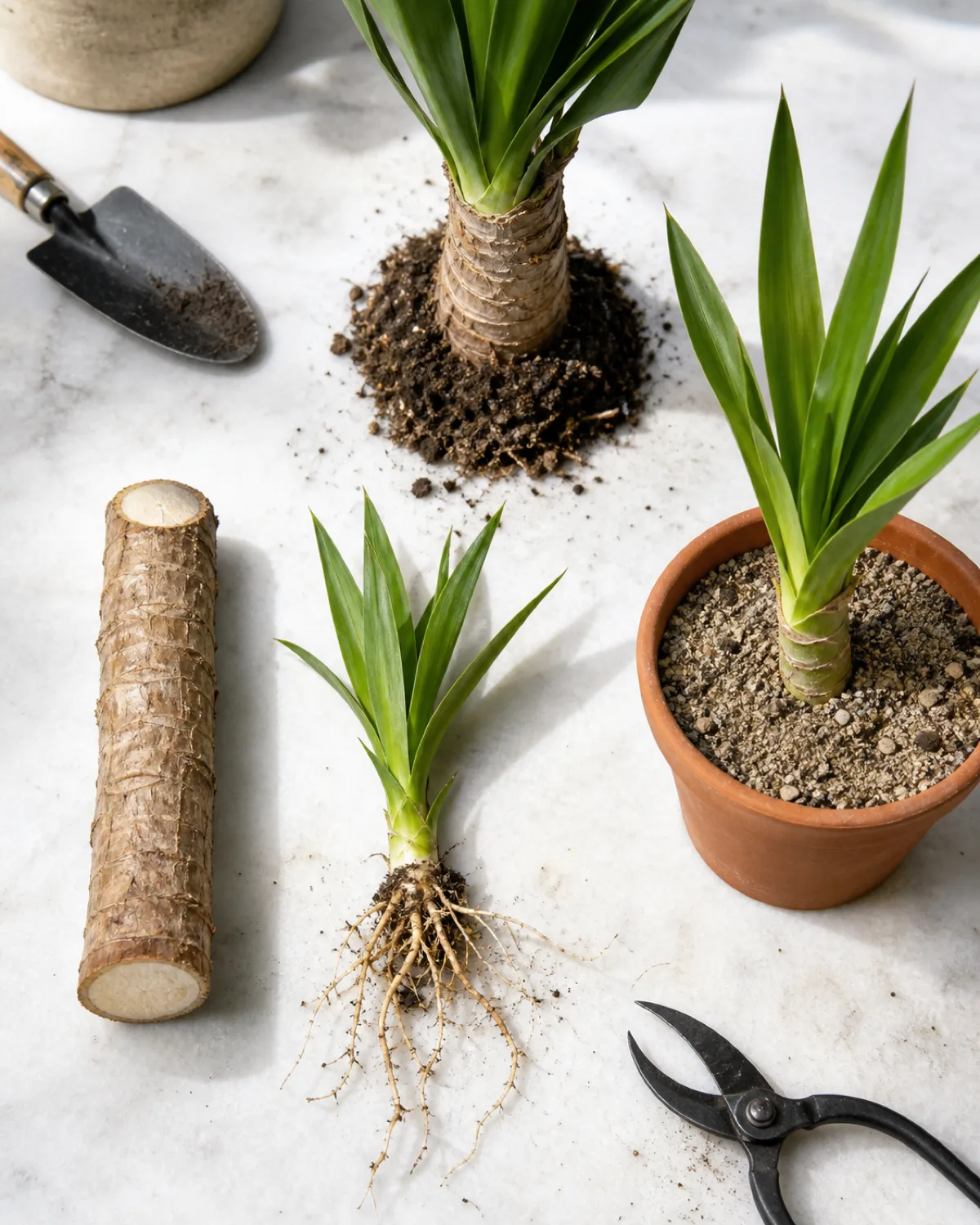
Yucca is one of the easiest large houseplants to propagate because the woody cane and offsets root reliably without the humidity chambers and heat mats that tropical cuttings often require.
Cane cutting is the highest success-rate method, around ninety percent. Cut a section of cane at least four inches long. Let both cut ends dry and callus for one to two days in open air. Insert the bottom end two inches deep into dry, sandy soil.
Do not water for the first week — the callused end needs to stay dry while root initiation begins. After one week, begin light watering every ten to fourteen days. Roots develop in four to six weeks, and new leaf rosettes emerge from dormant buds on the cane.
Offset division works when the mother plant produces pups — small rosettes that appear at the base of the trunk. Wait until the pup is eight to ten inches tall and has developed its own root system. Slice it away from the mother plant with a clean knife, cutting through the underground connection. Let the cut dry for twenty-four hours, then pot independently in the same gritty desert mix.
- Seed propagation: Possible but impractical indoors — requires hand pollination, and germination takes one to three months with low success rates
- Water rooting: Not recommended for yucca — the cane is too woody and prone to rot when submerged, unlike pothos or philodendron cuttings that root in water within days
- Cane pruning bonus: Every cane pruning (section eight above) produces both a new branching point on the mother plant and a viable crown cutting — one action, two plants
All propagation work is best done in spring or early summer when the plant is actively growing and the wound-healing response is strongest.
Five yucca species you can actually grow indoors
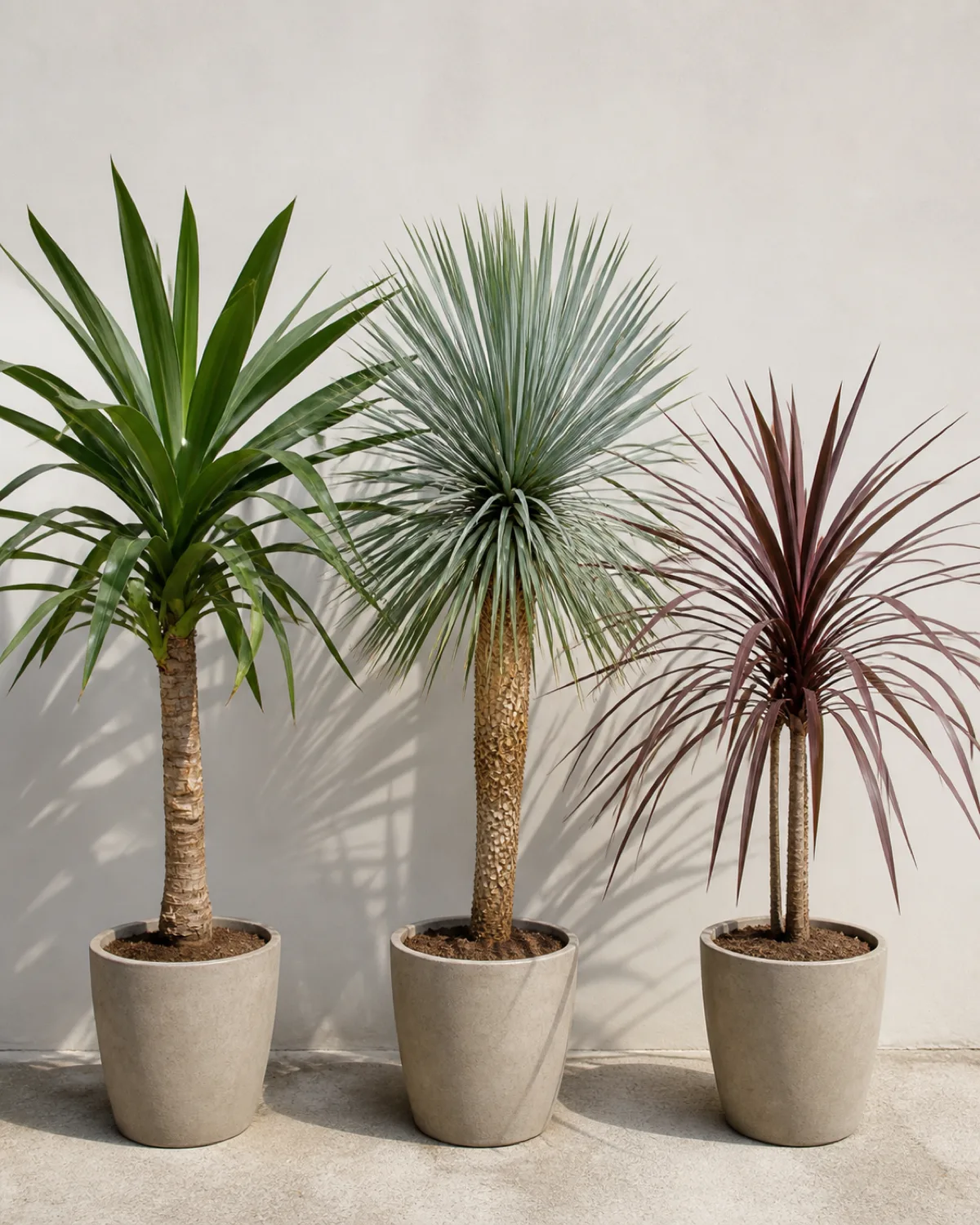
Most indoor yuccas sold in nurseries are a single species — Y. elephantipes — but several others adapt well to indoor conditions, each with a distinct visual character.
Y. elephantipes (spineless yucca, stick yucca) is the default indoor choice and the one this guide primarily covers. Wide, smooth-edged leaves without sharp tips make it safe around walkways and children. The trunk base swells as the plant matures, giving it the elephant-foot silhouette. Grows to six or eight feet indoors over many years. The most forgiving of any yucca species for beginners.
Y. aloifolia (Spanish bayonet) is the opposite in terms of leaf safety. The leaves end in genuine needle-sharp tips that can puncture skin. More compact than elephantipes at three to four feet, with a denser rosette and sawtooth leaf margins. The name says it all — treat it like a bayonet and position it where nobody walks past.
Yucca care cheat sheet
- 1Desert native: opposite care from tropical plantsDirect sun, bone-dry soil, low humidity. Everything most houseplants avoid is what yucca demands.
- 2Light: four to six hours direct sun dailySouth or west window. Etiolation, color fade, and loose rosettes all signal insufficient light.
- 3Water: complete dry-out between soaksLift-test the pot weight. Summer every ten to fourteen days. Winter every three to four weeks or longer.
- 4Soil: fifty percent cactus mix, thirty perlite, twenty sandWater must drain in under thirty seconds. Terra cotta pot with drainage holes, one to two inches wider than roots.
- 5Temperature: sixty to ninety degrees, no humidity neededStandard indoor air is perfect. Never mist — water in the rosette center causes crown rot.
- 6Fertilize: half-strength monthly, spring through summer onlyStop in fall and winter. Flush salts every three to four months with deep plain-water soaking.
- 7Tight pot preferred: upsize every two to three yearsSpring only. Yucca prefers being root-bound. Check for rot when the root ball is exposed.
- 8Prune the cane: cut triggers double branchingSaw at any height. Two to three new rosettes sprout below the cut in three to six weeks.
- 9Propagation: cane cuttings are ninety percent successFour-inch cane segment, callus two days, dry sandy soil. Offsets work too once eight inches tall.
- 10Best indoor species: elephantipes is spineless and beginner-safeAloifolia has real daggers. Gloriosa is blue-green. Desmetiana turns purple. Rostrata is collector-level.
- 11Bottom yellow leaves: normal aging, not alarmThree to five lower leaves per year dry and drop naturally. Mid-crown yellowing means overwatering or low light.
- 12Pests: scale insects are the primary threatBrown oval bumps on leaves and cane. Cotton swab with rubbing alcohol plus neem oil spray.
- 13Toxic to cats and dogs via saponinsASPCA listed. Some species have sharp leaf tips — choose spineless elephantipes for pet households.
- 14Seasonal rhythm: feed and prune spring to summer, rest winterGrowth nearly stops in winter. Cut watering by half. Resume feeding and repotting in March.
Kultivy — www.kultivy.com
Y. gloriosa (Adam's needle) has blue-green leaves with a distinctive powdery coating that gives the foliage a frosted appearance. Among the yucca species that tolerate indoor conditions, gloriosa is the most flexible with light — it handles partial shade better than elephantipes, making it the only yucca that survives long-term on an east-facing window without significant etiolation.
Y. desmetiana is the rare color variant. The leaves shift from green to deep purple-red as light intensity increases, producing the most saturated foliage color of any yucca. Compact at two to three feet, it suits smaller spaces where elephantipes would overwhelm. The color response works the same way as croton: more direct light, deeper pigment.
Y. rostrata (beaked yucca) is the collector's species. Hundreds of narrow, stiff, blue-silver leaves radiate from a central point to form a near-perfect sphere.
It requires the strongest light of any indoor yucca — a minimum of six hours of direct sun — and grows slowly enough that a small specimen purchased today will still be a small specimen in five years. Striking, demanding, and worth the effort for the right window.
Why your yucca leaves turn yellow (and when that is normal)
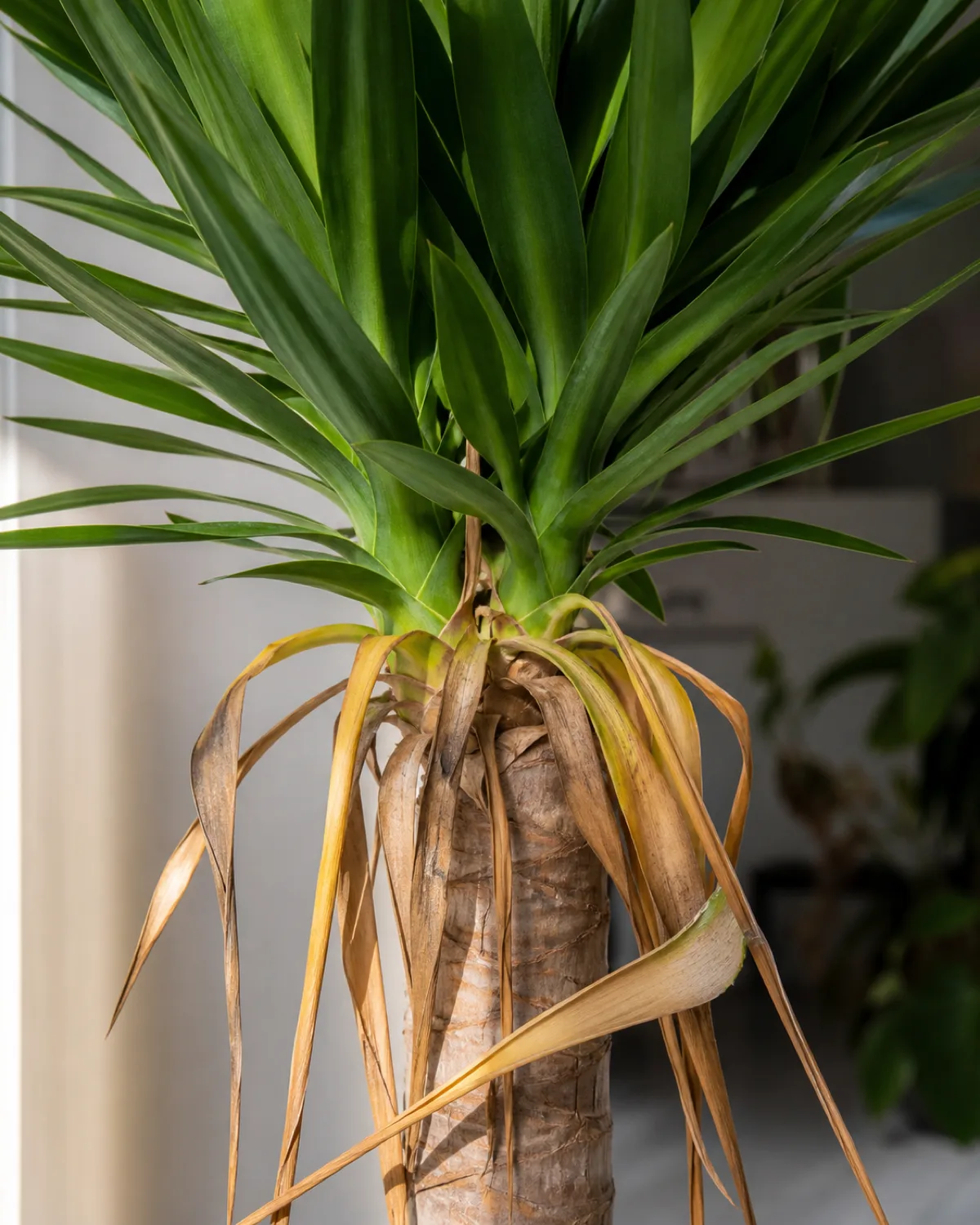
The lowest leaves on a yucca naturally yellow, dry out, and drop every year. Three to five lower leaves per growing season is standard aging — the plant diverts resources from old growth at the base to new growth at the crown. This is not a problem.
Pull the yellow leaf downward with a firm tug, peeling it away along the grain of the fibers. It separates cleaner than cutting and leaves no stub that could trap moisture or harbor pests.
The alarm signals come when yellowing appears in the middle or upper portions of the rosette, where it should not happen on a healthy plant.
- Overwatering (most common cause): Leaves turn yellow and feel soft or mushy rather than crispy. Check the cane base — if it gives when you press it or smells sour, root rot has started. Stop watering immediately, unpot the plant, trim all dark or soft roots, and repot in fresh dry mix
- Insufficient light: A gradual, uniform fade from deep green to pale yellow-green across many leaves at once. The plant is not dying but photosynthesizing below the rate it needs. Move to a brighter window
- Root-bound stress: Even yellowing across the plant with roots visibly escaping the pot. Repot one size up
- Cold damage: Sudden large-scale yellowing after a cold snap or overnight exposure near a freezing window. Affected leaves will not recover — remove them and relocate the plant away from the cold source
Common pests and how yucca handles them
Yucca's thick, leathery leaves and preference for dry conditions make it naturally resistant to most common houseplant pests. Fungus gnats, which breed in damp topsoil, rarely appear because the soil dries completely between waterings. Spider mites, which thrive in dry air on thin-leaved tropicals, generally avoid yucca's thick cuticle.
The one pest that does target yucca is scale.
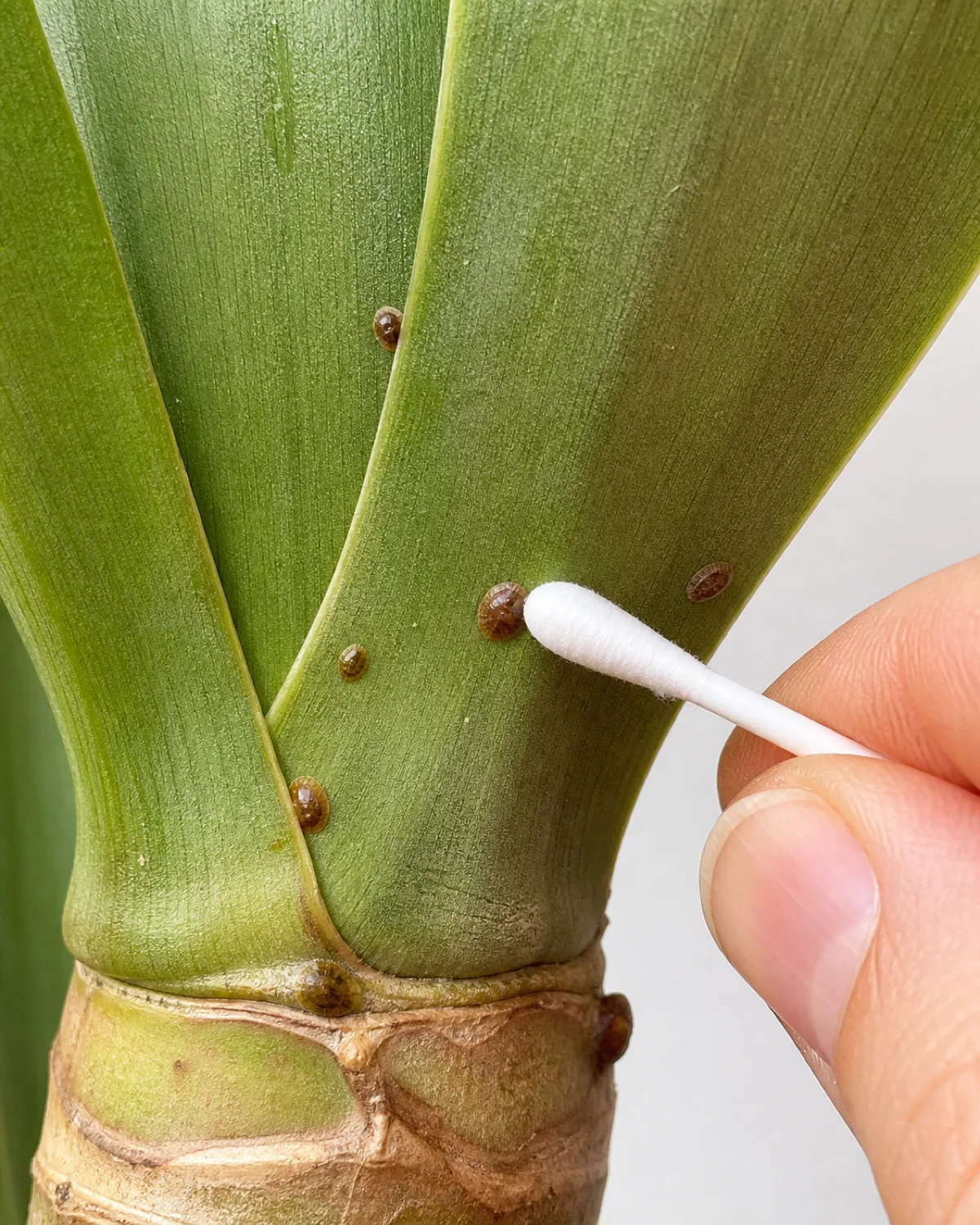
Scale insects appear as small brown or tan oval bumps along the leaf midrib, at the base of the rosette, and on the woody cane. They anchor themselves to the plant surface and feed on sap, weakening the plant gradually over weeks. A heavy infestation produces sticky honeydew residue on leaves and nearby surfaces.
- Manual removal: Dip a cotton swab in seventy percent isopropyl alcohol and press it against each scale insect individually. The alcohol dissolves the waxy shell that protects the insect. Check every leaf, both sides, and the cane surface
- Neem oil follow-up: After manual removal, spray all leaf surfaces with neem oil solution every seven days for three consecutive weeks to catch any crawlers (juvenile scale that are mobile before they anchor)
- Mealybugs: Less common but occasionally appear as white cottony clusters in the rosette center or at leaf-stem junctions. Same alcohol-swab treatment followed by neem
- Prevention: Inspect the plant monthly, especially the undersides of leaves and cane crevices. Quarantine any new plant for two weeks before placing it near your yucca
Toxicity, safety, and the leaf-tip warning
The ASPCA classifies yucca as toxic to cats and dogs. The plant contains saponins — compounds that cause vomiting, diarrhea, and excessive drooling if a pet chews on the leaves. Toxicity is moderate rather than severe, but any ingestion warrants a call to your veterinarian.
The physical hazard is species-dependent and often overlooked. Y. aloifolia and Y. gloriosa have terminal leaf spines sharp enough to pierce skin and cause puncture wounds. A child or pet running past a low-placed specimen can catch a leaf tip at eye level.
- Spineless solution: Choose Y. elephantipes for any household with children or pets. The leaves end in flexible points that bend rather than pierce
- Tip trimming: For species with sharp tips, cut the terminal quarter inch off each leaf at a forty-five degree angle with sharp scissors. The plant does not suffer from this trim — it affects only the dead, hardened tip tissue, not the living leaf
- Placement strategy: Position yucca away from walkways and high-traffic zones. The rosette diameter extends twelve to twenty-four inches from the cane in all directions — leave at least six inches of clearance beyond the leaf tips for safe passage
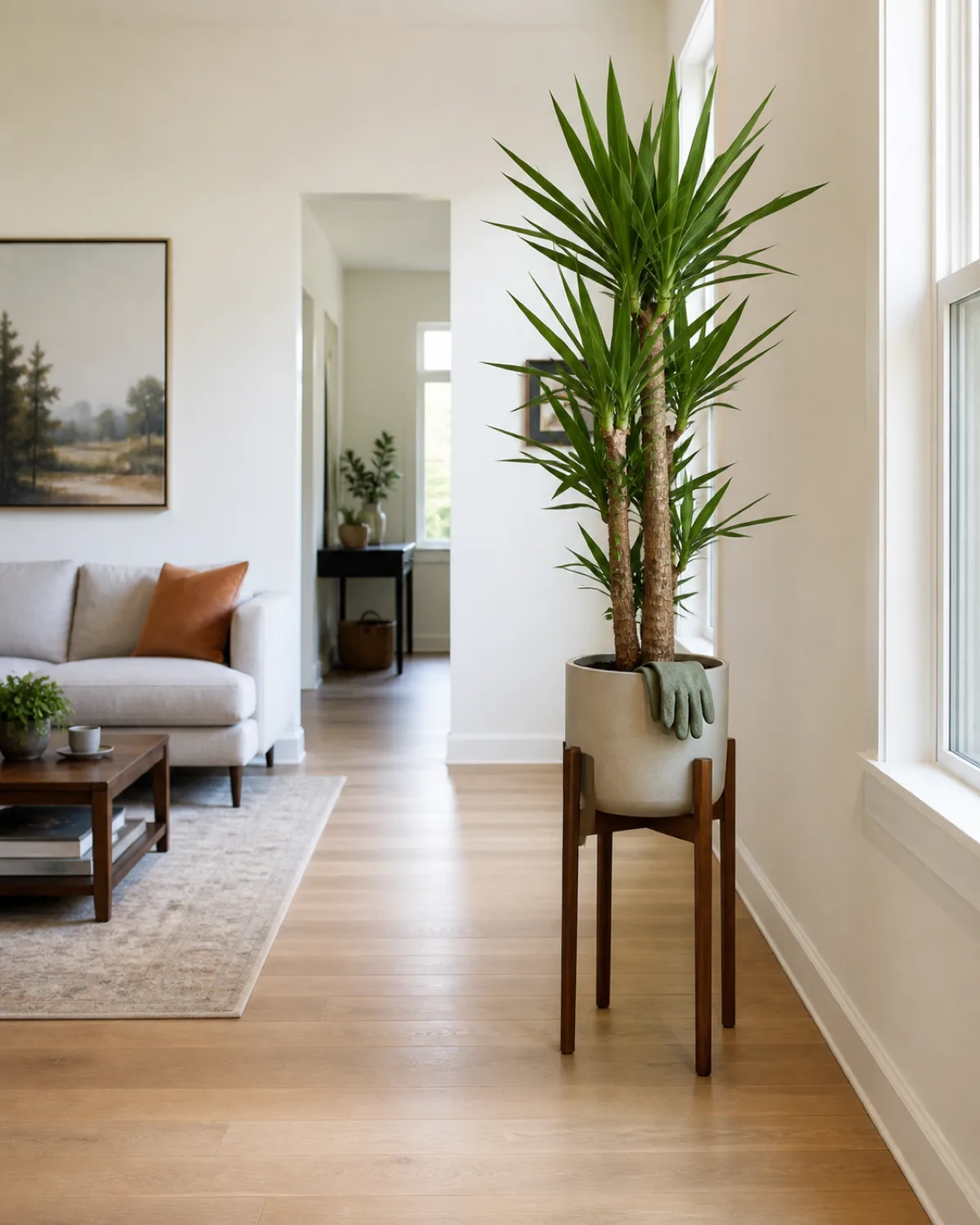
- Handling gloves: Wear leather gardening gloves when repotting, pruning, or moving any yucca. Even spineless species have micro-serrations along the leaf edges that can produce paper-cut-like abrasions
Seasonal care calendar: what yucca needs month by month
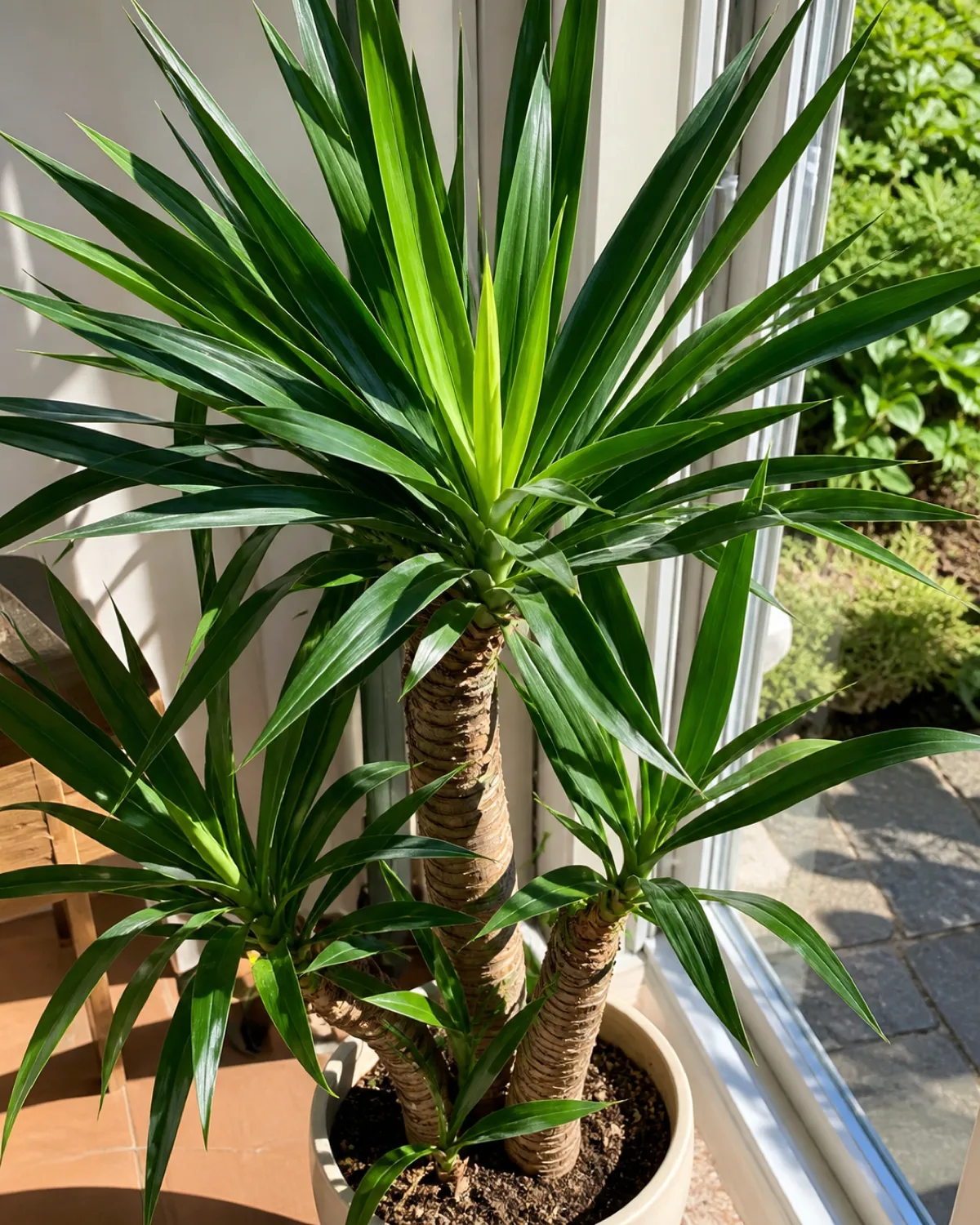
Yucca follows a clear seasonal rhythm driven by light availability and temperature, not by an internal dormancy clock like oxalis. The pattern repeats every year and simplifies care once you recognize it.
Spring (March through May) is the activation window. New leaf growth resumes at the crown, lighter green than the mature leaves below. This is the time for every proactive care task: resume monthly fertilizing at half-strength, assess whether repotting is needed, perform any cane pruning or propagation, and begin increasing watering frequency back to the ten-to-fourteen-day rhythm.
Summer (June through August) is peak growth. The rosette adds its maximum number of new leaves. Outdoor placement in full sun is safe if temperatures stay above fifty degrees at night — the plant grows faster outdoors with unrestricted natural light than it does behind even the brightest window.
- Watch for scale: The pest is most active in warm months, inspect every two weeks
- Outdoor transition: If you move yucca outside for summer, transition over five to seven days to avoid sunscald on leaves adapted to filtered-through-glass light
- Watering peak: Summer evaporation is highest — you may water every seven to ten days rather than fourteen
Autumn (September through November) is the slowdown. Gradually reduce watering frequency as growth stalls. Stop fertilizing by October. If the plant spent summer outdoors, bring it back inside before night temperatures drop below fifty degrees. This is the last window for repotting — after November, root recovery slows too much.
Winter (December through February) is semi-dormancy. Growth slows to near zero. Water every three to four weeks or only when the pot feels feather-light. Keep the plant in the brightest available spot — winter sun angle is lower and daylight hours are shorter, so the same window that provided ideal light in July may be marginal in January.
- Leaf shedding: More lower leaves yellow and drop during winter than in other seasons — this is normal seasonal divestiture, not a problem
- No fertilizer: Feeding a semi-dormant plant risks salt accumulation with no root uptake to counterbalance it
- Rotate quarterly: Turn the pot ninety degrees every season to prevent lopsided growth toward the window
The constant across all four seasons: keep yucca in the brightest spot in the house, let the soil dry completely between waterings, and never mist.

Mara writes plant care guides grounded in published botany and first-hand growing experience, not recycled social-media advice. Every recommendation on Kultivy is tested against real-world conditions before it reaches your screen. More about our editorial standards.