A yellow leaf is a symptom, not a diagnosis. The same golden color can mean six different things depending on which leaf turns, how fast it happens, and what the soil feels like when you push your finger in.
Most guides tell you to water less. That fixes exactly one of the ten causes below and makes several others worse. This guide matches each yellowing pattern to its specific cause so you can identify the real problem before you change anything.
Each cause leaves a different visual signature. Match the pattern, find the fix.
Why Leaves Turn Yellow in the First Place
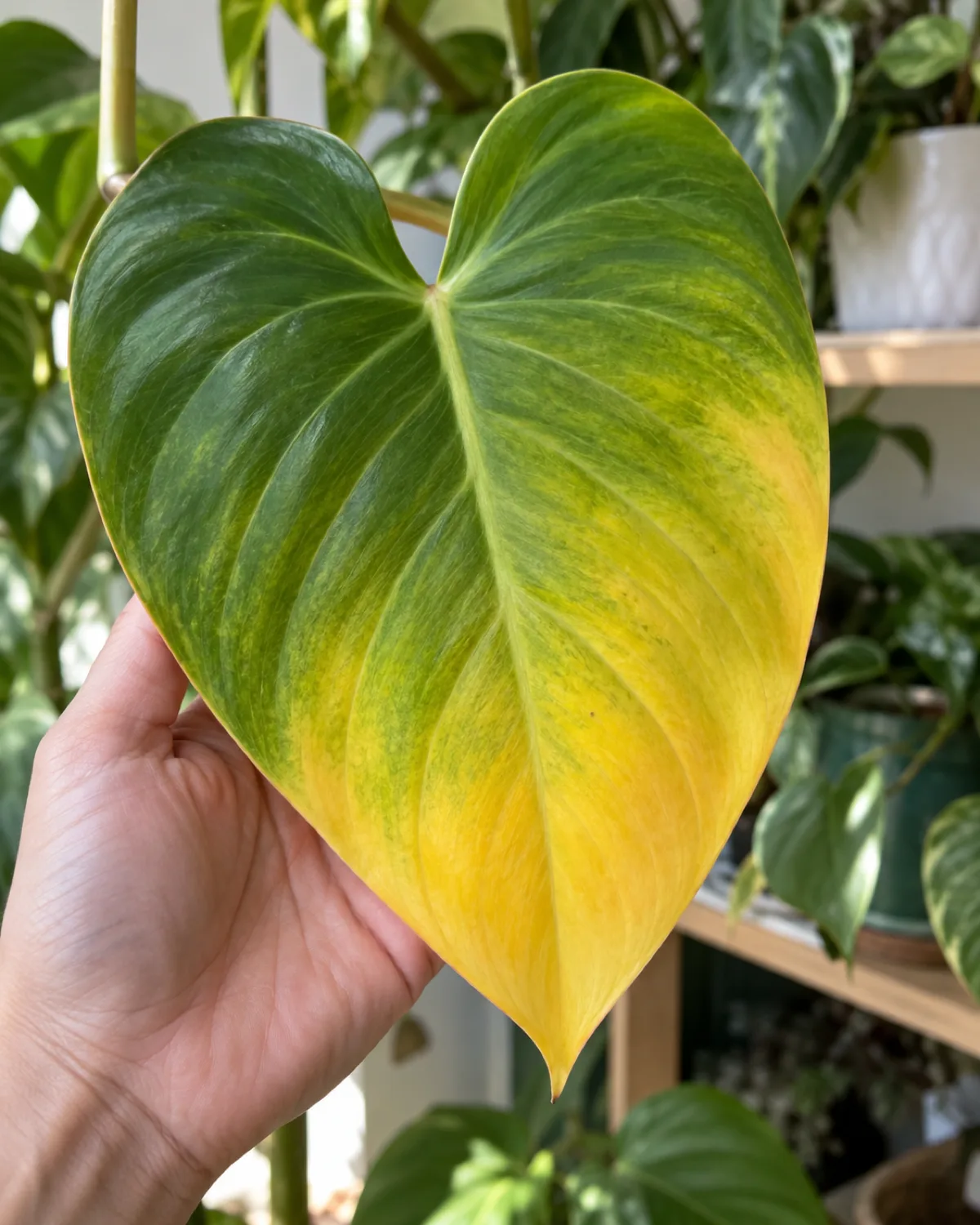
The green in every leaf comes from chlorophyll, the pigment that converts light into energy. When a leaf turns yellow, the chlorophyll is breaking down and the yellow carotenoid pigments underneath — always present but normally masked — become visible.
This process is called chlorosis, and it happens for one of two reasons. Either the plant is deliberately pulling resources out of that leaf to redirect them somewhere more useful, or the leaf itself can no longer manufacture chlorophyll because something in the environment has gone wrong.
- Deliberate reabsorption happens during natural aging — the plant salvages nitrogen, phosphorus, and magnesium from old leaves before dropping them
- Environmental chlorosis happens when the root system, light conditions, temperature, or nutrient supply prevent the leaf from maintaining its chlorophyll
- The visible result looks identical in both cases, which is why "yellow leaf" alone tells you almost nothing
The distinction matters because treating a natural process as a problem wastes time, and treating a serious problem as natural aging lets the damage spread. The next nine sections each describe a specific yellowing pattern so you can tell them apart.
Answer these before changing anything about how you care for the plant.
Overwatering: Yellow Leaves That Feel Mushy
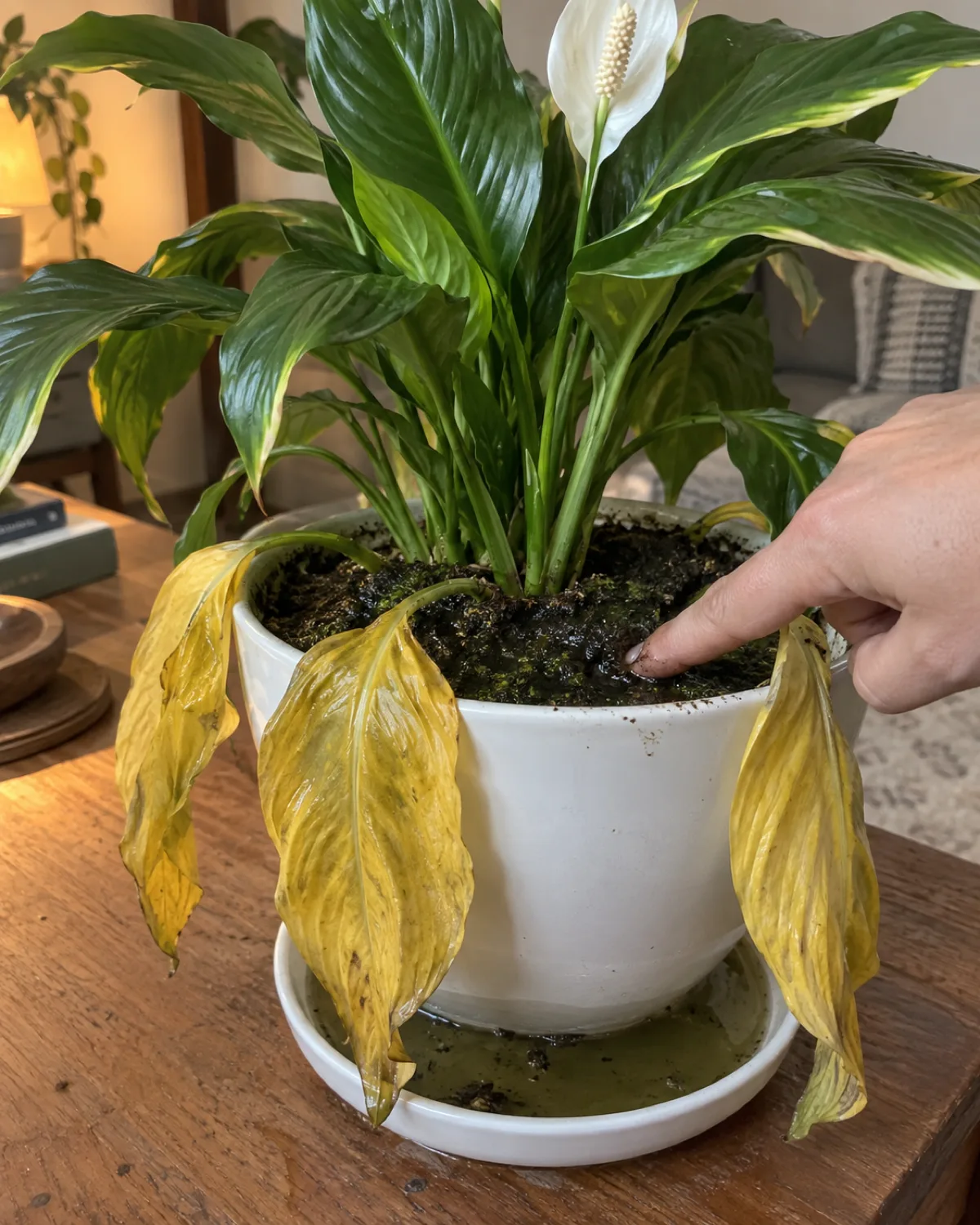
Overwatering is the most common cause of yellow leaves in houseplants, and it is also the most misunderstood. The problem is not the volume of water you pour — it is how long the soil stays wet afterward.
When soil stays saturated for days, the air pockets that roots depend on for oxygen fill with water. The roots switch to anaerobic respiration, weaken, and begin to die. Dead roots cannot deliver water or nutrients to the leaves, so the plant sacrifices its oldest lower leaves first.
The overwatering yellowing signature:
- Lower leaves turn yellow first, progressing upward
- Yellow leaves feel soft, limp, and slightly mushy to the touch
- Soil is still damp or wet several days after the last watering
- The pot feels heavy when you lift it
- A sour or musty smell from the drainage hole in advanced cases
The fix is not watering less frequently. The fix is improving drainage so the soil dries at a healthy rate. Check that the pot has a drainage hole, that the saucer is emptied after watering, and that the soil mix contains enough perlite or bark to prevent compaction.
- If the yellowing is limited to one or two lower leaves and the roots still look white when you unpot, adjust watering and move on
- If multiple leaves are yellowing and the roots are brown and mushy, you are dealing with root rot and need to trim the dead roots and repot in fresh mix
- Snake plants and ZZ plants are especially vulnerable because their thick succulent roots store water internally — they need far less frequent watering than most tropical houseplants
Underwatering: Yellow Leaves That Feel Crispy
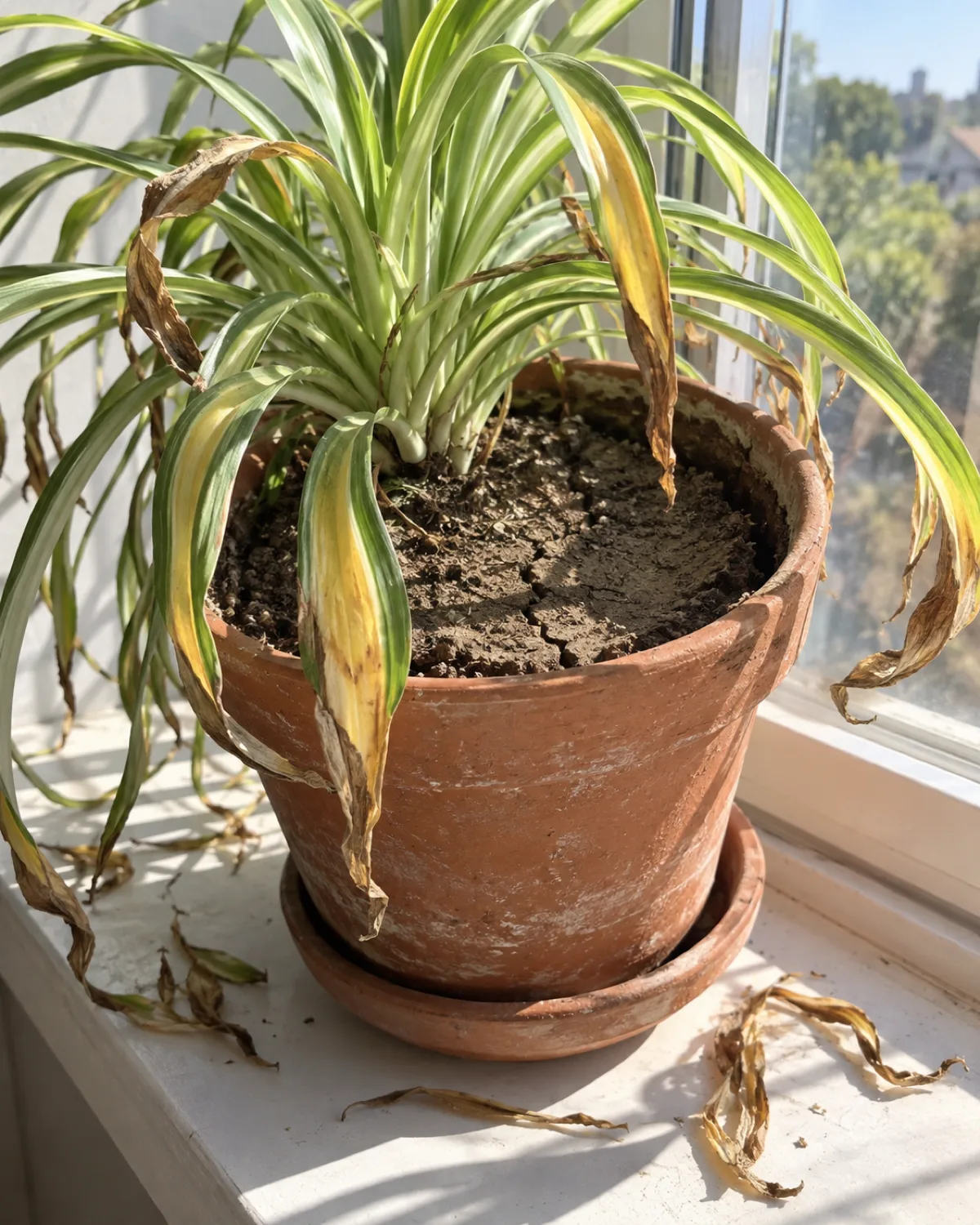
Underwatering yellowing looks nothing like overwatering yellowing once you know what to feel for. The key difference is texture.
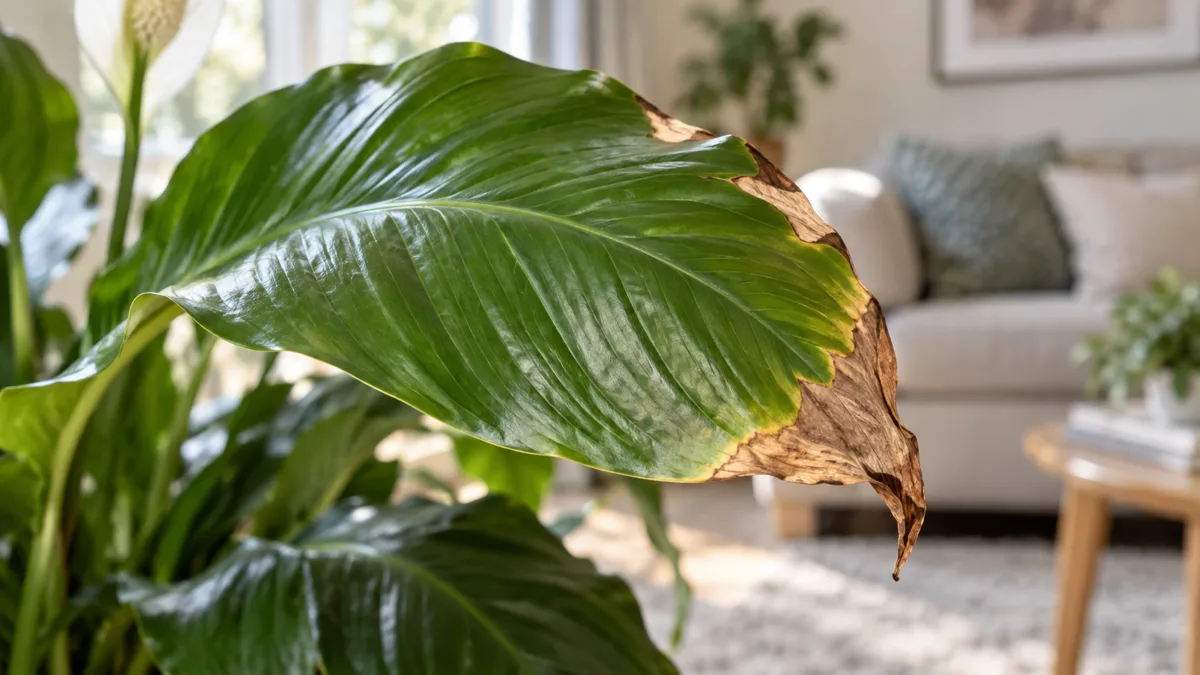
An underwatered yellow leaf is dry, papery, and often crispy at the edges. The browning starts at the leaf tips and margins and works inward, with the yellowing following behind. The leaf may curl inward as the cells lose turgor pressure.
The underwatering yellowing signature:
- Edges and tips brown and crisp before the rest of the leaf yellows
- The leaf feels dry and papery, not soft or mushy
- Soil has pulled away from the pot edges, leaving a visible gap
- The pot feels noticeably light when lifted
- The entire plant may droop but perks back up within hours after watering
The cellular explanation: when water supply drops below what the leaf needs to maintain cell pressure, the chloroplasts — the organelles that hold chlorophyll — break down as the cell dehydrates. The damage starts at the thinnest tissue (edges and tips) because those areas lose moisture fastest.
- Quick test: water the plant thoroughly and check back in 24 hours — if the remaining green leaves perk up and look normal, underwatering was the cause
- Prevention: the finger test at two inches deep catches most underwatering before it causes visible damage
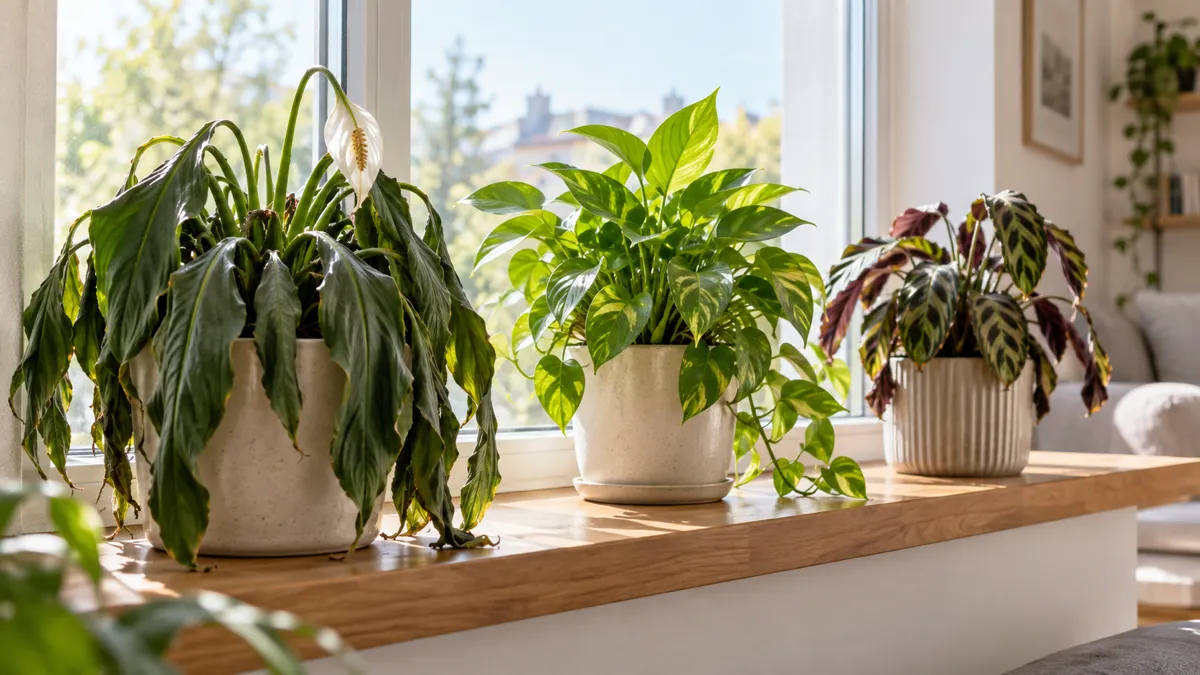
- Chronic underwatering in species like peace lily shows as a dramatic droop before any yellowing — the droop is actually an early warning system that gives you time to act
Too Little Light Pushing Leaves to Quit
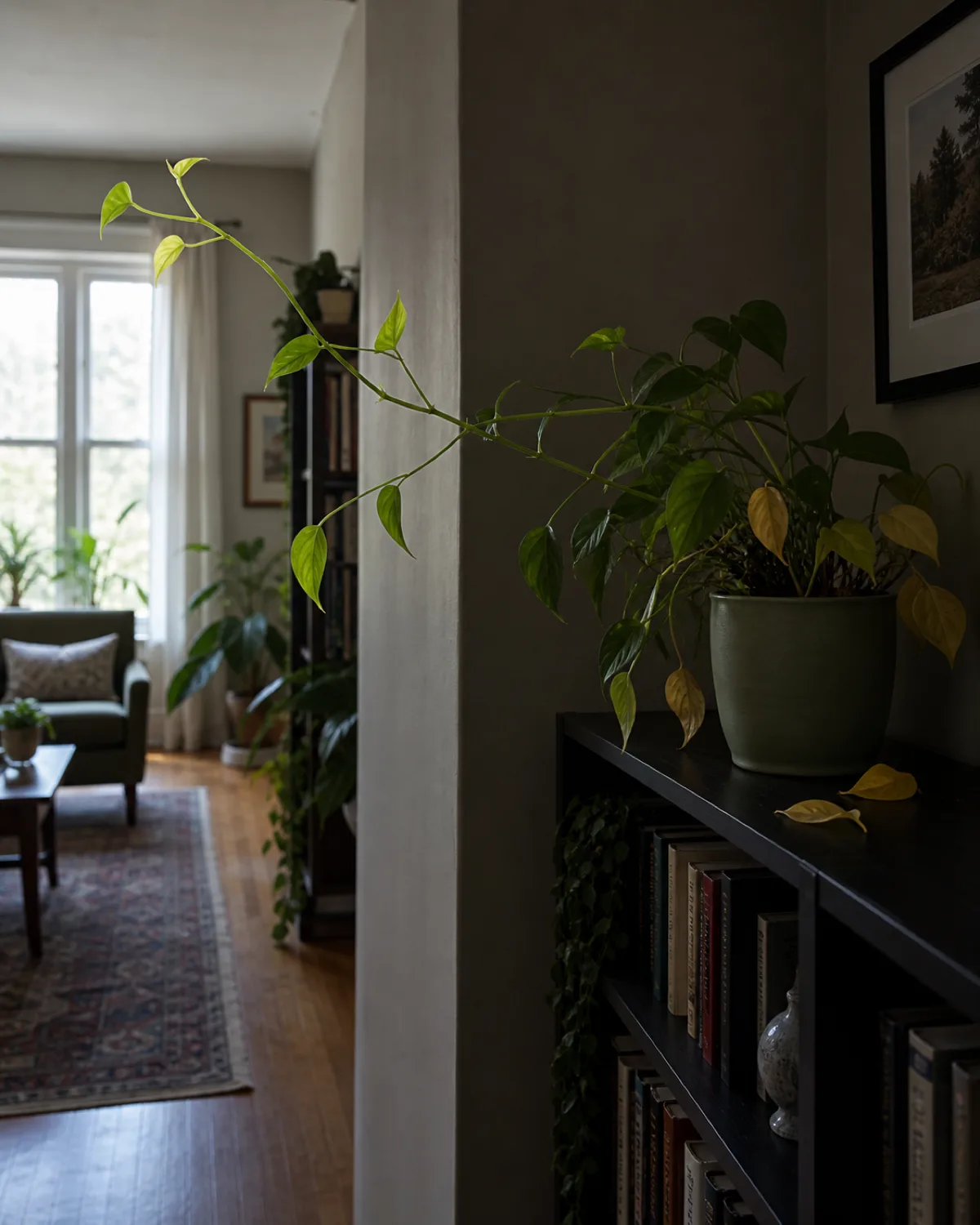
A plant in too little light faces a budget problem. Each leaf costs energy to maintain — water, nutrients, cellular repair — and the return on that investment is the sugar the leaf produces through photosynthesis. When light drops below the threshold where a leaf can pay for itself, the plant cuts its losses.
The lower and interior leaves go first because they receive the least light. Upper leaves shade them, walls block side light, and the geometry of the plant works against the leaves closest to the pot.
The low-light yellowing signature:
- Lower and interior leaves yellow while the top of the plant looks healthy
- New growth is leggy — long internodes, small leaves, stems leaning toward the light source
- The yellowing is gradual, happening over weeks rather than days
- Fallen yellow leaves accumulate without any obvious watering or temperature problem
This pattern is easy to confuse with natural aging because both affect the lowest leaves. The difference is volume and speed. Natural aging drops one or two leaves over months. Low-light stress drops several leaves in weeks, and the new growth tells the story — leggy, stretched, pale.
- Move the plant closer to a window or add a grow light
- Read the light requirements guide to understand what bright indirect, medium, and low light actually mean in measurable terms
- The shadow test is fast and free: hold your hand a foot above the plant and check the shadow on the surface below — a crisp shadow means bright light, a soft shadow means medium, no shadow means the plant is not getting enough
Too Much Direct Sun Burning the Pigment Out
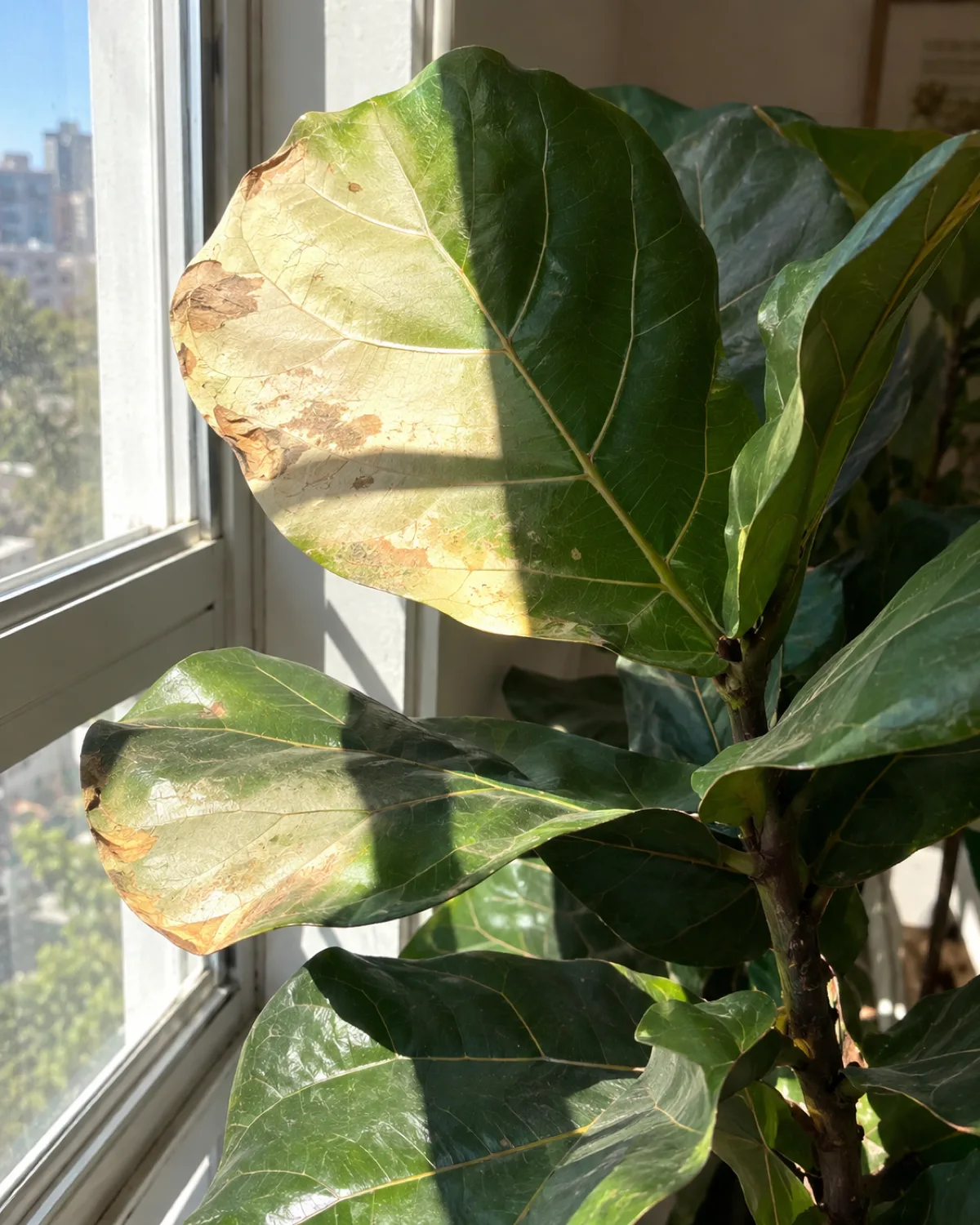
Sunburn on a leaf looks completely different from every other type of yellowing. Instead of the whole leaf turning yellow, only the parts directly exposed to the sun lose their color.
UV radiation destroys chlorophyll faster than the leaf can replace it. The result is bleached, washed-out patches that are often tan or white rather than pure yellow. The damage is strictly one-sided — the half of the leaf facing the window shows the burn while the shadowed half stays green.
The sunburn signature:
- Patches of pale yellow, bleached white, or tan on the sun-facing side only
- The damage has a clear boundary where light hits versus where shadow falls
- Affected areas may turn papery and brown after a few days
- The pattern follows the angle of direct sun, not the age of the leaf
The fix is the opposite of low-light yellowing. Moving the plant into more light makes sunburn worse, while moving it into less light fixes it. Species like fiddle-leaf fig and calathea are especially sensitive to direct afternoon sun.
- Sheer curtains cut direct sun intensity by about 50 percent without reducing the overall brightness enough to trigger low-light problems
- Morning sun (east window) is gentler than afternoon sun (west or south window) because the angle and intensity are lower
- A plant that was fine in the same spot all winter may burn in summer as the sun angle changes and direct rays reach deeper into the room
Nutrient Deficiency Written in the Veins
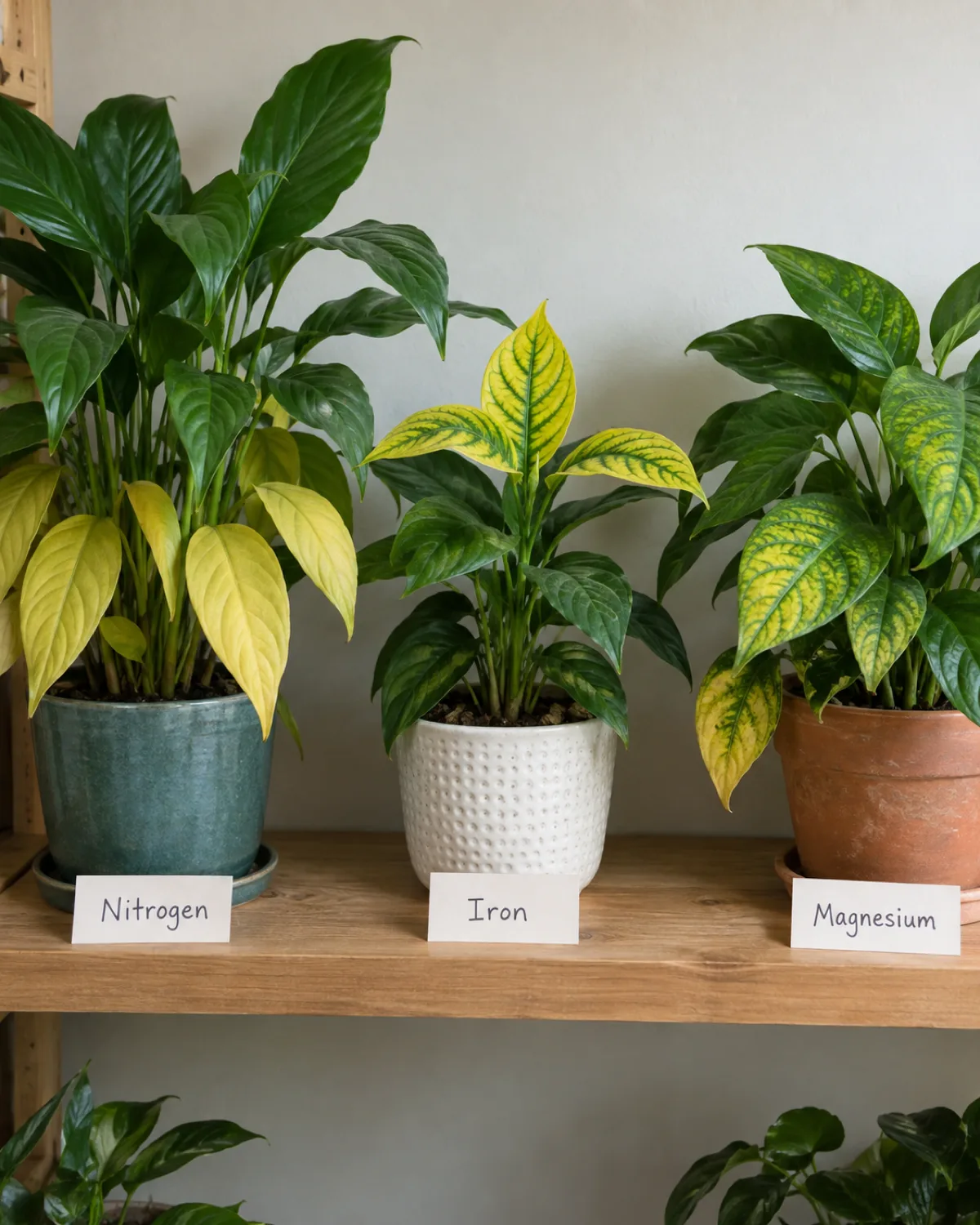
Nutrient deficiencies produce the most specific yellowing patterns of any cause on this list. The pattern tells you which nutrient is missing because different elements are mobile or immobile within the plant.
Nitrogen deficiency — the most common in houseplants. Nitrogen is mobile, meaning the plant pulls it from old leaves to feed new growth. Oldest leaves turn uniformly pale yellow, starting at the bottom and working up. The entire leaf yellows evenly, with no pattern of green veins or spots.
Iron deficiency looks like the opposite. Iron is immobile — the plant cannot move it from old leaves to new ones. The youngest, newest leaves turn yellow while the veins stay dark green, creating a striking pattern called interveinal chlorosis. This is often caused by soil pH being too high rather than an actual lack of iron in the mix.
Magnesium deficiency hits the oldest leaves with yellow patches between the veins. It looks similar to iron deficiency but affects old leaves instead of new ones, because magnesium is semi-mobile.
- The fix for all three: a balanced liquid fertilizer at half strength, applied during the growing season
- If you have not fertilized in more than three months during spring or summer, nitrogen depletion is the most likely culprit
- Iron deficiency that persists after fertilizing usually means the soil pH has drifted alkaline — flushing the soil with distilled water or repotting in fresh acidic mix resolves it
- Do not double the fertilizer dose to fix a deficiency faster — fertilizer burn damages roots and creates new problems on top of the old ones
Follow these before you change anything about the plant's care routine.
Temperature Stress and Cold Drafts
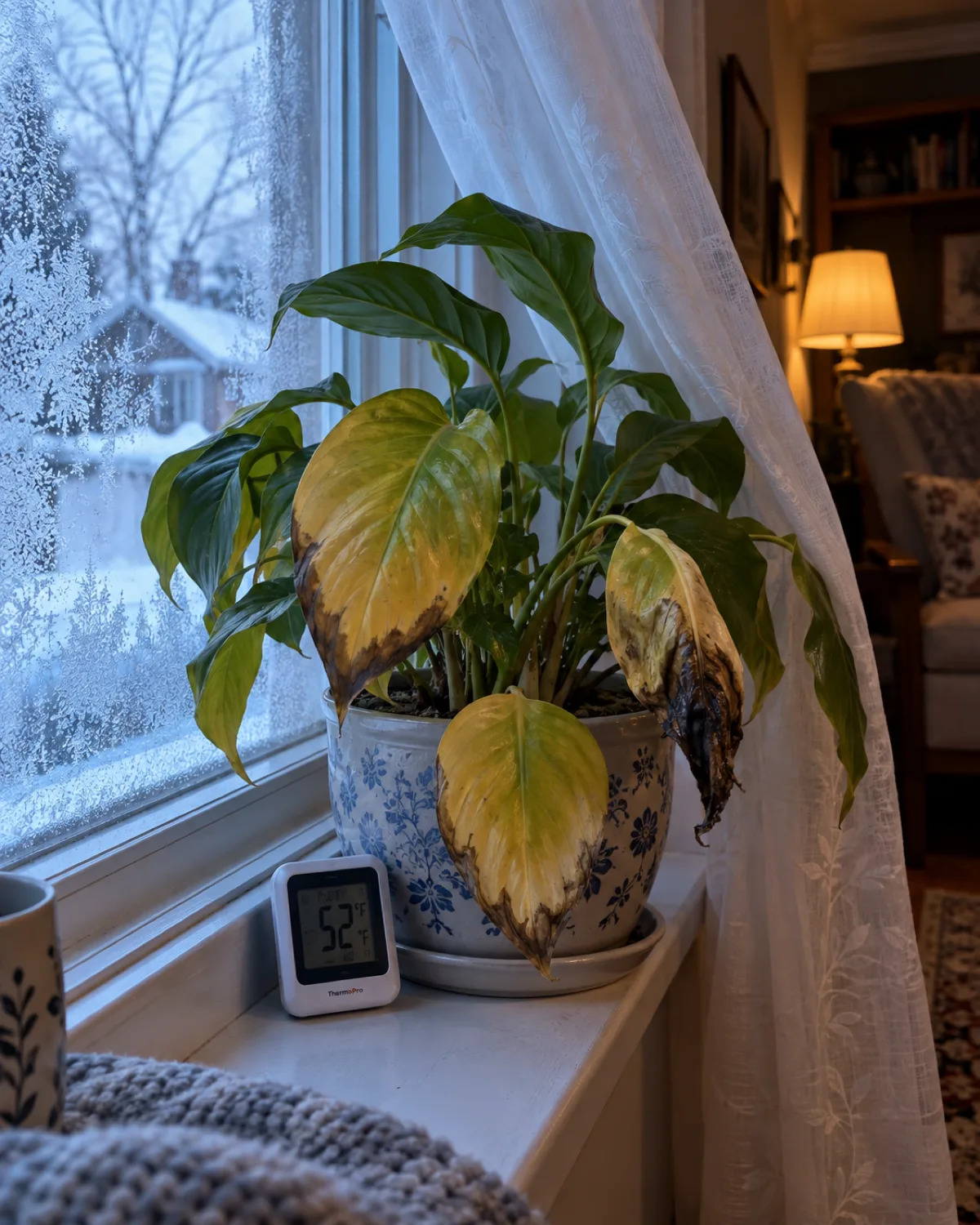
Temperature-related yellowing is fast and dramatic. A tropical plant exposed to a cold draft or placed near an AC vent can yellow multiple leaves within days, whereas most other causes take weeks.
Most houseplants evolved in tropical or subtropical environments where temperatures stay between 60°F and 85°F year round. Below 55°F, the enzymatic processes that maintain chlorophyll slow dramatically. The leaf cannot repair chlorophyll as fast as it degrades, and rapid yellowing follows.
The temperature stress signature:
- Sudden yellowing of multiple leaves within a few days, especially after a placement change
- Leaves may develop dark, water-soaked patches at the edges — a sign of cell damage from cold
- The yellowing does not follow the age pattern (not bottom-up or top-down) — it hits whichever leaves were most exposed to the temperature extreme
- Blackened leaf tips or margins in severe cold exposure
Common cold-draft sources that people miss:
- Window glass in winter — even with the window closed, glass radiates cold and the air layer against it can be 15°F colder than the rest of the room
- AC vents blowing directly on foliage during summer
- Exterior doors that open frequently in winter
- Uninsulated walls in older buildings
The fix is relocation, not treatment. Move the plant away from the cold source, trim the damaged leaves, and it will recover if the root system is undamaged. Species like fiddle-leaf fig, croton, and dieffenbachia are the most cold-sensitive common houseplants.
- Heat stress above 90°F can also cause yellowing, though this is rare indoors — it is more common for plants placed near radiators or on top of appliances that generate heat
- A digital thermometer near your most sensitive plant catches temperature swings you might not notice during the night or while you are at work
Natural Aging: The Yellow Leaves You Should Ignore
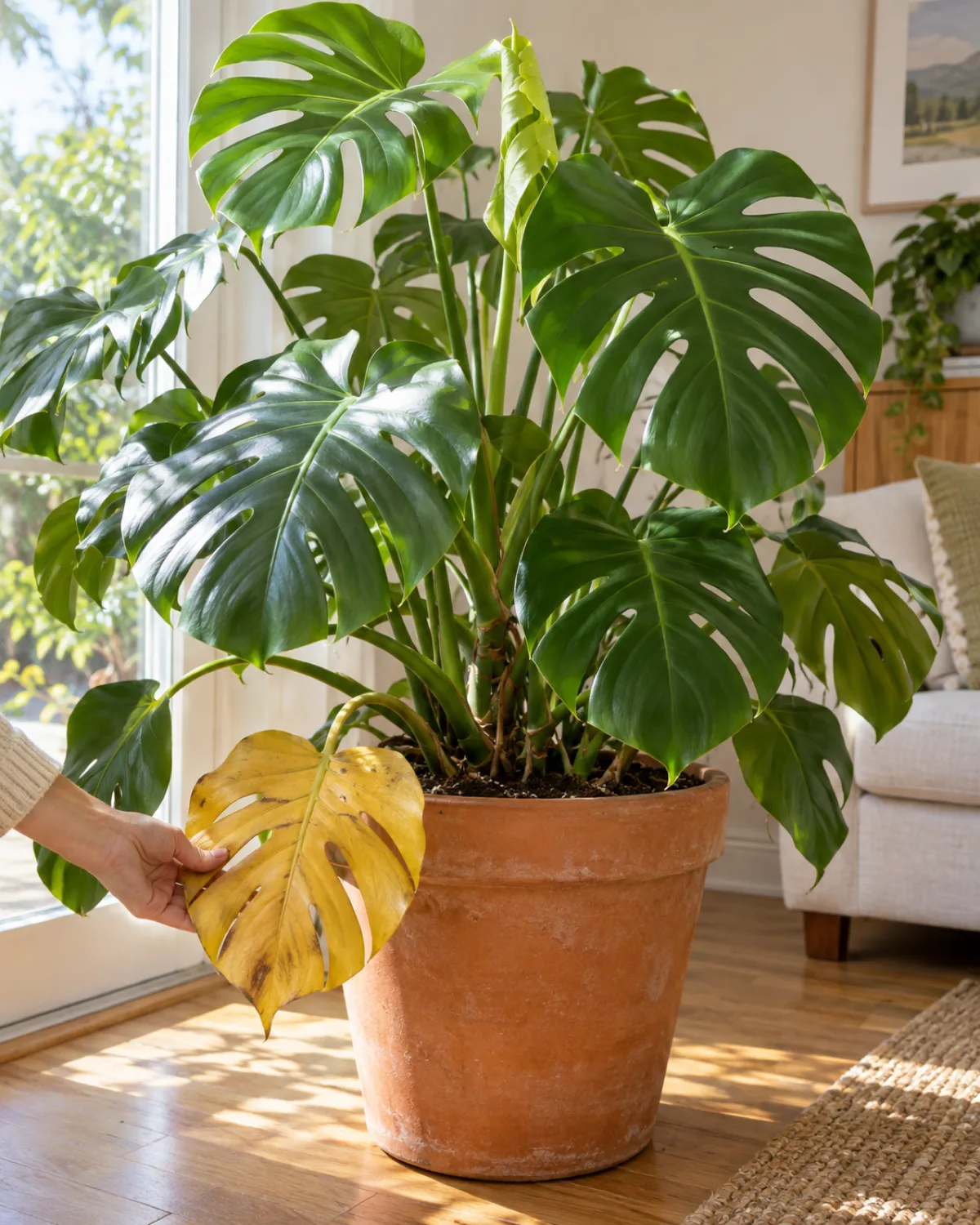
Not every yellow leaf is a problem. Plants drop their oldest leaves as a normal part of growth, and trying to prevent this is like trying to prevent autumn.
As a plant grows, its lower leaves become less efficient. They are farther from the light source, shaded by newer growth above, and the plant's internal transport system prioritizes the youngest, most productive tissue. The plant deliberately breaks down the chlorophyll in these old leaves, reabsorbs the nitrogen and phosphorus, and drops them.
The natural aging signature:
- Only one or two of the lowest, oldest leaves yellow at a time
- The rest of the plant looks healthy with normal new growth
- The yellowing is slow and gradual — the leaf fades over a week or two before dropping
- No changes to watering, light, temperature, or fertilizer preceded the yellowing
The key distinction is the ratio: one yellow leaf on an otherwise healthy plant with active new growth is almost always aging. Three or more yellow leaves with no new growth is almost always a problem.
- Monstera, philodendron, and pothos regularly drop their lowest leaf as each new leaf unfurls — this is resource reallocation, not decline
- Dracaena species are particularly prone to this, often dropping two or three lower leaves at once while the crown produces a flush of new growth
- Do not cut a yellowing-but-still-attached leaf — let it finish the reabsorption process so the plant recovers the maximum nutrients before the leaf detaches naturally
Pest Damage That Shows Up as Yellowing
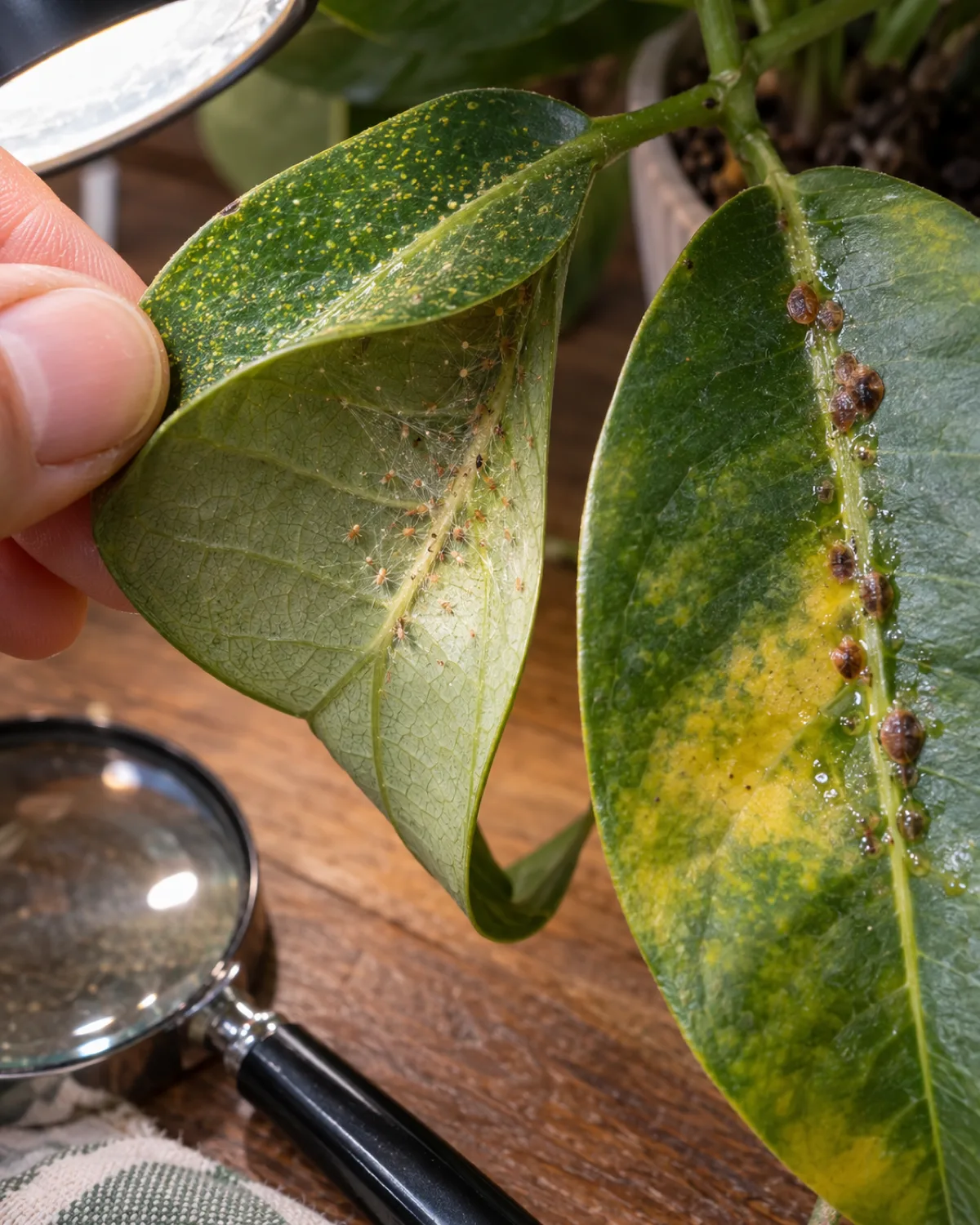
Pest-related yellowing has a pattern that none of the other causes produce: it is scattered, irregular, and concentrated where the pests are feeding.
Sap-sucking insects puncture individual cells to extract the liquid inside. Each puncture site loses its chlorophyll and appears as a tiny yellow dot. Enough punctures and the entire leaf yellows, but the progression is spotty and irregular rather than the uniform yellowing you see from watering or nutrient issues.
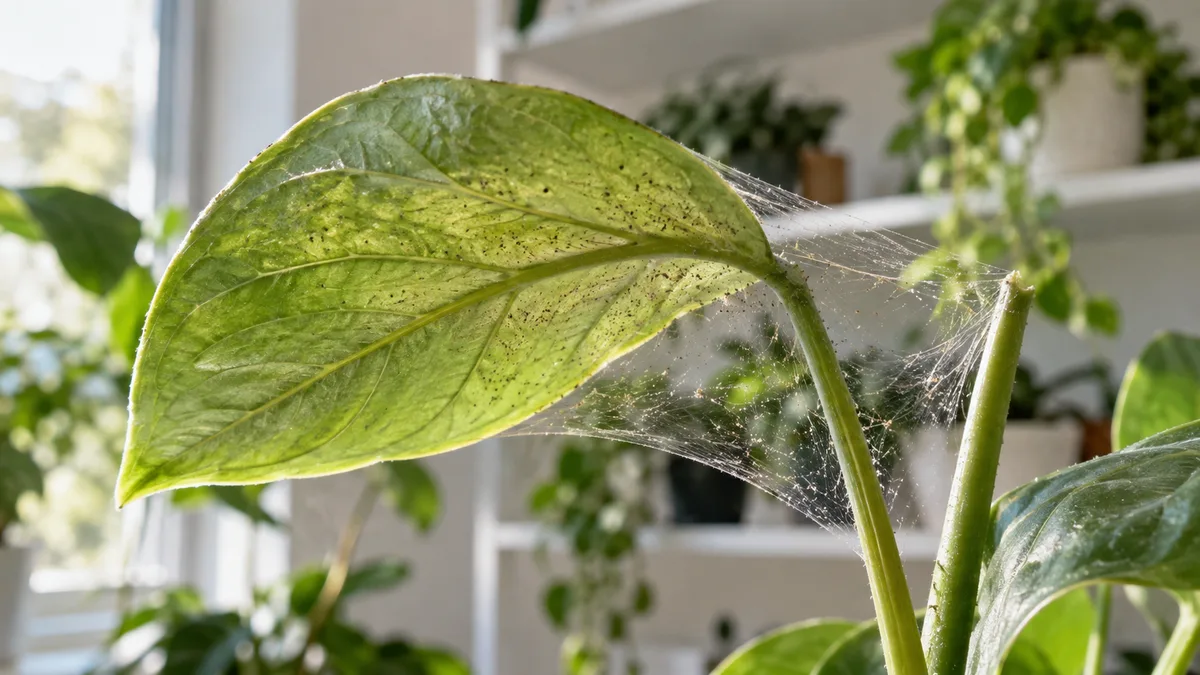
Spider mites leave the most recognizable mark — stippled yellow dots scattered across the leaf surface like tiny pinpricks, with fine webbing visible near the leaf axils and undersides. The houseplant pest guide covers identification and treatment in depth.
Scale and mealybugs produce yellow patches around their feeding sites, along with sticky honeydew residue that coats the leaf and can develop sooty black mold. Check along the midrib and leaf stems where these insects tend to cluster.
- Thrips leave silvery-yellow streaks rather than dots, because they scrape the surface rather than puncturing
- Aphids cluster on new growth and cause yellowing of the youngest leaves and growing tips — similar location to iron deficiency but with visible insects
- Fungus gnats themselves do not cause yellowing, but their larvae feeding on roots in wet soil compound overwatering damage
The pest check takes 30 seconds: flip the yellowing leaf over, look at the underside near the veins and stem, and check for movement, webbing, sticky residue, or tiny bumps. If the leaf looks clean underneath and there is no residue on the top surface, pests are probably not the cause.
The Five-Minute Diagnosis Checklist
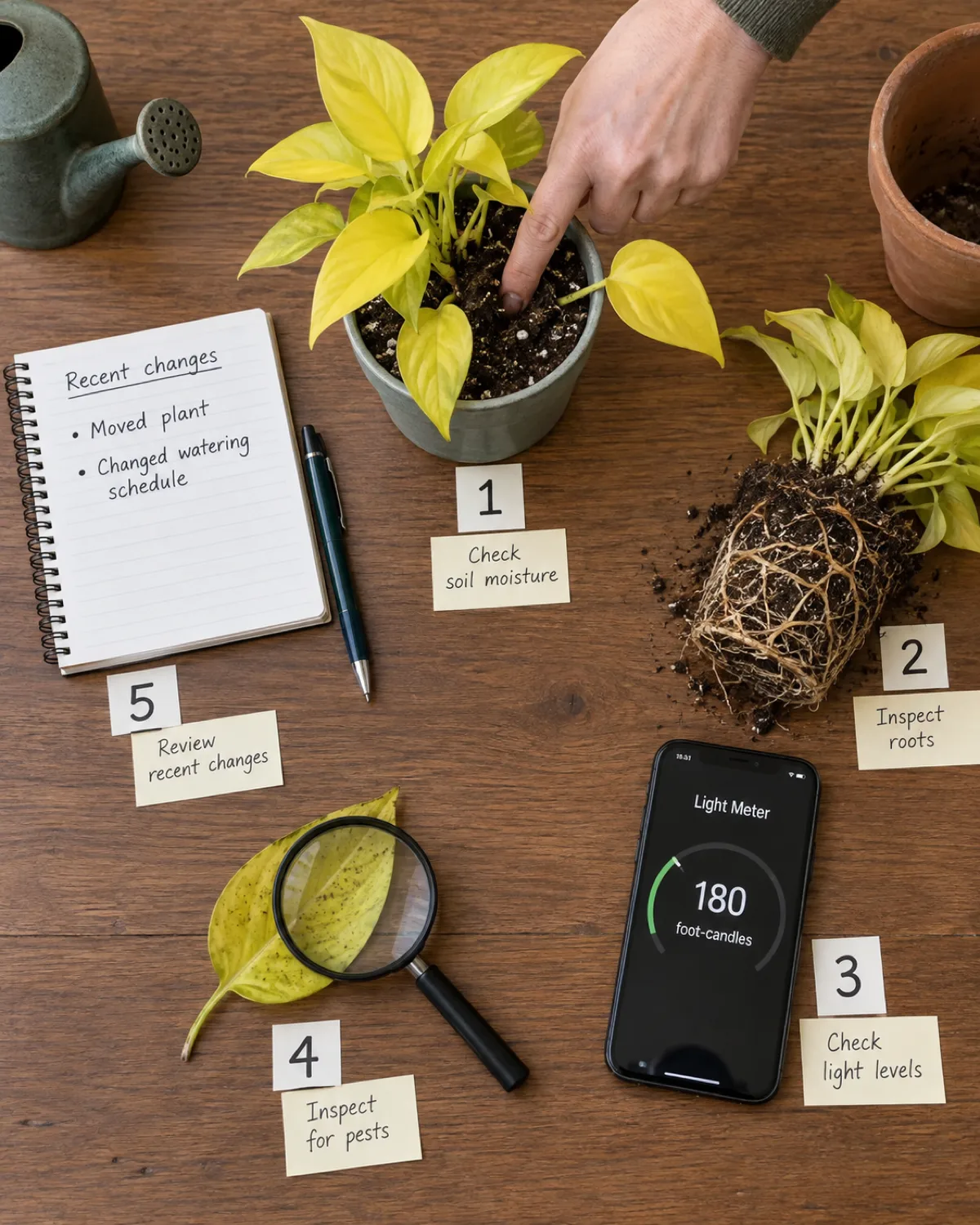
Narrowing ten causes down to one takes five minutes if you follow a sequence instead of guessing. Work through these steps in order — each one eliminates several possibilities.
Step 1: Check the soil moisture. Push your finger two inches into the soil.
- Wet and the plant was watered within the last few days → overwatering (section 2)
- Bone dry with soil pulling from pot edges → underwatering (section 3)
- Neither extreme → move to step 2
Step 2: Check the roots. Slide the plant out of its pot and look at the root ball.
- Brown, mushy, foul-smelling roots → root rot, which is advanced overwatering damage
- White, firm, healthy roots → the problem is above ground, move to step 3
Step 3: Check the light. Assess where the plant sits relative to windows.
- More than six feet from a window in a dim spot, with leggy new growth → too little light (section 4)
- Direct sun hitting the leaf surfaces with bleached patches on the sun-facing side → sunburn (section 5)
- Adequate indirect light → move to step 4
Step 4: Check for pests. Flip the yellowing leaves over.
- Tiny dots, webbing, sticky residue, or visible insects → pest damage (section 9)
- Clean undersides, no residue → move to step 5
Step 5: Check for recent changes. Think back over the past two weeks.
- Moved the plant, repotted, changed watering, fertilized, or had a temperature swing → the change is the trigger; give it time to adjust or undo the change
- No changes at all, one or two bottom leaves, healthy new growth → natural aging (section 8)
- No changes, multiple leaves, no new growth → nutrient deficiency (section 6), especially if you have not fertilized in months
When two causes seem equally likely, fix the easier one first. Adjusting watering takes seconds. Moving the plant costs nothing. Start simple, wait two weeks, and reassess.
Yellow Leaves Quick-Reference
- 1Chlorosis is a symptom, not a diagnosisTen different causes produce the same yellow color. Match the pattern before you act.
- 2Overwatering: mushy lower leaves, wet soilImprove drainage and let the mix dry before watering again. Check for root rot if multiple leaves are affected.
- 3Underwatering: crispy edges, bone-dry soilWater thoroughly and the remaining green leaves should recover within a day.
- 4Low light: bottom leaves drop, top growth stretchesMove closer to a window or add a grow light.
- 5Sunburn: bleached patches on the sun-facing sideMove out of direct sun or filter with a sheer curtain.
- 6Nutrient deficiency: pattern depends on the missing elementOldest leaves uniform yellow means nitrogen. Youngest leaves with green veins means iron.
- 7Temperature stress: sudden yellowing after a cold draftRelocate away from the cold source. Trim damaged leaves.
- 8Natural aging: one old leaf at a time, healthy new growthLeave it alone. The plant is recycling nutrients, not declining.
- 9Pest damage: stippled dots, webbing, or sticky residueFlip the leaf over and inspect. Treat with neem oil or insecticidal soap.
- 10Five-minute checklist: soil, roots, light, pests, changesWork through the five steps in order. Each one eliminates multiple causes.
kultivy.com
For beginners dealing with their first yellow leaf: start with the soil moisture test and the pest check. Those two steps alone identify the cause in more than half of all cases, and neither one requires unpotting the plant or buying anything.

Mara writes evidence-based houseplant guides for Kultivy, turning botanical science into care steps anyone can follow. Every recommendation is tested against published horticultural research, grower experience, and the reality of indoor conditions. More about Kultivy.