Walk into any garden center and the succulent table is a blur of rosettes, columns, trailing strands, and things that look like pebbles. They all get labeled "succulent" and shelved together.
The care differences between an Echeveria and a Lithops are wider than the gap between a fern and a fiddle leaf fig.
This guide breaks down ten indoor succulent types by what they look like, how they grow, and which one fits your space. If you already know the general care rules, this is the next step.
From growth-form identification and light matching to ten collectible indoor varieties with ID cues and care notes.
How to Read a Succulent by Its Shape
Every succulent falls into one of four growth forms, and recognizing the form tells you more about care than knowing the Latin name.
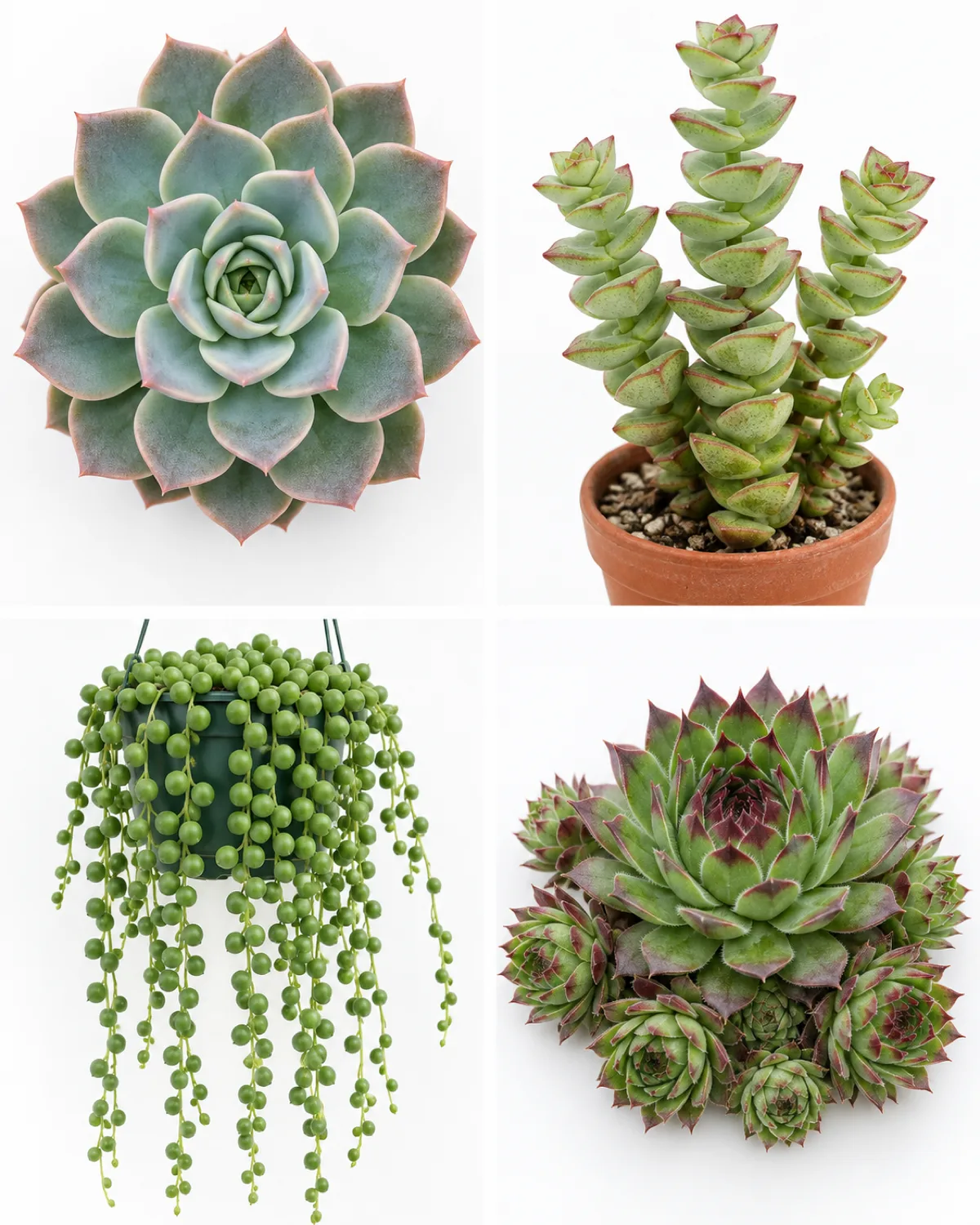
Rosettes grow outward from a central point in a spiral, like a rose frozen open. Echeveria, Aeonium, and many Sempervivum follow this pattern. Columnar types stack upward, leaf on top of leaf, building towers. Crassula perforata and some Sedum species do this.
Trailing succulents cascade downward in strands, with string of pearls and donkey tail as the best-known examples. Clustering types multiply sideways, pushing out offsets until a single pot holds a colony.
A rosette grows outward from a central point. A columnar stacks upward. A trailer cascades down. A clumper multiplies sideways. Know the form, and you know what pot, what shelf, and what light it needs.
Leaf texture adds another identification layer. A dusty powder coating (farina) signals a sun-lover that uses the coating as sunscreen. Touch it and the fingerprint stays.
Translucent windows at the leaf tips mean the plant evolved to pull light through its top while staying buried. Haworthia and Lithops both use this trick. Plump, swollen leaves store more water than flat ones, which usually means longer gaps between watering.
- Farina coating: chalky white or silver powder that rubs off; found on Echeveria, some Graptoveria, and Kalanchoe
- Leaf windows: clear or translucent patches on leaf tips; found on Haworthia cooperi, Lithops, and some Peperomia
- Plump versus flat: rounder and thicker means more water storage and longer drought tolerance
The form also determines your display strategy. Rosettes look best from above in shallow dishes. Trailing types need height — a shelf edge, hanging basket, or macramé hanger. Columnar types suit tall narrow pots. Clustering types fill wide, shallow containers over time.
Choosing the Right Succulent Type for Your Space
Light availability is the single biggest factor. Most succulent types need the brightest spot in your home, and the ones that tolerate less light are the exception rather than the rule.
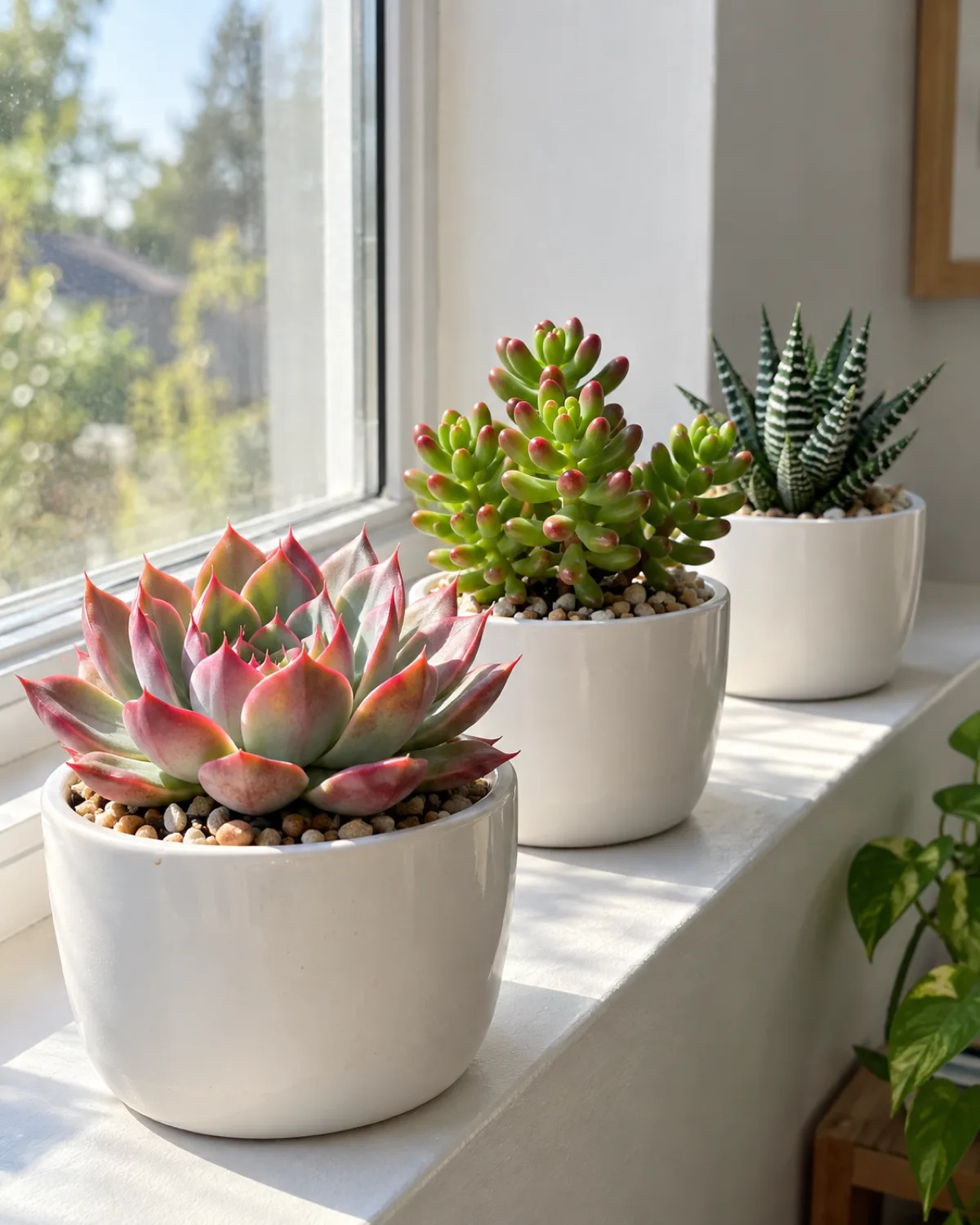
A south-facing window with several hours of direct sun opens the door to the widest range: Echeveria, Aeonium, most Sedum, and Kalanchoe all thrive there. East or west windows with bright indirect light work for Haworthia, Gasteria, some Crassula, and certain Aloe species.
A north-facing window is too dim for almost every succulent without supplemental grow lights.
Three questions narrow the field from dozens of genera to the two or three that actually work in your room.
Size matters more than people expect. Some succulent types stay under three inches for years: Lithops, Haworthia, and compact Echeveria. Others turn into furniture-scale specimens. A jade plant grown for a decade becomes a small tree, and certain Aloe species reach three feet indoors.
- Windowsill compact: Haworthia, Lithops, mini Echeveria, Gasteria
- Shelf or hanging: Sedum morganianum, Senecio rowleyanus, string of hearts
- Floor or table statement: Crassula ovata, tall Aloe, Aeonium tree-forms
- Dish garden mix: combine different genera by matching light requirements and watering needs
Think about how you want to display them before you buy. A shallow terracotta dish garden looks best with mixed rosettes and small compact types. A single architectural specimen like an Aeonium or jade tree deserves its own pot and pedestal.
Trailing types are wasted on a tabletop where nobody sees the cascade.
Echeveria — The Classic Rosette
Echeveria is the genus that made succulents an Instagram phenomenon. The tight spiral rosettes, the powdery farina coating, the stress colors that shift from silver-blue to coral-pink under bright light. No other succulent type produces this level of visual drama in a three-inch pot.
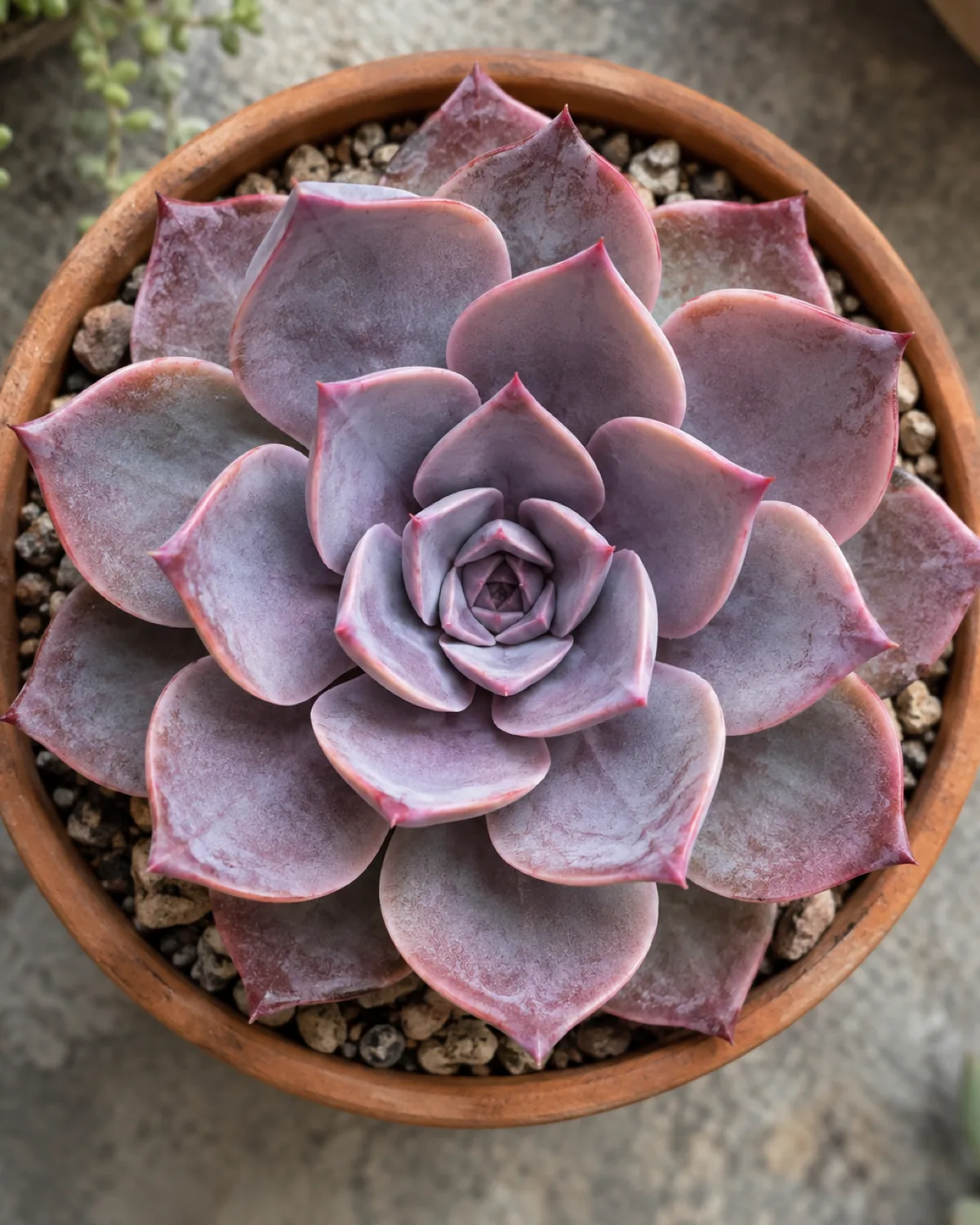
The genus contains hundreds of cultivars. 'Perle von Nürnberg' is the most widely sold, with purple-pink leaves dusted in silver farina. 'Lola' stays pale lavender and compact. 'Afterglow' grows dinner-plate-sized rosettes with pink-edged leaves. 'Black Prince' turns near-black under strong light.
The range is enormous, and collecting different cultivars is a hobby in itself.
Echeveria needs the most light of any indoor succulent type. Without direct sun for at least four to six hours daily, the rosette stretches upward (etiolation), losing its compact shape permanently. A south-facing window is ideal.
If your Echeveria starts growing tall and leggy, the answer is always more light, not more water, not fertilizer.
- ID cues — symmetrical rosette, farina powder coating, pastel colors, leaves that snap cleanly when bent
- Light — direct sun, minimum four hours, south window preferred
- Water — soak and dry only when soil is bone dry, roughly every 10–14 days in summer
- Size — 2 inches (mini cultivars) to 12 inches (Afterglow, Elegans)
- Propagation — leaf cuttings root easily; offsets appear at the base of mature plants; full propagation guide here
- Beginner rating — moderate (easy to keep alive, hard to keep compact without strong light)
Handle Echeveria as little as possible. The farina coating protects against sun damage and doesn't grow back once rubbed off by fingers. Water the soil directly, not the rosette center — standing water in the crown causes rot faster than overwatering the roots.
Haworthia — The Low-Light Exception
If you love succulents but your apartment faces north or east, Haworthia is your genus. These compact plants evolved under shrubs and rock overhangs in South Africa, so they handle indirect light that would kill an Echeveria within months.
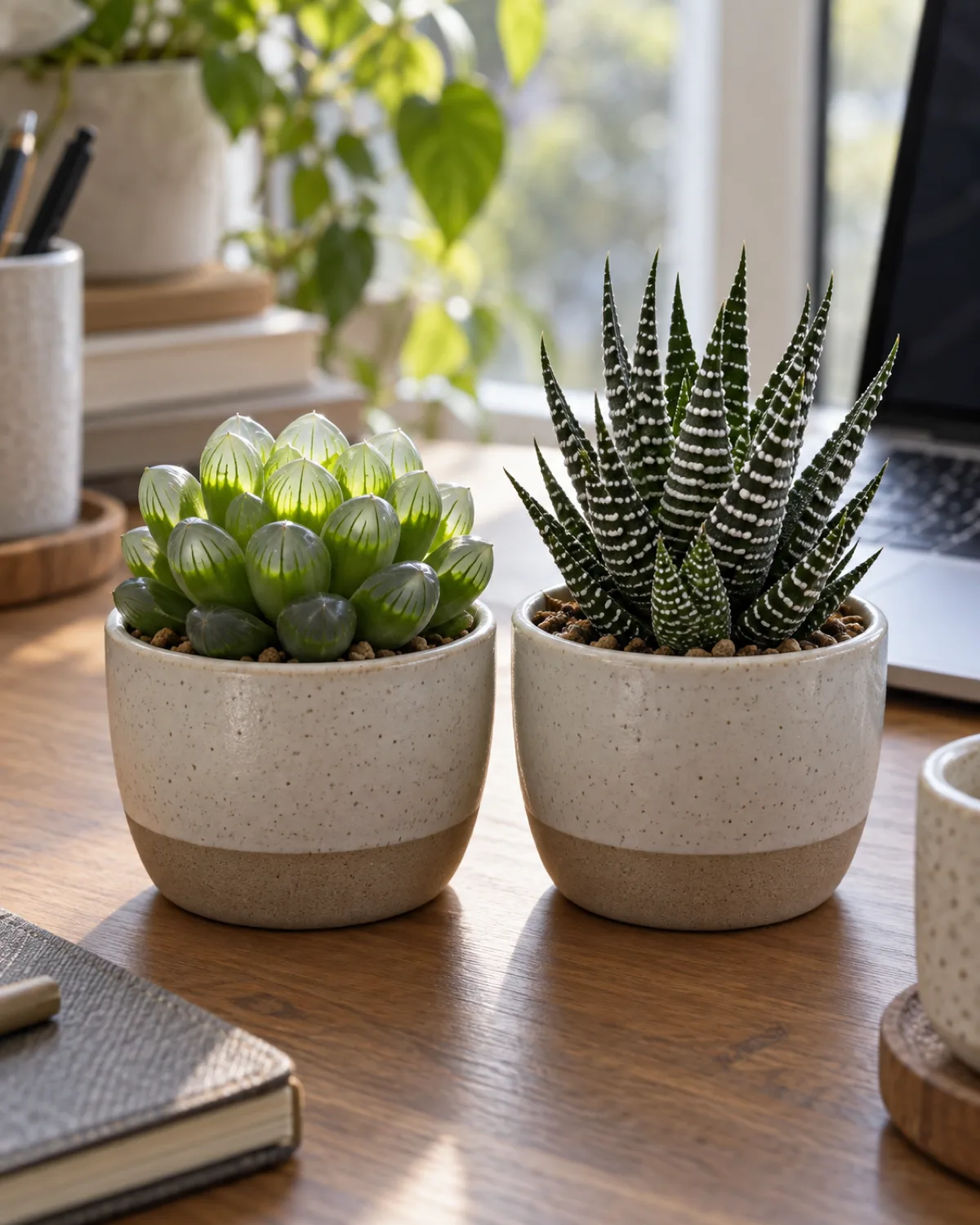
The two species you will see most often are Haworthia fasciata (zebra plant) with raised white bands on dark green leaves, and Haworthia cooperi with translucent leaf windows that glow when backlit. Both stay small at three to five inches and offset into clumps over time, slowly filling a pot without outgrowing it.
Haworthia's leaf windows are a survival adaptation. In the wild, the plant buries itself in sandy soil with only the transparent leaf tips exposed. Light enters through the windows and reaches the photosynthetic cells below.
Indoors, this means the plant is built to work with less light than any other succulent type.
- ID cues — compact rosette or column, leaf windows or white raised bands, stays under 5 inches
- Light — bright indirect, tolerates east or north-facing windows; direct afternoon sun can sunburn leaves
- Water — every 10–14 days in summer, monthly in winter; more forgiving of slight overwatering than most succulents
- Size — 2–5 inches, clumping
- Propagation — offsets separate easily; leaf cuttings are slow but possible
- Beginner rating — excellent (the most forgiving succulent type for low-light apartments)
Haworthia's biggest enemy indoors is overwatering combined with poor drainage. Use a gritty, fast-draining mix with at least 50 percent inorganic material. The plant stores enough water in its thick leaves to survive three weeks of drought without visible stress.
Sedum — The Trailing and Stacking Shapeshifter
Sedum is the wild card genus. It includes trailing plants that cascade two feet from a hanging basket, upright stonecrop rosettes that look like Echeveria cousins, and jelly bean–shaped leaves in colors from bright green to candy-apple red. No other succulent genus covers this much visual territory.
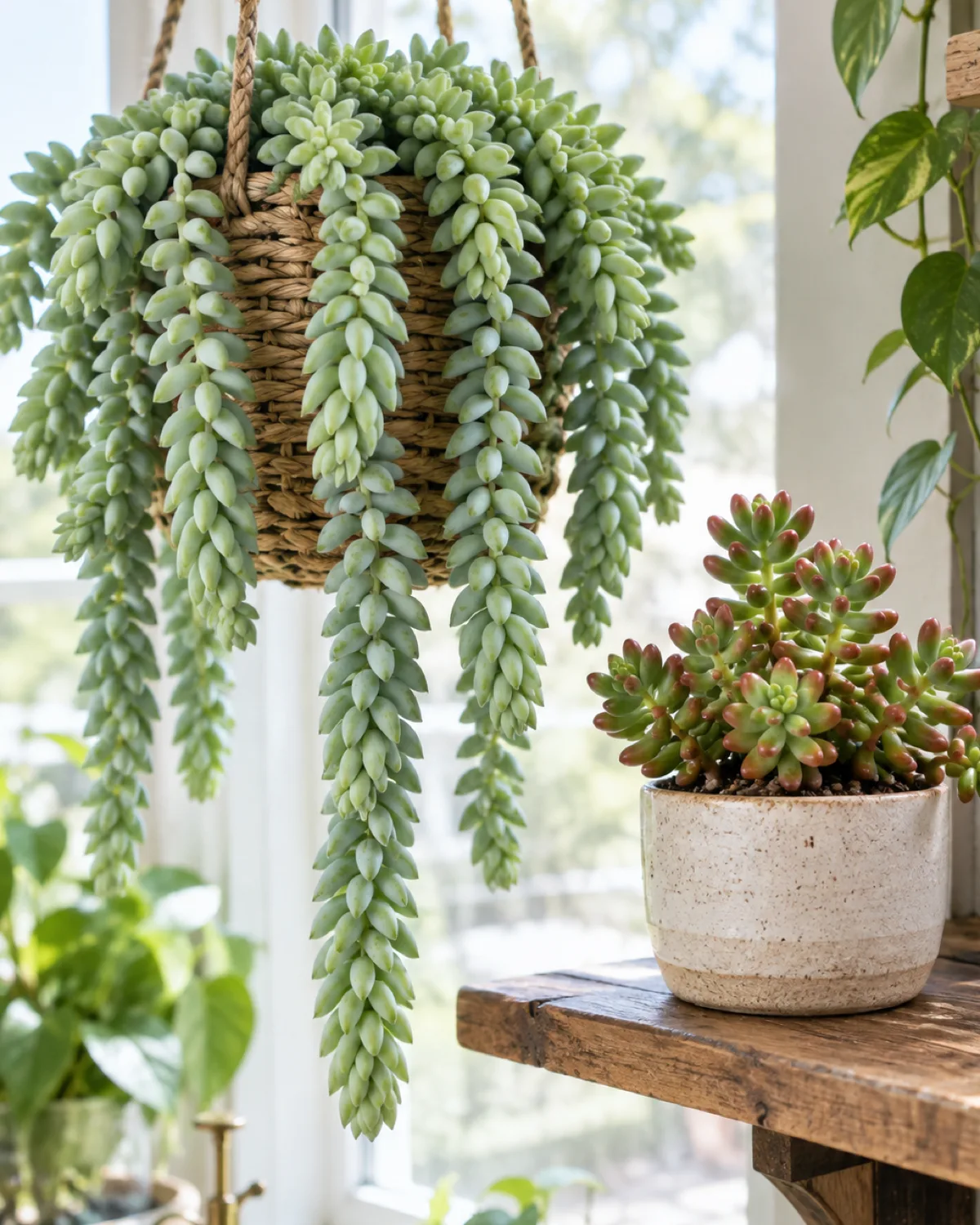
Sedum morganianum (donkey tail or burro's tail) is the most popular trailing variety. Its fat, overlapping blue-green leaves form thick ropes that hang straight down. Handle it carefully — the leaves detach at the slightest touch, which is annoying for display but convenient for propagation, because every dropped leaf can root into a new plant.
Sedum rubrotinctum (jelly bean plant) grows upright stems covered in plump, bean-shaped leaves that turn red at the tips under strong light. It's one of the fastest-growing indoor succulents and one of the hardest to kill.
- ID cues — plump rounded leaves (not flat), easily detachable, fast-growing; forms vary wildly from trailing to upright
- Light — bright to full sun; trailing types tolerate slightly less than upright ones
- Water — every 7–12 days in summer; Sedum tolerates more frequent watering than most succulents
- Size — trailing types cascade 1–3 feet; upright types stay 4–8 inches
- Propagation — the easiest of all succulent types; dropped leaves self-root where they land
- Beginner rating — excellent (the most forgiving genus overall)
Sedum's growth speed means it needs repotting more often than slow growers like Haworthia. Annual repotting in spring keeps the roots from circling. For trailing varieties, a shallow pot or hanging basket works better than a deep container — the roots are shallow and the visual payoff is in the cascade, not the pot.
Crassula — The Architectural Brancher
Crassula is the genus that builds miniature trees. The jade plant (Crassula ovata) is the most famous member: a thick-trunked, woody-stemmed succulent that can live for decades and grow over three feet tall indoors. The genus goes far beyond jade, including some of the most sculptural succulent forms available.
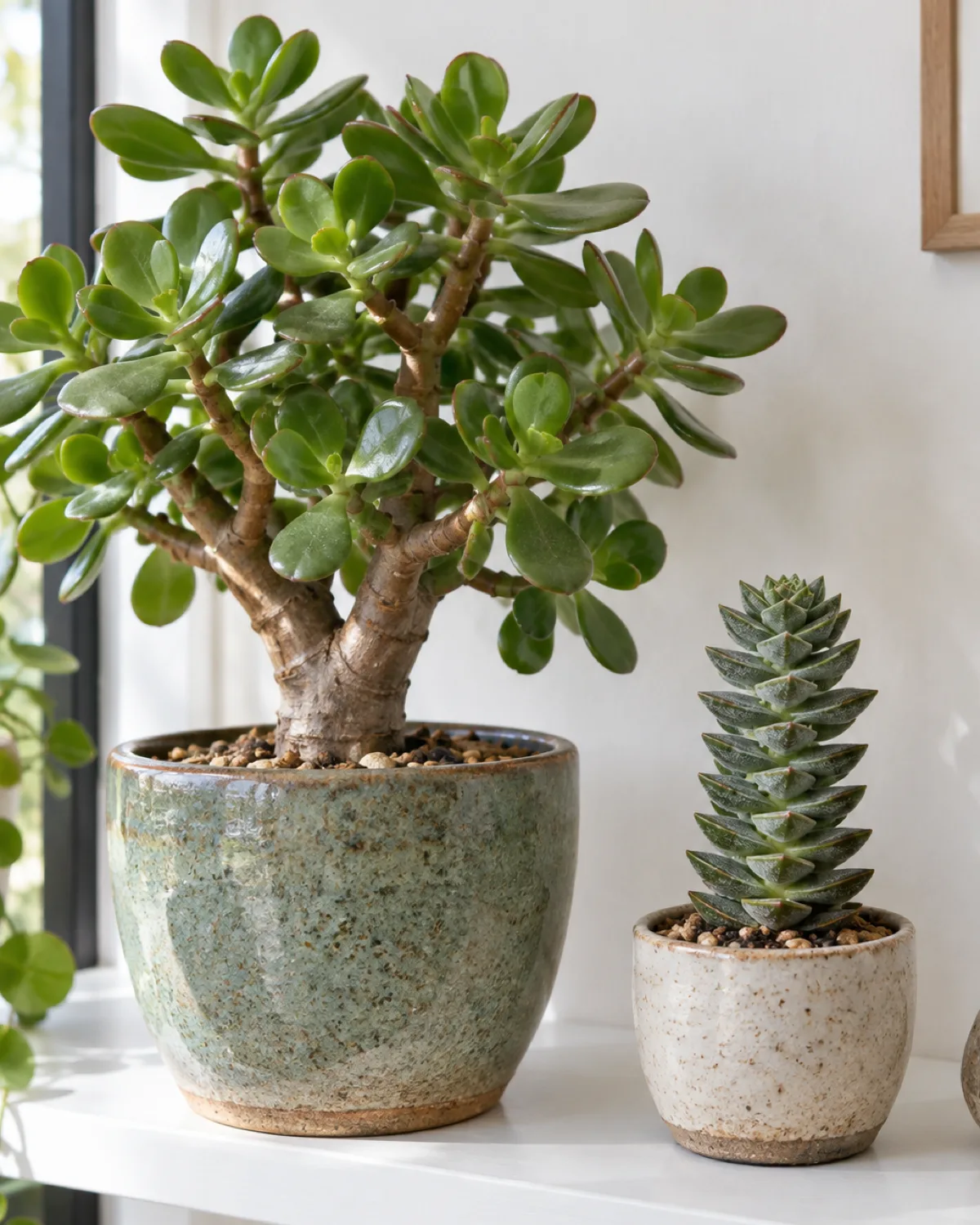
Crassula 'Buddha's Temple' stacks thick, squared-off leaves in a precise pagoda column. Crassula perforata (string of buttons) threads pairs of triangular leaves along a wiry stem. Crassula ovata 'Gollum' grows tubular, trumpet-tipped leaves that look like underwater coral.
The jade plant itself develops a bonsai-like trunk over years that responds well to pruning and shaping.
What unites the genus is the woody stem structure. While most succulents stay herbaceous with soft stems that snap cleanly, Crassula develops actual bark, branches, and a tree-like architecture. This makes them excellent candidates for bonsai-style shaping over long timeframes.
- ID cues — woody stems, opposite leaf pairs, branching architecture; jade has glossy oval leaves, others vary widely
- Light — bright indirect to direct sun; jade tolerates lower light than most Crassula species
- Water — every 10–14 days in summer; the wrinkle test is the most reliable indicator
- Size — from 3-inch columns (C. perforata) to 3-foot trees (mature C. ovata)
- Propagation — stem cuttings root reliably; leaf cuttings are slower; jade drops leaves that sometimes self-root
- Beginner rating — good (jade is nearly indestructible; unusual varieties are moderate)
A mature jade plant is one of the few succulents that genuinely increases in value and beauty over time. Ten-year-old specimens with thick trunks and full canopies become heirloom plants passed between generations.
Give it the brightest spot you have and leave it in the same pot for two to three years between repottings. Slight root-binding encourages trunk thickening.
Aloe — The Medicinal Rosette
Aloe vera sits on more kitchen windowsills than any other succulent, and most people who own one have broken a leaf open to use the gel on a burn. The genus includes over 500 species, from miniatures that fit in a teacup to tree-sized specimens that grow outdoors in Mediterranean climates.
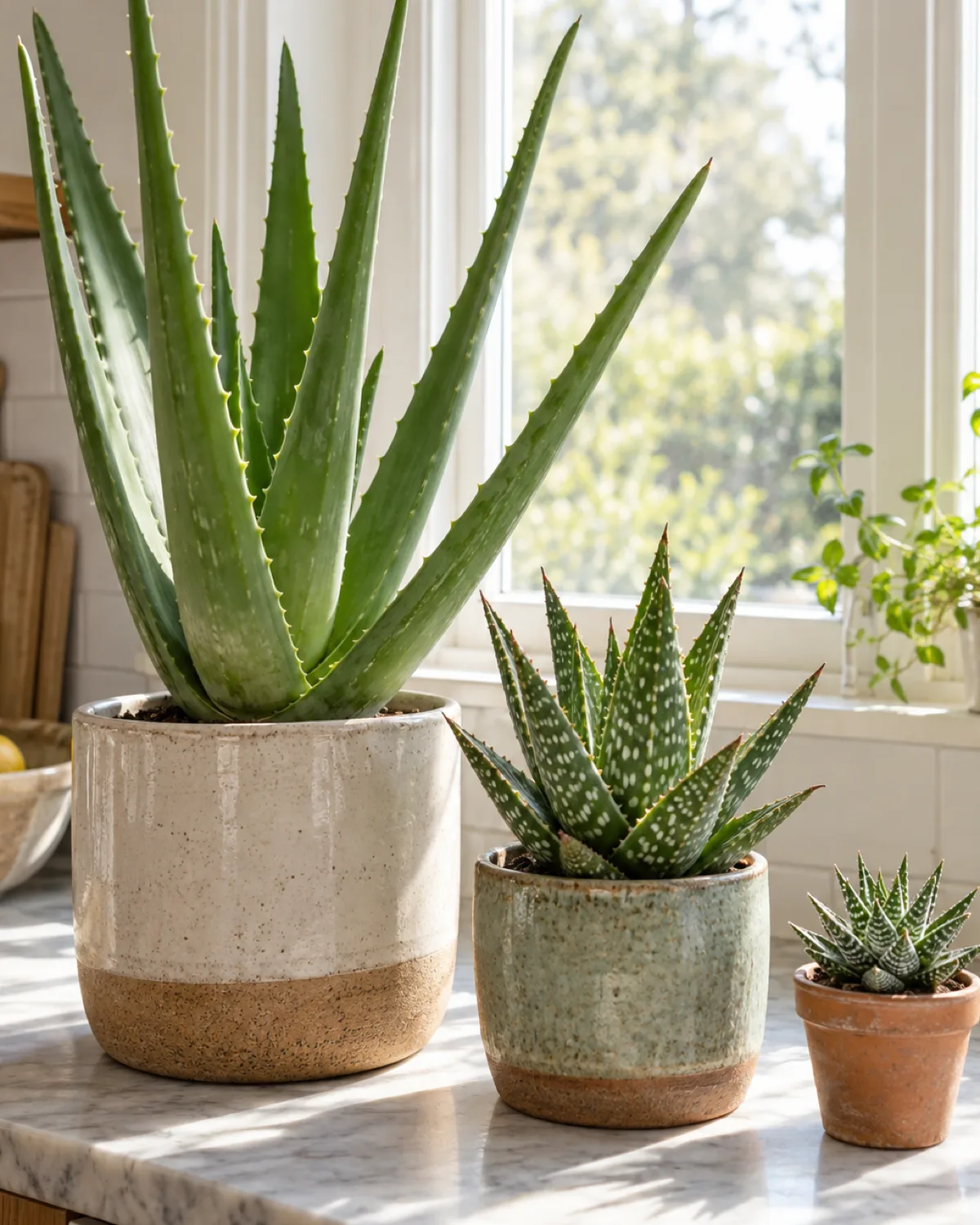
Aloe vera (A. barbadensis) has thick, upright, sword-shaped leaves with serrated margins and translucent inner gel. Aloe 'Christmas Carol' stays compact with white-spotted leaves. Aloe aristata (lace aloe) forms a tight rosette with soft white teeth and produces orange tubular flowers readily indoors.
Aloe 'Minnie Belle' is a true miniature at under three inches.
The sharp marginal teeth are the quickest way to tell an Aloe from a Haworthia. Haworthia has smooth or banded leaf margins, while Aloe has distinct spines or teeth running along the edges. Aloe also tends to grow larger and prefers more light.
- ID cues — sword-shaped leaves with marginal teeth or spines, gel-filled interior, typically upright habit
- Light — bright indirect to direct sun; more tolerant of lower light than Echeveria but less than Haworthia
- Water — every 7–14 days; Aloe needs more water than most succulents due to its thinner leaves and faster metabolism
- Size — 2 inches (miniatures) to 3 feet (mature A. vera indoors)
- Propagation — offsets (pups) are the primary method; leaf cuttings rarely succeed with Aloe
- Beginner rating — excellent (Aloe vera specifically is one of the hardest succulents to kill)
Aloe is one of the few succulent genera where toxicity varies by species. Aloe vera gel is safe for human skin use, but the yellow latex layer between the gel and the outer skin is a strong laxative and can cause gastrointestinal distress in pets.
If you have cats or dogs, keep Aloe out of reach. The ASPCA lists it as toxic to both.
Lithops (Living Stones) — The Camouflage Specialist
Lithops are the succulent type that makes people stop and stare. Each plant is just two fused leaves shaped like a pair of pebbles, with a fissure between them. They evolved in southern African deserts to look indistinguishable from the surrounding gravel, a camouflage strategy against grazing animals.
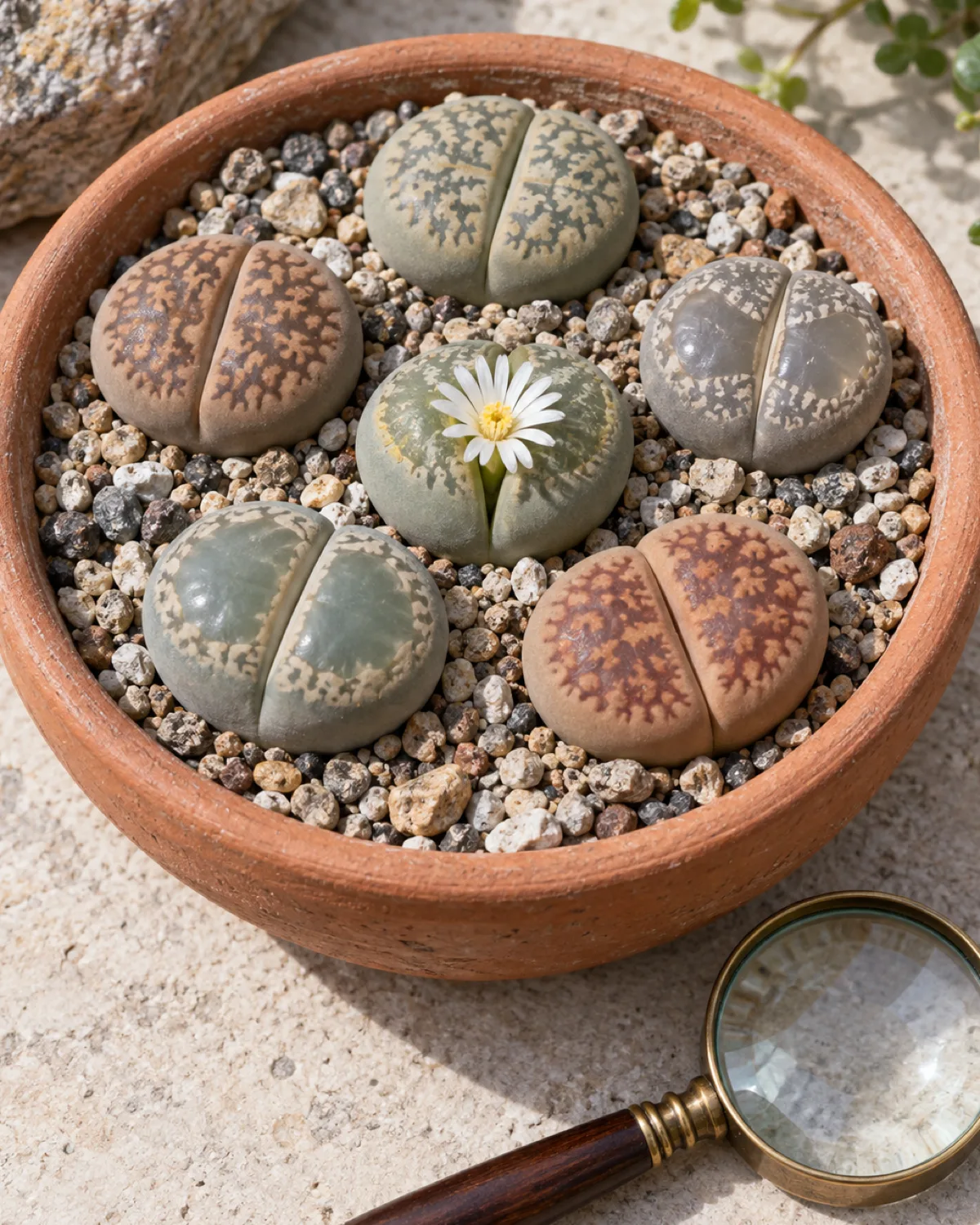
The tops of the leaves have translucent windows that allow light to reach photosynthetic cells deep inside. In the wild, Lithops bury themselves up to their window-tops in sand, with only the transparent cap visible. This is the same light-harvesting trick that Haworthia uses, taken to an extreme.
Lithops care is unlike any other succulent. The watering cycle follows the plant's leaf replacement process, not the season.
Lithops replace their leaves once per year. Watering at the wrong stage kills them. Use this decision framework.
Most Lithops collections die from overwatering. The total number of waterings per year for a healthy Lithops is typically three to five. Not per month, per year. That makes them the lowest-maintenance succulent type if you can resist the urge to water.
- ID cues — two fused leaves resembling pebbles, top windows, fissure between leaves, no visible stem
- Light — direct sun, minimum four hours; south-facing window required
- Water — three to five times per year total, timed to leaf absorption cycle
- Size — 0.5–2 inches per plant; usually grown in clusters in shallow pots
- Propagation — seed only (extremely slow); division of mature clumps is possible but risky
- Beginner rating — advanced (easy to accidentally kill with water; the watering logic is counterintuitive)
Display Lithops in shallow pots with a mineral top dressing that matches the stone colors. Part of the appeal is that visitors can't tell which are plants and which are actual pebbles. Avoid plastic pots — terracotta's breathability helps prevent the moisture retention that kills Lithops.
Senecio and Curio (String-of-) — The Trailing Pendant
The trailing succulents that cascade from hanging baskets and shelf edges belong almost entirely to the Senecio/Curio genus. String of pearls, string of bananas, string of dolphins: all close relatives that evolved spherical or crescent-shaped leaves to minimize surface area and maximize water storage.
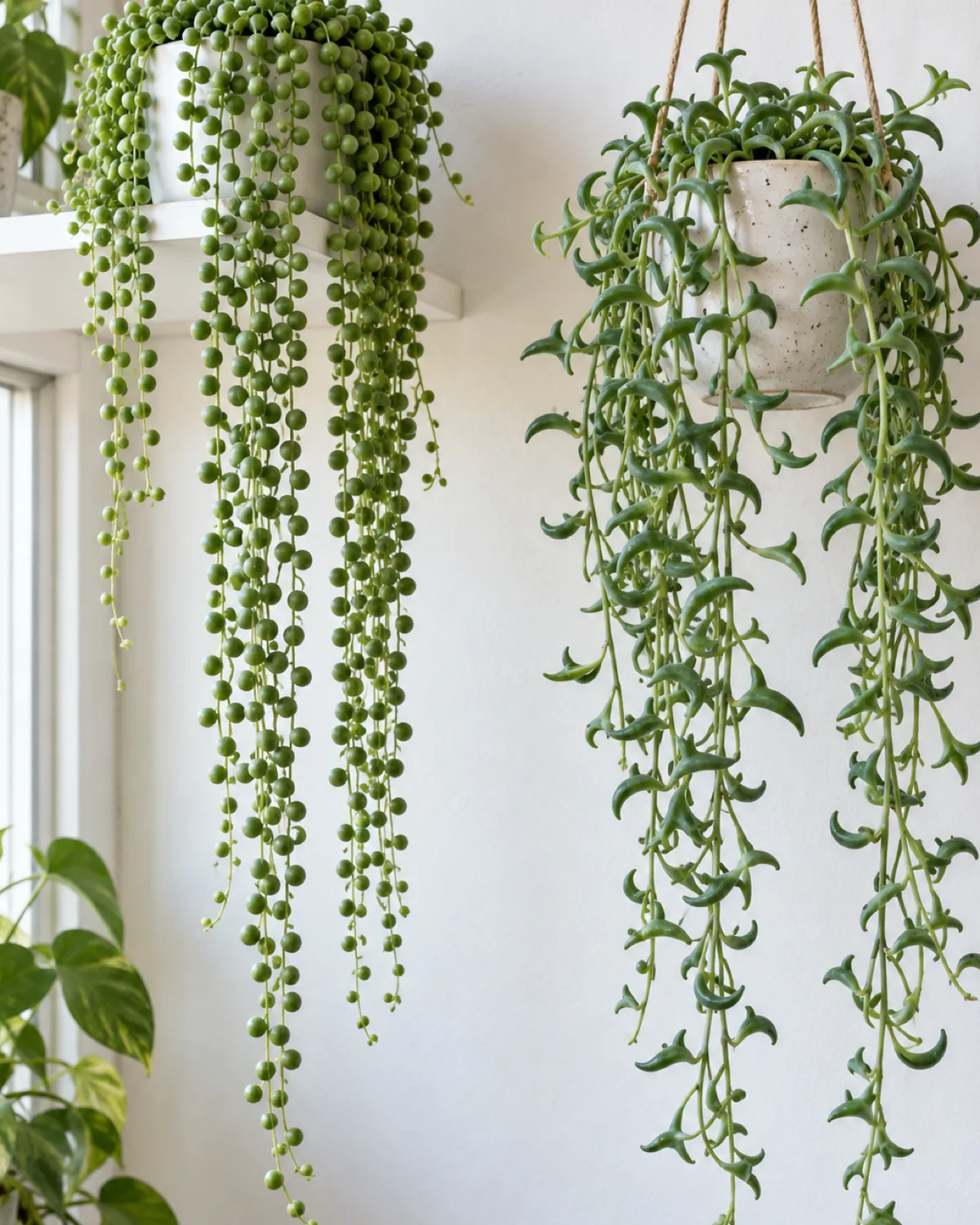
String of pearls (Senecio rowleyanus, reclassified as Curio rowleyanus) is the most popular. Each leaf is a perfect green sphere with a translucent window stripe along one side. Healthy strands cascade two to three feet from the pot, creating a beaded curtain effect.
String of bananas (S. radicans) has crescent-shaped leaves and is slightly hardier. String of dolphins (S. peregrinus) is a hybrid with leaves shaped like leaping dolphins, charming but harder to find.
These trailing types have brittle stems that snap if you handle them roughly or if a cat bats at the strands. They also rot faster than most succulents because their thin stems hold less water than a thick rosette.
- ID cues — pendant trailing habit, spherical or crescent leaves on thin wiry stems, milky sap when broken
- Light — bright indirect to some direct morning sun; avoid harsh afternoon sun which scalds the thin stems
- Water — every 7–10 days when trailing actively; reduce in winter; bottom watering prevents crown rot
- Size — strands reach 1–3 feet in length; the root mass stays compact
- Propagation — butterfly cut (snip and lay strands on moist soil); roots from nodes within 2 weeks
- Beginner rating — moderate (easy to underwater or overwater; the thin stems give less buffer than chunky rosettes)
Hang them in a bright east window where morning light hits the strands without the afternoon intensity that burns them. Use a hanging basket or a high shelf where the cascade has room to grow without being disturbed.
Display location makes or breaks these plants. A trailing succulent on a tabletop is a mess of tangled stems, but the same plant on a high shelf becomes a living curtain.
Kalanchoe — The Flowering Succulent
Most succulents bloom reluctantly indoors, if at all. Kalanchoe blossfeldiana is the exception. It produces dense clusters of tiny flowers in red, orange, yellow, pink, and white that last four to eight weeks. Garden centers sell millions of them as disposable flowering plants, but with the right light cycle, they rebloom year after year.
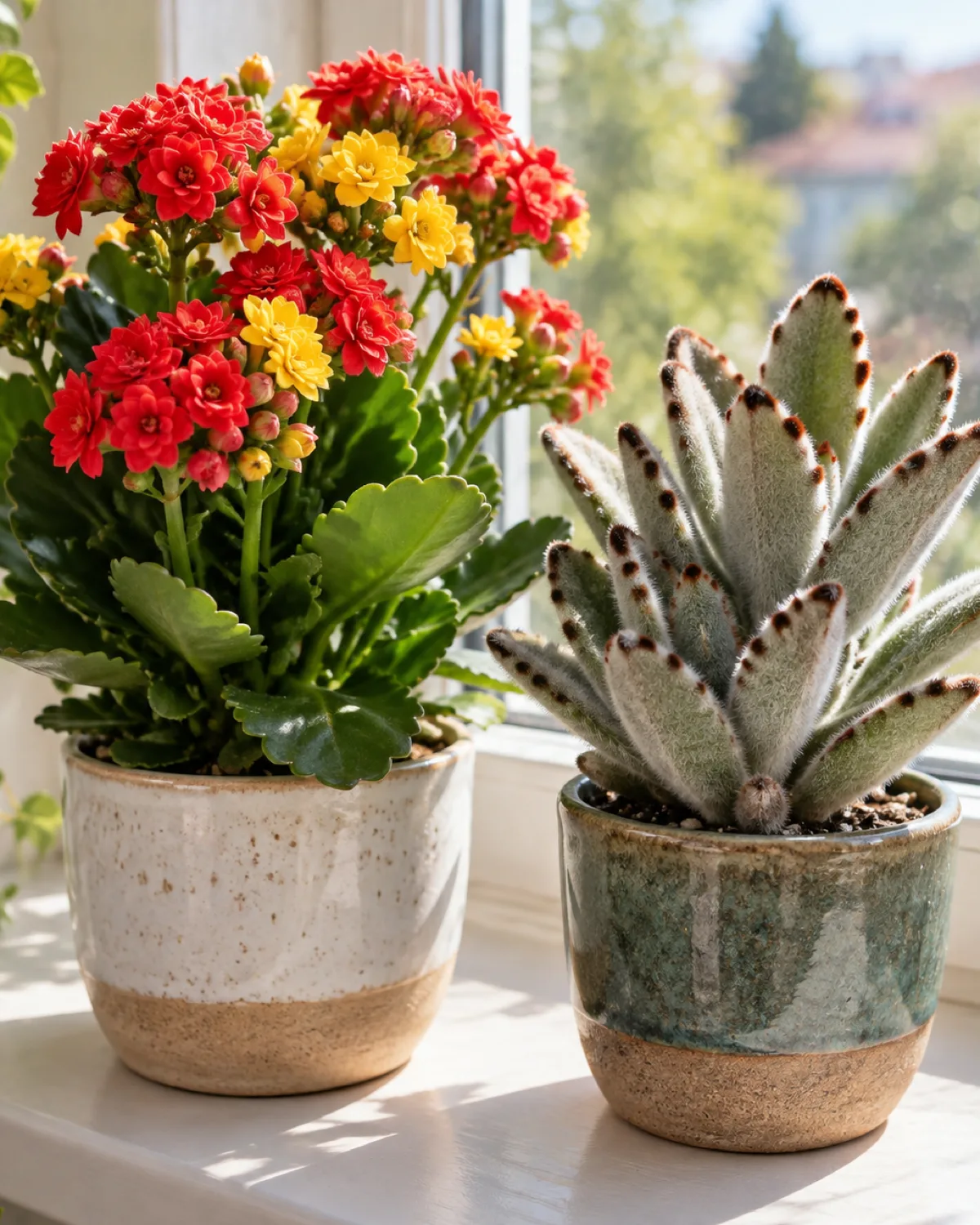
The genus goes well beyond the florist's Kalanchoe. K. tomentosa (panda plant) has thick, fuzzy, silver-grey leaves edged with chocolate-brown spots, one of the most touchable succulents.
K. daigremontiana (mother of thousands) grows tiny plantlets along the margins of its leaves, which drop off and root wherever they land. It is one of nature's most aggressive self-propagators.
Reblooming K. blossfeldiana requires a trick: six weeks of long nights (14 hours of darkness) in autumn triggers flower bud formation. Cover the plant or move it to a closet each evening and return it to the light each morning. Without this dark treatment, the plant grows healthy foliage but never reflowers.
- ID cues — scalloped leaf margins (blossfeldiana), fuzzy coating (tomentosa), or marginal plantlets (daigremontiana); thick stems
- Light — bright indirect to direct sun; K. blossfeldiana tolerates slightly less light than most succulents
- Water — every 7–10 days; more water-tolerant than desert types like Echeveria or Lithops
- Size — 6–12 inches for most indoor species
- Propagation — stem cuttings root easily; K. daigremontiana self-propagates by dropping marginal plantlets
- Beginner rating — excellent (one of the most forgiving succulent genera; K. daigremontiana may be too forgiving)
Be aware that Kalanchoe is toxic to cats and dogs. The ASPCA lists the entire genus as containing cardiac glycosides, the same compounds that make oleander dangerous. If you keep pets, place Kalanchoe on high shelves or in rooms pets cannot access.
Gasteria — Haworthia's Tongue-Shaped Cousin
Gasteria is the succulent genus that deserves more attention than it gets. It tolerates low light like Haworthia, stays compact, grows slowly, and has an unusual growth pattern that immediately distinguishes it from every other type on this list.
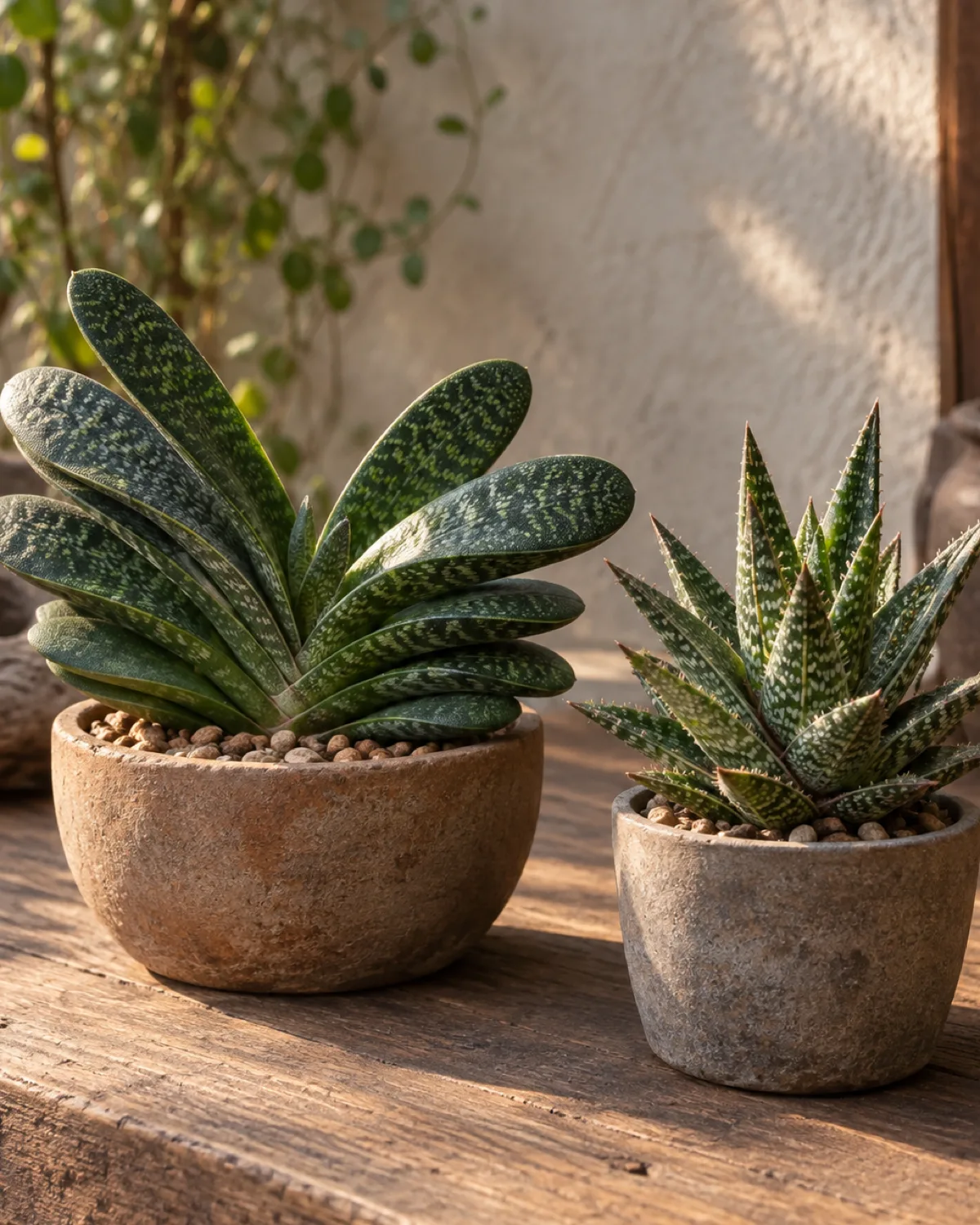
Most succulents grow in rosettes or spirals. Gasteria grows in two ranks: leaves alternate on opposite sides of the stem, creating a flat fan shape (the botanical term is distichous). As the plant matures, some species transition to a spiral rosette, but the young growth pattern is always the two-ranked fan.
The leaves are thick, tongue-shaped, and often covered with raised white tubercles that give the surface a rough, sandpapery texture. The genus name comes from the stomach-shaped flowers (gaster = stomach in Greek), though you'll rarely see them bloom indoors.
- ID cues — distichous (two-ranked) growth pattern, thick tongue-shaped leaves, raised white surface bumps, compact habit
- Light — tolerates low to bright indirect; one of the few succulent types that works in east-facing or partially shaded windows
- Water — every 10–14 days; similar tolerance to Haworthia, slightly more drought-resistant
- Size — 3–8 inches; slow-growing, stays compact for years
- Propagation — offsets separate easily; leaf cuttings possible but extremely slow (months to root)
- Beginner rating — excellent (combines Haworthia's low-light tolerance with even slower growth and higher drought resistance)
Gasteria hybridizes readily with both Aloe and Haworthia, producing intergeneric hybrids (×Gasteraloe and ×Gasterhaworthia) that combine traits from both parents. These hybrids often inherit Gasteria's low-light tolerance with Aloe's larger size or Haworthia's window-leaf beauty, making them worth seeking out in specialty collections.
Aeonium — The Tree-Form Rosette
Aeonium grows rosettes on top of woody, branching stems, creating miniature tree silhouettes unlike any other succulent type. Aeonium 'Zwartkop' (also sold as 'Black Rose') is the showpiece variety. Its leaves are so deeply burgundy they appear nearly black, making it one of the most dramatic plants in the entire succulent world.
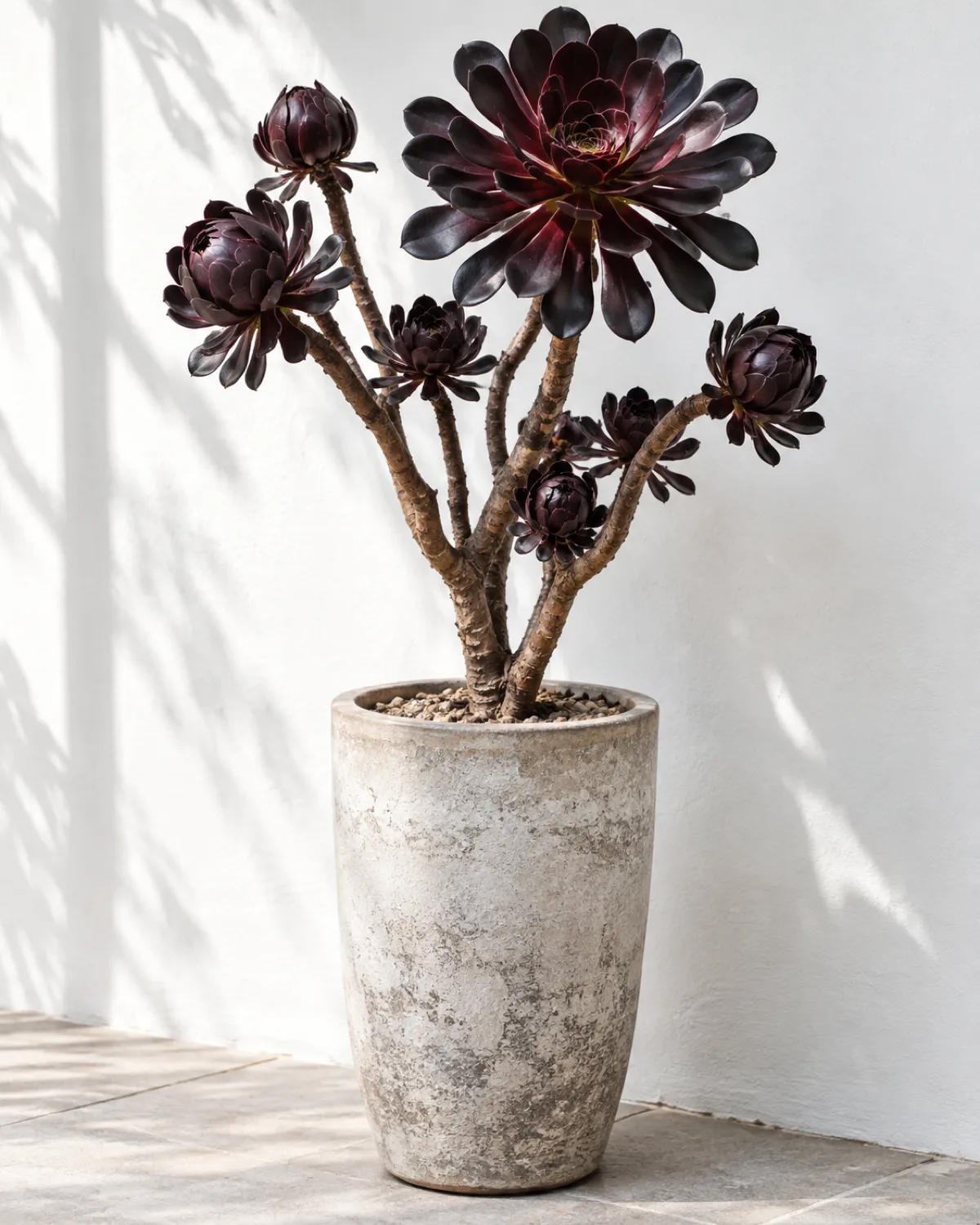
The genus comes from the Canary Islands, not the African deserts where most succulents originate. This ancestry gives Aeonium a quirk that catches new owners off guard: it goes dormant in summer, not winter.
While every other succulent on this list grows actively in warm weather, Aeonium drops its lower leaves, tightens its rosettes, and stops growing when temperatures rise above 80°F. It wakes up in autumn and grows through winter and spring.
This reversed schedule means you water Aeonium in winter (its growing season) and barely water it in summer (its dormancy). Getting this backward, watering heavily in summer when the plant is asleep, is the most common way Aeonium dies indoors.
- ID cues — flat rosettes on woody branching stems, tree-form silhouette, lower leaves drop naturally revealing bare trunk
- Light — full sun to bright indirect; needs strong light for the deepest 'Zwartkop' coloring
- Water — every 7–10 days during winter growing season; barely water in summer dormancy
- Size — 1–3 feet tall with branching; can be pruned to control shape
- Propagation — stem cuttings root reliably; beheading a leggy plant produces a new compact rosette on the stump
- Beginner rating — moderate (easy to grow, but the reversed dormancy schedule confuses beginners)
Aeonium's monocarpic rosettes die after flowering. Each individual rosette blooms once, sets seed, and shrivels. Because the plant branches, losing one rosette to flowering does not kill the whole specimen. Cut the spent flower stalk cleanly and let the remaining branches fill in the gap.
Quick Reference
10 succulent types at a glance
- 1EcheveriaFarina-coated pastel rosettes. Needs direct sun. Moderate difficulty — stretches without enough light.
- 2HaworthiaCompact zebra stripes and window leaves. Tolerates low light. Excellent beginner choice.
- 3SedumJelly beans and donkey tails. Trailing or stacking. Most forgiving genus overall.
- 4CrassulaJade trees and stacked pagodas. Architectural branchers that grow for decades.
- 5AloeSword leaves with marginal teeth. Medicinal gel. Toxic to pets. Easy care.
- 6LithopsLiving stones. Water three to five times per year total. Advanced — counterintuitive watering.
- 7Senecio / CurioTrailing strings with spherical or crescent leaves. Best in hanging baskets. Moderate difficulty.
- 8KalanchoeFlowering clusters or fuzzy leaves. Rebounds year after year. Toxic to pets.
- 9GasteriaTongue-shaped distichous leaves. Tolerates shade. Easiest succulent you've never heard of.
- 10AeoniumTree-form rosettes, near-black cultivars. Summer dormancy — water in winter, not summer.
kultivy.com — save for your next garden center visit
Frequently Asked Questions
What is the easiest succulent for beginners?
Sedum and Haworthia tie for the top spot. Sedum (especially jelly bean plant) grows fast, roots from dropped leaves, and tolerates more watering mistakes than any other genus.
Haworthia works better for low-light apartments because it thrives in indirect light where most succulents would stretch and fail.
- Bright south window → start with Sedum
- East or north-facing window → start with Haworthia
How do I identify my succulent?
Start with the growth form. Is it a rosette, a column, a trailer, or a clumper? Then check the leaf texture.
- Powdery coating → Echeveria
- Translucent windows → Haworthia or Lithops
- Fuzzy hair → Kalanchoe tomentosa
- Smooth glossy surface → Crassula
Growth form plus texture narrows the field to two or three genera. From there, search within that genus for your specific leaf shape and color.
Can succulents grow in low light?
Most cannot. Haworthia and Gasteria are the two genera that genuinely tolerate low to medium indirect light because their ancestors evolved under shrub cover and rock overhangs. Every other type needs bright light or direct sun.
- Low light tolerant: Haworthia, Gasteria
- Needs bright indirect or direct sun: Echeveria, Sedum, Aeonium, Lithops, Kalanchoe, Crassula
Without enough light, succulents stretch (etiolate), lose their compact shape, and eventually weaken. If your space is dim, consider supplemental grow lights or stick with the two shade-tolerant genera.
How often should I water different succulent types?
It varies widely by genus.
- Lithops — three to five times per year total, timed to leaf absorption
- Haworthia, Gasteria, Echeveria — every 10–14 days in summer, monthly in winter
- Sedum, Kalanchoe — every 7–10 days, more water-tolerant
- Aloe — more water than most succulents
- Aeonium — reversed schedule: water in winter, barely water in summer
For all types, the soak-and-dry method is the universal rule: saturate the soil, let it dry completely, then water again.

Mara writes about houseplant care, propagation, and indoor styling at Kultivy. She believes every windowsill deserves at least one plant that earns its spot.