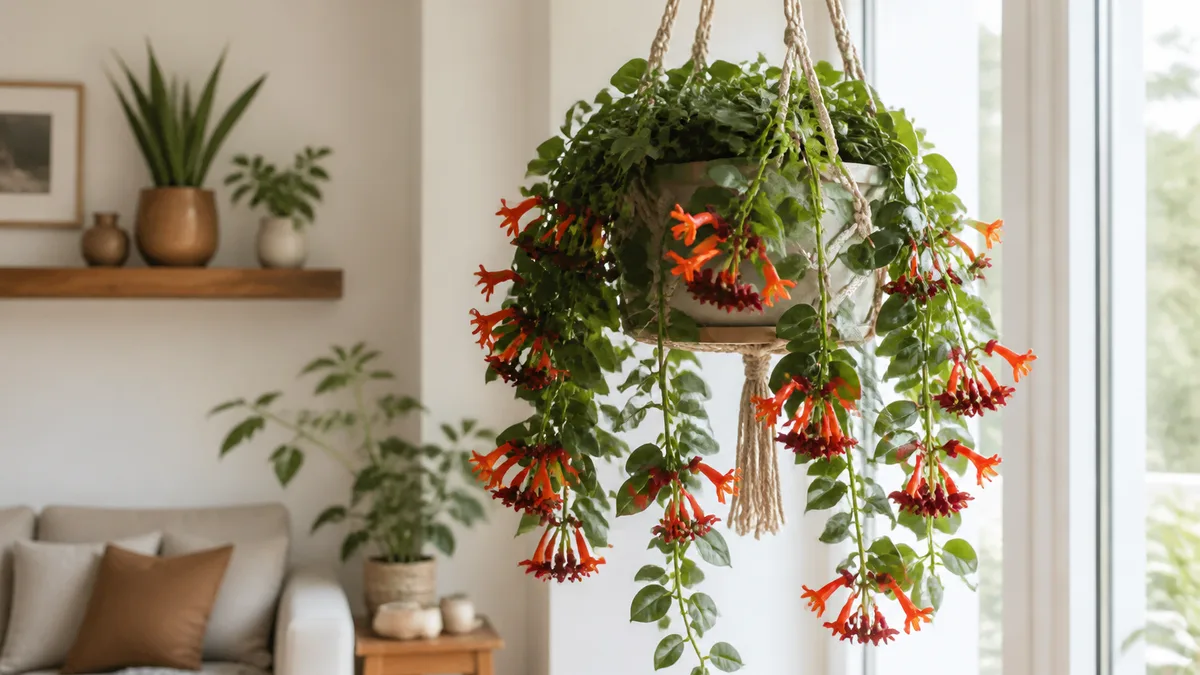
A Christmas cactus is not really a cactus — not the way a barrel cactus or prickly pear is. It is an epiphyte from the cloud forests of southeastern Brazil, growing in tree branch crooks, anchored by thin roots in decomposing leaf litter.
That origin explains almost every care difference. It wants humidity, not dry air. Filtered light, not blazing sun. Chunky organic soil, not sandy grit. And it blooms through long nights and cool temperatures, not a winter dry rest.
Get those conditions right and the plant will bloom every holiday season for decades — some specimens have been passed down through four generations of the same family.
From epiphyte identity and the Christmas-vs-Thanksgiving question to the darkness-and-cool bloom trigger, propagation from stem cuttings, and pet safety.
What Makes a Christmas Cactus Different from Every Other Cactus
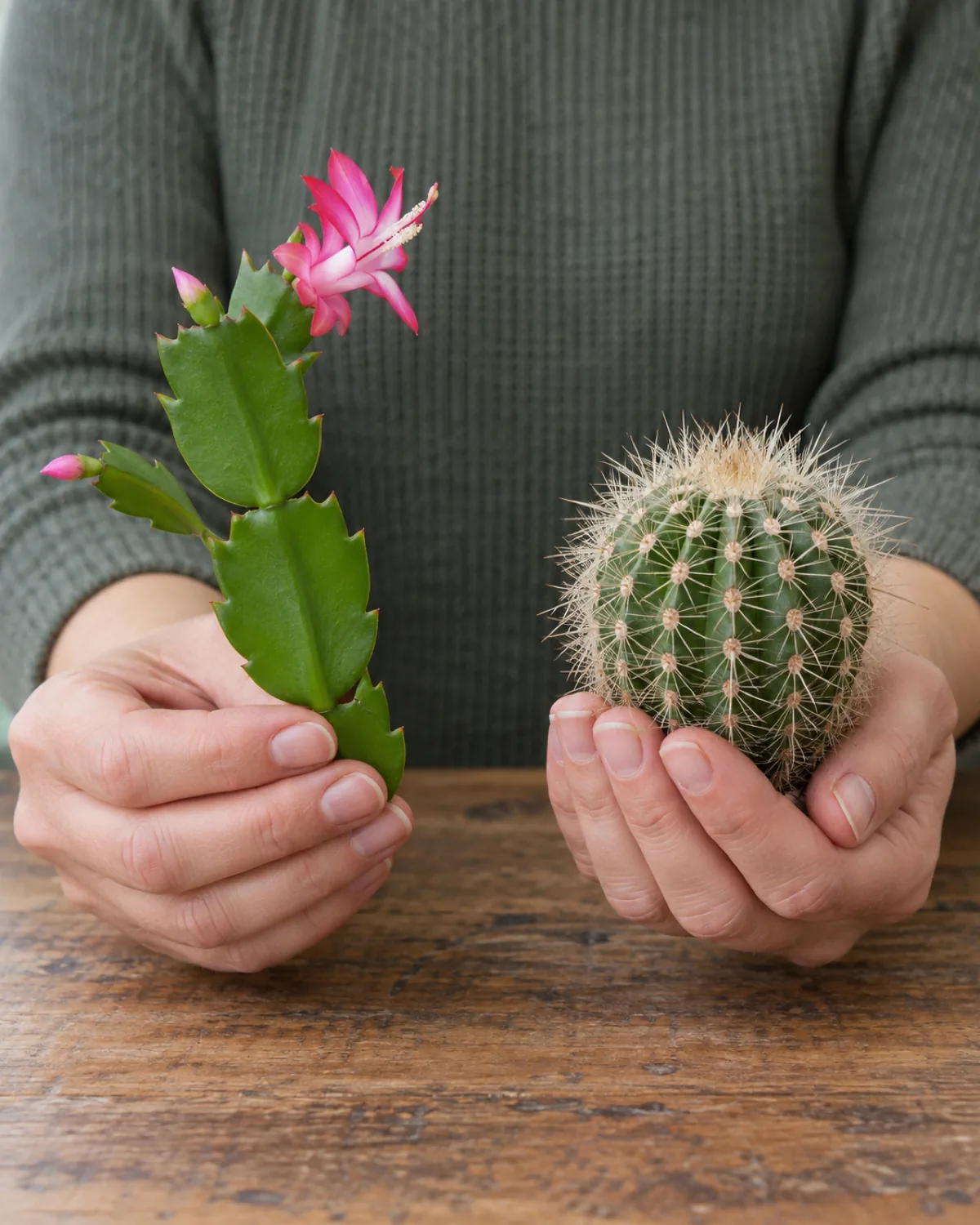
Schlumbergera grows wild in the Organ Mountains of southeastern Brazil, clinging to tree branches and rock crevices in cloud forests that sit above 1,000 meters. It is an epiphyte — a plant that grows on other plants for physical support, not parasitism — in the same way that orchids and bromeliads are epiphytes.
Its stems are flat, segmented chains called phylloclades. Each segment is a modified stem that performs photosynthesis and stores a modest amount of water. The segments have smooth, rounded or scalloped margins — no spines, no ribs, no woolly areoles of the kind you see on a desert cactus.
Flowers form at the tips of the terminal segments, emerging from small areoles that are barely visible to the naked eye. The blooms are tubular with layered petals that curve backward, and they come in shades of pink, red, white, salmon, and magenta depending on the cultivar.
The practical consequence of all this is straightforward:
- Standard cactus care advice — full sun, bone-dry soil, sandy grit mix, minimal humidity — will stress or kill a Christmas cactus
- It needs filtered light, consistently moist (not wet) soil, a chunky organic mix, and moderate humidity
- The bloom trigger is photoperiod (day length) plus cool temperatures, not a winter dry rest
If you have been treating yours like a desert cactus and wondering why it drops segments or refuses to bloom, the epiphyte identity is almost certainly the missing piece.
Christmas vs Thanksgiving vs Easter Cactus: How to Tell Yours Apart
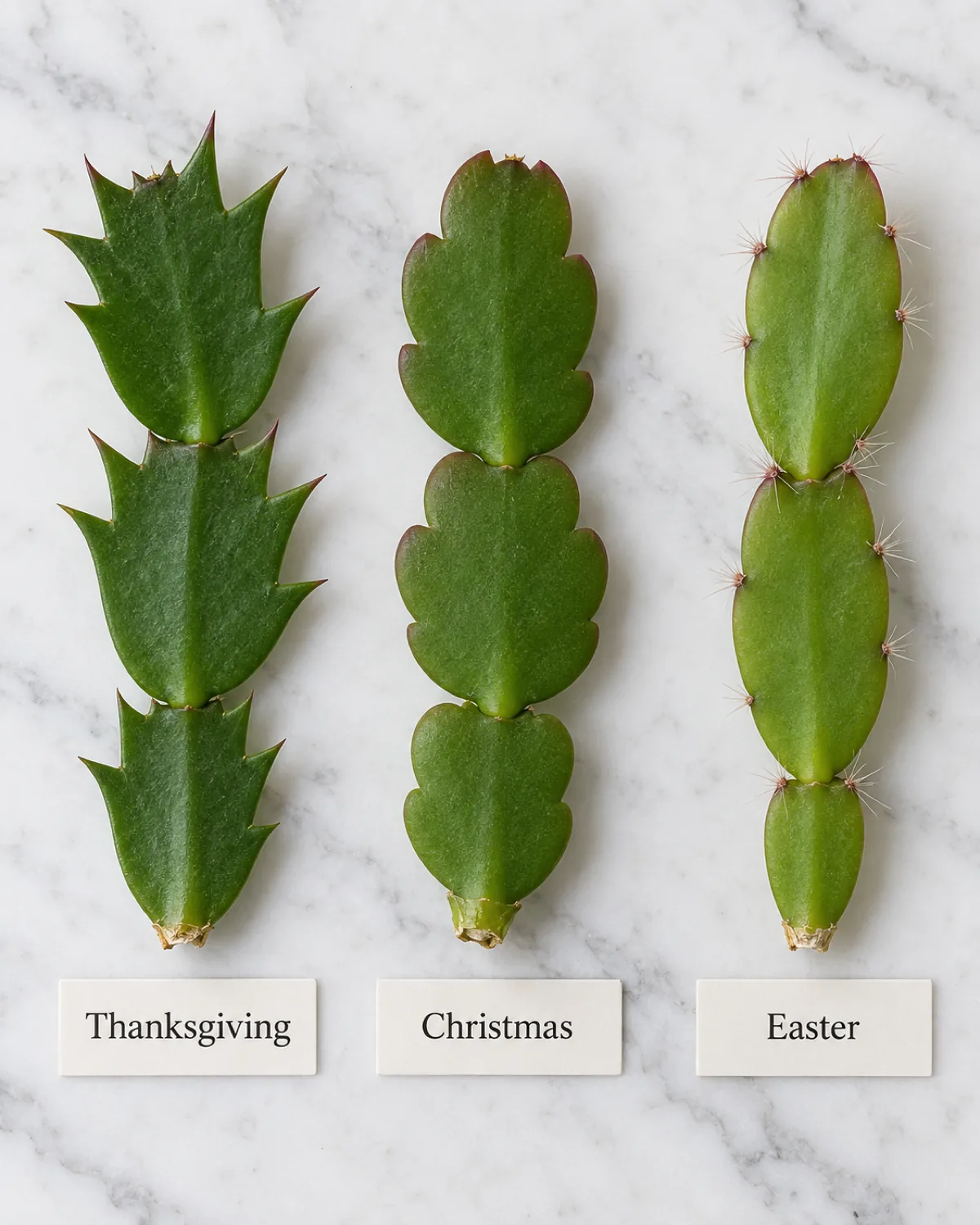
The plant sold as "Christmas cactus" at most garden centers is almost always a Thanksgiving cactus (Schlumbergera truncata). The true Christmas cactus (Schlumbergera × buckleyi) is less common in retail. Both bloom around the holidays, both need the same care, and the distinction matters mainly for timing expectations and identification satisfaction.
The segment edges are the fastest way to tell them apart:
- Thanksgiving cactus (S. truncata): pointed, claw-like teeth along the segment margins, two to four per side, with a distinctly jagged silhouette
- Christmas cactus (S. × buckleyi): gently rounded, scalloped edges with no sharp points — the margins look almost wavy
- Easter cactus (Rhipsalidopsis gaertneri): rounded edges with small bristle-like hairs emerging from tiny areoles at the scallop points
Bloom timing is the second cue. Thanksgiving cactus typically blooms in November, a few weeks before the true Christmas cactus. Easter cactus blooms in spring, around March or April, and needs a different trigger (cool dry rest, not darkness).
The flower shape differs too. Thanksgiving cactus flowers are asymmetrical with the stamens pushed to one side. Christmas cactus flowers hang more symmetrically with evenly spaced petals. Both are tubular, but the Christmas cactus bloom droops more noticeably.
For care purposes, Thanksgiving and Christmas cacti are interchangeable. Same light, same soil, same bloom trigger. If yours blooms in early-to-mid November, it is probably a Thanksgiving cactus. If it blooms closer to late December, it may be a true Christmas cactus or a hybrid.
Light That Mimics the Forest Canopy
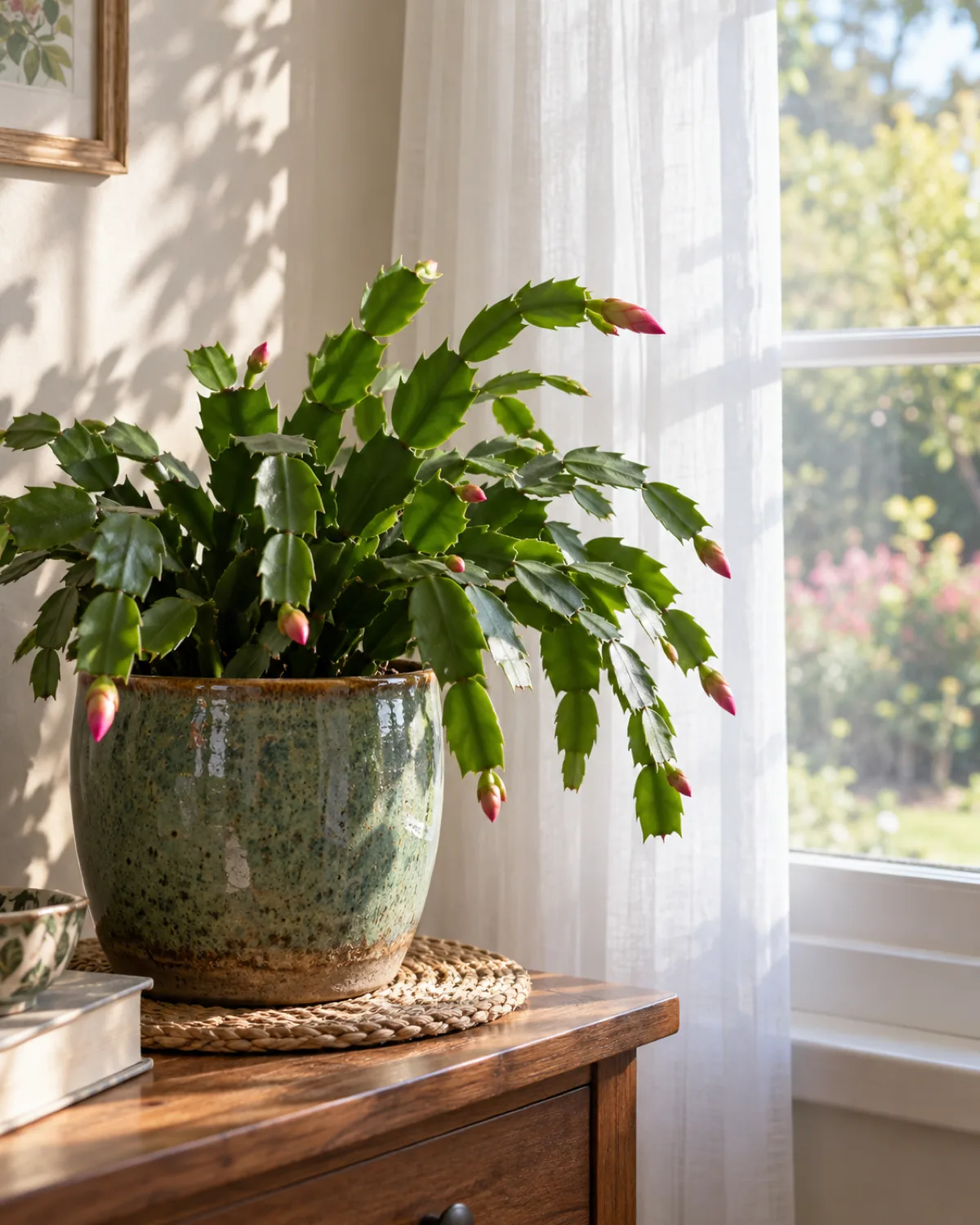
Bright indirect light is the target. In its native habitat, a Christmas cactus grows under a forest canopy where direct sun rarely reaches the plant. Indoors, that translates to a spot near a window where the plant gets plenty of ambient light but no harsh midday rays hitting the segments directly.
An east-facing window is ideal — bright morning sun is gentle enough that it will not bleach the segments. A north-facing window works well in summer when ambient light is strong, but may be too dim in winter for bud development. West and south windows work if you pull the plant back a foot or two from the glass, or filter the light through a sheer curtain.
Direct sun causes visible damage quickly. The segments bleach from deep green to a pale reddish-purple, then develop brown, papery patches where tissue has died. If you see that purple-bronze tint spreading across the segments, the plant is getting sunburned and needs to be moved.
Too little light produces a different set of symptoms:
- New segments grow thinner and paler than the older ones
- The plant stretches toward the light source, creating leggy gaps between segments
- It refuses to set buds even with correct darkness and temperature treatment
During summer, many growers move their Christmas cactus outdoors to a shaded porch or under a tree canopy. This mimics the bright-but-filtered conditions it evolved in, and the slight temperature drop at night encourages compact, sturdy growth. Bring it back inside before night temperatures drop below 50°F (10°C).
Watering an Epiphyte That Looks Like a Cactus
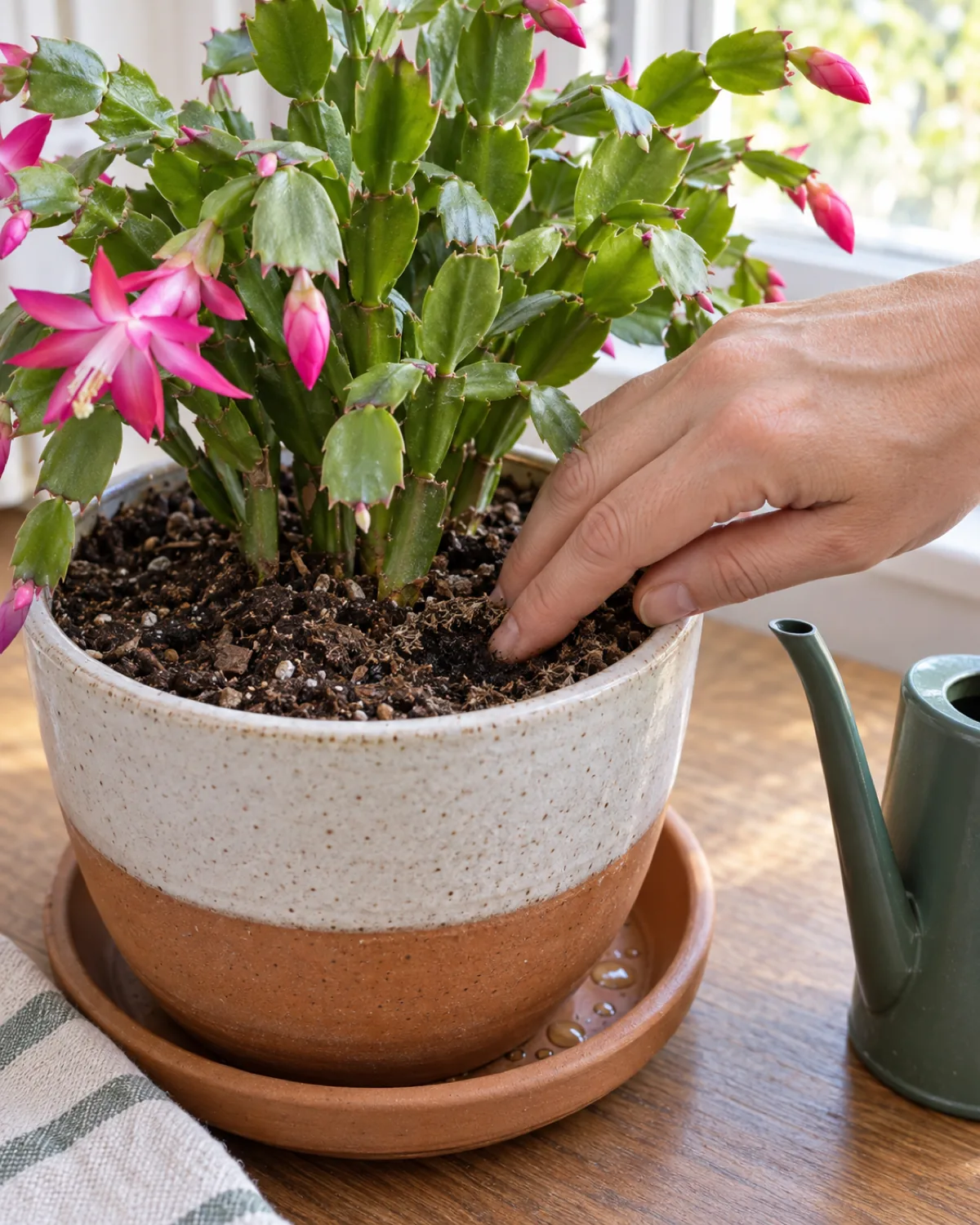
Water when the top inch of soil feels dry to the touch. This is more frequent than desert cactus watering — you are not waiting for the entire pot to dry out — but less frequent than most tropical houseplants.
The epiphyte roots are thin and fibrous, evolved to absorb moisture from decomposing leaf litter and rainwater runoff. They rot quickly in standing water but also suffer if the soil stays bone-dry for weeks at a time. The sweet spot is evenly moist soil that drains freely and never stays soggy.
A few guidelines that keep the watering rhythm right:
- Spring and summer (active growth): water when the top inch is dry, roughly every seven to ten days depending on pot size, humidity, and temperature
- Early fall (bud-setting period): reduce watering slightly — let the top inch-and-a-half dry out — to help trigger bud formation alongside the darkness treatment
- During bloom: keep the soil consistently moist but not wet, because dry spells during bloom cause bud drop
- Winter post-bloom: reduce watering to let the plant rest, roughly every two to three weeks
Bottom watering works well for Christmas cactus. Set the pot in a shallow tray of water for twenty to thirty minutes, let the soil wick moisture up through the drainage holes, then remove the pot and let excess water drain completely. This ensures the root zone gets evenly moistened without waterlogging the surface.
The general houseplant watering guide covers the finger test and pot-weight method in more detail. If your segments are going limp and wrinkled, check whether the soil is bone-dry (underwatering) or waterlogged (root rot from overwatering) — the symptom looks the same, but the causes are opposites.
Humidity and Temperature: The Tropical Roots Show
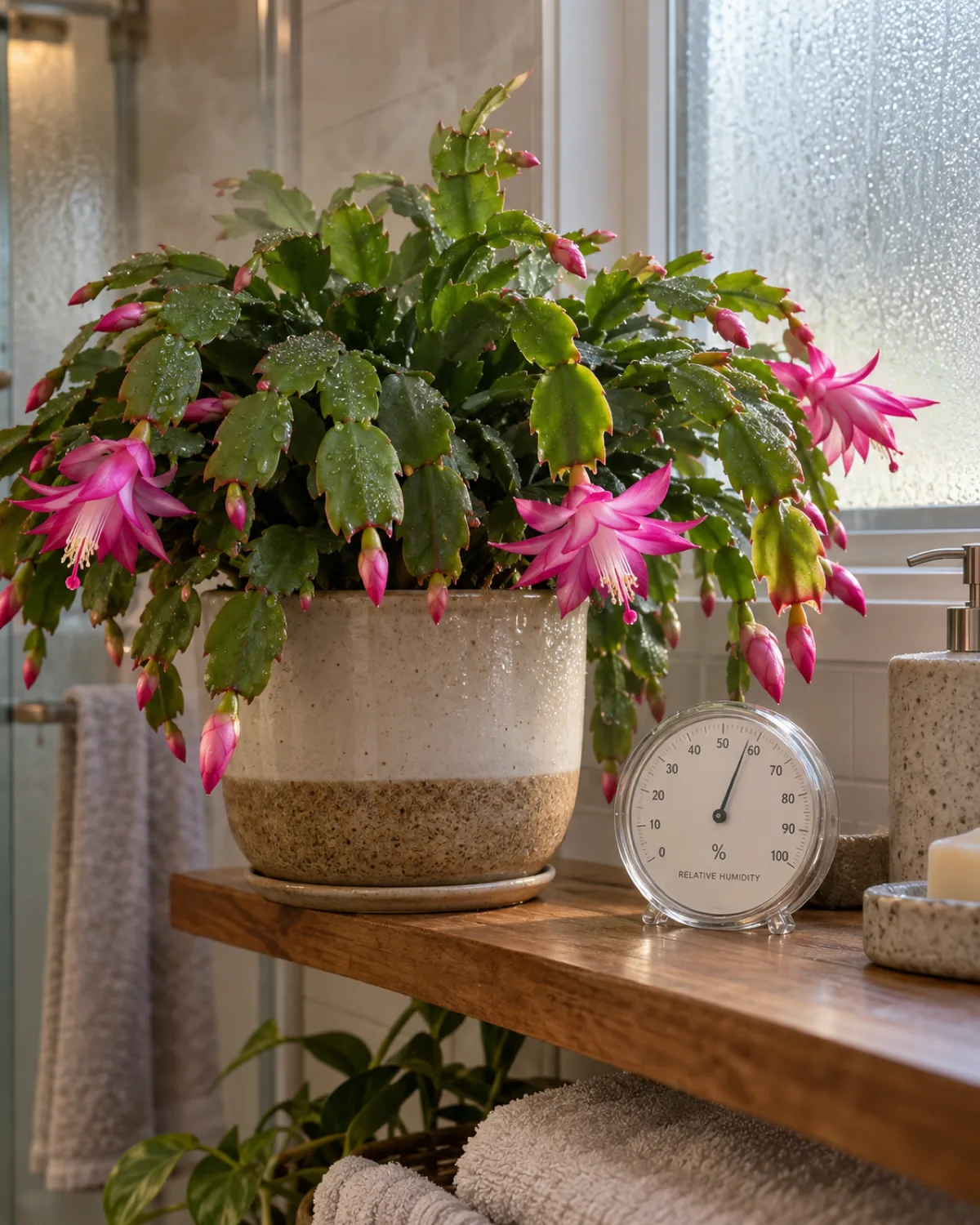
A Christmas cactus wants 50 to 60 percent relative humidity — lower than what a humidity-hungry tropical like an anthurium demands (60 percent and up), but significantly higher than what a desert cactus needs, and higher than most homes deliver in winter when heating systems dry the air to 20 or 30 percent.
Signs of low humidity show up at the segment edges first:
- Edges turn brown and papery, starting at the tips
- New segments come in thinner and more brittle than they should
- Flower buds shrivel and drop before opening
A pebble tray beneath the pot (a shallow tray filled with pebbles and water, with the pot sitting on top of the pebbles above the waterline) raises the local humidity around the plant. Grouping it with other tropical houseplants also helps — plants release moisture through transpiration, and a cluster of them creates a microclimate.
For temperature, the range is 60 to 70°F (15 to 21°C) during most of the year. Christmas cactus tolerates normal household temperatures without complaint, but it is sensitive to two things: cold drafts and heat sources.
A window that lets in cold air in winter, a heating vent blowing directly on the plant, or a spot near a radiator will all cause bud drop. The temperature swing, not the absolute temperature, is what damages developing buds. A consistent 65°F is better than alternating between 50°F at night and 75°F during the day.
The exception is the bloom-trigger period in fall, when cooler temperatures (55 to 60°F) combined with long darkness actively promote bud formation. That cool period is not a stress — it is what the plant expects from the approach of the Southern Hemisphere winter in its native range.
Soil Mix for an Epiphyte
Standard cactus mix is too mineral-heavy for a Christmas cactus. The grit and sand that desert cacti need to replicate rocky desert soil will drain too aggressively and leave the epiphyte roots without the organic moisture they depend on.
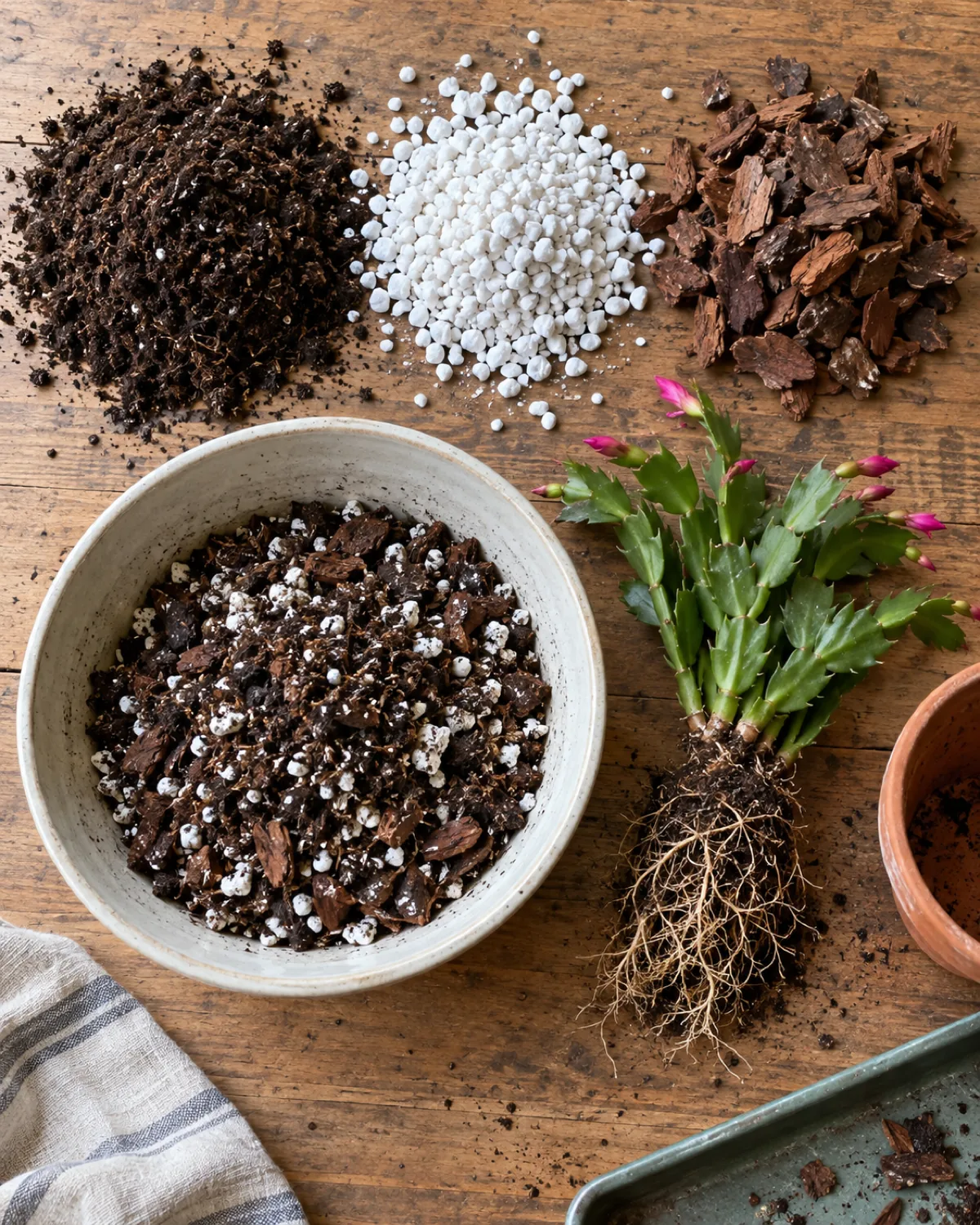
The ideal mix mimics the decomposing leaf litter and bark that collects in tree branch crooks:
- One part peat or coco coir: holds moisture and provides organic richness
- One part perlite: creates air pockets and ensures drainage
- One part orchid bark (small or medium grade): mimics the chunky debris these plants root into in the wild
This mix holds moisture long enough for the roots to drink but drains freely enough that the bottom of the pot never stays waterlogged. If you pick up the pot an hour after watering and it still feels heavy and sodden, the mix is too dense — add more perlite or bark.
The pH should sit slightly acidic, around 5.5 to 6.2. Peat naturally falls in this range. If you use coco coir, it tends to be closer to neutral, which is fine — Christmas cactus is not pH-fussy enough to notice a half-point difference.
Compare this to the succulent and cactus soil guide for desert species, where grit can make up 70 percent of the mix. The ratio is essentially reversed: organic-dominant for the epiphyte, mineral-dominant for the desert dweller. The roots look different too — thin, fibrous, and thread-like on a Christmas cactus versus thick and fleshy on a desert cactus.
Repot every two to three years in spring, moving up one pot size. Terracotta is better than plastic because it breathes and helps the outer soil dry at a rate closer to what these roots expect.
Fertilizing Through the Growth Cycle
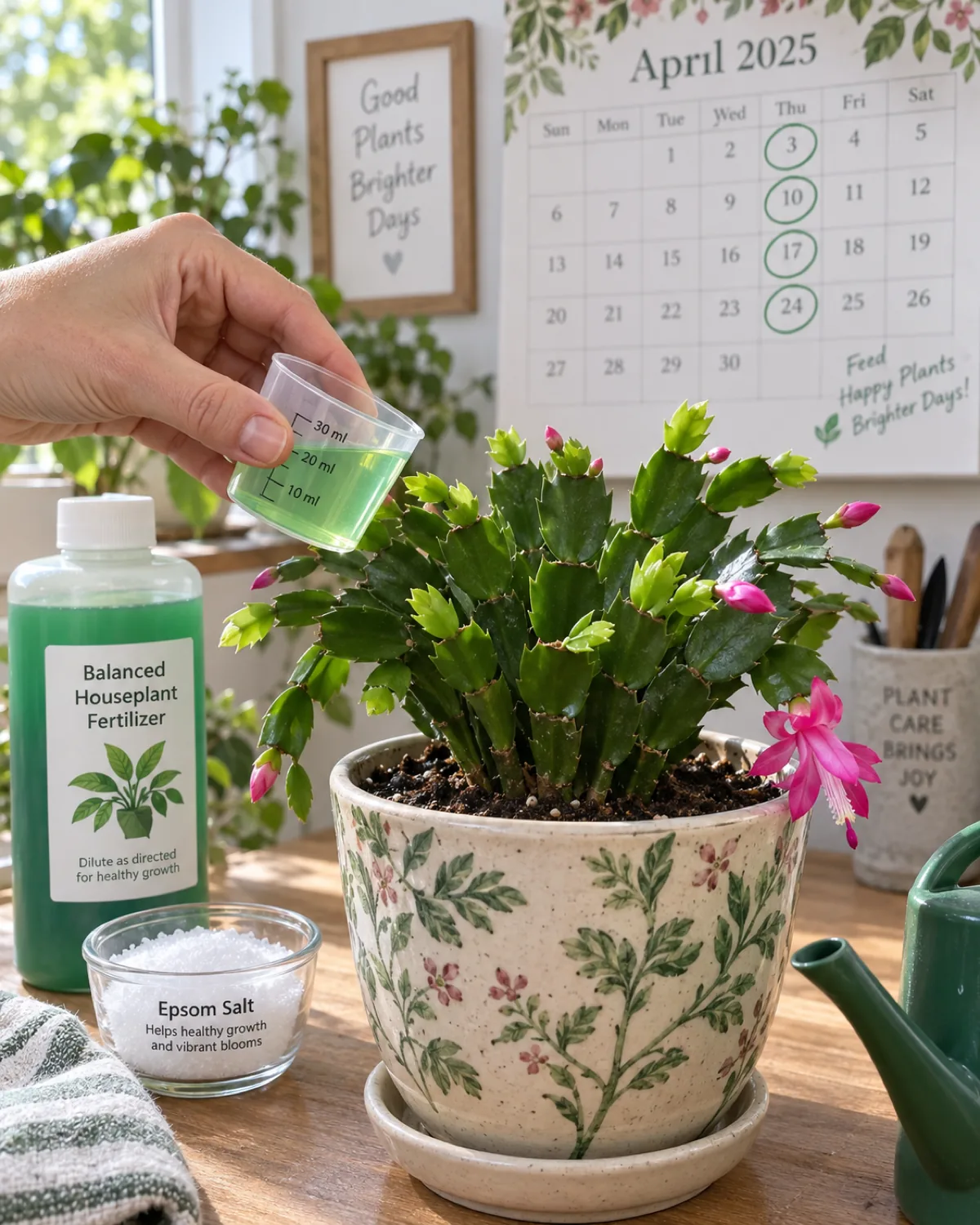
Feed monthly from April through August with a balanced liquid fertilizer (10-10-10 or 20-20-20) diluted to half the label strength. This covers the active growth period when the plant is pushing out new segments and building energy reserves for blooming.
The feeding calendar in three phases:
- April through August: half-strength balanced liquid fertilizer once a month, plus one teaspoon of Epsom salt (magnesium sulfate) per gallon of water every other month for deeper green segments
- September: stop all fertilizer — this is part of the bloom trigger, not neglect; continued feeding tells the plant to keep growing leaves instead of forming buds
- October through March: no feeding until blooming ends and new spring growth appears
Avoid fertilizers marketed for "blooming plants" that load up on phosphorus. The bloom trigger is environmental (darkness and cool temps), not nutritional — high-phosphorus feeding cannot compensate for missing the photoperiod cue.
The complete houseplant fertilizing guide covers NPK ratios and dilution methods in more detail.
The Bloom Trigger: How to Get Flowers Every Year
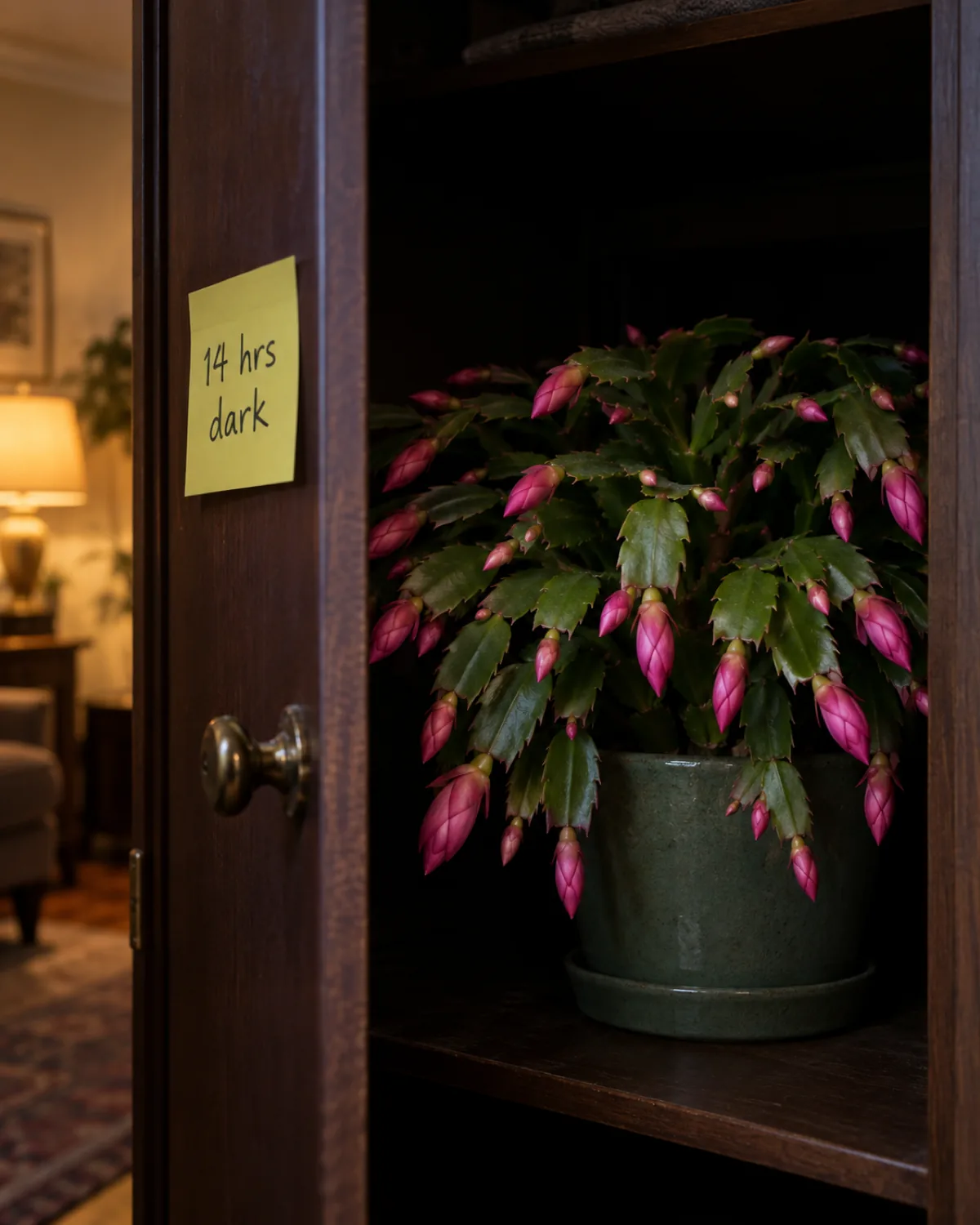
This is the section that determines whether your Christmas cactus is a blooming showpiece or a healthy green plant that never flowers. The trigger is specific, and partial attempts produce partial results or none at all.
Starting in mid-September, the plant needs two things simultaneously for six to eight weeks:
- 14 or more hours of uninterrupted darkness every night — not "a dim room," but true darkness where no artificial light reaches the plant between roughly 6 PM and 8 AM
- Cool temperatures between 50 and 60°F (10 to 15°C) during the dark period — a cool spare bedroom, an unheated porch, or a basement works
The darkness must be uninterrupted. Even a brief exposure to light — turning on a hallway light, a streetlight shining through the window, opening the closet door for thirty seconds — resets the clock. The plant measures night length through photoreceptor proteins, and any light exposure during the dark period signals "this night was too short."
A practical setup that works:
- Move the plant to a closet, cabinet, or spare room that stays dark and cool from evening through morning
- Set a daily alarm or routine: plant goes into the dark at 6 PM, comes out at 8 AM
- Keep the room at 55 to 60°F — an unheated spare bedroom is often perfect
After six to eight weeks, small buds appear at the tips of the terminal segments. They start as tiny reddish nubs and swell over the following four to six weeks into full-sized flower buds. Once buds are visible and about the size of a pea, you can move the plant back to its normal display spot and resume regular light exposure. The buds are committed at that point and will continue developing.
The timeline from starting the darkness treatment to full bloom is roughly ten to twelve weeks. Start in mid-September and expect flowers by late November to December.
Common bloom-trigger mistakes:
- Starting the treatment too late (November instead of September) — the buds do not have time to develop before the holidays
- A room that gets light pollution from streetlights or other rooms
- Temperatures that stay above 65°F during the dark period
- Moving the plant repeatedly during the treatment, which stresses it
Walk through these four checks in mid-September. One missing item and the buds may not form.
Pruning and Shaping After the Show
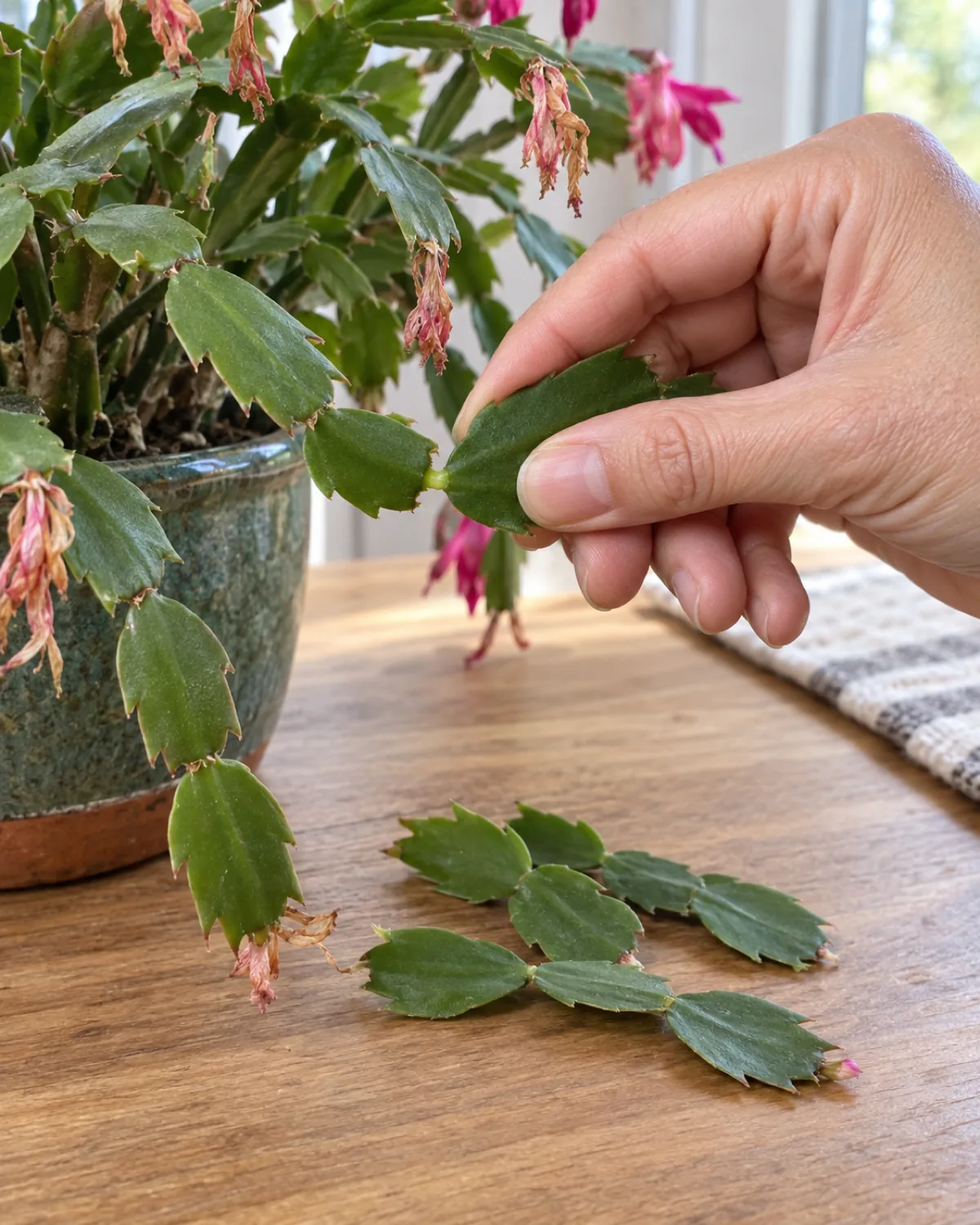
Prune in late winter or early spring, after the plant has finished blooming and before new growth begins. Each pruned stem tip produces two or three new segments where there was one, creating a fuller, more cascading plant over time.
The technique is as low-tech as it gets. Grip the segment you want to remove and twist it at the joint where it connects to the next segment. It separates cleanly along the natural weak point — no tools needed.
Quick pruning rules:
- Remove one to two segments per branch, not more in a single session
- If the plant is severely leggy or lopsided, spread the pruning over two sessions a few weeks apart
- Save every removed segment — each one is free propagation material (see next section)
- A mature plant with stems trailing two feet or more responds well to pruning the longest branches back by a few segments to keep it manageable
Propagation from Stem Cuttings
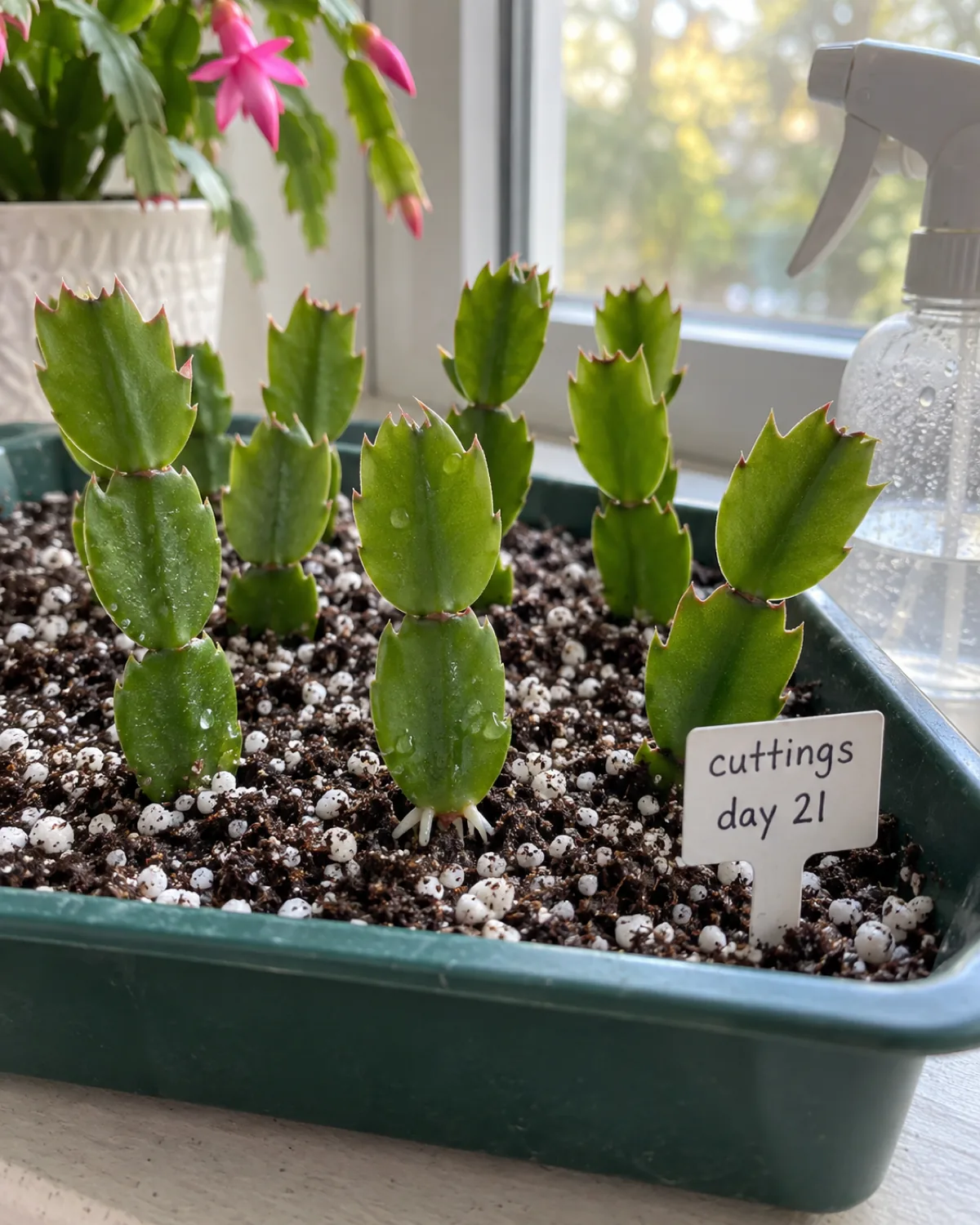
Christmas cactus is one of the easiest houseplants to propagate, and stem cuttings are the only method you need. The success rate is high enough that beginners can expect most of their cuttings to root.
Take cuttings in spring or early summer when the plant is actively growing. Each cutting should be a chain of two to three connected segments — a single segment can root, but a two-to-three-segment cutting is more vigorous and produces a fuller plant faster.
The process from cutting to rooted plant:
- Twist or cut the segment chain at a natural joint, just as you would when pruning
- Let the cut end callous for 24 to 48 hours — set the cuttings on a paper towel in a shaded spot at room temperature. The wound seals over, reducing the chance of rot when planted
- Plant the calloused end about half an inch deep in a moist mix of equal parts perlite and peat (or coco coir). The mix should be damp, not wet
- Keep it warm and humid — cover the tray loosely with a clear plastic bag or dome to hold humidity, and place it in bright indirect light. Remove the cover for a few minutes daily to prevent mold
- Roots appear in three to six weeks — you will know rooting has happened when you give the cutting a gentle tug and feel resistance
Once the cutting is rooted and showing new segment growth, transplant it into a regular Christmas cactus soil mix in a small pot. Water as you would an established plant.
The general propagation guide covers callusing, rooting hormones, and troubleshooting in more detail. Christmas cactus rarely needs rooting hormone — the success rate without it is already high — but dusting the calloused end with hormone powder before planting speeds root formation by a week or so.
Common Problems and What They Actually Mean
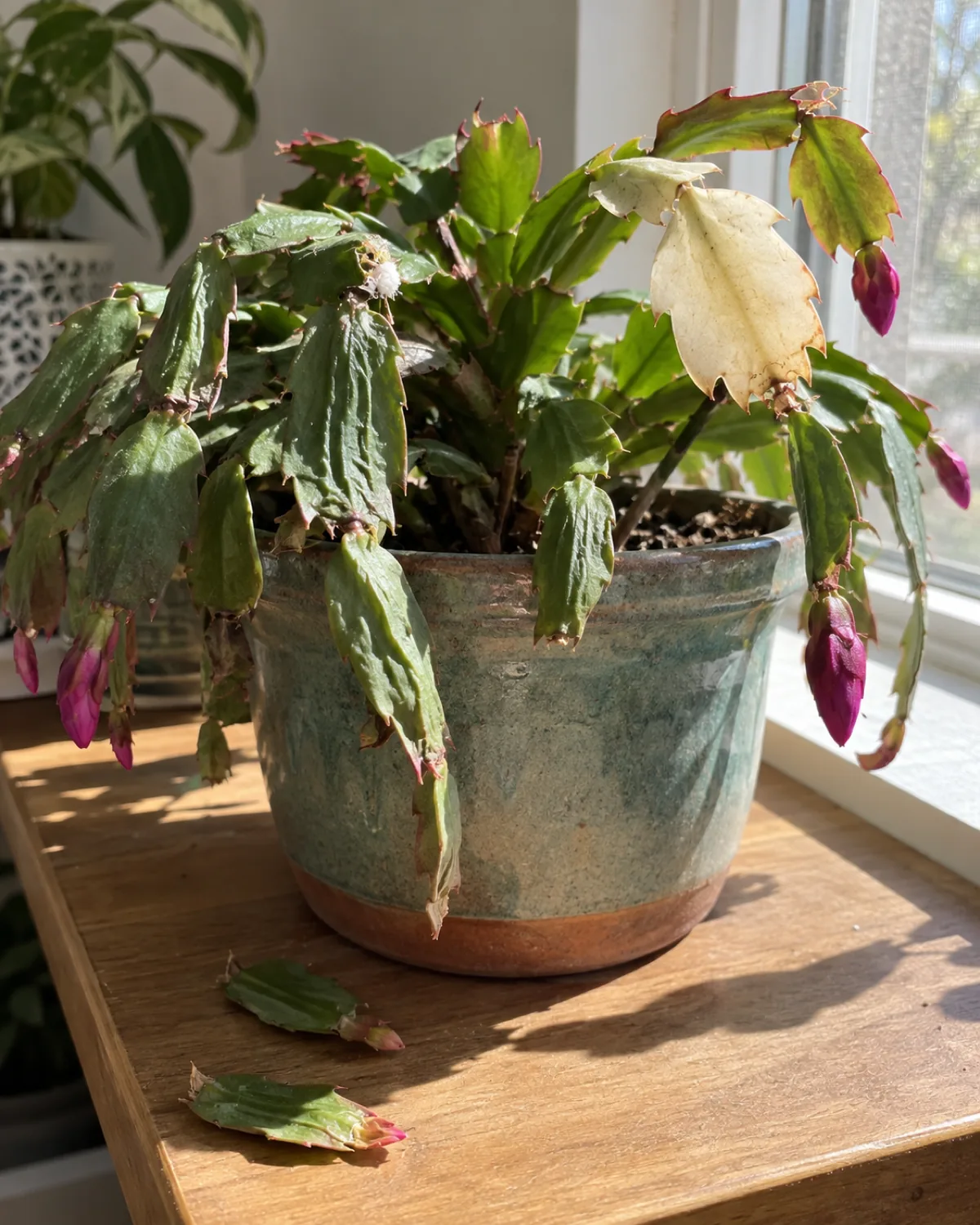
Most Christmas cactus problems trace back to watering, light, or temperature. The plant is forgiving in general, but it communicates stress clearly through its segments.
Segment drop is the most alarming symptom and the most common complaint. Segments detach and fall off, sometimes in clusters. The usual causes:
- Overwatering — the roots begin to rot and can no longer support the plant, so it sheds segments to reduce demand
- Cold drafts or sudden temperature changes — moving the plant from a warm room to a cold porch, or placing it near a drafty window
- Bud-stage stress — during the bloom period, any disruption (moving the plant, inconsistent watering, temperature swings) can cause both buds and segments to drop
Limp, wrinkled segments mean the plant is not getting enough water to the stem tissue. Check the soil first:
- Bone-dry soil — water thoroughly and the segments should plump up within a day or two
- Wet, soggy soil — the roots may be rotting; see the root rot guide for diagnosis and rescue steps; this is the more serious scenario
No blooms despite a healthy-looking plant almost always means the bloom trigger was incomplete:
- Light leaked into the dark-period room
- Temperatures stayed above 65°F during the dark treatment
- The treatment started too late or was too short (less than six weeks)
- Fertilizing continued through the fall
Pale or bleached segments signal too much direct sun. Move the plant farther from the window or add a sheer curtain.
Mealybugs appear as small white cottony clusters in the joints between segments. They feed on sap and weaken the plant over time. Dab individual bugs with a cotton swab dipped in rubbing alcohol, or treat the entire plant with neem oil spray. The pest and disease guide covers the three-week neem treatment cycle.
Is Christmas Cactus Safe for Pets
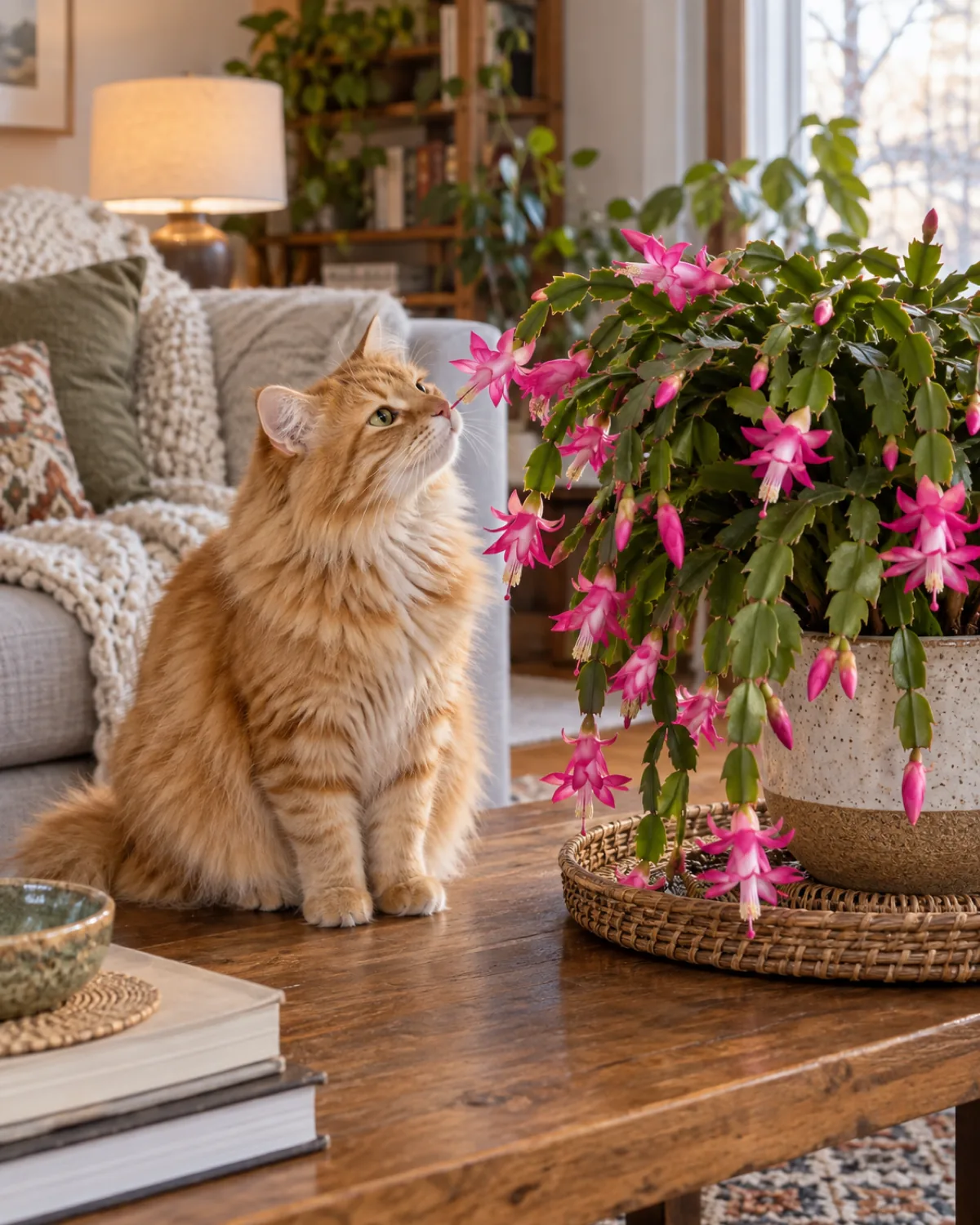
The ASPCA lists Schlumbergera as non-toxic to both cats and dogs. A pet that chews on a segment may experience mild gastrointestinal upset — the fibrous plant material is not particularly digestible — but there are no toxic compounds in the stems, flowers, or roots that would cause poisoning.
This makes Christmas cactus one of the safest holiday plants you can display. Poinsettia, often feared as highly toxic, is actually only mildly irritating (its reputation is worse than its bite). But Christmas cactus goes a step further — it is genuinely non-toxic, not just mildly toxic with mild symptoms.
A few practical points for pet households:
- Place the plant where pets cannot knock it off a shelf — a falling terracotta pot is a bigger danger than the plant itself
- If a cat or dog regularly chews on the segments, move the plant out of reach not because of toxicity but because repeated chewing damages the plant and the ingested fiber may cause vomiting
- The pet-safe plants guide and the cat-safe plants list cover more options for households where pet safety is a primary concern
Christmas cactus is safe to give as a holiday gift to households with pets — no disclaimers needed.
Christmas Cactus Care: 12 Things to Get Right
- 1It is an epiphyte, not a desert cactusCloud forest origin means filtered light, organic soil, and moderate humidity — the opposite of desert cactus care.
- 2Check the segment edges to identify yoursPointed teeth = Thanksgiving. Rounded scallops = Christmas. Bristled bumps = Easter. Most store-bought are Thanksgiving.
- 3Bright indirect light, never direct sunEast window ideal. Direct sun bleaches segments purple then brown. Too little light prevents bud formation.
- 4Water when the top inch is dryMore frequent than desert cactus, less than tropical foliage. Reduce in fall for bud trigger. Bottom watering works well.
- 5Humidity 50 to 60 percent, temperature 60 to 70°FPebble tray or plant grouping for humidity. Hates drafts and heat vents. Cool temps in fall help trigger blooms.
- 6Chunky organic soil: peat, perlite, orchid barkEqual parts of all three. Not sandy cactus grit. Should drain freely but hold moisture. Slightly acidic pH.
- 7Fertilize monthly spring through August, then stopHalf-strength balanced liquid. Epsom salt every other month for magnesium. Stopping in September is part of the bloom trigger.
- 814 hours darkness plus cool temps for 6 to 8 weeksThe bloom trigger. Start mid-September. Even brief light exposure resets the clock. Closet or spare room at 50 to 60°F.
- 9Prune by twisting off 1 to 2 segments per branchAfter blooming, before new growth. Each pruned tip branches into two or three new segments. Save the cuttings.
- 10Propagate from 2 to 3 segment cuttingsCallous 24 to 48 hours, plant in moist perlite-peat mix. Roots in 3 to 6 weeks. High success rate without hormone.
- 11Segment drop means watering, drafts, or stressOverwatering rots roots. Cold drafts shock buds. Limp plus wet soil = root rot. Limp plus dry soil = just needs water.
- 12Non-toxic to cats and dogsASPCA listed as safe. Mild GI upset possible if chewed in quantity. One of the safest holiday plants for pet households.
kultivy.com
Frequently Asked Questions
How often should I water a Christmas cactus?
Water when the top inch of soil feels dry. The rhythm shifts through the year:
- Spring and summer: every seven to ten days
- Fall bud-setting: let the top inch-and-a-half dry to help trigger buds
- Winter post-bloom: every two to three weeks
Always check the soil rather than following a fixed calendar — pot size, humidity, and temperature all shift the timing.
Why is my Christmas cactus dropping segments?
The three most common causes:
- Overwatering — roots rot and can no longer support the stems
- Temperature shock — cold draft, heat vent, or moving the plant between rooms
- Bud-stage stress — any disruption while buds are forming can trigger segment and bud drop
Check soil moisture first. Soggy soil means root rot; appropriately moist soil points to an environmental cause.
Can I put my Christmas cactus outside in summer?
Yes. The rules for outdoor placement:
- Dappled shade only — under a tree canopy or on a covered porch, never in direct afternoon sun
- Bring it back inside before nighttime temperatures drop below 50°F (10°C)
- Inspect for hitchhiker pests before it comes indoors
How long do Christmas cactus live?
Decades. Many documented specimens exceed thirty years, and some have been passed down through four generations of the same family. There is no built-in lifespan limit — the plant grows larger and more floriferous with each passing year.
Why won't my Christmas cactus bloom?
Almost always an incomplete bloom trigger. Check these four items:
- Did the plant get 14-plus hours of uninterrupted darkness nightly for six to eight weeks?
- Was the dark room between 50 and 60°F?
- Was there zero light pollution (hallway light, phone screen, streetlight through the window)?
- Did you stop fertilizing by September?
One missed item is enough to prevent bud formation entirely.