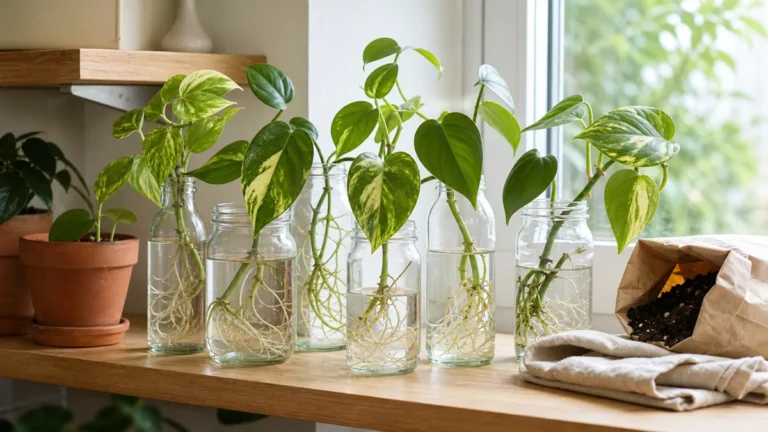
Water propagation is the closest thing to a magic trick in houseplant care. You snip a stem, drop it in a glass of water, and within days tiny white roots push out of the node — a whole new plant growing from nothing but tap water and sunlight.
No soil, no rooting hormone, no special equipment. Just a clean glass, a sharp pair of scissors, and a windowsill with bright indirect light.
This guide covers the science, the cutting technique, the container setup, ten houseplants that root reliably in water, the mistakes that kill cuttings, and how to move water roots to soil.
From the science of root formation to ten plants that root fastest, common mistakes, and how to transplant to soil. Jump to what you need.
How Water Propagation Actually Works
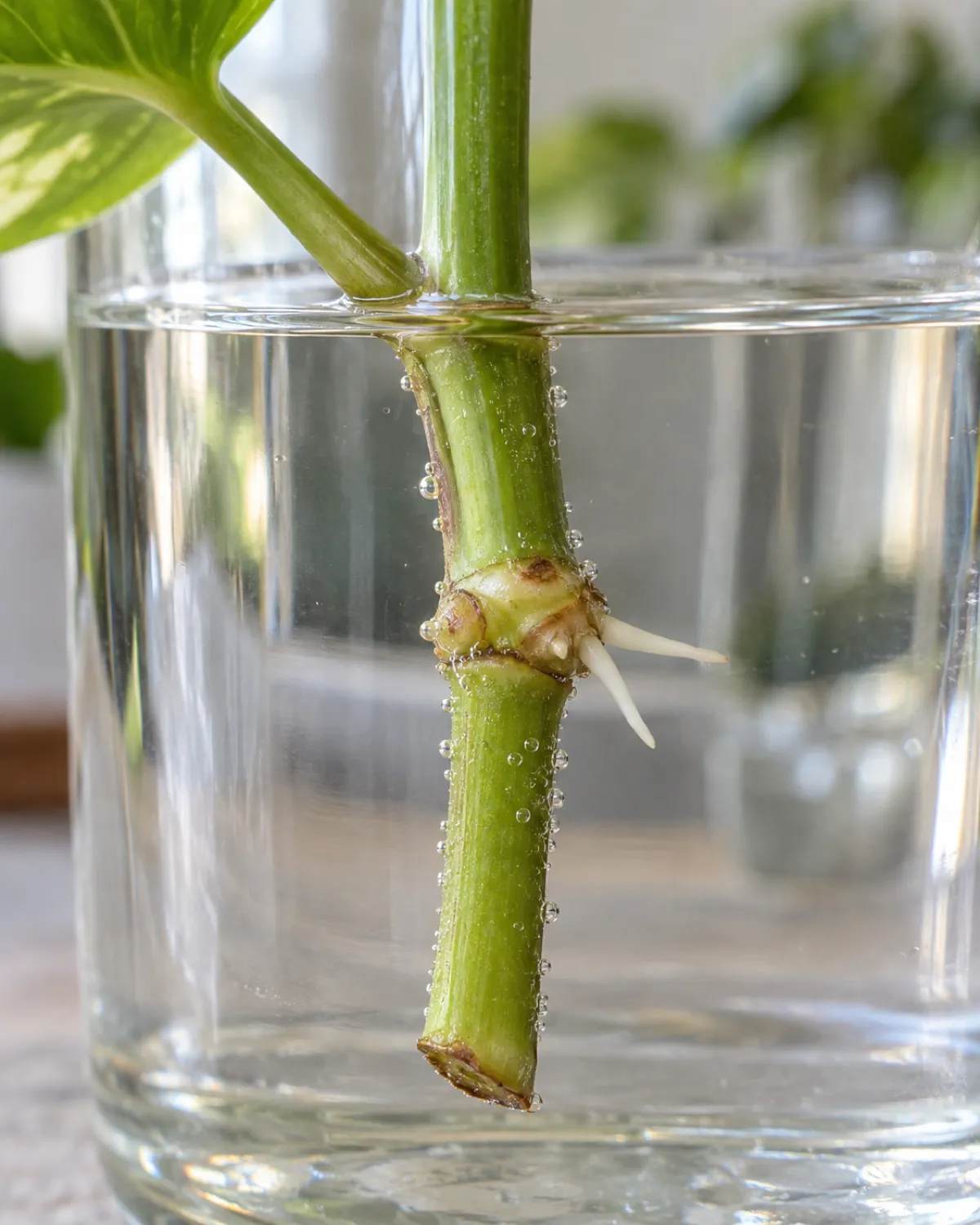
Every stem has dormant root cells sitting at each node — the small bumps where a leaf meets the stem. In nature those cells never activate because the plant is already rooted and auxin, the growth hormone that triggers root formation, keeps flowing downward through the intact stem.
When you cut a stem below a node, you sever that highway. Auxin pools at the cut end, and the dormant cells at the submerged node receive the chemical signal to wake up and start building roots.
- Auxin pooling: gravity pulls the hormone to the lowest point of the cutting, which is why the submerged end roots and the top does not
- Oxygen from water: dissolved oxygen in fresh water feeds the new root tissue as it pushes outward
- Water roots vs soil roots: water roots are white, brittle, and have fewer root hairs than soil-grown roots — they are structurally different, which matters at transplanting time
- Why some plants refuse: woody-stemmed plants, most conifers, and many succulents lack the adventitious root cells at their nodes that make water propagation possible
The speed depends on the species. Tradescantia can push visible roots in 48 hours. Monstera takes three to four weeks. The difference comes down to how many dormant root cells each species stores at its nodes and how readily auxin activates them.
Anatomy of a Cutting — Finding the Node That Roots
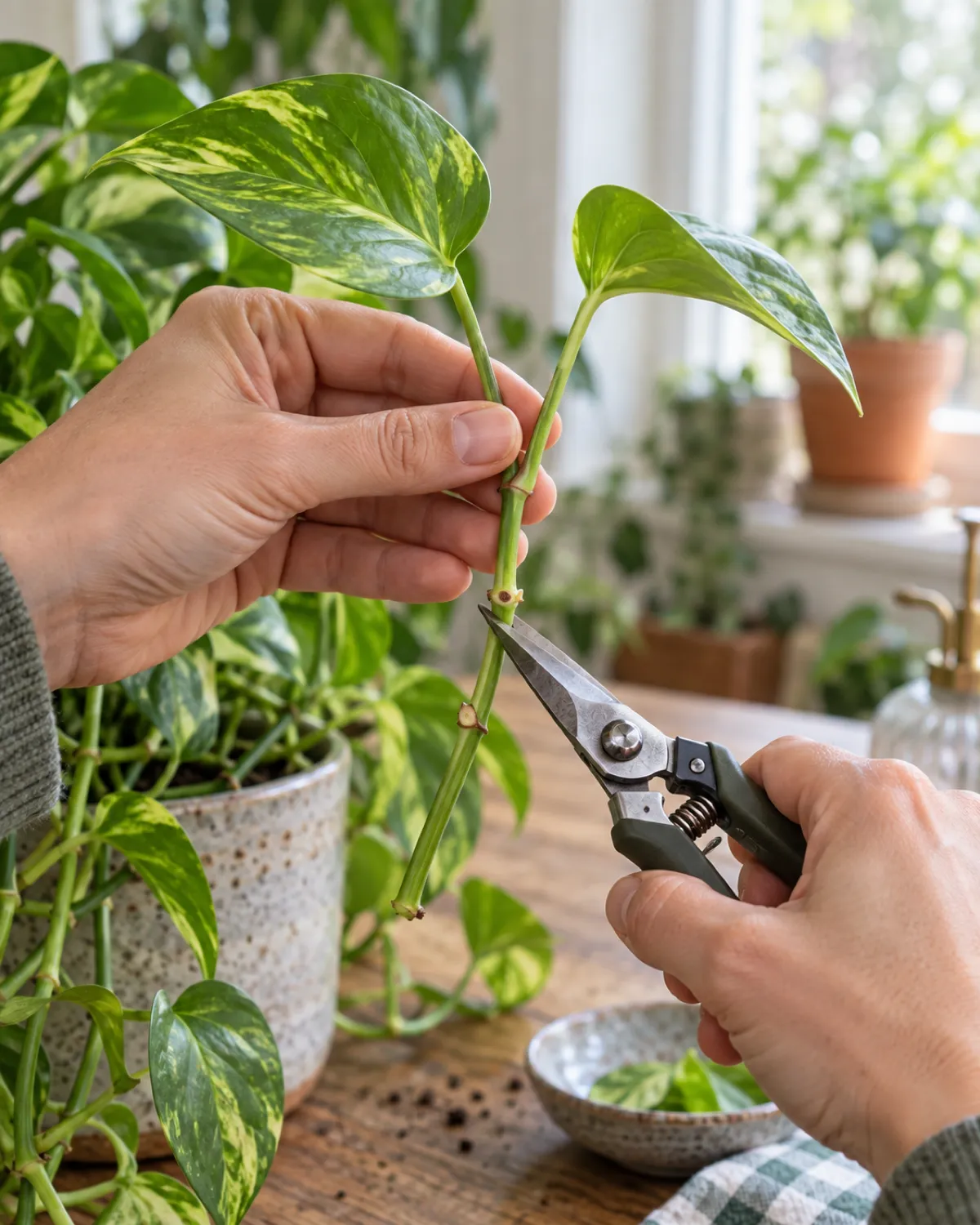
The single most common reason water propagation fails is cutting in the wrong place. Cut between nodes — the smooth, featureless section of stem — and there are no dormant root cells to activate. The cutting will sit in water, slowly rot, and never produce a single root.
A node looks like a slight bump or ring on the stem. It is the exact point where a leaf, a branch, or an aerial root attaches. On some plants the node is obvious — a thick knuckle on a monstera stem, a brown nub on a philodendron. On others it is subtle — a faint line on a coleus stem right where the leaf pair emerges.
Get these three right and water propagation works almost every time, regardless of species.
Here is the step-by-step method for preparing any cutting:
- Identify the node: find the bump, ring, or aerial root nub on the stem
- Cut 1 cm below the node: angle the scissors at 45 degrees for maximum surface area
- Strip lower leaves: remove every leaf that would sit beneath the waterline
- Keep 1–2 leaves above: the cutting needs photosynthesis to fuel root growth
- Stem thickness: pencil-thick stems root more reliably than very thin or very thick ones
Aerial roots — the brown nubs that some aroids grow along the stem — are pre-formed root primordia. A cutting that includes an aerial root has a head start because those cells are already partway through differentiation. Submerge the aerial root and new white roots will branch from it faster than from a bare node.
Container, Water, and Light Setup
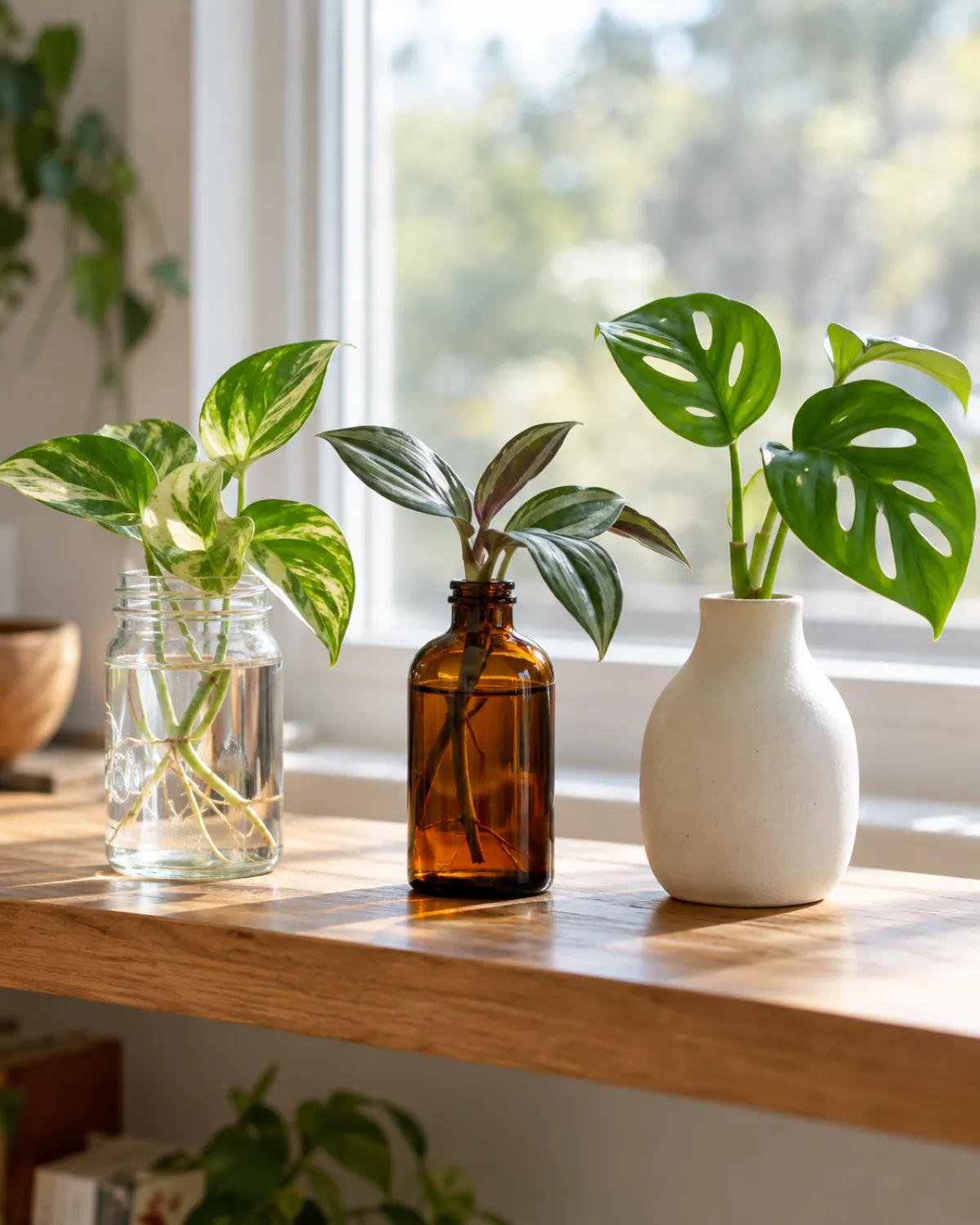
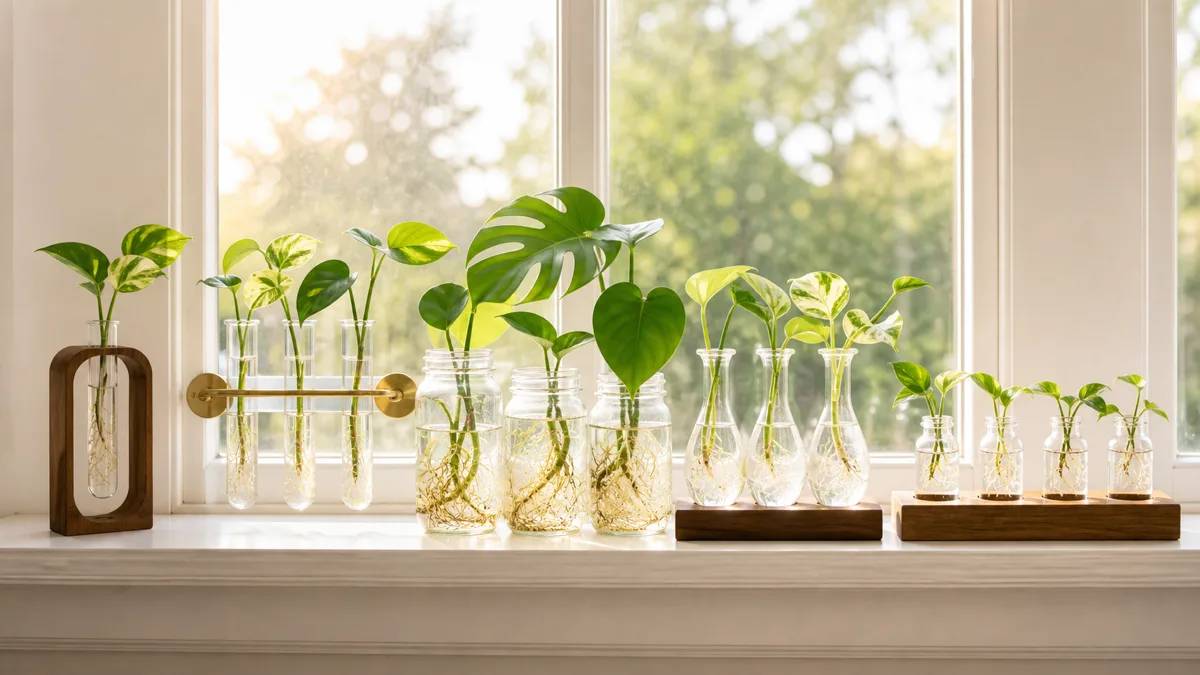
The container matters more than most people think. A clear glass lets you monitor root growth without disturbing the cutting — you can see the roots lengthen day by day, spot rot early, and know exactly when the cutting is ready to transplant.
A narrow-necked bottle or vase holds the stem upright without support. A wide-mouth jar works too but the cutting may lean or slip underwater, so rest the leaf across the rim to keep the stem vertical.
All three work. The best one depends on whether you prioritize monitoring, algae prevention, or aesthetics.
Water quality and maintenance rules that apply regardless of container:
- Filtered or dechlorinated water: chloramine in treated tap water damages root tips — let tap water sit uncovered for 24 hours or run it through a filter
- Room temperature water: cold water shocks the cutting and slows root formation
- Full water change weekly: topping off lets bacteria accumulate — dump, rinse, refill
- Bright indirect light: enough for photosynthesis but not direct sun, which heats the water and breeds bacteria
- Fill level: submerge the node and an inch of stem, no more — deep water drowns the stem
Pothos — The One-Week Wonder
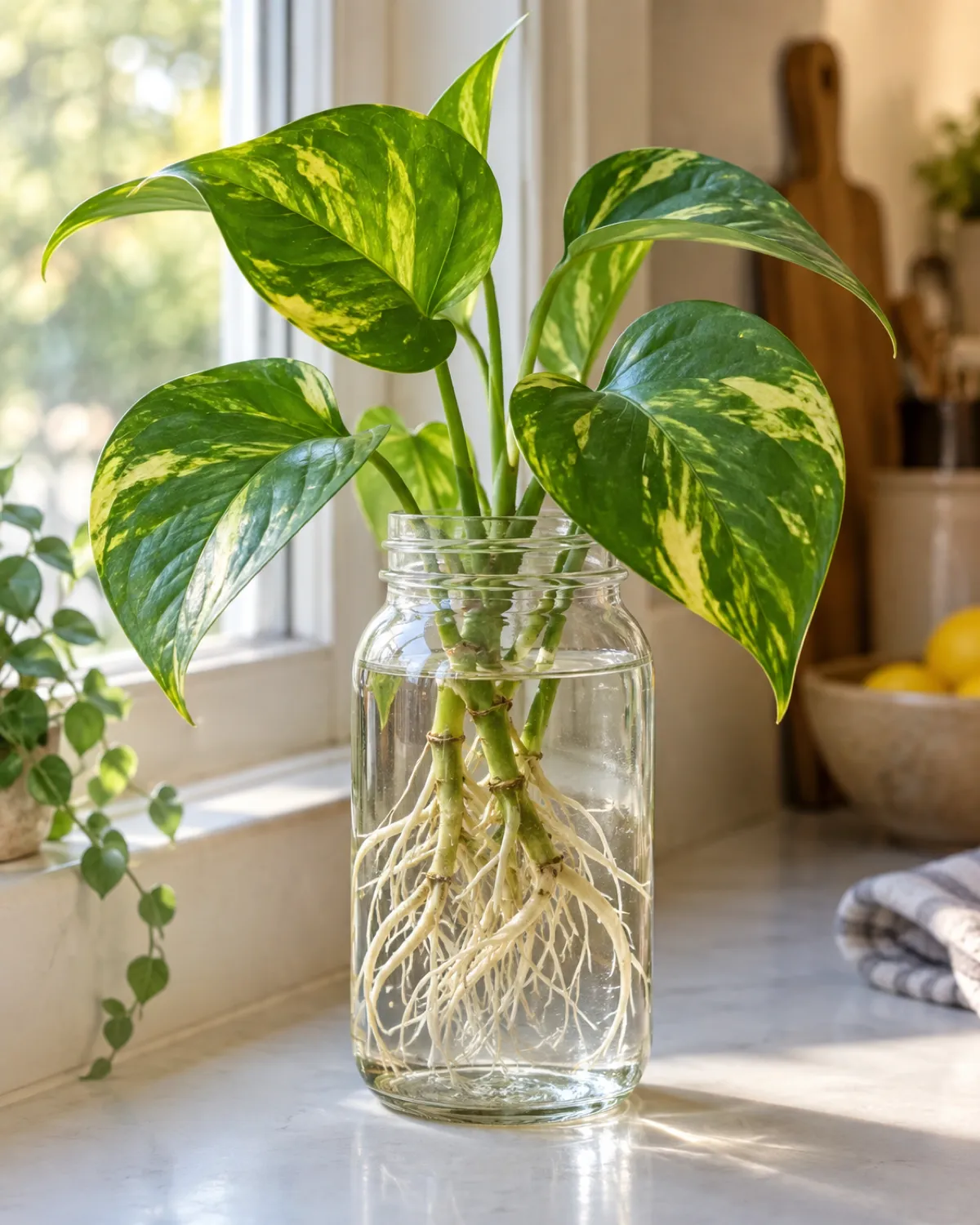
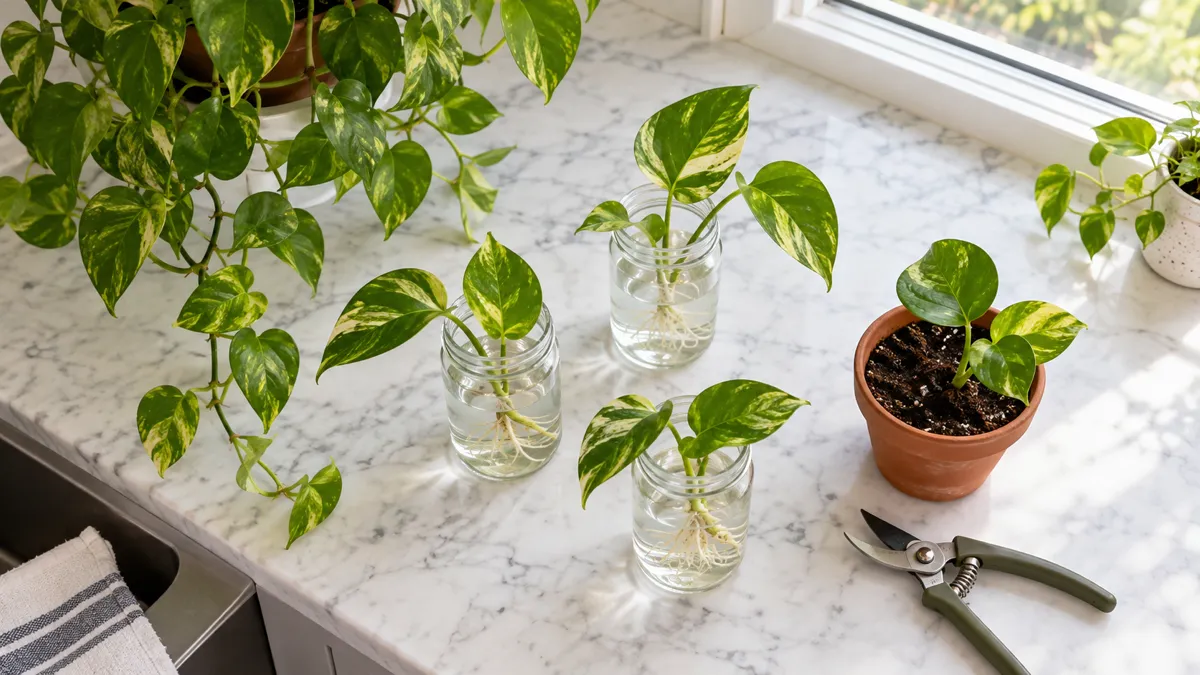
Pothos is the plant that proves water propagation works. Any node on any vine will push visible white roots within seven to fourteen days, and the cutting can live in water indefinitely if you keep the water fresh.
Golden pothos and marble queen are the fastest rooters. Neon pothos and manjula are slightly slower but still reliable. Every variety follows the same method — cut below a node, strip the lower leaf, drop the node end in water.
- Time to visible roots: 7–14 days
- Can live in water permanently: yes, with weekly water changes and a drop of liquid fertilizer monthly
- Single-node vs multi-node: both work — single-node cuttings maximize the number of new plants from one vine, multi-node cuttings produce bushier plants
- Translucent root show: the white roots against a clear glass jar are one of the most satisfying sights in houseplant care
If you have never propagated a plant before, start here. Pothos roots so willingly in water that failure requires active effort — leaving the water unchanged for weeks, submerging the leaves, or cutting between nodes.
Tradescantia — Roots Before You Finish Your Coffee
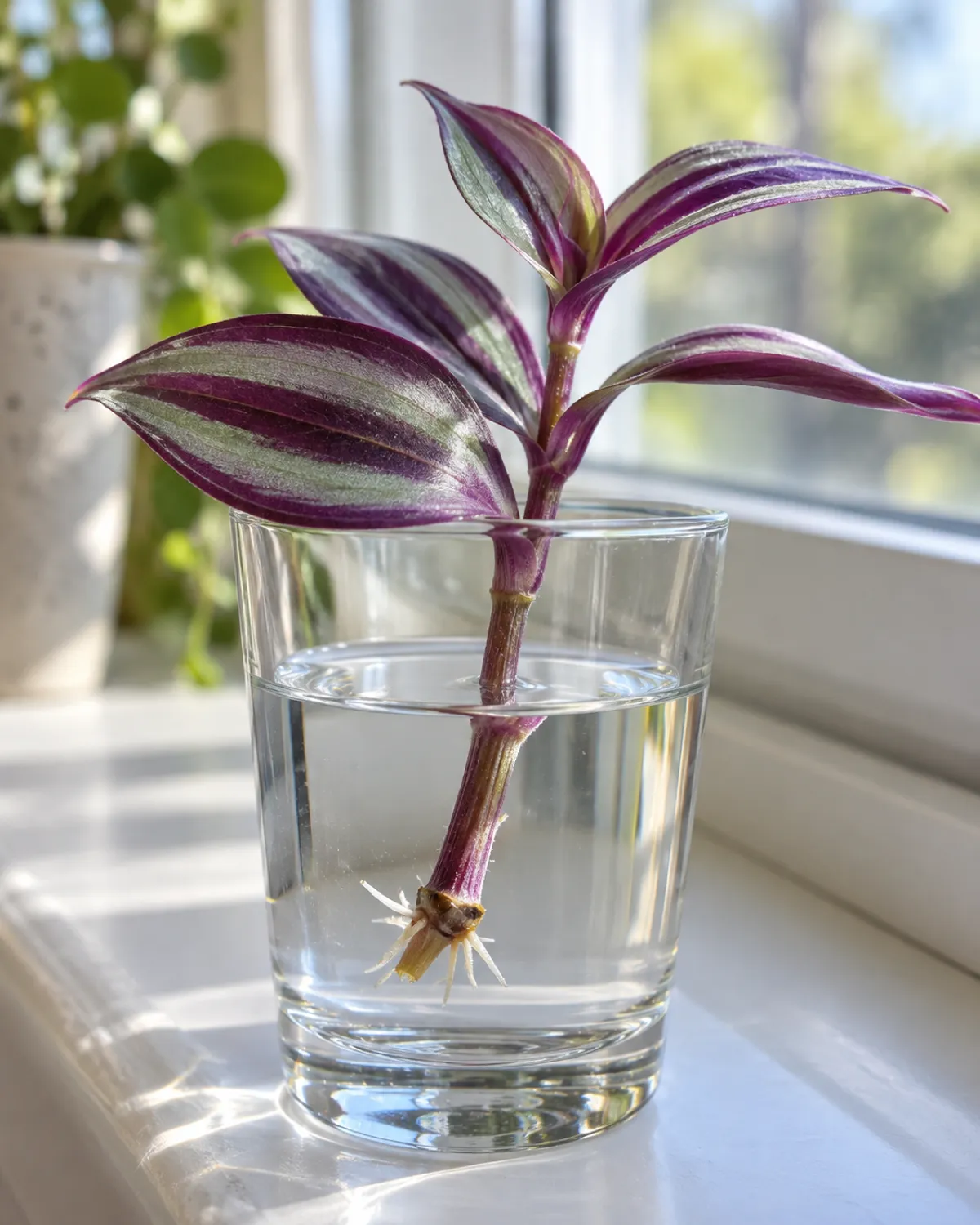
Tradescantia is the fastest-rooting houseplant most people will ever propagate. Stem tip cuttings can show visible root bumps within 48 hours in warm conditions, and by day three to five the roots are long enough to transplant.
The method is almost too simple. Pinch or snip a stem tip about four inches long, right above a node on the mother plant. Strip the lowest leaf pair. Drop the cut end in water. Wait.
- Time to visible roots: 3–5 days
- Best varieties for water propagation: zebrina (purple stripes) and nanouk (pink and green) are equally fast
- Stem tip vs mid-stem cuttings: stem tips root faster because they carry the highest concentration of growth hormones
- Branching bonus: the mother plant will branch from the cut point, becoming bushier every time you take a cutting
Tradescantia stems are soft and herbaceous, which means they rot faster than woody stems if the water goes stale. Change the water every three to four days for tradescantia specifically — more often than you would for a pothos or philodendron.
Philodendron — Aerial Roots Give It a Head Start
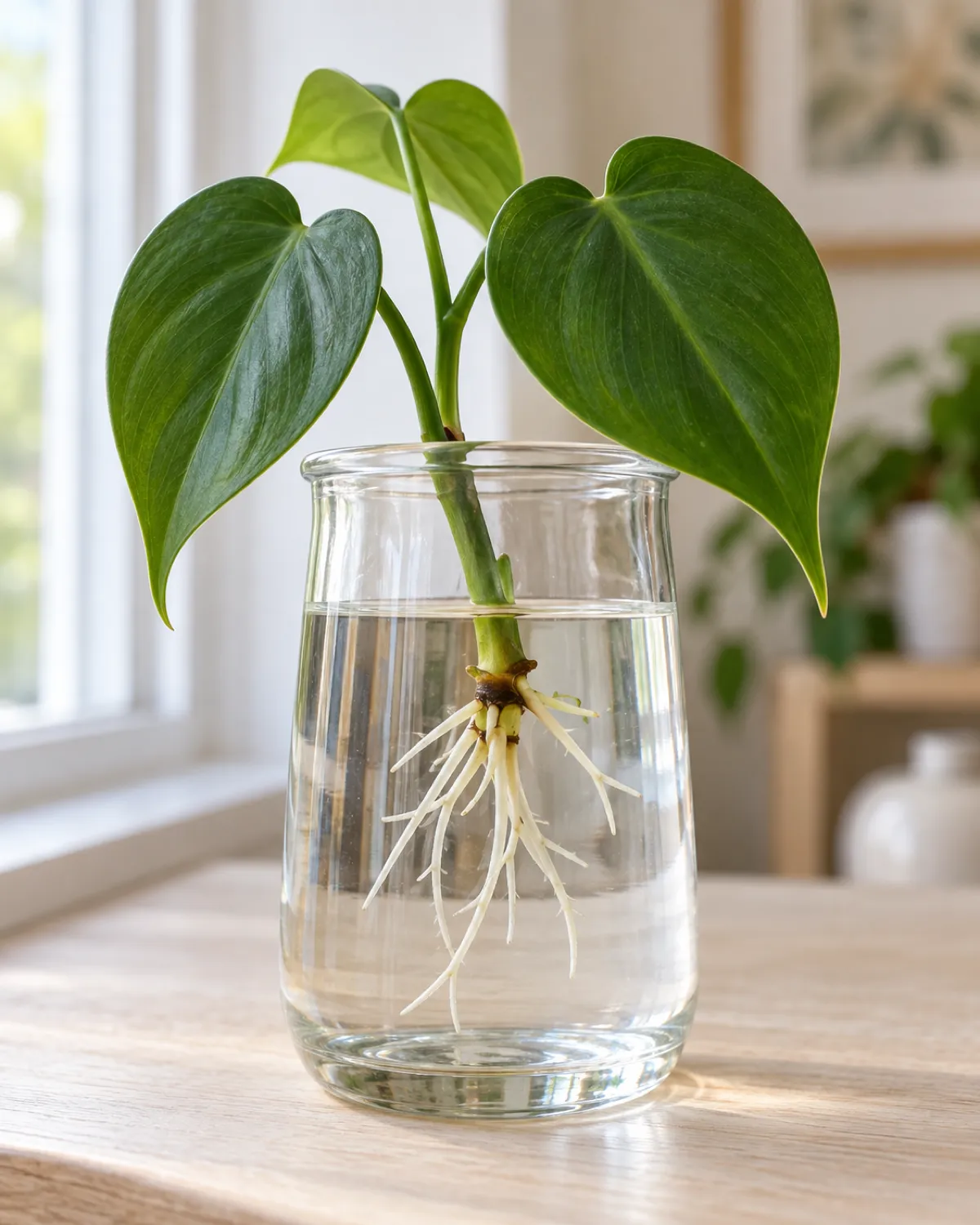
Vining philodendrons — heartleaf, brasil, micans, lemon lime — are among the most reliable water propagators because they grow aerial root nubs along the stem that give cuttings a built-in head start.
Those brown nubs are partially differentiated root tissue. When you submerge one, new white roots branch from it within a week — faster than rooting from a bare node alone.
- Time to visible roots: 10–14 days from a bare node, 5–7 days if the cutting includes an aerial root
- Best candidates: heartleaf philodendron, philodendron brasil, philodendron micans
- Self-heading types: upright philodendrons like birkin or prince of orange can root in water but are slower and less reliable than vining types
- Node spacing: cut to include one or two nodes — more stem below water means more potential root sites
The key difference between philodendron and pothos water propagation is that philodendron roots tend to be thinner and more delicate. Handle them gently at transplanting time and pot into a very light mix to avoid snapping the new roots.
Monstera Deliciosa — Single-Node Cuttings Worth the Wait
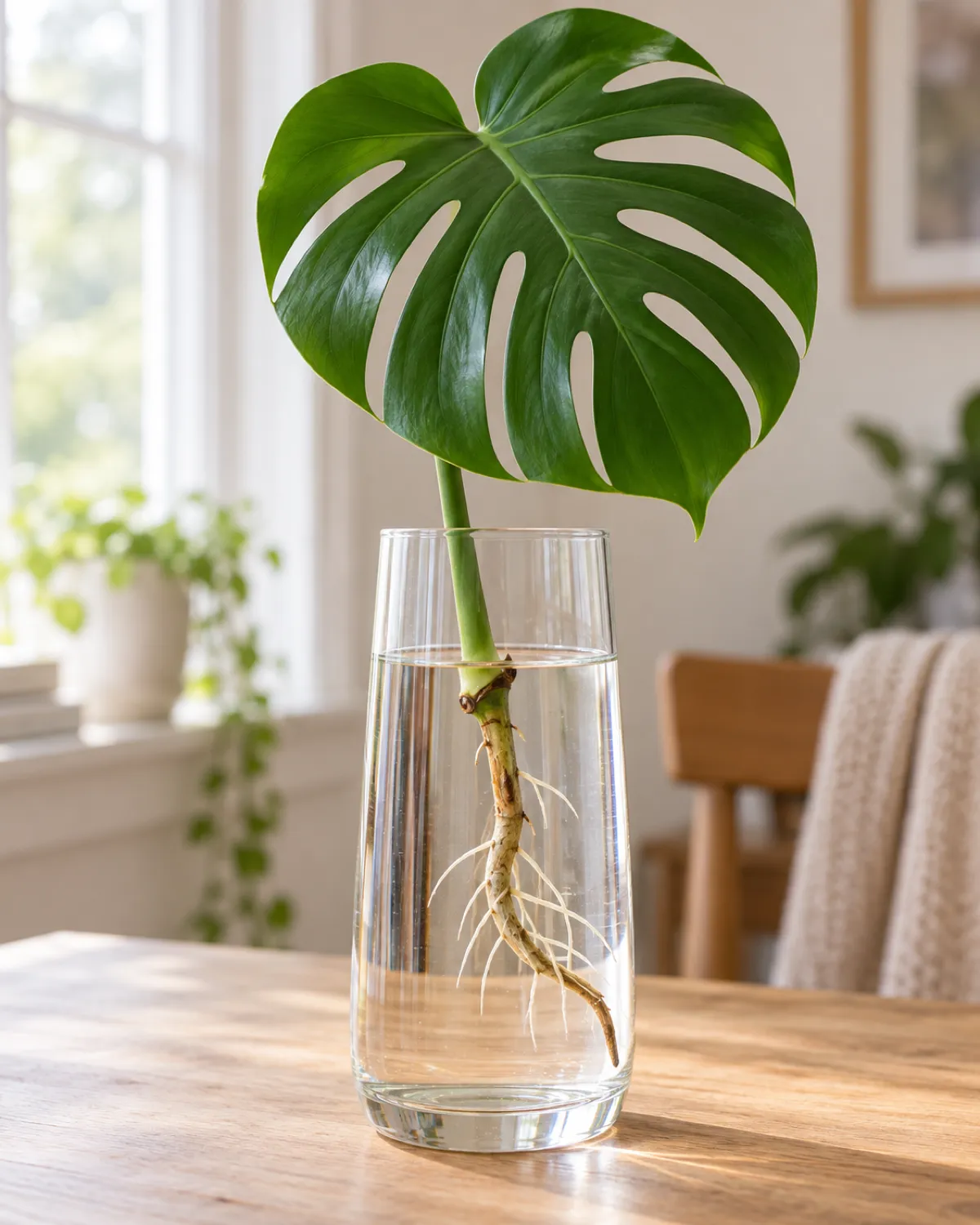
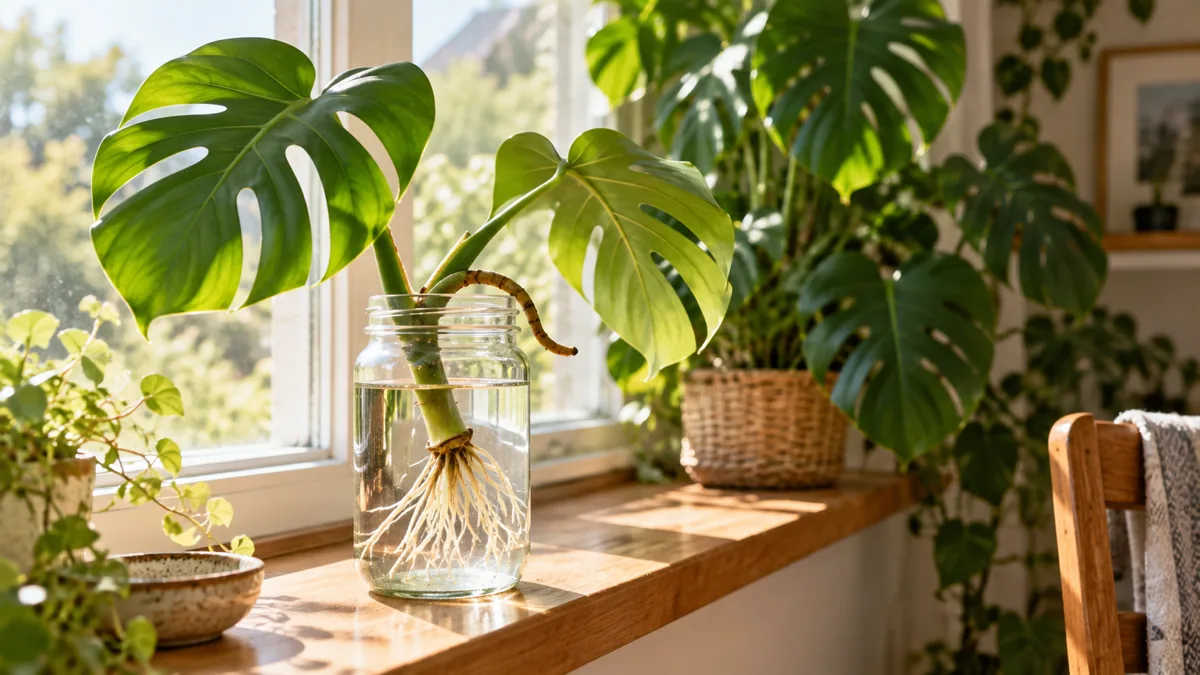
Monstera is the most-searched plant for water propagation, and with good reason — watching a fenestrated leaf perch above a glass vase while roots slowly push from the node below is deeply satisfying. But monstera requires more patience than pothos or tradescantia.
A monstera cutting needs at least one node and ideally an aerial root. The cutting can be a single node with one leaf or a longer section with multiple nodes. Single-node cuttings root just as reliably as multi-node ones, and they let you get more new plants from a single vine.
- Time to visible roots: 3–4 weeks
- Must-have: at least one node with an aerial root for best results
- Water level: shallow — just enough to cover the aerial root and node, not the entire stem
- Water changes: twice weekly to prevent the bacterial film that monstera is especially sensitive to
- Leaf size: a larger leaf means a larger energy reserve, which helps sustain the cutting through the long rooting period
Be patient. Three to four weeks with no visible change is normal. Resist the urge to pull the cutting out and inspect it — every disturbance sets the process back.
Spider Plant — Drop a Baby in Water and Walk Away
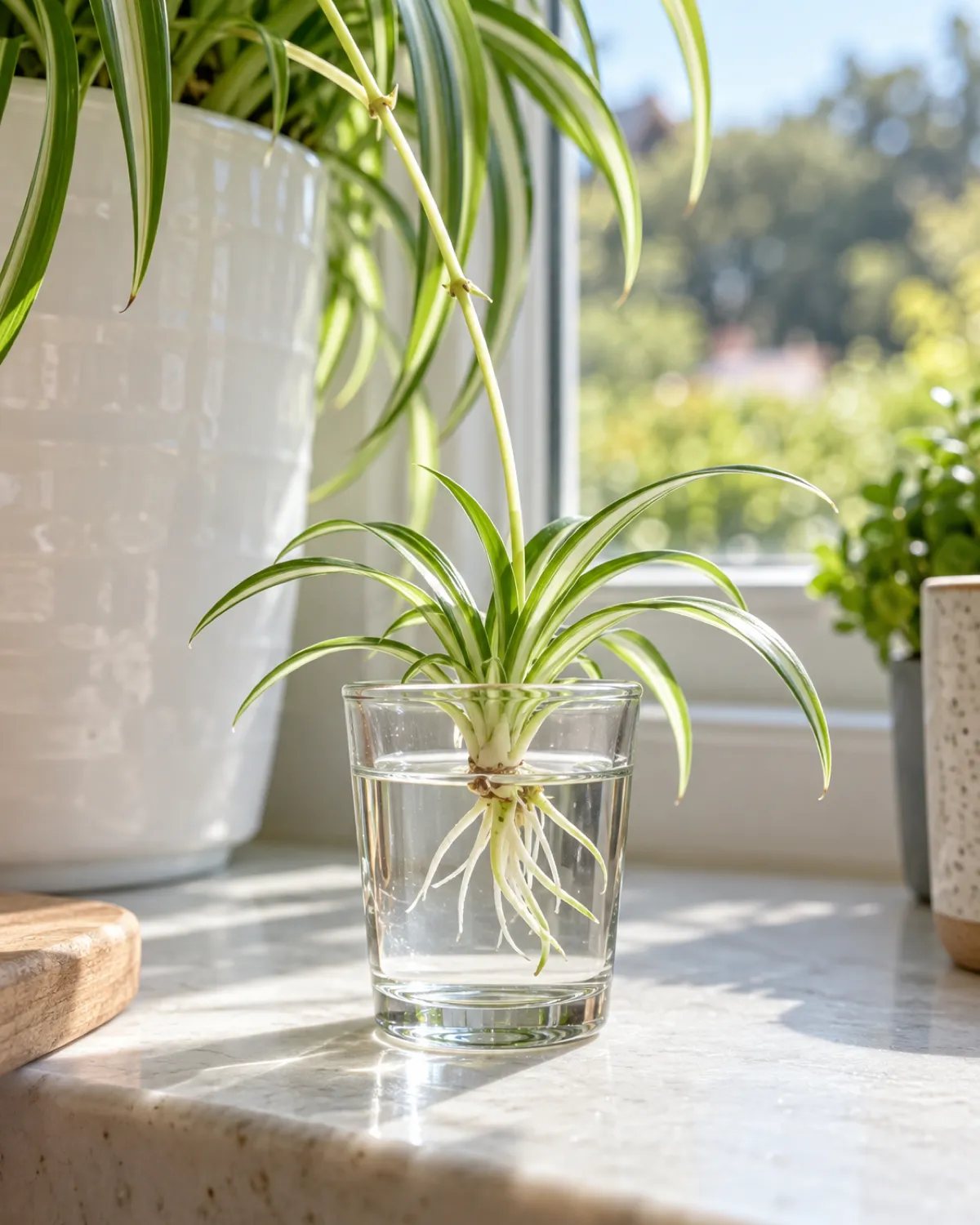
Spider plants make water propagation effortless because they do most of the work themselves. The mother plant sends out long arching stolons tipped with miniature plantlets, and those babies often have root nubs already forming before you even remove them.
Snip the plantlet from the stolon or twist it free gently. Set the base in a shallow dish of water — just enough to cover the root nubs. Roots push out in five to seven days, and the plantlet is ready to pot in about two weeks.
- Time to visible roots: 5–7 days (root nubs are often already present)
- Separation method: snip from stolon with clean scissors, or twist gently — both work
- Water depth: shallow, just the base and root nubs submerged — the leaves should stay dry
- Kitchen windowsill safe: spider plants are non-toxic to cats and dogs, making the kitchen windowsill propagation station worry-free
You can also root spider plant babies while they are still attached to the mother plant. Set a small glass of water below the stolon and rest the plantlet in it. The mother feeds the baby through the stolon while the roots develop, giving the cutting an even higher success rate. Snip the stolon once the roots are an inch long.
Begonia — Cane Stems Root Faster Than You Expect
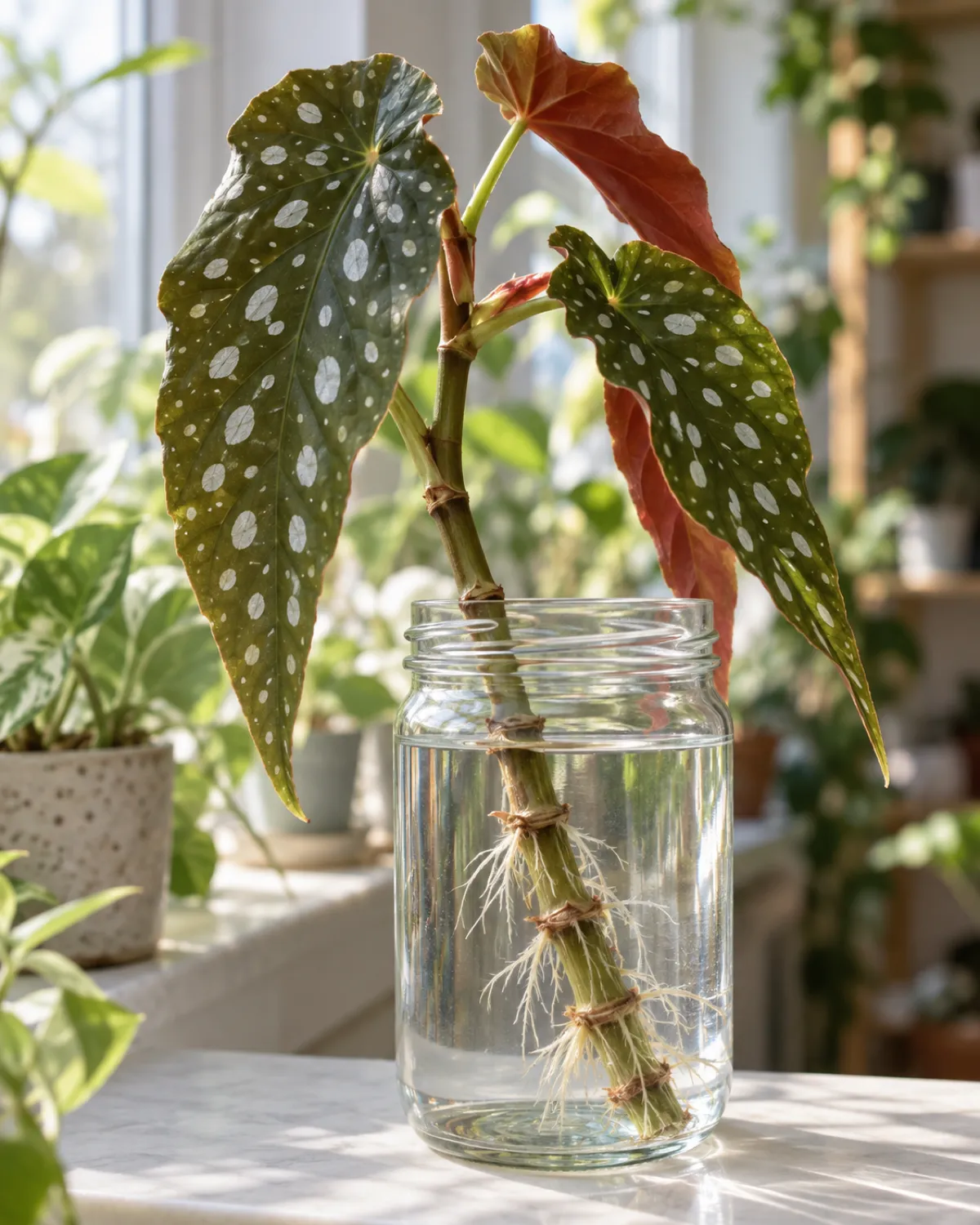
Cane-type begonias — angel wing, maculata, corallina — root remarkably well in water. The thick, bamboo-like stems have clearly defined nodes that produce roots in two to three weeks, and the polka-dot leaves make the propagation jar look like a piece of décor while you wait.
Cut a section of cane that includes two to three nodes and at least two leaves. Strip any leaves from the bottom node that would sit underwater. Place in a jar with enough water to cover one to two nodes.
- Time to visible roots: 2–3 weeks
- Best for water propagation: cane-type begonias (angel wing, maculata, corallina)
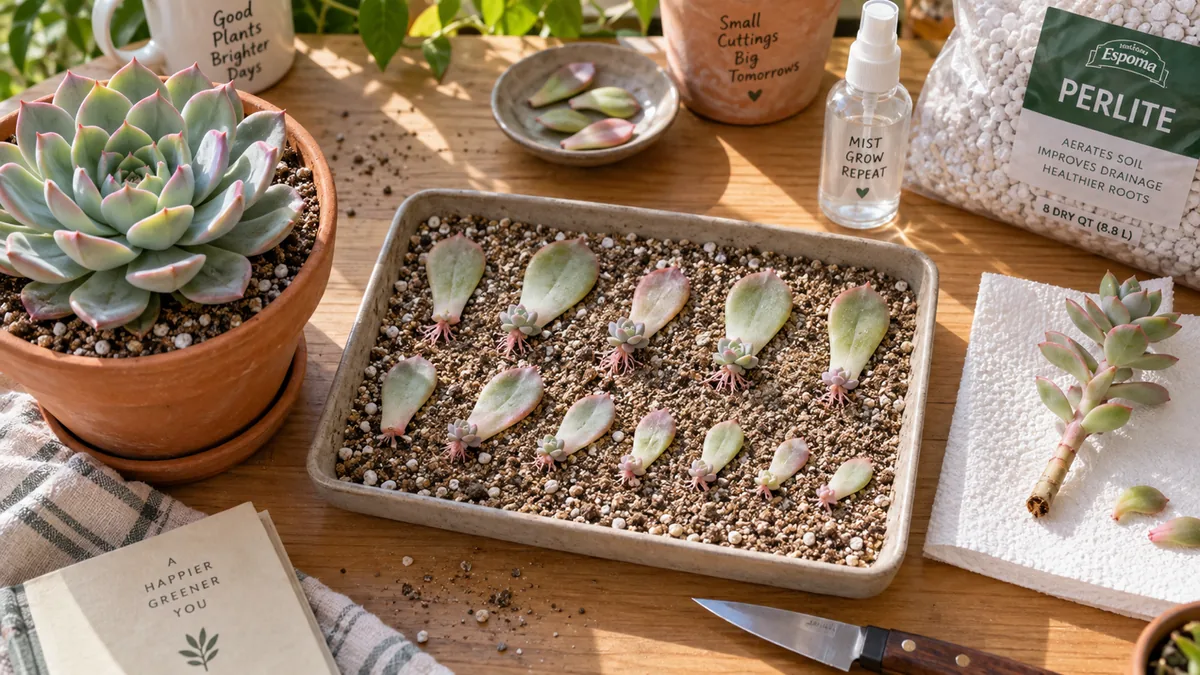
- Not recommended for water propagation: rex begonias — they propagate best by leaf wedge in moist perlite, not water
- Watch for rot: begonia stems are succulent and can rot in warm, stagnant water — change water every four to five days
New growth will emerge from the top node of the cutting while roots develop from the submerged nodes. Once roots are two to three inches long, transplant to soil — begonias do not thrive permanently in water the way pothos does.
Coleus and Chinese Evergreen — Soft Stems and Thick Stems That Both Surprise You
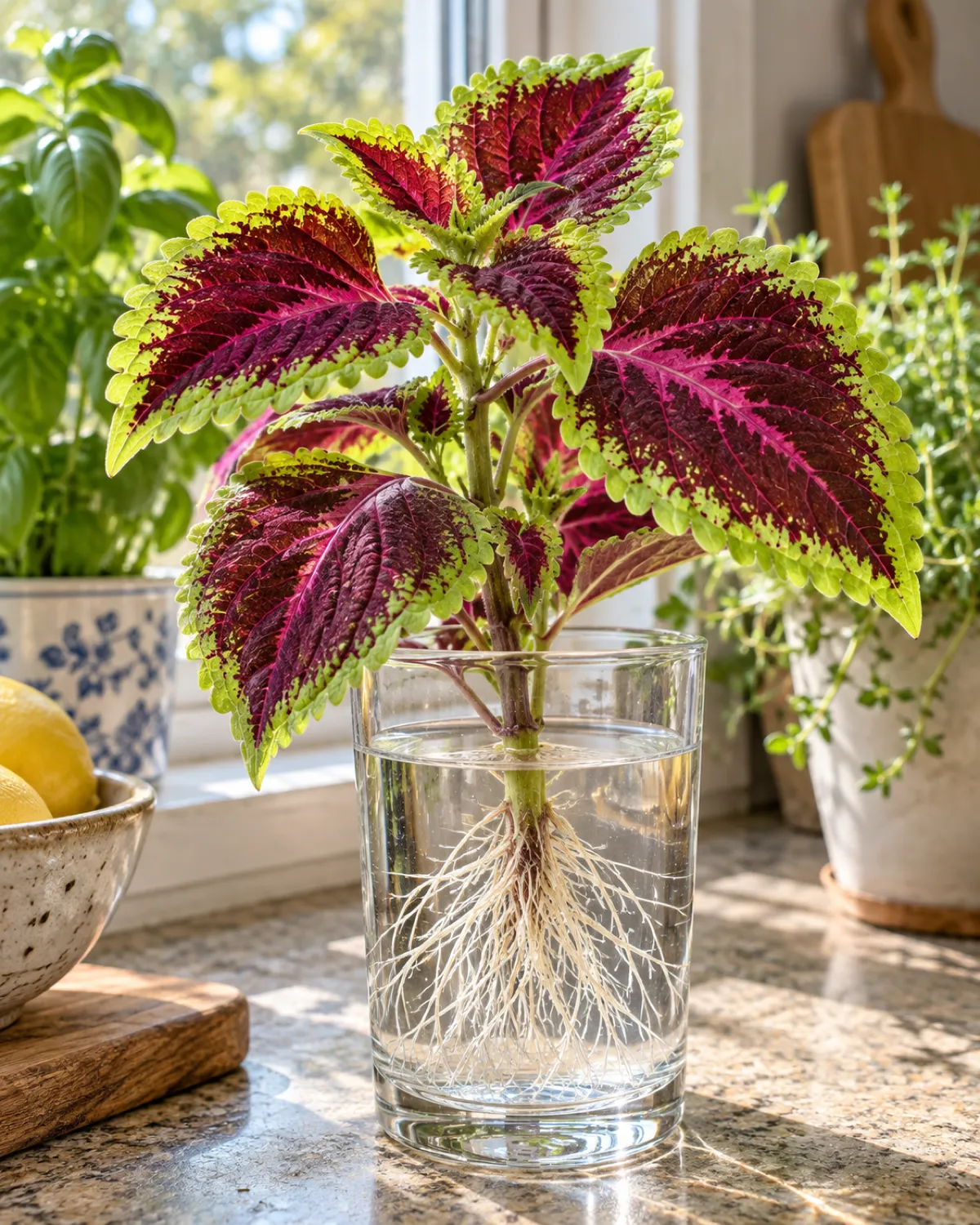
These two plants sit at opposite ends of the stem spectrum — coleus is soft and herbaceous while Chinese evergreen is woody and thick — but both root in water with surprising reliability.
Coleus roots at every submerged node, producing visible roots in seven to ten days. Pinch below a node pair, strip the lower leaves, and drop the cutting in water. The mother plant pushes two new stems from the cut point, becoming bushier each time.
- Coleus roots: 7–10 days, dense root ball from every submerged node
- Permanent water culture: coleus grows indefinitely in water on a sunny windowsill — add liquid fertilizer every two weeks
- Branching bonus: each cut makes the mother plant bushier, so propagation doubles as pruning
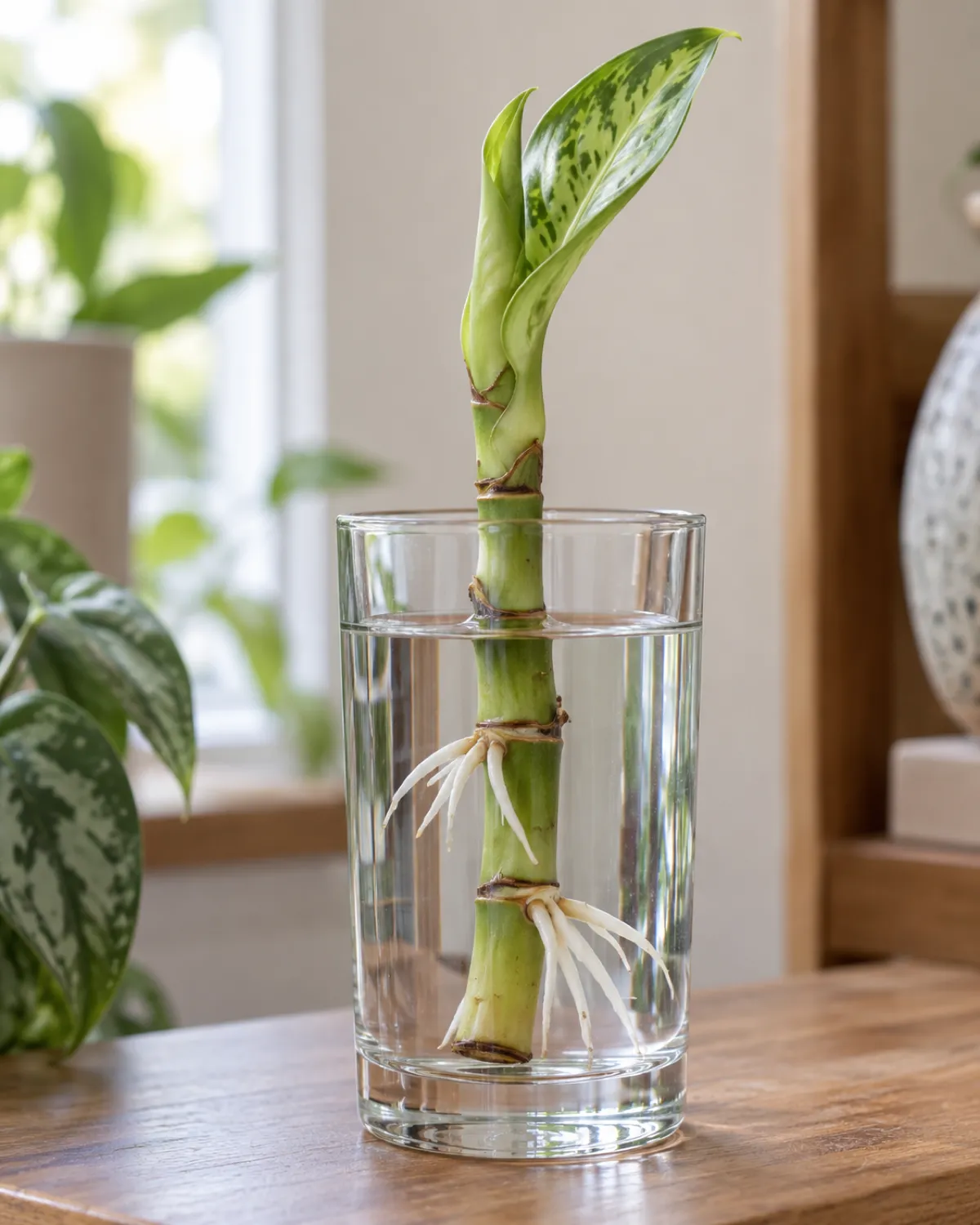
Chinese evergreen takes longer — three to four weeks for visible roots — but thick stem sections with two or three nodes root reliably. Strip all leaves from the submerged nodes, place upright, and change water weekly.
- Chinese evergreen roots: 3–4 weeks, thick stems take longer to break through
- Stem sections work: leafless stem sections root as long as each has at least two nodes — the top bud pushes new growth once roots establish
- Silver varieties: Silver Bay and Silver Queen root just as readily as plain green forms — keep the glass in a warm room for faster results
Syngonium — The Arrowhead Vine That Roots at Every Joint
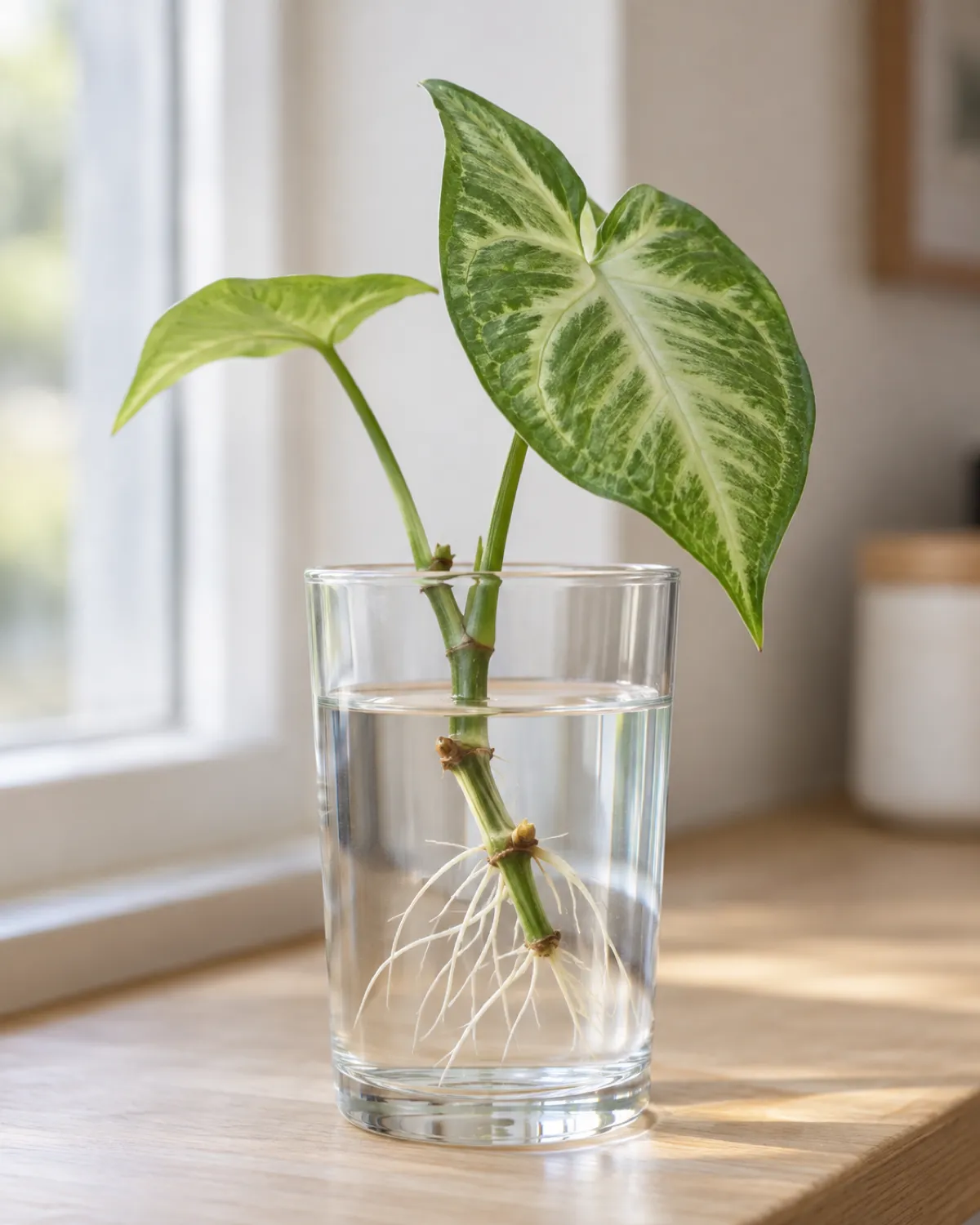
Syngonium stems have visible root bumps at every node — small brown or green nubs that are essentially pre-formed roots waiting for water contact. This makes syngonium one of the most predictable plants for water propagation.
Cut below a node, submerge the node, and roots appear in ten to fourteen days. Single-node sections work just as well as longer cuttings, so one vine can produce a dozen new plants.
- Time to visible roots: 10–14 days
- Node visibility: root bumps are visible as small nubs at every joint, making it easy to identify exactly where to cut
- Juvenile vs mature leaves: cuttings with juvenile arrow-shaped leaves root faster than those with mature lobed leaves
- Pink varieties: pink syngonium and neon robusta root at the same speed as green varieties — variegation does not slow water propagation in this genus
Syngonium is an excellent choice for propagation stations or multi-glass windowsill displays because the compact arrow-shaped leaves look tidy in small containers. Once roots reach two to three inches, transplant to a small pot with standard aroid mix.
Common Mistakes That Kill Water Cuttings
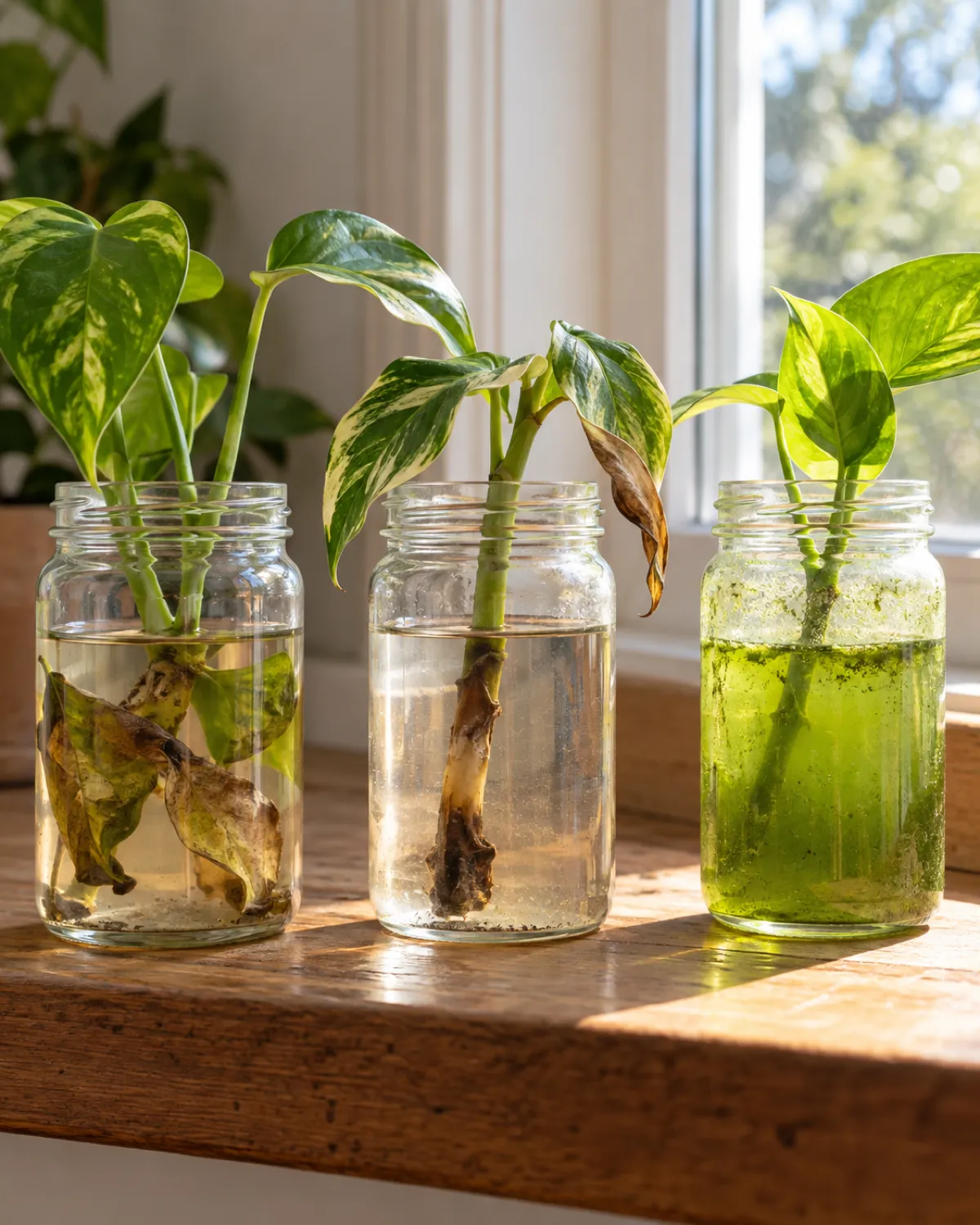
Water propagation is forgiving, but a few mistakes kill cuttings reliably. Most of them are preventable by understanding what the cutting actually needs — a clean node in fresh water with bright indirect light.
The number one killer is cutting between nodes. No amount of rooting hormone, fresh water, or patience will make a stem segment without a node produce roots. If your cutting has been sitting in water for three weeks with no root growth, pull it out and check — if there is no node on the submerged portion, start over with a new cutting.
- Cutting between nodes: no dormant root cells means no roots, ever — always cut below a visible node
- Submerged leaves: leaves rotting underwater cloud the water with bacteria that suffocate new root tissue — strip every leaf below the waterline before placing
- Stagnant water: forgetting water changes allows bacteria to multiply and oxygen to deplete — full change weekly, more often for soft-stemmed plants
- Too much direct sun: direct sunlight heats the water, accelerates bacterial growth, and causes algae — bright indirect light is ideal
- Too-deep containers: only the node and an inch of stem need to be submerged — the rest of the stem should be in air
- Moving cuttings back and forth: transferring a cutting from water to soil to water again stresses the roots — once you start in water, stay in water until transplanting
If a cutting is rotting, cut above the rot, let the fresh cut dry for an hour, and start again in clean water. A cutting with a healthy node can restart the rooting process even after a failed first attempt.
Moving Water Roots to Soil Without Losing the Plant
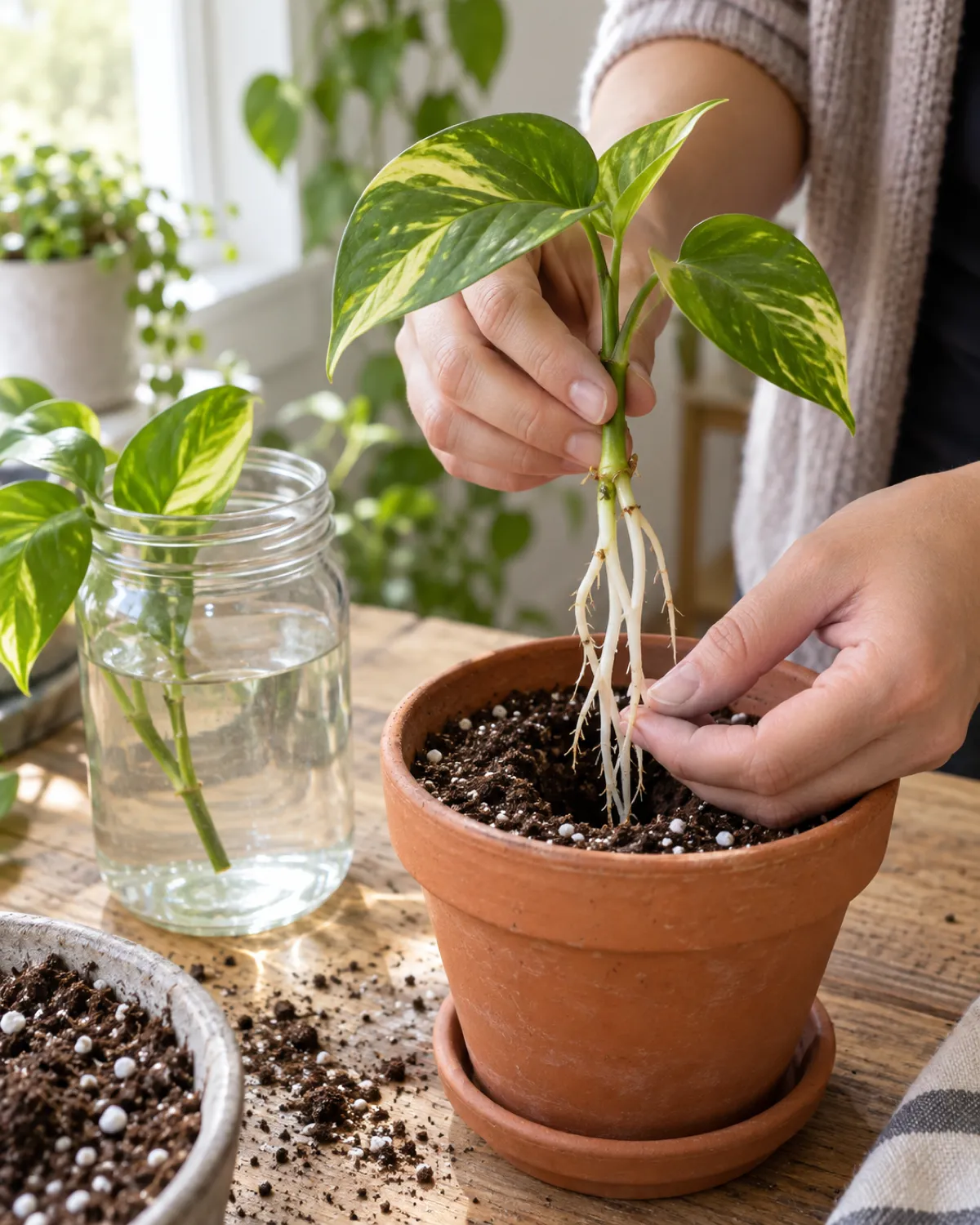
The transition from water to soil is the moment most water-propagated plants are lost. Water roots are structurally different from soil roots — they are thinner, more fragile, and have fewer root hairs. Plunging them into dense potting soil crushes the delicate tissue and suffocates the roots that have never had to push through resistance.
The fix is a gradual transition. Transplant when roots are two to three inches long — long enough to anchor in soil but young enough to adapt. The longer a cutting sits in water, the more specialized its water roots become and the harder the switch.
- Transplant timing: roots 2–3 inches long — earlier if the plant is fast-growing like tradescantia, later risks harder transition
- Soil choice: light, airy mix with extra perlite — never dense standard potting soil — water roots need air pockets to survive the switch
- Watering after transplant: keep the soil consistently moist for the first two weeks so the water-adapted roots do not dry out during the transition period
- Transplant shock is normal: expect some leaf drooping for the first week — the plant is building new soil-adapted roots while the water roots restructure
- Humidity boost: cover the newly potted cutting with a clear plastic bag or cloche for a few days to reduce moisture loss while the roots adapt
- The window: if you wait until roots are six inches or longer, the transition becomes much harder and leaf loss is almost guaranteed
The best recipe for the transition pot is equal parts standard potting mix, perlite, and orchid bark. This gives the water roots the airiness they need while still providing enough moisture retention to support the cutting through the transition.
13 Water Propagation Essentials Worth Bookmarking
- 1Auxin pools at the cut end and triggers root cellsCut below a node so the hormone hits the dormant root cells — cut between nodes and nothing happens.
- 2Find the node before you cutThe bump where a leaf meets the stem is the only spot that can grow roots. Miss it and the cutting rots.
- 3Clear glass lets you watch and catch rot earlyYou see roots lengthen day by day and spot brown mushy stems before they ruin the water.
- 4Pothos roots in seven days almost every timeThe easiest first propagation — any node, any variety, any season.
- 5Tradescantia roots in three days flatThe fastest-rooting houseplant most people will ever grow.
- 6Philodendron aerial roots give a head startSubmerge the brown nub and white roots branch from it in under a week.
- 7Monstera needs patience — three to four weeksSingle-node cuttings with an aerial root are the way. Worth the wait.
- 8Spider plant babies already have root nubsSnip the plantlet, set it in water, and roots push out in five days.
- 9Cane begonias root from thick stemsAngel wing and maculata root in two to three weeks — rex types need leaf wedge instead.
- 10Coleus roots fast, Chinese evergreen roots slow — both workSoft stems in seven days, thick stems in three weeks. Every node counts.
- 11Syngonium has visible root bumps at every jointArrow-shaped leaves and predictable rooting in ten to fourteen days.
- 12Stagnant water and submerged leaves kill cuttingsFull water change weekly and strip every leaf below the waterline before placing.
- 13Transplant when roots hit two to three inchesUse a light airy mix and keep the soil moist for two weeks while the water roots adapt.
kultivy.com
FAQ
Can all houseplants be propagated in water?
No — only plants with adventitious root cells at their nodes root reliably in water. Good candidates include:
- Most aroids: pothos, philodendron, monstera, syngonium
- Tradescantia, coleus, and spider plant babies
- Cane-type begonias (angel wing, maculata)
Woody-stemmed plants, most succulents, and cacti cannot root in water or rot before roots appear. Rex begonias need leaf-wedge propagation in moist perlite instead.
How often should I change the water for propagation?
Once a week for most plants. Soft-stemmed cuttings like tradescantia and coleus benefit from changes every three to four days because their stems decompose faster.
- Dump the old water completely — never just top off
- Rinse the glass to remove biofilm
- Refill with room-temperature filtered or dechlorinated water
Why are my water cuttings rotting instead of rooting?
Three common causes:
- Submerged leaves decomposing and clouding the water
- Cutting between nodes where no root cells exist
- Forgetting to change water for weeks
If the stem is brown and mushy, cut above the rot into green tissue, let the fresh cut dry for an hour, then restart in a clean glass with fresh water.
Can a plant live in water permanently?
Some can. The best candidates for permanent water culture:
- Pothos — thrives for years in water with weekly changes
- Lucky bamboo — a classic water-only houseplant
- Coleus and tradescantia — grow indefinitely with a drop of liquid fertilizer every two weeks
Most other plants decline over time because they need the microbial ecosystem that soil provides.
Do I need rooting hormone for water propagation?
For these plants, no. Rooting hormone can speed things up by a day or two, but the effect is marginal when the cutting naturally pools auxin at the cut end. Save rooting hormone for difficult woody cuttings and soil propagation.

Mara Quinn edits Kultivy, where she shares houseplant care, propagation, beginner-friendly plant picks, and plant-styling ideas for anyone who wants their indoor plants to actually thrive. Every guide is image-led and reviewed for clarity, usefulness, image accuracy, and Pinterest-to-page alignment before it goes live. Visit the About page.