- Diagnose Your Lawn in 60 Seconds
- Know Your Grass Type (It Changes Everything)
- The 4 Things That Actually Matter Your First Year
- Your First-Year Zone 7 Lawn Care Calendar
- 5 Things That Can Absolutely Wait Until Year Two
- The Mistakes I Made So You Don’t Have To
- Common Lawn Problems and What They’re Telling You
- The Honest Weekly Routine (30 Minutes)
- Frequently Asked Questions
Lawn Care 101: A First-Year Homeowner’s Honest Playbook
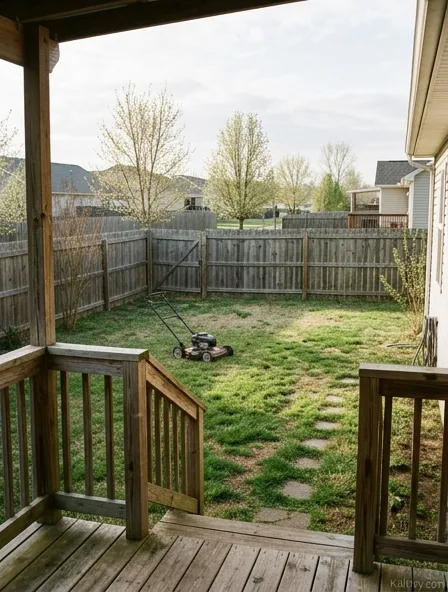
A first homeowner lawn can look like it has been through a small war: patchy grass, a dandelion army, and a strip of bare dirt along the fence that may or may not have been lawn at some point.
Search for “lawn care for beginners” and it is easy to drown in 13-step advice about soil tests, broadcast spreaders, pre-emergent herbicide, and dethatching rakes. For a first-year homeowner, that much information can make doing nothing feel easier.
For most first-year homeowners, lawn care for beginners does not require 13 steps. It requires four core habits. Everything else is extra credit that can wait until year two. This playbook keeps the focus on actual numbers, Zone 7 timing examples, and common mistakes to avoid first.
Regional and safety note: This guide uses Zone 7 and common transition-zone lawns as the example. Grass type, watering rules, fertilizer limits, and pesticide rules vary by location. Follow product labels, local regulations, and your cooperative extension office for site-specific guidance.
Diagnose Your Lawn in 60 Seconds
Before you buy a single product, walk outside and answer three questions. Your answers determine where you start.
Question 1: What color is your grass right now? If it’s green in spring and fall but brown in summer, you likely have a cool-season grass (tall fescue, Kentucky bluegrass, or perennial ryegrass). If it’s green in summer and brown in winter, you have a warm-season grass (bermuda, zoysia, or St. Augustine). In many Zone 7 transition-zone lawns, grass that stays green from April through October with a brownish winter is often tall fescue or a fescue-bluegrass blend.
Question 2: Can you see bare soil? If more than 30% of your lawn shows dirt, you have a density problem that mowing and watering alone won’t fix. You’ll need overseeding — but not until fall. Mark it on your calendar and keep reading.
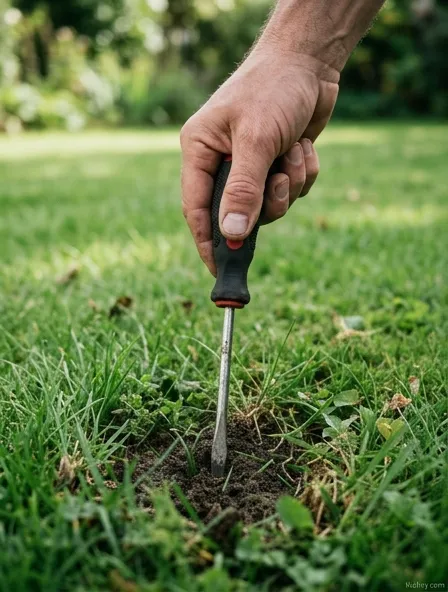
Question 3: Does the ground feel rock-hard when you push a screwdriver into it? If a standard screwdriver won’t sink past 2 inches, your soil is compacted. That means water, air, and fertilizer can’t reach the roots. You’ll need aeration — also a fall project. For now, just note it.
Many first-year homeowners answer “cool-season or transition zone,” “some bare spots,” and “pretty hard.” That is normal, and it is still enough information to start with the right basics.
Know Your Grass Type (It Changes Everything)
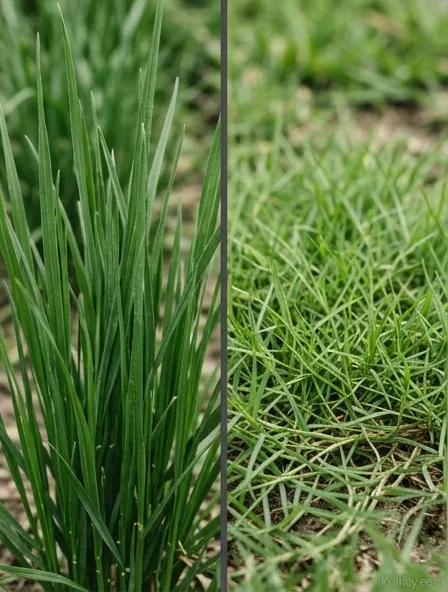
A common beginner mistake is mowing every lawn at the same height. Bermuda in Zone 8 and tall fescue in Zone 7 need very different cuts. Mowing tall fescue at 2 inches is basically a buzz cut it never asked for, and the result is usually thin, stressed grass with more weeds.
Grass type determines your mowing height, watering schedule, fertilizer timing, and when to overseed. Get this one thing right and every other decision gets easier.
Cool-Season Grasses
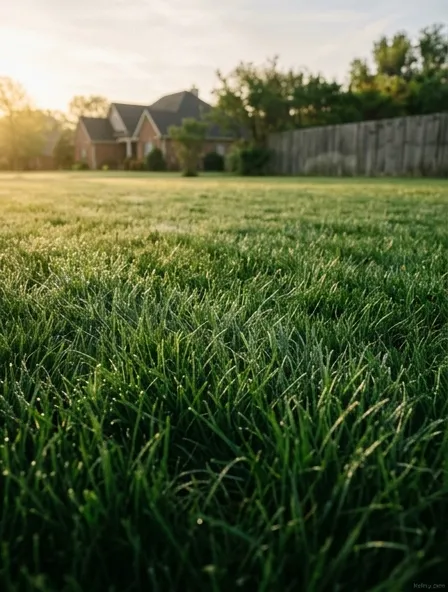
These grow in the northern half of the U.S. and the transition zone (roughly Zones 5–7). They love spring and fall when temps sit between 60°F and 75°F. They slow down or go dormant in summer heat and survive winter cold.
Tall Fescue is the workhorse of Zone 7 lawns. Deep roots, decent drought tolerance, stays green longer than bluegrass in summer. It grows in bunches rather than spreading, so bare spots need reseeding. Mow at 3–4 inches.
Kentucky Bluegrass is the classic dark-green, fine-textured lawn grass. It spreads by underground runners and fills in bare spots on its own, which is a huge perk. The trade-off: it needs more water and fertilizer than fescue and struggles in summer heat without irrigation. Mow at 2.5–3.5 inches.
Perennial Ryegrass germinates faster than anything — 5 to 10 days — so it’s often mixed with bluegrass and fescue for quick fill-in. It doesn’t spread on its own. Mow at 2.5–3.5 inches.
Warm-Season Grasses
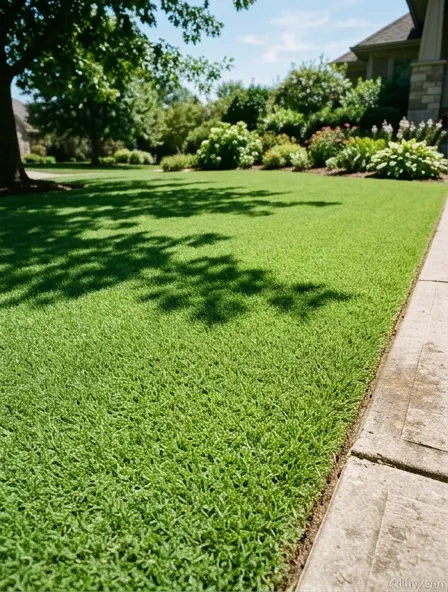
These dominate the southern half of the country and the lower edges of Zone 7. They peak in summer when temps hit 80–95°F and go brown and dormant once nighttime temps drop below 55°F consistently.
Bermuda Grass is aggressive, durable, and handles foot traffic like a champ. It spreads fast and recovers from damage quickly. Loves full sun, hates shade. Mow low at 1–2 inches.
Zoysia Grass is a dense, carpet-like grass that tolerates heat and moderate cold. It’s slower to establish than bermuda but gorgeous once mature. Handles some shade. Mow at 1.5–2.5 inches.
St. Augustine Grass has wide, flat blades and thrives in humid, coastal, warm climates. It handles shade better than most warm-season grasses. Not common in Zone 7 proper. Mow at 3–4 inches.
Grass Type Comparison Chart
| Grass Type | Season | Mow Height | Water (in/wk) | Sun Needs | Spreads? | Drought Tolerance | Zone 7 Common? |
|---|---|---|---|---|---|---|---|
| Tall Fescue | Cool | 3–4″ | 1 | 4–6 hrs | No (bunching) | Good | Yes — most common |
| Kentucky Bluegrass | Cool | 2.5–3.5″ | 1.5 | 6+ hrs | Yes (runners) | Moderate | Yes — in blends |
| Perennial Ryegrass | Cool | 2.5–3.5″ | 1 | 6+ hrs | No (bunching) | Low | Yes — in blends |
| Bermuda Grass | Warm | 1–2″ | 1 | 8+ hrs | Yes (aggressive) | High | Lower Zone 7 |
| Zoysia Grass | Warm | 1.5–2.5″ | 0.75–1 | 6+ hrs | Yes (slow) | High | Lower Zone 7 |
| St. Augustine | Warm | 3–4″ | 1–1.5 | 4–6 hrs | Yes (stolons) | Low | Rare |
If you’re not sure what you have, pull a small plug of grass and soil from your lawn and take it to your local cooperative extension office or a good garden center. They’ll identify it in minutes, usually for free. For plant health, pest, or soil concerns, your local extension office or a certified professional can give advice tailored to your area. Everything in this guide flows from that one answer.
The 4 Things That Actually Matter Your First Year
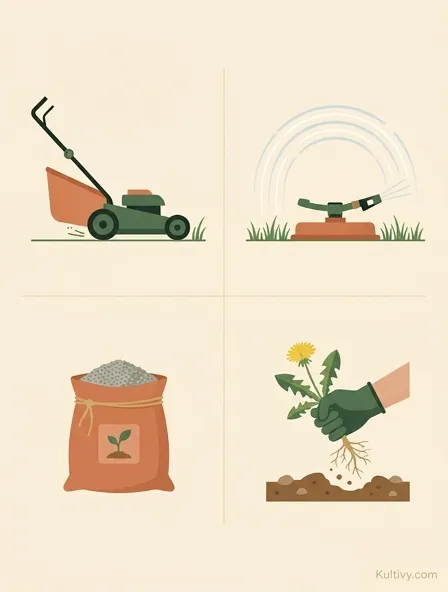
Every lawn care article wants to give you a dozen steps. For the first year, focus on four. These are the habits that make the biggest visible difference for a typical beginner lawn. Everything else — soil tests, aeration, dethatching, pre-emergent timing — is genuinely useful, but it is year-two material for many homeowners. Trying to learn it all at once is how you end up closing browser tabs and doing nothing.
1. Mow High, Mow Often, Mow Sharp
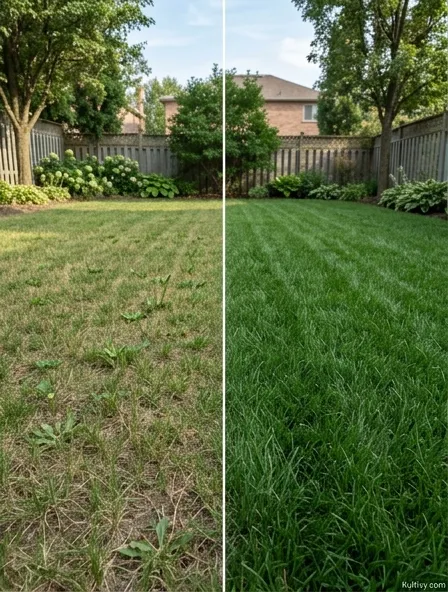
Mowing is the task you’ll do most often, and it has one of the biggest returns on effort. Get it right and your lawn gets thicker, greener, and more weed-resistant. Get it wrong for a few months and you are basically inviting every dandelion seed in the neighborhood to move in.
Mow high. Set your mower to the recommended height for your grass type (see the chart above). For the tall fescue that dominates many Zone 7 lawns, that is 3 to 4 inches. It may feel like you are not cutting enough. Do it anyway. Taller grass shades the soil, helps reduce water evaporation, keeps soil temperatures lower, and blocks sunlight from reaching weed seeds. A taller blade also supports a deeper root system.
Mow often. Follow the one-third rule: never cut more than one-third of the blade height in a single pass. If your target is 3.5 inches, mow when it reaches about 5 inches. During peak growth in Zone 7 (April–May and September–October), that means mowing every 5 to 7 days. In summer, every 7 to 10 days. Skip the calendar and watch the grass instead.
Mow sharp. A dull blade tears grass instead of cutting it. Torn tips turn brown within a day and become entry points for disease. Sharpen your mower blade at least once a season — twice if you mow over 25 times a year. A sharpening file or bench grinder takes 15 minutes, or your local hardware store will do it for $10–15.
Two more rules: alternate your mowing direction each time (north-south this week, east-west next week) to prevent ruts and soil compaction. And leave the clippings on the lawn. They decompose in days and return up to 25% of your lawn’s annual nitrogen needs back to the soil. Free fertilizer. The only time to bag clippings is when they clump so thick they smother the grass underneath.
Time investment: 20–40 minutes per mow, once a week during peak season.
2. Water Deeply and Infrequently
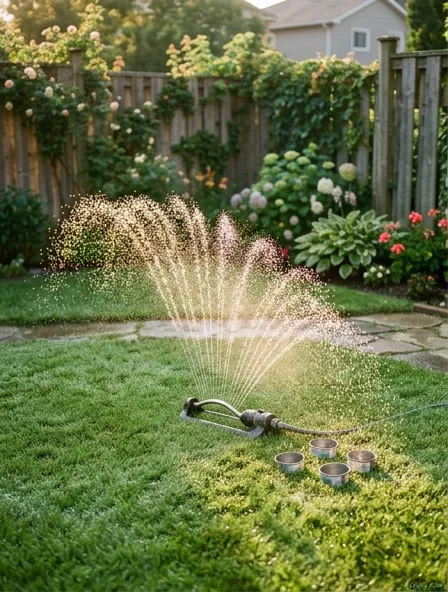
This is where many beginners go wrong for an entire summer: watering a little bit every single day because it feels like the careful thing to do. The result is shallow roots, fungal pressure, and a lawn that wilts quickly when watering stops. Daily light watering trains roots to stay near the surface, where they struggle with heat and drought. You want roots growing 4 to 6 inches deep, and you get there by making them work for it.
The one-inch rule: most lawns need about 1 inch of water per week, including rainfall. That’s it. Deliver that inch in one or two deep sessions rather than seven shallow sprinkles.
How to measure: set a few empty tuna cans or straight-sided cups around your lawn. Run your sprinklers and check how long it takes to collect ½ inch of water. That’s your session time, run twice per week. Most standard sprinklers take 20–30 minutes to deliver ½ inch.
When to water: between 6 AM and 10 AM. Morning watering lets blades dry before evening, which helps reduce fungal disease. Evening watering leaves grass wet overnight and can contribute to brown patches, especially during humid summer weather.
How to check soil penetration: after watering, push a screwdriver into the soil. It should slide easily to 4–6 inches. If it stops at 2 inches, your session was too short. If the soil is still soggy 24 hours later, it was too long.
Signs your lawn is thirsty (before it goes brown): footprints that stay visible for more than 30 seconds after you walk across the grass, a bluish-gray tint instead of bright green, or leaf blades that fold in half lengthwise. If you notice any of these, water within 24 hours.
Time investment: 5 minutes to set up sprinklers, twice a week. The sprinkler does the rest.
3. Feed It Twice a Year (That’s Enough)

Fertilizer overwhelms many first-year homeowners. Nitrogen ratios, slow-release vs. quick-release, organic vs. synthetic, liquid vs. granular — it can feel like chemistry class. For your first year, two carefully labeled applications of a basic granular fertilizer is usually plenty for a typical lawn. You do not need to optimize. You need to feed the grass without overapplying nutrients.
The two feeds that matter:
For cool-season grass in Zone 7, the most important feed is in early fall (September). This is when fescue and bluegrass are growing most aggressively, putting down deep roots and thickening up. The second feed goes down in mid-spring (April), at half the rate listed on the bag, to support green-up without pushing too much tender growth before summer heat.
For warm-season grass in Zone 7, flip it: the primary feed is in late spring (May) when the grass is fully green and actively growing. A second feed in midsummer (July) keeps it going. Stop fertilizing by mid-September — late feeding pushes new growth that gets killed by the first frost.
Understanding NPK (the three numbers on the bag): every fertilizer label shows three numbers like 24-0-11. The first is nitrogen (N) — drives green leaf growth and is the most important number for lawns. The second is phosphorus (P) — supports roots, but most established lawns don’t need extra. The third is potassium (K) — helps the grass resist stress, drought, and cold. For general maintenance, look for a fertilizer with a high first number, low or zero middle number, and a moderate third number.
The one rule that prevents burning: never apply more than 1 pound of nitrogen per 1,000 square feet in a single application unless a soil test or qualified local guidance tells you otherwise. The bag’s label tells you the spreader setting to achieve the intended rate. Follow it exactly. More is not better; overapplication can create brown stripes and nutrient runoff risk. Always follow label directions, avoid applying before heavy rain, and consult your extension office if your area has fertilizer restrictions.
Time investment: 20–30 minutes per application, twice a year.
4. Mow Out the Weeds (Seriously, That’s the Strategy)
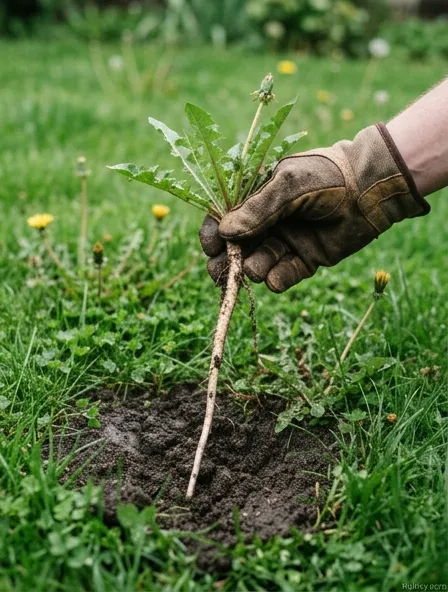
This surprises many beginners: weed control does not always start with bottles of herbicide. Herbicides exist and can work when used correctly, but a thick, tall, well-fed lawn is the best baseline weed control. Dense turf shades the soil surface and physically blocks weed seeds from germinating.
If you are doing the first three things in this guide — mowing high, watering deeply, and feeding twice a year — you are already fighting much of your weed battle. Many first-year weed problems are really symptoms of a thin, scalped, overwatered lawn. Raising the mowing height and fixing the watering schedule can reduce weed pressure before any spray enters the conversation.
For the weeds that still show up, hand-pull them after a rain when the soil is soft. Grab the base and pull slowly to get the root. A stand-up weed puller tool saves your back on dandelions and other taproot weeds. Ten minutes after each mow, walk the lawn and pull what you see. That’s the whole system for year one.
When you’re ready for year two, you can consider pre-emergent herbicide in early spring (when soil temps approach 55°F, which in Zone 7 is typically mid-March, around when forsythia blooms). Pre-emergent creates a barrier that stops crabgrass and other annual weed seeds from sprouting. But it also stops grass seed from germinating, so never apply it if you’re planning to overseed within 6–8 weeks. This is a year-two optimization, not a requirement for your first season. If you use any herbicide, follow the product label, keep it away from drains and waterways, and obey local rules.
Time investment: 10 minutes of hand-pulling after each mow.
Your First-Year Zone 7 Lawn Care Calendar
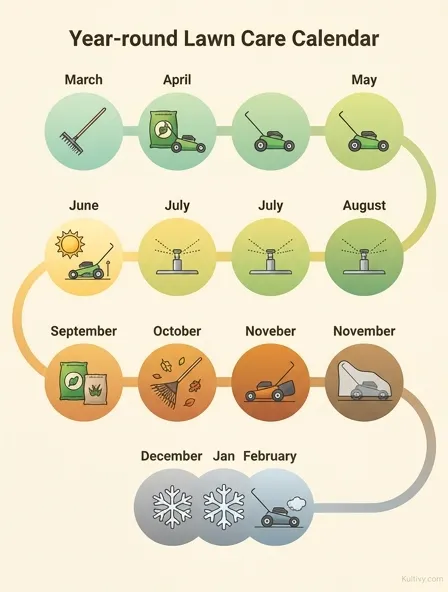
A simple month-by-month calendar is often easier than a long list of chores. The calendar below assumes cool-season grass (tall fescue or fescue-blend), which is what many Zone 7 lawns have. If you have warm-season grass, a different USDA zone, watering restrictions, or a local nutrient ordinance, shift the mowing, watering, and feeding windows to match your grass and local rules.
| Month | What to Do | Time Needed |
|---|---|---|
| March | First mow when grass reaches ~5 inches (set blade to 3.5″). Sharpen mower blade. Clean up winter debris. | 1 hour total |
| April | Apply spring fertilizer at half rate. Begin weekly mowing. Start watering 1″/week if rain is short. | 30 min/week |
| May | Continue weekly mowing. Monitor for dry spells. Hand-pull visible weeds after mowing. | 30 min/week |
| June | Raise mowing height by ½ inch for summer. Water deeply 1–2× per week. Mow every 7–10 days. | 30 min/week |
| July–August | Maintain summer mowing and watering. Grass growth slows — mow less often. Don’t fertilize cool-season grass. | 20 min/week |
| September | Apply fall fertilizer (most important feed of the year). Resume weekly mowing as growth picks up. Overseed bare spots now if needed. | 1–2 hours total |
| October | Keep mowing as grass grows. Rake or mulch fallen leaves weekly. Water if fall is dry. | 30–45 min/week |
| November | Final mow — lower blade to 2.5″ for the last cut. Remove remaining leaves. Store mower with stabilized fuel or drained tank. | 1 hour total |
| December–February | Stay off frozen grass. Service mower. Plan spring calendar. | 0 min/week |
Total first-year time investment: roughly 30 minutes per week during the active season (March–November), plus a couple of one-hour sessions for fertilizer and seasonal prep. That’s it. You don’t need to live in your yard to have a decent lawn.
5 Things That Can Absolutely Wait Until Year Two
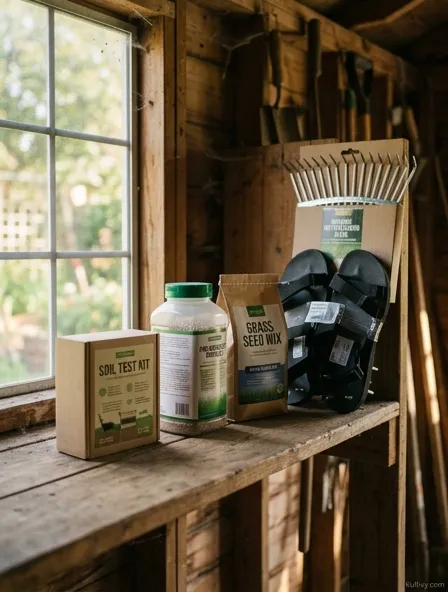
The internet will make you feel like you need to do all of these immediately. You don’t. These are real, useful practices — but they’re optimizations, not foundations. Do the four things above first. Once your lawn is healthier and you’ve got the weekly rhythm down, layer these in one at a time.
Soil Testing
A soil test tells you your pH, nutrient levels, and soil type. It’s genuinely valuable — it turns fertilizer guessing into precision. Your local cooperative extension office offers testing for $10–15. But it’s not urgent for year one. A basic balanced fertilizer applied twice covers most lawns. Get the test in fall of your first year so you can use the results to fine-tune your year-two plan.
Aeration
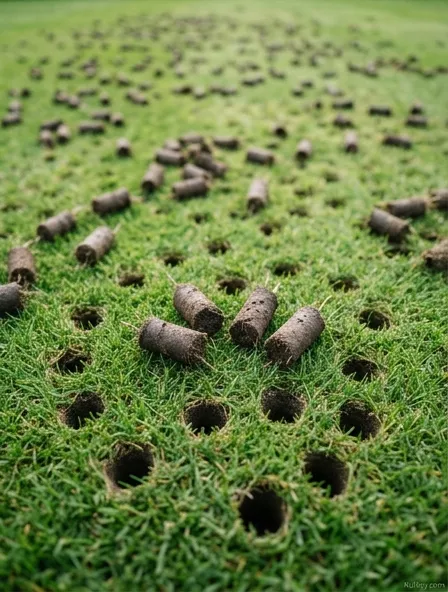
A core aerator pulls 2–3 inch plugs of soil out of your lawn, relieving compaction and letting water and nutrients reach the root zone. It’s transformative for compacted clay soils, which are common in Zone 7. But it requires renting equipment ($50–80/day) or hiring out ($100–200), and the timing matters — early fall for cool-season grass, late spring for warm-season. Add this in year two, ideally paired with overseeding.
Dethatching
Thatch is the layer of dead organic material between the green blades and the soil. A thin layer (under ½ inch) is actually good — it insulates roots and retains moisture. Over ½ inch, it becomes a barrier that blocks water and invites disease. Press your thumb into the lawn: if it feels spongy, you may have a thatch issue. But it builds up slowly, and unless your lawn is genuinely spongy, this can wait.
Pre-Emergent Herbicide
Pre-emergent stops weed seeds from germinating by creating a chemical barrier in the top layer of soil. It can help against crabgrass when used correctly, but it is not a first-year requirement. Timing is everything — apply only according to the label when soil temps approach 55°F (mid-March in Zone 7). It also prevents grass seed from germinating, so you cannot overseed within 6–8 weeks of application. If your lawn has bare spots that need seeding, skip the pre-emergent. This is a year-two tool for lawns that are already thick enough.
Overseeding
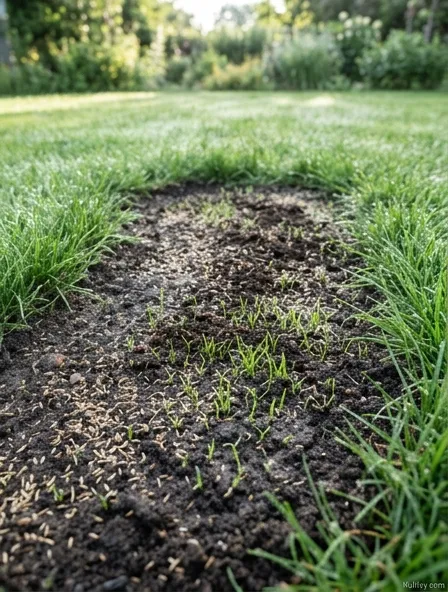
If your lawn has thin areas or bare patches, overseeding introduces new grass seed to fill them in. For cool-season lawns, the window is early fall (mid-September in Zone 7) when soil is warm, air is cool, and weed competition drops. Mow low before seeding, spread seed with a spreader, keep the area consistently moist for 2–3 weeks, and don’t apply pre-emergent. If your lawn is under 30% bare, the four fundamentals above will improve density on their own. If it’s more than 30%, schedule overseeding for September of your first year.
The Mistakes I Made So You Don’t Have To
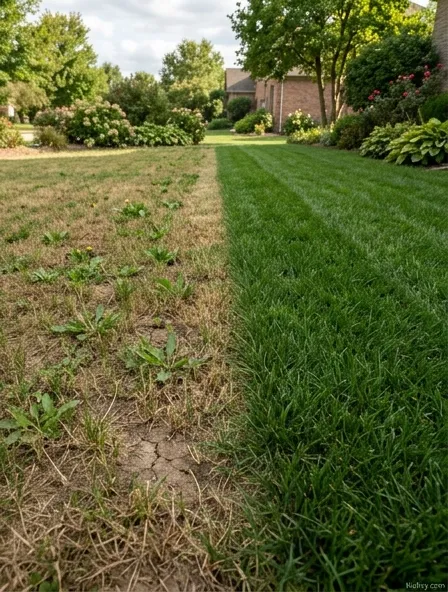
Some of these already came up earlier in the guide. Here is the full list, because it is useful to see exactly how a beginner can go wrong even with good intentions.
Scalping the lawn for months. Setting the mower to 2 inches can work for some bermuda lawns, but it is too low for many fescue lawns. Fescue cut that short often turns thin, brown at the tips, and more weed-prone. Raising the blade toward 3.5 inches is often the turning point.
Watering every day for 10 minutes. It feels responsible, but it often creates a shallow root system and more fungal pressure. Switching to one or two deeper sessions per week is usually a better beginner baseline, adjusted for rainfall, soil, and sprinkler output.
Doubling the fertilizer rate. More food does not equal more green. It can create fertilizer burn, runoff risk, and stressed grass. Follow the bag rates exactly.
Applying pre-emergent and grass seed in the same month. Pre-emergent can prevent new grass seed from germinating. In many programs, pre-emergent and new grass seed should not overlap within a 6–8 week window unless the product label says otherwise.
Ignoring the mower blade. Dull mower blades tear grass instead of cutting it, leaving ragged brown tips. A sharpening file, hardware-store sharpening service, or annual blade replacement can fix a problem that often looks like disease or drought stress.
Panicking about every weed. Spot-spraying every individual dandelion can turn lawn care into whack-a-mole. Once mowing height, watering, and feeding improve, the grass often thickens enough to crowd out many weeds on its own. The remaining weeds can often be hand-pulled after rain.
Common Lawn Problems and What They’re Telling You
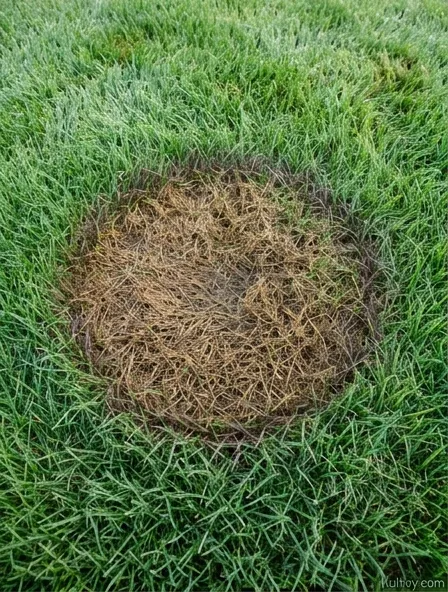
Your lawn communicates through symptoms. Once you know the language, most problems point to one of the four fundamentals.
| Symptom | Likely Cause | Fix |
|---|---|---|
| Brown tips on every blade | Dull mower blade | Sharpen the blade — this alone solves it |
| Brown patches, irregular shapes | Fungal disease from evening watering or overwatering | Water mornings only; reduce frequency to 1–2×/week |
| Thin grass, lots of weeds | Mowing too low (scalping) | Raise mower to recommended height for your grass type |
| Grass wilts by afternoon, footprints stay | Underwatering or shallow roots | Water deeper and less often (1″/week in 1–2 sessions) |
| Yellow-green color, slow growth | Nitrogen deficiency | Apply fertilizer at the next seasonal window |
| Spongy feel underfoot | Thatch buildup over ½ inch | Plan dethatching for next active growth period |
| Water pools on surface after rain | Soil compaction | Plan core aeration for next fall (cool) or late spring (warm) |
| Circular brown patches with green center | Brown patch fungus | Improve drainage and air circulation; reduce nitrogen |
Most of the time, the answer is one of the big four: adjust mowing height, fix watering habits, feed at the right time, or just let the grass get thicker. The diagnostic table above covers 90% of what you’ll encounter in your first two years. For persistent disease or unclear symptoms, contact your local extension office or a turf professional.
The Honest Weekly Routine (30 Minutes)
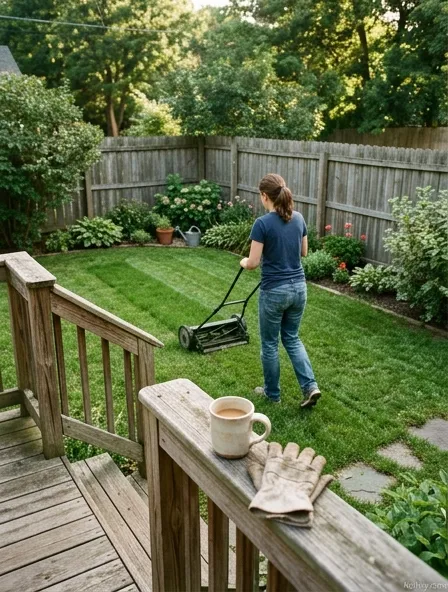
For a beginner, the active-season routine can stay simple. During April through October in a Zone 7 cool-season lawn, a realistic weekly rhythm looks like this:
Saturday morning, 30 minutes total:
Mow the lawn — 15 to 25 minutes depending on yard size. Alternate direction each week. Leave the clippings unless they clump heavily. While mowing, scan the color and look for any brown spots or weed clusters. After mowing, pull obvious weeds — 5 to 10 minutes. If rainfall is short, run the sprinkler in the morning long enough to deliver the needed water for your lawn and sprinkler setup.
That is the routine. It is not glamorous or complicated, but it is the kind of repeatable system that can move a patchy beginner lawn toward something respectable without turning the first year into a full-time hobby.
Start with the four things that matter. Do them consistently for one season. You’ll be surprised how much a lawn can forgive when you finally stop overcomplicating it.
Frequently Asked Questions
How often should a beginner mow their lawn?
During peak growing season, mow once every 5 to 7 days. The key is to follow the one-third rule — mow when your grass is about 50% taller than your target height rather than sticking to a rigid calendar. For tall fescue in Zone 7, that means mowing when it reaches about 5 inches and cutting it back to 3.5 inches. In summer when growth slows, you may only need to mow every 7 to 10 days.
How much water does a lawn actually need per week?
Most established lawns need about 1 inch of water per week, including rainfall, but local watering restrictions, soil type, heat, and grass species can change the target. Deliver water in one or two deep sessions rather than daily light sprinkles when irrigation is allowed. Deep, infrequent watering encourages roots to grow 4 to 6 inches deep. Place empty tuna cans on your lawn to measure how long your sprinkler takes to deliver half an inch per session, then adjust for rainfall and local rules.
When should I fertilize my lawn in Zone 7?
For cool-season grasses like tall fescue (the most common in Zone 7), the most important fertilizer application is in early fall around September, when the grass is growing most aggressively. A second lighter application in mid-spring around April supports green-up. For warm-season grasses like bermuda, the primary feed is in late spring (May) with a second in midsummer (July). Stop fertilizing warm-season grass by mid-September to avoid frost damage to new growth.
What is the best mowing height for grass in Zone 7?
It depends on your grass type. Tall fescue, the most common cool-season grass in Zone 7, should be mowed at 3 to 4 inches. Kentucky bluegrass and perennial ryegrass do best at 2.5 to 3.5 inches. If you have warm-season bermuda grass, mow low at 1 to 2 inches, and zoysia at 1.5 to 2.5 inches. When in doubt, mow higher — taller grass shades the soil, reduces water evaporation, blocks weed germination, and develops deeper roots.
Do I need to aerate my lawn the first year?
Not usually. Aeration is valuable for compacted soil, but it is best treated as a year-two project after you have established consistent mowing, watering, and fertilizing habits. If a screwdriver won’t push more than 2 inches into your soil, your lawn will benefit from core aeration — schedule it for early fall for cool-season grass or late spring for warm-season grass. It pairs well with overseeding for maximum impact.
How do I get rid of weeds without chemicals?
The most effective non-chemical weed control is a thick, healthy lawn. Mow at the recommended height for your grass type, water deeply once or twice a week, and fertilize on schedule. Dense turf shades the soil and physically blocks weed seeds from germinating. For weeds that still appear, hand-pull them after a rain when the soil is soft — grab the base and pull slowly to remove the entire root. A stand-up weed puller tool makes this easier on your back for taproot weeds like dandelions.